
Justin Verlander’s 2023 Player Option Reportedly Conditional On Reaching Innings Threshold
Justin Verlander’s deal to return to the Astros became official this week. The contract guarantees him a $25MM salary in 2022 and reportedly contains a matching $25MM player option for the 2023 season. However, the Associated Press reports that Verlander’s option is conditional on him reaching 130 innings pitched next season.
Verlander should have a strong chance of reaching that tally. He’s no doubt locked into the Astros’ rotation, and he eclipsed 130 frames every year between 2006-19. The workhorse shattered that mark in every year other than 2015, surpassing 200 frames on twelve separate occasions. So long as he remains healthy, Verlander shouldn’t have any problem getting to 130 innings and at least giving himself the option of picking up some extra financial security.
That health caveat is an important one for any pitcher, though, and that’s particularly true in Verlander’s case. He’s thrown just six innings over the past two seasons on account of a 2020 elbow injury that necessitated Tommy John surgery. Verlander’s expected to be at full strength to start next year, and the Houston front office was clearly confident enough in his health to put a $25MM salary on the table. Yet requiring an innings threshold to vest the 2023 player option affords the team some cover in case the 38-year-old Verlander (39 in February) suffers another injury next season.
The terms of Verlander’s deal were reportedly agreed upon in mid-November, but the signing wasn’t finalized until this week. Some observers may have wondered whether concerns about Verlander’s surgically-repaired elbow could’ve been the cause for the delay, but that doesn’t appear to be the case. Buster Olney of ESPN wrote this week that the lag between the reported agreement and the finalization of the deal was due to some sort of administrative hold-up on the part of Major League Baseball.
KBO’s Samsung Lions Re-Sign Jose Pirela, David Buchanan
The Samsung Lions of the Korea Baseball Organization announced yesterday that they’ve re-signed former big leaguers José Pirela and David Buchanan. Pirela will be guaranteed $800K, with an additional $400K in available incentives; Buchanan is guaranteed $1.2MM, with $500K possible in incentives (via Dan Kurtz of MyKBO.net).
Pirela, 32, suited up in the majors each season from 2014-19. The right-handed hitter spent his first two seasons with the Yankees, then logged three-plus years with the Padres and had a brief stop with the Phillies. He posted a .257/.308/.392 line in just more than 300 MLB games before making the jump to Japan’s Nippon Professional Baseball over the 2019-20 offseason.
After a year with the Hiroshima Carp, Pirela moved to South Korea last winter. He hooked on with the Lions and hit a strong .284/.357/.490 with 28 home runs over 616 plate appearances. That showing impressed the Daegu-based club enough they’ll bring him back for a second season.
Buchanan spent two seasons in the big leagues, serving as a member of the Phillies’ rotation from 2014-15. The righty tossed 192 1/3 innings of 5.01 ERA ball in Philadelphia before heading to Japan in advance of the 2017 campaign. After three seasons with the Yakult Swallows, the Georgia native signed with the Lions for 2020.
He’s spent the past two seasons in the Samsung rotation, tossing 348 innings in Korea’s top league. Buchanan has an impressive 3.21 ERA in that time, striking out 19.1% of opponents while walking only 7.2% of batters faced.
Cardinals Expected To Prioritize Bullpen Help After Lockout
The Cardinals have made one big addition to the pitching staff this offseason, signing starter Steven Matz to a four-year deal. They’ve not done much to address the bullpen yet, though, with the re-signing of T.J. McFarland the only big league move in the later innings.
Adding to the bullpen figures to be a priority for the St. Louis front office coming out of the lockout. As part of a reader mailbag, Katie Woo of the Athletic writes that the Cardinals are likely to pursue free agent relief help on major league contracts once the transactions freeze is lifted.
As is the case every offseason, there are a decent number of bullpen options in free agency from which to choose. Raisel Iglesias and Kendall Graveman, arguably the top relievers available this winter, have already signed. Each landed a deal of at least three years in length, and Woo suggests the Cardinals are likely to look into one-year or two-year offers.
Kenley Jansen, Ryan Tepera, Andrew Chafin, Joe Kelly and Collin McHugh are among the top unsigned relievers. The Cardinals are plenty familiar with Kelly, a former Cards’ draftee who spent his first two and a half MLB seasons in St. Louis. Meanwhile, Derrick Goold of the St. Louis Post-Dispatch wrote last month that the Cardinals were “intrigued” by Tepera, who has been quietly excellent over the past couple seasons with the two Chicago clubs.
Adding some veteran stability to the bullpen could allow the Cards more freedom with in-house options like Alex Reyes, Jordan Hicks and Génesis Cabrera. All three have worked in relief over the past few seasons, but the front office has seemingly left the door open for each to compete for a rotation spot (or at least a hybrid, swingman type role) in 2022. Some or all of that trio will eventually remain in a single-inning role, but bringing in an established veteran capable of working alongside Giovanny Gallegos in high-leverage spots could ease the pressure to have Reyes, Hicks and Cabrera all available in the late innings.
In other potential areas for an upgrade, Woo suggests the front office could look externally for some offensive help if the designated hitter comes to the National League in the upcoming collective bargaining agreement. As things currently stand, Juan Yepez and Lars Nootbaar might be the favorites for DH playing time among the in-house options, at least until top prospect Nolan Gorman is ready for everyday MLB run.
Nelson Cruz is the top bat-only free agent available, but St. Louis could address the position by adding a bat-first utilityman capable of rotating through DH and other positions on the diamond. Speculatively speaking, old friend Brad Miller — or another player of his ilk — could be a viable target. An offensive-minded utilityman could assume a good chunk of the DH at-bats early in the season while retaining enough flexibility to contribute in other ways if Gorman, Nootbaar or Yepez prove worthy of everyday playing time.
Rockies, Ty Blach Agree To Minor League Deal
The Rockies have reached agreement on a minor league contract with southpaw Ty Blach, reports Thomas Harding of MLB.com (on Twitter). As Harding notes, it marks a homecoming for Blach, a Denver native.
Blach has pitched in parts of four big league seasons, the bulk of which have come with the division-rival Giants. He shouldered a fairly significant workload between 2017-18 in San Francisco, tallying 282 1/3 innings of 4.56 ERA/4.18 FIP ball during that two-year stretch. That’s decent back-of-the-rotation production, as Blach demonstrated solid control and kept the ball on the ground at a strong 49.7% clip.
Even during his best seasons, Blach never missed many bats though. He’s one of the softer throwers around the league, averaging right around 90 MPH with his sinker. Blach only punched out 12.3% of opponents during that stretch (a mark that’s around ten points lower than the league average for starters) and the Giants placed him on waivers in July 2019. The Orioles claimed Blach and gave him five starts, but he posted an 11.32 ERA across 20 2/3 innings in Baltimore before being outrighted off their 40-man roster.
Blach remained in the organization as a non-roster player, but he underwent Tommy John Surgery in July 2020. He missed a bit more than a year recovering from that procedure, then spent the last few months of the 2021 season rehabbing in the low minors. Blach elected minor league free agency after not getting another call to the bigs in Baltimore.
The 31-year-old will now join his hometown organization in hopes of getting back to the majors for the first time in three seasons. He can presumably serve as either rotation or long relief depth for Colorado, which is likely to open the year with a starting staff of Germán Márquez, Kyle Freeland, Antonio Senzatela, Austin Gomber and Peter Lambert after losing Jon Gray in free agency.
Cubs Announce Seven Minor League Deals
The Cubs announced a series of minor league deals with invitations to Major League Spring Training on Friday, signing infielder Dixon Machado, infielder Ildemaro Vargas, righty Jonathan Holder, catcher P.J. Higgins and lefty Locke St. John. The Cubs also confirmed previously reported minor league deals with lefty Stephen Gonsalves and righty Mark Leiter Jr.
Machado, 30 in February, spent parts of four seasons as a backup infielder with the Tigers from 2015-18 before spending the 2019 season with the Cubs’ Triple-A affiliate in Iowa. From there, he signed on with the Lotte Giants of the Korea Baseball Organization, serving as their primary shortstop in 2020-21 and hitting a combined .280/.358/.393 with 17 home runs, 52 doubles, two triples and 23 steals (in 29 tries) over the life of 1095 plate appearances. Regarded as a quality defender, Machado hit just .227/.285/.295 in 505 Major League plate appearances in Detroit, though he posted a .261/.371/.480 slash in 102 games/393 plate appearances with the Cubs’ Iowa affiliate in 2019.
The 30-year-old Vargas spent nine game with the Cubs in 2021 — a season he split between Chicago, Arizona and Pittsburgh. A versatile defender who’s appeared at all four infield positions and both outfield corners in the big leagues, Vargas is a switch-hitter with a .233/.268/.355 batting line in parts of five MLB seasons with four teams. (He’s also been with the Twins, in addition to three already-listed clubs.) He’s had much more success in Triple-A, where he’s a .324/.368/.472 batter in 1736 plate appearances.
Holder, 28, looked to be on the path toward cementing himself in the Yankees’ bullpen as recently as 2017-18, when he logged a combined 105 1/3 innings of 3.42 ERA ball with a 22.6% strikeout rate and a tiny 6.1% walk rate. Holder had a pair of IL stints for shoulder troubles in 2019, however, the second of which ended his season in early August. He finished that year with an ugly 6.31 ERA, and he managed just a 4.98 mark in 21 2/3 innings with the Yankees a year later, posting career-worst walk and strikeout rates along the way.
This will actually be Holder’s second season in the Cubs organization. He signed a non-guaranteed, $750K Major League deal with Chicago last winter after being non-tendered by the Yankees, but recurred shoulder woes wiped out the year for him. Holder opened the season on the 10-day IL with a shoulder strain, moved to the 60-day on April 26, and never returned. He ended the season on the Major League injured list and would’ve been considered a big league free agent who was ineligible to sign, but it seems (based on Holder’s transaction log at MLB.com) that this deal was actually finalized on Nov. 19 but simply not announced until today.
It’s a similar story for the 28-year-old Higgins, who was on the Cubs’ Major League injured list at season’s end but became a free agent after being outrighted in early November. Like Holder, his player page at MLB.com indicates that this deal came together on Nov. 19 but wasn’t immediately announced. (It should be noted that it’s commonplace for teams to hold off on announcing minor league deals/Spring Training invites individually and instead announce them in batches like this.)
Higgins made his big league debut with the Cubs this past season, appearing in nine games and going 1-for-23 at the plate. A 12th-rounder back in the Cubs’ 2015 draft, Higgins has spent his entire career in the organization, batting .273/.359/.370 in just over 2000 minor league plate appearances.
As for St. John, who’ll turn 29 in January, he was a 32nd-round pick by the Tigers back in 2014 and briefly appeared in the Majors with the 2019 Rangers. He yielded four runs in 6 2/3 innings during that brief cup of coffee but has a solid minor league track record, with a 3.44 ERA, a 22.6% strikeout rate and an 8.7% walk rate in 483 1/3 innings (including 79 innings of 4.10 ERA ball with a 28.5% strikeout rate in Triple-A).
Padres Expected To Add Matt Williams, David Macias To Coaching Staff
The Padres are “on the verge” of adding Matt Williams as their new third base coach, per Jeff Sanders of the San Diego Union-Tribune. Britt Ghiroli and Dennis Lin of The Athletic report that Williams is indeed set to join the staff (Twitter link), adding that the Friars are also set to name assistant East Carolina University coach David Macias their new first base coach. The Padres are also hiring former Mariners bench coach Jared Sandberg as their new Triple-A skipper, per Ghiroli and Lin.
Williams, 56, managed the Nationals from 2014-15 and was even named National League Manager of the Year in 2014. He’s quite familiar with incoming Padres skipper Bob Melvin, having served as Melvin’s third base coach in Oakland from 2018-19. Williams also spent five years on the D-backs’ Major League staff, from 2010-13 and again in 2016, where he served as both third base coach and first base coach. He’s spent the past two seasons in South Korea, managing the Kia Tigers of the Korea Baseball Organization. Lin reported earlier this week that the Padres had spoken to Williams about joining the team as Melvin’s new third base coach.
Of course, Williams is also known for an excellent playing career that spanned 17 Major League seasons. A five-time All-Star, four-time Gold Glove third baseman, four-time Silver Slugger and 2001 World Series champion with the D-backs, Williams blasted 378 home runs while batting .268/.317/.489 in 7595 plate appearances from 1987-2003. He took home MVP votes on four occasions, finishing second place in 1994, third place in 1999 and sixth place in both 1990 and 1993.
Although the 35-year-old Macias is joining the Padres’ staff from the college ranks, he’s no stranger to working with Major League clubs. The former Vanderbilt player was a 19th-round pick of the Cubs back in 2008 and played four minor league seasons with them. He spent 2016-17 working with the Mariners, first as their international player programs coordinator and staff systems coordinator, then stepping up as the manager of Seattle’s Class-A affiliate in Clinton.
Macias departed the Mariners organization to work with the coaching staff at his alma mater, Vanderbilt, and had only just joined the ECU coaching staff this past summer. He worked specifically with catchers and outfielders at ECU, though it’s not clear whether he’ll do the same with the Padres.
The Padres have not yet formally announced their 2022 staff, though Lin tweets that they plan to do so next week.
KBO’s SSG Landers Re-Sign Wilmer Font
The SSG Landers of the Korea Baseball Organization have officially re-signed right-hander Wilmer Font to a one-year deal that includes a $1.1MM base salary and a $200K signing bonus, tweets Daniel Kim of MBC Sports. Font can also earn an additional $200K via incentives.
It’ll be the second season with the Landers for Font, who earned an even $1MM in a successful debut campaign. The 31-year-old righty stepped right into the Landers’ rotation and made 25 starts, pitching to a 3.46 ERA with a strong 26% strikeout rate, a 7.5% walk rate and a 55% ground-ball rate that towers over any ground-ball percentage posted by Font during his six big league seasons. Font also induced a whopping 26 infield flies — just over a quarter of the fly-balls he allowed were harmless pop-ups — and surrendered only a dozen long balls on the season (0.74 HR/9).
Prior to signing in South Korea, Font had quickly become a well-traveled big league journeyman. While the results weren’t strong, teams continued to be enamored of Font’s raw movement and velocity; he was designated for assignment four times from April 2018 to July 2019 but traded each time before even reaching waivers, as he went from the Dodgers to the A’s, from Oakland to Tampa Bay, from the Rays to the Mets, and from the Mets to the Blue Jays.
Along the way, Font posted an unsightly 5.54 ERA but averaged better than a punchout per frame while sitting just shy of 95 mph with his fastball. His best work came with the Rays, for whom he pitched to a 3.o7 ERA with a 22.8% strikeout rate and 9.6% walk rate through 41 innings from 2018-19. However, Font struggled with Tampa Bay early in 2019, pushing the Rays to DFA him — at which point the Mets offered up a young pitcher (minor league righty Neraldo Catalina) to take their own shot on him.
With another strong season in the KBO, it stands to reason that Font could garner free-agent interest from either Nippon Professional Baseball in Japan or from Major League teams. The newfound ground-ball rate is of particular intrigue, given Font’s career 38% mark in 151 2/3 Major League innings. For now, he’ll take home a second straight seven-figure salary — no small sum for a player who has spent 14 years in professional baseball but had yet to even go through arbitration in the Majors.
Cubs, Mark Leiter Jr. Agree To Minor League Deal
The Cubs have a minor league deal in place with free-agent righty Mark Leiter Jr., per their transaction log at MLB.com. As a minor league free agent who was not on a 40-man roster or Major League injured list at season’s end, Leiter was eligible to sign a minor league deal during the lockout.
It’s been three years since Leiter — the son of 11-year MLB veteran Mark Leiter, nephew of 19-year veteran Al Leiter and cousin of 2021 No. 2 overall draft pick Jack Leiter — last pitched in the Majors. He split the 2018 campaign with the Phillies, who selected him in the 22nd round of the 2013 draft, and the Blue Jays, who claimed him off waivers from Philadelphia in Sept. 2018. The righty logged 114 innings through 47 games (36 relief appearances, 11 starts) between Philly and Toronto from 2017-18, pitching to a 5.54 ERA with a 20.5% strikeout rate and 8.3% walk rate.
Leiter would’ve competed for a spot with the 2019 Jays had he been healthy, but he was diagnosed with a torn ulnar collateral ligament during Spring Training that year and missed the season due to Tommy John surgery. He signed a minor league deal with the D-backs in Feb. 2020, but he was not included in Arizona’s 60-man player pool when the league returned from the Covid-19 shutdown (as was the case with most minor league signees of this nature).
Leiter finally did make it back to the mound in 2021, spending the season with the Double-A and Triple-A affiliate for the Tigers. His work in Triple-A was particularly sharp, as he totaled 89 innings of 3.34 ERA ball with an outstanding 30.5% strikeout rate, a strong 6.6% walk rate and an above-average 46.9% ground-ball rate through 17 appearances (15 starts). Those numbers fall in line with Leiter’s prior success in Triple-A, where he now has a career 3.60 ERA, 29.1% strikeout rate and 6.9% walk rate in 147 1/3 innings.
The Cubs have strengthened their rotation considerably this offseason, signing Marcus Stroman and effectively being gifted left-hander Wade Miley when the Reds surprisingly placed him on waivers. They’ll join mainstay Kyle Hendricks and righties Adbert Alzolay and Alec Mills in the rotation, barring further MLB additions after the lockout. Leiter could vie for a bullpen job this spring (assuming his deal contains a Spring Training invite) or head to Triple-A Iowa to give the Cubs some experienced rotation depth.
Chicago has also added lefty Stephen Gonsalves on a minor league pact and selected lefty Conner Menez from the Giants in the minor league Rule 5 Draft this month, adding some additional non-roster depth even as transactions of the Major League variety have been frozen.
NPB’s Orix Buffaloes Sign Breyvic Valera, Jesse Biddle, Jacob Waguespack
Infielder Breyvic Valera, left-hander Jesse Biddle and right-hander Jacob Waguespack have all signed with the Orix Buffaloes of Nippon Professional Baseball in Japan, the team announced this week (link via Yahoo Japan). MLB Network’s Jon Heyman tweets that Valera will earn $1MM on his deal.
The 29-year-old Valera ended the 2021 season on the Blue Jays’ roster but was granted his release earlier this month so that he could pursue this opportunity. He played 37 games and tallied 97 plate appearances with a .253/.313/.356 batting line for Toronto this past season.
While Valera has had a difficult time sticking on one team’s 40-man roster and has been designated for assignment on six different occasions, he’s also been claimed off waivers four times and traded once — illustrating the manner in which his defensive versatility and strong minor league production hold appeal to clubs. The switch-hitter has appeared in 93 big league games but spent time with five teams, hitting .236/.302/.322 in 235 plate appearances while seeing action at second base, shortstop, third base and in right field. Valrea has been much more productive in the upper minors, evidenced by a .303/.377/.443 batting line in 1730 Triple-A plate appearances.
Biddle, 30, has pitched in parts of four MLB seasons, with the bulk of his work coming as a member of the Braves. The former No. 27 overall pick has also spent time with the Rangers, Reds and Mariners, pitching to a combined 5.07 ERA in 103 big league frames. Biddle spent the early portion of his pro career as a starter and, for a couple seasons, ranked among the game’s top 100 prospects at Baseball America and MLB.com.
Biddle struggled between Double-A and Triple-A in 2015, however, and he wound up requiring Tommy John surgery following that season. He missed all of the 2016 campaign a good portion of the 2017 season as well while recovering, and he’s worked exclusively out of the bullpen since making it back to the mound. He’s been hit fairly hard in the Majors but posted strong minor league numbers as a reliever, including a 2.67 ERA and a whopping 37.7% strikeout rate through 33 2/3 innings with Triple-A Gwinnett this past season.
Waguespack, 28, made 13 starts for the 2019 Jays and held his own with a 4.38 ERA, an 18.8% strikeout rate and an 8.7% walk rate. His 2020 season was a struggle, however, as he was tagged for 16 earned runs on 27 hits and nine walks in just 17 2/3 innings of work. In all, Waguespack carries a 5.08 ERA in 95 2/3 innings at the big league level.
As with Valera and Biddle, the minor league track record on Waguespack is quite a bit better. He’s notched a 3.86 ERA in parts of six minor league campaigns since being selected by the Pirates way down the board in the 37th round of the 2012 draft. Making it to the big leagues at all is something of a feat for a 37th-round selection, and Waguespack will now head to Japan and secure the first notable, guaranteed salary of his professional career.
All three players figure to earn more playing in Japan than they’d have received in 2022 had they remained in North America. Valera would’ve been in line for a pre-arbitration salary (i.e. near the league minimum) and, as his transaction history makes abundantly clear, was not a lock to last the whole season on the roster. Biddle and Waguespack would’ve been minor league free agents who’d likely command minor league contracts with non-roster invitations to Spring Training. Signing in Japan also creates the possibility for each of the three to earn raises if they find success and re-sign in NPB or the KBO for future seasons. With strong enough results, it’s plausible that any of the three could garner interest in a big league return at some point down the road.
Marc Narducci: My Hall Of Fame Ballot
Marc Narducci spent 37 years covering all sports for The Philadelphia Inquirer before recently retiring in July. He covered everything from high school sports to the Phillies winning the World Series and the Eagles winning the Super Bowl. A lifelong Southern NJ resident, he remains a freelance writer and broadcaster. Marc reached out to see if MLB Trade Rumors would be interested in publishing his Hall of Fame ballot. I am happy to do it and hope it can be an interesting topic of debate for our readers. Here’s Marc…
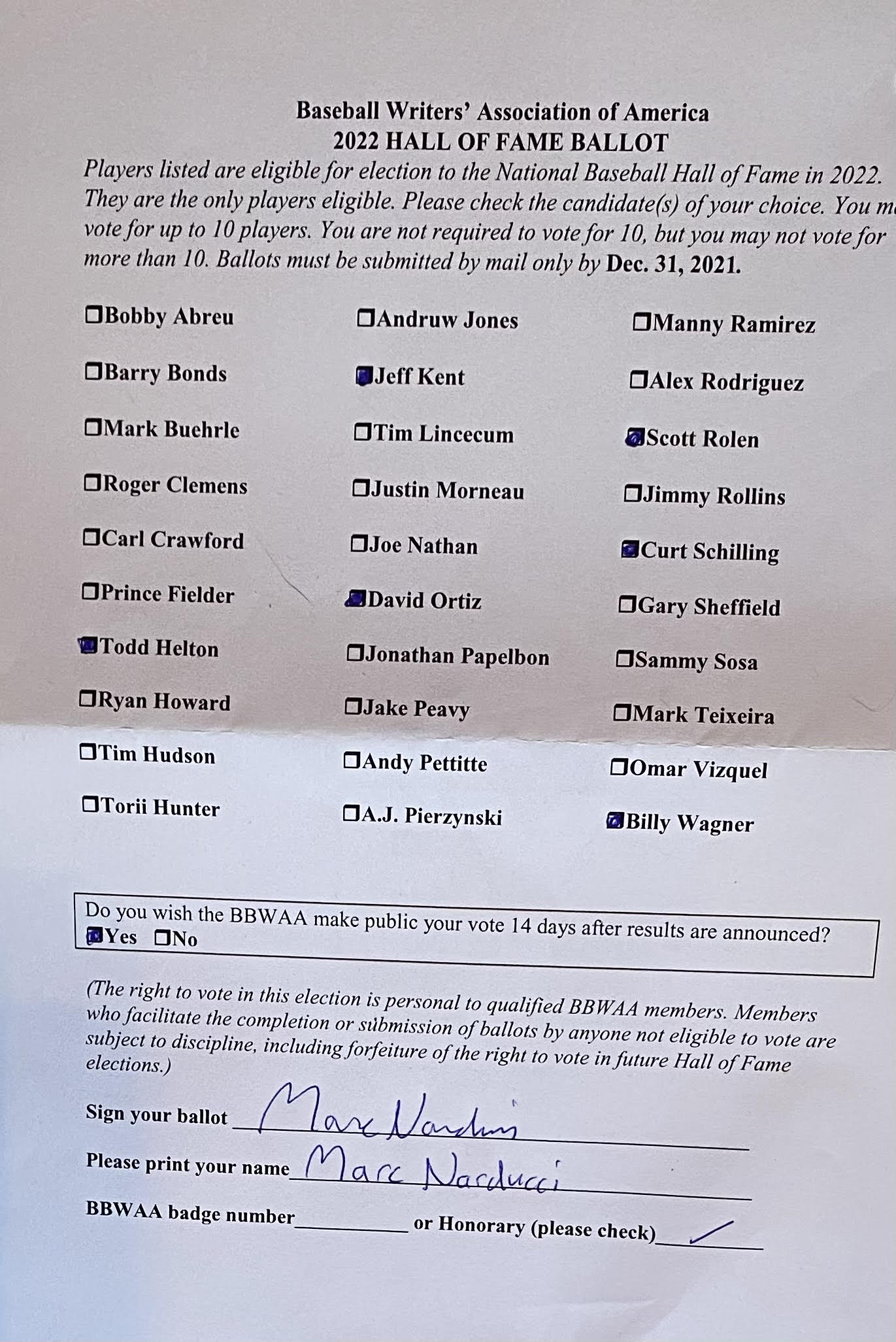 Voting for the Baseball Hall of Fame is an honor, but it’s difficult to see any sport where the task is more challenging.
That’s because of the steroid era.
One thing that should be stated off the bat is that there is no right or wrong answer when filling out the ballot in the opinion of this reporter.
As a former The Philadelphia Inquirer writer for 37 years, the decision of other voters won’t be questioned.
We can all agree to disagree and there will be many disagreements, especially when seeing my ballot.
The steroid era has made things so difficult. Do you vote for players associated with steroids?
One school of thought says the best players should go in regardless and the Hall of Fame would be empty without some of the great stars of the game such as Barry Bonds and Roger Clemens.
Others, and this is the camp will you find me, look at it the opposite way.
The steroid era did permanent damage to the sport. It also hurt the players who followed the rules and were thus competing at a severe disadvantage. Not only that, it hurt former players such as Hank Aaron, who was the all-time home run king and was passed by Bonds.
Due to the damage of the steroid era, Bonds, Clemens, Manny Ramirez, Alex Rodriguez, Sammy Sosa and Gary Sheffield aren’t on my ballot.
Ramirez and Rodriguez tested positive for PEDs. The others didn’t but Sheffield admitted using a steroid cream. Sosa, Bonds and Clemens maintain their innocence.
Sosa was caught with a corked bat, which even without the suspicion of steroids, would be a stain against his candidacy.
Two former federal authorities who were central to the Bay Area Laboratory Co-Operative (BALCO) steroids trafficking case, say there is no doubt that Bonds and Clemens used performance enhancing drugs during their careers.
Again, I know that people feel that writers are being sanctimonious in keeping players out whose on-field exploits deserve induction, but everybody has to vote the way he or she thinks is best.
So why is David Ortiz on this writer’s ballot?
We will get to that in a bit.
Here are the players that I voted for in alphabetical order on my ballot in my second year as a voter. One other thing – we know that stats such as RBI and pitcher’s wins are taboo in the sabermetric world, but we have included them for people who still care about those statistics.
Let’s get this out of the way first – there are those who won’t vote for Helton due to the fact that he played his career at Coors Field. No doubt it helped him, but he was more than solid on the road. Plus, the toll on a hitter having to go from playing in Colorado to another city isn’t easy.
In addition, a lot of players have competed at Coors and didn’t come close to the numbers that Helton posted. (All stats used are courtesy of Baseball-Reference.com and Fangraphs.com).
Here is his career slash line at Coors: .345/.441/.607. This was Helton on the road: .287/.386/.469.
Having an .855 road OPS isn’t too shabby.
Let’s look at two stats that take into account the ballpark – OPS+ and WRC+. Helton’s career OPS+ was 133 and his career WRC+ was 132, which means he was 33 percent and 32 percent above league average in those categories
Helton is off the charts with his career offensive statistics.
He had a career .316/.414/539 slash line with 369 home runs and 1406 RBI.
Helton was a five-time All-Star, a three-time Gold Glove winner and was Top 10 in the MVP voting three times.
His career OPS of .953 is 22nd on the all-time list. He also had more career walks (1,335) than strikeouts (1,175). That is almost unheard of in these free-swinging days.
During a 10-year stretch from 1998-2007, he hit .332/432/.585 with 298 home runs and OPS+ of 144. His career B-WAR is 61.8, which is 17th among first baseman. Of those 17, 11 are in the Hall of Fame.
A former college quarterback and teammate of Peyton Manning at the University of Tennessee, Helton was the No. 8 overall pick of the Rockies in the 1995 draft and would play his entire 17-year career with the Rockies. This is his fourth year on the ballot and he received 44.9% of the vote last year.
Kent has just two years to go on the ballot and last year he earned just 32.4 percent of the vote. He had a special skill that was way above the second basemen in the Hall of Fame – the ability to hit home runs. Kent has the most home runs of any second baseman in history, 377. He hit 351 of them while playing second base.
Even if one takes the 351 total, that is 50 more than the closest Hall of Fame second baseman, Rogers Hornsby, who hit 301.
Hornsby (.577) is the only Hall of Fame second baseman with a higher slugging percentage than Kent’s .500.
Only four Hall of Fame second basemen have a higher career OPS than Kent (.855). His 1.518 RBI are third among all second basemen.
Kent was a five-time All-Star, the 2000 MVP who hit for average (.290) and power. He also had a career 123 WRC+.
His career B-WAR was just 55.5, but that was mainly because he was considered a below average fielder.
Still, his offense was elite, surely enough for HOF induction.
In 2009, the New York Times reported that Ortiz was among the list of players who failed a 2003 anonymous drug test. Commissioner Rob Mandred says there were 10 false positives in the survey testing and it is possible that Ortiz was one of them.
He also said Ortiz never failed a drug test although we cited examples of the above mentioned players who didn’t either. That said, I feel less certain about Ortiz and only he knows the truth.
So giving him the benefit of the doubt, he’s a sure-fire Hall of Fame player even though he spent the majority of his career as a DH. For instance, 485 of his 541 career home runs came as a DH. Ortiz hit for average (.286) and power. Besides the 541 home runs, he had a .931 career OPS and career OPS+.of 141. He is also 22nd on the career RBI list with 1,768.
In the postseason he helped the Boston Red Sox win three World Series titles, and hit .289 with 17 home runs and a .947 OPS in 385 plate appearances.
There are 17 third basemen in the Hall of Fame, fewest of any position. Only nine third baseman have a higher B-WAR than Rolen (70.1), eight of whom are in the HOF and the other, Adrian Beltre, is a sure-fire candidate. (This also includes Paul Molitor as a third baseman, even though just 3,623 of his 1,267 plate appearances came at third base. It does not include Alex Rodriguez, who had a career B-War of 117.5, but only 42.7% of his plate appearances came as a third baseman).
Rolen was a seven-time All-Star and eight time Gold Glove winner. His defense was every bit as strong as his offense. Rolen’s defensive B-WAR (21.2) is behind just one Hall of Famer – Brooks Robinson, who is No. 1 among third basemen (39.1). (Beltre, at 27.1 is a future Hall of Famer ahead of Rolen).
Only eight HOF third basemen have a higher OPS (.855).
Rolen finished with a .281 average, 316 home runs and 1,287 RBI and was NL Rookie of the Year in 1997 with the Phillies. His career WRC+ was 122.
Rolen was a World Series champion with the 2006 St. Louis Cardinals, batting .421 with a 1.213 OPS in the five-game win over the Detroit Tigers.
He was a major threat on offense and defense, both carrying equal weight. This is his fifth year on the ballot and he is trending upward after earning 52.9% of the vote last year.
Schilling may be the first player to talk his way out of the Hall of Fame. His public comments and tweets have been well-documented and he will likely pay for them. This is his 10th and final season on the ballot. Last year he was close to the 75% total with 71.1%. Normally that would mean he would make it this year, but it would be a surprise if he gets in. He even tried to get off the Hall of Fame ballot, saying he doesn’t want to get voted in by the members of the Baseball Writers Association of America. That is not exactly a convincing way to sway voters. The Hall of Fame denied his request.
That said, what he did on the field, despite all his verbal gaffes, make him a Hall of Fame pitcher and he got my vote.
Just a few numbers..
Everybody talks about his 11-2 postseason record in 19 starts, but his WHIP was 0.968 and his strike-to-walk ratio was 4.80.
He was a late bloomer and still went 216-142 with a career a 3.46 ERA and 3,116 strikeouts.
Schilling won three World Series titles, two with Boston and one with the Arizona Diamondbacks and went to another World Series with the Philadelphia Phillies, where he was the 1993 NLCS MVP. He was runner-up for the Cy Young Award three times and fourth another.
Schilling was among the best big-game pitchers of his era and the only thing bigger was his mouth, which will likely keep him out of Cooperstown.
There are eight relief pitchers in the HOF. Only Mariano Rivera has a better ERA and ERA+ than Billy Wagner. A seven-time All-Star, Wagner’s career ERA was 2.31 and his adjusted ERA was 187. His 11.9 strikeouts per nine innings is best in MLB history (minimum of 750 innings pitched). He also has a career 0.998 WHIP.
Wagner had 422 saves in 491 opportunities (85.9 percent). Only two Hall of Fame relievers have a higher save percentage. Mariano Rivera (89.1%) and Trevor Hoffman (88.8%). Wagner also has a higher strikeout ratio (33.2%) than any reliever in the HOF. The closest is Hoffman (25.8%).
Now the negative. Wagner pitched only 903 innings, fewest of the Hall of Fame pitchers. Wagner also didn’t have a stellar postseason record, although it included just 11 2/3 innings over 14 appearances.
We can see why some may keep Wagner out due to the fact that all eight relievers in the Hall of Fame each exceeded 1,000 innings. Yet he has so many top achievements among the best relievers in the game’s history that he belongs with them in Cooperstown.
This is his seventh year on the ballot and he received 46.4% of the vote last year.