
Cardinals, Oscar Hernandez Agree To Minors Deal
The Cardinals have agreed to a minor league contract with catcher Oscar Hernandez, tweets Bob Nightengale of USA Today. The former D-backs and Red Sox backstop will head to Major League camp on a non-roster invite.
Hernandez, 26, was the top pick in the 2014 Rule 5 Draft, when the D-backs selected him out of the Rays organization. Touted for his defensive skills behind the dish, Hernandez looked decidedly overmatched in two seasons with Arizona, hitting a combined .167/.239/.262 in a tiny sample of 47 plate appearances. He hasn’t appeared in a big league game since 2016, although he was on the Red Sox’ Major League roster briefly this past season. However, Hernandez was called up as a depth option and designated for assignment without ever appearing in a game for Boston.
In parts of 10 minor league seasons, Hernandez is a .246/.323/.417 hitter — although he’s managed just a .210/.276/.336 output at the Triple-A level. He’s thrown out 42 percent of runners who attempt to steal against him in the minors, though (plus one of two in the Majors), and he routinely draws strong framing marks in the minors.
Matt Wieters was the primary backup to ironman Yadier Molina in 2019 but is currently a free agent. Well-regarded prospect Andrew Knizner is the only other catcher on the Cardinals’ 40-man roster, so Hernandez will add a glove-first depth option.
Nationals, Carlos Tocci Agree To Minor League Deal
2:28pm: Tocci does not currently have a Spring Training invite, Sam Fortier of the Washington Post tweets. It’s possible that the Nats could add him to big league camp at some point, of course, but if not, it seems likely that he’d head straight to Triple-A Fresno.
2:09pm: The Nationals have agreed to a minor league pact with outfielder Carlos Tocci, reports Bob Nightengale of USA Today (via Twitter). The fleet-footed 24-year-old will be in Major League Spring Training as a non-roster invitee.
Tocci, once a relatively high-profile international signing by the Phillies, spent the 2018-19 seasons in the Rangers organization after Texas acquired him in the 2017 Rule 5 Draft. Selected more for his speed, defense and contact abilities than for his chances of becoming an impact player at the plate, Tocci was hidden on the Rangers’ roster in a limited role throughout the 2018 campaign. He appeared in only 66 games and took just 135 turns at the plate, posting a woeful .225/.271/.283 batting line in that time.
Struggles were somewhat foreseeable, as Tocci had played in just 17 Triple-A games through the 2017 campaign and had long faced questions about a lack of power. But Tocci’s difficulties at the plate continued into the 2019 season in Triple-A, where despite a leaguewide boom in offense, he mustered a paltry .244/.313/.308 batting line (55 wRC+). Scouting reports on Tocci have long touted his plus defensive tools, but he’ll need to make some strides with the bat if he has any hope of establishing himself as viable big league outfielder.
Tocci gives the Nats some additional depth in center field — not that the club is hurting in that regard. Victor Robles, Juan Soto and Adam Eaton are lined up to start once again in 2020, while Michael A. Taylor projects as the primary backup option. Andrew Stevenson gives the Nats another option on the 40-man roster as well, but the organization’s center-field depth in the upper minors is a bit lacking.
Phillies Sign Ronald Torreyes
The Phillies announced Tuesday that they’ve signed infielder Ronald Torreyes to a minor league contract. The Philadelphia organization also formally confirmed its previously reported minor league signing of catcher Christian Bethancourt. Both players will be in Major League camp this spring.
Torreyes, 27, spent the 2019 season in the Twins organization. He appeared in seven big league games late in the season and tallied 17 plate appearances, including a rare walk-off hit by pitch, but he was otherwise relegated to Triple-A work. In 330 plate appearances with the Twins’ affiliate in Rochester, Torreyes hit .256/.289/.406 with 11 homers, 11 doubles, a triple and two steals.
The deal with Philadelphia will bring about a reunion of sorts with incoming skipper Joe Girardi, who knows Torreyes quite well from his time with the Yankees. The versatile Torreyes was an oft-used bench piece for Girardi in 2016-17, tallying 505 plate appearances and a .281/.311/.374 batting line along the way. He doesn’t get on base much or hit for power, but the right-handed-hitting Torreyes is a tough strikeout (career 13.2 percent) who is capable of playing second base, third base and shortstop.
Torreyes will have plenty of competition in Spring Training as he looks to land a spot on Girardi’s roster for the 2020 season. The Phillies have also brought in Josh Harrison, Phil Gosselin and T.J. Rivera on minor league deals this winter.
Seeking Feedback On Our iPhone/iPad App
Many of you are regular users of our Trade Rumors iOS app, and in fact you may be reading this post through it. We launched the Trade Rumors app more than five years ago as a mobile-friendly way to read our articles and set up custom notifications. While we’ve addressed bugs and added a few features along the way, the app is due for a refresh.
If you’re a current user of the Trade Rumors iOS app and you’ve identified a bug or something that doesn’t seem to work correctly, please go to the Settings icon in the upper right, scroll down to “Feature Requests or Help,” and let us know about the issue. Over the next few months I aim to address any outstanding bugs we can identify.
If you have a feature request or other feedback about the app, we’d love to hear it. Current app users can use that same “Feature Requests or Help” option. Plus any MLBTR reader, whether you currently use the app or not, is welcome to email us about it at traderumorsapp@gmail.com or leave feedback in the comments of this post. If certain feature requests come up repeatedly, we’ll look into adding those to the Trade Rumors app. For example, adding a Dark Mode option seems to make sense. Especially since the original MLBTR website color scheme was basically Dark Mode!
If you’re not using our free Trade Rumors app yet, download it today!
Orioles Designate Eric Hanhold
The Orioles have designated righty Eric Hanhold for assignment, the club announced. His roster spot goes to infielder Jose Iglesias, whose signing is now official.
Hanhold never made it into an O’s uniform before he lost his 40-man spot, though it’s still possible he’ll end up with the organization if he clears waivers. He was claimed from the Mets in September.
Outside of a three-game MLB stint in 2018, Hanhold has plied his trade in the top reaches of the New York farm since coming over as the player to be named later in the trade that sent Neil Walker to the Brewers. Hanhold pitched to a 3.84 ERA with 7.7 K/9 and 3.7 BB/9 in 63 1/3 upper-minors innings in 2019.
Dodgers To Sign Edubray Ramos
The Dodgers have a minors deal with righty Edubray Ramos, according to Bob Nightengale of USA Today (via Twitter). It includes an invitation to MLB camp.
Ramos, 27, is a nice buy-low candidate to roll the dice on. He had been an effective hurler for the Phillies but was non-tendered after an injury-riddled 2019 season in which he was ineffective and showed reduced velocity when he was available to pitch.
If all works out, the Dodgers can retain Ramos for years into the future via arbitration. He threw 42 2/3 innings of 2.32 ERA ball with 8.9 K/9 and 3.2 BB/9 for the Phils in 2018.
Nationals Sign Starlin Castro
JANUARY 7: This deal is now official.
JANUARY 3: The Nationals have a deal with infielder Starlin Castro, according to Ken Rosenthal of The Athletic (via Twitter). It’s a two-year arrangement, per Joel Sherman of the New York Post (Twitter link). The deal promises the Magnus Sports client $12MM, per Jeff Passan of ESPN.com (via Twitter).
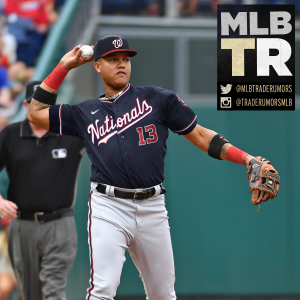
Castro will be tasked with handling second base for the defending World Series champs. Fellow free agents Brian Dozier and Asdrubal Cabrera handled most of the work at that position last year in D.C.
The Nationals have seen plenty of Castro over the past several seasons, as he has appeared with the division-rival Marlins. He has had ups and downs over the years, but has always showed up — averaging 149 games per season since 2011 — and typically delivered a useful combination of league-average offensive production and average glovework. Poorly graded baserunning has long been a bit of a drag on his overall value.
It’s not an exciting signing, by any stretch, but does check a box for the Nats. And perhaps the club sees reason to hope for a bit more out of Castro. He’s still just 29 years of age and vastly increased his offensive productivity in the second half of the 2019 campaign. In his final 285 plate appearances of the year, he slashed a hefty .302/.334/.558 with 16 long balls. He’s never going to draw many walks, so the question is Castro can continue to make better contact — both harder and higher — and thus maintain a meaningful portion of that second-half power outburst.
Even if Castro enters the season as the presumptive second baseman, he could ultimately move into a more flexible role — especially if top prospect Carter Kieboom forces his way into an everyday role. Castro has plenty of experience on the left side of the infield and could become part of a timeshare at third base if that becomes desirable (whether in the first or second year of the deal). Castro would pair well with a lefty hitter, as he has long been much more dangerous against southpaws.
As things stand, the Nats would rely upon the switch-hitting Wilmer Difo to spell Castro and shortstop Trea Turner. The team could pursue an upgrade over Difo. It might also add a more offensive-oriented player who can spend time at first base. There could be some overlap there, as well. The team’s ultimate moves at third base — Josh Donaldson remains the chief target, with a few major trade candidates also possible — may end up dictating the finishing touches on the bench. Whether or not Ryan Zimmerman ends up returning will also be a factor.
White Sox To Sign Steve Cishek
The White Sox have reached a deal with free agent reliever Steve Cishek, per Jeff Passan of ESPN.com (via Twitter). He’ll be guaranteed $6MM in the pact, which per MLB.com’s Mark Feinsand (Twitter link) includes his 2020 salary and a $750K buyout of a $6.75MM option.
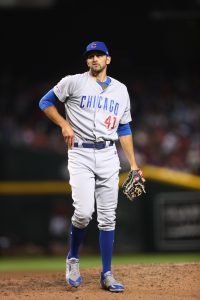
It’s a move that reflects the shifting tides of Chicago’s two sides. Cishek had stabilized the Cubs’ pen for the past two years. With his former team pressing up against its budget ceiling, he’ll cross town to take up a late-inning role with a White Sox organization that is hopeful of a breakout 2020 campaign.
Cishek has sidearmed his way through an awful lot of good innings over ten seasons in the majors. He has worked to a 2.69 ERA in 556 total frames and never once finished a full season with an ERA over 3.58. Having picked up 132 saves along the way, Cishek is no stranger to high-leverage spots.
Can the South Siders expect more of the same? There are conflicting signs. Cishek’s strikeout rate has wavered over time; last year’s 10.5% K%-BB% was a personal low. But he still generated grounders on half of the balls put in play against him, limited the long ball nearly as well as ever (at least compared to the league average), and held opponents to a sub-.250 BABIP for the fourth-straight season. Statcast identified some good fortune (.285 wOBA-against; .313 xwOBA-against) but found that Cishek was elite at limiting hard contact (25.9%) and exit velo (84.5 mph).
It’s ultimately hard to argue with the results, even if they haven’t always quite been supported by the peripherals. Cishek doesn’t throw hard but generates lots of spin. He’s an unconventional pitcher who has proven consistently capable of befuddling MLB hitters. He’s unquestionably better against same-handed hitters, though that’s true of most hurlers.
Cishek may not on the upswing at 33 years of age. But he’s a nice get on a one-year deal. That suits the needs of a White Sox organization that wants to boost its immediate chances without risking too much future payroll space on veteran players.
Photo courtesy of USA Today Sports Images.
Sign-Stealing Punishment For Astros Expected In Coming Weeks
It’s widely accepted at this point that the Astros impermissibly utilized technology to steal signs and then conveyed the information gleaned to hitters in the batters’ box during regular-season games. According to a report from Jeff Passan of ESPN.com, the subjects of the resulting investigation have copped to the bad acts.
With the investigative work nearing a conclusion, Passan says that commissioner Rob Manfred will likely mete out discipline within the next two weeks. Several notable figures are reportedly potential suspension targets: GM Jeff Luhnow, manager A.J. Hinch, and former bench coach/current Red Sox skipper Alex Cora.
Notably, per the report, players that participated in the elaborate-yet-ham-fisted scheme are not expected to be disciplined. But the team could end up paying a massive fine. There’s no indication yet whether a loss of draft picks or other competitive sanction might be applied. In handing down punishment for improper use of technology in 2017, Manfred promised that such penalties were on the table, saying: “[A]ll 30 Clubs have been notified that future violations of this type will be subject to more serious sanctions, including the possible loss of draft picks.”
It would never be acceptable for the product of baseball — individual contests and the overall regular/post-season championship schedule — to be compromised by teams acting outside of the rules, especially in a scheme as devious and concerted as the one allegedly put into action by the Astros. The stakes are raised yet higher by the fact that MLB is wading into murky waters in the gambling arena. And it probably doesn’t help that the league is currently facing major pushback for its plans to dramatically curtail minor league ball.
It’s a major decision for Manfred, who already watched as the Astros bungled a self-inflicted scandal involving since-fired assistant GM Brandon Taubman just months ago. He’ll certainly need to create precedent that serves as a legitimate deterrent. But doing so with respect to a marquee roster could prove challenging.
The complexities deepen when one considers the potential entanglements. Cora is one major instance. Reporting earlier today implicates the Red Sox in a less-egregious but nevertheless impermissible act of signaling espionage. The skipper could conceivably be at fault in both episodes. The Boston organization may not be alone in its manner of harnessing technology.
Untangling all of this could prove tricky. Andy Martino of SNY.tv even seems to suggest (Twitter link) that the Astros have claimed or could claim that such actions on the part of competitors might justify or at least mitigate their own rule-breaking. A source suggests, rather bizarrely, that the Houston club was simply making up for the fact that it was not able to mis-use its own replay room because it “was far away” from the dugout, unlike most other teams. If this strained logic is any indication of the thinking around the game — not to mention the actual and/or perceived pervasiveness of cheating — then the MLB rules and enforcement regime is badly in need of re-working, beginning with the imposition of clear and effective disincentives relating to this incident.
Red Sox Reportedly Utilized Replay Room To Ascertain Opponents’ Signs In 2018
The Astros stand accused of utilizing technology to steal catcher signs and then relay them in real-time to batters in the box. While the investigation into that matter continues — we’ve already seen rather convincing documentation of at least some malfeasance — broader scrutiny has unsurprisingly begun.
The 2018 Red Sox team, which followed the Astros as World Series champs, now stand charged of misusing technology. As Evan Drellich and Ken Rosenthal of The Athletic report (subscription link), on the basis of team sources, “at least some players visited the video replay room during games to learn the sign sequence opponents were using.” The behavior is said to have occurred during the regular season but not during the postseason.
The sources that spoke with The Athletic make clear that the Sox’ uniformed personnel made dedicated pursuit of electronic sign-stealing. But the approach was fundamentally different from that allegedly employed by the Astros. The Houston organization is said to have had a team employee watching a live game feed, conveying the pitch type via audio signal (banging on a trash can). In Boston, upon sussing out the signs, the Red Sox would reportedly utilize the information in a time-honored manner: runners reaching second base would look in at the catcher and then deliver the news to the hitter by some visual cue.
In spite of those differences, it seems clear that the Red Sox’ purported action also violated the rules. Per Drellich and Rosenthal, a league memo issued prior to the ’18 campaign provided: “Electronic equipment, including game feeds in the Club replay room and/or video room, may never be used during a game for the purpose of stealing the opposing team’s signs.” That wouldn’t appear to leave much room for interpretation.
Notably, the Boston organization was fined and chastised by commissioner Rob Manfred at the end of the 2017 season for improper utilization of technology. At the time, Manfred indicated that he had received assurances of future compliance from the Sox. The commissioner also provided in a press release: “[A]ll 30 Clubs have been notified that future violations of this type will be subject to more serious sanctions, including the possible loss of draft picks.”