
Yankees To Sign Zack Granite
The Yankees have agreed to a minor-league deal with outfielder Zack Granite, per Bob Nightengale of USA Today (via Twitter). He’ll receive an invitation to MLB camp.
Granite, 27, cracked the majors briefly with the Twins back in 2017 after a strong showing at Triple-A that year. He proved that his keen eye is still good against MLB pitching, drawing a dozen walks against nine strikeouts in 107 plate appearances, but didn’t make much hard contact and ended with a .237/.321/.290 batting line.
In recent years, Granite has plied his trade exclusively at the highest level of the minors. He spent the 2019 season with the Rangers organization, turning in a .290/.331/.375 slash in 541 plate appearances.
Yankees Intend To Withhold Jacoby Ellsbury’s 2020 Salary
3:56pm: If there was any doubt, the MLBPA erased it in a statement making clear that it’s ready to fight on this issue. (Via Ken Rosenthal of The Athletic, on Twitter.) The statement provides: “The Players Association will vigorously defend any action taken against Jacoby or his contract and is investigating potential contract violations by his employer.”
As Rosenthal notes, the CBA does speak to this subject, providing: “Any treatment a Player receives for a Work Related Injury by a health care provider who is not affiliated with the Club must be authorized by the Club in advance of the treatment in accordance with Regulation 2 of the [Uniform Player’s Contract].” But that general rule does not necessarily leave us with a clear guide to the outcome of the dispute.
For one thing, there are loads of potential factual and interpretive questions to be addressed. Just what constitutes medical treatment, for instance? For another, the current CBA includes letters of understanding exchanged between the league and union. One in particular acknowledges that there are open disagreements regarding what occurs in cases of conflict in medical opinion. There are perhaps also other legal concepts that might limit the extent to which an employer, even if theoretically empowered by a collective bargaining agreement, may dictate the health and medical choices of an employee. Beyond all that, even if it is determined that Ellsbury has breached his contract, it must still be established that the breach justifies the full or partial abrogation of the Yankees’ future salary obligations.
In other news, Ellsbury is said to be planning to attempt a return in 2020, per Jon Heyman of MLB Network (via Twitter). His anticipated timeline for readiness is not evident. Obviously he’d be looking to catch on with another organization if he’s able to show he’s physically capable of giving it another shot.
1:26pm: The Yankees finally cut bait on Jacoby Ellsbury this week, begrudgingly waving the white flag on the center fielder’s ill-fated seven-year, $153MM contract. Ellsbury is still owed $26,142,857 of that deal — his 2020 salary plus a $5MM buyout on his option for the 2021 season. But he may not receive all of that cash without a fight.
It seems the Yankees intend not to pay Ellsbury his salary for the coming season, based upon the premise that Ellsbury underwent outside medical treatment without approval to rehab the injuries that have plagued him since 2017. George A. King III and Ken Davidoff of the New York Post reported the brewing battle, with Jon Heyman of MLB Network adding further details (via Twitter).
We don’t know much about the precise factual underpinnings of this issue, but the reporting suggests the team believes that Ellsbury acted inappropriately for multiple years. Presumably, the organization believes it can establish that the alleged actions not only violated the terms of his contract, but also contributed to his inability to return to the field of play over the past two seasons.
Ellsbury’s outlook for 2020 isn’t really known, though there has been no indication that he’s likely to play. The once-excellent outfielder had a few solid but generally uninspiring years in New York before falling apart physically more recently. We’ve seen a steady stream of generally ambiguous ailments cited over the past few campaigns. The 36-year-old hasn’t even made it into a single rehab game.
What we do now know is the anticipated procedural progression of the dispute. The Yankees will simply refuse to cut Ellsbury his checks, per Heyman, leaving it to him and agent Scott Boras to pursue a grievance action. It is somewhat difficult to imagine that there won’t be a full-throated battle on both the factual and contractual merits of the Yanks’ anticipated course of action, though certainly a settlement will also be possible. No doubt the league, union, and Yankees’ insurer will have major roles to play in this as well.
It’s all but impossible to guess how this’ll turn out based upon what little we know at present. There’s nothing in terms of recent precedent for such a grievance — at least not one that was public knowledge — so it’s difficult to gauge just how much of the contract the Yankees might ultimately be able to avoid paying or whether they even have a legitimate hope of winning their case. But any finances saved will be notable, as the Yankees currently have about $203MM on the books for 2020 (including projected arbitration salaries) and about $210MM worth of luxury tax considerations.
Offseason Outlook: Philadelphia Phillies
MLBTR is publishing Offseason Outlooks for all 30 teams. Click here to read the other entries in this series.
The Phillies have a pivotal offseason ahead of them, as the club is still seeking its first playoff berth since 2011 despite a concerted effort to emerge from a multi-year rebuilding process. With manager Gabe Kapler dismissed in favor of veteran Joe Girardi, the pressure on the front office is mounting to put together a winning unit.
Guaranteed Contracts
- Bryce Harper, OF: $300MM through 2031
- Jean Segura, SS: $43.75MM through 2022 (including $1MM buyout of 2023 option)
- Andrew McCutchen, OF: $40MM through 2021 (including $3MM buyout of 2022 option)
- Aaron Nola, RHP: $39MM through 2022 (including $4.25MM buyout of 2023 option)
- Scott Kingery, INF/OF: $20.5MM through 2023 (including $1MM buyout for 2024)
- Jake Arrieta, RHP: $20MM through 2020
- Odubel Herrera, OF: $19.5MM through 2021 (including $2.5MM buyout of 2022 option)
- David Robertson, RP: $13MM through 2020 (including $2MM buyout for 2021)
- Jay Bruce, OF: $13MM through 2020 (Mariners are paying $11.625MM)
Arbitration-Eligible Players (projections via MLBTR contributor Matt Swartz)
- Cesar Hernandez – $11.8MM
- J.T. Realmuto – $10.3MM
- Jose Alvarez – $3.0MM
- Maikel Franco – $6.7MM
- Vince Velasquez – $3.9MM
- Hector Neris – $4.7MM
- Adam Morgan – $1.6MM
- Zach Eflin – $3.0MM
- Andrew Knapp – $800K
- Non-tender candidates: Hernandez, Franco
Option Decisions
- Jason Vargas, LHP: Phillies declined $8MM option in favor of $2MM buyout
- Pat Neshek, RP: Phillies declined $7MM option in favor of $750K buyout
- Jared Hughes, RP: Phillies declined $3MM option in favor of $250K buyout
Free Agents
- Tommy Hunter, Juan Nicasio, Corey Dickerson, Drew Smyly, Logan Morrison, Dan Straily, Rob Brantly, Fernando Salas, Brad Miller, Sean Rodriguez, Nick Vincent, Jason Vargas, Pat Neshek, Jared Hughes
Over the past two winters, the Phils have added the likes of Bryce Harper, Andrew McCutchen, Jake Arrieta and David Robertson via free-agent deals while swinging high-profile trades to acquire J.T. Realmuto and Jean Segura (among others). The directive from ownership and the front office alike has been clear: bring playoff baseball back to Philadelphia. Hard as it may be to believe, the Phillies haven’t played a postseason game since 2011, when their roster featured the dominant trio of Cliff Lee, Cole Hamels, and the late Roy Halladay. (Roy Oswalt wasn’t exactly a shabby fourth starter, either.)
Aggressive as they’ve been, however, the Phillies simply haven’t been able to sustain a season’s worth of winning ways. The 2018 and 2019 Phillies each had clear talent, as both iterations of the team enjoyed a lengthy run in first place in the NL East. However, those two most recent versions of the Phils also faceplanted in stunning fashion late in the season and were left at or just shy of the .500 mark. Now, fourth-year GM Matt Klentak is feeling more pressure to construct a winner than ever before.
The clearest area for improvement is on the pitching staff, where Philadelphia hurlers were a nearly across-the-board disappointment — so much so that pitching coach Chris Young was jettisoned after just one year on the job. Bryan Price, who like Girardi is a seasoned dugout veteran, will step into Young’s place and work to improve upon a Phillies rotation that posted a lowly 4.64 ERA (4.91 FIP) and a bullpen that wasn’t much better (4.38 ERA, 4.84 FIP).
In the rotation, Aaron Nola is really the Phillies’ only surefire bet to be an above-average starter. The 2019 season certainly wasn’t Nola’s best, but the 26-year-old has cemented himself as a quality workhorse upon whom the club can rely. Jake Arrieta was once described similarly, but he struggled in 2019 while pitching through a bone spur in his elbow and ultimately succumbed to season-ending surgery. At 34 years of age in March, the former Cy Young winner is somewhat of a wild card in the rotation.
The 2019 Phillies opted to forgo veteran rotation additions and instead leaned heavily on Zach Eflin, Nick Pivetta and Vince Velasquez, entrusting the balance of its Opening Day rotation spots to that young trio. Of the three, only Eflin delivered useful results — and even he briefly lost his grip on a rotation spot and found himself sojourned to the bullpen. Through 163 1/3 innings, the 25-year-old notched a 4.13 ERA with 7.1 K/9, 2.6 BB/9 and a 44.6 percent ground-ball rate. Eflin’s 1.54 HR/9 mark was higher than one would like (hence his 4.85 FIP), but his bottom-line results were plenty serviceable. The same can’t be said for the 26-year-old Pivetta or the 27-year-old Velasquez. Pivetta logged a brutal 5.74 ERA as a starter, while Velasquez was only a bit better (4.96 ERA in the rotation).
It can be argued that the Phillies should have a greater sense of urgency than any other team in MLB when it comes to adding to the rotation (particularly now that Jake Odorizzi accepted a qualifying offer in Minnesota, giving the rotation-needy Twins a bit more stability). Fortunately, it’s a deep class of starting pitching headlined by a pair of bona fide, franchise-altering aces in the form of Gerrit Cole and Stephen Strasburg. But, while the Phillies have been as aggressive as anyone on the open market in recent seasons, Klentak has suddenly offered a more measured approach with regard to free agency.
“One of the things we’ve got to try to do, if we can, is to not forfeit draft picks, and that’s hard when you’re fishing in the deep end of the free-agent pond,” Klentak said in a recent appearance on the 94 WIP Midday Show. But we lost our second-round pick last year and our second and third the year before. That doesn’t sound like a lot, but that’s where Scott Kingery comes from. That’s where Spencer Howard comes from. That’s where Connor Seabold comes from. … We’ve got to try to hang onto that as much as we can.”
Perhaps Klentak was merely doing everything in his power to avoid doubling down on owner John Middleton’s “stupid money” decree a year ago this time, but those comments don’t sound like a portent for a run at Cole or Strasburg. Middleton could, of course, take matters into his own hands, but Klentak’s recent sentiment is surely of note.
If the organizational preference is indeed to add rotation help — and Klentak did plainly state a need to address the starting staff in that same interview — then the top names on the Phillies’ radar would likely be Hyun-Jin Ryu and old friend Cole Hamels, who has already expressed interest in a return to the Phils. Other notable names lacking a qualifying offer include Dallas Keuchel, Michael Pineda, Rick Porcello, Tanner Roark, Julio Teheran and Kyle Gibson. While no one from that bunch is of the same caliber as the Cole or Strasburg — Ryu may not be far off, but his durability is a perennial question mark — the Phils do have options to round out the rotation if they prefer to hang onto their draft choices.
As always, the trade market will present innumerable alternatives. Corey Kluber, Matthew Boyd, Chris Archer, Jon Gray, Robbie Ray, Marco Gonzales and (depending on the direction the Red Sox go) Eduardo Rodriguez are all, at the very least, plausible winter trade candidates. Other, less-expected names will surely surface as well.
There’s also reason to believe the Phillies will work to improve their relief corps. The club’s relief unit — like those of the rest of the NL East teams — was not a strength in 2019. Closer Hector Neris is a solid performer at the back of the unit. Pitchers such as Jose Alvarez, Seranthony Dominguez, and Ranger Suarez showed some promise. Victor Arano could be a big asset if he can return to health. But there’s obviously room for improvement. Klentak could consider any and all remaining open-market options, though he’d need to hit the trade market if he prefers to pursue a tried-and-true closer type.
Looking at the team’s lineup, there are nearly as many questions as answers. J.T. Realmuto will once again be the team’s primary catcher in 2020 — and perhaps for years to come if the two sides can come to terms on an extension, which is another key winter priority for Klentak and his staff. Bryce Harper is now entrenched in right field, and a healthy Andrew McCutchen will return from an ACL tear to man the other outfield corner. On the infield, first baseman Rhys Hoskins will look to rebound from a terrible second half, and Jean Segura is signed through 2022. Scott Kingery will be in the mix somewhere, but his ability to play third base, second base, shortstop and the outfield gives the Phils quite a bit of flexibility.
They’ll need it, particularly with the possibility of non-tendering Maikel Franco and Cesar Hernandez. The latter of the two has generally been a solid second baseman but could see his arbitration price climb north of $11MM in 2020, which is an untenable financial arrangement, especially with a free agent market loaded with veteran alternatives. The former, meanwhile, has struggled immensely and never fully delivered on his once ballyhooed prospect status. And then there’s center fielder Odubel Herrera, who was suspended 85 games under MLB’s domestic violence policy and isn’t guaranteed a place in the organization moving forward. (And even before that ban, Herrera wasn’t producing at the plate.)
The Phillies, then, could explore the market for third basemen, second basemen and/or center fielders depending on how they want to play their cards. The infield offers ample possibilities, with Anthony Rendon, Josh Donaldson and Mike Moustakas all available in free agency and a host of serviceable (but unspectacular) second basemen on the market as well. Rendon and Donaldson have qualifying offers attached to them, so if the Phillies are indeed avoiding such free agents, they’d likely look to Moustakas as the headlining free-agent option. A pursuit of Didi Gregorius may not be an immediately obvious fit, but Segura could move to either second or third base to facilitate that type of deal. (And on cue, there’s now reporting to suggest this could indeed be a consideration.)
The center field market is rather thin, with only Brett Gardner and Shogo Akiyama representing viable regulars in free agency. But the trade market offers a natural fit in Pirates center fielder Starling Marte. The Phillies could also line up with the Red Sox on a Jackie Bradley Jr. deal.
The Phillies, though, have the financial means and the urgency needed to go searching for a bigger fish. If the Red Sox truly are going to explore moving Mookie Betts, he’d look mighty fine roaming center field in Philly for the 2020 season (if not beyond). There’s been plenty of speculation about the possibility of the Cubs moving Kris Bryant this winter, and the Phils have a need at the hot corner. Francisco Lindor‘s name is out there, too; clearing the way for him at short would easily be worth the trouble. The Phillies don’t have the deepest of farm systems, but there’s every reason for Klentak to push the envelope and try to bring a winner to Citizens Bank Park.
Some may question whether the Phillies can plausibly afford to spend much after last year’s free-agent bonanza, but on an annual basis, Harper’s record deal isn’t really that cumbersome. The Phillies have about $167MM on the 2020 books — if you include all of the projected arbitration salaries. Jettisoning Hernandez and Franco, for instance, would trim $18.5MM from that sum.
In terms of luxury tax considerations, the club is at a manageable $186MM (including Hernandez and Franco). At this point, it’s hard to justify drawing a hard line at that $208MM barrier. The Phillies were extremely aggressive last winter, are trying to extend Realmuto and have no designs on going back into rebuild mode at any point in the near future. Treating the luxury threshold as a salary cap would be a suddenly weak-hearted change of course to what has been an aggressive pursuit — particularly given the fact that as a first-time offender, the only real penalty they’d face would be a 20 percent overage fee on their first $20MM. That’s a $4MM slap on the wrist even if they cross the plane by as much as $20MM. And with Arrieta, Robertson and several arbitration players off the books next winter, dipping back beneath the line shouldn’t be that difficult.
The Phillies may have a tough road to contention given the strength of their division rivals, particularly those in Atlanta and D.C., but their direction remains obvious. We’re talking about a big-market, high-payroll club that hasn’t been to the playoffs in nearly a decade, has a GM entering his fifth season, and is only nine months removed from signing a player to the largest free-agent contract the sport has ever seen. The Phillies should and will aggressively add to the roster this winter.
Phillies Showing Interest In Didi Gregorius
The Phillies are showing interest in free agent shortstop Didi Gregorius, according to a report from Jon Morosi of MLB Network (via Twitter). Having not received a qualifying offer from the Yankees, Gregorius will not require draft compensation upon signing.
While the Phils don’t lack for options at shortstop — Jean Segura and Scott Kingery each remain on hand — the club is in need of infield improvements. We noted the Philadelphia org as a possible contender for Gregorius in our listing of the top fifty free agents, though we guessed he’d end up with the Reds on a strong, three-year deal.
The Cincinnati club is reportedly also in pursuit of Gregorius. It’s good news for him to have multiple suitors at this relatively early stage of the market. Despite a somewhat tepid 2019 showing after returning from Tommy John surgery, Gregorius stands out a great deal among the available shortstops for his relative youth and strong all-around track record. While there are some exceptional third basemen and other quality infielders available, teams that want a true shortstop will surely be interested first and foremost in Gregorius.
For the Phils, adding Gregorius would likely set up a chain reaction. Segura, who trailed off a bit in his first season in Philadelphia, could be dangled in trade. But he’d also be an easy fit as a heavy part of the second base mix and fill-in/insurance plan for Gregorius at short. If Gregorius and Segura form the primary double-play combo, that’d likely lead to the departure of second baseman Cesar Hernandez, who is as much a non-tender as a trade candidate. (Meanwhile, the team still seems likely to part with Maikel Franco and bring in a new option at third base.)
The original version of this post indicated that Gregorius had been issued a qualifying offer, when in fact he had not. We regret the error.
D-backs Reportedly Open To Trading Robbie Ray
With one year to go before reaching free agency, left-hander Robbie Ray stands out as a fairly obvious trade candidate, and Jayson Stark of The Athletic tweets that other clubs feel that the Diamondbacks are indeed more open to trading Ray than they have been in the past. They report indicates the club would prefer controllable pitching in a theoretical return for Ray (though surely there’s no shortage of bats that’d intrigue GM Mike Hazen and his staff).
There’s plenty to like about Ray but also some cause for concern. On the one hand, he only just turned 28 years old and has clearly established himself as one of MLB’s premier strikeout artists. Ray’s 30.8 percent strikeout rate since the start of 2016 ranks fourth among all starters, trailing only Max Scherzer, Chris Sale and Justin Verlander. Over that same span, the 70.8 percent opponents’ contact rate against Ray is the fourth-lowest in the Majors, with only Scherzer, Blake Snell and Luis Castillo ahead of him. He showed his upside with a dominant 2017 season that saw him make the National League All-Star team and finish seventh in Cy Young voting after notching a 2.89 ERA with a league-leading 12.1 K/9 mark.
On the other hand, Ray’s 2019 season wasn’t exactly a high point. He tied a career high with 174 1/3 innings but also pitched to a 4.34 ERA with a 4.29 FIP and 4.02 SIERA. Control has always been an issue for Ray, and it’s only worsened over the past two seasons, during which time he’s walked 12.1 percent of the batters he’s faced. Ray’s fastball averaged 95.3 mph in 2016 and 94.2 mph from 2017-18, but his mean heater was down to 92.7 mph in 2019. He’s missed time in each of the past three seasons, although none of his injuries have been arm-related. He was sidelined by a concussion in 2017, missed six weeks due to an oblique strain in 2018 and had a brief 10-day IL stint in 2019 due to back spasms.
Ray’s strikeout abilities are the sort of thing upon which clubs dream, however, and the general lack of clearly available, high-end arms on the trade market should lead to a healthy amount of interest in the lefty in the coming weeks (or months). MLBTR contributor Matt Swartz projected a $10.8MM salary for Ray in his final trip through the arbitration process.
With a strong 2020 season, it’s easy to see Ray being the type of pitcher who’d command a qualifying offer next winter — particularly since he’ll pitch all of the 2021 season (his first would-be free-agent year) at 29 years of age. He might alternatively be viewed as a possible extension target. That could increase the willingness of some organizations to give up a prized pitching prospect for a rental hurler, though Hazen will need to work the lines hard to get a premium farmhand.
It is fair to question the reasoning behind a Ray trade from the Arizona perspective. The organization has had plenty of success under Hazen at enhancing the long-term outlook while remaining competitive. But pulling off a repeat of the successful Paul Goldschmidt swap is easier said than done. And while the Snakes have a variety of youthful rotation options to fill in if Ray departs, losing him would significantly downgrade the club’s prospects for success in 2020. If the organization feels it can at least feature as a primary Wild Card contender, if not even challenge the Dodgers in the NL West, perhaps it’s best served hanging onto Ray and hoping he’ll throw well enough both to spur a winning campaign and to warrant a qualifying offer at season’s end.
White Sox Extend Jose Abreu
The White Sox announced that they’ve agreed to a three-year, $50MM contract with first baseman Jose Abreu. The 32-year-old slugger had previously accepted a one-year, $17.8MM qualifying offer, effectively making this a two-year, $32.2MM extension.
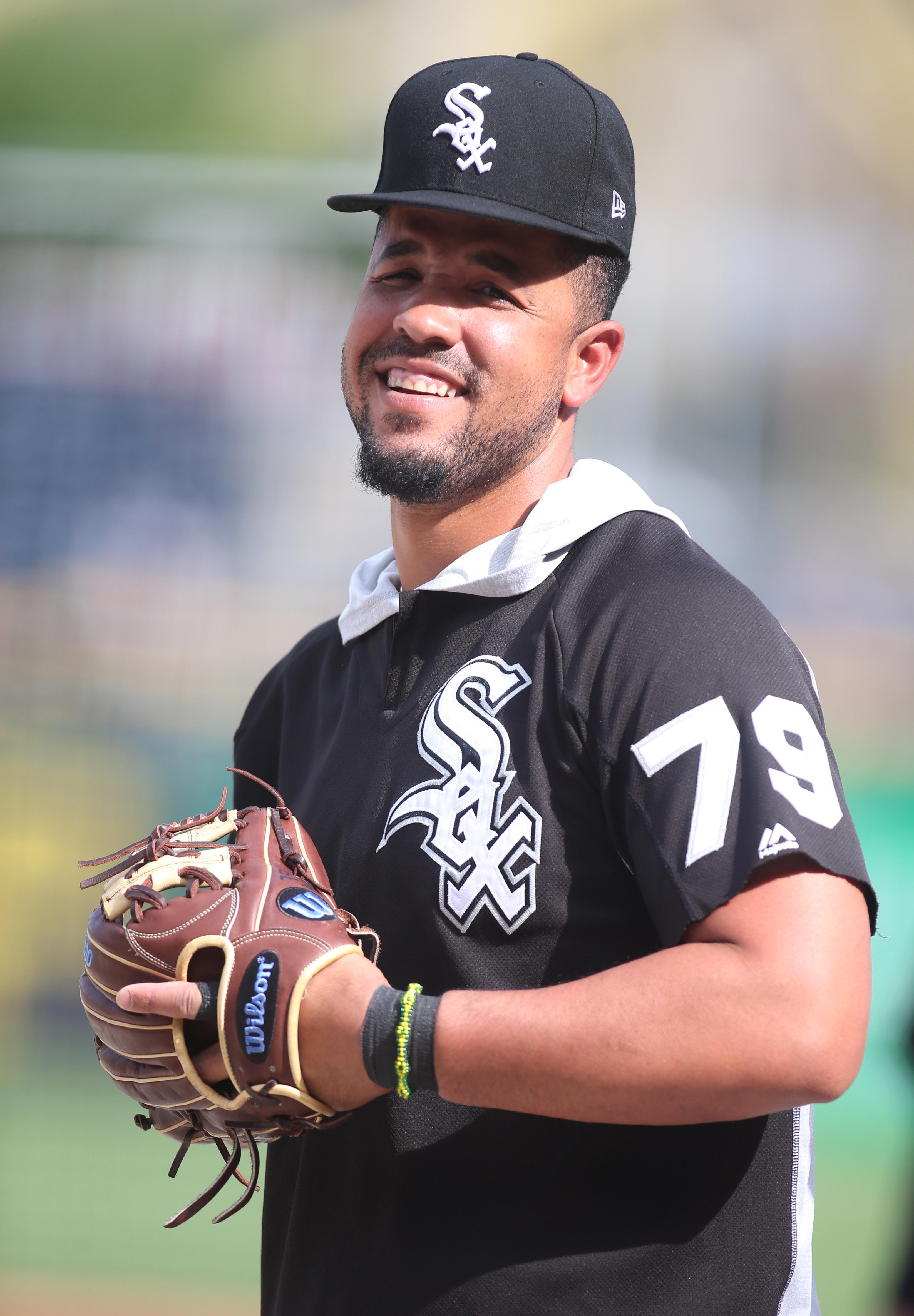
Under the new contract, Abreu will receive a $5MM signing bonus and an $11MM salary in 2020 before being paid $16MM in 2021 and $18MM in 2022. Four million dollars of that 2022 salary will be deferred, according to the team. Abreu is represented by ISE Baseball.
In signing Abreu to this type of extension, the White Sox are effectively betting (in a fairly substantial manner) on a rebound in his age-33 season next year. That’s not to say that Abreu had a poor 2019 campaign; he batted .284/.330/.503 with 33 home runs and was a decidedly above-average hitter overall. But unlike his 2014-17 production, Abreu’s output in 2018-19 has been more good than it has been great. Park- and league-adjusted measures such as OPS+ (119) and wRC+ (117) agree that he’s been nearly 20 percent better than a league-average hitter in that span, but that’s a far cry from the premium levels at which Abreu produced from 2014-17 — particularly in his brilliant 2014 rookie campaign, when he was arguably the best hitter in baseball.
The open market simply hasn’t rewarded players of this age and skill set in recent years, and it’s unlikely that Abreu would’ve had this type of earning power next winter without returning to his previous levels of excellence with the bat. Given the fact that Abreu has never been rated as a strong defensive first baseman and isn’t likely to make considerable improvements as he progresses deeper into his mid-30s, an uptick at the plate is all the more important.
All of that said, it’s also undeniable that Abreu has emerged as the heart of the White Sox in recent years. The front office, ownership and teammates alike have lauded Abreu for his leadership and the manner in which he mentors young players as they arrive on the scene. He’s also a fixture in the community on the south side of Chicago and is generally beloved by Sox fans. All of that surely factors in when pricing out a deal and is particularly likely to resonate with owner Jerry Reinsdorf, who has been vocal about his desire to keep Abreu in a Sox uniform (as has GM Rick Hahn).
From a financial standpoint, the new structure of the deal does give the Sox a bit of extra breathing room when constructing the 2020 roster. Assuming that signing bonus still counts against the 2020 ledger, they’re now at about $93.7MM in projected salary when factoring in projected arbitration payouts. Parting with either Yolmer Sanchez or James McCann, who was displaced as the team’s starting catcher by yesterday’s Yasmani Grandal signing, would create further flexibility. Sanchez is projected by MLBTR contributor Matt Swartz to earn $6.2MM in 2020, while McCann’s projection checks in at $4.9MM.
The extent to which Reinsdorf is willing to spend on the 2020 roster isn’t definitively known by anyone outside of the White Sox’ top decision-makers, but they’re currently about $30MM shy of their record Opening Day payroll mark ($128MM in 2011) — a number that could jump to $40MM depending on the fate of Sanchez and McCann. The Sox now have about $46MM in guaranteed money on the books for the 2021 season and about $53MM on the books in 2020
That leaves them plenty of latitude for an additional long-term signing — particularly since key young players like Tim Anderson and Eloy Jimenez are already locked into long-term deals that provide cost certainty. They’ll still need to budget for pricey arbitration salaries for both Yoan Moncada and Lucas Giolito beginning in 2021, however, meaning multiple long-term additions will begin to clog up the books in a hurry. But if ownership is willing to push payroll beyond its previously established heights moving forward, it’s certainly plausible that the Sox could have more than one addition up their sleeve between now and Opening Day. The club is hopeful of adding both a right fielder and a starting pitcher to the mix, so further additions do indeed seem likely, although either could come on a shorter-term arrangement.
KBO’s Kiwoom Heroes Re-Sign Eric Jokisch
Former Cubs lefty Eric Jokisch has re-signed with the Kiwoom Heroes of the Korea Baseball Organization, per an announcement from the Heroes (link via Jee-ho Yoo of the Yonhap News Agency). He can earn up to $700K on the one-year deal.
Now 30 years of age, Jokisch only appeared in one MLB season — when he posted a 1.88 ERA in 14 1/3 innings with Chicago back in 2014 — but had a track record of solid performances in the upper minors before heading to South Korea last offseason. Jokisch’s first year with the Heroes was a strong one, as he pitched 181 1/3 innings of 3.13 ERA ball with 7.0 K/9 against 1.9 BB/9.
Since Jokisch is only re-upping on a one-year deal, he’ll be a name worth keeping an eye on over the course of the 2020 campaign. It’s become increasingly common for fringe big leaguers who find success in the KBO or in Japan’s Nippon Professional Baseball to use those leagues as a launching pad for a second chance in MLB. Eric Thames, Miles Mikolas, Chris Martin and Merrill Kelly have all done so in recent years, and righty Josh Lindblom is looking to add his own name to that list this winter.
MLBTR Poll: Grading The Grandal Deal
Catcher Yasmani Grandal has now been the top backstop available on the open market in back-to-back offseasons. But this winter’s trip to free agency turned out drastically different for Grandal than last year’s. Coming off a prosperous run with the Dodgers an offseason ago, Grandal turned down a four-year, $60MM offer from the Mets before signing a one-year, $18.25MM guarantee with the Brewers. Grandal’s Milwaukee pact was barely more than the qualifying offer he rejected from the Dodgers, but it did give the 31-year-old the opportunity to make a substantial amount for a single season and once again make a case for a lucrative long-term deal. A year later, it seems fair to say things worked out well for the switch-hitting Grandal.
In his lone season as a Brewer, Grandal showed yet again that he’s one of the most well-rounded catchers in baseball. He earned the second All-Star nod of his career, racked up 5.2 fWAR, slashed .246/.380/.468 with a career-high 28 home runs in 632 plate appearances, and ranked near the top of the league as a pitch framer. While Grandal’s stellar 2019 output wasn’t much different than his 2018 production, he wasn’t going to settle for another one-year deal this time.
Grandal officially departed Milwaukee on Thursday to become the highest-paid player in the history of the White Sox, who signed him to a four-year, $73MM deal with full no-trade protection in 2020 and a partial NTC thereafter. It’s an undeniably bold strike by Chicago, which hasn’t finished with a .500 or better record since 2012 and hasn’t clinched a playoff spot since 2008. However, the White Sox are aiming to wrap up a multiyear rebuild and put themselves back on the map in the AL Central division, where they’re wedged between two contenders (the Twins and Indians) and a pair of noncompetitive clubs (the Royals and Tigers).
The Grandal signing figures to help the White Sox move closer to relevance in 2020, as he’s a clear upgrade over their No. 1 catcher from last season, James McCann. Of course, as is the case with all big-money acquisitions, there’s risk involved – especially when talking about a 30-something catcher. To Grandal’s credit, though, he has been eminently durable and extraordinarily consistent to this point. And Grandal’s bat is so sturdy that it should work just fine at designated hitter, where he’ll be able to play on occasion to partially save himself from the wear and tear of catching. If there’s another reason to like this move for Chicago, it’s that the club didn’t give up any draft compensation for Grandal, who was ineligible to receive a QO.
In your opinion, did the White Sox make a wise move in handing Grandal a franchise-record payday? (Poll link for app users)
Grade Chicago's Yasmani Grandal signing
-
B 34% (8,559)
-
A 33% (8,407)
-
D 18% (4,478)
-
C 14% (3,463)
-
F 2% (487)
Total votes: 25,394
East Notes: Mets, Ramos, BoSox, Holt, Rays, Braves
The latest on a few East Coast clubs…
- The Mets have reportedly shown interest in free-agent catcher Robinson Chirinos, but a union between the two sides doesn’t look realistic. Chirinos a starting-caliber catcher, after all, and the Mets already have a somewhat expensive No. 1 backstop in Wilson Ramos, who’s slated to earn $10.75MM through 2020 (including a $1.5MM buyout for ’21). While Ramos didn’t have a great year in 2019, his first as a Met, the team’s “committed to” him heading into next season, Anthony DiComo of MLB.com writes. The 32-year-old Ramos was subpar behind the plate this season, evidenced by a 15 percent caught-stealing rate and a low ranking in Baseball Prospectus’ Framing Runs Above Average metric, but he did turn in another fine offensive campaign. Barring an unexpected turn, it seems he’ll start again next year for New York, though the team could bring in someone who – unlike Chirinos – is suited for a backup role.
- The Red Sox reached out to free-agent utilityman Brock Holt about a new deal after the season, but there haven’t been discussions since they hired Chaim Bloom as their chief baseball officer Oct. 28, Holt told Barstool Sports’ Section 10 podcast (hat tip to Chris Cotillo of MassLive.com). Although other teams have contacted Holt, he revealed there’s “nothing serious” brewing between him and any clubs. MLBTR predicts a two-year, $8MM contract for the versatile Holt, who’s coming off back-to-back solid seasons at the plate. The 31-year-old batted .297/.369/.402 in 295 PA in 2019, which is looking more and more like his last season as a member of the Red Sox.
- The Rays made the decision to designate third baseman Matt Duffy for assignment Thursday after failing to find a trade partner for the 28-year-old, according to general manager Erik Neander (via Marc Topkin of the Tampa Bay Times). But moving on from the oft-injured Duffy was a tough call for the Rays, per Neander, who stated: “Wish that his health and his time with us would have gone different in that regard and we could have had him on the field more. He really is a special player and there’s the obvious stuff you can measure in how he impacts a game. His intangibles, his leadership, his influence on a younger impressionable clubhouse like we have is worth a lot.” Despite the respect the organization has for Duffy, Neander noted the Rays are happier with their current third basemen (including No. 1 option Yandy Diaz).
- Much like his previous deal with the Rangers, the two-year, $14MM contract reliever Chris Martin signed with the Braves gives him the opportunity to become a free agent at the end of it, Jon Heyman of MLB Network tweets. Martin will only have three-plus years’ service time then, meaning he’d remain eligible for arbitration under normal circumstances, but there’s language built into the pact that will allow him to return to the open market when it expires.
Coaching/Front Office Notes: Bucs, D-backs, Giants, O’s
Rays bench coach Matt Quatraro remains in the running to become the Pirates’ next manager, per Jon Heyman of MLB Network. The race is seemingly down to Quatraro, Athletics quality control coach Mark Kotsay and Twins bench coach Derek Shelton, though Heyman notes there may be other unreported names in the mix. Hiring a manager could end up as the first important order of business for new GM Ben Cherington, whom the Pirates brought aboard earlier this week.
- Diamondbacks executives Amiel Sawdaye and Jared Porter have been mentioned as future general managers, though the two told Ken Rosenthal of The Athletic (subscription link) they’re content to stay in Arizona working under GM Mike Hazen. “It would be really hard to leave Arizona not just because of the culture Mike has created, the ease of living, the obvious excitement over the organization. But coming in and building something and wanting to see it through is so important,” said Sawdaye, who added, “If I never become a GM and this is my ultimate job and I’m here for the next 25 years, I can tell you I’ll be darned happy.” Porter echoed Sawdaye, saying: “I’ve never been more excited about working somewhere. I’ve never been more determined and focused to make a team and an organization better.” The feeling’s mutual on the D-backs’ end, as the franchise recently signed the two assistant GMs to extensions.
- Greg E. Johnson has grabbed the reins as the Giants’ control person, Henry Schulman of the San Francisco Chronicle reports. He’ll take over for Rob Dean, who held the position on an interim basis after MLB suspended now-reinstated president/CEO Larry Baer in March, though Dean is still with the organization. Baer and president of baseball ops Farhan Zaidi are now expected to report to Johnson and Dean, but “day-to-day operations should not be affected by Thursday’s moves,” Schulman writes. Johnson’s the son of Charles B. Johnson, who was part of the investment group that bought the Giants in 1993.
- The Orioles are close to hiring Rockies assistant Anthony Sanders as their first base coach, Jon Morosi of MLB.com tweets. Sanders is a former major league outfielder who managed at the rookie level with the Rockies, though he was most recently their outfield and base-running coordinator. Assuming Sanders takes over as the O’s first base coach, he’ll succeed Arnie Beyeler.