
MLBTR Chat Transcript: 3/10/17
Click here to read a transcript of today’s chat with host Jeff Todd.
Rays Claim Jumbo Diaz From Reds
The Rays have claimed right-hander Jumbo Diaz off waivers from the Reds, per MLB.com’s Mark Sheldon (on Twitter). Diaz had been designated for assignment late last week when the Reds claimed Christian Walker from the Braves. The Rays placed right-hander Nathan Eovaldi, who will miss the 2017 season following Tommy John/flexor surgery, on the 60-day disabled list to create a spot on the roster.
The 33-year-old Diaz posted a seemingly palatable 3.14 earned run average in 43 innings out of the Cincinnati bullpen last season, but the hard-throwing righty also displayed some troubling trends. Diaz posted career-worst marks in K/9 (7.7), BB/9 (4.0), swinging-strike rate (10.4 percent) and average fastball velocity (95.9 mph). A .239 BABIP and a strand rate just north of 80 percent also contributed to that impressive 3.14 mark but prompted ERA alternatives like like xFIP (4.60) and SIERA (4.24) to forecast a more pessimistic outlook.
Diaz logged significantly better strikeout and walk rates in his only other two seasons in the Majors, however (2014-15). All told, he carries a 3.65 ERA with 9.4 K/9, 3.3 BB/9, a 43.7 percent ground-ball rate and a heater that has averaged 96.9 miles per hour. Diaz is out of minor league options, so he’ll have to break camp with the Rays at the end of the month or once again be exposed to waivers before he can be sent to the minors. However, the Rays’ opportunity to see Diaz up close will be somewhat limited, as he’s currently pitching for the Dominican Republic in the 2017 World Baseball Classic.
Chad Bettis To Begin Chemotherapy After Cancer Unexpectedly Spreads
1:15pm: Bettis spoke to the media, and the Denver Post’s Nick Groke writes that the right-hander gave good news on his prognosis — a roughly 90 percent rate of healthy recovery in cases similar to his own. Bettis says that “optimistically,” he’d be able to return to the baseball field as soon as this season.
12:29pm: Rockies right-hander Chad Bettis shared the frightening and unfortunate news today that the testicular cancer for which he underwent surgery earlier this offseason has unexpectedly spread. The 27-year-old’s full statement, which he shared on Twitter, reads as follows:
“During my routine health checkup last week, my oncologist believed that he had seen inflamed lymph nodes and ordered an immediate biopsy. I learned this week that my testicular cancer has unexpectedly spread, and I will begin a regimen of chemotherapy in the very near future. Although my blood tumor markers remain at normal levels, it’s clear that I need to be aggressive in my fight against this illness. Without being proactive, we wouldn’t have caught this. I am committed to beating this cancer. My family and I are grateful for the support of the Major League Baseball Players Association, the Rockies organization and you, the fans.”
While there are certainly baseball-related ramifications for the Rockies, the health and well-being of Bettis obviously takes priority. We at MLBTR extend our best wishes to Bettis and hope for a full recovery and, eventually, a return to the mound. Readers are encouraged to share their support and well wishes for Bettis and his family on Twitter.
Bettis had been slated to join Jon Gray, Tyler Anderson and Tyler Chatwood in the Rockies’ 2017 rotation a year after logging a career 186 innings over the course of a career-best 32 starts.
Cody Anderson Diagnosed With Mild UCL Sprain
Indians right-hander Cody Anderson (not to be confused with Cleveland closer Cody Allen) has been diagnosed with a mild sprain of the ulnar collateral ligament in his right elbow, the team announced. There’s no timetable for the 26-year-old to return to throwing, as the team is “in the process of completing our medical due diligence on the most appropriate plan of treatment.” Paul Hoynes of the Cleveland Plain Dealer tweets that Anderson is headed for a second opinion on the elbow, but skipper Terry Francona said signs point to Anderson avoiding surgery. Anderson previously underwent arthroscopic surgery on his elbow back in November.
It’s not clear that Anderson would’ve had a spot on the Indians’ roster out of the gate in 2017, as the Cleveland rotation is full with right-handers Corey Kluber, Carlos Carrasco, Danny Salazar, Trevor Bauer and Josh Tomlin. However, Anderson has logged significant time with the Tribe in each of the past two seasons and could’ve been one of the first lines of defense in the event of an injury. Alternatively, he could’ve broken camp with the club as the team’s long reliever and handled occasional spot start duties. That role, to date, remains up in the air for Cleveland.
Last year, Anderson struggled to a 6.68 ERA in 60 2/3 innings with Cleveland, though he looked more impressive out of the bullpen later in the year. In 18 2/3 innings out of the ‘pen, Anderson yielded nine runs on 20 hits and three unintentional walks with 19 strikeouts. And a year prior, he posted a sterling 3.05 ERA in 15 starts as a rookie. While that 2015 level of performance seemed largely unsustainable, last year’s 6.68 ERA was perhaps even more fluky in the opposite direction.
Overall, Anderson sports a career 4.50 ERA that is a dead match for his 4.50 FIP and a near-mirror image of his 4.47 SIERA. Whether a healthy Anderson would’ve broken camp with the team can’t definitively be known, but his absence nonetheless thins out the Cleveland pitching depth. Mike Clevinger and Carlos Frias are among the 40-man right-handers that have some big league experience, though the Indians also have Rule 5 pick Hoby Milner and a slew of alternatives in camp that could vie for the final spot on the pitching staff, as can be seen on the team’s depth chart at Roster Resource.
AL Central Notes: Hefner, ChiSox, Tigers, Indians
The Twins have hired former big league right-hander Jeremy Hefner as an advance scout, Hefner himself announced (Twitter link). Hefner, who was forced to retire due to myriad injuries (including a pair of Tommy John surgeries in 2013-14), notes that he’ll help formulate game plans and reports for the Major League club and adds that he’ll have some non-traditional duties with his new position as well. The 30-year-old Hefner last pitched in the Majors back in 2013 when he tossed 130 2/3 innings of 4.34 ERA ball with 6.8 K/9 against 2.5 BB/9 for the Mets.
More from the division…
- Despite a pause in their sell-off, the White Sox remain open for business, Joel Sherman of the New York Post writes. Indeed, as GM Rick Hahn told MLBTR in February, the club would have preferred to have made four more deals at this point. But that doesn’t mean the team is ready to deal just to move salary, and some rival officials think the Sox are setting unrealistic price tags on their remaining veterans. “I think our asks are commensurate with what we are willing to give up,” Hahn tells Sherman, while noting the team is still open to deal. Sherman also looks at how Jerry Reinsdorf came around to the idea of selling, with the veteran owner finally agreeing that the organization’s best shot at capturing another title would come through a rebuild.
- While it’s still early in camp, the results from right-hander Anibal Sanchez haven’t been encouraging, as Anthony Fenech of the Detroit Free Press writes. Sanchez, along with expensive veterans Mike Pelfrey and Mark Lowe, have all been knocked around thus far, and Fenech notes that it’s difficult to imagine a team with postseason aspirations breaking camp with all three on the roster. Sanchez, who has allowed 11 earned runs in 5 2/3 innings, is owed $16MM this coming season plus a $5MM buyout on his 2018 option. Pelfrey’s struggles have been similar (eight runs in six frames), and he’s set to earn $8MM in the second season of a two-year deal. Lowe is set to earn $5.5MM and has surrendered three runs in his 3 2/3 innings, albeit with a more encouraging 5-to-1 K/BB ratio. Obviously any spring stats — especially those accumulated through March 10 — should be taken with a large grain of salt, but none of that trio performed well in 2016, either.
- The Indians‘ payroll will surpass $100MM for the first time this year, writes Joel Sherman of the New York Post, who notes that the lack of holes on a roster with a still-limited payroll — Cleveland’s projected $124MM payroll will rank in the bottom half of the league — is fairly remarkable. Cleveland is trying to determine who will claim the final spot in the bullpen, who will serve as a utility infielder and who will claim the remaining reserve outfield role, but beyond that the roster is largely set. General manager Mike Chernoff noted to Sherman that his team typically wouldn’t be able to pursue a marquee name like Edwin Encarnacion, “…but having cost controllable guys allowed one big guy.”
- Michael Brantley will play in a five-inning simulated game — his third simulated contest of the week, writes Paul Hoynes of the Cleveland Plain Dealer. The Indians still don’t know exactly what they can expect of Brantley, though Hoynes spoke to manager Terry Francona quite a bit about Brantley’s progress and the team’s hopes. As Francona observed to Hoynes, if Brantley is able to return to his former self — a big if — Cleveland will have effectively added two dynamic middle-of-the-order bats to an already imposing lineup.
NL Notes: Phillies, Greinke, Carpenter, Nats
As his organization embarks on a year in which it hopes to see continued growth, Phillies GM Matt Klentak discussed the state of the club on MLB Network on Sirius XM (Twitter link). Klentak says he sees “a lot of growth,” with many young players joining major league camp for the first time. The club’s winter strategy was to “do everything we can to supplement this group” of young talent, he says, while being careful “not to stunt the development of our young players.” As for hyped shortstop prospect J.P. Crawford, Klentak says that having two established middle infielders in Freddy Galvis and Cesar Hernandez allows the team to avoid rushing him to the bigs after an aggressive promotional timeline through the minors.
Here are a few more notes out of the National League:
- Diamondbacks righty Zack Greinke has continued to exhibit slower-than-usual fastball velocity this spring, as Nick Piecoro of the Arizona Republic reports. The veteran didn’t crack 90 mph in his second spring outing; while he noted “it’s still early,” Greinke did acknowledge “it’s not ideal, either.” Skipper Torey Lovullo said that he’s not concerned at this point, but a rival scout does tell Piecoro that he observed a downturn in Greinke’s offerings. At this point, it’s just something to watch, but as Piecoro notes, there are some additional reasons concern, including Greinke’s late-2016 shoulder issues and his delayed start to spring (which the team says wasn’t due to health).
- Cardinals first baseman Matt Carpenter is playing, but only bunting in game action as he works through lower back pain. He’s about ten days from being ready to hit in a game, per Derrick Goold of the St. Louis Post-Dispatch (via Twitter). While that doesn’t leave a ton of time for Carpenter to ramp up for Opening Day, it seems he’ll be able to do so barring a setback.
- The Nationals played a reduced role on the international market for quite some time, but as Jorge Castillo of the Washington Post writes, the club was able to find value in older Dominican players. As ever, age is relative; the Nats were targeting players who had fallen through the cracks of the traditional July 2 market and remained unsigned at 17 or 18 years of age. Outfielder Rafael Bautista was late to the game, but showed enough to command a $35K bonus and has shown enough to earn a 40-man spot, as has first baseman Jose Marmolejos. Catcher Pedro Severino and infielder Wilmer Difo were some of the others who signed for little but have already reached the bigs as the Nats targeted “pitchers and middle-of-the-field players with tools,” as Castillo writes. It’s an interesting look at the organization’s strategy, which has certainly evolved over recent years.
Offseason In Review: Milwaukee Brewers
This is the latest entry in MLBTR’s Offseason In Review series. The full index of Offseason In Review posts can be found here.
The Brewers’ offseason saw them continuing to add young talent, but they also acquired several veterans who should help make them fun to watch as they integrate younger players onto their roster.
Major League Signings
1B Eric Thames: three years, $16MM (including $1M buyout on $7.5MM option for 2020)
RHP Neftali Feliz: one year, $5.35MM
LHP Tommy Milone: one year, $1.25MM (non-guaranteed)
Notable Minor League Signings
Joba Chamberlain, Ryan Webb, Eric Sogard, Ivan De Jesus Jr..
Trades And Claims
Acquired 3B Travis Shaw, SS Mauricio Dubon, RHP Josh Pennington and PTBNL from Red Sox for RP Tyler Thornburg
Acquired C Jett Bandy from Angels for C Martin Maldonado and RHP Drew Gagnon
Claimed 1B Jesus Aguilar from Indians
Lost RHP Miguel Diaz to Twins in Rule 5 Draft
Notable Losses
Chris Carter, Thornburg, Blaine Boyer, Chris Capuano
Needs Addressed
The Brewers’ offseason mostly continued their recent trend of rebuilding what had been an aging roster, but their activity this winter also showed small signs that they’re looking toward contending in the near future.
Their first big move of the winter was to replace first baseman Chris Carter with Eric Thames, who signed a three-year, $16MM deal the same day the Brewers designated Carter for assignment, thereby avoiding taking him through the arbitration process. The Carter move was eyebrow-raising — it isn’t every day that a team drops a 41-homer hitter who’s set to receive a seemingly reasonable salary. The arbitration process, though, rewards counting stats like home runs and likely would have minimized Carter’s shortcomings, such as his strikeout and contact issues and lack of defensive value. MLBTR projected in October that Carter would receive $8.1MM through arbitration, and there are suggestions the salary might have gone higher. That sum seems paltry for a prolific home-run hitter, but the apparent ambivalence to one-dimensional power sources on this winter’s market strongly indicates that teams aren’t overly interested in sluggers who don’t bring something else to the table. The Brewers’ inability to trade Carter, as well as his eventual signing with the Yankees on a mere $3.5MM deal, suggest that the league didn’t think Carter was worth nearly as much as the arbitration process would have paid him.
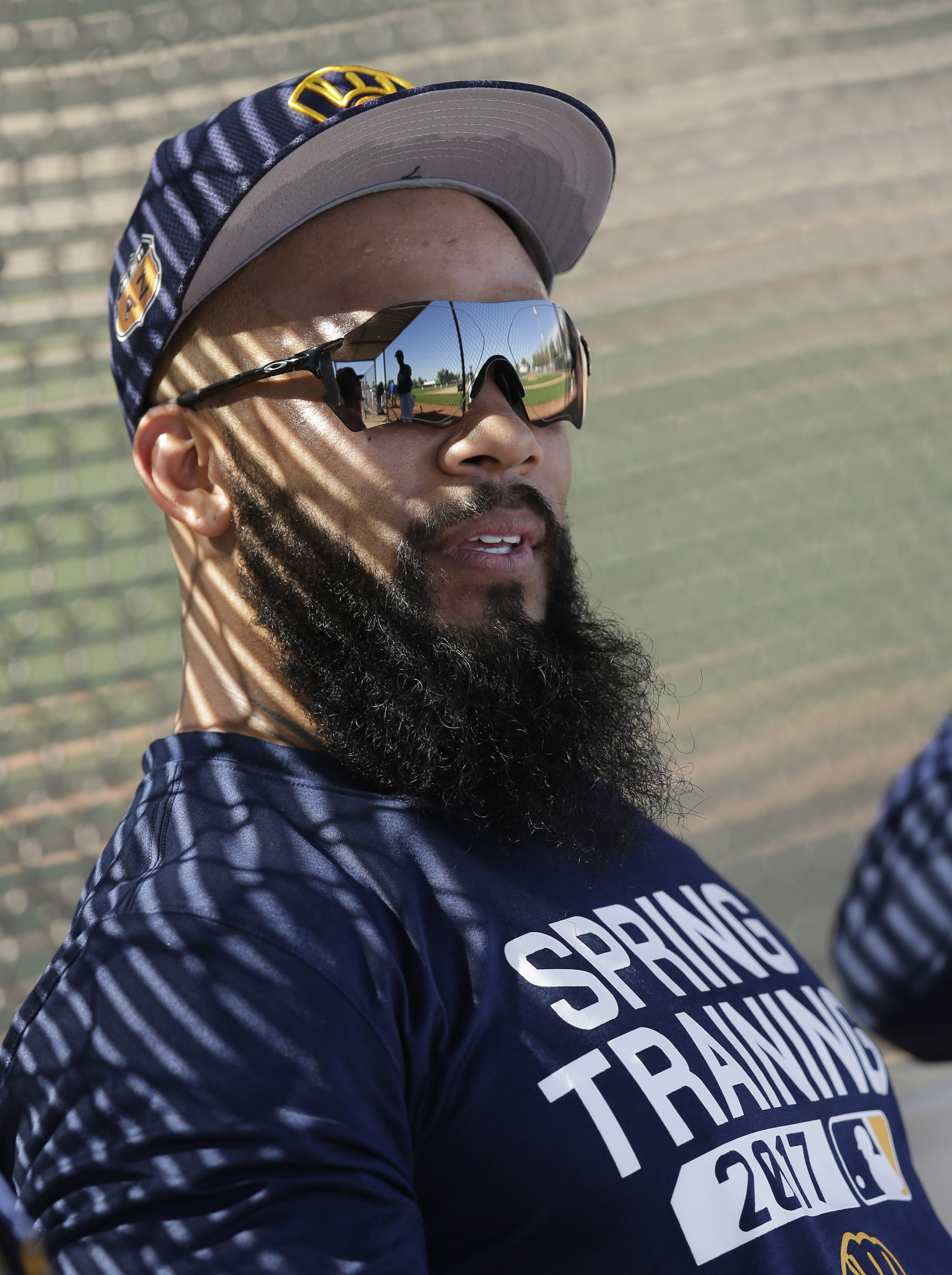 In Carter’s place, the Brewers landed Thames, whose unusual background makes him an interesting and somewhat outside-the-box fit for the team’s first-base opening. Thames spent two forgettable seasons with the Blue Jays and Mariners in 2011 and 2012 before heading to the NC Dinos in South Korea, where he emerged as one of the KBO’s most fearsome sluggers. Even in a league dominated by offense, Thames’ numbers stood out — he hit 124 home runs in Korea in a mere 1,634 plate appearances. He’s also still just 30, young enough that he could have several more power-hitting seasons left in him.
There’s still very limited data on how KBO stats will translate to the Majors, and the existing precedents for prime-age sluggers point in different directions — Jung Ho Kang has been a success (his off-the-field problems notwithstanding), while Byung Ho Park‘s first season was a failure. Perhaps the biggest difference between Kang and Park prior to their arrivals in the states, though, was their plate discipline. Kang had 293 strikeouts in his last three seasons in Korea, while Park had a very high 399 (including 161 in his last season there). Thames, like Kang, had 293 whiffs in his three seasons in the KBO, suggesting a balanced approach that could play well as he returns to the big leagues. The well-rounded offensive game Thames demonstrated in Korea, where he posted OBPs above .420 in all of his three seasons, also contrasts sharply with that of Carter. No one really knows how Thames’ game will play in the big leagues at this point, but the Brewers, as a rebuilding club that didn’t have an obvious fix at first, were in great position to gamble on a relative unknown.
More analysis after the break …Read more
Caleb Cotham Retires
Reliever Caleb Cotham has decided to hang up his spikes, he announced on Twitter. Cotham, 29, had recently agreed to a minor-league deal with the Mariners.
Cotham isn’t being forced out of the game due to a catastrophic injury, though he has had his share of injury woes both recently and in the past. Instead, it seems, he’s not interested in continuing to endure the toll of the grind.
“For me it is time to explore how I can give back and offer value to the game of baseball in ways other than playing,” Cotham writes. “My love for the game has never been higher, I am just no longer willing to pay the emotional/physical price to rehab/play at the highest level.”
There’s no doubting the pressures and demands placed upon a player in Cotham’s situation. Over the past two years, he has bounced between the upper minors and the majors. While he was able to earn 35 MLB appearances, Cotham allowed 27 earned runs in that span and faced an uphill path to the Mariners’ active roster this year.
Cotham first cracked the bigs with the Yankees after a breakthrough 2015 season in which he threw 57 innings of 2.21 ERA ball with 9.6 K/9 and 2.1 BB/9 in the upper minors. He ended up being dealt to the Reds as part of the return for Aroldis Chapman.
While he made the Opening Day roster with Cincinnati, Cotham contributed to the team’s historically dreadful relief work. He was ultimately sidelined with shoulder inflammation and then suffered a season-ending knee injury upon his return to the minors. (That string of ailments surely brought back unwanted memories; originally a fifth-round pick out of Vanderbilt, Cotham threw only 31 innings from 2009 through 2011 owing to knee and shoulder surgery.) The Reds outrighted him off of their 40-man roster in late October.
‘Lucky Charm’ Jared Porter On Metrics, D-Backs’ 2017 Roster
This is the second half of an interview with Diamondbacks assistant GM Jared Porter, conducted by MLBTR contributor Brett Ballantini. Click here to read Part 1.
In the second part of the conversation, Porter addresses the intricacies of his job, including his go-to stats, and taking the “macro” view on the Diamondbacks’ future:
—
You were with the Cubs when the Diamondbacks traded for Shelby Miller, which from the jump seemed a significant overpay by Arizona. What was your impression?
It’s impossible for me to weigh in heavily due to the fact that I wasn’t here and don’t know all of the circumstances surrounding the trade. With that said, we are really excited to have a pitcher of Shelby Miller’s quality in our rotation. It’s been great getting to know Shelby as a person over the course of the last month or so and has been exciting to watch him feature such explosive stuff in his first two spring outings. He’s in impeccable physical shape and has a great mindset heading into the season. We’re lucky to have Shelby on the Diamondbacks.
Analytics is a rabbit hole that ultimately yields greater and greater understanding of the game. We’re so far from sheer batting average or pitching wins now, we can never go back. But clearly, each front office doesn’t just have a Baseball-Reference stock ticker of WAR numbers that steers evaluation. There are nuances wrapped in projections inside of data. Even among your own equfront office, with a relatively flat hierarchy, each of you must have your own pet data or go-to projections. If you can give me the Shake n’ Bake without revealing its flavor, what is your go-to stat?
Great question. I don’t think I have a “go-to stat,” but what I like the most is the data that helps prove things that are hard for our eyes to see or that can be hard to gauge within a scouting report. Player evaluation is so tough, even for the best evaluators, that any advantages we can find and use are so important.
For me, I’ve really been gravitating towards run prevention data lately. Some examples of this are PITCHf/x data (movement qualities of the pitch), pitch results data (how a pitcher’s stuff impacts the way hitters put balls into play) and pitch sequencing data (how a pitcher uses his pitches); defensive data and defensive positioning data; and catcher defense analysis.
One area that tends to get over-reported is catcher framing. While I’m a firm believer in the value of catcher framing and the impact it makes, the story often stops with catcher framing data and not enough attention is paid to the importance of game-calling and game leadership when it comes to evaluating catchers. A big part of a pitcher’s conviction in the stuff he’s throwing has to do with how the game is called and led behind the plate.
Your most significant trade of the offseason sent Jean Segura to the Seattle Mariners for Taijuan Walker and Ketel Marte. Was that a matter of selling high on Segura, buying low on Walker, or a little bit of both?
We’re really excited to have Taijuan Walker and Ketel Marte in Diamondbacks uniforms right now. We gave up a very talented and well-rounded impact player in Jean Segura as the centerpiece of the deal for Seattle, but continuing to add young, controllable, high-ceiling players like Taijuan and Ketel will make our talent pool deeper and more sustainable from a macro viewpoint.
Taijuan is a pitcher who all three organizations I’ve worked for have tried to acquire over the last two or three years. Getting to know him a bit over the course of the last month has given us a lot of confidence in the person he is. He wants to be great, and he wants to win. We’re very excited to have such a talented athlete in our program.
You have an exhausting number of responsibilities, overseeing player personnel, baseball operations, and the medical staff. But arguably your more significant responsibility with Arizona is in pro scouting. I’m guessing that amateur scouting—confirming blue chips or uncovering hidden treasure—is significantly different from pro scouting, where we imagine a half-dozen guys with radar guns trying to pick the bones of this summer’s early rebuilders. How do the roles of amateur and pro scouts differ?
The nature of all scouting is the same: Consistently beat other teams by evaluating and recommending talented, championship-caliber players for your organization. The types of scouting that I have the most significant responsibility for within Arizona are professional (other teams’ minor league players, and the independent leagues), major league (other teams’ major league players, and advance scouting), and international professional (typically NPB, KBO, and Cuban players who don’t fall under the amateur cap).
There are a few major differences between amateur and professional scouting that stand out. Every year there is a draft, so it’s a fact that an enormous pool of amateur players will be selected and signed to play professional baseball every June. For this reason, there’s a culminating point in every draft cycle. We don’t have as much information on amateur players. Although the information available is growing at an astonishing rate, there still isn’t as much information available in comparison to professional players. We haven’t had the opportunity to see amateur players compete against their professional peers on a daily basis yet, so the accuracy of evaluations is more volatile and higher risk. It becomes critical to mitigate the risk as much as you can while continuing to maximize the upside and the potential impact of players you’re bringing in.
On the professional and major league side, we have significantly more information, but oftentimes the assets you’re giving up in player or financial capital are so great that it makes the margin for error within these decisions minuscule. Also, the player pool to select from is more finite. Professional scouting is more of an ongoing process with regards to acquisition. Although there are a few big dates, like the Trade Deadline or Winter Meetings, the professional player acquisition period is literally 365 days a year, because a transaction can happen at any time.
Which scouting is a greater challenge, or more fun?
The best way for me to describe it is that it’s all awesome, and it’s all really challenging. You can never learn enough about player evaluation with regards to organizational building and roster construction.
You have inherited a Diamondbacks team that seems a given to put 69 wins in the rearview mirror, with not just superstars like Zack Greinke, Paul Goldschmidt and A.J. Pollock, but quite a few budding stars as well. Obviously, you’ve got a long-term vision of remaking the team, but how jazzed are you regarding your immediate, 2017 prospects?
We’re all very excited about the talent on our 40-man roster and certainly feel fortunate to inherit so many talented and athletic players with high ceilings. [Rookie manager] Torey Lovullo has set a great tone in camp, with everyone being part of a unified group headed in the same, positive direction. It’s been a point of emphasis for us this offseason to put a well-rounded, versatile, and deep group of major league players together going into the season. It’s still roughly a month to go before Opening Day, but so far, so good. Personally, I’ve enjoyed getting to know our players better as competitors and people, and am excited to continue to do so.
I asked Dave Stewart this question last year, and for all his intensity and aggressiveness, he surprised me with a muted answer. With specific regard to making an offer to a guy like [ex-Los Angeles Dodger] Greinke, is there any additional incentive beyond what he can do for the Diamondbacks—does taking a valuable player away from a direct rival color your decision-making at all? Or, asked another way, are the battles for wins fought exclusively between the lines, or can a front-office guy steal a couple of wins for the team and contribute the same value as a hitter with a knack for a game-winning RBI?
No, I don’t see it this way at all. It’s our job to help build a sustainable, deep, and well-rounded Diamondbacks team regardless of what other teams in our division are doing. If we do that, it doesn’t matter what other teams are doing because we’ll be able to provide Torey and our coaching staff with the necessary weapons to navigate a 162-game schedule, and hopefully more.
There is some nuance within the season with regards to matchups, maybe stocking your bullpen with a certain type of reliever for a series or two, picking the right time to spot start a guy, or adding a bat that might match up well for a certain stretch. But when it comes to the macro decisions, we have to constantly focus on making our team better and not worry about the others.
Fortunately, this is something I was able to see first-hand in Boston when I was younger due to the incredible depth and talent in the AL East at the time. I never saw Theo give in to any pressures that might have been there to match our division rivals, and I feel that as a result our internal player pool was always deep and sustainable, with great young players ready to make an impact at the major league level.
You were hired by the Red Sox in 2004 and, poof, there goes an 86-year Curse of the Bambino. The Cubs snapped you up in 2016 and, boom, the longest streak in the history of pro sports, 108 years without a title, is gone. Every time you join a new team, they win a World Series. Arizona’s drought of 15 seasons is slightly less dramatic than what you’ve conquered already. So, pressure’s on, are you going to make it three-for-three?
I wish it were that easy. I’ve been fortunate to work around great people and for teams with great players in Boston and Chicago. My hunch tells me that it’s been more about the players than me being a curse breaker! We’ll chalk it up to good timing.
With that said, we have a talented group here in Arizona and we are working daily to create the culture both in the office and in the clubhouse through Torey that we’ve seen lead to sustainable success in Boston and Chicago.
Follow Brett Ballantini on Twitter @PoetryinPros
Cubs, Kris Bryant Agree To Record Pre-Arb Deal
The Cubs have agreed with star third baseman Kris Bryant on a record-setting pre-arbitration salary, Jon Heyman of Fan Rag reports. Fresh off of a year in which he won the National League’s Most Valuable Player award, Bryant will take home $1.05MM.
Chicago also shared some of its World Series wealth with righty Kyle Hendricks, who’ll earn a hefty $760,500, per Gordon Wittenmyer of the Chicago Sun-Times. Hendricks was another key performer for the Cubs, turning in an outstanding campaign that saw him land third in the N.L. Cy Young voting. Larger-than-usual salaries are also on tap for Addison Russell ($644K), Javier Baez ($609K), and Kyle Schwarber ($565,500), per Wittenmyer’s report.
Bryant’s payday doesn’t blow the prior record out of the water, but does land a bit north of Mike Trout‘s 2014 salary of $1MM. Recently, standout Red Sox outfielder Mookie Betts was renewed at $950K after his own high-quality season. Notably, unlike Trout and Betts, Bryant has yet to achieve his second full year of MLB service — owing to the team’s controversial decision to delay his MLB debut in 2015.
The 25-year-old star will reach arbitration next year, though, as he’ll easy qualify for Super Two status. If he posts anything approaching the numbers from his first two season — including a composite .284/.377/.522 batting line and 65 total home runs — Bryant will earn a massive raise in his first trip through the arb process.
If the sides discuss a larger contract, Trout could again provide a target. His six-year, $144.5MM pact, which replaced the above-noted arb deal in 2014, was the second-largest contract ever given to a 2+ player. Buster Posey still holds the record for that service class at $159MM over eight years. Odds are that the Scott Boras-repped Bryant would be looking for quite a bit more money than either of those two players; certainly, it’s arguable that the market has moved northward since that time, and the Trout contract seems a notable bargain in retrospect for a player of that quality (even given the remaining club control the organization had).
Hendricks, 27, was in the 2+ arb class, but fell well shy of Super Two eligibility. After a solid 2015 effort, he turned one of the most surprising campaigns in the league last year. Over 190 frames, Hendricks worked to a National League-leading 2.13 ERA with 8.1 K/9 and 2.1 BB/9. He, too, will be in line for big first-year arb earnings if he can replicate that success.