
Latest On Seiya Suzuki’s Trade Candidacy
While the overwhelming majority of the focus on the Cubs’ outfield mix this winter has been on the trade candidacy of Cody Bellinger, teammate Seiya Suzuki has emerged as an intriguing trade candidate in his own right in recent weeks. Previous reporting has described the club as “determined” to move one of the two outfielders, and today Suzuki’s agent Joel Wolfe offered notable insight on the possibility of his client getting dealt, as relayed by ESPN’s Jesse Rogers.
Wolfe told reporters (including Rogers) this afternoon that Cubs president of baseball operations Jed Hoyer approached him last night about which teams are interested in Suzuki’s services. Notably, Suzuki has a full no-trade clause, meaning that he and Wolfe are free to reject any trade proposal involving the outfielder. Wolfe suggested that while Suzuki is theoretically open to a trade, he added that “it’s a pretty small universe” in terms of teams he would be willing to entertain being moved to.
In addition to confirming that there are teams at least inquiring on Suzuki’s availability, Wolfe’s comments also revealed one potential motivation for Suzuki to entertain trade offers: his desire to play the outfield on a regular basis. Following the emergence of top prospect Pete Crow-Armstrong as the club’s everyday center fielder last summer, Suzuki found himself parked at DH on a regular basis once the club’s outfield mix was fully health and Bellinger cemented himself as the club’s regular right fielder. That’s a situation he was evidently displeased with, as Wolfe suggested that Suzuki likely “would not have signed with a team” who pitched being their everyday DH to him in free agency.
That potential source of discord between player and team shines a new light on the Cubs’ efforts to trade either Suzuki or Bellinger this winter. With Ian Happ locked in as the club’s left fielder and Crow-Armstrong having cemented himself in center, it’s undeniable that the club’s best defensive alignment with their current group of players involves Bellinger in right field with Suzuki at DH. Suzuki was well-regarded defensively for his work in the outfield during his NPB days but has oscillated between average and below average throughout his three seasons in the big leagues according to defensive metrics. His -3 Outs Above Average last year ranked 33rd among 42 qualified right fielders. While Bellinger did not get enough reps to qualify, he’s earned +2 Outs Above Average for his work across all three outfield spots in two seasons with the Cubs and is generally regarded as a plus defender in an outfield corner.
Of course, that’s not to say the Cubs would necessarily prefer to trade Suzuki. Indeed, the club’s apparent aggressiveness in shopping Bellinger suggests just the opposite, and it’s not hard to see why. For one things, Bellinger’s $27.5MM salary in 2025 eclipses the $19MM Suzuki is owed this year, and Bellinger’s player option for 2026 offers Chicago less certainty moving forward than Suzuki’s guaranteed contract. What’s more, Suzuki is a better hitter and perhaps even the best hitter on the team. The 29-year-old’s .283/.366/.482 (138 wRC+) slash line this year dwarfs Bellinger’s own line of .266/.325/.426 (109 wRC+), and Suzuki has long been a statcast darling who hits the ball hard and takes his walks compared to Bellinger’s low exit velocities and contact-oriented approach.
To that end, Cubs GM Carter Hawkins spoke to reporters (including Meghan Montemurro of the Chicago Tribune) this afternoon and downplayed the likelihood of a trade.
“We don’t want to trade Seiya,” Hawkins said, as relayed by Montemurro. “but, look, as [Wolfe] talked about there’s people interested in great players and so if teams come asking those are at least conversations that we’re willing to have, but I really don’t think much is going to come of it.“
Hawkins’s comments lend further credence to previous reporting regarding Suzuki’s availability that suggested while the Cubs were willing to entertain offers for the slugger, a deal was only likely to come together if Chicago was unable to trade Bellinger. To this point, Bellinger has received reported interest from the Yankees, Mariners, Astros, and Diamondbacks at the very least, suggesting that a Bellinger trade remains the more likely outcome unless the market for his services falls apart in the coming days and weeks.
Red Sox Preparing Offer To Corbin Burnes
The Red Sox are preparing a formal contract offer to Corbin Burnes, write Chris Cotillo and Sean McAdam of MassLive. The former Cy Young winner is the final clear top-of-the-rotation arm available in free agency.
Boston came up empty in their pursuit of Max Fried. While the Sox were one of Fried’s top suitors, they balked at the massive $218MM guarantee which the southpaw landed from their rivals. The Red Sox have also seen reported targets Blake Snell and Nathan Eovaldi head elsewhere. The supply is limiting if the Sox are going to follow through on chief baseball officer Craig Breslow’s stated goal of “raising the ceiling” in the rotation.
Burnes would obviously accomplish that. While the righty hasn’t missed as many bats over the past couple seasons as he did during his best years in Milwaukee, he’s still an ace. Burnes fired 194 1/3 innings of 2.92 ERA ball for the Orioles in his platform year. He added eight innings with one run allowed in his lone postseason start. If the Red Sox were to land Burnes, they’d have one of the stronger rotations in MLB. He’d top a staff also including Tanner Houck, Brayan Bello, Kutter Crawford and a hopefully healthy Lucas Giolito.
At the start of the offseason, MLBTR predicted Burnes would receive a seven-year, $200MM commitment. That’ll almost certainly be light. Burnes was above Fried on virtually every contract prediction (MLBTR’s included). This has been a very strong market for starting pitchers. There’s a chance Burnes could land eight or even nine years on a deal that checks in between $250MM and $300MM at this point.
The Giants and Blue Jays are also known to be involved on Burnes. Baltimore has expressed a desire to keep him around, but that seems to be a longer shot. As a player who rejected a qualifying offer, he’d cost the Sox their second-highest draft pick and $500K of pool space from their 2026 international signing class.
Burnes isn’t the only qualified free agent (nor the lone high-profile Boras Corporation client) whom the Sox are pursuing. Boston is reportedly in the mix for Alex Bregman. In a separate column, McAdam writes that the third baseman is something of a divisive player in the Fenway Park offices. According to McAdam, manager Alex Cora and team president Sam Kennedy are more keen on a Bregman pursuit than Breslow happens to be. Cora is personally familiar with Bregman from his time as bench coach in Houston.
Whether Breslow is lower on Bregman as a player or simply prefers to focus his attention on starting pitching, that’s a potential complicating factor for free agency’s top remaining position player. The Sox presumably aren’t going to come away with both Burnes and Bregman. They could keep Rafael Devers at third base or pursue a Nolan Arenado trade if Bregman heads elsewhere. If they’re looking for a top-of-the-rotation arm and come up empty on Burnes, they’d likely go to the trade market. Reports have cast them more on the periphery of the Garrett Crochet bidding. The Sox floated the possibility of swapping Triston Casas for one of Seattle’s starters, but the Mariners rebuffed that interest while expressing a desire to hold their young pitching.
MLB Mailbag: Vlad Jr., Yankees, Seiya Suzuki, Sasaki, Giants
We (Steve Adams and Tim Dierkes) are on the scene at the Hilton Anatole in Dallas for Day 2 of the Winter Meetings. At the time of this writing, Tuesday has been quiet in terms of completed deals, but plenty of action is yet to come. We carved out some time from meandering the lobby to field subscriber questions on Vladimir Guerrero Jr.'s potential contract, what the Yankees might do after losing out on Juan Soto, the Cubs and the Seiya Suzuki trade situation, the idea of signing Roki Sasaki to an extension, what's next for the Giants, and much more.
Jeff asks:
Jays fan question - if 26 year old Soto is worth 765M, isn't 26 year old free agent Vlad Jr now worth ~500M? How bad has Ross Atkins bungled his window to sign Vlad at a more reasonable price, over several years of dithering? All the talk had been a Devers comp in the mid-300s, but that ship has surely sailed, right?
Vladimir Guerrero Jr.'s likely rising price tag was a big topic of conversation around the lobby of the MLB Winter Meetings in Dallas Monday night.
It's worth noting that Guerrero will turn 27 shortly in advance of his first free agent season, as opposed to Juan Soto spending the entire first year of his new deal at the age of 26. We have rarely seen a prominent free agent hit the market at 27, perhaps with the exception of Carlos Correa's weird three-year post-lockout contract. Otherwise you're looking at international free agents like Jose Abreu or Seiya Suzuki, or Cody Bellinger who took a one-year deal at that point.
Steve and I spoke to our esteemed former colleague Ben Nicholson-Smith last night about a potential Vlad Jr. price tag, and Ben mentioned Rafael Devers as a comp just as Jeff did in his question. Indeed, Devers' contract only covers free agent years and started with his age-27 season. That was a ten-year, $313.5MM extension. Due to deferred money, Alex Speier of the Boston Globe wrote that the CBT hit on Devers' deal is "just more than $29 million." In other words, the present value of Devers' deal was below $300MM. It was also not signed on the open market.

Unlock Subscriber-Exclusive Articles Like This One With a Trade Rumors Front Office Subscription
- Access weekly subscriber-only articles by Tim Dierkes, Steve Adams, and Anthony Franco.
- Join exclusive weekly live chats with Anthony.
- Remove ads and support our writers.
- Access GM-caliber tools like our MLB Contract Tracker
Rocky Colavito Passes Away
Nine-time All-Star Rocky Colavito has passed away, the Guardians announced. The longtime MLB slugger was 91.
A native of the Bronx, Colavito signed with the Indians out of high school. He had consecutive 30-plus home run seasons in Triple-A and played his way to Cleveland by his age-21 season. Colavito carried that over against MLB pitching, hitting 21 homers over 101 games as a rookie in 1956. He finished runner-up to Luis Aparicio in AL Rookie of the Year voting.
Colavito hit 25 homers in 1957. By the ’58 season, he was one of the sport’s most feared power bats. Colavito popped 41 homers while hitting .303 with an MLB-best .620 slugging percentage at age 24. He placed third in that year’s MVP balloting. Colavito drove in 113 runs that season and tallied 111 RBI the next. On June 10, 1959, he became the eighth player in MLB history to hit four homers in a game. He led the American League with 42 longballs en route to his first All-Star nod and a fourth-place MVP finish.
Early in the 1960 season, Cleveland traded Colavito to the Tigers in a one-for-one deal for star shortstop Harvey Kuenn. While Colavito hit 35 homers during his first season in Detroit, his average dropped to .249 in a disappointing overall season. He had a major rebound in ’61, as he set career marks in homers (45) and RBI (140). He hit .290 with a .402 on-base percentage, ranking top 10 among qualified hitters in OBP and OPS. He placed eighth in MVP voting in what was arguably the best year of his career.
Colavito played two more seasons in Detroit. He hit another 37 homers while leading the AL with 309 total bases in ’62. Detroit dealt him to the Athletics over the 1963-64 offseason. Colavito hit .274 with 34 longballs for the then Kansas City-based franchise. Things came full circle the next winter, as the A’s traded him back to Cleveland. Colavito combined for 56 homers over the next two seasons and paced the AL with 108 RBI in 1965. He saw limited playing time with the White Sox, Yankees and Dodgers to close his 14-year playing career.
A career .266/.359/.489 hitter, Colavito was one of the best run producers of his day. He drove in 1159 runs on more than 1700 hits, 379 of which cleared the fences. Colavito had seven 30-homer seasons, including a trio of years with at least 40 longballs. He topped 100 runs batted in on six occasions. Colavito is 81st on the all-time leaderboard in home runs and slots in the top 200 in RBI. While he never got much consideration from voters for Cooperstown, he was inducted into the Cleveland franchise’s Hall of Fame in 2006.
Colavito’s impact on baseball extended well beyond his playing days. He worked in the sport for decades as a coach and radio broadcaster. MLBTR sends our condolences to his family, friends, loved ones and many fans.
Pirates, Elvis Alvarado Agree To MLB Deal
The Pirates are in agreement with reliever Elvis Alvarado on a major league split contract, reports Noah Hiles of the Pittsburgh Post-Gazette (X link). The righty gets a 40-man roster spot with the Bucs, a notable development for a minor league free agent.
Alvarado secures a 40-man spot for the first time in his career. The 6’4″ righty has bounced around in minor league free agency. He has appeared in the Nationals, Mariners, Tigers and Marlins systems. Alvarado spent most of the ’24 campaign in Triple-A with Miami. He had a strong season, working to a 2.79 ERA in 48 1/3 innings. He struck out a third of opponents but walked an untenable 18% of batters faced.
The Bucs are clearly intrigued by Alvarado’s swing-and-miss ability. His command remains a serious work in progress. There’s not a ton of downside for Pittsburgh, which has a handful of open 40-man spots. Alvarado has a full slate of minor league options and will probably begin the season at Triple-A Indianapolis. The split deal means he’s paid at differing rates for his MLB and minor league work. He’ll very likely be paid around the MLB minimum for whatever time he spends at PNC Park.
Blue Jays Acquire Andres Gimenez
The Blue Jays and Guardians are in agreement on a four-player trade sending second baseman Andrés Giménez to Toronto. The Jays get Giménez and reliever Nick Sandlin for infielder Spencer Horwitz and outfield prospect Nick Mitchell. No cash is changing hands, so the Jays are absorbing the final five years of the Giménez contract.
It’s the first out of nowhere trade of the Winter Meetings. While it’s never a complete shock to see Cleveland deal a high-priced player, there hadn’t been much to suggest they were shopping their Gold Glove second baseman. Giménez appeared to be a core piece since he signed one of the biggest contracts in franchise history just two seasons back: a seven-year, $106.5MM extension.
Instead, the defensive stalwart is on the move for the second time in his career. Giménez began his career with the Mets, where his well-rounded profile made him one of the system’s top prospects. Cleveland acquired him alongside Amed Rosario as the key pieces in their return for Francisco Lindor and Carlos Carrasco during the 2020-21 offseason.
Giménez struggled during his first year in Cleveland, but he had a breakout showing in 2022. He played plus defense to win his first Gold Glove. Giménez also turned in an impact season at the plate, hitting .297/.371/.466 with 17 homers across 557 plate appearances. He was a deserved All-Star and finished sixth in MVP balloting in the American League.
Following that breakout season, the Guardians signed Giménez to the aforementioned extension. It remains the second-largest investment in the organization’s history, not too far behind the $124MM deal which José Ramírez inked the preceding spring. Cleveland surely envisioned building their long-term infield around that duo.
That’s not quite how things played out, as Giménez’s bat has taken a step backward. The Guardians probably didn’t expect him to repeat the offensive production he managed in 2022. He had a lofty .353 average on balls in play that would be hard to maintain, nor was he likely to be hit by as many pitches (an AL-high 25) as he’d been that year. Giménez’s numbers probably dropped off more sharply than Cleveland anticipated, though, as he has been a below-average hitter in consecutive seasons.
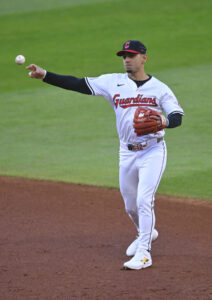
In 2023, the lefty-swinging Giménez hit .251/.314/.399 with 15 homers across 616 plate appearances. He improved his contact skills but saw his walk rate and power numbers take a step back. Those trends continued this year. Giménez managed just nine homers in 633 trips to the plate. He kept his strikeout rate to a tidy 15.3% clip but drew walks at a career-low 4.1% mark. He wrapped up the year with a middling .252/.298/.340 slash — his weakest offensive output over his three full seasons in Cleveland.
Despite the concerning offensive trends, Giménez remains a valuable all-around player. He has stolen 30 bases in consecutive seasons and is a good overall baserunner. He hasn’t had an injured list stint since 2020 and has topped 140 games in each of the last three seasons. Most significantly, he’s the sport’s best defensive second baseman. Giménez has been named the AL’s Gold Glove winner in three straight years. He has racked up 59 Defensive Runs Saved over that stretch. That’s well above Marcus Semien’s 37 mark that ranks second at the position. Statcast’s Outs Above Average doesn’t point to quite as big a discrepancy (49 to 40), but both metrics consider Giménez the game’s best keystone defender.
The Jays have poked around the market at second and third base. They have a handful of young players who are capable of manning one or both of those positions — Ernie Clement, Will Wagner, Joey Loperfido, Addison Barger, Orelvis Martinez and Leo Jiménez among them — but it’s a group light on MLB experience. Giménez has a much higher floor in the middle infield. He’ll play second base for at least the upcoming season. That’s probably his long-term home, though he could be an answer at shortstop if Bo Bichette walks next offseason. Giménez came up as a shortstop. He hasn’t played there since 2022, but he’s an athletic enough defender that he could probably handle the position.
The Jays are taking on a decent chunk of money to make that happen. Giménez is under contract for at least the next five seasons. He’ll make $10MM next year, $15MM in ’26, and $23MM annually for the final three guaranteed years. There’s a $23MM club option for the 2030 campaign that comes with a $2.5MM buyout. The deal also calls for a $1MM assignment bonus in the event of a trade. Including that bonus, Giménez is guaranteed $97.5MM for his age 26-30 campaigns. RosterResource calculates the Jays’ projected luxury tax number around $229MM, putting them roughly $12MM below next year’s base threshold.
Toronto also deepens a subpar middle relief group with the Sandlin acquisition. The low-slot righty has a solid track record over four years in the big leagues. Sandlin, who turns 28 next month, carries a 3.27 earned run average across 195 1/3 career innings. Despite a pedestrian 92-93 MPH fastball, he has shown the ability to miss bats. Sandlin carries a career 27.7% strikeout rate, which he essentially matched over 57 2/3 frames this past season.
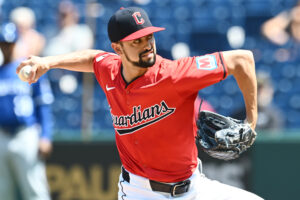
The Southern Miss product has middling control. Sandlin walked 11% of batters faced this year, right in line with his 11.4% overall walk percentage. That’ll probably keep him in the middle innings rather than leverage work, but Sandlin’s four-pitch mix has helped him avoid the platoon issues that plague many ‘pen arms. The Jays are desperate for any kind of reliability in the bullpen. Only the Rockies had a worse relief group this year. Toronto subsequently moved on from Jordan Romano, Génesis Cabrera and Dillon Tate. They’re in agreement to bring Yimi García back on a two-year free agent deal, but they could use as many as four or five relief acquisitions this winter.
Sandlin has a little less than four years of MLB service. He’s entering his second of four arbitration seasons after qualifying early as a Super Two player. MLBTR contributor Matt Swartz projects him for a $1.6MM salary next year. He should remain affordable over his three years of club control.
The biggest appeal for Cleveland is offloading the expensive portion of Giménez’s contract. Horwitz, 27, provides them with an upper level depth infielder. The lefty-hitting Horwitz has shown offensive promise both in Triple-A and the big leagues. He turned in an impressive .265/.357/.433 batting line over 381 plate appearances this year. Horwitz picked up 12 homers and 19 doubles while showing excellent strike zone awareness. He walked at an 11% clip while striking out 18.4% of the time.
Horwitz has a stellar minor league track record. He’s a career .316/.433/.471 hitter with nearly as many walks as strikeouts in 208 Triple-A games. He clearly has offensive ability, but he’s yet to get a full MLB run because of a lack of defensive value. Horwitz has been a first baseman for most of his minor league career. His 5’10” frame and hit-over-power approach are rare at that position. The Jays used him as part of their second base mix as well, but teams don’t seem to view him as an everyday player there.
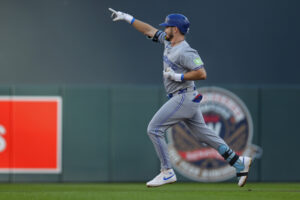
The lack of defensive flexibility made Horwitz a tough fit on a team with Vladimir Guerrero Jr. He’s similarly squeezed in Cleveland. Josh Naylor would be the first baseman if he’s not traded. Kyle Manzardo could take over even if the Guardians move Naylor. Horwitz still has a minor league option, so he could go back to Triple-A, but he has nothing left to prove there offensively. It’d be a surprise if a Cleveland team that emphasizes infield defense is willing to use him as their regular second baseman. Ben Nicholson-Smith of Sportsnet tweets that Horwitz might end up being flipped to a third team.
In any case, the Guardians will need to find a new second baseman. Juan Brito is on the 40-man roster and hit .256/.365/.443 during his age-22 season in Triple-A. He’s a potential regular, though there’d be risk for Cleveland in relying on a player who has yet to make his MLB debut. The Guards could pursue a stopgap via free agency or trade if they want to add some stability coming off a division title. Over the longer term, the move opens second base for this year’s first overall pick Travis Bazzana. The Oregon State product profiles as a quick-moving second baseman who could get to the majors by the end of next season if all goes well.
Mitchell, a 21-year-old outfielder, rounds out the return. Toronto just drafted the Indiana product in the fourth round. A left-handed batter, Mitchell hit .289/.350/.467 in 22 games as a college draftee in Low-A. Baseball America wrote in its draft report that Mitchell had good contact skills and above-average speed that gave him a shot to stick in center field. He probably projects as a fourth or fifth outfielder.
Jeff Passan of ESPN first reported the Jays and Guardians were finalizing a Giménez deal. Kiley McDaniel of ESPN was first with Horwitz’s inclusion. Ken Rosenthal of the Athletic had Sandlin going to the Jays, while Ben Nicholson-Smith of Sportsnet was first to report the full trade and the absence of cash considerations.
Images courtesy of USA Today Sports.
Tigers Designate Akil Baddoo For Assignment
The Tigers formally announced their previously reported signing of right-hander Alex Cobb this evening. In a corresponding move, outfielder Akil Baddoo was designated for assignment as noted by MLive’s Evan Woodbery.
Baddoo, 26, was a second-round pick by the Twins back in 2016. The outfielder’s major league career wouldn’t begin until 2021, after he was selected by the Tigers in the 2020 Rule 5 Draft. That first taste of big league action went remarkably well for the youngster, as he slashed an impressive .259/.330/.436 with a 108 wRC+ in 124 games for Detroit while splitting time between left field and center. Baddoo’s 26.5% strikeout rate was somewhat elevated, but he made up for it by walking at a healthy 9.8% clip and clubbing 13 homers, seven triples, and 20 doubles while swiping 18 bases during his rookie season.
That combination of power and speed was tantalizing enough that the Tigers stuck with Baddoo on a part-time basis despite lackluster numbers at the plate. Between the 2022 and ’23 season, he hit just .212/.302/.331 (80 wRC+) in 582 combined trips to the plate. While he went a decent 23-for-32 on the bases in those years, his power evaporated as he posted a combined isolated slugging percentage of just .119, down from the solid .177 figure of his rookie campaign. That downturn in performance in conjunction with the emergence of exciting outfield options like Riley Greene and Kerry Carpenter from the Detroit farm system left Baddoo with fewer and fewer big league opportunities as his time in the organization continued.
That dwindling playing time in Detroit came to a head in 2024, as after a winter that saw the Tigers add Mark Canha to the lineup and a phenomenal Spring Training performance from Wenceel Perez, Baddoo found himself as the odd man out on Opening Day. Baddoo was optioned to the minors and ended up spending the overwhelming majority of his 2024 campaign at Triple-A. He made just 82 trips to the plate in the big leagues this past year and struggled badly in that limited time with a .137/.220/.301 slash line and a 32.9% strikeout rate. The Tigers kept him on the roster through last month’s non-tender deadline despite Baddoo being projected by MLBTR contributor Matt Swartz for a $1.6MM salary in his second trip through arbitration, but he’s now lost his 40-man roster spot with the club nonetheless.
Looking ahead, any club in the league will now have the opportunity to claim Baddoo off waivers if the Tigers don’t work out a trade for him within the next few days. The 26-year-old’s combination of youth and past big league success could make him an intriguing option for outfield-needy clubs, although his recent struggles and arbitration-level price tag could turn some potential suitors away.
Giants Sign Willy Adames
The Giants officially have their new shortstop. San Francisco finalized their seven-year, $182MM contract with Willy Adames this afternoon. The CAA client will be introduced at Oracle Park on Thursday. The deal, which is the largest in Giants history, reportedly contains a $22MM signing bonus and a full no-trade clause. There is no deferred money on the contract. Adames will make $10MM in the first two seasons of the deal and $28MM in the final five.
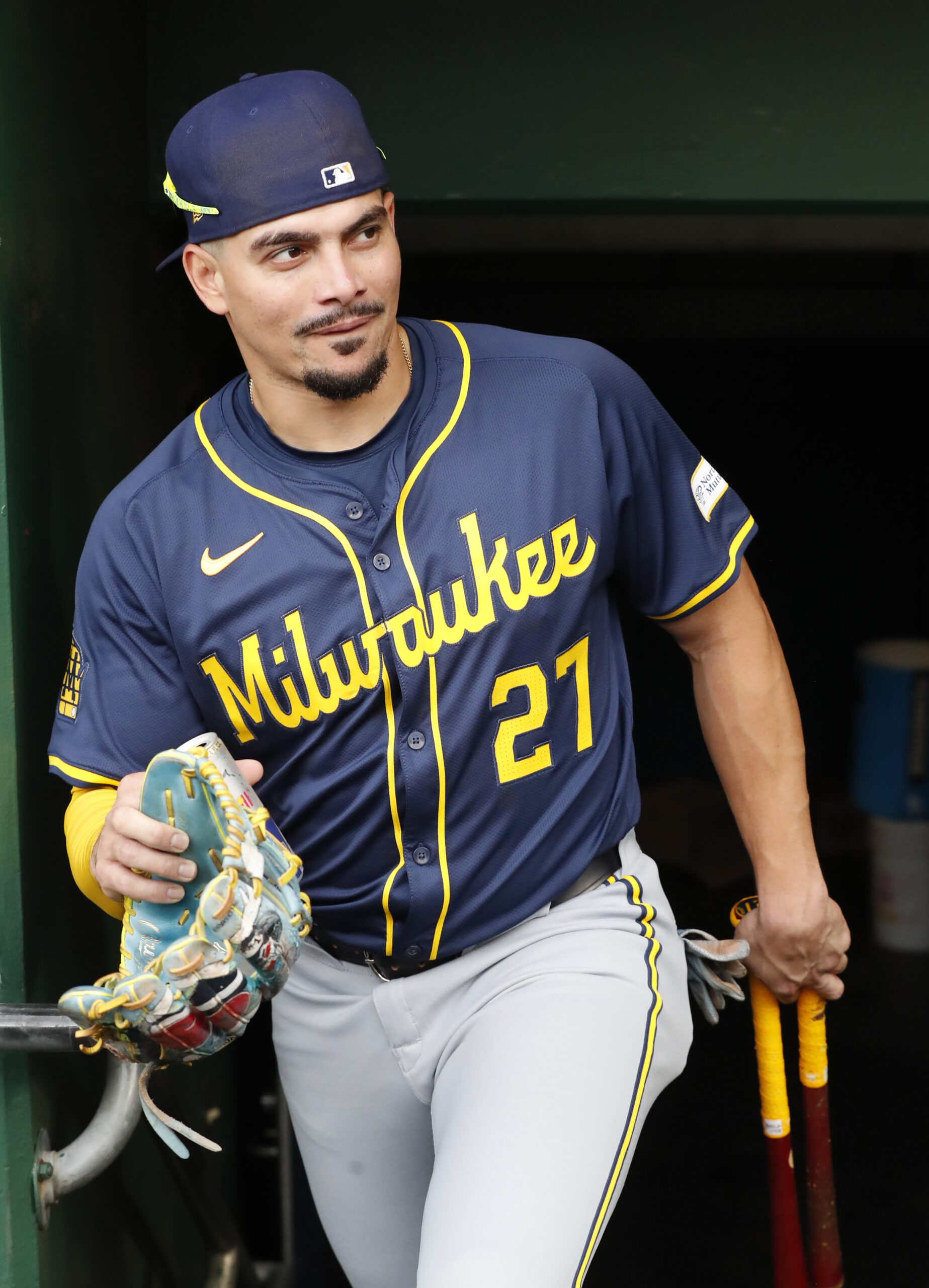
Adames, 29, was the top shortstop available on the market this winter and goes to a team that has been candid about its desire to upgrade at the position this winter. They’ve now done so by bringing in one of the league’s steadiest players on both sides of the ball to handle the position.
Adames has been worth at least 3.1 fWAR and 3.0 bWAR in each of his five full, 162-game seasons in the majors thanks to that consistency. A career 109 wRC+ hitter who slashed a strong .251/.331/.462 (119 wRC+) with Milwaukee in 2024, the addition of Adames as a middle-of-the-order bat should help improve a Giants offense that managed just a 98 wRC+ last year.
While San Francisco’s 112 wRC+ at shortstop last year a strong figure, much of that production was thanks to multi-positional bat Tyler Fitzgerald, who took over the position down the stretch but was a lackluster defender with a -4 in Outs Above Average last year. Adames was only worth a +1 figure by OAA last year but posted excellent +16 and +10 figures in the metric in 2022 and ’23 and should be a major upgrade to the club’s defense who forms a dynamic tandem with third baseman Matt Chapman on the left side of the infield. That combination of above-average offense and defense at a premium position on the diamond was enough to make Adames the #5 ranked free agent on MLBTR’s annual Top 50 MLB Free Agents list last month, where we predicted a six-year $160MM deal for the shortstop.
Adames managed to top that prediction by one year and $22MM, which isn’t necessarily a major shock given the thin infield market and Adames’s wide range of suitors. The Yankees, Phillies, Astros, Braves, Blue Jays, and Red Sox were all linked to Adames in recent weeks, and a handful of those suitors were seemingly drawn in by his willingness to move off of shortstop in order to facilitate a deal. That made him a particularly attractive option for clubs like the Yankees and Astros, for whom a potential position change made Adames an interesting “Plan B” option should they fail to re-sign incumbent sluggers Juan Soto and Alex Bregman given their apparent comfort with incumbent shortstop Anthony Volpe and Jeremy Pena.
Ultimately, however, Adames has landed with a club that figures to play him at shortstop on a daily basis. Fitzgerald, who slashed .280/.334/.497 (132 wRC+) in 96 games with the club last year, seems likely to be in line for the lion’s share of playing time at second base now that he’s been bumped off of shortstop but also has experience at first base and in the outfield that could theoretically lead to a multi-positional role if needed. With former top prospect Marco Luciano as well as youngsters like Heliot Ramos, Luis Matos, and Grant McCray likely to impact the club’s outfield mix next year alongside incumbents Jung Hoo Lee and Mike Yastrzemski, it’s not impossible to imagine the addition of Adames leaving the club more or less set on the positional side.
Even if San Francisco doesn’t make further additions to their hitting corps, questions remain about their plans for the remainder of the offseason. Reporting has previously indicated that the club plans to enter 2025 with a lower payroll than 2024, and RosterResource indicates that signing Adames has left the club with a projected payroll of $180MM for 2025. That’s $26MM below their final estimate for the 2024 season, which would be consistent with a reduction in payroll if the club didn’t make additional moves. The Giants have also featured prominently in the rumor mill for starting pitching this winter, however, and were connected to top free agent starter Corbin Burnes just last week.
Signing Burnes in addition to Adames would surely push their payroll to or even beyond 2024 levels, which would suggest either a reversal regarding their payroll plans or an intention to cut salary elsewhere, perhaps by trading a player such as Yastrzemski or first baseman LaMonte Wade Jr. It’s also worth noting that the Giants are forfeiting their second- and fifth-highest draft picks (as well as $1MM in international bonus pool money) in order to sign Adames. That could make the club hesitant to sign an additional qualified free agent like Burnes in order to preserve their remaining draft capital, or it’s possible that San Francisco could be emboldened to make another qualified signing because the draft penalty becomes relatively less-severe on additional signings. For example, signing Burnes would now cost the Giants only their second- and fifth-highest picks in next year’s draft after accounting for the picks forfeited to sign Adames, meaning they would actually be giving up what were actually their third- and seventh-highest selections in the draft at the start of the offseason.
Jeff Passan of ESPN first reported the Giants and Adames had agreed to a seven-year, $182MM deal that included a $22MM signing bonus. Susan Slusser of the Francisco Chronicle initially reported the sides were making progress. Robert Murray of FanSided reported the no-trade clause and the absence of deferrals. Slusser also first reported the specific annual breakdown.
Nationals Win Draft Lottery
Major League Baseball conducted its third annual draft lottery this afternoon at the Winter Meetings. The Nationals won the lottery and will pick first overall. They’ll be followed by the Angels and Mariners. Washington had just above a 10% chance of securing the top pick, the fourth-highest odds.
Here’s the first round order:
- Nationals
- Angels
- Mariners
- Rockies
- Cardinals
- Pirates
- Marlins
- Blue Jays
- Reds
- White Sox
- Athletics
- Rangers
- Giants
- Rays
- Red Sox
- Twins
- Cubs
- Diamondbacks
- Astros
- Braves
- Orioles
- Brewers
- Royals
- Tigers
- Padres
- Phillies
- Mets
- Guardians
- Yankees
- Dodgers
As part of the Players Association’s efforts to reduce the incentive for non-competitive teams to lose games, the latest collective bargaining agreement introduced a lottery to determine the top six overall selections. A team’s odds of landing a higher pick are still weighted in favor of the clubs with the worst records, although the Rockies and Marlins had identical chances (22.5% apiece) of landing the top selection.
All non-playoff teams ostensibly have a chance to win the lottery. However, the CBA also prevents a team that is not a revenue sharing recipient from landing within the top six in consecutive seasons. No team can get a lottery pick more than two years in a row. That ruled out the White Sox and Athletics this year. Chicago is not a revenue sharing recipient and picked fifth last year, while the A’s were in the top six in both 2023 and ’24.
The Sox were not allowed to pick higher than 10th, while the A’s were capped at 11th. That’s despite the White Sox having the worst season of all time that would’ve placed them among the three likeliest teams to pick first. That increased the odds for every team but was especially beneficial to Colorado and Miami (from a probability perspective) by pushing their chances of the #1 pick north of 20%. Unfortunately for those teams, the balls didn’t bounce their way. The Angels and Nationals were the other teams with at least a 10% shot.
Seattle and St. Louis come away as big winners. The Mariners went 85-77 and had the second-best record of any non-playoff team. St. Louis had the fourth-best mark for clubs that didn’t get to the postseason. They nevertheless were fortunate to spring into the top five. It’s a particularly disappointing outcome for Miami, who didn’t land a lottery pick at all despite sharing the best shot at the first selection. The only silver lining is that they’ll remain eligible for lottery picks for at least 2026 and ’27 if they don’t make the playoffs.
Teams that exceeded the third tier of luxury penalization have their top picks dropped by 10 spots unless that selection lands within the top six. (In that instance, the club’s second-highest pick would move back.) MLB has yet to officially announce the 2024 tax data, but it is believed that the Mets, Dodgers and Yankees are the only clubs that surpassed the $277MM threshold for the pick to be dropped. All those teams made the playoffs and weren’t eligible for the lottery anyhow.
The lottery only comes into play for the first round of the draft. From the second round onwards, pick order is determined in inverse order of the prior season’s standings, aside from compensatory and competitive balance selections.
Baseball America published its most recent Top 100 draft prospects in September. As always, that’s worth a full read. Texas A&M outfielder Jace LaViolette topped BA’s list, though there’ll obviously be plenty of changes to the board as next spring’s amateur baseball season gets underway.
Padres Notes: Offseason Needs, Loáisiga, Payroll, Cease
After a successful 2024 campaign that saw the Padres return to the postseason despite cutting payroll and trading Juan Soto, president of baseball operations A.J. Preller is doubtlessly looking to improve his team over the winter. To that end, he told MLB.com’s AJ Cassavell that he’s looking to address holes in the corner outfield, the starting rotation, and behind the dish. None of that is especially surprising considering some of the players the Padres lost to free agency this winter, namely left fielder Jurickson Profar, starter Martín Pérez, and catcher Kyle Higashioka. Moreover, starter Joe Musgrove will miss the 2025 season after undergoing Tommy John surgery, leaving the rotation without much depth.
With that said, the Padres have not yet been linked to many free agents to fill those holes. They’re interested in starter Roki Sasaki (per ESPN), but at this point, so is just about everyone else. When it comes to catchers, they’re starting to run out of options, with Higashioka, Travis d’Arnaud, Danny Jansen, and Gary Sánchez off the market and Carson Kelly nearing a deal with the Cubs. As for corner outfielders, the Padres haven’t been strongly connected to anyone yet; Preller told Cassavell he hasn’t closed the door on a reunion with Profar, but that’s pretty much it.
Similarly, the Padres have expressed some interest in bringing back Ha-Seong Kim, although the infield seems to be less of a priority. After all, the team already has an internal option to replace Kim at the keystone: Jake Cronenworth can play more often at second base and Luis Arraez can play more often at first.
Bolstering the bullpen isn’t at the top of Preller’s to-do list either, but ESPN’s Jorge Castillo recently included the Padres on a list of suitors for right-hander Jonathan Loáisiga. While the Padres lost Tanner Scott to free agency, they still have a pair of imposing back-end relievers in Robert Suarez and Jason Adam. Jeremiah Estrada and Adrian Morejon also enjoyed strong breakout seasons in 2024, while Yuki Matsui was solid in his first taste of MLB action. Even so, there’s no such thing as too much bullpen talent, and Loáisiga is the kind of high-upside arm it can’t hurt to check in on. Due to numerous arm injuries over the past three years (most recently a torn UCL), he’s unlikely to sign for multiple years or much money. However, he was dominant the last time he was healthy in 2021, tossing 70 2/3 innings with a 2.17 ERA. He flashed a 98 mph sinker and nasty sweeping curveball in a handful of outings earlier this year, and it’s possible he’ll be back from his internal brace procedure in time for Opening Day.
So, why might the Padres be particularly interested in a buy-low free agent like Loáisiga? Perhaps it’s the same reason they haven’t linked to many other free agents, even at areas of greater need. Kevin Acee of The San Diego Union-Tribune writes that San Diego’s payroll will likely fall somewhere in between last year’s final tally of $169MM and the current RosterResource estimate of $210MM for 2025. In other words, Preller might need to get some cash off the books before can start spending.
One idea to help the Padres reduce payroll that’s recently been picking up steam is trading Dylan Cease. According to Acee, they have indeed discussed the idea with other teams at the Winter Meetings. It’s not clear how serious those discussions are; some of Acee’s sources suggest the Padres are actively shopping the right-hander, while others suggest they’re merely open to offers.
Needless to say, Cease isn’t a player most contending teams would consider trading. According to FanGraphs, he was worth 4.8 WAR in 2024 and 17.2 WAR over the past four seasons. That’s not the kind of production that’s easy to replace at any price, let alone his $13.7MM projected salary. That said, this wouldn’t be the first time Preller has traded a star player while remaining competitive. Perhaps he’s confident the Padres will land Sasaki. Alternatively, he could be planning to trade for Garrett Crochet; the Padres have been linked to the White Sox ace. Those might be the only two options for San Diego to replace a top-of-the-rotation pitcher like Cease at a lower salary.
Indeed, without Sasaki or Crochet, it’s hard to imagine how trading Cease wouldn’t set the Padres back. After all, Preller himself said that adding a starting pitcher was a priority this offseason. Beyond Cease, Michael King, and Yu Darvish, the Padres rotation is all question marks. Randy Vásquez struggled in his first season with San Diego, while Matt Waldron quickly slowed down after a hot start in 2024. Dealing Cease could help the Padres fill other holes on the roster, but without a frontline starter to take his place, such a move might just be one step forward and two steps back.