
Checking In On 2024’s Reliever-To-Rotation Experiments: July Edition
About a quarter of the way through the 2024 season, I took a look at how the most prominent examples of teams’ attempts to turn an established reliever into a starter had progressed. At the time, the majority of these experiments were going well, by and large. At that mid-May juncture, most of the relievers making the switch had yet to reach their innings workloads from the season prior. Now that we’re at the season’s halfway point, that’s no longer the case. Many of the pitchers striving to make this jump are now approaching or have already eclipsed their 2023 innings totals — if not their career-high workloads — so it seems a good time to check back on how they’re faring.
As a reminder, the focus here is pitchers who pitched exclusively or near-exclusively out of the bullpen last season. Someone like the Rays’ Zack Littell or Red Sox’ Kutter Crawford, who moved into the rotation last summer and continued that move this year, isn’t the focus.
Garrett Crochet, LHP, White Sox
Stats at quarter mark: 9 games started, 46 2/3 innings, 4.63 ERA (2.47 SIERA), 34.2 K%, 4.8 BB%, 43.8 GB%
Stats since: 9 GS, 54 2/3 innings, 1.65 ERA (2.27 SIERA), 36.3 K%, 5.2 BB%, 45.5 GB%
At the 25% mark of the season, Crochet sat on a pedestrian ERA but elite K-BB profile. His production had been skewed by a series of three straight rough outings: five runs versus the Reds, seven in Philadelphia and another five in Minnesota.

Those three starts still stand as the worst three of his season. Crochet hasn’t yielded more than three runs in a single outing since that time. He’s not only maintained his elite K-BB profile but improved upon it, slightly upping his strikeout rate while sustaining his exceptional command. No starter in baseball is striking out hitters at a higher rate than Crochet, and only 12 are limiting their walks more effectively.
At last check, Crochet had ace-like rate stats but pedestrian run-prevention numbers overall. That’s no longer the case. The only question as to whether Crochet is a bona fide No. 1 starter is one of durability. All of the pieces are there, but Crochet has never pitched a full season in the rotation. In fact, this year’s combined 101 1/3 innings not only stand as a career-high, they eclipse his combined total of professional innings pitched — majors and minors combined — since being selected in the first round of the 2020 draft.
With two and a half years of team control left, a bottom-of-the-barrel $800K salary and the worst team in baseball behind him, Crochet stands as a clear-cut trade candidate. The Sox reportedly broached the possibility of an extension with him but are now expecting to trade him after contract talks failed to progress. A new team will have to worry about how Crochet will hold up down the stretch, but there’s little doubting that he’s a front-of-the-rotation talent.
Jordan Hicks, RHP, Giants
Stats at quarter mark: 9 GS, 48 innings, 2.44 ERA (3.99 SIERA), 19.9 K%, 8.2 BB%, 56.2 GB%
Stats since: 8 GS, 37 2/3 innings, 4.54 ERA (4.29 SIERA), 22.2 K%, 10.2 BB%, 45.8 GB%
Early on, Hicks was thriving in terms of run-prevention in spite of a pedestrian strikeout rate. He’s picked up the strikeout rate a bit since that time but has seen his command, ground-ball rate and velocity all drop. After averaging 5 1/3 innings through his first nine starts, Hicks is averaging about 4 2/3 innings per outing and has seen his average sinker velocity drop by nearly two miles per hour. Since mid-May, his sinker is averaging 93.5 mph — down from the 95.5 mph at last check and even further from the 100.2 mph Hicks averaged in his time as a reliever.
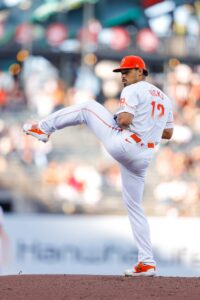
Hicks has struggled to turn the lineup over multiple times. Opponents own an awful .196/.268/.348 slash when facing him the first time in a game. Unlike many pitchers, who experience a stark drop when facing opponents a third time, Hicks’ troubles begin the second trip through the order. Opponents in those settings carry a .267/.373/.382 slash. He’s only faced a hitter for the third time on a given day 57 times this season, but opponents have batted .283/.333/.434 in that small sample.
Back in May, I noted that opponents had posted an embarrassing .079/.167/.105 slash in the 42 plate appearances Hicks had finished off with a splitter. They’ve fared better against the pitch since that time, though it’d be hard to have performed much worse. And, with opponents still slashing only .160/.244/.272 against the pitch (which Statcast credits with a .270 expected wOBA), that newly implemented offering still has the look of a plus pitch.
Hicks has remained reasonably effective but hasn’t been the roaring success he was through the first quarter of the season. San Francisco signed the 27-year-old flamethrower to a four-year, $44MM deal and did so with an eye toward Hicks starting, so it’s clear this is a multi-year undertaking. Nothing Hicks has done to date suggests he decidedly can’t handle being a starter, but he’s faded from his early-season production, which is perhaps to be expected for a pitcher whose 85 2/3 innings are already a career-high mark.
The manner in which Hicks has begun to fade only further underscores the remarkable nature of Crochet’s performance to date as he navigates uncharted workload territory. That said, Hicks has an overall 3.36 ERA with a nearly average strikeout rate, a manageable walk rate and a plus ground-ball rate. There have been some roadblocks of late, but this year could serve as a launching pad to a better performance in 2025-27, when he’s more accustomed to his current workload.
Reynaldo Lopez, RHP, Braves
Stats at quarter mark: 7 GS, 40 1/3 innings, 1.34 ERA (4.00 SIERA), 25.2 K%, 10.1 BB%, 40.2 GB%
Stats since: 7 GS, 39 innings, 2.08 ERA (3.58 SIERA), 26.1 K%, 7.0 BB%, 32.7 GB%

The Braves have been judicious with Lopez’s start-by-start workload thus far. He hasn’t topped 94 pitches in a single appearance and has only recorded four outs after the sixth inning all season. So far, that level of caution has paid off. Since last check, Lopez hasn’t lost any life of his heater and has actually tacked on 0.4 mph on average, per Statcast.
Atlanta doesn’t often give Lopez the opportunity to turn the lineup over a third time, and the opportunities he’s had haven’t gone well. Lopez has yielded a mid-.500s OPS to opponents the first or second time through the order but has been tagged for a .245/.359/.396 batting line the third time through. It’s not egregious, but it’s far less dominant than his first couple trips through a lineup.
Lopez is still running a plus strikeout rate, and he’s improved his command and his velocity as the season has worn on. As the only member of this list who’s previously worked multiple full seasons as a starter, he might have been the best-equipped to handle this transition, and so far it doesn’t appear he’s slowing down much at all.
Lopez entered the season with a career 71.1% strand rate, and he’s currently stranding 86.3% of his baserunners. His .279 average on balls in play is lower than league average but right in line with his career .281 mark. He’s allowed only 0.45 homers per nine frames, thanks in large part to a paltry 4.7% homer-to-flyball ratio that sits well shy of his career 11.3% mark. There’s some correlation there; it’s easier to strand runners if you’re almost never allowing a ball to clear the outfield fence, after all. In all likelihood, both that HR/FB and strand rate will trend toward his career marks as the season (and, more broadly, his three-year contract) wears on, but the outside-the-box bet on Lopez as a starter looks like one that will pay off for Atlanta.
Jose Soriano, RHP, Angels
Stats at quarter mark: 7 GS, 38 2/3 innings, 3.72 ERA (4.03 SIERA), 20.3 K%, 9.5 BB%, 61.5 GB%
Stats since: 5 GS, 33 2/3 innings, 3.21 ERA (3.97 SIERA), 16.9 K%, 6.2 BB%, 58.6 GB%
Soriano was continuing his sharp start to the season when he was scratched from a mid-June start due to abdominal pain. The Halos discovered an infection in the young righty’s abdomen that required a trip to the injured list and was expected to sideline him a few weeks. That’s thrown a bit of a wrench into his rotation breakout, though there’s no indication it’s a serious issue and the Halos can take solace in the fact that there’s no arm issue at play. And, after pitching just 65 1/3 innings last season, Soriano is already at 72 1/3 frames this year, so perhaps it can serve as a well-timed breather for his right arm.
The 25-year-old Soriano’s first run as a starter in the big leagues this season looked promising through mid-May and continues to do so. Impressively, he hasn’t lost any life on his four-seamer or sinker despite the shift from short relief to starting work. Statcast measured his average four-seamer at 98.9 mph in both 2023 and 2024, while his sinker clocked in at an average of 97.7 mph in 2023 and is actually marginally better in 2024 at 97.8 mph.
That sinker has helped Soriano run up an elite ground-ball rate; his 60.1% grounder rate ranks third among the 145 big league pitchers with at least 50 innings pitched this year, trailing only Framber Valdez (61.4%) and Cristopher Sanchez (60.3%). That uptick in grounder rate over last year’s 51% mark correlates with a huge spike in Soriano’s sinker usage (13.3% in ’23, 40% in ’24). The extra sinker usage has come at the expense of some four-seamers (25.8% in ’23, 17.8% in ’24) and particularly Soriano’s knuckle curve (41.2% in ’23, 27.5% in ’24).
The tweak in repertoire could come down to a pursuit of efficiency as Soriano looks to work deeper into games. The right-hander fanned 30.3% of opponents last season and registered a hearty 14.8% swinging-strike rate but also required 16.6 pitches per inning pitched, on average. In 2024, his strikeout rate is down to 20.3% with a 10.2% swinging-strike rate. But he’s significantly upped his grounder rate and is now averaging just 15.1 pitches per frame. Soriano averaged 6 2/3 innings per start in the five appearances between our last check and this one, so it seems clear he’s placing an emphasis on being able to work deeper into games in his new role. Opponents are hitting .313/.421/.521 in 58 plate appearances when facing him a third time, so the results aren’t there so far, however.
Bryse Wilson, RHP, Brewers
Stats at quarter mark: 11 G (5 GS), 34 innings, 2.65 ERA (4.60 SIERA), 20.4 K%, 10.9 BB%, 39.1 GB%
Stats since: 9 G (4 GS), 44 innings, 5.52 ERA (4.27 SIERA), 17.6 K%, 6.7 BB%, 41.3 GB%
Wilson hasn’t technically “started” each of his past nine appearances, but he’s averaged five innings per outing while working as a starter and bulk reliever (on the heels of an opener). Effectively, the Brewers are using him as a starter — they’re just shielding him from the top-third of some lineups on occasion, when the matchup dictates.
This wasn’t a planned move to a longer role. The former Braves top prospect and Pirates hurler entered the season slated for a second straight season as Milwaukee’s long man, but injuries to Wade Miley, Joe Ross, Robert Gasser and DL Hall combined to not only push Wilson into this rotation-ish role but to keep him there. After pitching 76 2/3 innings of pure long relief in 2023, Wilson is already at 78 frames and counting.
As one would typically expect, Wilson’s fastball has taken a slight dip as he’s stretched out for longer stints. He averaged 94 mph through the season’s first quarter, but several of those earlier appearances were still in short relief. He’s averaging 93.2 mph since mid-May and has seen his strikeout rate drop but also seen his walk rate improve. As he’s been tasked with facing more lefties, Wilson has upped his changeup and cutter usage a bit, doing so at the expense of his four-seamer and curveball.
Wilson has been far too homer-prone this season (1.62 HR/9) and is giving up too much hard contact (45.8%, per Statcast). More so than any pitcher on this list, he’s run into troubles the third time through the order; in 45 such plate appearances, they’ve posted a Herculean .400/.467/.650 slash. Those plate appearances account for just 13.6% of Wilson’s batters faced this season but have resulted in 21.5% of his home runs allowed. Wilson seems best suited for a long relief role or a five-inning start/bulk role, but he’s pitched more than five innings six times this season and is giving Milwaukee some desperately needed innings when their rotation is in tatters.
A.J. Puk, LHP, Marlins
Stats at quarter mark: 4 GS, 13 2/3 innings, 9.22 ERA (7.13 SIERA), 15.6 K%, 22.1 BB%, 31.9 GB%
Stats since: 0 GS, 21 1/3 innings, 2.95 ERA (3.36 SIERA), 21.4 K%, 4.8 BB%, 44.3 GB%
The Marlins quickly pulled the plug on the Puk rotation experiment, and it’s worked out for all parties. The former No. 6 overall pick (A’s, 2016) turned heads as a starter in spring training but was shelled in what currently stand as the only four starts of his big league career (though Puk was a starter both for the University of Florida and in the minor leagues).
It’s unlikely that Puk would’ve continued to struggle quite so substantially had Miami continued using him as a starter, but the left-hander certainly looks more comfortable in the short relief role in which he thrived from 2022-23 (123 innings, 3.51 ERA, 19 saves, 22 holds, 29.4 K%, 6.9 BB%). He’s performing far better in his old role, and he required a three-week stint on the injured list for shoulder fatigue following his early start in the rotation.
There’s no reason to fault the Marlins for trying to stretch out a clearly talented reliever who has a track record in the rotation, but Puk is back in the bullpen and figures to draw attention over the next month from teams seeking left-handed bullpen help. He’s controllable through the 2026 season.
Tyler Alexander, LHP, Rays
Stats at quarter mark: 7 G (5 GS), 39 2/3 innings, 5.45 ERA (4.44 SIERA), 19.1 K%, 6.9 BB%, 30.4 GB%
Stats since: 3 G (1 GS), 17 innings, 7.94 ERA (3.68 SIERA), 20.3 K%, 1.4 BB%, 27.8 GB%
Alexander entered the season in the same type of role Wilson currently holds with the Brewers: occasional starter and frequent bulk reliever behind an opener. He made a handful of solid appearances early on, though the value of those was offset by some particularly rough outings versus the Yankees (six runs in seven innings) and the Royals (eight runs in five innings).
Following our last check-in, Alexander made three appearances before being optioned to Triple-A Durham, where he’s worked quite effectively out of the Bulls’ rotation: five starts, 29 2/3 innings, 3.64 ERA, 24.2% strikeout rate, 2.4% walk rate. That should position him as a depth option in the event of a big league injury and/or trade. Tampa Bay reportedly has considered fielding offers on current members of its big league rotation — Zack Littell and Aaron Civale, most notably. Part of that is due to the looming returns of Shane Baz and Jeffrey Springs, but Alexander gives them another rotation candidate who’s performed well recently in Durham.
The Rays haven’t abandoned the Alexander starting experiment, but for the time being he’s not in their big league rotation plans. Speculatively, that could make Alexander himself a trade option for teams seeking back-of-the-rotation depth, though if the Rays do ultimately move Littell, Civale or a more expensive arm like Zach Eflin, they may not want to deplete the rotation depth much further.
Dodgers Rumors: Stone, Crochet, Shortstop, Outfield
Several teams tried to pry right-hander Gavin Stone from the Dodgers in offseason trade talks, writes Bob Nightengale of USA Today, but Los Angeles held firm on the former top prospect and is now reaping the benefits. After yielding 31 runs in his first 31 big league innings last season, Stone has emerged as a vital member of manager Dave Roberts’ rotation.
Stone, 25, ranks second on the Dodgers with 89 innings pitched and is tied for second with 15 games started. He’s posted a terrific 2.73 earned run average through the season’s halfway point. While his 19.5% strikeout rate is below average and his .268 average on balls in play and 6.3% homer-to-flyball ratio suggest there’s likely some ERA regression in store, he has the look of a legitimate big league starter. The 2020 fifth-round pick has been a constant in the L.A. rotation while the team has navigated injuries for Yoshinobu Yamamoto, Walker Buehler and others.
The Dodgers have a whopping six starters on the injured list, to say nothing of oft-injured arms like James Paxton and Tyler Glasnow healthy and in the rotation. Glasnow, in particular, is already 17 innings from his career-high at the MLB level (120 innings). He’s never topped 155 innings in any professional season before.
Unsurprisingly, given the wide slate of current injuries and the health histories of their current arms, the Dodgers have been exploring the market for pitching. Nightengale reported within that same column that the Dodgers have already made an offer to the White Sox for lefty Garrett Crochet, which has been rejected, and the latest report from Ken Rosenthal, Patrick Mooney and Will Sammon of The Athletic also touches on Los Angeles’ interest in Crochet.
Crochet isn’t an ideal fit for a team seeking consistent, bankable innings — as the Dodgers currently are. This year’s 101 1/3 innings is more than Crochet, a 2020 draftee, had thrown in his entire professional career combined prior to the ’24 campaign. There are questions about how the left-hander will hold up down the stretch, and The Athletic trio suggests he’s not a lock to spend the remainder of the season pitching in a regular rotation role if he is indeed moved — as the White Sox are reportedly planning on after extension talks with Crochet quickly stalled out. The Dodgers, however, view Crochet as a legitimate October weapon regardless of the role in which he’s used and could simply figure out the specifics of his usage down the line, depending on how the second half of the season plays out.
Rotation innings are just one of multiple questions the Dodgers will face over the next four-plus weeks as the deadline looms. They’re also staring down an absence of six to eight weeks for star leadoff man Mookie Betts, who in recent years has moved from right field to both middle-infield positions, playing virtually anywhere the team asks without seeing any real drop-off in his MVP-caliber offensive production. With Betts on the shelf, the Dodgers have plugged hot-hitting Miguel Rojas back into a regular role at shortstop, and the veteran’s play this season could make that a more permanent arrangement when when Betts is healthy.
“I would, I would,” manager Dave Roberts replied when asked by Mike DiGiovanna of the L.A. Times whether he’d consider keeping Rojas his everyday shortstop when Betts returns. “I don’t think anyone can debate the level of shortstop play from Miguel Rojas. Some of it is contingent on the timeline for Mookie’s return and where Miggy is physically and how things are going. But to your question, would I consider it? Absolutely.”
Rojas, 35, is hitting .297/.344/.446 (126 wRC+) — his best career production outside of the pandemic-shortened 2020 season. He’s playing his customary brand of high-end defense at shortstop, drawing lavish praise from both Roberts and Dodgers third base coach Dino Ebel, who calls Rojas one of the five best defensive shortstops in the sport. (Statcast lists Rojas tied for seventh among all shortstops with six Outs Above Average in just 215 innings this season; every other name among the top-8 this season has played more than 700 innings).
Keeping Rojas at shortstop and sliding Betts back over to second base in place of Gavin Lux could deepen the team’s lineup and improve the defense. The Athletic report notes that adding an everyday outfielder would allow the Dodgers to use Betts at second base and go with a platoon of Andy Pages and Jason Heyward in the outfield alongside the new acquisition and Teoscar Hernandez.
Of course, that’s just one of many viable scenarios, and it’s not framed within that report as a clear objective so much as one of various possibilities that could be explored. Alternatively, if the Dodgers were to add someone who can handle second base on a regular basis — and do so at a higher level than in-house choices like Lux, Chris Taylor and Enrique Hernandez — that could push Betts back to the outfield.
As is frequently the case with the Dodgers, their blend of versatile defenders and a hefty lead in the division combine to create various trade avenues to explore while also reducing urgency to complete a deal. Los Angeles holds a 7.5-game lead over second-place San Diego in the NL West. They’ll surely upgrade in multiple areas between now and July 30, but the size of their lead likely reduces pressure on president of baseball operations Andrew Friedman, GM Brandon Gomes and their staff to complete something in the short-term and gives them the luxury of taking a fluid approach to augmenting an already first-place roster.
Report: White Sox Explored Extension With Garrett Crochet, Aiming For Deadline Trade
As the White Sox look to sell at the trade deadline, the team is reportedly open to discussing pretty much everyone on the roster, ranging from short-term veterans to more controllable players like Garrett Crochet. However, the Sox also recently had some talks with Crochet and his reps at CAA Sports about a contract extension, according to USA Today’s Bob Nightengale. These negotiations were “brief” and the team has “no optimism towards reaching an agreement,” and thus Nightengale writes that the White Sox are now indeed planning to move Crochet at the deadline, even though he is still under arbitration control through the 2026 season.
Crochet is on the hill against the Rockies today for the 18th start of a breakout campaign. The southpaw has a 3.05 ERA over 94 1/3 innings, with a league-best 130 strikeouts and 12.4 K/9, plus a 34.9% strikeout rate that ranks in the 98th percentile of all pitchers. This ability to miss bats has been paired with limited free passes, as Crochet’s 5.4% walk rate is a key stat given how he had dealt with some control issues in his young career. Crochet’s cutter and his 96.9mph fastball are both among the deadliest pitches in the league, leaving batters fooled unless they can capitalize on his below-average slider.
This kind of production isn’t exactly a surprise, given that Crochet was the 11th overall pick of the 2020 draft and was seen as an advanced enough prospect that he made his debut that very season, tossing six innings over five appearances. Chicago further eased him into the majors in 2021 by using him as a reliever, and Crochet delivered a 2.82 ERA over 54 1/3 innings out of the Sox bullpen. However, the injury concerns that long surrounded Crochet struck in 2022, as a Tommy John surgery cost him the entirety of that season and limited him to 12 2/3 frames in 2023.
Though it is quite rare to see midseason extensions actually finalized, it is common practice for clubs to at least broach the idea of a longer-term deal with potential trade candidates. After all, if a player has enough value to draw trade attention from multiple rival teams, that same player can provide value to his own team, so there’s no harm in a club seeing if any common ground could be found on a multi-year contract.
This logic even extends to a team like the White Sox, who are a lot closer to a full-on fire sale than they are to contending in the near future. Crochet only just turned 25 this month, and has been so impressive in his first season as a starting pitcher that he looks like he could be a front-of-the-rotation staple. Even if the Sox might internally acknowledge that it’ll take a few years to fully right the ship, Crochet is still young enough that it is possible to see him as the ace of the next contending White Sox club….as long as he isn’t traded, of course.
Interestingly, Nightengale floats the idea that a long-term contract might also factor into Crochet’s trade situation, as Crochet and his representations might quickly seek out an extension with a new team. Since Crochet has already thrown more innings (94 1/3) in 2024 than in the rest of his pro career combined (85 1/3 innings in the majors and minors from 2020-23), Nightengale suggested that Crochet might seek out some extra financial security to mitigate the extra risk if a new team asks him to put a lot more innings on his arm over the course of the regular season and potentially into October.
In terms of how the White Sox themselves intend to manage Crochet, Nightengale writes that the club “and Crochet already have a firm plan in place to greatly limit his workload.” This description runs somewhat counter to the looser arrangement Sox manager Pedro Grifol described to The Associated Press and other reporters earlier this week. Grifol didn’t describe the situation as an actual innings limit, citing a hypothetical scenario where Crochet might sail through several innings in a start on a low pitch count.
“It’s not something we’re going to put out and say, ‘Here’s what we’re doing,’ because nothing in this game is black and white…He’s slowly detraining through the course of the year so he can finish the season,” Grifol said. “We’re not going to detrain him and build him back to the capacity where he was at the start of the season. This is going downhill now. We have to really monitor his workload.”
A team that acquired Crochet would surely have these same innings-management concerns in mind, which adds another wrinkle to his trade market. Could a team with some rotation depth problems but with a fairly stable top two or three pitchers use Crochet as a starter to ensure they reach the playoffs, and then use Crochet as an (overqualified) relief weapon in the postseason? Could a team multiple decent starters but not a clear-cut ace perhaps insert Crochet as part of a six-man rotation, in order to try and keep him fresh for the playoffs? Or, could a team that is only a borderline contender this season acquire Crochet and stick to Chicago’s plan, perhaps more with an eye towards a full-fledged run at contention in 2025?
There is no shortage of interest in Crochet, as Nightengale reports that 15 teams have checked in with the White Sox front office about the left-hander’s services. The Sox have already turned down one offer from the Dodgers, who stand out as a logical suitor for several reasons — their win-now mentality, their rotation needs amidst several injuries to starters, and a deep farm system that would theoretically meet Chicago’s sky-high asking price.
In terms of other White Sox trade chips, Luis Robert Jr. continues to generate interest, but Nightengale feels the Sox might not have as much motivation to move the outfielder by the deadline. Robert missed close to two months of the season with a hip flexor strain and has only a .206/.280/.486 slash line over his first 118 plate appearances, albeit with eight home runs. With this latest injury and Robert’s modest production in mind, the White Sox wouldn’t exactly be selling high if they dealt Robert by July 30, so the team could wait until the offseason to more fully gauge offers (after Robert has presumably finished off the 2024 season in healthy and productive fashion). Robert’s contract comes with a pair of club options that control his services through 2027, so the White Sox have some flexibility in waiting to see if an acceptable trade offer emerges.
The Sox are also “openly shopping” Andrew Benintendi, Nightengale writes, which comes as zero surprise. If Crochet and Robert are Chicago’s top trade chips, Benintendi represents the other end of the spectrum, as a pricey veteran who is struggling through his second consecutive rough seasons. Since Benintendi is owed $47.5MM over the 2025-27 seasons, the White Sox would either have to eat all or virtually all of that remaining salary to facilitate a trade, or swap Benintendi for another unfavorable contract. Neither scenario would provide much benefit to the Sox, so Benintendi could remain one for the more immovable players in the sport.
AL Central Notes: Crochet, Clevinger, Wacha, Lange
Unsurprisingly, the White Sox have set an “exorbitant” asking price on Garrett Crochet in early trade talks, USA Today’s Bob Nightengale writes. As we already saw this past winter with the Dylan Cease trade negotiations and the eventual deal that sent Cease to the Padres, the Sox are naturally out for the biggest return possible when moving any of their most valuable trade chips. Crochet definitely fits that description, as he has broken out as a starting pitcher this year and is under arbitration control through the 2026 season.
Chicago isn’t likely to drop its demands much (or even at all) until closer to the deadline, and Crochet’s arbitration control also gives the Sox some extra leverage since the team doesn’t need to move the southpaw any time soon. If anything, Crochet having a full and healthy season as a starter might only increase what the White Sox might be looking for in trade talks during the offseason, when the Sox could speak to a wider array of potential suitors.
More from around the AL Central…
- Sticking with the White Sox, Mike Clevinger told reporters (including MLB.com’s Scott Merkin) that he is set to begin rehab assignment with Triple-A Charlotte. The plan is for Clevinger to start on Tuesday and Sunday in Charlotte before then possibly being activated from the 15-day injured list if all goes well. Clevinger hasn’t pitched since May 23 due to a bout of elbow inflammation, and he has a 6.75 ERA over 16 innings and four starts this season. Clevinger’s season already got off to a late start since he didn’t sign his one-year, $3MM free agent deal with Chicago until the start of April, but if he able to return healthy, he’ll have over a month to audition for interested teams heading into the trade deadline.
- Michael Wacha is slated to make a rehab start with the Royals‘ Arizona Complex League team tomorrow, manager Matt Quatraro told MLB.com’s Anne Rogers and other reporters. This might be Wacha’s only rehab outing, as Quatraro indicated that the Royals are planning to have the veteran righty back in their rotation next weekend. Wacha signed a two-year, $32MM contract (with an opt-out after this season) with Kansas City this past winter, and delivered a 4.24 ERA over his first 68 innings as a Royal before a non-displaced fracture in his left foot resulted in an IL stint. June 1 was the retroactive start date of that IL visit, so returning by next weekend makes for a relatively quick return for Wacha, which is good news considering the tricky nature of such injuries.
- Alex Lange had to leave the mound during an outing with Triple-A Toledo on Friday, and the Tigers reliever was in visible discomfort with an apparent upper-body injury. Lange was set to undergo tests this weekend and the team hasn’t yet given any official word on his status. Detroit optioned Lange to Triple-A last month after he posted a 4.34 ERA and (more distressingly) an 18.9% walk rate over 18 2/3 innings this season. Lange has long battled control problems but his stay in Toledo seemed to be bearing dividends, as he had only a 2.9% walk rate and a 3.12 ERA over 8 2/3 Triple-A innings.
White Sox Open To Offers On Luis Robert, Garrett Crochet
The White Sox are baseball’s worst team by a long shot and seemed to acknowledge that likelihood even before the season began when they traded Dylan Cease to the Padres in spring training. San Diego is already reportedly interested in yet another Sox pitcher, lefty Garrett Crochet, and ESPN’s Jeff Passan reports that the Sox are open to offers not only on Crochet but on center fielder Luis Robert Jr. Passan categorizes the ChiSox as “open for business” and lists Robert, Crochet, Erick Fedde and virtually all of the team’s short-term veterans as players who could be moved between now and the trade deadline.
Fedde, Tommy Pham, Paul DeJong, Mike Clevinger, John Brebbia, Tim Hill and other players who aren’t signed long-term — Fedde is signed through next season, the others are all free agents this winter — all stood as obvious trade candidates to begin with. I wrote about Fedde’s trade candidacy for MLBTR Front Office subscribers a couple weeks back. DeJong recently said on 670 The Score in Chicago that he and Pham both fully expect to be traded. That anyone from that group is viewed as likely to change hands is only logical.
Names like Robert and Crochet being available is far less certain, even for a rebuilding club like the Sox, given the amount of club control each has remaining. In Robert’s case, he’s signed through the 2027 season in the form of a $12.5MM salary this season, a $15MM salary in 2025 and a pair of club options valued at $20MM apiece (both with a $2MM buyout). Crochet entered the 2024 campaign with three years of big league service, meaning he’s in his first arbitration season and has another pair of seasons of club control beyond 2024.
It bears emphasizing that the Sox being “open” to offers or “willing to trade” either player is far different from the team actively shopping said players. That open-minded approach is also far from a guarantee that either will be moved. The substantial control remaining beyond the current season means Chicago GM Chris Getz will set an enormous asking price on both players, and both will still retain tremendous trade value into the offseason and even into next year’s deadline if a deal doesn’t come together this summer.
Robert, still just 26 years old, returned from the injured list yesterday after an absence of nearly two months. He suffered a Grade 2 strain of his hip flexor early in the season and was sidelined for the bulk of April and the entirety of May. He wasted little time in reminding the type of impact he brings to a game, going 2-for-4 with a homer in his return effort. The Cuban-born five-tool standout has played in only eight games and taken just 33 plate appearances this season but carries a .250/.273/.594 batting line with three homers.
Last year saw Robert take his always tantalizing game to new heights. The dynamic center fielder stayed healthy for a career-high 145 games and posted a stout .264/.315/.542 batting line with a career-high 38 home runs, 36 doubles, a triple and 20 stolen bases (in 24 tries). Robert ranked in the 84th percentile of MLB players in terms of sprint speed, per Statcast, and was among the league leaders in barrel rate. He’s a premium outfield defender with plus range and an above-average arm — evidenced both by gaudy Statcast percentile rankings and by career marks of +13 Defensive Runs Saved and +24 Outs Above Average in 3116 innings of work.
Durability and an over-aggressive approach at the plate are the primary knocks on Robert, who is two months into his fifth MLB season and already has five career IL placements for injury (plus another shorter stay on the Covid-related injured list). Robert played in 56 of 60 games during his rookie showing in the Covid-shortened 2020 season, but he logged just 68 and 98 games in 2021 and 2022, respectively, and he could finish the 2024 season with fewer than 100 games played as well, thanks to one already lengthy absence. He’s now had significant strains of his left and right hip flexors, in addition to an MCL sprain and a wrist strain in his career.
In terms of Robert’s approach at the plate, the results are strong so it’s hard to be too critical. But Robert rarely walks (career 5.3%) and chases pitches off the plate more than nearly any player in the sport. Since his 2020 debut, only Salvador Perez, Harold Ramirez and Javier Baez swing at more balls out of the strike zone than Robert’s massive 46.3% (at least among qualified hitters). His 54.6% contact rate on such swings is well below average, and his career 83.2% contact rate on pitches in the strike zone is also a couple points south of par. It hasn’t led to an exorbitant strikeout rate just yet — Robert has fanned in 25.5% of his career plate appearances — but it’s a less-than-ideal trend that could worsen if Robert loses what Statcast currently measures as elite bat speed (seventh fastest in the majors, on average).
There’s little precedent for a player of this quality with this level of affordability and team control being traded. Robert is owed just under $8MM through season’s end as of this writing plus another $45MM over the next three seasons. Three-and-a-half years of an MVP-caliber talent at a maximum rate of $63MM is a raucous bargain by today’s contractual standards. Teams may be wary of Robert’s injury history and free-swinging ways, but he’s signed for the remainder of his 20s and would be a legitimately franchise-altering deadline acquisition if a team can put together an impressive enough trade offer. Robert might not quite command the type of haul the Padres sent to the Nats for Juan Soto a couple years back, but he’s closer to that level of value than the standard deadline trade candidates. Getz alluded to as much in the offseason, calling Robert “one of the best players in baseball” and noting that he was a “difficult player to trade.”
There are similarities, in terms of trade value, when it comes to Crochet. It’s rare to see a high-end pitcher with two and a half seasons of club control traded at the deadline. Crochet is extra appealing given that his injuries and former role in the bullpen have tamped down his first-year arbitration price. He’s being paid only $800K this season. He’ll be due a pair of notable raises in each of the next two offseasons but still isn’t likely to command even $15MM in salary over those two years.
The 24-year-old Crochet’s transition from reliever to starter hit a brief snag with a trio of rough outings in mid-April, but he’s on an absolute tear right now and looks the part of a frontline starter, as one might expect for a former first-round talent who has long been touted to have ace upside. In 13 starts, Crochet is sitting on a 3.49 earned run average with vastly better fielding-independent marks (2.87 FIP, 2.48 SIERA). That’s due largely to his elite strikeout and walk numbers; Crochet has punched out 33.7% of his opponents against just a 5.4% walk rate — all while keeping the ball on the ground at an above-average 45.9% clip and averaging a blazing 96.9 mph on his heater.
Since that set of consecutive rough outings in April, Crochet has been on another planet. Arguably baseball’s best pitcher in that time, he’s logged a 1.35 ERA with a 53-to-7 K/BB ratio over his past 40 innings. Crochet allowed five, seven and five earned runs in his run of three straight rocky April outings. He’s yielded two or fewer runs in each of his ten other starts this season.
Rival clubs might be wary of how well he’ll hold up over the course of a full season in the rotation. It’s a fair qualm, as Crochet pitched just 25 innings last season and didn’t pitch at all in 2022 while recovering from Tommy John surgery. This year’s 69 2/3 innings are already a new career-high for the lefty, who entered 2024 with only 85 1/3 professional innings total (majors and minors combined). That said, even if there are concerns about Crochet fading down the stretch, there’s considerable long-term upside, as one would imagine the effects of a full starter’s workload will be more normalized for him in 2025 and 2026. If he wears down later this year, he’s also quite familiar with pitching in short relief.
Any trepidation about how he’ll hold up this year hasn’t stopped the Padres from reaching out to the White Sox. They’ve reportedly inquired on the lefty and have strong interest in him, which makes sense given not only Crochet’s dominance and San Diego’s need for arms, but also his minimal salary and the Friars’ relative proximity to the luxury tax barrier. Adding one of the game’s most dominant pitchers while barely even advancing your luxury tax line ought to hold overwhelming appeal for the majority of the team’s highest-spending clubs. At the same time, Crochet’s minimal salary also makes him appealing to small-market clubs with payroll concerns. Short of the innings worries, he’s an ideal trade target.
Because of that, the asking price on Crochet figures to be extreme, just as it will be with Robert. If Getz and his team genuinely make both available and play some bidders against one another, the Sox could genuinely overhaul the entire farm system with this pair of trades — to say nothing of deals involving Fedde, Pham and the other previously mentioned veterans. It’s going to take an enormous package of prospects to pry either player from the Sox, but with widespread mediocrity permeating the National League and leaving few teams in position to truly wave the white flag on the 2024 season, it could be a seller’s market. There’s no salvaging this lost season for the South Siders, but getting one or both of these trades right could wildly accelerate their rebuilding efforts.
Padres Showing Strong Interest In Garrett Crochet
The Padres are showing strong interest in left-hander Garrett Crochet of the White Sox, per a report from Dennis Lin and Ken Rosenthal of The Athletic. The report cautions that no deal is imminent but it also states that the Friars have been the most aggressive club in pursuing Crochet.
Significant trades are fairly rare at this time of the year, with the trade deadline still almost two months away. However, there are reasons why it’s not so far-fetched with these two clubs. The two sides already lined up on a notable deal at an odd time not too long ago, when the Sox sent Dylan Cease to the Padres in the middle of March, just as the season was about to begin. Each club has also made a noteworthy trade since that time, with the Sox sending Robbie Grossman to the Rangers in early May and the Padres acquiring Luis Arráez from the Marlins around the same time.
For the Sox, they have been aggressively rebuilding for about a year now, selling off just about any player nearing free agency. For the Padres, it’s a part of their general modus operandi, as president of baseball operations A.J. Preller seems to have a strong will to explore all possible avenues for upgrading the club even if those overtures fall outside of standard operating procedure.
But there are also reasons why a deal may not get done. Crochet is in a very unique situation, which makes him less straightforward than other players the Sox have traded. He is still quite young, only 24 years old, turning 25 later this month. He is still under club control for two more years after this one and is only making $800K this year. That’s a reflection of both his quick ascent to the majors and his injury troubles, as he was in the big leagues by his age-21 season but has missed significant time and hasn’t been able to push his salary up.
The Sox put Crochet in the bullpen when they first called him up, an understandable move at the time given his youth and lack of experience. But he then required Tommy John surgery in April of 2022, which prevented him from pitching at all in 2022 and limited him to just 13 appearances last year.
His time spent on the injured list allowed him to reach arbitration in the most recent offseason, but the lengthy absence meant that he barely pushed his salary above the $740K league minimum. Despite a fairly limited innings tally, the Sox decided to stretch him out this year and the results have been excellent. Crochet has thrown 69 2/3 innings over his 13 starts this year, allowing 3.49 earned runs per nine innings. He has struck out 33.7% of batters faced, limited walks to a 5.4% clip and also gotten grounders on 45.2% of balls in play.
For the Sox, they suddenly seem to have an ace on their hands, one who is still young and cheap and doesn’t have a ton on mileage on his arm. But on the other hand, his early promotion and Tommy John layoff means that he’s getting close-ish to free agency. Given the state of the Sox, it’s hard to imagine them returning to contention in the time frame of his club control, as their current record of 15-45 is easily the worst in the league.
Signing Crochet to an extension would be one way to avoid the trade path, but the lefty would have to agree to that. Thanks to his early call-up, he’s currently slated to reach free agency shortly after his 27th birthday, a rarely young age that could leave him well positioned to cash in a couple of years from now. The most recent offseason was rough for a lot of players, as many of them had to settle for deals well below expectations. But two players who blew past predictions were Yoshinobu Yamamoto and Jung Hoo Lee, both of whom were 25 years old.
If that leaves the Sox open to a trade, the time to do it is now when Crochet’s value is highest. By the offseason, they will only be able to market two postseason runs instead of three, while Crochet’s salary will also increase via arbitration.
But whether the Padres can pull off such a trade is another question, something that Lin and Rosenthal highlight in their report. The Friars have traded away many prospects in recent years, including in the aforementioned deals for Cease and Arráez, as well as for Juan Soto, Josh Hader, Sean Manaea and others. Per today’s report, the Sox would probably need to bring back a significant position player in any Crochet deal. The report mentions prospects Ethan Salas and Leodalis De Vries as possibilities but adds that the Padres are reluctant to part with either of those two in a Crochet deal.
Whether a deal can be done remains to be seen, but it’s understandable why the Padres are sniffing around for starting pitching. They recently put Joe Musgrove and Yu Darvish on the injured list, subtracting two of their most established starters. They still have Cease, but the rotation gets flimsy after that. Michael King was mostly a reliever until about a year ago and is still in the process of cementing himself as a big league starter. Matt Waldron and Randy Vásquez each have less than 105 major league innings pitched in their respective careers while Adam Mazur is going to be called up to make his major league debut this week.
Despite the rotation struggles, the club is currently 32-31 and holding onto a Wild Card spot. Proactively acquiring Crochet or any starting pitcher now, as opposed to waiting until the deadline in late July, could help the club stay afloat in what is shaping up to be a very competitive National League playoff race.
Checking In On 2024’s Reliever-To-Rotation Experiments
The 2023-24 offseason saw several teams go outside the box to add to their rotation mix by announcing plans to convert an established reliever into (or back into) a starting pitcher. It’s not a new concept by any means, of course, but it’s always notable when a player who’s found some success in one pitching role is shifted to the other — be it one-inning relievers stretching out to join a rotation or struggling starters shifting to the ‘pen and hoping to find new life as their stuff plays up.
In some instances — e.g. Jordan Hicks, Reynaldo Lopez — the pitchers in question signed lucrative multi-year deals as part of this planned pivot. For others, this role change comes amid their original six seasons of club control and could greatly impact their earnings in arbitration and/or in free agency down the road.
Now that we’re about a quarter of the way through the year, it seems like a good time to check in on how some of these role changes are playing out. Readers should note that this rundown will focus on pitchers who pitched exclusively or near-exclusively out of the bullpen last season. Pitchers like Boston’s Garrett Whitlock (who started 10 games last year and nine in 2022) or Tampa Bay’s Zack Littell (who moved to the rotation last summer and finished out the ’23 campaign as a starter) aren’t the focus here so much as arms who were more strictly confined to short relief recently.
Since so many of these transitions are going to bring about clear workload concerns, we’ll check back in periodically throughout the season. For now, here’s how things are going through about 25% of the schedule.
Jordan Hicks, RHP, Giants
Hicks’ transition from flamethrowing late-inning reliever to … well, flamethrowing starting pitcher has gone seamlessly thus far. It’s only nine starts and 48 innings, but the 28-year-old boasts a 2.44 ERA in his move to the rotation. A career-low 19.9% strikeout rate is a red flag, but Hicks’ 8.2% walk rate is lower than the league average and a career-best mark as well. His 56.2% grounder rate isn’t quite as high as the 60% mark he carried into the season but is still more than 10 percentage points above average.
As one would expect, Hicks’ blazing sinker has lost quite a bit of velocity now that he’s not throwing one max-effort inning at a time. His sinker sat at 100.2 mph last year but is clocking in at 96 mph in 2024. Even with four fewer miles per hour on his primary offering, however, Hicks has more than enough velocity to keep hitters off balance.
Hicks has also fully incorporated the splitter he tinkered with in 2023 into his arsenal this year. After throwing it just 1.6% of the time last season, he’s thrown 22.5% splitters in 2024. Opponents may as well not even bother swinging at the pitch. Hicks has finished off 42 plate appearances with a splitter, and hitters have posted a .079/.167/.105 slash in those instances. Opposing batters have chased the pitch off the plate at more than a 35% clip, and Hicks boasts a huge 42.9% whiff rate on the pitch, per Statcast.
The big question for Hicks, as it is for virtually any pitcher making this transition, is how his arm will hold up once he begins pushing it into uncharted waters. Hicks has never topped 77 2/3 innings in a big league season. That mark came way back in his 2018 rookie showing. The 105 frames Hicks tallied as a minor league starter in 2017 are the most he’s ever pitched in a full season. He’ll be approaching his MLB-high after he makes another four starts or so and will be on the cusp of a new career-high about 10 to 11 starts from now — when there’s still roughly half a season left to play. Hicks wasn’t even especially durable as a reliever, only surpassing 35 appearances in two of his five prior big league seasons. The early returns are outstanding, but the real test will probably come in late June and into July.
Reynaldo Lopez, RHP, Braves
Unlike Hicks, Lopez is no stranger to starting games at the MLB level. He started 73 games for the White Sox from 2018-20 after coming over from the Nationals alongside Lucas Giolito and Dane Dunning in the Adam Eaton trade. The first of those three seasons went well, but Lopez stumbled in 2019-20 and began to transition to the bullpen in 2021.
The shift to a relief role seemed to suit the right-hander well. His already impressive velocity played up even further. Lopez averaged better than 95 mph as a starter in ’18-’20 but saw that number jump to 97.1 mph in 2022 and a massive 98.4 mph in 2023. Over those two seasons, he pitched to a sharp 3.02 earned run average. His rate stats were somewhat uneven, as he showed pristine command (4.3% walk rate) but an only slightly higher-than-average strikeout rate in ’22 before jumping to a huge 29.9% strikeout rate in ’23 … but pairing it with a bloated 12.2% walk rate. Taken together, however, Lopez gave the Sox 131 1/3 innings with that 3.02 ERA, 31 holds, six saves, a 27.4% strikeout rate and an 8.5% walk rate.
When he signed with the Braves for three years and $30MM, that generally fell in line with expectations for what he’d command as a late-inning reliever. However, it quickly became clear that the Braves were going to stretch Lopez back out. There was plenty of skepticism — myself very much included, admittedly — but the experiment has gone better than anyone could’ve imagined.
Thus far, Lopez has not only been the Braves’ best starter but one of the most effective starters in the league. He’s pitched 35 1/3 innings of 1.53 ERA ball. His velocity has dipped back down to his 2018-20 levels, sitting 95.6 mph, but that’s to be expected working out of the rotation. His 25.5% strikeout rate is better than average but not elite. His 9.9% walk rate could stand to come down. But Lopez is throwing more curveballs than ever before (10%), has largely abandoned his changeup and is keeping the ball on the ground at a career-best 41.1% rate. That’s a bit shy of the 42.8% league average but noticeably higher than the 35% clip he posted during his time with the White Sox.
The uptick in grounders is one reason that Lopez is yielding a career-low 0.51 homers per nine innings. The other is a 5.4% homer-to-flyball rate that he almost certainly can’t sustain. That fluky HR/FB and an abnormally high 88.7% strand rate are part of the reason metrics like SIERA (3.87) and xFIP (3.79), which normalize HR/FB, tend to peg him for some regression. Still, even if he’s bound to see his ERA tick up by a couple runs, Lopez has looked great through his first six turns.
Time will tell just how his arm can handle a return to his 2018-19 workloads, but the early results are excellent — and the importance of his breakout is magnified by the loss of ace Spencer Strider to season-ending elbow surgery. Notably, Lopez exited last night’s start with some tightness in his back, but manager Brian Snitker suggested after the game that he’s likely to make his next start.
A.J. Puk, LHP, Marlins
On the other side of the coin, the Marlins’ efforts to move Puk back into a starting role quickly went down in flames. Puk, a former No. 6 overall pick who worked as a starter in the minors, looked excellent this spring. He pitched 13 2/3 innings over four starts and two earned runs with a 23-to-4 K/BB ratio. The transition could hardly have gotten out to a more promising start.
In his first four regular-season starts, Puk also pitched 13 2/3 innings. The similarities stop there. Opponents bludgeoned Puk for 14 earned runs on 19 hits and a stunning 17 walks. He fanned only 12 of his 77 opponents (15.6%).
Miami placed Puk on the injured list on April 20 due to left shoulder fatigue. He returned from the injured list just yesterday. Despite myriad injuries in their rotation, the Fish have already pulled the plug on the rotation experiment for Puk, announcing that he’ll be back in the bullpen following his stay on the injured list. It’s a role he thrived in over the past two seasons, logging a 3.51 ERA, 29.4% strikeout rate and 6.9% walk rate while piling up 22 saves and 19 holds.
If Puk returns to form as a reliever — he was particularly impressive in ’23, striking out 32.2% of opponents against a 5.4% walk rate — the ill-fated rotation gambit will be little more than a footnote in what hopefully ends up as a strong overall career as a reliever. If Puk’s struggles persist, however, there’ll be plenty of second-guessing the decision to take one of the team’s best relief arms and stretch him out despite a litany of injury troubles that had combined to limit Puk to only 147 2/3 innings in his entire career prior to this season.
Garrett Crochet, LHP, White Sox
Crochet has worked to a pedestrian earned run average on the season due to a bevy of home runs allowed, but the former first-rounder who’s drawn comparisons to Chris Sale since being drafted by the White Sox has turned in elite strikeout and walk numbers. The 4.63 ERA looks unimpressive, but Crochet has fanned more than a third of his opponents (34.2%) against a pristine 4.8% walk rate.
Crochet boasts an excellent 14.5% swinging-strike rate and is averaging 96.9 mph on his heater. That’s a ways from the 100.2 mph he averaged in six innings as a rookie in 2020, but Crochet has had Tommy John surgery since that time and is working in longer stints now as opposed to bullpen work in ’20. This year’s velocity actually slightly exceeds his average velocity from working purely as a reliever in 2022-23.
In terms of workload concern, Crochet is up there with Puk in terms of extreme uncertainty. He entered the season with a total of 73 big league innings since his No. 11 overall selection in 2020 and is already at 46 2/3 innings on the young 2024 campaign. So long as he keeps missing bats and limiting walks anywhere near his current levels, the run-prevention numbers will come down — FIP and SIERA peg him at 3.33 and 2.37, respectively — but it’s anyone’s guess as to how Crochet will hold up. He skipped the minor leagues entirely, so even if you add in his whole minor league body of work, that’d only tack last year’s 12 1/3 rehab innings onto his track record. Going from a total of 85 1/3 professional innings over a four-year period to a full starter’s workload is bound to have some bumps in the road, but so far Crochet looks quite intriguing as a starting pitcher.
Jose Soriano, RHP, Angels
The Angels nearly lost Soriano back in 2020, when the Pirates selected him in the Rule 5 Draft. At the time, Soriano was wrapping up his rehab from 2020 Tommy John surgery and could’ve been stashed in a rebuilding Pittsburgh bullpen upon his reinstatement from the injured list. A setback in his recovery early in the season prompted another wave of imaging and revealed a new tear, however. Soriano underwent a second Tommy John surgery on June 16, 2021. He was eventually returned to the Angels.
Unfortunate as that back-to-back pair of surgeries was, Soriano’s injury troubles allowed the Angels to keep him in the system. They’re now reaping the benefits. The flamethrowing righty made 38 relief appearances last season and pitched to a quality 3.64 ERA with a huge 30.3% strikeout rate — albeit against a troubling 12.4% walk rate. Soriano averaged 98.6 mph on his heater last year and wound up picking up 15 holds, as the then-rookie righty increasingly worked his way into higher-leverage spots.
The Angels announced early in spring training that Soriano would be stretched out as a starter. His ramp-up continued into the regular season. His first two appearances this year came out of the bullpen but both spanned three innings. He’s since moved into the rotation and has looked quite impressive. Through his first seven starts, Soriano touts a 3.58 ERA with an above-average 24.8% strikeout rate and an outstanding 62.8% ground-ball rate. Even though he’s working in longer stints, he’s improved his fastball and is now sitting at 99.3 mph with it. His 12.4% walk rate still needs improvement, but the returns here are quite promising.
Soriano only pitched 65 1/3 innings between the minors and big leagues last year, and he’s already at 38 2/3 frames on the 2024 season. He’s never pitched more than 82 1/3 innings in a professional season. We’ll see how he fares as he pushes past those thresholds, but there’s a lot to like with this rotation move — even though it’s garnered far less attention than some of the others around the game.
Tyler Alexander, LHP, Rays
The Rays obviously have a knack for finding hidden gems and converting unheralded arms into viable starting pitchers — hey there, Zack Littell — and Alexander is an example of their latest efforts to do so. The left-hander has started for the Tigers in the past and functioned in a swingman role, but the Rays picked him up in a low-cost move following a DFA in Detroit with the idea of stretching him out. Since it’s Tampa Bay, not all of Alexander’s “starts” have been, well, actual starts. He’s followed an opener on multiple occasions already, but he’s followed that one- or two-inning table-setter with at least four innings each time out.
Overall, Alexander has made eight appearances and averaged just under five frames per outing (39 2/3 total innings). He’s sitting on a pretty rough 5.45 ERA, thanks in part to a six-run drubbing at the hands of the Yankees last time out (though he did at least complete seven frames in that start, helping to spare the Tampa Bay bullpen). Alexander’s 19.1% strikeout rate is about three percentage points shy of average. His 6.9% walk rate is about two points better than average. However, he’s taken his longstanding status as a fly-ball pitcher to new heights in 2024, inducing grounders at just a 30.4% clip.
Alexander’s 14.5% homer-to-flyball ratio is only a couple percentage points north of average, but because of the sheer volume of fly-balls he’s yielding, he’s still averaging more than two taters per nine frames. Opponents have posted an ugly 11.8% barrel rate against him (ugly for Alexander, that is). If he can’t cut back on the fly-balls and/or start finding a way to avoid the barrel more regularly, it’s going to be hard for Alexander to find sustained success. The Rays don’t convert on every dart-throw — much as it’s fun to joke to the contrary — and so far the Alexander experiment hasn’t paid off.
Bryse Wilson, RHP, Brewers
Wilson’s move to the rotation wasn’t necessarily planned, but injuries up and down the Brewers’ staff forced the issue. Five of his past six outings have been starts and he’s sporting an eye-catching 1.78 ERA in that span. The rest of the numbers in that stretch are less impressive. Wilson has a tepid 17.3% strikeout rate in that stretch but has walked an untenable 13.5% of opponents. Opponents have posted a hefty 45.7% hard-hit rate (95 mph or more) against him during that time. Were it not for a .191 BABIP and 92.2% strand rate, the ERA wouldn’t look nearly as rosy. Metrics like FIP (4.64) and SIERA (5.34) are quite bearish.
Wilson is still scheduled to take the ball on Saturday in Houston, but his recent stretch of run-prevention doesn’t seem sustainable without some improvements in his K-BB profile.
White Sox Making Changes In Rotation
The 6-25 White Sox are shuffling up their rotation mix a bit. Manager Pedro Grifol told the Sox beat yesterday that right-hander Brad Keller would likely move into the rotation in the near future (X link via Scott Merkin of MLB.com), and he’s now listed as the probable starter Friday. Meanwhile, right-hander Mike Clevinger has made a pair of starts in Triple-A Charlotte since returning on a one-year deal and is likely to join the rotation next week, tweets Daryl Van Schouwen of the Chicago Sun-Times.
Right-hander Erick Fedde has been Chicago’s only above-average starter this season. Lefty Garrett Crochet started brilliantly but has been hit hard of late, ballooning his ERA to just under 6.00. Michael Soroka, Jonathan Cannon, Chris Flexen and Nick Nastrini have all made multiple starts but all came into today with an ERA north of 6.00. Flexen allowed just two earned runs over five innings today, lowering his ERA to 4.85. The Sox have combined for a 5.52 ERA out of the rotation, ranking 29th in the big leagues — ahead of only the Rockies. White Sox starters have averaged an MLB-worst 1.61 homers per nine frames.
Keller, 28, is a longtime division foe for the Sox, having spent his entire big league career prior to this season with the Royals. From 2018-20, Keller emerged as a steadying presence for Kansas City, going from a Rule 5 long reliever to a core member of the rotation. He pitched 360 1/3 frames of 3.50 ERA ball during that stretch, but his career went the opposite direction in three subsequent seasons.
From 2021-23, Keller was tagged for a 5.14 ERA as his command took a noticeable turn for the worse. He was limited to just 45 1/3 innings in 2023, logging a 4.57 ERA but issuing an alarming 45 walks along the way. Keller’s season ended early due to thoracic outlet symptoms. He inked a minor league deal with the ChiSox during the offseason and has made one scoreless relief appearance (1 2/3 innings) in addition to three starts at the Triple-A level, where he turned in a 4.50 ERA in 16 innings and piled up grounders at a huge 62.5% clip.
Clevinger will be entering his second season with the Sox. He started 24 games for the South Siders last year and notched a 3.77 ERA with a 20% strikeout rate, 7.3% walk rate and 30.9% ground-ball rate. Despite a solid season on the mound, Clevinger lingered in free agency and ultimately settled on a one-year, $3MM deal to return to the White Sox. He signed late enough that he required the current Triple-A tune-up before joining the big league rotation.
It’s not immediately clear who’ll lose their spot. Nastrini and Cannon have both already been optioned to Triple-A. Soroka and Flexen are veteran stopgaps who are only signed for the current season. Flexen has struggled mightily in the rotation and fared better in a pair of bullpen appearances, but as mentioned, he had a nice performance in today’s series finale against the Twins. Soroka has completed five innings in just three of his seven starts. Crochet’s workload figures to be monitored after he pitched just 24 1/3 frames last year in his return from 2022 Tommy John surgery. He’s never topped 54 1/3 innings in a professional season since being selected in the first round of the 2020 draft.
White Sox Name Garrett Crochet Opening Day Starter
White Sox left-hander Garrett Crochet came into 2024 looking to make the move from the bullpen to the rotation. Not only will he break camp as a starter, but the Sox announced that Crochet will take the ball on Opening Day.
Crochet, 25 in June, has taken an unusual and winding road to get here. He served mostly in a swing role at the University of Tennessee, logging 63 2/3 innings in 2018 across 17 outings, six of which were starts. The following year, he threw 65 frames over 18 outings, six of which were starts. In 2020, he was slowed by some arm soreness and made just one start of 3 1/3 innings before the season was shut down by the Covid pandemic.
Despite the fairly limited workload, Crochet was hitting 100 miles per hour with his fastball with a strong slider and changeup to match. The Sox believed in him enough that they nabbed him in the first round, 11th overall, in the 2020 draft. They didn’t hesitate to push him to the majors, as he was up with the Sox by the middle of September that year, debuting at the age of 21. He tossed six innings out of the Chicago bullpen and then another 2/3 of an inning in the postseason, all scoreless, though he was shut down in the playoffs with some forearm tightness.
In 2021, he got to make a more proper major league debut, though stayed in the bullpen all year. He tossed 54 1/3 innings with a 2.82 earned run average. His 11.7% walk rate was a bit high but he also struck out 28.3% of batters faced. He added another 2 1/3 innings in the playoffs. There were some rumblings about moving him to the rotation going into 2022 but it became something of a moot point when the lefty required Tommy John surgery in April of 2022, wiping out that entire season for him.
Crochet returned to the club in May of 2023 and was kept in relief, understandable given his long layoff. He made 10 appearances before landing on the injured list in mid-June due to some shoulder inflammation. He stayed on the shelf for three months, returning in the middle of September to make three more appearances. He finished the year with a 3.55 ERA in 12 2/3 innings.
Throughout all of those twists and turns, Crochet maintained he wanted to try his hand at a rotation job someday. The Sox let him get stretched out here in spring and he has responded well, having tossed nine official innings, all scoreless. He struck out 12 batters without walking any, allowing seven hits. It seems he has impressed the Chicago brass enough that they will give him the ball on Opening Day, when he will make his first major league start. Per Sarah Langs of MLB.com, this will be just the ninth time in the past 110 years that a pitcher makes his first career start on Opening Day, just the third in the past 80 years and just the second in the past 43 years.
That’s at least partially a reflection of the rotation situation for the White Sox. They recently traded Dylan Cease, who was previously in line to be the club’s Opening Day starter, to the Padres. That was the latest in a series of moves that subtracted from the club’s starting depth. Both Lucas Giolito and Lance Lynn were traded at last year’s deadline when they were impending free agents, while Mike Clevinger stayed through the 2023 campaign but eventually departed via free agency. Michael Kopech, who started 27 games for the Sox, was recently moved to the bullpen after a frustrating season.
That leaves Crochet in a rotation mix that will also include some offseason pickups. Erick Fedde was signed to a two-year deal after a strong season in the KBO. Chris Flexen got a one-year deal as the Sox hope for a bounceback after he had poor results in 2023. Michael Soroka was acquired from Atlanta in the trade that sent Aaron Bummer the other way.
That leaves one spot open for someone else. Nick Nastrini, acquired in the Lynn trade, has had an impressive spring. He’s allowed just one earned run in 11 innings but isn’t yet on the 40-man roster. Jake Eder is on the roster but has been slowed by shoulder soreness and hasn’t thrown in an official spring game. Jairo Iriarte also has a roster spot but he was reassigned to minor league camp by the Padres before coming over to the Sox in the Cease trade. Jared Shuster is also on the roster but was optioned by the Sox yesterday.
The Sox also have veterans like Chad Kuhl, Brad Keller and Jake Woodford in camp as non-roster invitees but could also look outside the organization for help. While they won’t be splurging on someone like Blake Snell or Jordan Montgomery, they were recently linked to free agent Michael Lorenzen and the open market still features guys like Clevinger, Noah Syndergaard, Johnny Cueto, Zack Greinke and others.
However it looks on Opening Day, it will likely change throughout the year. Soroka and Flexen are both impending free agents, making them candidates to be on the trading block this summer while the Sox are expected to be out of contention. The same could be true of Fedde, who will have a year and a half left on his deal a few months from now.
Crochet, meanwhile, will surely hit a workload limit at some point. Thanks to his injuries and working out of the bullpen, he has just 73 innings of major league experience. Since he was hurried to the majors after being drafted in 2020 when the minor leagues were cancelled, he’s hardly thrown on the farm either. His 12 1/3 innings while on rehab assignments last year are the totality of his minor league experience.
His time with Tennessee amounted to just 132 innings over three years. When combining that with his major and minor league work, it adds up to just 217 1/3 innings over the past six years. Tacking on his three playoff innings gets him to 220 1/3. That includes just 25 innings last year between the majors and minors and none the year before. That will make it essentially impossible for him to shoulder a full starter’s workload here in 2024, so the Sox will presumably have to make a decision about shutting it down at some point, with an eye on Crochet then pushing further in 2025.
Despite that lack of workload, Crochet has over three years of service time and avoided arbitration by agreeing to a salary of $800K for 2024. He’ll slated for two more arbitration seasons and would hit free agency after 2026 if he’s not optioned to the minors for an extended stretch of time between now and then. The lefty has been clear that moving to the rotation is a personal goal of his but he will also be in line for larger earnings if he makes the transition successfully. Assuming he does indeed reach the open market after 2026, he’ll be entering his age-28 season in 2027.
Chris Getz Discusses Kopech, Crochet
White Sox general manager Chris Getz spoke with reporters this morning. His implication that Dylan Cease was likely to remain on the roster into the season was the most notable development, but Getz also addressed a pair of Cease’s potential rotation mates.
The first-year GM said he still views Michael Kopech as a starting pitcher (link via James Fegan of Sox Machine). Chicago moved the hard-throwing righty to the bullpen at the tail end of a dismal 2023 campaign. Kopech posted a 5.16 ERA while walking more than 15% of opposing hitters in 26 starts through the first week of September. Manager Pedro Grifol deployed him in short stints — three relief appearances and a deliberately brief start as an opener — to close the year. Kopech was tagged for seven runs in 3 2/3 frames before undergoing a season-ending knee procedure.
That was a minor cyst removal surgery that isn’t expected to affect Kopech’s preparation for the season. The bigger question is whether he’ll be able to rebound from a performance perspective. Kopech showed some promise over 25 starts two seasons ago. He turned in a 3.54 ERA, albeit with a middling 21.3% strikeout rate and 11.5% walk percentage, in 2022. That was Kopech’s first full season working from the rotation. The hope was that he’d take a step forward with greater experience in the role. It did not happen last year.
Kopech built up to starting after working in relief in the early portion of his MLB career. Injuries, most notably a Tommy John procedure, wiped out his 2019-20 campaigns. The Sox used him out of the bullpen in ’21 to keep his workload in check. He was quite good in that capacity, turning in a 3.50 ERA with a massive 36.1% strikeout percentage and a much more manageable 8.4% walk rate over 69 1/3 innings.
That general playbook is one which Garrett Crochet is hoping to follow. The former first-round pick has come out of the bullpen for all 72 of his MLB appearances dating back to 2020. An elbow ligament replacement cost him the ’22 season and the first six weeks last year. Shoulder inflammation sent him back to the injured list a month after he returned and kept him on the shelf into September. The Tennessee product finished the year with 12 2/3 innings over 13 appearances.
Crochet has nevertheless been vocal about his desire to battle for a rotation spot. The Sox certainly aren’t going to expect him to make 30+ starts given his limited reps over the past two seasons. However, Getz left the door open for Crochet to compete for an Opening Day rotation job.
“It was very clear he was excited to get a look as a starter and when you’ve got a player that has that type of conviction, I think you’re doing the player a disservice to ignore that,” the GM told reporters. “He needs to be built up further. He hasn’t had too many starter innings under his belt. That’s even going back to college. But he’s a special arm. He’s shown three pitches in the past, so he’s got the starter kit.” Fegan writes that Getz indicated Crochet could spend some time on optional assignment to Triple-A Charlotte as the southpaw trains for a heavier workload.
Cease leads the staff, while KBO returnee Erick Fedde slots into the middle. Kopech and Crochet join Michael Soroka and Jared Shuster (acquired from Atlanta in the Aaron Bummer trade), free agent pickup Chris Flexen, and incumbent depth starters Jesse Scholtens and Touki Toussaint in competition for rotation work.