
Latest On MLB’s Red Sox Investigation
Back on February 16, commissioner Rob Manfred said that he hoped the league’s investigation into whether or not the Red Sox improperly used video replay technology to steal opponents’ signs would be concluded in two weeks’ time. That loose deadline has now passed, and it is still unclear as to when the league will report its findings and issue penalties (if any) to any Red Sox personnel. According to Joel Sherman of the New York Post, a decision from the league isn’t expected to come this week, but “the plan is before the regular season.”
For comparison’s sake, the original Athletic piece from Ken Rosenthal and Evan Drellich about the Astros’ sign-stealing activities was published on November 12, and Major League Baseball announced its disciplinary actions against the Astros almost exactly two months’ later, on January 13. The Rosenthal/Drellich report about the Red Sox was released on January 7, so assuming a general two-month window for such league investigations, it doesn’t seem outwardly unusual that MLB has yet to make an announcement as we hit March 1.
Circumstances could dictate a longer investigation, however. Given that the league was so roundly criticized for the perceived lightness of its discipline towards the Astros, it isn’t unexpected that MLB would take a more measured approach in exploring any possible violation the Red Sox may have committed. (Not that this would necessarily mean a bigger penalty — Sherman writes that the general feeling is that Boston’s “scheme was not as systemic or widespread as that of the Astros, thus, the penalties are not expected to be as severe.”) Manfred told reporters two weeks ago that the Red Sox investigation involved “there have been a couple of developments…that slowed us down” and required secondary interviews with some involved parties.
Interestingly, the Dodgers may have received some slight insight into the investigation when the club was preparing to acquire Mookie Betts from the Sox. Los Angeles “asked MLB if it should be concerned about acquiring Betts and were assured not to worry,” Sherman reports. Red Sox players aren’t subject to possible suspensions as per the outcome of the investigation, since players were given immunity so they could feel free to openly discuss their knowledge of any illegal goings-on inside the clubhouse and video room.
Red Sox Notes: Dalbec, Perez
The identity of the Boston Red Sox is unclear now that Mookie Betts and David Price play for a different organization. The trickle down effect of losing a bat like Betts from a lineup will certainly affect the other Boston position players, but they still have a talented group of players on hand, starting with corner outfielders Andrew Benintendi and Alex Verdugo. If that sweet-swinging pair can take their games to the next level, the Red Sox should once again roster an above-average offense in 2020. Believe it or not, the Red Sox were fourth in the majors in runs scored last season, so even without Betts, they could surprise some people. Let’s check in on some camp battles worth watching in Red Sox territory…
- Bobby Dalbec won’t be on the opening day roster, per Chris Cotillo of MassLive.com. Dalbec turns 25 this June, so it’s entirely likely he’ll be ready for major league action at some point this season. With Rafael Devers and Michael Chavis already on the roster, Dalbec is blocked at his natural position of third base. He has taken some reps at first base the last couple of seasons, which could pave the way for a 2020 debut. Mitch Moreland has his foot on the bag for now, with Chavis potentially sliding over from second against tough lefties. Even so, with the Red Sox holding a club option for Moreland in 2021 and a long history of just adequate offensive production, Moreland is hardly a monolith at first. With the expectation of making the opening day roster apparently dashed, Dalbec can focus in on the larger task at hand – putting himself in a position to usurp a roster spot at some point during the 2020 season.
- Martin Perez was courted this offseason by both the Rays and Red Sox, ultimately signing with the Red Sox on a one-year, $6MM deal just before Christmas. Perez, a client of OL Baseball Group LLC, felt strongly about joining the Red Sox, even going so far as to tell his agent that even if the Rays offered more money, he preferred signing in Boston, per The Athletic’s Chad Jennings. Perez’s most recent body of work hardly suggest he’s worthy of a bidding war – bidding skirmish, say – but Jennings provides an insightful quote from Red Sox Chief Baseball Officer Chaim Bloom, who says of Perez, “Basically, we felt two things. One, the stuff and the underlying way in which he pitched deserved better results than he got. And two, that there were further tweaks we could help him make to his repertoire to make him even more effective.”
The Athletics Have Placed Their Betts
At first glance, the Athletics didn’t really do much of note this winter. The club retained southpaw Jake Diekman and picked up infielders Tony Kemp and … picked up a club option over Yusmeiro Petit and … umm …. signed Ryan Goins to a minor-league deal.
Viewed through another lens, though, the notoriously low-budget A’s had a blockbuster, all-in offseason. Which lens is that? The one through which Red Sox owner John Henry views the game of baseball.
After trading away homegrown superstar Mookie Betts, Henry conveyed his cherished memories of Stan The Man for brownie points with the Boston fanbase. Saying his young heart would’ve shattered had childhood hero Stan Musial “ever been traded — for any reason,” the now-grown Henry … well, gave some reasons why Betts was sent west by one of the richest teams in sports.
It wasn’t about getting under the Competitive Balance Tax threshold, Henry says. Rather, it’s just the sort of thing that is foisted upon MLB teams — even those “consistently among the highest-spending clubs in baseball” — by the collective bargaining agreement (a deal those same teams negotiated to their general advantage).
The Red Sox, per Henry, were forced to “make hard judgments about competing for the future as well as the present.” Their hands were tied by the fact that, “In today’s game there is a cost to losing a great player to free agency — one that cannot nearly be made up by the draft pick given.” Ultimately, Henry said of the organization’s leadership: “we could not sit on our hands and lose [Betts] next offseason without getting value in return to help us on our path forward.”
There are many ways to approach and discuss these comments. For our purposes here, we’re not even going to consider what they mean for the Red Sox or the game of baseball. There’s no need to call for pitchforks; that statement has already had its day in the news cycle anyway. The Boston club certainly has spent and put a winner on the field of late. And Henry at least fessed up to the fact that the team simply decided to punt near-term performance for future value, even if he didn’t want to acknowledge the rather obvious financial component of that calculus.
What’s most interesting to me about the comments is that … holy smokes, the Oakland Athletics really believe! If Henry is to be taken at his word, then the A’s are making one heckuva roll of the dice by keeping, rather than trading, their own pending free agent star: shortstop Marcus Semien.
True, Semien almost assuredly isn’t as good as Betts, but the former actually contributed a full fWAR more than the latter in 2019. Semien is only earning $13MM, just under half the $27MM Betts will receive. But it’s a much bigger portion of the Oakland payroll than Betts was to the Boston budget. (That’s true just based upon simple math, but that tends to undersell the impact. The A’s have to consider every dollar spent over league minimum, while the Red Sox have far greater operating leeway to shoehorn in cost-efficient but more-than-minimum players.)
What of the odds of success in 2020, which is obviously a huge component of this decision? The Red Sox are well behind the Yankees on paper. But the A’s are chasing an uber-talented Astros team that remains mighty even without its crack signals operations unit. Both of these teams are unlikely to take their division, but each is a solid Wild Card contender. Fangraphs’ postseason odds aren’t gospel and obviously must be taken only as a guide to true roster capability (as they are intended) … but wait, how does this make sense? The Red Sox, sans Betts, project at about a coin flip of making the postseason. That tops the A’s, even with Semien! You might quibble with the projections and point to the upside on the Oakland roster. But don’t the Red Sox still have Chris Sale and Xander Bogaerts and Andrew Benintendi and Rafael Devers?
So, even as the Red Sox determined they couldn’t “sit on [their] hands and lose” Betts without adequate compensation after the coming season, the Athletics decided to keep Semien in roughly analogous circumstances. Well, analogous from a roster talent and postseason odds perspective. The low-budget A’s are the sort of team that’s typically forced to take its Betts-type players off the table on the rationale set forth by Henry, even if it stings, in order to preserve a long-term flow of talent and keep up with deeper-pocketed rivals. Instead, they’re letting their version of Betts ride.
It’s quite the juxtaposition. Perhaps the A’s still have designs on a Semien extension, but it’s far from inevitable and we haven’t heard indication that a deal is particularly likely. And if one is to be struck, it’ll require convincing him to forego free agency … which will assuredly require the kind of price that makes the A’s squirm (even if they can now finally see a new ballpark on the horizon). A mid-summer trade fall-back is available but isn’t exactly plan A. All things considered, in relative terms, the situation is quite similar to that which would’ve faced the Red Sox on Betts.
Look, I don’t really have a Take here. I’m not here to call the Oakland front office reckless or label Henry’s explanation feckless. My point is only this: given those two teams’ divergent approaches, doesn’t Henry’s statement suggest that one or the other is true?
Red Sox Ownership Downplays Role Of Luxury Tax In Mookie Betts Trade
Apparently not content to let Jim Crane draw all the headlines for ownership comments worthy of skepticism, Red Sox principal owner John Henry, chairman Tom Werner and president/CEO Sam Kennedy on Monday all denied that the trade of Mookie Betts and David Price to the Dodgers was driven by a desire to dip south of the luxury tax barrier.
In a lengthy prepared statement released on Twitter, Henry appealed directly to Red Sox fans, speaking of the “extraordinary challenges” with which the team was faced this winter and praising the work of chief baseball officer Chaim Bloom, general manager Brian O’Halloran and the rest of the team’s baseball operations department.
Henry attempted to connect to the fan base by reminding that everyone in the ownership group was first a fan, thus making them empathetic toward the pain and frustration fans have voiced in the days since the trade. “I grew up a fan of the St. Louis Cardinals,” said Henry. “My favorite player was Stan Musial. My heart would have been broken if Stan the Man had ever been traded — for any reason.”
Sticking with the Musial thread, Henry went on to lament the unfair system that prevented Musial and other players from generations past from being paid at their market rate and present the decision to part with Betts as the type of choice all clubs are forced to make “in this economic system.” To quote Henry at greater length:
“We were faced with a difficult choice. You can talk about dollars. You can talk about metrics and value. But in the end, even though we are consistently among the highest-spending clubs in baseball — with this year being no exception — we have to make hard judgments about competing for the future as well as the present. … In today’s game there is a cost to losing a great player to free agency — one that cannot nearly be made up by the draft pick given. We’ve seen other examples of this recently. … We felt we could not sit on our hands and lose [Betts] next offseason without getting value in return to help us on our path forward. We carefully considered the alternative over the last year and made a decision when this opportunity presented itself to acquire substantial, young talent for the years ahead.”
Werner suggested that the team had other ways to shed salary if that had been the main goal, noting that they could “hypothetically” have traded Price without moving Betts as well (Twitter link via WEEI’s John Tomase). Kennedy at least appeared to acknowledge that the financial element of the trade played a role, noting that the trade wasn’t “exclusively” about resetting the team’s penalty level (Twitter link, with video, via NBC Sports Boston):
“There are clearly certain advantages by resetting and getting under [the luxury tax], but we’ve tried to be clear that this was not exclusively about the CBT and getting under that CBT threshold. There would’ve been other ways to have done that. You don’t trade Mookie Betts to get under the CBT. We traded Mookie Betts and David Price and got back significant value in return.”
Of course, all of this comes fewer than five months after Henry said unequivocally that the Red Sox “need to be under” the $208MM luxury tax threshold for the upcoming 2020 season (link via the Boston Globe’s Alex Speier). “We’ve known for some time now we needed to reset [the penalties by staying under the threshold], as other clubs have done,” Henry said as recently Sept. 27.
Months later, Henry tried to walk that statement back, emphasizing that the team was more focused on “competitiveness” than resetting its luxury penalty in 2020. Red Sox brass will surely argue that the team is indeed better-poised to compete over the next half decade with Alex Verdugo, Jeter Downs and Connor Wong now in the organization, but there’s no doubt that the Boston club is a demonstrably worse team in 2020 without Betts in right field and without Price in the rotation. Perhaps the Red Sox could chase a Wild Card spot if things break right, but they look to be squarely behind the Yankees and Rays, at the very least, and the competition for the Wild Card spots in the AL will be steeper after active offseasons from the White Sox, Blue Jays, Rangers and Angels.
It seems particularly important to point out that Red Sox brass has sought to paint this as an either-or scenario: either trade Betts (and, ahem, $48MM of the $96MM owed to Price) now or risk losing Betts as a free agent this winter. That seems to ignore the possibility of taking aim at a rebound effort in 2020 with Betts and Price in the mix, then trading Betts at the deadline if the division looks out of hand. The return, of course, would be diminished, but the Sox would surely have been able to extract some long-term pieces while endeavoring for a competitive 2020 season.
It would be inaccurate to call the Betts/Price trade a pure salary dump. Henry, Werner, Kennedy and other Red Sox officials have a legitimate point when highlighting the long-term value they received in dealing away that pair of highly paid stars. But it also feels disingenuous not to acknowledge that dropping below the CBT threshold was a key — perhaps even the key — in making this deal. After all, Boston has previously let key players walk as free agents for minimal or no compensation — Craig Kimbrel and Jacoby Ellsbury come to mind — and they traded Jon Lester midseason in 2014 after spring extension talks didn’t come to fruition.
As for where they stand in the 2020 season, Henry didn’t want to concede that the Sox might be taking a step back, instead rhetorically asking reporters (Twitter link via the Boston Herald’s Jason Mastrodonato: “Don’t you think this would be a record payroll for a bridge year?” That’s not exactly a declaration that the team is all-in on winning in 2020, but it’s also less than an acknowledgment that this diminished version of the Red Sox is clearly something less than a division contender.
NL West Notes: Pederson, Stripling, Myers, Profar, Panda
Joc Pederson and Ross Stripling were all but officially headed from the Dodgers to the Angels in a trade that branched off from the original Dodgers/Red Sox/Twins three-team swap that would have sent Mookie Betts and David Price to Los Angeles. While that initial three-team trade broke down and was revived as two separate deals, however, the Dodgers and Angels broke off the planned swap that would have sent Pederson, Stripling, and prospect Andy Pages to Anaheim for a package that included infield prospect Luis Rengifo.
Dodgers president of baseball operations Andrew Friedman kept Pederson and Stripling up to date as talks progressed, though since no trade developed, both players are still in Dodger blue. The end result is a situation Pederson admitted was “a little awkward” as Spring Training begins, though he told media (including Bill Plunkett of the Orange County Register) that he is “excited to be here, ready to win a World Series.” Stripling concurred, saying that while the opportunity to be a full-time starting pitcher for the Angels was intriguing, he is happy to remain with what he described as “a first-class organization all the way through.” As to almost being traded, Stripling “didn’t choose to take it personally,” noting “I understand the business side of it…we had a chance to get Mookie Betts and David Price. If that means getting rid of Ross Stripling, then that’s part of it.”
More from around the NL West…
- Wil Myers also isn’t any stranger to the Mookie Betts trade saga, as he was reportedly part of a Padres offer headed to Boston in exchange for the star outfielder. “It seemed extremely real at that given moment,” Myers told the San Diego Union-Tribune’s Kevin Acee and other reporters, though he noted that “I’ve been traded twice. I’ve been in trade rumors a long time. I’ve figured out how to deal with it. I have no hard feelings toward anybody…I understand the business side.” The proposed Betts trade was far from Myers’ only inclusion in the offseason rumor mill, as the Padres have reportedly been trying to unload the former AL Rookie Of The Year (and at least some of the $61MM remaining on Myers’ contract) for much of the winter. If a trade doesn’t happen, Myers is looking forward to a new season and a fresh start with a new coaching staff, as he admitted to a bit of tension with former manager Andy Green. “Listen, it goes both ways. There are times you’re with a guy for four years and certain things happen,” Myers said. “Nobody hates Andy. It was a situation that happens. At the highest level, emotions run high.”
- While the Padres haven’t shut the door on using Jurickson Profar at other positions during the season, Profar’s Spring Training work will be focused around second base, manager Jayce Tingler told MLB.com’s AJ Cassavell and other reporters. “Right now, where we’re trying to get his progression on the throwing, we find it best to just stay concentrated at second base,” Tingler said. “But, again, being a switch-hitter and being able to play six or seven different positions, we view that as a positive.” Acquired in a trade with the Athletics in December, Profar is still looking to fully establish himself as an everyday player after dealing with multiple injuries and overall inconsistent performance, and he has still played in only 491 MLB games since the start of the 2012 season. Profar has spent the bulk of his time at the big league level as a second baseman (1536 2/3 of 3590 2/3 career innings), though after also spending a lot of time as a shortstop, third baseman, first baseman, and left fielder, it could be that stabilizing at one position will be what helps Profar not just improve defensively, but also get his bat on track.
- Pablo Sandoval is excited to be back with the Giants, telling Henry Schulman of the San Francisco Chronicle and other reporters that though he received offers from other teams this winter, “I didn’t want to make the same mistake I made before” in signing somewhere other than San Francisco. (i.e. signing with the Red Sox after the 2014 season.) It seems as if the Giants also had their eye on re-signing the Kung Fu Panda, as manager Gabe Kapler invited Sandoval along to a December lunch with pitchers Andrew Suarez and Shaun Anderson in Miami. “I think we envisioned [Sandoval] being a Giant,” Kapler said. It will still be a few months before Sandoval officially dons the orange-and-black in a regular season game, as the veteran is recovering from Tommy John surgery.
Red Sox/Dodgers Notes: Betts, Friedman, Verdugo
The latest news from two coasts, as the Dodgers and Red Sox continue to adjust to new realities after the blockbuster trade that sent Mookie Betts and David Price to Chavez Ravine…
- Talks between the Dodgers and Red Sox about Betts began to develop in late December, Dodgers president of baseball operations Andrew Friedman told Jorge Castillo of the L.A. Times and other reporters, though Los Angeles first looked into acquiring Betts prior to last July’s trade deadline. A late surge for the Sox (who had an 8-3 run during an 11-game between July 17 and 27) convinced them to keep Betts and make a push for the postseason. Pondering about what a deadline Sox/Dodgers trade would’ve looked like is an interesting what-if, especially since Friedman would’ve been negotiating with a different person — Dave Dombrowski was still Boston’s president of baseball operations at the time, before being replaced by chief baseball officer Chaim Bloom (who used to work with Friedman in the Rays’ front office).
- Unsurprisingly, the Dodgers don’t see Betts as just a one-year rental, as team president Stan Kasten told The Athletic’s Andy McCullough that pursuing a long-term extension with the outfielder was “certainly was part of our thinking [with the trade] — that that’s what we would like the outcome to be.” Friedman concurred, saying “from our standpoint, I think he’s going to fall in love with the city, the fan support, the teammates, the facilities. And we’re just trying to do everything we can to continue that and have our own guys want to stay.” Keeping Betts would require a financial commitment that would far surpass anything Friedman has made since he joined the organization in 2015, though surely the baseball ops head and Dodgers ownership are aware of what it will cost the team to lock Betts up — in all likelihood a $400MM+ deal. However, as McCullough notes, the Dodgers have seemingly laid the groundwork for big future expenditures with less than $45MM in guaranteed payroll commitments on the books following the 2021 season. It remains a question as to whether Betts would be open to an extension, of course, given how he has so steadfastly expressed his desire to test the open market as a free agent. Future contracts weren’t on Betts’ mind as he spoke with reporters, saying “I’m still trying to find a house and all those types of things. I’m not even really thinking about that. I’m just focused on staying with 2020 and going from there.”
- As to Betts’ projected replacement in the Red Sox outfield, Alex Verdugo might not be ready for Boston’s Opening Day lineup, Alex Speier of the Boston Globe reports. Back and oblique problems sent Verdugo to the injured list on August 6 of last season, and he only appeared in one minor league game after that placement. Speier writes that Verdugo’s back is still bothering him, though the Sox don’t see the injury as a long-term problem. If Verdugo does miss time at the start of the season, it could be for precautionary reasons, as “a small number of games missed early in the year is better than a substantial stretch on the sideline if he is rushed into the lineup.“
Details On Mets’ Pursuit Of Mookie Betts
Mookie Metts? It didn’t come to fruition, but the Mets did make an effort in December to acquire superstar outfielder Mookie Betts from Boston. The Red Sox ended up trading him to the Dodgers earlier this week.
One reason talks between the Mets and Red Sox broke down? The Mets weren’t open to moving infielder/outfielder Jeff McNeil for just a year of control over Betts, Joel Sherman of the New York Post reports (they also wouldn’t give him to the Indians for shortstop Francisco Lindor). However, the Red Sox regarded McNeil as “integral” to a potential trade package, according to Sherman. Understandably, the Mets weren’t going to part with the versatile, inexpensive 27-year-old after he was one of the majors’ most effective offensive players from 2018-19.
While the Mets weren’t willing to surrender McNeil for Betts, they did offer packages centered on outfielder Brandon Nimmo and infielder/outfielder J.D. Davis (quality, affordable players in their own right), per Sherman. Those deals also would have included one of the Mets’ infield prospects in either Andres Gimenez or Ronny Mauricio, two top-100 farmhands. It seems the Mets, reluctant to absorb all of Betts’ $27MM salary, also would have tried to include one of their highly paid, unwanted veterans in outfielder Yoenis Cespedes or infielder Jed Lowrie in order to somewhat offset the money they’d have taken on had a deal with Boston gone through.
Considering that getting under the $208MM luxury-tax threshold was one of the main causes for the Red Sox’s decision to unload Betts (and left-hander David Price with him), adding Cespedes or Lowrie wouldn’t have been palatable for them. They wound up accepting the Dodgers’ offer of outfielder Alex Verdugo and two prospects – infielder Jeter Downs and catcher Connor Wong – saving a total of $75MM in the process.
Meanwhile, although the Mets went big-game hunting for Betts, their outfield appears as if it’ll enter 2020 with mostly the same cast. That’s not necessarily a bad thing, even though none of the team’s current options can rival Betts. However, to their credit, McNeil, Nimmo, Davis, Michael Conforto and Dominic Smith all had good seasons a year ago. It’s anyone’s guess what the Mets will get from Cespedes after injuries shelved him for the vast majority of the prior three seasons, but he’s back on a reduced salary and has always produced when healthy.
Twins Acquire Kenta Maeda
FEBRUARY 10, 7:36pm: This deal is now official.
6:36pm: Young catcher Jair Camargo represents the last piece of the puzzle going to Minnesota, per Dan Hayes of The Athletic (via Twitter).
FEBRUARY 9, 6:35pm: The Twins are sending outfielder Luke Raley to the Dodgers as the final piece of the package heading to California, per MLB Insider Jeff Passan (via Twitter). Interestingly, Raley was originally drafted by the Dodgers. He was traded to Minnesota as part of the Brian Dozier deadline deal in 2018. Raley, 25, rejoins the Dodgers organization after hitting .302/.362/.516 in 33 games at Triple-A Rochester in 2019.
5:32pm: Interestingly enough, now that the Mookie Betts to the Dodgers deal is again near completion, the rest of the baseball world can move on. That includes the Minnesota Twins, who are completing their leg of this mega-deal in a new iteration.
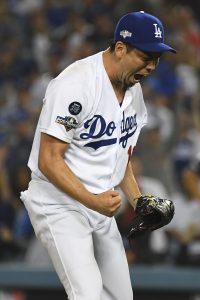
The Twins will now receive right-handed pitcher Kenta Maeda, along with $10MM cash from the Dodgers, per The Athletic’s Ken Rosenthal (Twitter links). They are also likely to receive a lower level prospect from the Dodgers, per Rosenthal, though the name of that prospect has not yet been revealed. Another report has the Twins sending an additional prospect to the Dodgers, per The Athletic’s Dan Hayes. That player is said to be an outfielder, per MLB Networks Jon Heyman.
If your head is spinning at this point, that’s okay. In total, Maeda, $10MM cash and a prospect is headed to the Twins for Brusdar Graterol, a draft pick (#67 overall) and another prospect. Deals are still pending physicals, which of course, is no small caveat, though expectations are that the deal will go through. We’ll keep this post updated as the names of those final prospects come rolling in.
The Dodgers will now keep Graterol, presumably making him a part of their bullpen picture in 2020. It’s certainly an interesting gambit for the Dodgers to take on Graterol after the Red Sox passed. Regardless, he becomes another weapon for the Dodgers to use in their quest to return to the World Series. He may even be the perfect candidate to take on the multi-inning fireman role that Maeda had played for the Dodgers over the past few postseasons. Alternatively, if Kenley Jansen‘s struggles continue, Graterol could step into a finishing role. However they plan on using him, the Dodgers not only added one of the best player’s in the game today, but also a high-risk, high-reward young hurler.
For the Twins, they get a reliable arm for their rotation at little financial investment to slot in with Jose Berrios and Jake Odorizzi at the top of their rotation. Even Maeda wins here, as he gets the security of starting for a playoff contender, something he’s long desired, per MLB Network’s Jon Heyman. Maeda has a fairly complex contract, but given the money being sent Minnesota’s way, the Twinkies have Maeda for the next four seasons at very reasonable rates. Maeda is only really assured of earning $3.15MM in each of the next four seasons by way of a $3MM base contact and $150K bonus for making the opening day roster. Of course, with Maeda in the rotation, there’s room for him to raise his worth on an annual basis with up to $6.5MM in potential bonuses.
Photo courtesy of USA Today Sports Images.
NL Notes: Dodgers, Cubs, Giants
The Mookie Betts trade is in the books, but now that Joc Pederson is no longer headed to the Angels, the Dodgers will have to sort out their 40-man roster, tweets Bill Plunkett of the Orange County Register. The Dodgers have 42 players on their 40-man roster at present. Finding a new trade partner for Pederson and/or Ross Stripling might be the most obvious answer, but the Dodgers may prefer not to rush a transaction of that magnitude. Speculatively speaking, Tyler White could find himself on the chopping block, with Kyle Garlick, Zach McKinstry and Edwin Rios other non-established big leaguers whom the Dodgers may need to consider moving or exposing to waivers. While we wait for the final confirmation of this deal to go through, let’s check in elsewhere around the National League…
- Theo Epstein saw the writing was on the wall long before the Cubs’ current financial strictures so severely limited their transactional flexibility, per Gordon Wittenmyer of the Chicago Sun Times. Epstein references a pattern – the Cubs, Astros, Red Sox – of teams reckoning with their young stars graduating into the arbitration process. After years of supporting homegrown cores with free agent additions in efforts to win a World Series, the Red Sox, Astros and Cubs, for differing reasons, have entered new phases. Sure enough, the Astros had to let Gerrit Cole walk in free agency, the Red Sox just shipped Mookie Betts to the Dodgers, and the Cubs are said to have been shopping Kris Bryant for most of the winter. Of course, the Cubs haven’t yet moved their young stars, but their value has declined. Epstein and company are stuck choosing between trading the stars from the cursebreaking Cubs at lower than peak value and watching them depreciate into a mediocre ballclub. Of course, there’s always the possibility of a bounceback for this Cubs core, but even a return to prominence in the NL Central would not provide the answers Epstein needs when it comes to the futures of Anthony Rizzo, Kris Bryant, Javier Baez, Willson Contreras, Kyle Schwarber and company.
- The Giants have extended a non-roster spring training invitation to catcher Ricardo Genoves, per Kerry Crowley of the Bay Area News Group. Given the timing, it’s safe to assume Genoves inclusion in the spring cohort comes as a result of the injury that will keep Aramis Garcia out for most of next season. That said, his inclusion is more about gaining a learning experience, and he’s not actually in the running for the Giants’ backup catching spot, per The Athletic’s Andrew Baggarly. Still, it seems a good opportunity for the 20-year-old Venezuelan backstop, and perhaps one that will put him on the radar of league officials league-wide. He was signed by the Giants at the open of the international signing period in 2015, but he tapped into real power at the dish for the first time this past season. Genoves managed a .265/.335/.469 line with 9 home runs in 51 games with Salem-Keizer of the Northwest League and Augusta in Low-A.
MLBTR Poll: Did The Red Sox Improve Their Return For Mookie Betts?
Five days ago, the Boston Red Sox almost traded 2018 MVP Mookie Betts to the Los Angeles Dodgers in a three-team deal. As we now know, that trade fell apart. Today, it was replaced by a new deal. This time, the Red Sox and Dodgers took matters into their own hands while Los Angeles satisfied their other agreements in a separate deal with the Twins (while yet another portion of the deal was scrapped altogether).
The earth-shattering move here is Boston dealing a former MVP in his prime. Though the Dodgers are only acquiring one season at $27MM, their books are relatively clean, and if nothing else, they are the prohibitive favorite to sign him long-term sometime next winter. But whether the Red Sox were wise to deal their young star – a player with 42 bWAR already on his resume – is not up for debate in this space. There’s clearly lots to sort out in cataloguing the pieces brought in by Dodgers’ President of Baseball Ops Andrew Friedman. But this isn’t the venue for that discussion either.
The financial aspect of this deal is difficult to process for many reasons. It’s no small feat to rid $75MM from the ledger in one fell swoop as the Red Sox did today. And yet, that the Boston Red Sox would be financially motivated to move one of the best players in the sport is beyond comprehension. Still, the financial numbers stayed relatively the same from version one to version two of this deal, so that can be tabled as well for now.
This space is all about parsing the Red Sox’ return. Let’s quickly review the specifics.
In version one, the Red Sox were to receive two players: Alex Verdugo from the Dodgers and Brusdar Graterol from the Twins. This time around, prospects Jeter Downs and Connor Wong are heading to Boston with Verdugo. Without seeing the medical reports that gave the Red Sox pause over Graterol, the two frameworks provide a fun what-if for the rest of us to ponder. The question here is obvious: should the Red Sox have stuck with Graterol? Or did they improve their return by swapping in Downs and Wong?
Graterol surged through the Twins’ system last season, reaching the majors less than a week after his 21st birthday. The hard-throwing righty earned his keep in a small sample, striking out 10 batters in 9 2/3 innings and finishing with a 4.66 ERA/3.42 FIP. MLB.com put him at #83 on their top 100 prospects list, while Baseball America came in a little more bullish with a #60 overall ranking. His talent isn’t in doubt – not with a sinker and four-seamer both clocked at 99 mph – but questions about his long-term health drove the the Red Sox to check behind door number two. If Graterol’s ceiling is that of a bullpen fireman, that’s a valuable asset – especially come playoff time. But even a move to the bullpen doesn’t guarantee the long-term viability of his right arm. Still, pitchers with Graterol’s stuff are rare birds and valuable commodities – even with one arm surgery already on the books.
Then there’s door number two. Downs had a big season at High-A last year after the Dodgers acquired him as the tax for taking on Homer Bailey in the Alex Wood/Yasiel Puig trade with the Reds. The 21-year-old Downs hit .269/.354/.507 in High-A before earning a promotion to Double-A in 2019. He showed well there, too, though only in a 12-game sample. He is likely to begin the year at Double-A for the Red Sox, but he’s climbing prospect boards. MLB.com put him at #44 overall, while Baseball America has him at #86. Most outlets peg him as the second baseman of the future, though he’s played more shortstop than second to this point.
Wong, 23, started the year at High-A last season as well. He finished exceptionally strong, however, putting up an impressive .349/.393/.604 line through 40 games in Double-A. Despite those gaudy numbers, he’s not as highly ranked. His power is legit, but he does strike out nearly 30% of the time, and he’s not yet walking at an average rate. Fangraphs’ had him as the Dodger’s #13 ranked prospect last season with a future value score of 40+, talent level appropriate for a bench role. For contract, Fangraphs has both Downs and Grateral with a 50 FV score. Were those ratings to come to fruition, Downs would project as an average regular, while Graterol could project as a back-end starter or potential late-inning reliever.
The debate largely centers on how much one wants to gamble on a high-end pitcher. But even the aerial view minimizes how much this deal really hinges upon the specific players involved.
To add one final wrinkle to this question, let me add this tweet from The Athletic’s Ken Rosenthal. He says, “A number of baseball people saying #RedSox did well. Verdugo, Downs, project as regulars; Wong has good arm, power. Also moved half Price’s money. Deal at least comparable to what #DBacks got for Goldy, who cost less than Betts in walk year and had no other contracts attached.”
Whether you agree with Rosenthal’s people or not, the Paul Goldschmidt deal is certainly an interesting touchstone. Just a year ago, the Diamondbacks received Carson Kelly, Luke Weaver, Andy Young and a competitive balance round B draft selection in exchange for one season of Goldy. For simplified context, Betts is a 27-year-old stellar defensive right fielder coming off a 6.8 bWAR season, while Goldschmidt was a 31-year-old first baseman coming off a 5.4 bWAR season.
Of course, the dollar savings factor into a comparison to the Goldschmidt trade, as Goldy made just $14.5MM last season. The Diamondbacks trade was motivated more about returning value for a player they weren’t likely to extend. The Red Sox motivations are similar, though they’re also getting out from under David Price’s contract. Not for nothing, but Price remains a viable major league starter.
Also muddying the waters here is how one views Verdugo‘s future. He’s long been a player projected for stardom, though a deep player pool and injuries slowed his ascent in Los Angeles. And there remain questions about his overall makeup as well. Still, he’ll turn just 24-years-old in May, and it wasn’t long ago that he was the top prospect in a Dodgers’ system that has continued to churn out big league players.
Last season was his first with regular playing time, and he made good with a .294/.342/.475 line with 12 home runs in 106 games before an oblique strain cost him most of the rest of the year. He’s got great bat-to-ball skills, and his defense is solid enough that he can man centerfield for a time if that’s a need. He’s a promising young player, but he’ll have big shoes to fill in Boston.
I’m giving you the chance to overrule Boston’s Chief Baseball Office Chaim Bloom. Which return would you prefer?
(Poll link for app users)
Which return do you prefer?
-
Version 2 (Verdugo, Downs, Wong) 70% (17,654)
-
Version 1 (Verdugo, Graterol) 30% (7,686)
Total votes: 25,340
(Poll link for app users)
Which star netted the better return?
-
Betts (Verdugo, Downs, Wong, $75MM in savings) 60% (12,778)
-
Goldschmidt (Kelly, Weaver, Young, Draft Pick, $14.5MM in savings) 40% (8,600)
Total votes: 21,378