
Red Sox Place Romy Gonzalez, Isaiah Campbell On Injured List
The Red Sox announced that infielder Romy Gonzalez has been placed on the 10-day injured list (retroactive to April 11) due to a left wrist sprain. This move comes a day after another IL placement, as Boston sent right-hander Isaiah Campbell to the 15-day injured list Friday due to a right shoulder impingement. Infielder Bobby Dalbec was called up from Triple-A to replace Campbell, while righty Cooper Criswell was promoted today from Triple-A in Gonzalez’s spot.
As manager Alex Cora told The Athletic’s Jen McCaffrey and other reporters, Campbell kept his shoulder discomfort private but his attempts to pitch through the issue had disastrous consequences. Campbell allowed eight earned runs over two innings of work in relief appearances on Wednesday and Thursday, quickly halting what had been a positive start to Campbell’s Red Sox tenure. Acquired from the Mariners for Luis Urias back in November, Campbell had a 2.08 ERA over his first 4 1/3 innings and five appearances in a Boston uniform. The righty will now be sidelined for at least the next two weeks, and the severity of the impingement isn’t yet known.
While Campbell worked out of the bullpen, Criswell will act as a spot starter in today’s game against the Angels, filling in after Nick Pivetta went on the 15-day IL earlier this week. Today’s start will mark Criswell’s Boston debut after signing a one-year, $1MM free agent deal with the club after the Rays non-tendered the right-hander in November. There’s some full-circle significance in facing Los Angeles since the Angels drafted Criswell in the 13th round in 2018, and he made his MLB debut in a Halos uniform in 2021. After tossing 4 2/3 innings in cup-of-coffee fashion over the 2021 and 2022 seasons, Criswell got a longer look with Tampa last season and posted a 5.73 ERA over 33 innings, often working as a bulk pitcher behind an opener.
Gonzalez is another offseason acquisition, picked up from the White Sox on a waiver claim in January. Gonzalez played in two games with Boston before hurting his wrist in a fall during Wednesday’s game. X-rays were negative on Gonzalez’s wrist, but an IL stint has been deemed necessary to give the infielder some time to fully heal up.
Dalbec’s addition can shore up the infield mix to some extent, but Gonzalez is now the fourth infield option on Boston’s injured list, joining Trevor Story, Vaughn Grissom, and utilityman Rob Refsnyder. Story will miss the entire season in the wake of shoulder surgery, while Grissom (hamstring strain) and Refsnyder (broken toe) have started minor league rehab assignments. Grissom and Refsnyder are tentatively on pace to be activated off the IL in late April, though Grissom’s timeline is a little uncertain since injuries prevented from playing whatsoever during Spring Training.
The impact of so many missing infielders is evident in Boston’s glovework, as McCaffrey notes that the defense has essentially fallen apart since Story was sidelined. The Red Sox are near the bottom of the league in Outs Above Average (-5) and Defensive Runs Saved (-7), and their 16 errors is tied for the most in baseball.
Three of those errors came in yesterday’s 7-0 loss to the Angels, and the lineup was also missing Rafael Devers. Due to nagging soreness in his left shoulder, Devers has missed Boston’s last two games and will also sit out of today’s contest.
“I’ve been feeling it since Spring Training,” Devers told MLB.com and other media yesterday. “But every time I was swinging, I was feeling it a little bit more and more. So for me, I think like two or three days [off] could be enough. I hope it doesn’t keep bothering me after these two or three days, but that’s something I can’t control. That’s why I’m just trying to keep working to get stronger, to get my shoulder back in a good way.”
It’s safe to say that Devers’ shoulder has contributed to the third baseman’s slow start, as Devers is hitting just .184/.326/.395 over his first 46 plate appearances. This relative lack of production has contributed to the lineup’s inconsistency, as the Red Sox have had trouble scoring runs despite hot starts from Tyler O’Neill and Jarren Duran.
Red Sox Select Joely Rodriguez, Naoyuki Uwasawa
The Red Sox announced Thursday that they’ve selected the contracts of left-hander Joely Rodriguez and right-hander Naoyuki Uwasawa — the latter of whom was just acquired from the Rays yesterday. Rodriguez will head straight to the MLB roster, while Uwasawa has been optioned to extended spring training. Righty Liam Hendriks (recovering from Tommy John surgery) and southpaw Chris Murphy (UCL sprain) have been placed on the 60-day IL to create 40-man roster space. Boston also placed righty Bryan Mata (hamstring strain) on the 15-day IL and placed infielder Vaughn Grissom (hamstring strain) and utilityman Rob Refsnyder (broken toe) on the 10-day IL.
Rodriguez, 32, was with the Sox in 2023 but pitched just 11 innings due to oblique, shoulder and hip injuries that combined to result in three different stints on the injured list. He posted a 6.55 ERA in his short time on the mound, striking out 27.5% of his opponents against an 11.8% walk rate and 45.2% ground-ball rate. He re-signed with the Sox on a minor league deal and turned in a strong showing this spring, holding opponents to a pair of runs on nine hits and three walks with nine strikeouts in seven innings of relief. He also recorded a massive 61.9% ground-ball rate.
Looking beyond last year’s struggles, Rodriguez has a decent track record in recent years. From 2020-22, Rodriguez pitched 109 1/3 frames between the Rangers, Yankees and Mets, working to a 4.28 ERA with even more encouraging secondary marks. Rodriguez fanned 25.5% of his opponents in that time and induced grounders at a huge 55.7% clip. His 10.3% walk rate was still a couple ticks north of the league average, but the lefty offered an enticing blend of missed bats and grounders while excelling at keeping the ball in the park (0.58 HR/9). Metrics like FIP (3.14) and SIERA (3.51) were rather bullish on his work.
Uwasawa, 30, has a long track record of success in Japan’s Nippon Professional Baseball but inked a minor league pact with the Rays over the winter. He most recently tossed 170 innings with a 2.96 ERA in NPB, though that strong mark was accompanied by a lackluster 17.8% strikeout rate and sub-par velocity. Last September, MLBTR contributor Dai Takegami Podziewski noted that Uwasawa’s fastball velocity was averaging 90.8 mph during the 2023 NPB season. Uwasawa does boast a strong 7.5% walk rate, which dropped as low as 5.9% in 2023, but he’s generally viewed as a soft-tossing finesse pitcher.
It was a rocky spring for Uwasawa, who was torched for seven runs in two innings during his debut with the Rays. He had one more rough outing and a pair of solid appearances, and the Sox got a first-hand look at him as they were his opponent in two of his four official spring outings. Uwasawa finished up his Grapefruit League campaign with a grisly 13.03, thanks largely to that first meltdown, but his track record in Japan and low cost of acquisition make him a reasonable enough flier for a Red Sox club that is thin on pitching depth after trading Chris Sale and seeing Lucas Giolito and the aforementioned Murphy go down with UCL injuries.
Red Sox Notes: Grissom, Winckowski, Rotation, Booser
Vaughn Grissom was already questionable for Opening Day, but Alex Cora offered an update this morning on the timeline for his second baseman’s return. “We’re talking mid-April probably, [or] late April,” the Red Sox manager told members of the media, including Ian Browne of MLB.com. Grissom has not yet appeared in a Grapefruit League game; he has been nursing a groin strain all spring.
Boston traded for Grissom in December, sending Chris Sale (and $17MM) to Atlanta to complete the exchange. The Red Sox were counting on the 23-year-old to be their everyday second baseman in 2024. Barring a significant setback, he can still fill that role, and if he returns in mid-April, he might only miss 15-20 games.
When news of Grissom’s injury first broke, Cora told Pete Abraham of The Boston Globe that Enmanuel Valdez would fill in at second base. Valdez started 44 games at the keystone for the Red Sox last season. He slashed a perfectly respectable .266/.311/.453 in 149 plate appearances, with eight doubles and six home runs. However, he took nearly 90% of his plate appearances with the platoon advantage and went 2-for-14 against left-handed pitching. Thus, Pablo Reyes is likely to grab some starts at second with a southpaw on the mound.
In pitching news from Red Sox camp, Cora told reporters (including Sean McAdam of MassLive) that Josh Winckowski is no longer in the running for the Opening Day rotation, and he will likely move to the bullpen to begin the season. As Browne points out, that leaves Tanner Houck, Garrett Whitlock, and Cooper Criswell competing for the final two jobs on Boston’s starting staff. Brayan Bello, Nick Pivetta, and Kutter Crawford will hold down the top three spots.
Winckowski pitched well out of the bullpen last season, posting a 2.88 ERA in 84 1/3 innings of work. His 3.84 SIERA and 3.82 xERA were more good than great, but there is no denying he was an effective reliever, especially against left-handed opponents. The same cannot be said for his time as a starting pitcher the year before. Over 70 1/3 innings, Winckowski pitched to a 5.89 ERA, 4.84 xERA, and 4.82 SIERA, striking out a mere 44 batters while walking 27. Nonetheless, the 25-year-old told Rob Bradford of WEEI that he still considers himself a starting pitcher.
While Cora suggested Winckowski would likely fill a multi-inning role at the MLB level, he didn’t completely shut down the possibility that the righty could begin the season as a starter at Triple-A (per McAdam). “We still have got decisions to make,” said the skipper. “We’ll transition him now to the bullpen… and we’ll make decisions after that.”
Out of Houck, Whitlock, and Criswell, a trio of tall, 27-year-old right-handers, it seems like the former two have the edge over the latter. Houck and Whitlock have significantly more big league experience, and both were serviceable out of the rotation for Boston in 2023. Houck has a career 3.86 ERA in 252 innings, while Whitlock has a career 3.51 in 223 1/3 frames. Criswell has pitched well this spring, but it would be hard to argue he has done enough to edge out either of his more proven teammates.
Turning back to the bullpen, Cora mentioned an interesting name to Christopher Smith of MassLive: Cam Booser. Booser will turn 32 in May. He has spent time in the Twins, Diamondbacks, and Red Sox organizationx. He has never been selected to a 40-man roster, let alone pitched in the major leagues. Yet Booser was the first name the manager mentioned, pointing out his upper-90s fastball velocity and the way he has landed “offspeed pitches for strikes.”
That said, Cora was also clear to emphasize the value of experience. Brennan Bernardino, who already has a spot on the 40-man roster, made 55 appearances last year with a 3.20 ERA. Joely Rodríguez, a non-roster invitee, has pitched in 168 games over six big league seasons. Chris Murphy, another 40-man arm, found moderate success as a multi-inning reliever last season, tossing 47 2/3 frames over 20 appearances with the Red Sox. Cora brought up all three of their names in the same discussion, and it’s hard to imagine Booser beating out any of them for a spot on the Opening Day roster.
Still, it’s becoming clear that Booser is a name to keep an eye on this season. He has given up just two runs in eight innings this spring, striking out eight and walking none.
Vaughn Grissom Likely To Miss Opening Day Due To Groin Strain
Vaughn Grissom will probably have to wait a bit longer to make his official Red Sox debut, as manager Alex Cora told reporters (including WEEI’s Rob Bradford) that the second baseman has been sidelined by a groin strain. The severity of the injury isn’t yet known, though it is serious enough that Cora was doubtful that Grissom would be ready for Boston’s season open on March 28 in Seattle.
Grissom has yet to see any Grapefruit League action at all due to a prior hamstring problem, so between that injury and now the groin strain, his first spring camp in a Red Sox uniform hasn’t been particularly memorable. It seems likely that Grissom will start the season on the 10-day injured list, as he’ll need time to both get healthy and then get some work in either at Spring Training proper or in extended spring camp to get himself at full readiness for regular-season games.
Amidst a relatively quiet offseason for the Red Sox, the club’s acquisition of Grissom stands out as its most headline-grabbing move. The Sox traded Chris Sale and $17MM (to partially cover Sale’s salary) to the Braves in exchange for Grissom, with the intent of installing Grissom as a long-term answer at second base. The position had been both a revolving door and a weak link for the Red Sox, but the Sox are hopeful that second base is now covered for the rest of the decade since Grissom is controlled through the 2029 season.
As an 11th-round pick for Atlanta in the 2019 draft, Grissom’s quick rise to the majors has been something of a surprise, particularly given the playing time lost during the canceled 2020 minor league season. The Braves are known for aggressively promoting certain prospects they feel they can provide immediate help at the big league level, and Grissom’s huge numbers in the minors earned him a 41-game look in the Show in 2022, with Grissom hitting .291/.353/.440 over 156 plate appearances.
This impressive start hinted at a larger role and perhaps the everyday shortstop job for Grissom in 2023, though Orlando Arcia ended up taking that role and Grissom spent most of last season at Triple-A Gwinnett. While Grissom continued to hit well at Triple-A, he had only 80 PA (hitting .280/.313/.347) in the majors since the Braves prioritized regular playing time for Grissom in the minors, and due to the durability of Arcia and mostly every member of Atlanta’s regular lineup.
Cora said that Enmanuel Valdez is the likeliest candidate to fill second base in Grissom’s absence, and players like Pablo Reyes, Rob Refsnyder, Romy Gonzalez, or Bobby Dalbec could also pick up the slack. The Red Sox were known to be looking for some position-player depth this week and signed C.J. Cron to a minor league contract, though Cron is a first-base only player. It seems possible the Sox might keep looking for a middle-infield type to further bolster their depth given Grissom’s situation.
Latest On Dylan Cease
Dylan Cease remains atop the list of potential trade candidates for teams seeking rotation upgrades this offseason, but White Sox general manager Chris Getz isn’t backing off on his asking price in a trade, writes ESPN’s Jesse Rogers. Other clubs who’ve spoken to the Sox about Cease tell Rogers that the ask has been “multiple” top prospects with additional lower-end talent; the Sox aren’t open to dealing two affordable years of control over their top starter for a package centered around just one top-tier prospect.
That generally aligns with prior reporting that the White Sox asked the Reds for last year’s first-round pick, Rhett Lowder, and top prospects Edwin Arroyo and Connor Phillips in exchange for Cease. Other teams have similarly balked at the idea of parting with so much talent from the top end of their system.
Rogers reports that the Braves approached the Sox and dangled infielder Vaughn Grissom, among others, but were rebuffed. Grissom instead went to the Red Sox in the Chris Sale trade. The Yankees, despite having known interest in Cease, aren’t likely to further deplete their farm after already acquiring Juan Soto (and Alex Verdugo) this offseason, per Rogers — at least not at the current asking price. Outfield prospect Spencer Jones, in particular, seems highly unlikely to be included in any potential deal, he adds. Meanwhile, Jim Bowden of The Athletic writes in his latest mailbag that talks between the Red Sox and White Sox never gained traction, thanks to Chicago’s steep ask.
Despite the lack of traction in talks thus far, Ken Rosenthal of The Athletic said in a Tuesday appearance on Foul Territory that he expects Cease to be moved prior to the season. The demand for starting pitching, as Rosenthal rightly observes, clearly outpaces the supply that’s available in free agency. Beyond that, the asking price on some other pitchers rumored to be available — Jesus Luzardo, in particular — would likely be even greater than the ask for Cease. Luzardo has three years of club control as compared to Cease’s two.
Each of the Red Sox, Orioles, Yankees, Rangers, Angels, Giants, Dodgers and Padres, at the very least, could still use some degree of rotation upgrade. The Cardinals signed three free agents early in the offseason (Sonny Gray, Lance Lynn, Kyle Gibson) but were reported to have interest in Cease even after making that trio of additions.
Getz, unsurprisingly, kept things close to the vest in his public comments yesterday. The newly minted general manager rattled off a series of familiar choruses, noting that Cease would only be moved for the right deal, that there was no urgency to make a swap given his remaining club control, and specifying that the majority of the league has shown at least some level of interest in the right-hander.
Cease is coming off a down season that saw him post a 4.58 ERA with a slightly diminished 27.3% strikeout rate. That’s down only by his lofty standards; he punched out 30.1% of his opponents a year prior while pitching to a sparkling 2.20 ERA that netted him a runner-up finish in American League Cy Young voting.
While last year’s ERA was unsightly, Cease still missed bats at a high level, sat just under 96 mph in terms of average fastball velocity, and notched a well above-average 13.6% swinging-strike rate. He’s also made a full slate of starts in each of the past four seasons, leading the Majors with 109 games started since 2020. Add in that Cease is projected for an eminently affordable $8.8MM salary in arbitration this winter (courtesy of MLBTR contributor Matt Swartz) and is controllable through the 2025 season, and his appeal becomes even more apparent.
Any team to acquire Cease would surely view him as a prime rebound candidate whom they can control for two seasons before recouping some prospect value in the form of a qualifying offer. An extension with Cease always remains a possibility, albeit perhaps a faint one. Clients of the Boras Corporation tend to test the open market, though there are plenty of examples of Boras clients who have instead signed extensions (e.g. Xander Bogaerts, Jose Altuve, Stephen Strasburg, Carlos Gonzalez — among others).
MLBTR Podcast: Yamamoto Fallout, the Sale/Grissom Trade and Transaction Roundup
The latest episode of the MLB Trade Rumors Podcast is now live on Spotify, Apple Podcasts, and wherever you get your podcasts! Make sure you subscribe as well! You can also use the player at this link to listen, if you don’t use Spotify or Apple for podcasts.
This week, host Darragh McDonald is joined by Anthony Franco of MLB Trade Rumors to discuss…
- The Dodgers signing Yoshinobu Yamamoto and what’s next for the teams that missed (0:55)
- Red Sox agreed to terms with Lucas Giolito and then traded Chris Sale to the Braves for Vaughn Grissom (7:50)
- The Royals spreading money around to various players (16:10)
- The Blue Jays sign Kevin Kiermaier and Isiah Kiner-Falefa (20:25)
- Mariners sign Mitch Garver (26:05)
- Reds sign Frankie Montas (28:35)
Check out our past episodes!
- Tyler Glasnow, Jung Hoo Lee, D-Backs’ Signings and the Braves’ Confusing Moves – listen here
- Shohei Ohtani, Juan Soto and Deferred Money – listen here
- Winter Meetings, Ohtani Secrecy, and the Mariners Shedding Salary – listen here
The podcast intro and outro song “So Long” is provided courtesy of the band Showoff. Check out their Facebook page here!
Braves, Red Sox Trade Chris Sale For Vaughn Grissom
The Braves and Red Sox have agreed to a major trade, as left-hander Chris Sale will head to Atlanta in exchange for infield prospect Vaughn Grissom, ESPN’s Jeff Passan reports. The Sox will also include $17MM in the deal to help cover Sale’s $27.5MM salary for the 2024 season, as per the Boston Globe’s Alex Speier. Sale had a full no-trade clause that he has waived to facilitate the move.
The surprising move ends Sale’s tumultuous run in Boston after seven years and six seasons, as Sale missed all of the 2020 campaign. After acquiring Sale as part of a blockbuster deal with the White Sox in December 2016, Sale pitched brilliantly in his first two seasons at Fenway, twice finishing in the top four in AL Cy Young Award voting and playing a big role in Boston’s World Series title in 2018.
Since 2019 was the last year of Sale’s previous contract, the Red Sox were aggressive in locking up their ace, signing him to a five-year, $145MM extension covering the 2020-24 seasons, with a $20MM club option for the 2025 campaign. Unfortunately, this extension has proven to be a big misfire, as Sale started to run into injury problems even late in the 2018 campaign. He was shut down in August 2019 with elbow inflammation and received a PRP injection, yet that elbow issue was only the harbinger for the Tommy John surgery that cost Sale his entire 2020 season and most of his 2021 campaign.
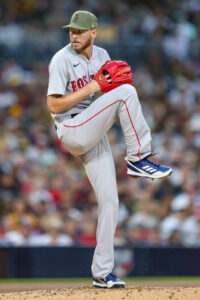
The bad injury luck continued over the last two seasons, as Sale was sidelined by a wide array of maladies including a stress reaction in his ribs, a fractured finger, a broken wrist (suffered in a bicycle accident), and a stress reaction in his shoulder blade. Sale tossed only 48 1/3 innings total in 2021-22, while rebounding to some extent to pitch 102 2/3 frames last season.
Sale’s 93.9mph fastball velocity in 2023 slightly topped his career average, while his strikeout, walk, and hard-hit ball rates were all well above the league average. While the southpaw may never get back to his past elite form, Sale’s 2023 performance at least indicated that he still has a good deal left in the tank as he enters his age-35 season, provided that he can just stay on the field.
This is exactly what the Braves are counting on from Sale as a third or even a fourth starter, behind Max Fried, Spencer Strider, and Charlie Morton in the team’s rotation. President of baseball operations Alex Anthopoulos is counting in Sale’s upside to bolster the pitching staff, and Atlanta’s collection of younger arms (AJ Smith-Shawver, Dylan Dodd, Huascar Ynoa, Darius Vines, and top prospect Hurston Waldrep) and swingman Reynaldo Lopez can provide extra depth should Sale or anyone else in the rotation need time on the injured list.
In typical Anthopoulos fashion, this particular trade came out of nowhere, even if the Braves were known to be looking for some pitching help. Atlanta made a strong bid for Aaron Nola before he re-signed with the Phillies, and such free agent and trade targets as Tyler Glasnow, Dylan Cease, Sonny Gray, and Seth Lugo were also linked to the Braves on the rumor mill.
Because Sale’s extension the Red Sox contained $10MM of deferred money per season, he’ll cost the Braves merely $500K in actual salary in 2024. Even without the deferral involved, a one-year, $10.5MM deal for Sale as a free agent would’ve been a reasonable or even a slight bargain price for a pitcher with his track record. It could perhaps be argued that the Braves might have been better off finding such a pitcher on the free agent market rather than trade away a promising young player like Grissom, but it is also fair to note that such a rotation upgrade might not have existed at a $10.5MM price tag. Or, dealing for a pitcher like Cease, Corbin Burnes, Shane Bieber, or other still-available trade candidates might’ve cost Atlanta lot more than only Grissom.
Sale’s $20MM club option for 2025 shouldn’t be discounted either, as the Braves might consider exercising that option if Sale pitched well. The $20MM figure matches what Morton is earning this season, and since Morton has flirted with retirement over the last few years, Sale could potentially step in as Atlanta’s veteran rotation arm if Morton does hang up his cleats next winter. Sale’s $20MM club option is actually a vesting option that becomes guaranteed if he finishes the year healthy, and finished in the top 10 in NL Cy Young Award voting.
Anthopoulos and team chairman Terry McGuirk weren’t kidding last November when they said that the Braves planned to keep increasing payroll. The Braves’ $203MM Opening Day payroll from 2023 was already a club record, and Roster Resource now projects a payroll just shy of $241MM for the 2024 squad. After topping the luxury tax barrier for the first time in 2023, the Braves’ estimated $280MM tax number now soars over the third penalty tier of $277MM, so they’ll face increasingly hefty overages as second-time payors. Passing the third tier means that Atlanta’s top pick in the 2024 draft will now drop 10 spots, and they’ll face the standard tax penalties related to qualified free agents and the international bonus pool.
This doesn’t appear to be much of a deterrent for an Atlanta club that has been swimming in extra revenues since the opening of Truist Park and its neighboring ballpark village project known as The Battery. The Braves have used this money to lock up several members of its roster on contract extensions, and this young core has already delivered the 2021 World Series championships and six straight NL East crowns.
The outlook hasn’t been as rosy at Fenway Park, as the Red Sox have been very inconsistent since that 2018 title. On the heels of consecutive last-place finishes in the AL East, Craig Breslow replaced Chaim Bloom as the team’s chief baseball officer, and Breslow now has his first true blockbuster trade as a front office executive.
Starting pitching has been a known need for the Red Sox all winter, and Boston just signed Lucas Giolito yesterday to help address the rotation mix. While moving Sale diminishes from the number of available arms, the trade does free up some money to help make other moves, and the Sox simply might’ve wanted a more reliable starting pitching option than the injury-plagued Sale. Plus, adding six years of team control over a promising player like Grissom is a nice return for the Sox at the cost of $17MM.
Grissom immediately fills Boston’s need for second base help. An 11th-round pick for Atlanta in the 2019 draft, Grissom has torn up minor league pitching during his four seasons in the Braves’ farm system and quickly got himself on the radar for a big league call-up. Grissom hit .291/.353/.440 over 156 plate appearances in 2022, though followed up with a more modest .659 OPS in just 80 PA last season. Given a chance at the everyday shortstop job, Grissom fell behind Orlando Arcia on the depth chart, and ultimately spent most the season at Triple-A since the Braves wanted him to play regularly rather than ride the bench.
Grissom has spent much of his minor league career as a shortstop, yet there has been some question about his long-term viability at the position. Moving to second base or third base was difficult on a Braves team with Ozzie Albies and Austin Riley already in place, so Grissom had been getting some reps as an outfielder as a possible candidate to fill the club’s left field vacancy. However, the acquisition of Jarred Kelenic from the Mariners also seemed to close that door.
No such position blocks exist in Boston, as the Red Sox might well just install Grissom as their Opening Day second baseman. He fits Breslow’s preferred add of a right-handed hitter, and Grissom’s glovework could or should work out well at the less-demanding second base position. Getting Grissom in the fold could now relegate Enmanuel Valdez, Pablo Reyes, or Rob Refsnyder to pure backup duty or perhaps even as trade chips, while Ceddanne Rafaela now looks even likelier to be used as an outfielder (and Rafaela might yet be a trade candidate himself).
Photo courtesy of USA Today Sports Images
Alex Anthopoulos, Craig Breslow Discuss Chris Sale Trade
The Braves and Red Sox got together on a major trade earlier today where Boston swapped left-hander Chris Sale and cash considerations to Atlanta in exchange for infielder Vaughn Grissom. In the aftermath of the deal’s announcement, Braves president of baseball operations Alex Anthopoulos and Red Sox chief baseball officer Craig Breslow both spoke to reporters about the deal and what’s next for their organization as 2023 comes to a close.
Anthopoulos spoke glowingly of Sale in the aftermath of the deal, describing him to reporters (including Justin Toscano of the Atlanta Journal-Constitution) as a “playoff-caliber starter” while noting that adding such a pitcher to the club’s rotation was a major goal for the Braves this offseason. With right-hander Kyle Wright having undergone shoulder surgery and been shipped to Kansas City earlier this offseason, the club had little certainty behind its front-of-the-rotation duo of Spencer Strider and Max Fried.
Veteran righty Charlie Morton figured to slot into the #3 spot in the rotation, but posted the highest full-season walk rate of his career in 2023 and celebrated his 40th birthday last month. Meanwhile, youngster Bryce Elder started the season strong but faded down the stretch with a 5.49 ERA across his final 15 starts. The addition of Sale, a seven-time All Star who posted a 3.16 ERA across his final 15 starts last season, adds an arm with potentially elite upside to the club’s mix while also bolstering the club’s overall pitching depth to help make up for the departure of Wright. As noted by The Athletic’s David O’Brien, Anthopoulos made clear that Sale is “locked” into the club’s rotation for 2024 alongside Fried, Strider, and Morton.
Of course, it can’t be ignored that Sale has managed just 31 starts over the past four years due to injuries, including Tommy John surgery. Anthopoulos acknowledged the injury concerns that come with adding the veteran lefty, but noted that “anyone you acquire, there’s risk” while also adding that “it was a shot we wanted to take” thanks in part to Anthopoulos’s strong belief in Sale’s ability and makeup.
“We think he’s an absolute perfect fit with our group,” Anthoupolos said, “We’ll get to know him and we’ll do everything we can to put him in the best position to stay healthy and have success.”
When discussing the club’s plans for the remainder of the offseason, Anthopolous remained vague, noting that the offseason has no set end point and that moves continue to happen even into Spring Training. He went on to note that the club will “keep an open mind” for the remainder of the offseason. It wouldn’t be a shock if the club was done with the heavy-lifting of its offseason at this point, as they’ve already bolstered the pitching staff with Reynaldo Lopez and traded for a starting left fielder in Jarred Kelenic in addition to the acquisition of Sale.
On the other end of the trade, Breslow called moving on from Sale “a really tough, tough decision” when speaking to reporters (including Alex Speier of the Boston Globe), particularly considering Sale’s legacy as a key piece of the club’s 2018 World Series team. At the same time, Breslow lauded Grissom for his “really strong right-handed bat” while also noting that he figures to remain under club control for the next six seasons.
“I’ve talked long about the exciting emerging core of players around whom we want to build,” Breslow said, “…we certainly count Vaughn in that group.”
Though Breslow noted that Grissom has the versatility to play all over the field, he made clear that he views the 22-year-old as the club’s everyday second baseman. That would seemingly leave veteran infielder Trevor Story poised to return to shortstop on a full-time basis. Story struggled in 43 games last season after returning from UCL surgery over the summer, but prior to that injury had a long track record as a quality, two-way shortstop that earned him a six-year, $140MM deal with the Red Sox prior to the 2022 season.
One curious aspect of the deal from Boston’s perspective is that the club has made adding to its starting rotation an explicit goal throughout the offseason, and parting ways with Sale, who in spite of his recent injuries arguably remained their highest-ceiling starter, creates an even bigger hole in their starting five. Breslow emphasized (as relayed by Pete Abraham of the Boston Globe) that the club still plans to add to its rotation even after yesterday’s signing of Lucas Giolito, and that the club views both free agency and the trade market as potential avenues for a deal. Speier relays that Breslow noted the importance of the club being willing to part with prospects in order to acquire “quality, controllable starting pitching.”
The club has recently been linked to a reunion with left-hander James Paxton while also frequently being connected to top remaining rotation arms such as Jordan Montgomery and Shota Imanaga. Of course, there are plenty of other players still available who could represent an upgrade for the club’s rotation including Marcus Stroman and Yariel Rodriguez in free agency or Dylan Cease and Shane Bieber on the trade market. A trade would likely become an even more attractive route for adding to the rotation if the club’s reported pursuit of outfielder Teoscar Hernandez winds up successful, as it would add an everyday bat to the outfield mix and make the likes of Wilyer Abreu and Ceddanne Rafaela easier to part with in trade.
Braves Notes: Grissom, Rotation, Payroll
The Braves’ decision to decline their $9MM club option on Eddie Rosario created a vacancy in left field, and the team is still deciding how to go about patching that need. Among internal options, former top infield prospect Vaughn Grissom appears to be the leading candidate. Braves president of baseball operations Alex Anthopoulos acknowledged that playing Grissom in left field is a possibility “because he’s a tremendous athlete” (link via David O’Brien of The Athletic). Justin Toscano of the Atlanta Journal-Constitution writes that Anthopoulos also said at last week’s GM Meetings that Grissom has already expressed an openness to play anywhere on the field.
Grissom, 23 in January, broke into the Majors on a blistering hot streak in 2022, hitting .347/.398/.558 in his first 103 plate appearances. His bat went cold to close out that season, however, and he didn’t provide much offense in scattershot looks throughout the 2023 campaign. In all, he’s followed those 103 torrid trips to the plate with 133 plate appearances of .240/.293/.289 output. However, Grissom looked like he little to prove in Triple-A this past season, mashing at a .330/.419/.501 rate in a much larger sample of 468 plate appearances.
Though the organization is clearly open to the idea of testing Grissom’s natural athleticism in the outfield, it should be noted that he’s yet to log a single professional inning on the grass. He’s played exclusively shortstop (2140 innings), second base (792 innings) and third base (235 innings) between the big leagues and the minors, playing the two middle infield spots exclusively in the big leagues.
Of course, regular playing time at any of those spots will be hard to come by in 2024. Ozzie Albies and Austin Riley have second base and third base locked down, respectively. Former utilityman Orlando Arcia seized the everyday shortstop job after Dansby Swanson departed in free agency, hitting .264/.321/.420 with 17 home runs in 139 games. It’s fair to point out that Arcia has a limited track record and also faded in the season’s final month (.200/.260/.316 from Sept. 1 onward), but the strength of his season overall should earn him another look in 2024. Besides, one of the very reasons Arcia was given an everyday look at shortstop was due to the organization’s concerns with Grissom’s defensive abilities at the position.
External options abound, with the free-agent market including the likes of Lourdes Gurriel Jr., Michael Brantley and Tommy Pham, among others (to say nothing of a potential lower-cost reunion with Rosario). Trade options include Alex Verdugo, Max Kepler and Dylan Carlson, to name just a few. Going with Grissom would allow the Braves to get a longer look at a top homegrown talent while also saving some payroll to allocate to the team’s expected pursuit of a starting pitcher. At the same time, bringing in an external option could free the possibility of including Grissom as part of a trade package to add a starter who might be more cost effective than a free agent.
The Athletic’s Ken Rosenthal writes that the Braves expect to pursue at least one arm this offseason, listing longtime division rival Aaron Nola as potential fit (albeit in somewhat speculative fashion) due to his southern roots and his relationship with current Braves pitching coach Rick Kranitz (Nola’s former bullpen/pitching coach in Philly).
Despite their bevy of long-term contract extensions, the Braves have thus far resisted going beyond a $22MM average annual value for any player on their roster. Anthopoulos has spoken in the past as to how that’s not a limitation that’s written in stone, however; the Braves paid Josh Donaldson $23MM on his one-year deal, for instance, and they’re surely held interest in free agents who’d command a larger AAV than that. Rosenthal reports that for “the right pitcher,” the Braves would be willing to extend beyond a $22MM AAV.
Whether that’s Nola, NL Cy Young frontrunner Blake Snell, NPB ace Yoshinobu Yamamoto, AL Cy Young finalist Sonny Gray, a trade candidate or an extension candidate (i.e. Max Fried) remains to be seen. Rosenthal points out that the Braves don’t have a Scott Boras client on the current roster — Snell and Yamamoto are repped by Boras — though I’d add that like the $22MM AAV, that’s not a hard-and-fast rule. The Braves have had Boras clients on the roster in recent seasons, Touki Toussaint and Dallas Keuchel among them.
Anthopoulos and Braves CEO Terry McGuirk have both publicly spoken about the expectation that payroll will increase for a third straight season, though much of that uptick in spending will come from the roster that’s already in place. Many players who were signed to long-term contract extensions will see their salaries increase under the terms of those deals. That’s true of Austin Riley (a $5MM increase), Matt Olson ($1MM) and Sean Murphy ($5MM). Re-signed relievers Joe Jimenez ($8MM) and Pierce Johnson ($7MM) will also see increases over last year’s respective salaries of $2.765MM and $5MM. Meanwhile, Fried and A.J. Minter are in line for raises on last year’s respective salaries of $13.5MM and $4.2875MM.
The Braves finished the 2023 season with a payroll just shy of $205MM and more than $245MM of luxury-tax commitments, per Roster Resource. They’re already at $207MM and $236MM per those same projections, though non-tenders and potential trades will impact the bottom line.
Braves Planning To Increase Payroll
The Braves anticipate increasing their player payroll, president of baseball operations Alex Anthopoulos told reporters (including David O’Brien of the Athletic). Chairman Terry McGuirk echoed those sentiments, telling Justin Toscano of the Atlanta Journal-Constitution that “that ‘glideslope’ that we’re on, we will stay on” in reference to the organization raising payroll in three straight seasons.
Atlanta opened the 2023 campaign with a player payroll in the $203MM range, according to Cot’s Baseball Contracts. Their luxury tax figure — which is based on the combined average annual values of a team’s deals — was well higher, estimated around $250MM. The Braves clearly surpassed the $233MM base tax threshold and seem likely to do so again next year, when the first threshold rises to $237MM.
The Braves have around $165MM in guaranteed salaries for next season. Their arbitration class should add between $25MM and $30MM. That could put them within $15-20MM of last year’s season-opening mark before making further additions. Roster Resource projects their CBT number a hair below $237MM.
Even with some kind of uptick in spending, it seems unlikely the Braves would play near the top of the free agent market. That hasn’t been Anthopoulos’ preferred course of action anyhow. Atlanta has been far more aggressive on the trade and extension fronts than in adding free agents from other clubs.
With some measure of flexibility, however, they could be more active than in recent offseasons in sifting through the middle tier. Starting pitching could be the biggest priority. Atlanta has Spencer Strider, Max Fried and Charlie Morton to occupy the top three spots. The final two positions are less settled. Bryce Elder likely has the inside track on the #4 job but struggled down the stretch after an All-Star first half. Kyle Wright will miss the entire season after undergoing shoulder surgery.
AJ Smith-Shawver and prospect Hurston Waldrep are high-upside options who could compete for an early-season job. Anthopoulos said today that Huascar Ynoa is expected to be a full go for Spring Training after missing last season to Tommy John rehab (via Toscano). Jared Shuster, Dylan Dodd and Michael Soroka are depth options — although Soroka could be non-tendered — but it’d behoove the Braves to add another source of innings. Seth Lugo, Michael Wacha and Jack Flaherty are speculative free agent possibilities.
The lineup is a lot more established. Left field is the lone vacancy after the team declined its option on Eddie Rosario. While a free agent pursuit of someone like Lourdes Gurriel Jr. or old friend Joc Pederson could be on the table, the Braves have a potential internal upside play. Atlanta has kept Vaughn Grissom in the middle infield, hoping the reps will allow his glove to catch up to his advanced bat. With Ozzie Albies and Orlando Arcia on the roster, there may not be a path to at-bats for Grissom on the infield.
Anthopoulos told reporters that the organization has given thought to getting Grissom experience in left field. If they put that into action during Spring Training, it’d give the right-handed hitter a clearer path to MLB work. Grissom spent most of this year in Triple-A, hitting .330/.419/.501 as a 22-year-old.