
Cardinals Appear Unlikely To Trade Ryan Helsley
With the Cardinals viewing next season as an opportunity to transition to a younger core, various St. Louis players jumped out as logical trade candidates. Ryan Helsley was chief among them, as the hard-throwing righty is one year from free agency. Helsley is one of the best relievers in baseball and would surely get a lot of attention on the trade market.
Nevertheless, Ken Rosenthal of the Athletic reports that teams in contact with the Cardinals expect St. Louis to hold their closer into next season. President of baseball operations John Mozeliak supported that notion. “(A trade is) something we will always remain open-minded to, but our plan is to have him be part of our organization,” Mozeliak told Rosenthal. That aligns with reporting from Derrick Goold of the St. Louis Post-Dispatch, who wrote last month that the Cards were inclined to keep Helsley unless blown away by the offers.
That stops a little short of taking him off the market entirely. It’s not quite as definitive a declaration as, say, A’s GM David Forst flatly stating they were going to keep designated hitter Brent Rooker last month. Still, it’s notable that the team’s front office leader went on record to downplay the possibility of a trade.
Helsley has had a dominant three-year run at the back of the bullpen. He broke out with a 1.25 earned run average across 64 2/3 innings in 2022. A forearm strain wiped out a few months of his ’23 campaign, but he posted a 2.45 ERA through 36 2/3 frames when able to take the mound. Helsley’s arm held up over a completely healthy season this year. He fired a career-best 66 1/3 innings with a 2.04 mark over 65 appearances.
After beginning his career in a setup role, Helsley proved himself an elite closer this past season. He led the majors with 49 saves while surrendering only four leads. He paced the National League with 62 games finished. Helsley punched out nearly 30% of opposing hitters against a tolerable 8.6% walk rate. Going back to the start of the ’22 season, he carries a 1.83 ERA with a huge 34.6% strikeout percentage through 167 2/3 innings.
That level of production behind a triple-digit fastball and wipeout slider would’ve made Helsley arguably the best reliever on the trade market. (One can debate whether he’s better than Milwaukee closer Devin Williams, who could be dealt before his final season of team control.) MLBTR contributor Matt Swartz projects Helsley for a $6.9MM salary during his final trip through the arbitration process. That’s well below market price for a lockdown closer.
Carrying Helsley into next season would be a frankly puzzling decision. The Cardinals surely feel they’d get a ton of interest at next summer’s deadline, though there’s always the possibility of an early-season injury tanking his trade value. An offseason trade would also keep open the chance for an acquiring team to recoup draft compensation if Helsley walks in free agency. Teams can only make a qualifying offer to players they’ve had on the roster for the whole season. A team that acquires Helsley before Opening Day could make him a QO next winter; one that lands him at the deadline could not.
Qualifying offers for relievers are rare but not unheard of. Raisel Iglesias and Josh Hader declined QOs before their trips to free agency. Edwin Díaz would’ve received a QO had he not re-signed just before hitting the market. A typical Helsley season could put him in that tier. There’s enough volatility with relievers that he certainly wouldn’t be a lock for the QO, but that possibility could hold some value to other teams now and would not exist over the summer.
The Cardinals themselves could make Helsley a qualifying offer if they don’t trade him at all. Speculation about a full teardown has quieted in recent weeks. Willson Contreras and Sonny Gray, both of whom have no-trade clauses, are unlikely to be dealt after expressing their preference to stick around. The Cards are expected to entertain trade possibilities on Nolan Arenado. Beyond that, they could run things back with most of last year’s roster. Paul Goldschmidt, Kyle Gibson, Andrew Kittredge and Lance Lynn were their free agents of note.
Perhaps the Cardinals feel they can hang in the NL Central mix if they get a few internal improvements. There’s still a decent amount of talent on a roster that finished above .500 at 83-79 this year. Winning the division would be a long shot unless they’re active in free agency, but they seem to be willing to at least see how things play out in the season’s first couple months.
Cardinals Sign Ryan Vilade To Minor League Deal
The Cardinals announced that they have signed infielder/outfielder Ryan Vilade to a minor league contract. The Icon Sports Management client also receives a non-roster invite to major league spring training.
Vilade, 26 in February, has some slivers of major league experience. He got into three games for the 2021 Rockies and then 17 games for the 2024 Tigers. He has a .157/.200/.216 batting line in 56 plate appearances in the big leagues. He was outrighted by Detroit at the end of the season and elected free agency.
Those numbers are obviously not impressive, but it’s also a tiny sample size and the Cards are surely looking more at his minor league track record. He got into 108 Triple-A games in 2024, slashing .278/.346/.449 for a 105 wRC+ in his 442 plate appearances at that level. He also stole 20 bases while lining up defensively at all three outfield spots and the three non-shortstop infield positions.
Vilade also has a bit of prospect pedigree, as he was a second-round pick of the Rockies in 2017. He hit well in the lower levels of the minors in the early stages of his professional career, getting ranked by Baseball America as one of Colorado’s top ten prospects from 2018 to 2022. But he didn’t hit much at the Triple-A level in 2021 or 2022, so the Rockies put him on waivers. The Pirates put in a claim and ran him through waivers, with Vilade then going on to have another lackluster Triple-A season in 2023.
He was able to elect free agency going into 2024 and signed a minor league deal with the Tigers. As mentioned, he didn’t do much in his brief major league time but got back on track a bit at the Triple-A level, enough to intrigue the Cardinals.
St. Louis is planning for 2025 to be a reset year, where they will be more focused on upgrading their player development pipeline than on short-term contention. As such, it’s possible that they could consider trades of players with limited long-term value. Nolan Arenado seems like he could be on the move since he is turning 34 and wants to play for a contender. Brendan Donovan and Lars Nootbaar have three years of club control left and are plausible candidates to be available. Nolan Gorman still has four years of club control remaining but seems to have fallen out of favor with the Cards, making him a change of scenery candidate. Paul Goldschmidt is already gone via free agency.
Vilade’s ability to play multiple positions means that he could take up some of the playing time that might shake loose as the club shuffles the roster. If he gets a roster spot at any point, he still has one option year remaining and only has a few days of service time, meaning he can potentially be cheaply retained into the future.
Cardinals Expect To Field Interest In Steven Matz This Offseason
As the Cardinals look to trim payroll and shift towards focusing on young players in 2025, they’ve widely been expected to look to trade a number of their more expensive, veteran players. It seems as though that won’t come to pass with Willson Contreras and Sonny Gray, both of whom seem unlikely to waive their no-trade clauses to facilitate a move elsewhere. Third baseman Nolan Arenado is seemingly open to a move, however, though his own no-trade protection means that he would need to approve of any deal as well. One veteran player who lacks no-trade protection, however, is southpaw Steven Matz. That could leave the Cardinals motivated to part with him this winter, and Derrick Goold of the St. Louis Post-Dispatch suggests that the club plans to “field interest” on both Matz and closer Ryan Helsley this winter.
MLBTR’s Anthony Franco discussed Helsley’s trade candidacy earlier this month, and previous reporting from Goold suggested that the Cardinals figure to set a high asking price for their closer. By contrast, Matz figures to be a more affordable player for teams to acquire who the Cardinals figure to be more motivated to move. The 33-year-old is entering the final year of his contract in 2025 and is due $12.5MM for next season. By offloading Matz’s contract, St. Louis’s payroll projection for next year (courtesy of RosterResource) would drop from just under $147MM to just $134MM. After the club spent $183MM on payroll in 2024, that type of drop off should be more than enough to accomplish their goal of reallocating funds away from payroll into their player development apparatus, and could even open the door to the club making some modest upgrades in free agency, whether that be a reunion with veteran right-hander Kyle Gibson or bringing a new arm into the organization.
While the Cardinals would surely like to offload the final year of Matz’s contract, that may be easier said than done. The lefty has had an up-and-down tenure with St. Louis since signing with the club prior to the 2022 season. He’s struggled with injuries and ineffectiveness throughout his time there, totaling just 197 1/3 innings of work during that time. Of his 52 appearances with the Cardinals, he’s started 34 while pitching out of the bullpen for 18.
His results have been roughly league average overall when he’s been healthy enough to take the mound, with a 4.47 ERA (95 ERA+), a 4.01 FIP, and a 21.9% strikeout rate. That production has been somewhat unsteady, however, with most of it coming during his mostly-healthy 2023 season. That year, Matz posted a 3.84 ERA (114 ERA+) with a 3.75 FIP in 105 innings of work. That solid work is sandwiched between two campaigns that saw him post an ERA north of 5.00. That includes this past season, where Matz struggled to a 5.08 ERA with a similar 4.88 FIP in 44 1/3 innings. He struck out just 17.4% of opponents this past year while posting a 7.9% walk rate that was his worst since 2018.
That’s not a particularly enticing body of work for potential trade partners, though that doesn’t mean Matz is impossible to trade. Notably, Matz has pitched substantially better in his relief outings with the Cardinals than he has during his time in the rotation. In 163 frames for the club as a starter, Matz has posted a 4.91 ERA. Meanwhile, his 33 1/3 innings as a member of the bullpen saw him post a much more intriguing 2.43 ERA. While the lefty’s overall results and durability as a member of the rotation leave his contract with little if any surplus value, it wouldn’t be a shock to see a club intrigued by his work out of the bullpen acquire him to act as a versatile reliever capable of stepping into the rotation if necessary. It’s a role some pitchers such as Nick Martinez, Jakob Junis, Spencer Turnbull, and Michael Lorenzen have found success with in recent years, and a team that values that sort of flexibility on their pitching staff like the Giants or Rangers could be a good fit for the lefty’s services.
NL Central Notes: Pirates, Brown, Cardinals
The Pirates are making some changes to their front office, per a report from MLB.com’s Alex Stumpf. Stumpf notes that director of coaching and player development John Baker is moving into a new role with the club that will see him oversee the club’s performance team. While the move has not been announced by the club to this point, Stumpf adds that the search for a new farm director is already underway as Baker vacates the position.
A former player who spent parts of seven seasons in the big leagues, Baker retired from his playing career in 2015 and caught on with the Cubs in their front office that offseason as a special assistant. Baker eventually stepped into the role of mental skills coordinator with Chicago and remained in that role with the club until he departed for Pittsburgh during the 2020-21 offseason to take on his aforementioned role as director of coaching and player development. As Stumpf notes, the Pirates began implementing more individualized development plans for their players under Baker’s leadership.
With Baker now changing roles, the Pirates will need to fill both the farm director role. As Stumpf notes, that’s not the only high-level role that’s as of yet unfilled in Pittsburgh as the club will also need to hire a new director of pro scouting after moving him to a different, unspecified role within baseball operations. Those yet-to-be-named farm and pro scouting directors will join a wave of personnel hires by the Pirates this winter that already includes international scouting director Max Kwan, VP of research and development Kevin Tenenbaum, hitting coach Matt Hague, and assistant pitching coach Brent Strom.
More notes from around the NL Central…
- Cubs fans received some good news yesterday when Sahadev Sharma and Patrick Mooney of The Athletic reported that right-hander Ben Brown has been cleared for a normal throwing program this offseason. The 25-year-old was acquired by the club at the 2022 trade deadline in the deal that sent right-hander David Robertson to Philadelphia but didn’t make his big league debut until this year. The youngster looked quite good for the Cubs early in the season with a 3.58 ERA and 3.11 FIP in 55 1/3 innings of work while swinging between the rotation and bullpen. He struck out 28.8% of opponents faced against a walk rate of 8.6% but saw is time in the majors cut short by a stress reaction in his neck that sidelined him for the remainder of the season. Chicago reportedly plans to add a starting pitcher to the rotation alongside Justin Steele, Shota Imanaga, and Jameson Taillon this winter, which could leave Brown to either compete with Javier Assad and Jordan Wicks for the fifth spot in the rotation this spring or else spend the year in the bullpen.
- The Cardinals are hiring Matt Pierpont as their director of pitching, as Pierpoint himself noted on X (h/t to Adam Jude of The Seattle Times). Pierpont, 33, pitched in the minor leagues for seven seasons before catching on with the Mariners as a coach prior to the 2021 season. Since then, he’s risen within the organization to the role of pitching coordinator. Now, he’s been promoted again as he moves on to St. Louis, where he’ll be tasked with working to improve the club’s internal pitching options. Andre Pallante and Sem Robberse are among the young pitchers at or near the major leagues, while top prospect Tink Hence dominated the Double-A level and could also look to make his big league debut at some point in 2025.
Brandon Crawford Announces Retirement
Giants legend and long-time shortstop Brandon Crawford has announced his retirement in a post on his personal Instagram account today. The Giants announced (X link from Justice delos Santos of The Mercury News) that Crawford will be celebrated at the club’s upcoming game on April 26, when they will be hosting the Rangers, managed by Crawford’s former skipper Bruce Bochy.
“Growing up in the Bay Area and going to games at Candlestick,” Crawford says, “I always dreamed of playing for the San Francisco Giants. Being drafted by my hometown team and spending most of my career with them far surpassed any dream I had as a kid. I definitely pretended to win a World Series in my backyard – but winning two? That was beyond my wildest dreams.” He goes on to express gratitude to that organization as well as the Cardinals, his family members, coaches, teammates, fans and many others who he crossed paths with.
As Crawford himself mentioned, he could hardly have asked for more of the platonic childhood baseball dream. In 2008, he was drafted by the club he grew up cheering for, with the Giants selecting him in the fourth round out of UCLA. In 2010, the Giants won the World Series, their first title since the club moved from New York to San Francisco. However, Crawford was still a minor leaguer at that time.
He was able to make his major league debut in late May of 2011, and he did so in memorable fashion. In his first game in the show, he hit a grand slam in the seventh inning, his first major league hit (YouTube link from MLB). That gave the club a 5-3 lead over the Brewers and they held on to win 5-4. Despite that notable start, the first season wasn’t great overall. He hit just .204/.288/.296 and only got into 66 games. The Giants finished 86-76 and missed the playoffs.
In 2012, Crawford took a firmer hold of the shortstop job in San Francisco, getting into 143 games. His offense still wasn’t especially impressive but it was better than the year prior and his defense was well regarded. The club went 94-68, winning the National West and advancing to the postseason. Crawford hit just .217/.321/.283 in the playoffs but the Giants went on to defeat the Reds, Cardinals and Tigers, earning their second title in three years.
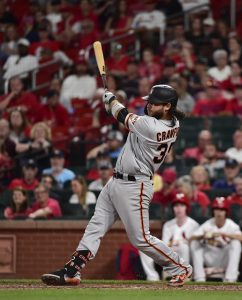
The following year, Crawford’s performance held fairly steady. His offense was again a bit below league average but with strong shortstop defense. However, the Giants slid to 76-86, well out of contention. They came back in 2014, with an 88-74 record that was enough to snag a Wild Card spot. At that time, there were just two such spots per league and those clubs faced off in a one-game, winner-take-all matchup. The Giants cruised through that game with an 8-0 victory, then defeated the Nationals, Cardinals and Royals to secure yet another title. The Giants had three trophies in five years and Crawford had two rings with his hometown club before his 28th birthday.
Crawford had his best offensive season to date in 2015, as he hit 21 homers with a .256/.321/.462 slash line. He made his first All-Star Game and collected both a Silver Slugger and his first Gold Glove award. While the team’s performance fell off, Crawford emerged as a legitimate star. The Giants recognized as much and signed him to a six-year, $75MM extension.
It was more of the same in 2016. Crawford hit .275/.342/.430 while continuing to play elite shortstop defense. He won his second straight Gold Glove and found his name on MVP ballots for the first time. Crawford’s offense dropped over the next few years, but he continued to play excellent defense. He earned a third straight Gold Glove in ’17 and another All-Star appearance in ’18.
While Crawford appeared to be on the downswing of his career toward the end of the 2010s, he hit surprisingly well in the shortened ’20 season. It would’ve been easy to write that off as a small sample blip if Crawford didn’t follow that up with a monster year. At age 34, Crawford set a career mark with 24 homers while hitting .298/.373/.522 in 138 games. He earned another Gold Glove and All-Star nod and finished fourth in NL MVP balloting as the Giants reeled off 107 wins to secure their first division title in a decade.
San Francisco re-signed their longtime shortstop to a two-year, $32MM extension on the heels of that resurgent showing. Neither Crawford nor the team managed to sustain their ’21 form, though, and that deal didn’t wind up working as the club hoped. San Francisco let Crawford walk once he hit free agency last winter. He signed a one-year contract with the Cardinals but was limited to 29 games as a veteran backup to rookie Masyn Winn in St. Louis.
Crawford finishes his career with more than 1400 hits and a .249/.318/.395 batting line over more than 6300 plate appearances. He hit 147 homers and drove in 748 runs. Crawford’s production was even more impressive on the other side of the ball. He was one of the preeminent defensive shortstops of his era and earned four Gold Glove nods. Crawford made three All-Star teams, appeared on MVP ballots twice, and won the aforementioned two titles with his hometown club. Baseball Reference valued his career around 29 wins above replacement over parts of 14 seasons. B-Ref calculated his career earnings around $114MM. MLBTR salutes Crawford on an excellent career and sends our best wishes in his post-playing days.
Image courtesy of USA Today Sports.
Nolan Arenado Reportedly Willing To Move To First Base
Third baseman Nolan Arenado is a logical trade candidate with the Cardinals planning a reset year. As the Cards assess the interest, Katie Woo of The Athletic reports that Arenado is willing to move to first base with a new club, or at least play the hot corner less often.
Arenado has long voiced a desire to compete, which is what spurred his trade from Colorado to St. Louis years ago. He also declined an opportunity to opt-out of his contract after 2022, seemingly content with the Cardinals’ status as perennial contenders. But their performance has sagged in recent years, causing them to pivot to a focus on player development and less on immediate contention, at least for 2025 but perhaps longer.
With that near-term future outlook, it makes sense to consider trading some players that aren’t part of the long-term plans. Arenado is turning 34 years old in April and has three years left on his contract, so there’s logic to the club making him available. He has a no-trade clause but it makes sense that he would have some openness to waiving it, given his desire to compete and win. Woo reports that Arenado has not demanded a trade but was receptive to the idea when president of baseball operations John Mozeliak discussed it with him.
It’s not uncommon for players to be willing to change positions in order to expand their possible landing spots. This offseason, free agents like third baseman Alex Bregman and shortstop Willy Adames are reportedly willing to move to other infield spots. Both are strong defenders at their positions, but it’s a sensible tactic in keeping one’s market as wide open as possible.
With Arenado, it makes a little bit less sense. Over the past couple of years, his offense has declined but he has still been a valuable player thanks to his third base defense. He has slashed .269/.320/.426 over the two most recent campaigns, offense that translates to a 104 wRC+, barely above league average. However, FanGraphs has still calculated him as being worth about three wins above replacement in each those seasons (2.7 in 2023 and 3.1 in 2024), thanks to his strong glovework.
Arenado has never played a position other than third, though he probably wouldn’t have much trouble moving across the diamond since first base is generally considered a less demanding position. But that would also deprive him of his best asset at this point in his career, unless his bat can rebound in a big way.
His willingness to move could perhaps be a factor if a club already had an excellent third baseman, with Jeff Jones of the Belleville News-Democrat (Bluesky link) speculating that the Padres are one such club. That team has Manny Machado, a strong third baseman in his own right, entrenched at third base as a franchise cornerstone. He is under contract for almost another decade, through 2033.
They have a bit less certainty at first base. Jake Cronenworth and Luis Arráez got most of the playing time there in 2024 but both are capable of playing second base. The Padres had Xander Bogaerts at the keystone for much of 2024 but he moved back to shortstop when Ha-Seong Kim got injured, and Kim is now a free agent. Arráez is also not a great defender, at secord or first base, so perhaps he would best fit in the designated hitter slot.
Theoretically, it’s possible that the club could have an infield of Machado, Bogaerts, Cronenworth and Arenado from left to right, with Arráez in the DH spot. From time to time, Machado could get a breather as the DH, with Arenado moving to third and Arráez playing first.
There are also other reasons why the fit could make sense, as Arenado previously played for Padres manager Mike Shildt when Shildt was skipper in St. Louis. Arenado is also a Southern California native. That has often led to rumors of him eventually being traded to the Dodgers, but the fit there is a bit trickier. The Dodgers have Shohei Ohtani taking up the DH spot, Freddie Freeman at first and Max Muncy at third. Theoretically, they could acquire Arenado and trade Muncy, though it’s unclear if they have any desire to do so. Muncy’s defense is a bit behind Arenado’s but he’s been better at the plate lately, having slashed .218/.342/.481 over the past two years for a 124 wRC+.
It would perhaps be simpler for the Padres to just acquire a first baseman and for Arenado to go to a club with a gap at third base. The Red Sox are reportedly thinking of moving Rafael Devers to first and could replace him at the hot corner by acquiring Arenado. Teams like the Blue Jays, Mariners, Astros, Nationals, Brewers, Tigers, Mets and Phillies have been connected to free agents like Bregman or Adames, or are at least speculative fits for a new third baseman. Arenado’s no-trade clause means that he would get to determine whether or not he goes to those clubs and it’s unknown how he would feel about them in terms of their ability to contend or how much their respective geographic locations would matter to him.
On top of all that, the Cardinals will have to assess what other clubs are willing to offer in return. Though the Cards are planning to run a lower payroll in 2025, they don’t really need to move Arenado’s contract in order to accomplish that. RosterResource already projects them to be about $35MM lower than they were in 2024, so cost savings shouldn’t be the priority here. To that end, Woo reports that they won’t move Arenado just to move him or dump salary.
A trade would presumably only come together if the Cardinals feel they are getting something of value in return. Perhaps they could eat some the remainder of Arenado’s contract in order to line up on a deal. He is owed $74MM over the next three seasons though some of that money is deferred and the Rockies are also still on the hook for $5MM this coming season. In addition to adding some young talent in the trade, the Cards could also use their reset year to give Arenado’s playing time to players like Brendan Donovan, Nolan Gorman, Jordan Walker, Thomas Saggese or others.
For a team like the Padres, like they might prefer the Cardinals to eat some money, since their payroll has been such an issue in recent years. They dialed back spending after 2023, dealing Juan Soto to the Yankees, and avoided the competitive balance tax. Going into 2025, RosterResource projects their payroll to be about $40MM above 2024 levels before making any significant offseason moves, with their CBT a bit over the line already as well. On the other hand, they have traded away a lot of prospects in recent years and might not want to further deplete their farm just to awkwardly wedge Arenado into their infield mix.
Woo’s reporting also adds that no deal is close to being completed, but she adds that things could pick up at the Winter Meetings, which take place from December 8 to 11.
Red Sox Reportedly Considering Moving Rafael Devers Off Third Base
The Red Sox have held internal discussions regarding the possibility of moving longtime third baseman Rafael Devers off the position, per a report from MassLive’s Sean McAdam. McAdam goes on to suggest that the club views a trade for third baseman Nolan Arenado with the Cardinals as a potential option to fill their vacancy at the hot corner in the event Devers changes positions, whether that be a move to first base or DH.
The idea of Devers moving to first base has previously been floated by The Athletic’s Ken Rosenthal and The New York Post’s Jon Heyman throughout the offseason so far, though McAdam’s report stands as the first confirmation that a position change for Devers is under internal consideration within the organization. Previously, chief baseball officer Craig Breslow has declined to comment on the possibility of moving Devers off third beyond saying that the club wouldn’t seriously entertain the idea without first discussing it with Devers himself. That could be a complicating factor in a position change, as Devers’s agent, Nelson Montes de Oca, recently told Alex Speier of The Boston Globe that Devers has no plans to move off the hot corner.
“He is a third baseman,” Montes de Oca told Speier, “and he will continue to play third base and work hard to get better at it. That’s his position, that’s what he likes to play, and that’s what he will be playing.”
Resistance to a position change from Devers’s camp isn’t the only potential obstacle to a move. After all, the Red Sox have an extremely talented incumbent first baseman in Triston Casas, who at just 24 years old remains under team control for four more seasons and has previously expressed interest in signing with Boston on a long-term extension. The youngster missed much of the 2024 season due to injury but is a career .250/.357/.473 (125 wRC+) hitter since making his big league debut late in the 2022 season. There’s been speculation at times this winter that the Red Sox could consider moving on from Casas to land starting pitching, but Breslow was quick to shoot down those rumors earlier this month. Given that, a move to first base for Devers would require the front office to either reverse their stance on dealing Casas or else park him at DH on a regular basis, pushing Masataka Yoshida (and the three years and $55.6MM remaining on his contract) either to the bench or off the roster entirely.
Complicated as a position change for Devers would be, the potential benefits for the club could be substantial. Devers is among the worst fielding third basemen in the sport by most metrics, and a move across the diamond would surely improve the club’s infield defense dramatically. In 2024, Devers was worth -9 Defensive Runs Saved and posted a -5 in Statcast’s Fielding Run Value metric. That’s the lowest DRS and tied for the lowest FRV among all qualified (min. 750 innings) third basemen this year. Replacing Devers with an average or even slightly below average glove at third would improve the club’s infield defense considerably, but a position change for Devers would likely be just as motivated by it creating an avenue to improving the club’s offense.
If third base were to be opened by Devers moving to first, that would create an easy place for the Red Sox to add a right-handed bat to the lineup. Adding some thump from the right side has been a priority for Boston dating back to the trade deadline, and the club’s need for a right-handed hitter to add to their offense only grew more pronounced when outfielder Tyler O’Neill hit the open market earlier this month. Most attention on this need has been focused on the outfield at this point in the offseason given the club’s reported interest in either a reunion with O’Neill or pivoting to a deal with Teoscar Hernandez, but the club’s outfield remains crowded with Jarren Duran, Wilyer Abreu, and Ceddanne Rafaela all in the mix for playing time already before considering top prospect Roman Anthony (or veterans Yoshida and Rob Refsnyder), who should be ready to take on a regular role at some point in 2025.
Complicated as that outfield picture already is, it’s easy to see why adding a right-handed bat to the infield could be a preferable, more straightforward option than adding another player to the club’s logjam on the grass. Given that, it’s perhaps no surprise that the club has been connected to both longtime Astros third baseman Alex Bregman and former Brewers shortstop Willy Adames in free agency. Both players have expressed an openness to moving to second base (as well as third, in the case of Adames) if their new club so desires, meaning the addition of either player wouldn’t necessarily require Devers to change positions. With highly-regarded second base prospect Kristian Campbell seemingly in the mix for starts in Boston as soon as Opening Day, however, it’s easy to see why the Red Sox may prefer to install Bregman or Adames at the hot corner and move Devers to first.
While the club’s interest in Bregman and Adames has been reported semi-frequently to this point in the winter, McAdam’s suggestion that Arenado could be a consideration for the Red Sox is the first connection between Boston and the veteran star. Unlike Bregman and Adames, it’s all but unfathomable that a ten-time Gold Glove award winner like Arenado would change positions in deference to Devers, meaning a deal for the 33-year-old would certainly require a position change for the younger star. Arenado is also coming off his second consecutive down season offensively. While he was a finalist for the NL MVP award back in 2022, he’s hit just .269/.320/.426 (104 wRC+) in two seasons since then.
That said, Arenado’s defense has remained well above average even if it’s no longer quite as elite as it was during his peak, and that’s allowed him to be a roughly three-win player in each of the past two seasons. While he may no longer offer the same level of impact as Bregman or Adames, the three years and $74MM remaining on the veteran’s contract pales in comparison to the nine-figure sums both free agents are expected to land and would likely do little to impede Boston’s pursuit of other top-of-the-market names like Juan Soto, Corbin Burnes, and Blake Snell, especially if a deal involved the Cardinals either retaining some money or taking on a sizable portion of Yoshida’s contract in return. Any deal involving Arenado, of course, would require the veteran’s approval given his full no-trade clause. While the 33-year-old hasn’t requested a trade to this point, both he and the Cardinals appear to be open to parting ways if the right deal comes along given the club’s plans to retool and focus on youth in 2025.
National League Non-Tenders: 11/22/24
The deadline to tender a contract to arbitration-eligible players is tonight at 7pm CT. Here’s a rundown of the players on National League teams that have been non-tendered today. This post will be updated as more decisions are revealed. MLBTR contributor Matt Swartz projected salaries for all players eligible for arbitration last month. All players who are non-tendered before this evening’s deadline go directly into free agency, where they’re eligible to sign with any of MLB’s 30 clubs.
Onto the transactions…
- The Braves non-tendered outfielder Ramón Laureano, left-hander Ray Kerr, as well as right-handers Griffin Canning, Huascar Ynoa and Royber Salinas, which you can read more about here.
- The Brewers parted ways with lefty reliever Hoby Milner, who’d been projected at $2.7MM for his final arbitration season. The typically reliable southpaw was tagged for a 4.73 ERA in 64 2/3 innings this year.
- The Cardinals have non-tendered right-hander Adam Kloffenstein, per Jeff Jones of the Belleville News-Democrat (Bluesky link). The righty only just made his major league debut in 2024 and was not yet arb-eligible. He immediately becomes a free agent without being exposed to waivers.
- The Cubs have non-tendered infielder Nick Madrigal, per Jesse Rogers of ESPN (X link). Madrigal has hit .251/.304/.312 for a 76 wRC+ over the last three seasons with the Cubs and was projected for a $1.9MM salary next year. Chicago also announced they non-tendered outfielder Mike Tauchman, which comes as a bit of a surprise after he reached base at a .357 clip this year. Patrick Wisdom, Adbert Alzolay, Brennen Davis and Trey Wingenter — all of whom were designated for assignment earlier this week — were also dropped.
- The Diamondbacks non-tendered lefty reliever Brandon Hughes, per a club announcement. The 28-year-old southpaw allowed 16 runs over 17 2/3 big league innings this year. He wasn’t eligible for arbitration but would’ve occupied a 40-man roster spot if offered a contract.
- The Dodgers are non-tendering right-hander Brent Honeywell Jr. and left-hander Zach Logue, per Jack Harris of the Los Angeles Times (X link). Both pitchers are still in their pre-arbitration years, so this was more about the Dodgers sending them to free agency without exposing them to waivers, as opposed to cost cutting. Perhaps the club will look to re-sign them on minor league deals.
- The Giants only made two non-tenders, parting with lefty Ethan Small and righty Kai-Wei Teng. Teng had been designated for assignment earlier in the week. Small, who was in his pre-arbitration years, spent the season in the minors or on the injured list.
- The Marlins had zero non-tenders. They offered contracts to everyone on the 40-man roster.
- The Mets dropped a trio of players from the 40-man roster: relievers Grant Hartwig and Alex Young and outfield prospect Alex Ramirez. Young was the only member of that group who’d been eligible for arbitration. The southpaw pitched well in a depth role, but the Mets didn’t want to keep him around at a $1.4MM projection. Hartwig made four appearances this year, while the 21-year-old Ramirez (a former top prospect) had a .210/.291/.299 showing in Double-A.
- The Nationals announced that they have non-tendered right-hander Kyle Finnegan and Tanner Rainey, which you can read more about here.
- The Padres dropped four players from the roster: righties Luis Patino and Logan Gillaspie, outfielder Bryce Johnson and infielder Mason McCoy. Patino, who underwent Tommy John surgery last summer, was the only member of the group who’d been eligible for arbitration. The other three cuts are simply about roster maintenance. The Padres could try to bring anyone from that group back on minor league deals.
- The Phillies will not be tendering a contract to outfielder Austin Hays, which MLBTR covered earlier today.
- The Pirates are expected to non-tender first baseman/outfielder Connor Joe and outfielder Bryan De La Cruz, per Alex Stumpf of MLB.com (Bluesky link). They are also non-tendering right-hander Hunter Stratton, per Noah Hiles of the Pittsburgh Post-Gazette (X link). Joe was projected for a salary of $3.2MM next year and De La Cruz $4MM. Stratton had not yet qualified for arbitration. Joe has been around league average at the plate in his career but doing more damage against lefties. De La Cruz has hit .253/.297/.407 in his career for a wRC+ of 90. Startton had a 3.58 ERA this year but his season was ended by knee surgery, giving him an uncertain path forward.
- The Reds have non-tendered right-hander Ian Gibaut, per Gordon Wittenmyer of the Cincinnati Enquirer (Bluesky link). The righty was projected for a salary of $800K. He spent the vast majority of 2024 on the injured list due to arm trouble and only made two appearances on the season.
- The Rockies moved on from starter Cal Quantrill and second baseman Brendan Rodgers, which MLBTR covered here.
Latest On Nolan Arenado
Speculation regarding a potential offseason trade of Nolan Arenado kicked up the moment president of baseball operations John Mozeliak announced the club would take a step back and focus on player development and that they were beginning a transitional process that would see Chaim Bloom take over as president of baseball operations beginning next offseason. Unsurprisingly, that announcement was quickly followed by reports that the Cardinals indeed planned to gauge the market for interest in Arenado.
Derrick Goold of the St. Louis Post-Dispatch now reports that, to no one’s surprise, the Cardinals have spent the early stages of the offseason doing just that. He adds one critical element, writing that Arenado has not specifically asked to be traded. That’s a key wrinkle in the saga, as it differs from the last time Arenado was traded. The then-Rockies third baseman was frustrated in the years following his initial extension in Colorado, as the team hadn’t put together a competitive roster. Given the circumstances leading to his last trade, it was only fair to wonder whether Arenado might waive his no-trade clause to try to facilitate a trade to a team with more of a win-now mentality than the 2025 Cardinals will have. That doesn’t appear to be the case at this time.
It’s still possible, of course, that Arenado could be on the move at some point this winter. While he apparently has not specifically requested a trade, there’s simultaneously no indication that he’s voiced a preference to remain with the Cardinals through their reset period (as teammates Willson Contreras and Sonny Gray, who also have no-trade clauses, reportedly have done). Arenado’s original motivation in pursuing a trade from the Rockies and his decision to forgo the opt-out in his contract following the 2021 season stemmed from a desire to put down roots in a perennially competitive setting.
If the Cards find a deal to their liking that would send him to a clear win-now team, they’d likely present him with the scenario and he’d then have to weigh the merits of approving a deal. But, that’s a far different scenario than Arenado asking to be moved and the pressure that would put on Mozeliak, Bloom and the rest of the front office to find a deal or head into the season with a veteran who’s clearly unhappy to be on the roster.
Arenado, 34 in April, has had consecutive underwhelming seasons at the plate. He’s posted a solid but unremarkable .269/.320/.426 slash (104 wRC+) since Opening Day 2023, striking out in only 15.5% of his plate appearances but also walking at a tepid 6.8% clip. Despite all the accolades he’s amassed in his career, he’s never been a consistent source of premium contact (at least by measure of exit velocity, barrel rate and hard-hit rate). Still, he posted career-low marks in all of those categories this past season, including a particularly light 3.2% barrel rate and 31.2% hard-hit rate.
That said, Arenado remains at least an average hitter with plus bat-to-ball skills and a premium glove at the hot corner. His defensive ratings aren’t as lofty as they were when the six-time Platinum Glove winner was widely regarded as perhaps the best defensive player in Major League Baseball, regardless of position. However, he still posted emphatically positive marks in Defensive Runs Saved (6) and Outs Above Average (9). Arenado’s nine errors this year tied for his career-low mark in a 162-game season. He’s as surehanded as they come, and though his arm strength (by measure of Statcast) has continued to dip in recent seasons, his range remains elite.
As recently as 2022, Arenado was an MVP finalist who posted a .293/.358/.533 batting line with 30 homers and elite glovework. Even if he can’t return to those heights, he’s an above-average player on a contract that doesn’t exactly pay him like a superstar anyhow. Arenado is owed $74MM over the next three seasons, but the Rockies are on the hook for $10MM of that sum ($5MM in both 2025 and 2026).
It’s a frontloaded deal — he’s owed $32MM, $27MM and $15MM in the next three seasons — so perhaps the hefty 2025 salary ($27MM after the Rockies’ contributions) could be a pause for some interested parties. On the other hand, a big-payroll club that’s accustomed to paying the luxury tax might not balk too much at Arenado’s effective $21.33MM average annual value, for tax purposes. His remaining guarantee and the associated AAV are generally in line with what good but non-superstar free agents like Christian Walker and Teoscar Hernandez are expected to command.
Goold notes that the Cardinals don’t feel any financial pressure at this point to shed the deal. They’ve already scaled back payroll quite a bit and could do so with further trades of shorter-term players. As such, they might not be compelled to simply move Arenado to a team that’s willing to absorb the contract but offer minimal prospects.
At the same time, if the Cardinals’ lack of financial pressure means they’d be comfortable paying down some of that remaining salary, they could in effect buy a better return. Covering even one-third of the contract would render Arenado priced comparably to the three years and $45MM that Jeimer Candelario secured in free agency last winter. Plenty of clubs might be intrigued in that scenario. It’s ultimately Arenado’s call, thanks to that no-trade protection, but to this point he’s not forcing the team’s hand.
Cardinals Add Four Players To 40-Man Roster, Outright Drew Rom
The Cardinals announced Tuesday that they’ve selected the contracts of outfielder Matt Koperniak and right-handers Tink Hence, Tekoah Roby and Matt Svanson. The team added that left-hander Drew Rom went unclaimed on waivers and has been assigned outright to Triple-A Memphis. The Cardinals now have 39 players on their 40-man roster.
Of today’s additions, Hence is the most highly regarded. The 22-year-old finished the season as a consensus top-100 prospect, placing as high as 30th on Baseball America’s rankings and also landing 46th at FanGraphs and 61st at MLB.com. He spent 2024, his age-21 season, pitching at the Double-A level, where he logged a 2.71 ERA in an abbreviated workload.
Hence started just 20 games on the season, tallying 79 2/3 innings while missing nearly all of June and July. The Cardinals didn’t specify the nature of his injury, but Hence departed his June 5 start after two innings, returned to pitch one inning on June 23, and then didn’t return to the mound until July 27. Hence’s season came to an end after he was lifted from a Sept. 11 start following just 1 1/3 innings.
Even with the truncated year, Hence remains one of the minor leagues’ most promising young arms. He set down a whopping 34.1% of hitters on strikes in 2024 and showed average or better command, with an 8.1% walk rate. Hence sits mid-90s with a heater that can climb to 98-99 mph, rounding out his repertoire with one of the best changeups in the minors and a solid slider. There are some durability concerns even beyond this past summer, as he’s yet to reach 100 frames in any season of his professional career. Still, he’s teeming with upside, and his Double-A success could open the door for a big league debut later in 2025 if he can stay healthy.
Roby, 23, has drawn his share of top-100 fanfare as well, though his stock dipped amid shaky results and injury troubles of his own in 2024. FanGraphs ranked him 91th in the game at season’s end, but he’d fallen off most other prominent rankings. The 2020 third-rounder, selected by the Rangers and traded to the Cards in the Jordan Montgomery swap, pitched just 38 1/3 innings with a 6.57 ERA between High-A and Double-A in ’24.
Roby has posted middling ERA numbers in his career but regularly logged impressive rate stats and garnered attention from scouts due to plus raw stuff across the board — headlined by his curveball. Roby needs to improve his command and prove he can handle a starter’s workload, as he’s a bit undersized at 6’1″ and has never reached 105 innings in a pro season.
The 26-year-old Koperniak signed with the Cards as an undrafted free agent in the summer of 2020, following that year’s five-round amateur draft. He spent the whole 2024 season in Triple-A, where he hit .309/.370/.512 with 20 homers, 28 doubles, three triples, five steals, an 8.4% walk rate and an 18.7% strikeout rate. He played all three outfield spots but spent the bulk of his time in left field.
Svanson, 26 in January, was acquired from the Blue Jays in the trade sending Paul DeJong to Toronto. He spent the 2024 season working out of the Double-A bullpen, where he logged 63 2/3 innings of 2.69 ERA ball with a 20.8% strikeout rate, 8.8% walk rate and 52.7% ground-ball rate. He’ll presumably head to Triple-A early in 2025 and is a candidate for a look in the big leagues as soon as this coming season.
Rom, who’ll turn 25 in a few weeks, was acquired from the Orioles in the ’23 trade sending Jack Flaherty to Baltimore. He struggled through eight starts with the Cardinals in 2023, yielding an 8.02 ERA, but missed the entire 2024 season following arthroscopic shoulder surgery. Since he’s already cleared waivers, Rom will stick with the club as a depth option for the upcoming season. He hasn’t had any big league success yet, but he had the look of a potential back-of-the-rotation starter in the Orioles’ system before the shoulder injury ruined his 2024 season.