
Astros To Re-Sign Justin Verlander
The Astros have kicked off their offseason with a bold strike, agreeing to re-sign ace Justin Verlander. It’s reportedly a two-year, $50MM guarantee that contains even $25MM salaries over the next two seasons and allows Verlander to opt out after 2022.
The sides came to terms less than an hour after the ISE Baseball client had rejected the team’s one-year, $18.4MM qualifying offer. That proved to be a wise decision, as Verlander will handily top that salary next season and pick up some financial security in the form of his 2023 player option.
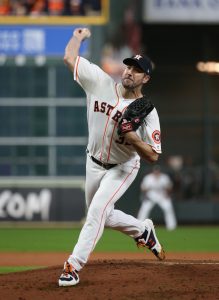
Verlander has only made one appearance in the past two years because of an elbow injury that required a September 2020 Tommy John surgery. When last we saw him at full strength, the 2011 AL MVP was as good as ever. He tossed 223 innings of 2.58 ERA ball in 2019, winning his second career Cy Young award and helping lead Houston to a pennant.
That kind of top-of-the-rotation production is nothing new for Verlander, an eight-time All-Star and future Hall of Famer. He’d posted a 2.52 ERA across 214 frames the year prior, and he has an incredible nine seasons of 200+ innings with an ERA below 3.50 on his resume. Simply put, few pitchers can match the combination of workload and productivity Verlander has put together year in and year out for the bulk of his career.
Of course, there’s real risk Verlander doesn’t regain his peak form coming off two lost seasons. He’ll turn 39 years old in February, so there’d be fairly significant downside even if he weren’t coming off a major arm procedure. The ceiling when investing in a player of this caliber is immense, though, a fact that’s reflected in the seemingly robust interest he generated during his brief stay on the open market. Not only were a few of the game’s top spenders rumored to be involved, Verlander’s deal fairly handily tops the two-year, $40MM figure MLBTR projected entering the offseason — particularly once one factors in the player-friendly opt-out provision.
The Astros determined that to be a risk worth taking, a justifiable stance given that they’re squarely amidst a win-now window. Even facing Verlander’s potential departure, starting pitching wasn’t exactly a need. Despite Verlander missing all of 2021, the Astros’ starting staff ranked fifth in ERA (3.60), albeit with middle-of-the-road strikeout and walk numbers. Zack Greinke looks likely to sign elsewhere this offseason, and the team could look into trades involving Jake Odorizzi. Even still, Houston would bring back Lance McCullers Jr., Framber Valdez, Luis García, José Urquidy and Cristian Javier — one of the stronger rotation cores around the league.
A healthy Verlander is the kind of player teams will find room for even in the absence of an ostensible positional need though. Not only should he help the team manage the workloads of the younger arms, the front office is no doubt envisioning the possibility of rolling him back out as a Game One playoff starter. They’re as familiar as anyone regarding Verlander’s recovery process, current form, and work habits. They clearly feel strongly about his ability to bounce back.
In doing so, the Astros will indirectly forfeit a draft pick. While they won’t be stripped of a pick for signing one of their incumbent free agents, they’ll lose the right to collect a compensatory pick in the 70-75 overall range — which they would’ve received had Verlander signed elsewhere after rejecting Houston’s qualifying offer. That’s a small price to pay, even for a team whose farm system has been hit hard by the punishment from the 2017 sign-stealing scandal, given their current competitive window.
The Astros would stand to add a compensation pick in the event Carlos Correa departs. Like Verlander, Correa also rejected a QO, and the star shortstop is in position for a mega-deal as the top player on the market. The Astros’ previous efforts to re-sign Correa haven’t come particularly close to getting anything done, and Verlander’s return would seem to make the chances of Correa coming back even more remote.
Houston’s 2022 commitments now sit around $162MM, in the estimation of Jason Martinez of Roster Resource. That’s after accounting for estimated salaries for arbitration-eligible players but before considering the possibility of a Correa contract. Signing Correa would no doubt push the 2022 tab well above this past season’s $188MM franchise-record player expenditure (via Cot’s Baseball Contracts). Houston was prepared to enter the 2020 season with a payroll above $200MM before the pandemic necessitated a shortened season with prorated salaries. If owner Jim Crane is willing to go to that level again, then there might be room in the budget for a more earnest Correa pursuit, but it remains to be seen if that kind of spending is on the table.
Regardless of where the Astros go from here, re-signing Verlander serves as a reminder that Correa’s free agency doesn’t mark the end of the club’s competitive window. In addition to a rotation that has as much upside as any in the league, the Astros will roll into 2022 with a lineup that includes Alex Bregman, José Altuve, Yordan Álvarez, Yuli Gurriel, Michael Brantley and Kyle Tucker. They’ll look to hold off the Mariners, Angels and Rangers — all of whom have already been or are expected to be very aggressive this offseason — at the top of the AL West. The A’s look likelier to go in the opposite direction, but Oakland’s current core has been strong enough to compete over the past couple seasons, and it remains to be seen whether they’ll tear the roster down to its studs. All in all, it should be one of the game’s more entertaining and competitive divisions in 2022.
The Verlander signing also paints a picture of what has been a strong rotation market in the early going. The Angels took a similar short-term, high-salary upside flier on Noah Syndergaard yesterday — one day after the Tigers went to five years with an opt-out to land Eduardo Rodríguez. Teams like the Angels, Braves, Blue Jays, Yankees, Red Sox and White Sox were all linked to Verlander in recent days, and it stands to reason those clubs remain motivated to add rotation upside via free agency or trade. Max Scherzer, Kevin Gausman, Robbie Ray, Marcus Stroman and Carlos Rodón are among the numerous starting pitchers still on the free agent market who have recently posted top-of-the-rotation type of production.
Ben Verlander of Fox Sports first reported Justin Verlander’s agreement with the Astros. Mark Berman of Fox 26 reported that Verlander’s 2022 salary would be $25MM and reported the presence of the 2023 player option. Jon Heyman of the MLB Network reported that the option was also valued at $25MM.
Image courtesy of USA Today Sports.
Final Qualifying Offer Decisions
Giants first baseman Brandon Belt was the only one of the fourteen players tagged with the one-year, $18.4MM qualifying offer this offseason to accept the deal, reports Mark Feinsand of MLB.com (Twitter link). That means players like Justin Verlander, Freddie Freeman and Robbie Ray have all declined the offers, as had been anticipated.
Verlander was the only one of the aforementioned trio who ever looked like a realistic possibility to accept the QO, as he’s coming off a season lost to Tommy John surgery recovery and turns 39 years old in February. Astros owner Jim Crane told reporters last month that Verlander was looking for a contract “of some length,” though. He and his representatives found that multi-year pact on the open market, as Verlander quickly re-signed with Houston on a two-year guarantee with an opt-out possibility after 2022.
Freeman and Ray, meanwhile, made the very easy call to turn the QO. They’re among the top handful of players in this year’s class, with each likely to land a five or six-year deal that pushes well north of $100MM. There was no incentive for either player to entertain the possibility of taking a QO, since declining has no impact on their ability to continue to negotiate a longer-term arrangement with their incumbent clubs, as Verlander did with the Astros.
Here’s a full rundown of the players who rejected the qualifying offer (all other decisions had been previously reported):
- Nick Castellanos, Reds
- Michael Conforto, Mets
- Carlos Correa, Astros
- Freddie Freeman, Braves
- Raisel Iglesias, Angels
- Robbie Ray, Blue Jays
- Eduardo Rodríguez, Red Sox (later signed with Tigers)
- Corey Seager, Dodgers
- Marcus Semien, Blue Jays
- Trevor Story, Rockies
- Noah Syndergaard, Mets (later signed with Angels)
- Chris Taylor, Dodgers
- Justin Verlander, Astros (to re-sign with Astros)
Brandon Belt Accepts Qualifying Offer With Giants
Brandon Belt is staying in San Francisco, as the MLB Players Association announced this evening that he has chosen to accept the Giants’ qualifying offer. He’ll play next season on an $18.4MM salary.
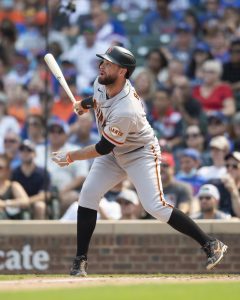
Belt has spent his entire career in black and orange, first joining the organization when they selected him in the 2009 draft. The left-handed hitter was in the big leagues by 2011, and he’s spent the past decade as the Giants’ primary first baseman. He signed a long-term extension in April 2016 to guarantee he’d spend at least his first eleven major league seasons in the Bay Area, and he’s now set to return for a twelfth.
This offseason would’ve been presented Belt with his first opportunity to test free agency. After ten days for he and his representatives at Excel Sports Management to explore the market, he’s decided to forego that possibility. Instead, he’ll return to a franchise and city with which he’s clearly comfortable on a strong one-year pact. The current collective bargaining agreement prohibits teams from tagging a player with a QO more than once in his career. Assuming no changes to that provision in the next CBA, Belt is on track to hit free agency next winter without draft pick compensation attached.
That’d only be necessary, of course, if Belt and the Giants don’t agree on another long-term deal within the next twelve months. Players and teams are free to negotiate an extension even after a player accepts the QO. That’s not common, but it’s also not unheard of. Over the 2019-20 offseason, the White Sox and José Abreu lined up on a three-year deal just eight days after Abreu had accepted Chicago’s qualifying offer. Belt’s reps have recently discussed the possibility of a multi-year pact, and today’s development wouldn’t foreclose them continuing to do so.
Regardless of whether a long-term deal gets done, the Giants are surely thrilled to welcome Belt back in 2022. Not only is he a respected member of the organization, he’s coming off perhaps the best two-year stretch of his career. Going back to the start of 2020, the 33-year-old owns a .285/.393/.595 line with 38 home runs across 560 trips to the plate. Among those with 500+ plate appearances, only Juan Soto and Bryce Harper have topped Belt’s offensive output, by measure of wRC+.
As he has throughout his career, Belt has backed up that bottom line production with elite batted ball metrics. He’s been in the top six percent of the league in each of the past two seasons in Statcast’s barrel rate — essentially how often he makes hard contact at the optimal angle for extra-base impact. His overall hard contact rate and average exit velocity are also above par. And Belt gets to that authoritative contact without selling out for power. His 24.8% strikeout rate over the past two seasons is only a tick higher than the league average, while he’s drawn walks in a fantastic 13.9% of his appearances in the batter’s box.
While there’s little question about Belt’s status as an impact middle-of-the-order presence, his profile isn’t without red flags. Because he signed a mid-career extension, his first trip to the open market was set to come in advance of his age-34 campaign. Teams have become increasingly reluctant to dole out lofty multi-year deals for players through their mid-30’s, and that’s especially true of defensively-limited boppers. And while Belt has been great when healthy, he’s also been dinged up fairly frequently throughout his career.
Since emerging as a regular in 2012, Belt has only topped 500 plate appearances in four seasons. He’s dealt with repeated concussion issues in the past, and he’s gone on the injured list four times within the last two years alone. None of those issues resulted in long-term absences during the season, but Belt underwent right heel surgery last offseason and wasn’t able to partake in the Giants’ NL Division Series in 2021 after fracturing his left thumb on a hit-by-pitch in late September.
Between his age, position and injury history, Belt apparently wasn’t generating such interest over the past ten days that he felt compelled to pass up on a strong one-year offer. He’ll return to the middle of the order on a Giants team that’ll enter the season with astronomical expectations after winning a franchise-record 107 games. He’ll be joined by fellow franchise mainstay Brandon Crawford, but the club will have their work cut out for them in replacing the production and presence of Buster Posey, after the likely future Hall of Famer announced his retirement two weeks ago.
Belt’s return adds $18.4MM to the 2022 books, but that’s well within their range of comfortability. The front office was content with the possibility of Belt returning at that price when they made the QO, with good reason. Even after factoring in Belt’s return, San Francisco has just $97MM in estimated commitments, according to Jason Martinez of Roster Resource. That’s well shy of the franchise’s $200MM heights, leaving plenty of room for president of baseball operations Farhan Zaidi and his staff to add to a roster that’s facing the potential departure of four-fifths of its 2021 starting rotation.
Joel Sherman of the New York Post first reported the news.
Image courtesy of USA Today Sports.
Angels Designate Junior Guerra For Assignment
The Angels announced they’ve designated reliever Junior Guerra for assignment. The move opens a spot on the 40-man roster for the recently-signed Noah Syndergaard.
Guerra had been eligible for arbitration. Had the Angels tendered him a contract, he’d have been in line for a salary in the $1.3MM range, in the estimation of MLBTR contributor Matt Swartz. Coming off a disappointing 2021 campaign, Guerra looked like a non-tender candidate. Today’s designation will indeed function as something of an early non-tender, as he’ll be eligible for minor league free agency if he passes through waivers unclaimed.
From 2016-19, Guerra had a generally solid run as a swingman with the Brewers. He’s scuffled over the past couple seasons since leaving Milwaukee, though. While Guerra posted a solid 3.04 ERA over 23 2/3 frames with the D-Backs in 2020, his peripherals were less impressive. Arizona released him after the season, and the Angels signed the veteran to a minor league deal in January.
Guerra cracked the season-opening roster and spent the entire year in Anaheim, but he didn’t fare particularly well. The 36-year-old pitched to a career-worst 6.06 ERA over 65 1/3 innings of long relief. That came with a subpar 19.9% strikeout percentage and a far too high 15% walk rate, Guerra’s third consecutive season issuing free passes to more than 10% of opposing hitters.
Angels Sign Noah Syndergaard
The first of what Angels fans hope will be multiple rotation additions is in the books, as the Halos announced a one-year agreement with free-agent righty Noah Syndergaard. The 29-year-old will reportedly collect a $21MM salary in 2022 before re-testing the free agent market next offseason.
Syndergaard received an $18.4MM qualifying offer from the Mets last week, and his agreement with the Angels effectively amounts to rejecting that offer. As such, the Angels will forfeit their second-highest selection in next year’s draft. The Mets, meanwhile, will receive a compensatory draft pick after the completion of Competitive Balance Round B (typically in the No. 75 overall range).

Syndergaard has scarcely pitched since the completion of the 2019 season thanks to 2020 Tommy John surgery and a series of setbacks in his recovery this year. He did make it back to the mound for two innings of bullpen work with the Mets late in the 2021 campaign, at least demonstrating that he was healthy enough to pitch in a big league game.
The general hope had been that he’d be recovered from surgery and rejoin the Mets’ rotation around June, but Syndergaard’s recovery was shut down on May 27 due to inflammation in his surgically repaired elbow. He resumed throwing about six weeks later but was again set back — this time by a positive Covid-19 test.
When healthy, Syndergaard has proven to be one of the more dynamic pitchers in the game. The 6’6″, 242-pound righty is one of the more physically imposing pitchers in MLB and, at his peak, boasted the velocity to match that frame. Syndergaard averaged a blistering 98.1 mph on his heater from 2015-19, pitching to a combined 3.31 ERA and 3.37 SIERA along the way. The big righty finished fourth in NL Rookie of the Year voting in ’15 and finished eighth in Cy Young voting during an All-Star 2016 season.
At his best, Syndergaard combines that elite velocity with high-end strikeout rates and plus walk rates. He’s fanned a hearty 26.4% of career opponents against just a 5.6% walk rate — including a career-best 29.3% strikeout rate in that All-Star 2016 season. Syndergaard has never walked more than 6.1% of his opponents in a given season, and he’s also kept the ball on the ground at an above-average 49% clip in 718 career innings.
It’s that lack of innings, of course, that is the primary red flag on Syndergaard at present. In addition to the 2020 Tommy John surgery and series of 2021 setbacks, Syndergaard was limited to just seven starts in 2017, owing to a torn lat muscle. He also missed time in 2018 due to some ligament damage in his pitching hand.
With that context in mind, Syndergaard falls in line with some recent rotation additions by the Angels: high-upside, high-risk arms on a one-year deal (e.g. Matt Harvey, Julio Teheran). That comes in spite of a new general manager — Perry Minasian replaced Billy Eppler to begin the 2020-21 offseason — though one would imagine that this is the first of multiple pieces Minasian and his staff will add this winter. It remains possible that the Angels will add a starter on a multi-year deal. Still, the Angels have had longstanding rotation issues but nevertheless repeatedly eschewed long-term deals for pitchers, suggesting at least some aversion to such deals on owner Arte Moreno’s behalf.
To be fair, none of the short-term rotation additions the Angels have made in recent years carry the same upside as Syndergaard on a one-year contract. Minasian has vowed to “significantly” improve his team’s starting staff in 2022, and a healthy Syndergaard would be a clear step in that direction. He’ll join Shohei Ohtani atop the rotation for the time being, but that duo would require greater workload management than most top-of-the-rotation pairs throughout the league. As such, it wouldn’t be a surprise to see the Angels also target some more reliable bulk innings with their next addition — be it on the free-agent market or via the trade market.
Beyond Ohtani and Syndergaard, the Angels have plenty of promising arms but little in the way of established MLB hurlers. Young lefties Patrick Sandoval and Jose Suarez both showed well in 2021 but tallied fewer than 100 frames apiece. Fellow southpaw Reid Detmers was a first-round pick in 2020 and is viewed as one of baseball’s top pitching prospects, but he was hit hard in his 2021 MLB debut. Former top prospect Griffin Canning ought to get another look after some injuries and struggles have deflated his stock, and righty Jaime Barria gives the Angels a solid back-of-the-rotation option as well.
With a return to form by Syndergaard and another healthy season of Ohtani, it’s easy to see this staff being the best the Angels have had in recent memory. At the same time, that’s a lot to bank on. Given the injury risk strewn throughout this group and the general attrition rate of young pitchers, it’s equally plausible that the Angels could again find themselves scrambling to piece things together. Syndergaard is quite arguably as great an upside play as there is on this offseason’s market, but the Angels still have some heavy lifting to do on the rotation front if they hope to finally piece together the reliable staff that has eluded them in recent years.
The Syndergaard signing gives the Angels six guaranteed contracts on next year’s books, totaling a hefty $129.95MM just among that group. A small arbitration class works in their favor and brings the team’s projected payroll into the $150MM range, however, even after accounting for a slate of pre-arbitration players to round out the roster. That should leave room for at least one more significant addition on the starting staff (perhaps two, if one comes via trade).
As for the Mets, the loss of Syndergaard and the potential loss of fellow free agent Marcus Stroman — another reported Angels target — leaves them with ample questions in their own rotation. Jacob deGrom is the game’s best pitcher but missed significant time due to injury in 2021. Carlos Carrasco‘s brief Mets tenure has been punctuated by injury troubles, and Taijuan Walker wilted after a terrific first half. The Mets have younger options in the rotation themselves (e.g. David Peterson, Tylor Megill), but they’ll surely be on the hunt for upgrades after being spurned by Syndergaard.
Jon Morosi of MLB.com reported the sides were nearing agreement on a contract. Jeff Passan of ESPN reported the sides had agreed on a one-year, $21MM deal.
Photo courtesy of Imagn/USA Today Sports.
Pirates Release Three Players
The Pirates announced they’ve released three players: right-hander Tanner Anderson, catcher Taylor Davis and utilityman Phillip Evans. Pittsburgh’s 40-man roster now sits at 37.
Anderson and Davis each made it to the majors at the very tail end of the regular season. Anderson was selected to the big league club on September 30. He made his first and only appearance of the season that night, tossing five innings of two-run ball out of the bullpen. It was very brief homecoming for the 28-year-old, who began his MLB career with the Bucs in 2018.
While Anderson has now earned a major league call in three separate seasons, he has just 12 appearances and 38 2/3 cumulative innings to show for it. Anderson owns just a 5.82 ERA in that limited time, but he has a 4.52 mark in more than 200 career Triple-A frames. That includes a 4.01 ERA over 51 2/3 innings between the A’s and Pirates’s top affiliates in 2021, albeit with an unexciting 12.3% strikeout rate.
Davis only made two MLB appearances, collecting a couple of singles in five at-bats. He’s appeared in parts of four major league campaigns but hasn’t tallied more than 20 plate appearances in any year. The 31-year-old spent most of this past season with the Triple-A affiliates of the Orioles and Bucs, hitting .248/.344/.325 between the two stops.
Evans has the most big league time of this group. He played in just under half the Pirates’ games in 2021, picking up 247 plate appearances while starting games at all four corner spots on the diamond. Evans drew walks at a robust 11.3% clip but didn’t make a huge offensive impact. He popped just five home runs en route to a .206/.312/.299 slash line.
Nationals Re-Sign Jefry Rodriguez To Minor League Deal
The Nationals have brought right-handers Jefry Rodriguez and Luis Reyes back to the organization on a pair of minor league deals, tweets Jesse Dougherty of the Washington Post.
Rodriguez, 28, has spent time in Majors in parts of three seasons, including a pair of separate stints with the Nats. He’s totaled 123 innings of 5.34 ERA ball between Washington and Cleveland, striking out 16.8% of his opponents against a 13.7% walk rate that is far too high. He tossed 24 1/3 frames for the Nationals in 2021, yielding an unsightly 16 runs on 25 hits and 17 walks with 20 strikeouts.
Rough big league numbers notwithstanding, Rodriguez posted strong numbers in the middle levels of the minors and has a 4.29 ERA in 100 2/3 innings of Triple-A ball. His 21.3% strikeout rate and 11.6% walk rate in Triple-A still leave something to be desired, but Rodriguez has posted decent run-prevention numbers throughout his minor league tenure and still sits around 95 mph with his heater.
The 27-year-old Reyes will give the Nats some innings in the upper minors as well. He’s spent parts of eight minor league seasons in the Nationals organization since signing as a teenager out of the Dominican Republic in 2012. Reyes split the 2021 season between Double-A and Triple-A, pitching to a combined 5.19 ERA in 126 2/3 innings. He’s spent his entire pro career to this point in the same organization and will hope for an opportunity to make his debut at some point in the 2022 season.
Both Rodriguez and Reyes return as depth options for a Nationals club that is in clear need of stockpiling just that. With Max Scherzer now a free agent, Joe Ross ending the season with a slight UCL tear (which did not require surgery) and both Stephen Strasburg and Patrick Corbin coming off disappointing 2021 campaigns, Washington’s once-vaunted rotation is rather suddenly a collection of question marks.
The Nats will likely give young righty Josiah Gray plenty of opportunity in 2022, and it’s all but a certainty that they’ll add a veteran starter or two this winter. Still, retaining some familiar organizational depth makes some sense for them, and they’ll probably be on the lookout for other rotation hopefuls they can bring into the fold on non-guaranteed pacts in addition to whatever Major League deals are signed. The Nats also brought back lefty Sean Nolin on a minor league deal earlier this month.
Braves Sign Manny Pina
The Braves announced Monday that they’ve signed veteran catcher Manny Pina to a two-year contract worth $8MM. (Atlanta is one of the few organizations that publicly discloses financial terms.) Pina will earn $3.5MM in 2022 and $4.5MM in 2023. The contract also has a $4MM club option for the 2024 season, which does not come with a buyout. Pina is a client of Rep 1 Baseball.
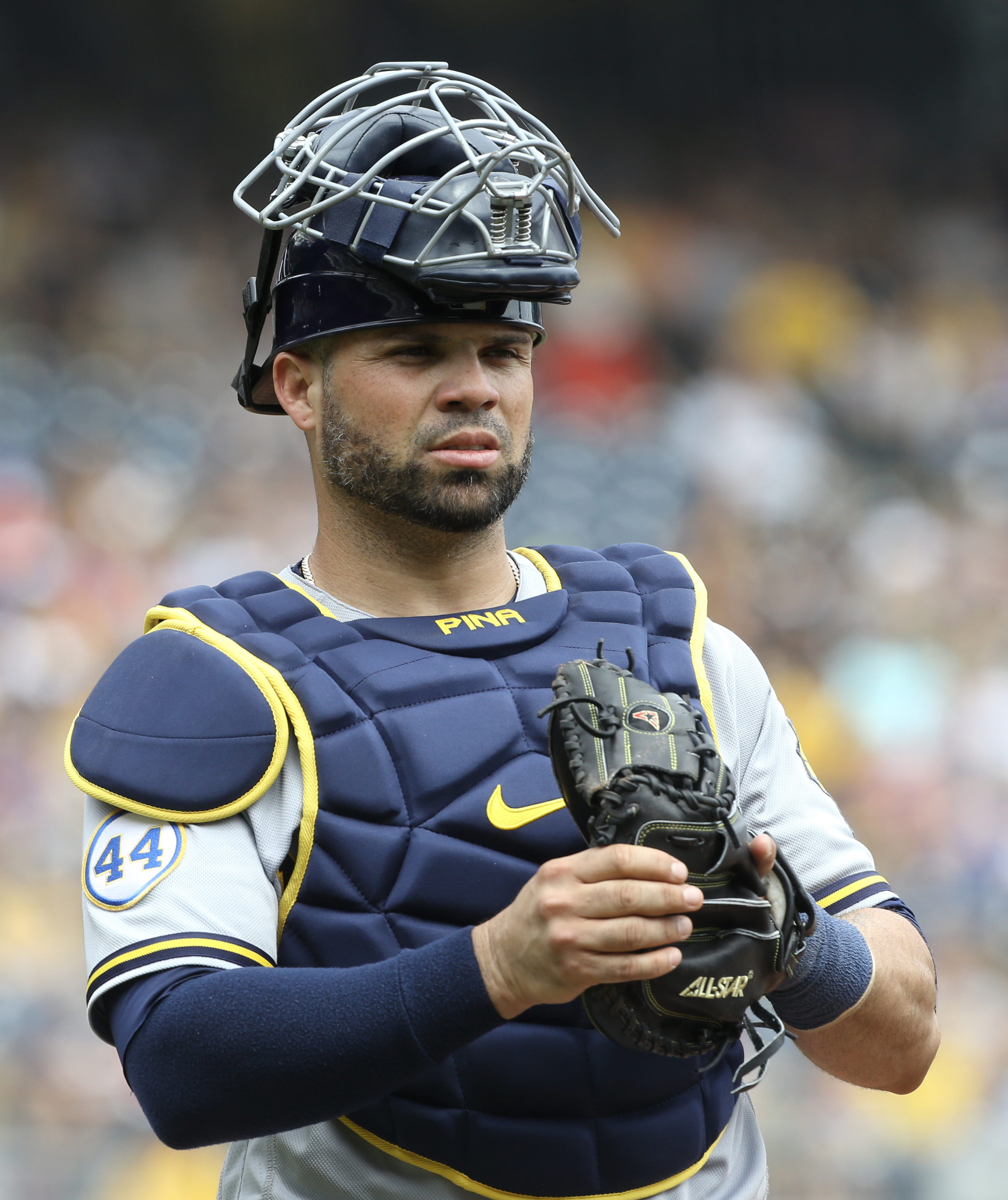
It’s at least a moderate surprise to see Atlanta ink another catcher. The Braves already extended veteran Travis d’Arnaud on a two-year, $16MM contract late in the season, giving them a veteran option to provide a bridge to up-and-coming prospects William Contreras and Shea Langeliers. With Pina now on board, both Contreras and Langeliers have veteran roadblocks in their way on the big league roster.
Langeliers, who has just five games of Triple-A ball under his belt, likely wouldn’t have been an option until late in the 2022 season at the very earliest anyhow, but Contreras has already gotten his feet wet in the Major Leagues and seemed to be a candidate to break camp with the team behind d’Arnaud next year. The addition of Pina, on a two-year deal no less, makes that alignment unlikely anytime in the near future — unless the Braves opt to carry three catchers on the roster (which seems possible with the likely addition of a designated hitter in the National League). The added organizational depth, however, protects the Braves in the event of another injury to d’Arnaud and also frees the front office to at least be more open to trade scenarios involving their young backstops this winter.
In Pina, Atlanta is adding a well-regarded defensive catcher who has some pop in his bat but struggled to hit for average this past season, albeit due to a fluky low .162 average on balls in play. The 34-year-old Pina (35 next June) hit .189/.293/.439 with a career-high 13 home runs in 208 plate appearances this past season. Since establishing himself as the backup catcher with the Brewers back in 2016, he’s given Milwaukee 1209 plate appearances of .245/.314/.415 offense.
With the glove, Pina has been credited with a whopping 38 Defensive Runs Saved through just 2407 innings over the six-year run with the Brew Crew. He consistently draws plus framing marks and boasts a massive 35% caught-stealing rate, which is well north of the league average of 28% over the course of his MLB career.
Pina’s $3.5MM salary next season brings the Braves to $80.5MM in guaranteed contracts to seven players, plus a projected slate of $49.9MM in arbitration salaries, per MLBTR contributor Matt Swartz. Of course, that number doesn’t include franchise icon Freddie Freeman, who has been extended an $18.4MM qualifying offer he’s sure to reject. Freeman is a free agent for the first time in his illustrious career, but the Braves figure to make a strong push to retain him even after he fields interest from other clubs around the league.
This past season’s $131.4MM Opening Day payroll was a franchise record, but president of baseball operations Alex Anthopoulos has already indicated that ownership will increase that figure for the 2022 season.
Photo courtesy of Imagn/USA Today Sports.
Marlins Acquire Louis Head From Rays
The Marlins have acquired right-hander Louis Head from the Rays in exchange for a player to be named later or cash considerations. Miami has designated outfielder Brian Miller for assignment in a corresponding move to create roster space.
Head made his MLB debut in 2021 and impressed in terms of bottom-line numbers, posting a 2.31 ERA over 35 innings out of Tampa’s bullpen (with two “starts” but as an opener). Advanced metrics like a 4.03 SIERA and 23.9% strikeout rate weren’t as impressive and Head did benefit from a .216 BABIP, but he also did a very good job of limiting hard contact.
Perhaps moreso than his solid numbers, Head might be the poster child for the Rays’ penchant for shuttling pitchers back and forth from Triple-A. Head was called up and sent down a whopping 12 times last season, as the Rays constantly looked to move fresh arms in and out of their bullpen.
Head turns 32 in April, and was originally an 18th-round draft pick for Cleveland in 2012. After eight seasons in the minors with the Guardians and Dodgers, Head was on the verge of leaving baseball entirely before catching on with the Rays this past offseason. He’ll now go to Miami with presumably a better chance of sticking in the majors for a slightly more extended period of time, adding another live arm to a Marlins bullpen that was quietly pretty solid in 2021.
From the Rays’ perspective, they have the relief depth on paper to account for Head’s departure, and Tampa now also opens up another 40-man roster spot before Friday’s deadline to set rosters in advance of the Rule 5 draft. The Rays made another roster clearance-type of deal yesterday, sending utility infielder Mike Brosseau to the Brewers.
Miller also made his Major League debut this past season, receiving 11 plate appearances over five games. Miller was selected 36th overall in the 2017 draft, but a modest .284/.338/.360 slash line over 1759 PA in the Marlins’ system kept him from truly establishing himself as a part of the team’s future. Miller does boast plenty of speed, which has led to 119 stolen bases out of 155 chances and the defensive versatility to handle any of the three outfield positions.
NPB’s Hiroshima Carp Sign Nik Turley
The Hiroshima Carp of Nippon Professional Baseball signed left-hander Nik Turley to a one-year contract last week, the team announced. Turley will receive 73 million yen plus incentives (roughly $641K) as well as a signing bonus of 11 million yen (a little under $97K).
Turley spent the 2021 season pitching for the White Sox Triple-A affiliate in Charlotte, posting a 5.02 ERA and 33.1% strikeout rate over 43 relief innings. Turley’s work was hampered by an 11.6% walk rate, though of the 24 earned runs Turley allowed over his 43 appearances, 15 of those runs were surrendered over just four very rough games. The Sox never called Turley up to the majors at any point during the year, and the southpaw elected to become a free agent in October.
The 32-year-old has been pitching long enough that his pro career began in a draft round that no longer exists, as Turley was a 50th-round pick for the Yankees way back in 2008. Turley has tossed 39 1/3 innings (with a career 7.78 ERA) at the Major League level, with 17 2/3 frames for the Twins in 2017 and then 21 2/3 innings for the Pirates in 2020. In between those two seasons, Turley missed time due to an 80-game PED suspension, and then recovering from Tommy John surgery.
Turley’s 12 pro seasons have taken him to six different MLB organizations and a brief stint in indy ball, and he’ll now head to Japan for a new chapter of his career. Despite his lack of big league success, Turley has consistently drawn interest due to his high spin rates on his curveball and four-seamer, and his strikeout rates have increased as he has gradually transitioned from starting pitching to bullpen work. It isn’t out of the question that Turley could see some starting work again with the Carp, depending on how the club intends to use him.