
Pitching Rumors: Hand, Jeffress, Anibal, Teheran
The Dodgers have been linked to free-agent lefty Brad Hand over the past week or so, but they’re more on the “periphery” of his market, writes Fansided’s Robert Murray. The Mets are still in talks with Hand and his representatives, while both the Astros and Blue Jays are also involved to varying extents. Reports that Hand was closing in on a deal with the Mets last week proved a bit premature, although it seems they’re still squarely in the mix for the former All-Star closer. As for the Dodgers, even if they’re not major players in the Hand market at the moment, Murray suggests they’d still like to add another reliever to the bullpen.
A few more notes on the free agent pitching market as it starts to percolate…
- MLB.com’s Mark Feinsand tweets that Jeremy Jeffress is on the radar of several clubs, including the Red Sox, Cubs, Astros, Dodgers, Mets, Phillies, Nationals and Blue Jays. It’s a wide field, though the level of interest of each team surely varies. The 33-year-old Jeffress was dominant back in 2018 but hasn’t replicated that form since. He did post an aesthetically pleasing 1.54 ERA and 54.4 percent grounder rate in 23 1/3 innings with the Cubs last year, but the rest of his numbers were something of a mess. Jeffress’ 13.6 percent walk rate was his worst since establishing himself as a consistent presence in MLB bullpens, while his 19.3 percent strikeout rate was 10 percent lower than his 29.8 percent clip from that brilliant 2018 campaign. Last year also saw Jeffress post career-worsts in average fastball velocity (93.3 mph), average exit velocity (89.9 mph) and hard-hit rate (45.6 percent). If Jeffress can rediscover his ’18 form, he’d be a premium late-inning option, but last year’s ERA was propped up by a .161 average on balls in play that is miles south of his career .308 mark.
- Anibal Sanchez and Julio Teheran will be throwing in front of scouts during a showcase today, and several teams will have personnel on hand. The list of confirmed attendees includes the Rays (as per Marc Topkin of the Tampa Bay Times), Twins (SKOR North’s Darren Wolfson), Marlins (MLB.com’s Christina De Nicola), and Mets (the New York Post’s Mike Puma).
Nationals Avoid Arbitration With Trea Turner, Juan Soto
5:02pm: Washington has also settled with outfielder Juan Soto, who will earn $8.5MM, Joel Sherman of the New York Post tweets. The 22-year-old phenom still has three more seasons of control left after 2021.
4:33pm: The Nationals and star shortstop Trea Turner have agreed to a $13MM salary for next season, Mark Zuckerman of MASNsports.com was among those to report. Turner is a client of CAA Sports.
This settlement falls somewhere in the middle of MLBTR’s $9.4MM to $16.6MM arbitration projection for Turner, who has been stellar for the Nationals dating back to 2016. Last year may have been Turner’s best season yet, as the speedster batted .335/.394/.588 with 12 home runs and a dozen stolen bases in 259 plate appearances. The 27-year-old finished fourth among National League position players in fWAR (2.7) and seventh in wRC+ (157).
Turner is likely to stay in Washington for at least another couple of seasons, as he has another year of arb control left after 2021. However, based on the impact Turner has made in their uniform, it wouldn’t be a surprise to see the Nationals attempt to extend him before he’s eligible for free agency.
Nationals, Josh Bell Avoid Arbitration
The Nationals and newly-acquired first baseman Josh Bell avoided arbitration today, coming to an agreement on a one-year, $6.3MM contract, per USA Today’s Bob Nightengale (via Twitter). Bell made $4.8MM in 2020, his first season of arbitration eligibility. The Scott Boras client will be a free agent following the 2022 season.
Our initial projections had Bell set to make between $5.1MM and $7.2MM through arbitration, so the Nationals might have earned themselves a little extra spending money by coming to an early accord. Regardless, Bell expects to have a better year in 2021 after a relatively rough campaign in the truncated 2020 season.
Even after slashing .226/.305/.364 in 223 plate appearances this year, Bell still owns a career line of .261/.349/.466. A strikeout rate of 26.5 percent was particularly high compared to his career average of 19.0 percent. Assuming a regression to his career means, Bell should provide the Nats with efficient production in 2021 given his salary. Besides, with Juan Soto and Kyle Schwarber figuring to hit somewhere close and perhaps on either side of Bell in Washington’s lineup, Bell should benefit from the ambient potency.
Soto and Trea Turner represent the Nationals only remaining arbitration cases.
Notable International Signings: 1/15/21
The 2020-21 international signing period is officially underway, and though this signing period is open until Dec. 15, 2021, many of the big names have already signed. Teams have long since lined up deals with newly eligible teenage players, so the news today largely represents confirmation of what was anticipated. Still, it’s a day of no small moment, particularly for the young men embarking upon professional careers.
Let’s round up some of the most notable signings of the day. Most of these agreements have been known for awhile, as both Baseball America’s Ben Badler (signings tracker; scouting links) and MLB.com’s Jesse Sanchez (Twitter feed; rankings) have listed each club’s expected landing spot and approximate signing bonus on their rankings for months. You can find each team’s total bonus pool and other information on the process right here. Check the above links for further information and other signings. Despite today’s announcements, many of these deals won’t become official for even a couple of weeks, notes Sanchez. Here are a few key deals:
- Yoelqui Céspedes, OF, White Sox: The half-brother of outfielder Yoenis Céspedes, the Cuban outfielder joins a strong international tradition in Chicago with the White Sox, who currently field Cuban stars such as reigning AL MVP Jose Abreu, centerfielder Luis Robert, and third baseman Yoan Moncada. MLB.com has Céspedes ranked as the top international prospect in this class thanks to being a “a five-tool player with above-average tools across the board.” Baseball America is slightly less bullish, putting him at No. 12 on their board, noting that the pandemic limited opportunities for scouting. The 23-year-old will be one of the older prospects from this class to sign, and though he has the ability to play center, Robert’s presence in Chicago means he is probably ticketed for right. The White Sox also signed Cuban hurler Norge Vera for $1.5MM. Vera came in at No. 15 on MLB.com’s rankings. Fangraphs has Cespedes as Chicago’s new No. 25 ranked prospect, and Vera at No. 14.
- Armando Cruz, SS, Nationals: Cruz officially joined the Nationals today for the most money the Nationals have ever paid out to single player during the international signing period, with The Athletic’s Britt Ghiroli (via Twitter) pegging the final number at $3.9MM. BA writes in their scouting report, “He’s a defensive wizard with phenomenal hands and a strong arm, combining the ability to make acrobatic, highlight plays along with the internal clock and game savvy well beyond his years.” The Nationals signed 11 international players in total, notes Ghiroli.
- Pedro Leon, OF, Astros: Houston will pay $4MM to add MLB.com’s 7th-ranked international prospect to their system, per Sanchez. Baseball America has Leon as the top prospect of his class. Like Céspedes, the Cuban outfield is one of the older members of this class, but he brings plus speed, power, and the ability to stick in centerfield.
- Manuel Beltre, SS, Blue Jays: The Blue Jays added perhaps the most advanced hitter of the class in Beltre. MLB.com has Beltre as the No. 24 ranked prospect in the class, signing for $2.6MM, though Shi Davidi of Sportnet.ca (via Twitter) pegs the final number to be closer to $2.35MM. The Dominican shortstop could ultimately end up at second base, Sanchez writes, but he has arm enough to stay at short.
- Pedro Pineda, OF, Athletics: MLB Insider Jon Heyman (via Twitter) has Pineda signing with Oakland for less than $4MM, but the sum isn’t likely to fall far below that threshold. Baseball America has Pineda as the No. 11 ranked prospect in this class, writing, “Pineda is a strong, athletic, physical center fielder with a loud tool set and a power/speed threat. He has excellent speed, a fast bat and the power potential to hit 25-plus home runs.”
Several other well-regarded prospects also secured bonuses of $2MM or more, with the specifics provided here by Sanchez:
Corey Kluber, Steve Cishek, Anthony Swarzak Throw For Teams
Jan. 14: ESPN’s Buster Olney tweets that Kluber’s market could come together rather quickly with one throwing session for teams in the books. He’s not expected to require a second showcase to further demonstrate his health.
Jan. 13: Free-agent right-hander Corey Kluber held a showcase for interested teams today, and Marc Topkin of the Tampa Bay Times tweets that relievers Anthony Swarzak and Steve Cishek both threw for teams as well. (All three are clients of Jet Sports Management, so it’s natural that they’d host the workout together.) As many as 25 teams were present, per The Atheltic’s Britt Ghiroli (Twitter link).
ESPN’s Jeff Passan notes that Kluber’s velocity topped out at 90 mph, though given where he is in the rehab process from last year’s injuries, it wasn’t expected that he’d be up to peak velocity just yet. Eric Cressey, whose strength and conditioning facility hosted the showcase, told ESPN’s Jesse Rogers yesterday that Kluber was at 87-89 mph in the prior session. Cressey suggested that Kluber is already ahead of many pitchers who’ve not yet ramped up their throwing to this point. Kluber averaged 92 mph on his heater back during his excellent 2018 campaign.
The full list of teams in attendance isn’t known, although given that this was an open look at a two-time Cy Young winner and a pair of relievers with considerable late-inning MLB experience, it’d be more notable to learn which few teams weren’t in attendance than to know which clubs were. Still, it’s at least worth noting that each of the Mets, Yankees, Nationals, Red Sox, Rays, Twins, Cubs, Rangers, Marlins, Tigers, Pirates, Blue Jays, Diamondbacks and Indians were all reported to be attending the showcase. Obviously, it’s not an all-encompassing list.
Broadly speaking, if Kluber is indeed at a point in his rehab that inspires confidence, one would imagine the market for him will be robust. The extent to which clubs are willing to bet on a guaranteed contract on the two-time Cy Young winner will vary, but he should easily command a big league deal with plenty of incentives on top of whatever base the highest bidder will commit.
Kluber may be something of a lottery ticket at this point, but few gambles come with such pronounced upside. From 2014-18, the right-hander was one of the game’s premier pitchers, working to a combined 2.85 ERA while striking out 28.5 percent of the hitters he faced against just a 5.2 percent walk rate. Only three of the 179 qualified starting pitchers in that time period — Chris Sale, Clayton Kershaw and Max Scherzer — topped Kluber’s 23.3 K-BB%.
Since that time, however, he’s been limited to 36 2/3 innings by a fractured forearm (sustained when he was hit by a line drive), an oblique strain and a teres major strain. Traded from Cleveland to Texas last winter, Kluber pitched just one inning for the Rangers in 2020.
While most of the focus is understandably on Kluber, the presence of Swarzak and Cishek is certainly notable as well. Both righties are looking for rebounds of their own. Swarzak signed with the Phillies last winter but was released at the end of summer camp and didn’t sign with another club. A two-year, $14MM deal he signed with the Mets prior to the 2018 season proved regrettable, as shoulder issues torpedoed both of those seasons. However, back in 2017 Swarzak tossed 77 1/3 frames with a 2.33 ERA with 91 punchouts against just 22 walks.
Cishek, meanwhile, rattled off four straight seasons with a sub-3.00 ERA from 2016-19, leading to a $6MM deal with the White Sox last winter. He didn’t last on Chicago’s South Side, however, as he was roughed up for a 5.40 ERA in just 20 innings. Cishek’s control has been trending in the wrong direction the past couple of seasons, but he missed bats at his typical levels and didn’t see a velocity dip in 2020.
Latest On Reds’ Trade Discussions
The Reds and Nationals are known to have discussed a possible deal around third baseman Eugenio Suarez, and the failure to complete a deal seems to hinge on the Nats’ unwillingness to part with top pitching prospects Jackson Rutledge and Cade Cavalli, per MLB Insider Jon Heyman (via Twitter). Rutledge and Cavalli were the Nats’ top draft choices in the past two drafts. It’s not a surprise that Washington would hold on tight, as their system isn’t known for tremendous depth, and they traditionally value starting pitching. Besides, ace Max Scherzer will be a free agent after this season, and at some point, the Nats will need to graduate top pitching talent in order to maintain the standard they have set in the rotation. Any deal with the Nats would probably have to center on Carter Kieboom. If the Reds believe in Kieboom’s ability to play shortstop, he would make sense as a starting point for a deal.
The Reds seem more open to the idea of moving Mike Moustakas or Nicholas Castellanos, but neither has generated as much trade interest as Suarez, tweets Heyman. Despite an uninspired 104 wRC+ in 2020, Suarez remains the Reds’ most-compelling bat. A .214 BABIP was down by almost 100 points from his career average, and a shoulder injury might have slowed his production. His 29.0 percent strikeout rate is a touch high, but Suarez still boasts patience (13.0 percent walk rate) and power (.268 isolated power), as well as long-term control on a reasonable contract. The 29-year-old Suarez will make $10.79MM in 2021 before three years at $11.29MM and a $15MM club option in 2025. Relative to Moustakas (three years, $16MM AAV with club option) and Castellanos (three years, $15.3MM AAV with mutual option), Suarez’s deal looks like a bargain, and he’ll be just 33-years-old at the end of the 2024 season.
The most likely place for the Reds to add from outside the organization remains shortstop, as their 2021 starting shortstop doesn’t appear to be on the 40-man roster at present, writes the Athletic’s C. Trent Rosecrans. The organization clearly does not view Senzel as an option there, and Jose Garcia likely needs more the in the minors after being rushed into action in 2020. That could mean trading for a shortstop, but with so many options still available on the market – Marcus Semien, Andrelton Simmons, Freddy Galvis, Didi Gregorius – free agency remains their likeliest route to add an infielder.
Quick Hits: Manny Ramirez, Nationals, Sportsbook At Nats Park
The Sydney Blue Sox of the Australian Baseball League announced the release of Manny Ramirez today. The ABL has only been able to play two games of their season because of COVID shutdowns, and Ramirez had yet to appear because of an oblique injury. The language used in the initial press release announcing Ramirez’s injury caused some confusion, as it claimed Ramirez was out “due to ongoing sensitive and confidential medical reasons”, per Christian Nicolussi of The Sydney Morning Herald. Ramirez retired from Major League Baseball in 2011 after testing positive for a banned substance and receiving a 100-game ban, but he insists there is nothing untoward about his current circumstance beyond a strained oblique. Manny plans to stay in Australia for the time being. Returning stateside…
- The Nationals added some serious thunder to their lineup in the form of Kyle Schwarber and Josh Bell, but they could use someone with an offensive profile more similar to the departed Adam Eaton, writes Mark Zuckerman of MASNsports.com. Without a designated hitter in the National League, Eaton’s defensive position will go to Juan Soto, with Schwarber in left. Zuckerman’s looking for a “grinder” who runs well, gets on base, and makes contact. To Zuckerman’s point, after their new big four of Soto, Schwarber, Bell, and Trea Turner, the Nats project to field a bottom half of the lineup that may struggle to get on base. Yan Gomes (5.7 percent) Starlin Castro (5.0 percent), and Victor Robles (5.3 percent) all post subpart walk rats for their careers. Josh Harrison will get playing time as the first man off the bench, but his 4.1 percent walk rate won’t help in that regard, nor will youngster Luis Garcia, who profiles similarly to Castro and Harrison as a contact-first infielder. Carter Kieboom shows some promise in this regard (12.7 percent walk rate), but the 23-year-old third baseman hasn’t hit enough through 165 career plate appearances (54 wRC+) to guarantee playing time. Andrew Stevenson could be their internal answer if the DH does come to the National League. Stevenson fits the “grinder” profile to a tee.
- Staying in the nation’s capitol, the Nationals are partnering with BetMGM to open a sportsbook at Nats Park this season, per Scott Allen of the Washington Post. When the bill to legalize sports betting was passed in DC in 2018, one stipulation was that sporting arenas would have their own sportsbook, making third-party betting apps unavailable within a two-block radius. That will now be the zone for which the Nats new sportsbook – and associated mobile app – will be available. The brick-and-mortar will take over the “Center Field Social” space at N St. and Half St. NE, right off the metro and closest to the busiest stadium entrance in centerfield, though it’s not directly accessible from inside the stadium.
Nationals Sign Kyle Schwarber
1:31PM: The signing has been officially announced by the Nationals. USA Today’s Bob Nightengale reports that the deal also contains an $11MM mutual option for the 2022 season. That option contains a $3MM buyout, so Schwarber’s guaranteed money breaks down as that $3MM plus $7MM in salary.
9:44AM: The Nationals have signed outfielder Kyle Schwarber to a one-year contract, The Washington Post’s Jesse Dougherty reports (via Twitter). The deal will be official once Schwarber passes a physical. Schwarber will earn $10MM from the one-year pact, as per Joel Sherman of the New York Post. Schwarber is represented by Excel Sports Management.
Dougherty reported last month that the Nats were looking into Schwarber after he was non-tendered by the Cubs, with such teams as the Yankees, Angels, Blue Jays, and Twins also linked to the slugger’s market. It isn’t surprising that Schwarber generated such interest given that he had a 38-homer season in 2019, and hit .234/.337/.492 (with 94 homers) over 1606 PA with Chicago from 2017-19.
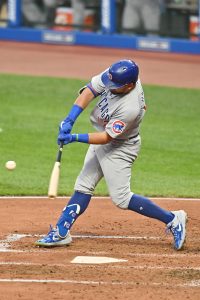 While those numbers were solid, however, they weren’t quite the elite-level production Chicago hoped to receive from a player drafted fourth overall in 2014. Schwarber’s gains with his bat were also rather mitigated by a lot of swings-and-misses (512 strikeouts from 2017-20, the 12th-most of any hitter in baseball in that stretch) and average to subpar baserunning and left field defense.
Things went south for Schwarber in 2020, as he hit only .188/.308/.393 with 11 home runs over 224 plate appearances. Between these lackluster numbers and the Cubs’ desire to cut payroll, Schwarber was non-tendered so Chicago could avoid paying him an arbitration salary projected to fall somewhere between $7.01MM and $9.3MM.
The fact that Schwarber surpassed even the highest arb projection in landing $10MM from Washington is indicative both of how much interest there must have been in his services, and a sign that the Nats are taking more stock in some of Schwarber’s advanced metrics than his bottom-line 2020 numbers. A look at Statcast indicates a solid case for a bounce-back performance, as Schwarber still made plenty of hard contact (including a 95th-percentile exit velocity of 92.8 mph). Between a .219 BABIP and a .302 wOBA that fell well beneath his above-average .330 xwOBA, it can also be argued that Schwarber ran into some bad luck over his sample size of 224 PA.
The Nationals are certainly hoping for a return for the 2017-19 version of Schwarber, as his left-handed bat would nicely augment a D.C. lineup that still leaned mostly towards right-handed hitters even after the addition of switch-hitter Josh Bell. Between Bell and Schwarber, the Nats have now added two sluggers looking for rebound seasons, and a lot of major power potential to a team that finished 21st among all clubs in home runs last year.
Juan Soto looks to be moving to right field to accommodate Schwarber, a position shift that was known to be under consideration depending on what type of corner outfielder the Nationals brought into the mix. Schwarber will surely get some DH time should the National League again use the designated hitter next season, which might have the benefit of unlocking some additional hitting potential for Schwarber since he could focus solely on hitting for those games. It also isn’t out of the question that Washington could break Schwarber in as a first baseman, as Anthony Rizzo‘s presence at the position forced the Cubs to deploy Schwarber in the outfield once Schwarber was moved from his original catcher spot.
Photo courtesy of USA Today Sports Images
MLBTR Poll: Will The Nationals Unlock Kyle Schwarber’s Potential?
In a sport known for its protracted regular season and voluminous historical records – playing for a franchise that had been without a championship crown for over a century – Kyle Schwarber established his legacy over a seven-game stretch of the 2016 playoffs. Though he only appeared in five games of the World Series, physical perseverance, inspired play and a confident batting eye turned Schwarber into a Chicago legend at the tender age of 23. His presence as a designated hitter for road contests at Progressive Field played no small part in turning the tide on a 3-1 series deficit (though starting Jon Lester, Jake Arrieta, and Kyle Hendricks in consecutive games didn’t hurt either). Schwarber reached base in half of his 20 plate appearances, and the Cubs won three of four games in Cleveland to take the crown.
While the baseball community largely recognizes that playoff performance is not predictive – nor repeatable – Schwarber is living proof that small samples, at times, do prove enduring. Schwarber will be memorialized for generations in Chicago for his appearance against the Cleveland Indians in 2016.
His myth-making return from season-ending injury is also a warning against our tendency to muddle the narrative of heroes. In that World Series, Schwarber did lengthen the lineup and provide a fear factor that was easier to see in real-time than in box scores after the fact, but it’s fair to wonder if his impact in Cleveland didn’t unwittingly get conflated with his status as a top prospect and his gargantuan output in the 2015 playoffs, when he hit .333/.419/.889 with five home runs in nine playoff games. The years since have only further complicated our ability to manufacture a compact narrative for Schwarber as a ballplayer. For starters, even a .136/.321/.273 line with just one home run, one RBI, two runs scored, and a negative championship win probability over 10 playoff games since 2016 hasn’t totally erased his reputation as a “championship proven” bat.
Further, his stat line in any given year is like an optical illusion (is he black and blue or white and gold?). His production hasn’t matched his reputation, and the advanced metrics don’t match the on-field production. In 2018, Schwarber hit a high-water mark by measure of 3.2 fWAR despite a .238 batting average and career-low 41.5 hard hit percentage. In 2019, he actualizes his “slugger” persona with a .531 slugging percentage, 29 doubles, and 38 home runs. He posted new highs with a 120 wRC+, .282 ISO, and 50.9 hard hit percentage – the third-highest mark in the Majors. The total package still amounted to just 2.1 bWAR/2.6 fWAR – solid numbers, but shy of the line for a presumed All-Star.
Then 2020 happened. His launch angle plummeted, and his .219 BABIP, .204 ISO, .188/.308/.393 line, and 90 wRC+ were all career-worst numbers. When the Cubs non-tendered him rather than pay the projected $7MM to $9MM in arbitration, few were surprised.
But the Nationals paid him $10MM for the 2021 season anyway – and that wasn’t shocking either. After all, Schwarber’s batted ball numbers have made him a popular bounce-back candidate among the Statcast crowd, and it’s not hard to see why: His resume includes finishing in the 95th percentile by exit velocity in 2019 and 2020, the 92nd percentile by barrel percentage in 2017, 2018, and 2019, and that 99th percentile mark by hard hit percentage in 2019.
At the same time, it’s worth considering how much of a role his subpar speed and 28 percent career strikeout rate play in his “under-performance.” He’s not the worst defender in the world, but negative three defensive runs saved in each of the last two seasons doesn’t inspire confidence that he’ll become a plus on that end of the field. Of course, with Victor Robles beside him in the outfield and Max Scherzer, Patrick Corbin, and Stephen Strasburg (hopefully) missing bats on a regular basis, the Nats seem to believe he doesn’t have to be a gold glove candidate. Besides, should the designated hitter make its way permanently to the National League, he may not have to spend every day in the grass.
The Nationals hope a reunion with Dave Martinez will provide Schwarber a comfortable environment to reset after a disappointing final season in Chicago. Beyond his relationship with Martinez – his bench coach for the first three years of his career – Schwarber will have a new social circle with whom to yuk it up about the ins-and-outs of hitting. That group will include hitting coach Kevin Long, his collegiate buddy Trea Turner, fellow new kid Josh Bell, and phenom Juan Soto. MLB.com’s Jessica Camerato provides video of Schwarber himself breaking down his new team (via Twitter).
Still very much in his prime entering his age-28 season, Schwarber may yet fulfill the legendary potential he established in the 2016 World Series. Given the new faces in the division and the now-rote proficiency of the three-time defending division champion Braves, the Nationals are counting on a big season from Schwarber to help the franchise rebound from a difficult 2020.
All that said, let’s keep this simple. Will Dave Martinez and the Nationals be able to unlock Schwarber’s potential and see him become a devastating middle-of-the-order presence? Or will Schwarber’s Statcast profile continue to betray him as he hits the ball hard but not often enough to truly classify as an elite bat?
Of course, there are many different ways to skin this cat, so let me offer this final framework as one way to simplify. Schwarber’s value proposition is his bat. By wRC+, which attempts to measure offensive contribution, adjusted for park and league, Schwarber has created 13 more runs than the average player over his career. As noted above, his career-high over a full season is 120 wRC+. But he also produced a 131 wRC+ over 273 plate appearances as a rookie in 2015. For context, 35 players posted a wRC+ higher than 130 in 2019, 24 managed that mark in 2018. Can Schwarber be one of those guys in 2021?
Will The Nationals Unlock Kyle Schwarber's Potential?
-
No 62% (5,781)
-
Yes 38% (3,493)
Total votes: 9,274
Schwarber's wRC+ in 2021 will be...
-
Between 100 wRC+ and 109 wRC+ 33% (2,307)
-
Between 110 wRC+ and 119 wRC+ 29% (2,017)
-
Under 100 wRC+ 18% (1,255)
-
Between 120 wRC+ and 130 wRC+ 13% (911)
-
Over 130 wRC+ 6% (435)
Total votes: 6,925
Quick Hits: Nationals, Schwarber, Martinez, Royals, Dozier, Red Sox, Prospects, Blalock, Yorke
Kyle Schwarber is now a member of the Washington Nationals, in no small part because of Nats manager Dave Martinez, per ESPN. Schwarber, of course, won a World Series with Martinez as his bench coach in Chicago. In fact, Martinez was the Cubs bench coach for the first three years of Schwarber’s career. Said Schwarber, per ESPN, “I love [Martinez] to death. I’m so excited to play for this guy. He only wants to win.” Washington hopes Martinez can help Schwarber recapture some of the magic that made him a star in Chicago. Schwarber will also reunite with Starlin Castro, with whom he played as a rookie on the 2015 Cubs. Elsewhere…
- Royals Assistant General Managers Scott Sharp and Jin Wong remain active in reaching out to agents about potential free agents, writes MLB.com’s Jason Beck. The Royals have been one of the more proactive teams in the Majors so far this winter, coming to terms with Mike Minor, Greg Holland, Michael A. Taylor, and Carlos Santana to Major League deals, all before the new year. The Royals are still potentially on the lookout for a left-handed bat, notes Beck. With just about $87MM in payroll commitments, the Royals have just a couple million before matching last year’s payroll. It wasn’t long ago, however, that Kansas City ran up payrolls over the century mark, so it’s possible they could extend yet another Major League contract, should the right deal fall their way.
- Ryan O’Hearn, Franchy Cordero, and Nicky Lopez are the only pure left-handed bats on the roster, and only the latter has a guaranteed spot as a regular player. Adalberto Mondesi and Carlos Santana are switch-hitters who will be in the lineup every day, but both have traditionally fared better hitting from the right side. In terms of their targets, Beck also notes that the Royals are growing comfortable with Hunter Dozier as the regular third baseman. All that in mind, a lefty corner outfielder would fit nicely onto the roster. Should they not find a bat at an appropriate price point, however, the Royals are believers in the long-term ability of Khalil Lee, who is a candidate for playing time in 2021.
- Red Sox prospect Bradley Blalock was a 32nd round draft choice in 2019, but after adding 10 pounds and roughly six miles per hour to his fastball, the 20-year-old right-hander will enter 2021 as a player to watch, per Alex Speier of Baseball America. Blalock is more-or-less just beginning his professional career, having signed out of high school for $250K in July of 2019. The Georgia native made just four appearances in rookie ball, giving up five earned runs on five hits and four walks while striking out four over 6 2/3 innings. Elsewhere in the system, the prospect gurus at MLB.com name Nick Yorke as a player who could rise quickly through Boston’s system, writing, “The California prep product has the sweet right-handed swing, bat speed, pitch recognition and discipline to potentially become a .300 hitter with 20 homers per season.” Yorke was the No. 17 overall selection of the 2020 draft.