
The Dodgers’ new-look front office has done a lot of wheeling and dealing already, but there’s more to come as it continues to overhaul the league’s most expensive roster.
Guaranteed Contracts
- Clayton Kershaw, SP: $163MM through 2020 (includes player opt-out after 2018)
- Adrian Gonzalez, 1B: $64MM through 2018
- Carl Crawford, OF: $41.75MM through 2017
- Andre Ethier, OF: $38MM through 2017 (includes buyout of 2018 club option)
- Brandon McCarthy, SP: $31MM through 2018
- Hyun-Jin Ryu, SP: $21MM through 2018
- Yasiel Puig, OF: $19.5MM through 2018 (can opt into arbitration when eligible; on track for 2017 eligibility)
- Brett Anderson, SP: $15.8MM through 2016 (accepted qualifying offer)
- Erisbel Arruebarrena, SS: $13MM through 2018
- Alex Guerrero, IF/OF: $10MM through 2017
- J.P. Howell, RP: $6.25MM through 2016 (exercised player option)
- Jose Tabata, OF: $4.75MM through 2016
Other Obligations
- Matt Kemp, OF: $14MM through 2019 (salary obligations remaining with Dodgers as part of trade with Padres)
- Michael Morse, OF: unreported portion of $8MM salary for 2016 (likely sufficient to make up all or most of difference between it and Tabata’s salary; agreed to as part of trade with Pirates)
Arbitration Eligibles (projections via MLB Trade Rumors)
- A.J. Ellis (5.151) – $4.5MM
- Kenley Jansen (5.073) – $11.4MM
- Justin Turner (5.045) – $5.3MM
- Juan Nicasio (4.084) – $3.1MM
- Yasmani Grandal (3.115) – $2.7MM
- Luis Avilan (3.077) – $1.1MM
- Joe Wieland (3.027) – $508K
- Scott Van Slyke (2.151) – $1.2MM
- Chris Hatcher (2.146) – $900K
Free Agents
Brandon Beachy, Zack Greinke (exercised opt-out provision, rejected qualifying offer), Chris Heisey, Jim Johnson, Howie Kendrick (rejected qualifying offer), Jimmy Rollins, Justin Ruggiano, Chase Utley
Andrew Friedman, Farhan Zaidi and co. have not been shy at all about taking advantage of the Dodgers’ deep pockets since taking the helm in Los Angeles. But the group has been more freewheeling than free spending in the traditional sense. For example: the club signed Hector Olivera last March, then flipped him (and ate the $28MM signing bonus) in July — before he ever appeared with the major league club — in a trade that brought in Alex Wood, Jose Peraza, Luis Avilan, and rental pieces. In the process, L.A. ate not only Olivera’s signing bonus, but also the tens of millions of dollars owed to Mat Latos, Michael Morse, and Bronson Arroyo.
That wasn’t even the only multi-player deal consummated with Atlanta. In their first year of office, we’ve also seen this front office team ship out a former superstar (and pay down part of the contract), sell a controllable All-Star and flip the key piece of the return for a one-year veteran, acquire the Phillies’ long-time double-play combo (here and here), roll the dice on risky free agent pitching, effectively purchase a draft pick, put late-season trust in an unproven prospect, and spend big internationally (on more than one occasion).
The organization also parted ways with skipper Don Mattingly, who was criticized at times for tactical decisions even as he drew strong reviews for handling a clubhouse full of personalities and payroll. In Mattingly’s place, the Dodgers have tabbed Dave Roberts as the new manager. That move could open the top brass up to criticism, as it’s his first time running a dugout. But, that sort of risk hasn’t seemed to hold sway in Los Angeles (and the Dodgers are hardly the only team to recently hire an inexperienced manager). Roberts will be tasked with leading an expensive, talented, and carefully constructed roster to an NL West crown and beyond.
With such a wide-ranging track record, it’s largely a fool’s errand to predict what the Dodgers’ brain trust will do this winter. But it’s clear what their biggest decision is, at least at this point: whether or not to re-sign Zack Greinke. The right-hander’s opt-out clause was perfectly timed to coincide with a 222 2/3-inning, 1.66 ERA masterpiece of a season. It doesn’t hurt that he held opposing teams to less than three earned per nine in his prior two seasons in L.A. The net result is that he’s going to be extremely expensive, in average annual value if not also years, as a free agent. With potential competition from the rival Giants, the stakes are high. Of course, we’ve also seen the Dodgers connected to varying degrees with top free agents (e.g. David Price, Jordan Zimmermann), and potential trade targets such as Shelby Miller, so it’s prudent at this point to consider all options open.
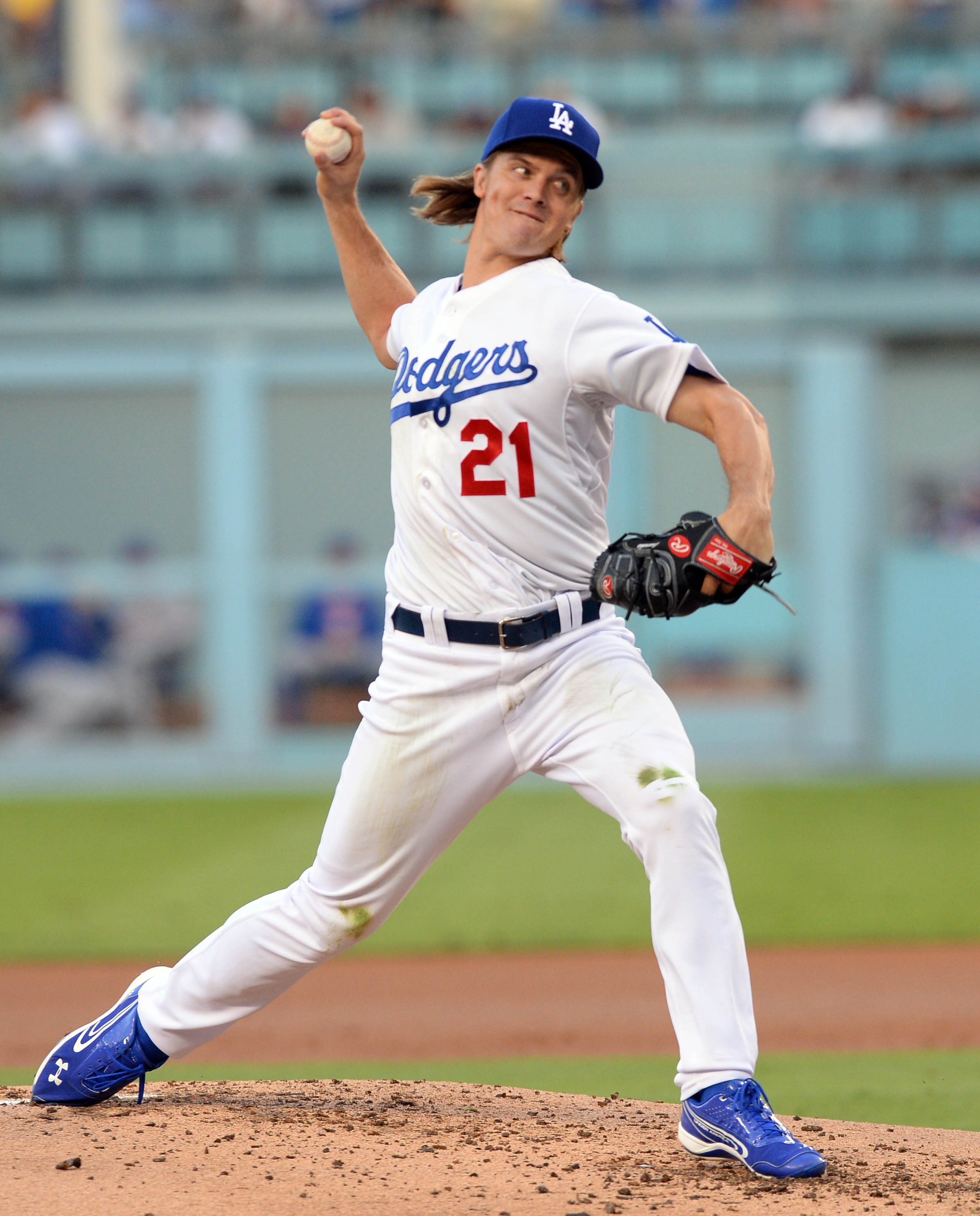
Whether or not the team brings Greinke back into the fold, moreover, the rotation figures to be an area of focus. That’s true despite the fact that Brett Anderson chose to return on a one-year, $15.8MM qualifying offer. Clayton Kershaw — the best pitcher in baseball — is firmly ensconced atop the rotation, and Alex Wood joins Anderson as a nice mid-rotation arm. But there’s a lot of uncertainty elsewhere, as Hyun-jin Ryu and Brandon McCarthy will each be working back from serious injuries (the former, hopefully, before the latter).
The team isn’t without options behind that group. Mike Bolsinger, Carlos Frias, Zach Lee, and Joe Wieland all have had a taste of the bigs. Jharel Cotton and Chris Anderson could soon be nearing MLB readiness as well. (That’s before considering the team’s two highest-upside young arms — Julio Urias and Jose De Leon — who could theoretically be ready as soon as 2016, but shouldn’t be pushed forward out of necessity.) But for a contending team that has seen its depth tested in recent years, there’s a good argument to be made for adding a veteran, even if Greinke or another top arm signs on.
While the rotation has some questions, the pen is the area that drew the most fan ire last year. But that’s not to say the relief corps has any obvious holes heading into 2016. Kenley Jansen remains a high-leverage stud. The team has right-handed middle-relief and/or set-up options including Chris Hatcher, Pedro Baez, Yimi Garcia, and Juan Nicasio — every one of whom struck out 10 or more batters per nine and carried a sub-4.00 ERA last year. And the Dodgers return southpaws Luis Avilan and J.P. Howell, with the former coming over in the aforementioned Olivera/Wood swap and the latter exercising his player option.
That looks to be a pretty strong group, and many of the younger rotation options noted above could slide into the pen if a need arose. But there’s still a reasonable argument to be made that the club ought to be proactive. For one thing, there’s only one elite arm in the pen as things stand. For another, that particular elite arm — Jansen — will reach the open market after the season. Whether or not the club will feel at all compelled to line up a replacement for him now, it makes sense that it is at least exploring the relief market for opportunities. We’ve heard talk that players such as Darren O’Day (via free agency) or even Aroldis Chapman (in a trade) might be real considerations.
The position player side of things is less interesting in some ways and more interesting in others. The infield is in good shape: Corey Seager appears set to take over at shortstop after his impressive debut, Adrian Gonzalez is locked in at first, and the Yasmani Grandal/A.J. Ellis pairing behind the dish figures to be maintained.
Los Angeles still has an array of options at second and third, with Justin Turner, Enrique Hernandez, Jose Peraza, and Alex Guerrero all on hand. (The last name on that list, Guerrero, could also end up as trade bait. And Turner is coming off of surgery, though we’ve not heard any indication that he’ll be limited.) Of course, all of those players hit from the right side, so it would be nice to add a lefty-swinging option. The team has been said to have interest in a reunion with Chase Utley, who could fill such a role. While that mix does not scream out for an upgrade, one of those positions could also theoretically be filled from the outside if a great opportunity arose.
Things start to get fun, though, when you turn to the outfield. Andre Ethier and Carl Crawford are both expensive, left-handed hitters who should probably be part-time players at this point. Joc Pederson showed both his rather steep upside and the reasons for doubt as he followed up on a huge first half with miserable play down the stretch. Yasiel Puig had his worst season as a big leaguer and continued to generate controversy, though he still carries one of the highest ceilings in all of baseball. Scott Van Slyke took a step back last year but still offers a supplementary right-handed bat. Guerrero (in the corner) as well as Hernandez and even Peraza (up the middle) could also contribute on the grass.
It’s not outlandish to imagine that group remaining intact. Those players represent a fairly intriguing blend of upside and depth, after all, as well as ample lineup construction possibilities. It didn’t prove unworkable to allocate playing time last year with such a wide variety of options. And, after all, there’s always injury and underperformance to account for.
That being said, there are several scenarios where this outfield mix could be shaken up — perhaps significantly. The free agent market is full of quality outfielders, some of whom could be alluring enough to force other transactions to clear space — though we haven’t heard much to suggest that. Even without a major addition, change could make sense. Ethier and Crawford are somewhat redundant, and any cost savings could be re-allocated if a willing trade partner is found. The former, of course, has been much more productive of late and carries more trade value. (Indeed, the remainder of his deal looks manageable, if a bit expensive.) Pederson seems unlikely to be moved, but he’d represent a big chip if the team wants to make a deal without giving up its young pitching prospects.
And then there’s Puig, who draws as many whispers as any player in baseball. There’s still no reason to believe that he’ll be shopped, per se, but if L.A. is really open to trading him the possibilities are more or less endless. Given his talent, established ceiling, and cost/control, it’s hard to imagine any team in baseball that wouldn’t be intrigued. It’d be hard to sell him now after a down season, as the return surely wouldn’t be what it might’ve been last winter, but Puig still represents a (hypothetical) centerpiece to a major deal — possibly one that would return a high-end, controllable starter.
One thing that’s clear is that there are relatively few limitations on what the Dodgers can do. Even if the goal is to pare back the payroll, the organization has not only immense spending capacity but also high-end, controllable talent (at the majors and in the minors) from which to deal. That creates an opportunity and sets an expectation for the creative front office.
Why in the world did they take on Tabata’s contract?
Swap of bad contracts.
We get it the Dodgers have endless money you say it every article, but if that was the plan just spending wild, Colletti would still be in charge of roster decisions probably. Reality is when push comes to shove the Red Sox can easily out bid the Dodgers on any SP if they wanted to do so.
From Day 1 the new owners and Stan Kasten have said Phase 1 includes investing money into the team, while rebuilding the farm system after years of negilent. Phase 2 is focused on more player development, which is already been seen with Joc, Seager, Enrique Hernandez this season.
I don’t doubt the Dodgers spending power I just think it is being way over stated because it isn’t what they are looking to do, like you said they are focusing on being younger and cost controlled, they obviously could get in a bidding war with the Red Sox on a SP but it probably would not be something this front office would want to do.
enrique hernandez is nothing to do with their development of him.before the dodgers aquired him. teams were trying to trade for him thinking he could be their starting shortstop or centerfielder. he is just under rated and should be targeted as an everyday player by other teams.
If that’s what you took away from what I wrote, then you are just trying to find it in whatever you read. I never remotely suggested they are planning to spend wildly.
And I’m not sure what the Red Sox have to do with this. Both organizations have huge spending capacities relative to the rest of the league, and both are smart enough not to just spend any and all amounts necessary to add the “best” players available.
Jeff T – good take on most of it, however you were too kind on the bullpen. The sub-4 ERA across the board doesn’t really tell the story of how most of the pen imploded in the last 1/3 of the season, minus Jansen and Hatcher. Mattingly had few reliable options and the Johnson deal, even only as a rental, was disastrous. I’m a Dodger fan, but I think they’ve got real issues on the pitching staff. Most is a crap shoot.
wheres the mets offseason outlook?
In a draft on my computer. Should be up in the next day or two.
My ideal scenario is to find a trading partner for Crawford. Assuming they don’t trade Puig or Ethier; Ethier in LF, Pederson in CF, Puig in RF
They could do that anytime they want. Just have to cover almost all of his salary, like they did with Kemp. A matter of time …
they didn’t cover almost all of kemp’s salary, they covered 32 out of 107 million. you’re right about crawford, “almost all” is probably what it would take for him
imagine a 1-2-3 of Kershaw, Grienke & Price?
I did and the Dodgers were still knocked out in the first round
how would they fit 6 starters into one rotation. since they would have those 3 plus woods,anderson and ryu. well that if ryu can come back 100%.
You can never have enough good pitchers. Having five starters go thru the season without any problems is pretty darn rare.
Ideal but impossible. More likely is Kershaw, Zimmerman, Anderson, Ryu and McCarthy. Bullpen is where we need desperate help. But now full of former closers.
Question: if Puig doesn’t opt into arbitration, would he be a FA after 2018 then? and if he does opt in after 2020?
That will impact salary for whatever years he’s eligible, not years of control.
no still under control for X years. same with jorge soler.
it going to be a fresh start for the dodgers with Roberts at the helm. cant wait for the season to start. they just need to fix the holes in the pen, resign zack or someone to fill his spot as a number two pitcher and find a 2nd baseman. after that dodgers should be set.
when it comes to the dodgers and how the payroll is, I think the plan from day one was they had to spend to try to win now while fixing the farm mess left by former owners. then when the time comes slowly bring in cheaper prospects to reduce payroll while still being a good team. since that pretty much starting with Pederson up and seager likely to stay and play either 3rd or SS. we will see pay roll reduce little by little with more prospect coming up in due time. I wonder if enrique Hernandez can earn a starting spot and have the dodgers bring in a vet like Utley to back him and other guys
I would love to see a swap of bad contracts between the Dodgers and Orioles. Ethier + $10MM for Jimenez. The Dodgers get a cost controlled SP who would likely be more effective pitching in Dodger Stadium than Camden Yards, and the Orioles get a corner outfielder that they sorely need. It also frees up the Orioles to extend Machado or pursue a mid-tier starter.
“cost controlled”
Is the goal to pare down payroll? If they have any goal but winning a series then the fans have every reason to be massively cheesed off.
The Dodgers are one of the few glamour teams in pro sports in the #2 media market. They have to compete with many things in SoCal for the discretionary money people have to spend. Obviously, they want to rebuild a farm system that was once the class of baseball but until then, they have to simply outspend for the best players.
Just a thought. Trade both Puig and Crawford. Bench Joc. Throw Ethier, Guerrero and Hernandez in the Outfield. Infield Turner, Seaguer, Re Sign Howie, and Adrian. SP’s-Kershaw, Zimmerman, Anderson, Ryu, McCarthy If all Ready by Spring. Then focus on Bullpen. Thats our Weak point, every year.