
Blue Jays, Josh Donaldson Agree To Record Arbitration Deal
The Blue Jays and third baseman Josh Donaldson have avoided an arbitration hearing by agreeing to a $23MM salary for the 2018 season, reports Shi Davidi of Sportsnet (via Twitter). That massive payday represents an all-time record payout for an arbitration-eligible player on a one-year contract. Donaldson, a client of MVP Sports Group, is entering his final year of team control and will be a free agent following the season.
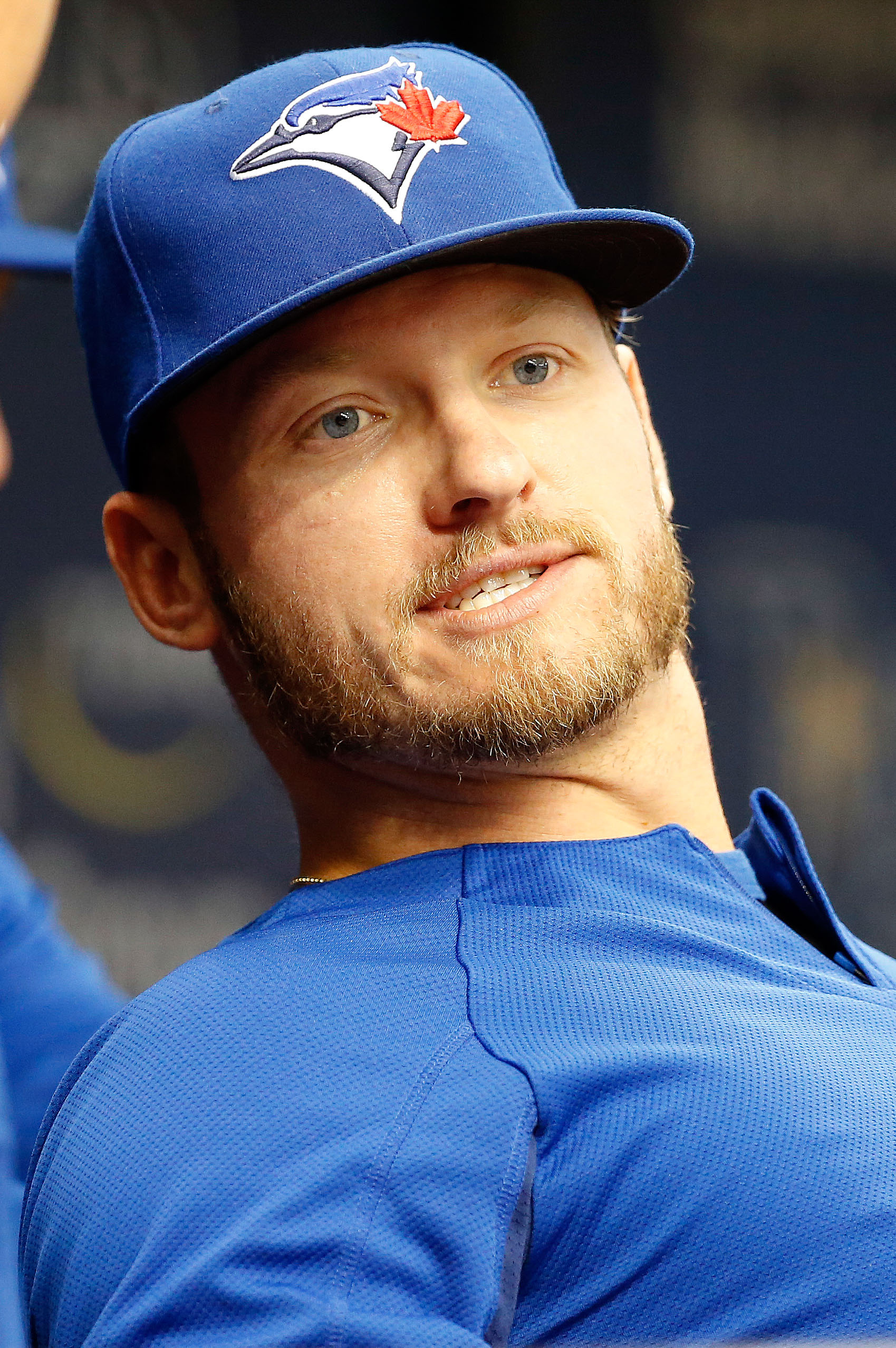
Donaldson, 32, recovered from a slow (by his lofty standards) start to the 2017 season and closed out the year on a blistering hot streak, during which he was one of baseball’s best hitters (if not the very best). From Aug. 1 through season’s end, Donaldson batted a ridiculous .302/.410/.698 batting line with 22 homers in 227 plate appearances. That Herculean stretch took his season batting line from .243/.364/.442 on the morning of Aug. 1 all the way to his final slash of .270/.385/.559.
The record payday handily tops the projected arbitration salary from MLBTR contributor Matt Swartz, whose arbitration projection algorithm had pegged Donaldson at $20.7MM. Recognizing the unique nature of Donaldson’s case, Matt took a lengthier look at the factors that could’ve factored into negotiations in an Arbitration Breakdown piece on Donaldson, explaining the reasoning behind the $20.7MM figure as well as some ways in which the projection could’ve been off target.
That ultimately proved to be the case, as Donaldson now has his name in the arbitration record books. Prince Fielder‘s $15.5MM contract was the largest one-year offseason payout for an arbitration-eligible position player, while David Price‘s $19.75MM salary in his last year before free agency was the largest one-year, offseason payout on record to date. (The “offseason” distinction is of note, as the Nationals bought out Bryce Harper‘s final year of arbitration eligibility for a hefty $21.65MM back in May, though Donaldson’s contract obviously tops that mark as well.)
Over the past three seasons in Toronto, Donaldson has been one of baseball’s elite players, posting a .285/.387/.559 slash (150 OPS+) while playing excellent defense at third base. Though he’ll hit the open market in advance of his age-33 season next winter, the 2015 American League MVP will have a strong case for a nine-figure contract in free agency, assuming good health and a characteristically excellent season in 2018.
Photo courtesy of USA Today Sports Images.
Arbitration Breakdown: Josh Donaldson
Recently, I have been discussing some of the higher-profile upcoming arbitration cases as part of MLBTR’s Arbitration Breakdown series. I rely partly on my arbitration model developed exclusively for MLB Trade Rumors, but will also break out some interesting comparables and determine where the model might be wrong. Full arbitration projections for 2018 are also available.
Josh Donaldson enters his third year of arbitration with an already extraordinarily high $17MM salary. This would already be the highest ever one-year deal signed in arbitration (with the exception of Bryce Harper’s 2018 salary, inked back in May) and Donaldson will certainly command a raise above that. The highest one-year deal ever signed went to Prince Fielder in 2011 at $15.5MM. However, Buster Posey and Ryan Howard earned $20MM during years generally covered by arbitration as part of multi-year deals inked earlier in their careers.
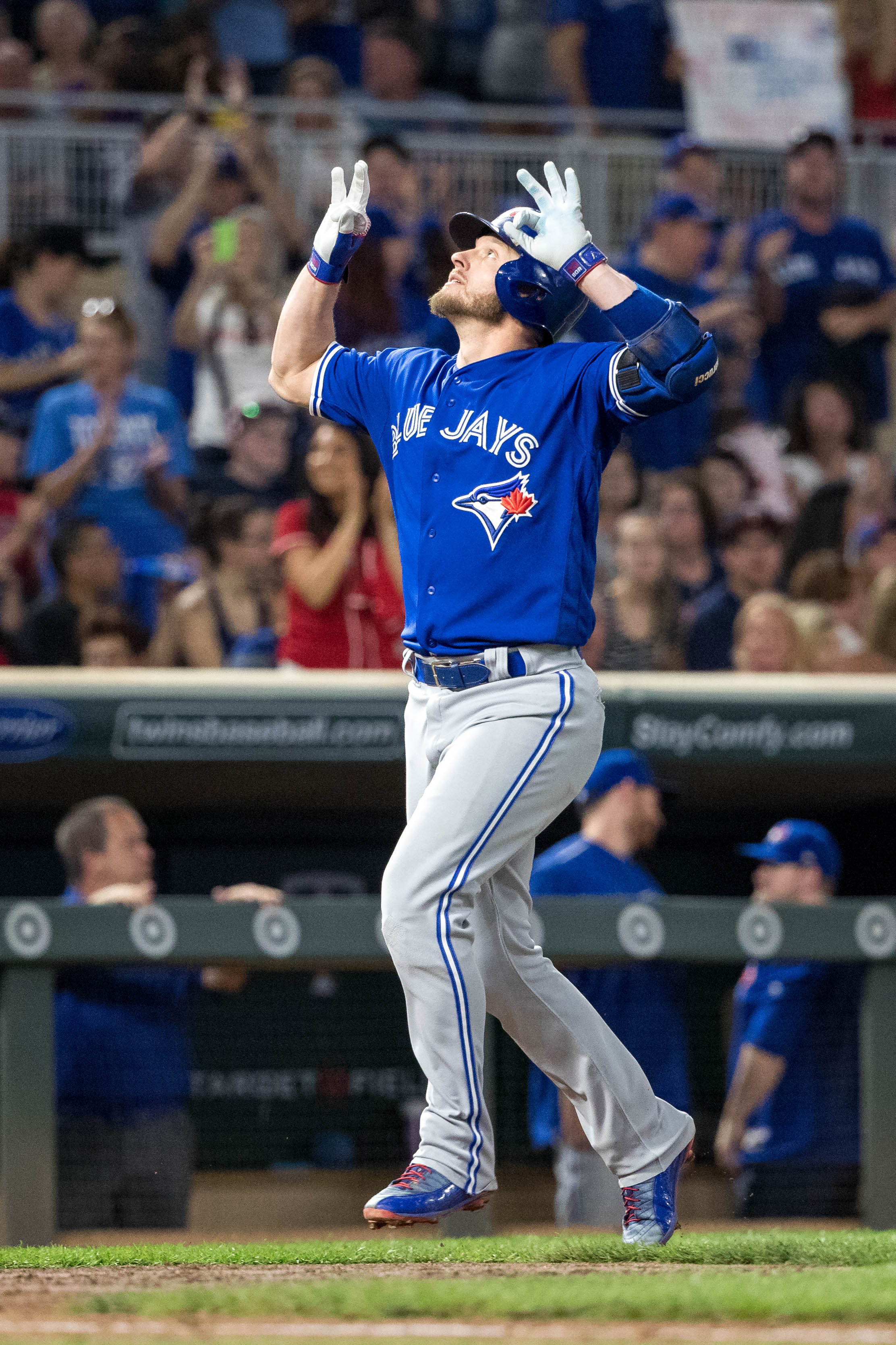
Generally, players who are beyond their first year of arbitration are effectively given raises, rather than absolute salaries, and my research has determined that these raises are almost exclusively based on their platform season. That is how my model is set up. In other words, Donaldson is projected to earn $20.7MM because the model projects a $3.7MM raise for a player with his 2017 performance.
However, Donaldson received a two-year deal covering 2016-17, making his case somewhat tricky. We sometimes see players in such circumstances being paid as a “re-slot” case, which means they are slotted back into the arbitration system based on career performance. So it is possible that Donaldson’s performance prior to 2017 will be considered. However, that would probably push his salary even further above the current record and seems unlikely.
Like many others in the league this season, Donaldson could see his case impacted by the record level of home runs that were hit in Major League Baseball in 2017. Big league hitters combined for a total of 6,105 total home runs — a whopping 26 percent increase over the average from the past five seasons. When I look at players with similar home run totals in that span, it isn’t clear if an arbitration panel (or teams and agents that are negotiating in the shadow of what an arbitration panel would say) would treat home runs from Donaldson as similar to other players with the same number as home runs, or as someone with maybe 26 percent fewer home runs.
In recent years, data has shown that run environment is not a big consideration in arbitration, and as such, my model does not adjust for league run environment in this way. Hitters in high-scoring years benefit from being compared to hitters in low-scoring years, and pitchers in low-scoring years benefit from being compared to pitchers in high-scoring years.
Donaldson hit 33 home runs but did so only in 496 plate appearances, and that total was only accompanied 78 RBIs. If we re-adjust his home run baseline to the average of the last five years, that would put us at 26. If we allow for the possibility that a potential panel might consider his home run total to be inflated, we might want to look for other players who hit 25 home runs. But playing time is a huge factor in arbitration, so we would want to look for players who did not play full seasons.
If we even limit to players with 25 home runs and under 600 PAs, we only get five players in the last five seasons. These are actually the same five players who hit 25 home runs but had fewer than 90 RBIs as well. They are Lucas Duda (who got a $2.5MM raise two years ago), Luis Valbuena (who got a $1.9MM raise two years ago), Brandon Moss (who got a $2.4MM raise three years ago), Chris Davis (who got a $1.65MM raise three years ago), and Jarrod Saltalamacchia (who got a $2MM raise five years ago).
All five of these players had batting averages between .196 and .244, so Donaldson at .270 is far above them. They also all hit between 25 and 27 home runs, which means Donaldson’s mark total of 33 will probably place him above that group as well. Valbuena and Saltamacchia are poor comparables because their averages were in the .220s and both had fewer than 60 RBIs. Davis, who hit .196, is probably also low. So we would rather compare Donaldson to Duda (.244/27/73) or Moss (.234/25/81). But it is clear that these are both probably floors, since Donaldson bests them on all major fronts considered in arbitration. That leads me to believe that Donaldson should definitely get a raise above $2.5MM.
If we relax the home run assumption and look for players who had fewer than 600 PAs, we find a couple other recent players who got raises around $2.9MM. Justin Smoak hit .226/18/59 in 328 PAs in 2016, and Steve Pearce hit .293/21/49 in 383 PAs in 2015. Both seem like floors as well. So we have to assume Donaldson probably pulls in above $3MM.
If we relax the playing time assumption, we could arrive at Todd Frazier in 2017. He hit .225/40/98 in 666 PAs, so while his batting average was low, the more-important home run and plate appearance totals put him as a clear favorite. He received a $3.75MM raise last year, so that seems like a plausible ceiling for Donaldson.
All of the players listed here were actually reaching arbitration for only their third year of eligibility and Donaldson is actually entering his fourth year of eligibility (his first year was 2015, before his two-year pact for 2016-17). If we want to strictly adhere to finding a fourth time eligible, we could see Eric Hosmer last year at .266/25/104 in 667 PAs. He got a $4MM raise and could potentially be a good comparable as well.
I think the model is pretty close to accurate for Donaldson in this case. I could see an argument for a raise in the low 3’s rather than the high 3’s, putting him between $20MM and $20.5MM instead of $20.7MM, but I do not think he will go lower than that.
Photo courtesy of USA Today Sports Images.
Rockies, Charlie Blackmon Avoid Arbitration
The Rockies have avoided arbitration with outfielder Charlie Blackmon by agreeing to a one-year deal worth $14MM, according to Jon Heyman of FanRag Sports (Twitter link). The ACES client had a projected arbitration salary of $13.4MM, per MLBTR contributor Matt Swartz. Matt also took a more in-depth look at Blackmon’s case and some of the intricacies surrounding his projection as part of his Arbitration Breakdown series.
Blackmon, 31, finished fifth in the NL MVP voting this past season on the heels of a brilliant campaign in Colorado. In a league-leading 725 plate appearances, Blackmon hit .331/.399/.601 with 37 homers, taking home the NL batting title. Blackmon also paced the National League in runs scored (137), hits (213), triples (14) and total bases (387). All of that combined to give Blackmon a massive raise of $6.7MM — a 91.7 percent increase over last year’s salary of $7.3MM.
This’ll be the final trip through the arbitration process for Blackmon, who will be a part of one of the best free-agent classes in recent memory next offseason. He’ll be joined by teammates DJ LeMahieu and Chad Bettis in that regard, both of whom are also eligible for arbitration this winter (as can be seen in MLBTR’s Arbitration Tracker). Lefty Zac Rosscup caps off the Rockies’ arbitration class.
Players Avoiding Arbitration: 1/11/18
With tomorrow’s deadline for exchanging arbitration figures looming, arbitration agreements are likely to flow freely — particularly with a newly universal file-and-trial stance spurring things along. As always, MLBTR’s 2018 Arbitration Projections and 2018 MLB Arbitration Tracker are the places to go for more information. We’ll track today’s deals right here:
- D-backs lefty Patrick Corbin has signed a one-year contract for the 2018 season, the club announced tonight. USA Today’s Bob Nightengale tweets that Corbin, who will be a free agent next season, will earn $7.5MM in his final season of arbitration. That comes in shy of his $8.3MM projection, though it’s nonetheless nearly twice what he made in 2017 ($3.95MM).
- The Blue Jays avoided arbitration with outfielder Ezequiel Carrera and lefty Aaron Loup, per Nightengale (Twitter links). Carrera’s $1.9MM salary matches his projection, while Loup’s $1.8125MM payday is slightly north of his own $1.8MM projection. Loup will be a free agent next winter, while Carrera is controlled through 2019.
- Nightengale also tweets that Angels catcher Martin Maldonado has agreed to a $3.9MM salary for the upcoming season, meaning the reigning AL Gold Glove winner behind the dish rather handily trounced his $2.8MM projection. Maldonado, 31, is also entering his final year of team control and will be a free agent next winter.
Earlier Agreements
Market Notes: Slow Offseason, Bruce, Giants, Cubs, Werth, K-Rod
As the free agent market continues to plod along, observers have continued to search for explanations. Of course, it’s worth bearing in mind that we’ve been weighing this topic this since late November, when it was already apparent that there were some forces at play that were slowing down signings. The full story has yet to be told, and won’t be until the market resolves itself, but it’s still worthwhile to think about the potential causes and ramifications.
In one of his last posts for Fangraphs, Dave Cameron observes that a lack of parity — on paper, at least — may be one cause of the glacial pace of signings. With leading organizations perhaps preferring to wait to see how their needs develop, and their top pursuers left unsure whether even significant investments will be enough, the current competitive imbalance could be helping to slow the market, Cameron argues.
Let’s take a look at a few links as the hot stove perhaps begins to sputter to life:
- Many others have also tackled the confounding nature of this year’s market in recent days. Ken Rosenthal of The Athletic suggests there’s a “lack of engagement,” not just a lack of deals, in a report that indicates that some agents believe there may be a budding case for collusion. SB Nation’s Marc Normandin takes a historically oriented perspective, examining baseball’s history of collusive behavior and placing the currently stalled market in that context. SI’s Tom Verducci runs through the possible drivers of the slow-down. At Fangraphs, Travis Sawchik wonders if Boras’ approach still works, while Kiley McDaniel (welcome back!) examines the current state of teams’ efforts to find competitive advantage by allocating resources between scouting and analytics. (That last point ties into the view many have expressed that the slow market stems in part from an increasing convergence, as McDaniel terms it, in player valuations and strategies across organizations.)
- The Giants‘ top offer to Jay Bruce was at the three-year level but would have promised about $10MM less to him than the $39MM he ultimately scored from the Mets, according to reports from Henry Schulman of the San Francisco Chronicle (Twitter link) and Bob Nightengale of USA Today (via Twitter). It seems that San Francisco was hoping to get some pop into the lineup at a bit of a discount, which is certainly understandable given the still-lengthy list of potential targets available in free agency and on the trade market. One additional name that has long been linked to the Giants, Andrew McCutchen of the Pirates, remains of interest, Nightengale further notes. There’s also a case to be made that the Giants ought to take the opportunity presented by the slow market development while forgetting about the luxury tax line this year, as Andrew Baggarly writes for The Athletic. Of course, that’s also true for a few other teams, and it’s arguable that such interest will help prop things up once player movement begins in earnest.
- There are still ongoing signals that the Cubs could make a splash. As Paul Sullivan writes for the Chicago Tribune, surprise winter additions are fairly commonplace in Wrigleyville. Manager Joe Maddon suggested yesterday that he believes the front office is still looking to build out the roster, Madeline Kenney of the Chicago Sun-Times reports. Maddon spoke highly of both Jake Arrieta and Alex Cobb, Kenney writes, and the skipper also hinted that president Theo Epstein and GM Jed Hoyer may not yet be done in adding pieces to the bullpen mix for the 2018 campaign.
- Seeking value will no doubt still drive Chicago, but it’s an imperative for the Indians. Paul Hoynes of the Plain Dealer names 15 free agents who might represent highly affordable targets for the Cleveland organization. Buttressing the relief corps and adding a righty bat seem to be the top priorities, Hoynes notes.
- Free agent outfielder Jayson Werth has given no indication that he’s readying for retirement. To the contrary, he tells ESPN.com’s Jerry Crasnick that he believes he can play for multiple additional seasons (Twitter links). There’s been little indication to this point that any particular teams are in pursuit of the 38-year-old after a rough and injury-limited 2017 campaign, but that could change once the market gets moving. Werth has posted decidedly subpar offensive lines in two of the past three seasons, but did hit at a league-average-ish .244/.355/.417 clip in 2016 and has continued to hit well against lefties.
- Veteran righty Francisco Rodriguez tells Jon Heyman of Fan Rag that he’s readying for a return and feels he can bounce back from a miserable 2017 season. The 36-year-old almost always delivered results in his 15 prior seasons of MLB action but was tagged for nine homers and 22 earned runs in just 25 1/3 innings last year, with a swinging-strike rate that dropped out of double-digits for just the second time in his long and excellent career. “I still have plenty left,” Rodriguez tells Heyman. “I am hoping to get an opportunity to help a team win a championship. I’m physically way better than I was last year. I’m ready. If I didn’t have it, I’d say it. I’m a straight shooter – my own worst critic.” Rodriguez is not receiving much interest at this point but says he’ll gladly throw for scouts to earn another chance.
Arbitration Breakdown: George Springer
Recently, I have been discussing some of the higher-profile upcoming arbitration cases as part of MLBTR’s Arbitration Breakdown series. I rely partly on my arbitration model developed exclusively for MLB Trade Rumors, but will also break out some interesting comparables and determine where the model might be wrong. Full arbitration projections for 2018 are also available.
George Springer enters his second year of arbitration eligibility (as a Super Two player) having compiled a solid .283 average to go along with 34 home runs and 85 runs batted in in 2017. As a result, he is projected for a $5MM raise to take him up to an $8.9MM salary in 2018.

One thing complicating Springer’s case is something that could affect a great number of cases this year—the high home run level throughout the league. This past season set a league record with 6,105 total home runs, which represented a 26 percent increase over the league average from the previous five seasons. As such, when examining players with similar totals over that five-year span, there’s no way of knowing whether an arbitration panel (or teams and agents that are negotiating in the shadow of what an arbitration panel would say) would treat home runs from Springer the same as they would in an environment when home runs were less prolific.
My model does not adjust for league run environment in this way; rather, the data has shown that run environment has not historically been a significant component in the arbitration process. Hitters in high-scoring years benefit from being compared to hitters in lower-scoring years, and pitchers in low-scoring years benefit from being compared to pitchers in high-scoring years. Springer could potentially be treated by a panel (or negotiated with in the shadow of what such a panel would say) as someone who hit closer to 26 home runs than someone with 34. But even still, his list of comparables shows solid earning potential.
There have only been a couple players entering their second year of eligibility with averages north of .275 and at least 25 home runs in the past five years, and both are from last year. Manny Machado got a $6.5MM raise after hitting .294 with 37 homers and 96 RBIs. Charlie Blackmon got a $3.8MM raise after hitting .324 with 29 home runs and knocking in 82 runs.
Machado is a more obvious ceiling because his numbers are not inflated by Coors Field, and he hit substantially more home runs than Blackmon in 2016. Blackmon might serve as a floor in Springer’s case due to the fact that he hit fewer balls into the seats, despite playing in Coors. However, his high batting average could make him more favorable at the same time. In the end, I think Springer might be closer to Blackmon than he is to Machado.
Few other players really show up as decent comparables, especially when limiting the field to those who did not sign multi-year deals. Looking to a statistical comparable that did sign a multi-year deal, J.D. Martinez signed a two-year contract covering 2016-17 which included a $3MM raise in the first year of the pact. It also was preceded by an exchange of figures in which Martinez asked for a $4.25MM raise, while the Tigers countered with an offer of a $2.25MM raise. Considering Martinez’s .282, 38 homers and 102 RBIs in the platform season for that two-year deal, this could suggest a lower number for Springer.
I am guessing Springer ends up closer to a $4MM raise than $5MM based on the cases of Blackmon and Martinez. But with little comparability and the uncertainty of how a panel will consider the relevance of Coors Field or Martinez’s multi-year deal, Springer may be able to land closer to that $5MM raise. This would still be south of Machado’s $6.5MM raise but would safely beat the other two players.
Photo courtesy of USA Today Sports Images.
Dave Cameron Joins Padres; Marlins Hire Bradley Woodrum
The Padres and Marlins each made a huge acquisition this week, though not the kind we typically cover here on MLBTR. Yesterday, FanGraphs stalwart Dave Cameron announced he will be joining the Padres to help build out their Research and Development department. And this morning, former MLBTR contributor Bradley Woodrum announced he’s joining the Marlins analytics team. Cameron and Woodrum were among the best sabermetric analysts operating in the public sphere, and we’ll sorely miss reading their work.
I first encountered Dave’s work about ten years ago, on U.S.S. Mariner. More than anyone, Dave was able to do incredibly intelligent baseball analysis in an understandable, easy-to-read way. Dave is a pioneer in the field of sabermetrics, and I made a point to read just about everything he wrote. I don’t remember much about the early days of FanGraphs, except that it had more graphs. When Dave joined, his writing made FanGraphs a must-read as well. Of course, the site has brought in countless talented writers and analysts since then. I first reached out to Dave in 2009 in hopes of understanding WAR better. He’s been gracious with his time over the years when I’ve approached him with many questions and has been a longtime friend of MLBTR. Dennis Lin of the San Diego Union-Tribune spoke to Dave, who has had previous interest from MLB teams, about his decision to accept the Padres’ offer.
Back in 2015, Bradley Woodrum applied for a project we were launching on MLBTR: an attempt to create a model that predicts the chance of a pitcher having Tommy John surgery (updated last September). I knew Brad from his stellar work at FanGraphs and The Hardball Times. The Tommy John project was a daunting undertaking, and I was amazed by Brad’s analytical abilities, professionalism, and perseverance in getting the project to the finish line. It took the better part of a year, but Brad delivered what I considered to be the best possible TJS prediction model, given the limitations of public data. I’m proud to have hosted that work on MLBTR. Armed with the superior data of a Major League club, I expect Brad to do great things.
MLBTR wishes the best to Dave Cameron and Bradley Woodrum in their new careers!
Agency Changes: Nelson Cruz, Jake Odorizzi
Here’s the latest agency news from around the game:
- Mariners slugger Nelson Cruz has hired Bryce Dixon and Primo Sports Group, according to Jon Heyman of FanRag Sports (via Twitter). The 37-year-old Cruz will give Dixon’s group a second premier player, joining right-hander Johnny Cueto as the two biggest fish at a smaller agency. Though Cruz will turn 38 this July, he remains among the game’s most productive hitters, as evidenced by last year’s .288/.375/.549 batting line and 39 homers. Cruz’s four-year, $58MM deal has proven to be an absolute bargain for the Mariners, as he’s posted a combined .292/.368/.557 with 126 long balls in the first three seasons of the deal. He’s more than justified the commitment already, but if his 2018 season comes anywhere near the level of consistency he’s shown in the first three years of the pact, he should have little problem securing a multi-year deal next offseason.
- Perhaps unsurprisingly, in the wake of yesterday’s unsettling news, Rays righty Jake Odorizzi has decided to move his representation to Excel Sports Management, according to FanRag’s Robert Murray (Twitter link). Odorizzi had been with CSE prior to agent Jason Wood’s dismissal from the agency in the wake of disturbing allegations made against him. Odorizzi becomes the second CSE client to jump to Excel in the wake of the scandal, joining Pirates prospect Mitch Keller. In Odorizzi, Excel will be adding another established big league client with a semi-notable arbitration case pending. Odorizzi is in his second trip through that process and has a projected arbitration salary of $6.5MM for the coming season. He’s controllable by the Rays through the 2019 season, though he has, of course, been oft-mentioned as a possible trade candidate.
Both of these switches are now reflected in MLBTR’s Agency Database, which contains representation info on more than 2,500 Major League and Minor League players. Agents, if you see any notable errors or omissions within the database, please let us know via email: mlbtrdatabase@gmail.com.
Mariners, Christian Bergman Agree To Minor League Deal
The Mariners and right-hander Christian Bergman have agreed to a minor league pact, per SB Nation’s Chris Cotillo (via Twitter). The All Bases Covered Sports Management client will be returning to the Seattle organization for a second season and will head to Major League Spring Training.
Bergman, 30 in May, appeared in 13 games for Seattle last season — eight starts and five relief appearances — working to a total of 54 innings. In that time, the former Rockies hurler posted an even 5.00 ERA with 5.5 K/9, 2.5 BB/9, 2.0 HR/9 and a 37.7 percent ground-ball rate. Though he’s never experienced much in the way of prolonged success in the Majors (5.58 ERA in 201 2/3 frames between the Rockies and Mariners), Bergman has demonstrated solid K/BB numbers in the minors. In 235 innings at the Triple-A level, Bergman owns a 4.40 ERA with 6.2 K/9 against 1.9 BB/9.
[Related: Updated Seattle Mariners depth chart]
The Mariners have been tied to numerous rotation options this offseason and still have somewhat of an unsettled mix at present. James Paxton, Felix Hernandez and Mike Leake are locks to take the ball every fifth day, health permitting. Righty Erasmo Ramirez likely has an inside track on a rotation spot as well after pitching well in his second stint with Seattle following a trade from the Rays last summer.
The 40-man roster features numerous candidates for the fifth spot in the rotation, including lefties Marco Gonzales, Ariel Miranda and Sam Moll as well as right-handers Andrew Moore, Max Povse, Chase De Jong and Robert Whalen. Hisashi Iwakuma headlines Seattle’s collection of non-roster invitees, which also includes Bergman and fellow re-signed righty Casey Lawrence.
Nationals Re-Sign Edwin Jackson To Minor League Deal
The Nationals and right-hander Edwin Jackson have agreed to a minor league contract, according to his agents at the ESQ Agency. Jackson’s deal comes with a $1.5MM base salary as well as an additional $1.4MM worth of incentives.
The 34-year-old Jackson returned for a second stint with the Nats in 2017, signing a midseason minor league pact after initially spending time in the Orioles organization. Jackson posted a pristine 0.44 ERA in 20 1/3 Triple-A frames for the Nationals before being called up to the big league roster following Joe Ross‘ season-ending Tommy John surgery. He’d go on to make 13 starts for the Nationals down the stretch, registering a 5.07 ERA with 7.4 K/9, 3.2 BB/9 and 38 percent ground-ball rate.
Jackson turned in a 2.94 ERA through his first eight starts, though he surrendered a whopping nine home runs through those 49 frames. That susceptibility to the long ball caught up to him over his final five starts, as Jackson was tagged for 24 earned runs in 22 innings of work. That said, he did average 93.6 mph on his heater with the Nationals and turn in an above-average 10.1 percent swinging-strike rate.
[Related: Washington Nationals depth chart]
The Nats will once again rely upon Max Scherzer, Stephen Strasburg, Gio Gonzalez and Tanner Roark in the top four spots of the rotation this coming season, though the fifth spot looks to be unsettled as Spring Training approaches. Jackson will join the race for that spot, vying with fellow right-handers Erick Fedde, A.J. Cole and Austin Voth as well as left-hander Tommy Milone (who also signed a minor league deal).
Of course, the Nationals have at times been linked to various starting pitching targets on both the free-agent and trade markets, leaving open the possibility that they’ll bring in another option to whom they’ll promise that remaining rotation vacancy.