
Pirates Sign Jarrod Dyson
February 13: The Pirates have officially announced the signing via press release. To create space for Dyson on the 40-man roster, the Bucs placed righty Jameson Taillon on the 60-day injured list. Taillon is expected to miss most, if not all of the 2020 season after undergoing Tommy John surgery last August.
February 12: The Pirates have a deal in place with veteran outfielder Jarrod Dyson, per Jason Mackey of the Pittsburgh Post-Gazette (Twitter link). It’s a one-year, big-league contract, per Jeff Passan of ESPN.com (via Twitter). Dyson will earn $2MM, per Jon Heyman of MLB Network. (Twitter link. Heyman also first reported the sides were close to a deal.)
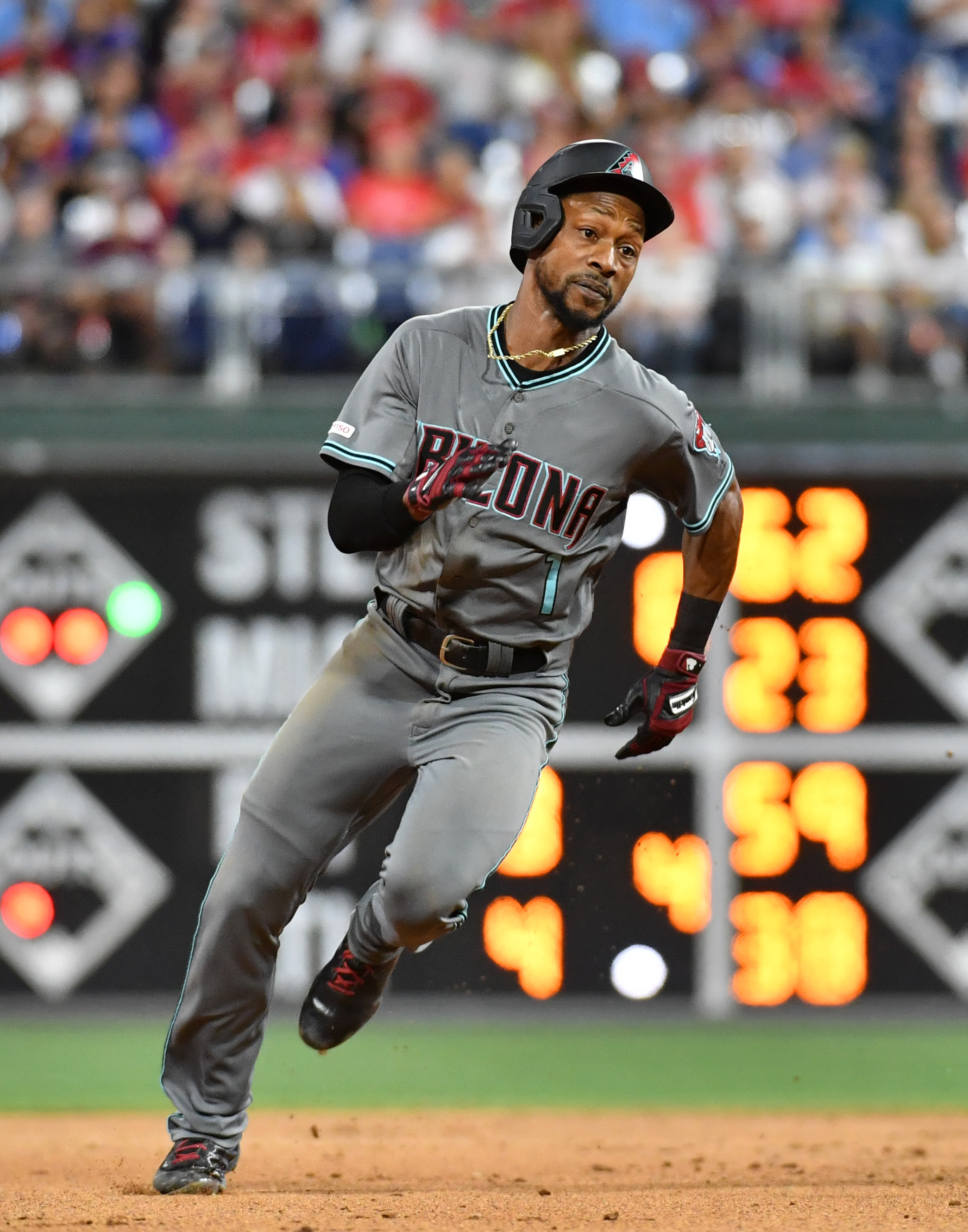
Dyson will help the Bucs cover for the departure of center fielder Starling Marte — who was dealt to Dyson’s most recent team, the Diamondbacks. It’s likely that the Pirates will utilize others up the middle as well, though we’ll know more when the club gathers up its position players in camp.
Now 35 years of age, Dyson is no longer quite the player he once was. He remains an excellent defender and elite baserunner, so the Bucs can feel confident they’ll get value in those areas. Those attributes also make Dyson an easy player to trade to a contender in need of a mid-season roster boost in anticipation of the postseason, as Dyson is a tailor-made late-inning bench asset.
Trouble is, the bat has lagged noticeably of late. From 2013-17, he carried a .262/.326/.361 slash line — hardly a standout mark, but within 12% or so of league-average productivity. It was easily enough to make Dyson a valuable player given his other high-grade tools. But over his two seasons with the Diamondbacks, Dyson has slumped to a meager .216/.302/.299 batting line.
There’s really not much to love about Dyson’s profile at the plate. He has boosted his walk rate of late but has consistently failed to make hard contact — though that was true also when he was turning in better outcomes. Whether due to his approach or those of opposing pitchers, Dyson’s launch angle has also headed northward. He has not gained any pop but has seen his batting average (and batting average on balls in play) dive.
It’s still easy to see the appeal of this move for the Bucs. There is some value to be found here and Dyson does keep the door open somewhat to competitiveness. Perhaps there is even a bit of overall upside, if the club can help him find a way to reduce the number of harmless fly balls he’s hitting while maintaining his plate-discipline improvements.
Astros Hold Press Conference On Sign-Stealing Scandal
In the latest confounding development out of the Astros organization, the club held a curious press conference today regarding the team’s still-boiling sign-stealing scandal. Chandler Rome of the Houston Chronicle is among the reporters covering the event on his Twitter feed.
In a long-awaited moment, star players Jose Altuve and Alex Bregman offered only cursory statements on a matter that has sparked outrage from many quarters. Team owner Jim Crane had new manager Dusty Baker ask for forgiveness on behalf of a team he only just joined. And Crane continued his attempt to confine a controversy that has morphed into a broadening crisis, offering what came off as a dismissive take on the matter.
Bregman stated that he is “really sorry” and added that he “hope[s] to regain the trust of baseball fans.” Altuve expresed “remorse” and said that “the whole organization feels bad about what happened in 2017.” That was all for now.
Crane also brought out Baker, who replaced the uniformed leadership (A.J. Hinch) from the periods during which the Astros engaged in a longstanding, widely suspected and ultimately discovered effort to steal signs utilizing technology and then convey those signals to batters in real time. The widely respected Baker asked for forgiveness on behalf of the players. Suffice to say, it was curious to ask him to do so.
Baker said the players “showed tremendous remorse, sorrow, and embarrassment” in a private team meeting last night. Perhaps we’ll hear more of that when the Astros open their clubhouse to reporters, but it was not quite on display in the initial comments.
Most of the talking was done by team owner Jim Crane, who continued to try to separate himself and the team’s players from the fiasco. He pinned the blame on Hinch and GM Jeff Luhnow, both of whom Crane canned in the aftermath of the release of the findings of MLB commissioner Rob Manfred.
Crane says that he agrees with commissioner Rob Manfred’s decision not to punish the players involved in the scandal. The organization’s “leaders enabled, condoned, and did not stop” the sign-stealing effort. Crane called the players “a great group of guys” who merely lacked “proper guidance from our leaders.” It’s quite a contrast to Manfred’s report, which specifically described a “player-driven effort.”
Crane not only sought absolution for the players he’s still paying to perform on the field. He also left no doubt as to his views on his role in the situation — namely, that he had nothing to do with it. While he panned Hinch and Luhnow for their failure of leadership, Crane evidently feels no similar responsibility.
Per Crane:
“Clearly the report states that I didn’t know about it. Had I known about it, I’d have done something about it.”
And what of his accountability, as the organization control person?
“No, I don’t think I should be held accountable.”
Crane’s rather craven approach to the matter continued as he addressed several other notable points. He acknowledged that the organization “broke the rules,” but maintained that he does not believe the sign-stealing effort had any “impact” on the team’s World Series win — leaving unaddressed the question why so much effort was put into the scheme. Frankly, no further proof beyond the concerted scheme is needed for the proposition that the people in uniform felt it improved their chances of winning.
Crane addressed the question of whether the team engaged in more recent, somewhat different cheating efforts: “I truly believe there were no buzzers ever.” Whether or not he’s sincere in that, the possibility of 2019 sign-stealing schemes is a matter that seems sure to be explored further.
Crane also noted there’ll “be some changes” in the team’s baseball operations department. He had originally maintained that the overall culture was not a problem, disputing Manfred’s report in that regard. But recent reporting has exposed the role of the baseball ops staff in originating and perpetuating the sign-stealing scheme. Several current employees were implicated clearly in a way that was not documented in the report.
Closer Role Notes: Red Sox, Pirates, Marlins
The notion of a closer’s role has evolved over the years, but there’s never been any doubt of the importance of a reliable late-inning relief strategy. While some organizations prefer more flexible arrangements, quite a few still utilize dedicated ninth-inning men. Settling on a closer isn’t just important to a team and to fantasy baseball gurus. It’s also a factor in a player’s trade and free agent status and — especially — to his potential arbitration earnings.
Here are some early notes on spring closer situations from around the game …
- Red Sox manager Ron Roenicke made rather clear that he views Brandon Workman as the top closing option entering camp, as Chris Cotillo of MassLive.com tweets. The club isn’t making anything official just yet, but the comments from the just-minted skipper give him a strong presumption. That’s not too surprising: the 31-year-old Workman emerged as a premium pen arm last year, when he racked up 71 2/3 innings of 1.88 ERA ball with 13.1 K/9 and 5.7 BB/9. He does have some experience closing out games, having finished 16 Boston wins as part of a committee approach last year.
- For the Pirates, there’ll be no waiting: new skipper Derek Shelton says Keone Kela will handle the ninth, as Adam Berry of MLB.com reports on Twitter. Kela’s time in Pittsburgh hasn’t exactly been smooth, but he’s undeniably talented enough to do the job and will now be challenged with added responsibility as the organization seeks to turn the page on a brutal 2019 season. There were numerous problems on and off the field for the Bucs. By far the most important was the arrest of closer Felipe Vazquez on charges so awful that it’s hard even to think of the matter from a baseball perspective. But the organization has obviously had to make decisions to account for that departure. There is plenty of incentive for Kela, who will be a free agent at season’s end. If things go better for the 26-year-old than for the remainder of the Pirates team, he could also feature as a significant mid-season trade piece.
- The Marlins have set about compiling a new-look bullpen this winter. It seems it’ll be anchored by one of the club’s recent veteran additions. Manager Don Mattingly strongly suggested that Brandon Kintzler is the top choice to function as closer, Craig Mish of FNTSY Sports Radio tweets. The 35-year-old isn’t exactly a prototypical swing-and-miss, capital-C closer type. But he did turn in 57 frames of 2.68 ERA ball last year with a typically strong 54.7% groundball rate. And Kintzler has saved 49 games in his career.
Major Leaguers Discuss Astros’ Sign-Stealing Scandal
It has been a tumultuous few weeks for the Astros, whose well-documented sign-stealing scandal has owned headlines over the past month. As a result, the club had to let go of its eminently successful GM-manager tandem of Jeff Luhnow and A.J. Hinch after Major League Baseball suspended them for a year apiece.
Since Luhnow and Hinch lost their jobs, Astros players have been accused of wearing buzzers under their jerseys last season in order to identify which pitches were coming. The league didn’t find any evidence that occurred, but Yankees manager Aaron Boone – whose team lost to the Astros in the 2019 ALCS – didn’t dismiss it Wednesday. Boone instead noted that it’s “certainly one of those great unknowns,” per Tom Verducci of Sports Illustrated. Hinch also addressed the matter, stating that he has “never seen any such device used in baseball. I am not aware of any such device existing or being utilized with the Astros, the players, or any other team.”
Regardless of whether Hinch is telling the truth, it’s up in the air whether he or Luhnow will work in MLB again. Houston has already replaced the two with Dusty Baker and James Click, respectively. Baker, owner Jim Crane and Astros players will address reporters at 9:30 a.m. ET on Thursday, the first day of media availability at spring training, Chandler Rome of the Houston Chronicle reports.
It’s unclear exactly what the Astros will say, but odds are they’ll take a regretful tone for their wrongdoing. Crane, after all, revealed a few weeks ago that the Astros would “apologize for what happened, ask forgiveness and move forward,” as Jeff Passan of ESPN relays.
Former Astros Marwin Gonzalez, Dallas Keuchel, Charlie Morton, Joe Musgrove and Max Stassi – all members of the franchise’s 2017 World Series-winning club – have already apologized for the team’s past misdeeds. Nevertheless, there are multiple major leaguers who have voiced disgust toward the Astros this week.
Angels left-hander Andrew Heaney – now teammates with Stassi – ripped into his division rivals, saying (via Maria Torres of the Los Angeles Times): “They sure as [heck] need to do more than what they already did. That was terrible. I understand they are going to go get their (stuff) in order and they are going to have their thing to say, and they are going to hide behind the commissioner’s report and whatever. But I don’t think that’s good enough.”
Meanwhile, Phillies reliever David Robertson opined (per Jim Salisbury of NBC Sports Philadelphia), “It’s a disgrace what they’ve done and they’re going to have to live with it and everyone knows.”
Robertson was a member of the Yankees in 2017, when the Astros defeated them in a seven-game ALCS to advance to the World Series. The typically reliable righty had a disastrous Game 6 during that series, yielding four earned runs on four hits while failing to record an out in a 7-1 loss. Robertson suggested to Salisbury that there was foul play involved in that dominant Houston performance.
“I got roughed up in Game 6,” he said. “And I felt like in that game I threw as well as I’ve ever thrown in my entire life. I had some pitches that got hit that I was a little shocked by and some pitches that didn’t get swung at that I was a little shocked by. At the time, I wasn’t thinking about what we know now. But it all comes together now and, you know, I’m upset about it, that’s for sure.”
Athletics righty Mike Fiers, an Astro from 2015-17, was instrumental in bringing Houston’s methods to light back in November. But Fiers isn’t the only member of the Athletics who knew something was wrong. GM David Forst and manager Bob Melvin, whose club finished second to the Astros in the AL West in each of the prior two seasons, informed Susan Slusser of the San Francisco Chronicle that the A’s complained to the league about their sign-stealing rivals. However, MLB did not take action against the Astros at that point. Had Fiers not eventually gone public with his complaints, it’s possible nothing would have been done.
Martin Prado Retires
Longtime major leaguer Martin Prado has officially called it a career, Jon Heyman of MLB Network tweets. Heyman first reported back in November that Prado was likely to retire.
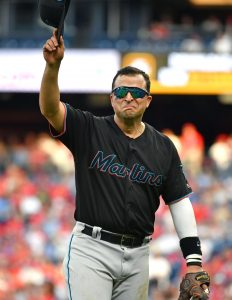
Now 36 years old, the Venezuela-born Prado began his professional career when he signed with the Braves in 2001. He debuted with the Braves in 2006, and two years later, he started to establish himself as an effective big leaguer. During his Braves heyday from 2008-12, Prado slashed .296/.346/.438 with 51 home runs, 30 stolen bases and 13.2 fWAR in 2,688 plate appearances, garnering time all over the infield and in left field along the way. He also earned his lone All-Star nod (2010) during his run in Atlanta.
Although Prado was rather productive as a Brave, they dealt him to the Diamondbacks prior to the 2013 season in a large trade that sent outfielder Justin Upton to Atlanta. The Diamondbacks quickly locked up Prado to a four-year, $40MM contract, though he only lasted a little more than a season in their uniform. They sent him to the Yankees in July 2014, but his time in New York was also fleeting. After just a few months as a Yankee, they shipped him to the Marlins ahead of the 2015 campaign.
Prado found a multiyear home in Miami, where he finished his career. He was a highly productive member of the Marlins’ roster during his first two seasons with the club, earning yet another $40MM guarantee (this time for three years) in September 2016. However, thanks in part to various injuries, Prado was unable to live up to the payday. He appeared in just 195 of a possible 486 regular-season games from 2017-19, during which he struggled to a .241/.276/.313 line and totaled only five homers in 616 trips to the plate.
Although his time in the majors didn’t end with a flourish, Prado enjoyed a much better career than most. He’ll wrap it up as a lifetime .287/.335/.412 batter with 100 HRs, 40 steals and 20.8 fWAR in 5,861 PA. Prado also earned just over $89MM in MLB, according to Baseball-Reference. MLBTR congratulates Prado for his accomplishments and wishes him well in retirement.
Photo courtesy of USA Today Sports Images.
Health Notes: White Sox, Leake, Perez, Dominguez
The White Sox opened camp with a series of unwelcome injury developments, as each of Yasmani Grandal, Lucas Giolito and Gio Gonzalez are all dealing with minor injuries (link via Daryl Van-Schouwen of the Chicago Sun Times). Grandal injured his calf in the weight room last week, and an MRI revealed a minor calf strain. Giolito is working through a strained muscle in his chest, and Gonzalez is battling some discomfort in his left shoulder. However, GM Rick Hahn expects all three to be good to go by Opening Day and referred to the injuries as “minor.” Grandal clearly isn’t overly worried about his status, as he joked with reporters that he was merely trying to get out of some running drills in Spring Training (Twitter link via MLB.com’s Scott Merkin). Giolito, meanwhile, is already throwing from 120 feet and said he’s “zero percent” concerned about his injury.
Some more health/injury notes from early on in camp…
- Diamondbacks right-hander Mike Leake is undergoing an MRI after experiencing soreness in his left wrist following a fall at his home, manager Torey Lovullo told reporters today (Twitter links via The Athletic’s Zach Buchanan). Lovullo described the MRI as precautionary in nature, so it doesn’t seem as though the organization is overly concerned at the moment. Leake, 32, landed in Arizona following a deadline swap with the Mariners and pitched to a 4.35 ERA in 60 innings (10 starts). Leake fanned just 27 hitters in those 60 frames but was quite stingy in terms of issuing free passes as well, surrendering just eight bases on balls. The ever-durable righty made at least 30 starts for the eighth consecutive season in 2019, eating up 197 innings between Seattle and Arizona.
- After missing the 2019 season due to Tommy John surgery, Royals stalwart Salvador Perez is ahead of schedule and expected to be ready for Opening Day, new manager Mike Matheny told reporters (link via MLB.com’s Jeffrey Flanagan). Perez is already throwing to second base without issue and is slated to meet with his doctors tomorrow for another check-in. Interestingly, Matheny suggested that Perez would not only see some time at designated hitter early in the season but also at first base, as the Royals look to be cautious with his throwing workload.
- Phillies right-hander Seranthony Dominguez managed to avoid Tommy John surgery last year after an elbow scare, and he now appears to be on track for Opening Day, tweets Matt Breen of the Philadelphia Inquirer. Dominguez resumed throwing in December and has now thrown three bullpen sessions — including one earlier today. The 25-year-old was lights out in his debut effort back in 2018 and took a step back in limited action in 2019 before hitting the injured list. In 82 2/3 innings between those two seasons, he’s pitched to a 3.27 ERA with 11.2 K/9, 3.7 BB/9 and 16 saves.
Details On Mets’ Pursuit Of Mookie Betts
Mookie Metts? It didn’t come to fruition, but the Mets did make an effort in December to acquire superstar outfielder Mookie Betts from Boston. The Red Sox ended up trading him to the Dodgers earlier this week.
One reason talks between the Mets and Red Sox broke down? The Mets weren’t open to moving infielder/outfielder Jeff McNeil for just a year of control over Betts, Joel Sherman of the New York Post reports (they also wouldn’t give him to the Indians for shortstop Francisco Lindor). However, the Red Sox regarded McNeil as “integral” to a potential trade package, according to Sherman. Understandably, the Mets weren’t going to part with the versatile, inexpensive 27-year-old after he was one of the majors’ most effective offensive players from 2018-19.
While the Mets weren’t willing to surrender McNeil for Betts, they did offer packages centered on outfielder Brandon Nimmo and infielder/outfielder J.D. Davis (quality, affordable players in their own right), per Sherman. Those deals also would have included one of the Mets’ infield prospects in either Andres Gimenez or Ronny Mauricio, two top-100 farmhands. It seems the Mets, reluctant to absorb all of Betts’ $27MM salary, also would have tried to include one of their highly paid, unwanted veterans in outfielder Yoenis Cespedes or infielder Jed Lowrie in order to somewhat offset the money they’d have taken on had a deal with Boston gone through.
Considering that getting under the $208MM luxury-tax threshold was one of the main causes for the Red Sox’s decision to unload Betts (and left-hander David Price with him), adding Cespedes or Lowrie wouldn’t have been palatable for them. They wound up accepting the Dodgers’ offer of outfielder Alex Verdugo and two prospects – infielder Jeter Downs and catcher Connor Wong – saving a total of $75MM in the process.
Meanwhile, although the Mets went big-game hunting for Betts, their outfield appears as if it’ll enter 2020 with mostly the same cast. That’s not necessarily a bad thing, even though none of the team’s current options can rival Betts. However, to their credit, McNeil, Nimmo, Davis, Michael Conforto and Dominic Smith all had good seasons a year ago. It’s anyone’s guess what the Mets will get from Cespedes after injuries shelved him for the vast majority of the prior three seasons, but he’s back on a reduced salary and has always produced when healthy.
Latest On Yankees’ Rotation
The Yankees’ rotation looked set when the month of February started, but the back surgery left-hander James Paxton recently underwent threw a wrench in their plans. They’re now lacking an obvious answer after Gerrit Cole, Luis Severino, Masahiro Tanaka and J.A. Happ. The team will give plenty of hurlers chances to emerge as its No. 5 during spring training, though, as Bryan Hoch of MLB.com relays.
General manager Brian Cashman on Wednesday named five pitchers – Luis Cessa, Deivi Garcia, Jonathan Loaisiga, Michael King and Jordan Montgomery – as candidates to take the last spot in New York’s rotation. The leader may be the 27-year-old Montgomery, who had an impressive rookie campaign in 2017 but hasn’t been much of a factor since then because of injury troubles. Montgomery underwent Tommy John surgery in June 2018 after throwing a mere 27 1/3 innings that year, though he did make a late-season return to a major league mound in 2019. Manager Aaron Boone said Wednesday that Montgomery’s now “in a good place” with respect to his health.
As for Montgomery’s competition, Cessa and Loaisiga have each garnered a decent amount of experience at the game’s highest level. Cessa’s heater checks in around 95 mph, but it hasn’t led to great results in the majors. He’s the owner of a 4.50 ERA/4.98 FIP with 7.37 K/9 and 2.91 BB/9 in 232 career innings. Most of his work (67 of 86 appearances) has come as a reliever. Cessa is out of minor league options, so he could end up in another organization if he doesn’t make the Yankees this spring.
Loaisiga can throw even harder than Cessa (96-97 mph), and he’s a former top-100 prospect, but his MLB production hasn’t been special, either. While Loaisiga recorded a tremendous strikeout rate of 11.18 per nine in his first 56 1/3 innings as a Yankee from 2018-19, he walked almost five per nine and only registered a 4.79 ERA/4.33 FIP. Moreover, the right-hander dealt with shoulder problems last season.
Neither Garcia nor King has appeared in the majors yet, but there’s plenty of promise in the two cases. FanGraphs’ Eric Longenhagen ranked the 20-year-old Garcia as the game’s 42nd-best prospect Wednesday, calling the 5-foot-10, 163-pounder “a diminutive firecracker righty with a beautiful curveball.” However, because of his size, there are questions about Garcia’s durability. He also didn’t put up great numbers last year as an extremely young Triple-A pitcher, as he managed a subpar 5.40 ERA/5.77 FIP with 10.13 K/9 and 4.5 BB/9 over 40 innings at the level.
King, 24, racked up a combined 62 2/3 innings in Triple-A from 2018-19, pitching to a sterling 2.30 ERA with 8.5 K/9 and 1.7 BB/9 in that span. He even made a one-appearance MLB debut last season, and currently ranks as the Yankees’ 19th-best prospect at MLB.com.
Considering how volatile the back end of most teams’ rotations are, it’s entirely possible (maybe even likely) that more than one of the above hurlers will start games for the Yankees as they await Paxton’s return. The World Series hopefuls figure to get Paxton back early in the summer, so those who wind up filling his spot could be on borrowed time in that role.
Diamondbacks, Aaron Blair Agree To Minor League Deal
The D-backs are bringing one of their first-round picks back to the organization, signing right-hander Aaron Blair to a minor league contract, per MassLive.com’s Chris Cotillo (Twitter link). He’s repped by PSI Sports Managament.
Blair, 27, was a supplemental first-rounder out of Marshall University in 2013. He ranked among baseball’s 100 best prospects per Baseball America, MLB.com and Baseball Prospectus in both the 2014-15 and 2015-16 offseasons. But while Blair was a fast riser who thrived during his first extended looks at Double-A and Triple-A, his career stalled out upon reaching the Majors.
Arizona included Blair in the franchise-altering trade that also sent Dansby Swanson and Ender Inciarte to Atlanta in exchange for Shelby Miller. He made his MLB debut with the Braves in April 2016, but from 2016-17 he combined to allow 64 earned runs with a lackluster 49-to-39 K/BB ratio over the life of 73 innings.
Blair eventually underwent surgery to repair a torn capsule in his pitching shoulder in April 2018 — a procedure that wound up sidelining him for not only the 2018 season but all of the 2019 campaign as well. After pitching just 2 2/3 innings between the Majors and Triple-A over the past two seasons, Blair will face an uphill battle in pitching his way back to the big leagues, but he’ll do so in his original organization — one where he had more success than he did at any point during his Braves tenure.
Padres Claim Breyvic Valera
The Padres announced Wednesday that they’ve claimed infielder/outfielder Breyvic Valera off waivers from the Blue Jays. In order to open a spot on the 40-man roster, San Diego has placed right-hander Anderson Espinoza on the 60-day injured list. Espinoza underwent Tommy John surgery late last April.
Valera, 28, was designated for assignment earlier this week when Toronto finalized its one-year deal with reliever Rafael Dolis. Valera spent time with both the Jays and Yankees in 2019, though he appeared in just 17 games and took just 52 plate appearances. Overall, Valera has appeared in the Majors with five teams but played in just 54 games, hitting .223/.294/.298 in 138 trips to the plate.
Lack of MLB track record aside, the switch-hitting Valera is the owner of a .302/.374/.442 slash in 1550 plate appearances at the Triple-A level. Coupled with his defensive versatility –he’s played second base, third base and all three outfield positions — it’s easy to see why so many clubs have been intrigued by his skill set and taken brief looks at him. At this point, however, Valera has exhausted all three of his minor league option years, meaning he’ll need to break camp with the Padres (or another club) or else be traded or placed on waivers once again.