
Jose Iglesias Interested In Re-Signing With Reds
Jose Iglesias has been an effective pickup at a low price for the Reds, who inked the former Boston and Detroit shortstop to a minor league contract last winter. Although he had to settle for a non-guaranteed deal, Iglesias earned a spot on the Reds’ roster and a $2.5MM salary coming into the season. The 29-year-old has since turned into a starter for Cincinnati, where he has batted .290/.321/.417 with a career-high eight home runs in 390 plate appearances.
It’s possible the slick-fielding Iglesias’ output this year will be enough to convince a team to sign him to a major league pact prior to next season. Whether or not that happens, Iglesias would like to stay in Cincy, he explained to Mark Sheldon of MLB.com.
“We haven’t gotten deep into that conversation yet. It’s going to happen soon, I guess,” Iglesias said. “Man, I love this group. That’s all I can say. This is where I belong. I don’t know, it’s totally out of my hands after that. I’ve enjoyed every single day I’ve come to the ballpark and leading by example, helping the younger players, and I’m very, very happy to be here.”
The Reds are also open to continuing their relationship with Iglesias, with president of baseball operations Dick Williams telling Sheldon that the club “could have any combination of (Jose) Peraza, (Freddy) Galvis and Iglesias on the team next year. None currently have guaranteed contracts, but we have interest in all of them as well as control over some of them, and we’ll evaluate how the pieces best fit together.”
Peraza, Galvis and Iglesias are currently part of a Reds middle infield mix that also includes Josh VanMeter, Kyle Farmer and the injured Derek Dietrich. Among Peraza, Galvis and Iglesias, the former has posted the least productive 2019. After racking up encouraging numbers last year, Peraza has only hit .241/.287/.355 in 321 trips to the plate this season. He’s on a $2.775MM salary and controllable via arbitration two more times. Galvis, just claimed from the Blue Jays on waivers this week, has a $5.5MM club option (or a $1MM buyout) for 2020. This has been a respectable campaign for the 29-year-old switch-hitter, owner of a .274/.305/.456 slash with 19 homers over 479 PA.
With everyone from the above group looking like candidates to return next season, the Reds once again appear as if they’ll have no shortage of in-house middle infield choices. However, Cincinnati could nonetheless seek higher-upside possibilities than Iglesias and the rest during the winter, when Williams and general manager Nick Krall figure to make an earnest attempt to construct a playoff-caliber roster. The Reds (56-63) have made obvious strides this year, but they’re still on pace for their sixth straight sub-.500 season, leaving room for improvement in their middle infield and elsewhere.
Athletics To Reduce Jurickson Profar’s Role
Second baseman Jurickson Profar rode the bench in favor of the just-promoted Corban Joseph for the Athletics’ victory over the Giants on Wednesday. It’s the beginning of a trend for Profar, who’s in for a “greatly reduced role,” Susan Slusser of the San Francisco Chronicle writes. Most of the switch-hitting Profar’s action will come against left-handed pitchers, Slusser explains, with the lefty-swinging Joseph and righty Chad Pinder set to eat into his playing time.
A late-season reduction in at-bats for Profar isn’t what the Athletics had in mind when they acquired him last winter, especially now that they’re locked in a playoff race. The addition of Profar from Texas in a three-way trade that also included Tampa Bay cost Oakland standout reliever Emilio Pagan and infield/outfield prospect Eli White. It didn’t look like an unreasonable price to pay for Profar, a once-prized prospect who finally lived up to some of his past promise in 2018. After largely disappointing from 2012-17, Profar batted .254/.335/.458 (108 wRC+) with 20 home runs, 10 steals and 2.9 fWAR as a 25-year-old last season.
The A’s likely expected more of the same from Profar this season, if not an even better performance. Instead, though, Profar has batted a miserable .205/.268/.382 (70 wRC+) through 395 PA. While Profar has swatted 15 homers and totaled seven more steals, his weak batting line and subpar reviews at second (minus-10 Defensive Runs Saved, minus-0.8 Ultimate Zone Rating), have limited him to a replacement-level impact in 2019. It may go down as the lone year with the Athletics for Profar. While he still has another season of arbitration control, in which Profar will hope to earn a raise over his current salary of $3.6MM, Slusser casts doubt on the possibility of him returning to the team in 2020.
Regardless of what his future holds, Profar – to his credit – is taking his demotion in stride, as he told Slusser: “I don’t feel like I’ve been contributing like I’m capable of, so I’m OK with it. I’ll just keep working and try to find it.”
Profar’s troubles have come against righties, who have held him to a .177/.245/.372 line (compared to a solid .304/.353/.418 versus lefties). A deeper dive into Profar’s numbers does indicate some bad fortune has factored into his woes. Profar has typically run low batting averages on balls in play in his career, evidenced by his lifetime .257 BABIP, but this year’s .205 mark is way down even by his standards. Meanwhile, according to Statcast, his .302 expected weighted on-base average easily outpaces his .278 real wOBA. Profar also remains difficult to strike out, having done so at a 15.2 percent clip this year.
Granted, those aren’t overwhelming positives, so the Athletics want to explore alternatives at the keystone. Manager Bob Melvin told Slusser the A’s aren’t “getting as much production as we want at that position, so maybe you look elsewhere.” That’ll lead them to Joseph, a 30-year-old with a mere 31 major league plate appearances under his belt.
Jeter: Marlins Haven’t Made Decision On Mattingly’s Future
The Marlins will reportedly move on from manager Don Mattingly after the season, but the 58-year-old said Wednesday he hopes to return to his post in 2020, Joe Frisaro of MLB.com relays.
“I’d love to be back, especially if they want you back,” said Mattingly, whose contract will expire at season’s end.
Marlins owner Derek Jeter acknowledged that Mattingly’s future is “something that we need to talk about sooner rather than later. We have touched base, and we’ll continue to talk.” To this point, though, the Marlins haven’t taken time to decide on whether they’ll make a change in the dugout, according to Jeter.
Going solely by win-loss record, it’s been a rather poor Miami tenure for Mattingly, whose teams have assembled a 263-339 mark. But judging by record wouldn’t be fair to Mattingly, who has tried to weather especially tempestuous times as the Marlins’ skipper. The franchise looked to be making progress in his first year on the job, a 79-win campaign, but it lost ace Jose Fernandez in a boating accident that September. The next season – an MVP-winning effort for outfielder Giancarlo Stanton – the Marlins hung in wild-contention late into the summer before falling apart and finishing 77-85.
Jeter and Bruce Sherman took over for the reviled Jeffrey Loria as the Marlins’ owners after the 2017 season, and they then launched the organization into a full rebuild. Since then, the Marlins have slashed a huge amount of payroll – not to mention big league talent – by trading the likes of Stanton, Christian Yelich, Marcell Ozuna and J.T. Realmuto. In the process, the Marlins have rebuilt a once-dreadful farm system into an impressive group, but Mattingly hasn’t really been in position to benefit from that. The MLB club has gone 107-172 dating back to 2018.
If the Marlins do move on from Mattingly after the season, it’ll represent one former Yankees captain waving goodbye to another. Mattingly held the role with the Yankees until he retired in 1995. Jeter, who debuted in Mattingly’s final season, took over as New York’s captain in 2003. Should Jeter part with him, it wouldn’t be a surprise to see Mattingly draw managerial interest from elsewhere at the outset of the offseason. He’s a respected presence in the game who, before landing in Miami, enjoyed a decent run as the Dodgers’ manager from 2011-15.
Athletics Sign Matt Harvey
9:53pm: The club has indeed signed Harvey, per Susan Slusser of the San Francisco Chronicle. Harvey will report to Triple-A Las Vegas.
9:17pm: The Athletics are closing in on a contract with free-agent right-hander Matt Harvey, according to Roster Roundup. It’ll be a minor league pact, Jon Heyman of MLB Network tweets.
An agreement with the A’s means Harvey will continue in the American League West, where he pitched for the Angels this season before they released him three weeks ago. The former Mets star, 30, was among the Angels’ most notable signings last winter, when they handed him an $11MM guarantee. But the Halos’ version of Harvey performed like one of the worst starters in baseball, which forced the team to drop him.
After reviving his career to some extent as a member of the Reds late last season, Harvey opened this year with a ghastly 7.09 ERA/6.35 FIP with 5.88 K/9 and 4.37 BB/9 across 59 2/3 innings and 12 starts. As you’d expect, he ranked near the bottom of the league in all of those categories. In the process, Harvey yielded home runs on a personal-worst 22.4 percent of fly balls, recorded the lowest average four-seam fastball velocity of his time in the majors (93.2 mph) and posted the second-weakest swinging-strike rate of his career (9.1). Hitters teed off on Harvey for a .372 weighted on-base average along the way, but according to Statcast’s expected wOBA metric (.390), he actually deserved worse.
Needless to say, this has been a nightmarish campaign for Harvey. There’s little harm in the A’s taking a flier on him on a minors pact, though, especially considering the success they’ve recently had bringing in castoff starters on low-cost deals (Edwin Jackson, Brett Anderson and Trevor Cahill spring to mind). And Harvey’s now back in the same organization as A’s executive Sandy Alderson, who was New York’s general manager during the hurler’s tenure there.
Having dealt with significant injuries to Sean Manaea, Jesus Luzardo, A.J. Puk, Marco Estrada and Jharel Cotton – not to mention an 80-game suspension to emergent ace Frankie Montas – Oakland has been forced to make do with a patchwork rotation for the second straight year. The club somehow won 97 games and earned a wild-card berth last season, though, and has weathered its issues in 2019 to log a 68-52 record.
Currently two games back of a wild-card spot, the Athletics have been aggressive in trying to upgrade their starting staff over the past few weeks. Prior to last month’s trade deadline, they acquired Tanner Roark from the Reds and Homer Bailey from the Royals. Those two are now part of a rotation that also includes Anderson, Mike Fiers and Chris Bassitt, while Manaea, Luzardo and perhaps even Harvey are among those who could also factor into the mix in the coming weeks.
Padres Likely To Place Fernando Tatis Jr. On Injured List
The Padres are likely to place phenom Fernando Tatis Jr. on the injured list because of back spasms, Kevin Acee of the San Diego Union-Tribune tweets. Tatis departed Tuesday’s game because of the issue and then sat out Wednesday.
This will be the second IL stint of the season for Tatis, a 20-year-old rookie shortstop who has been among the majors’ best players – first year or otherwise – in 2019. Although he missed a month earlier in the season with a hamstring strain, Tatis has still managed to slash an excellent .317/.379/.590 (149 wRC+) with 22 home runs, 16 steals and 3.7 fWAR across 372 plate appearances. Tatis may join Mets first baseman Pete Alonso as the leading NL Rookie of the Year vote-getters at season’s end, though having a pair of IL trips under his belt could help prevent the Padre from winning the award.
Regardless of whether he takes home any hardware this year, Tatis has the talent to end up in the running for plenty of accolades in the future. With that in mind, the Padres will surely be cautious with Tatis as he works his way back from this injury – especially considering they’re all but out of playoff contention. However, the club is hopeful he’ll be able to return after 10 days off, according to Acee.
The Kelvin Herrera Signing Hasn’t Gone The White Sox’s Way
At times since he debuted in the majors in 2011, right-hander Kelvin Herrera has been one of the majors’ most dominant relievers. Between 2012 and ’16, for instance, Herrera pitched to a sterling 2.57 ERA/2.96 FIP with 9.14 K/9, 2.69 BB/9 and a 48.7 percent groundball rate over 354 1/3 innings. He averaged a whopping 98.0 mph on his four-seam fastball along the way, and was a key reason why the Royals took home a World Series championship in 2015. That fall, Herrera turned in 13 2/3 innings of two-run ball (one earned) and totaled 22 strikeouts against three walks. Herrera hasn’t been the same caliber of pitcher over the past couple years, however, and is now struggling through the worst season of his career.
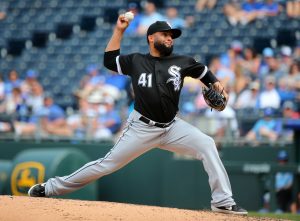
Things began going downhill for Herrera in 2017, his last full season as a Royal, and continued to spiral last year in a campaign divided between Kansas City and Washington. Herrera still notched an outstanding 2.44 ERA and barely walked more than two batters per nine over 44 1/3 innings, but his 7.71 K/9, 35.6 percent groundball rate, 3.95 FIP, 4.31 xFIP and 3.81 SIERA ranked among the least impressive figures during his time in the pros. Making matters worse, Herrera suffered a season-ending Lisfranc injury in his left foot in late August.
Although 2018 concluded in unfavorable fashion for Herrera, that didn’t stop the 29-year-old from landing a solid payday in free agency last winter. The rebuilding White Sox, familiar with the hurler from his run with the division-rival Royals, committed two years and $18MM to Herrera.
Unfortunately for Chicago, the Herrera contract has looked like a mistake to this point. Through 34 1/3 innings with the ChiSox, Herrera has limped to a 7.08 ERA. Only two relievers who have accrued 30-plus innings (David Hernandez, whom the Reds just released, and the Orioles’ Branden Kline) have had more trouble preventing runs than Herrera, whose average fastball velocity (95.8 mph) sits as the least imposing of his career. Unsurprisingly, a drop in swinging-strike rate – 10.8 percent, the worst of Herrera’s majors tenure – has accompanied his dip in velocity. At the same time, with 4.19 walks per nine, Herrera has issued more free passes than ever.
Herrera’s new status as one of the game’s least effective relievers has come with a change in repertoire. According to Statcast, after throwing his four-seamer anywhere from 40 to 60 percent in previous seasons, he’s down to 32.8 percent this year. Hitters have tattooed the pitch, though, with a .483 weighted on-base average/.421 xwOBA. They’ve also had plenty of success against his sinker (21.9 percent; .432 wOBA/.364 xwOBA) and cutter (10.3 percent; .375/.391). Conversely, Herrera’s non-fastballs – his changeup (21.5 percent; .218/.225) and slider (13.6 percent; .202/.220) – have stymied the opposition. Perhaps he’d be well-served to rely more on those offerings.
Regardless of pitch choice, it does seem Herrera has encountered a bit of bad luck this season. His fielding-independent pitching marks, including a 4.73 FIP, are all much more respectable than his ERA (although hardly great). Hitters have also victimized Herrera for an unsustainable .378 batting average on balls in play, which sits well above his career .292 mark and has come in spite of a low average exit velocity. Herrera’s mean exit velo against (85.8 mph) ranks as his best in the Statcast era and falls in the top 7 percent of the league. The .339 xwOBA Herrera has yielded is still unimpressive, but it looks far better than the .370 real wOBA hitters have mustered off him. Meanwhile, Herrera has only stranded 63.2 percent of runners – down from a lifetime mark of 77.7.
Herrera and the White Sox will, of course, hope fortune starts going in his favor over the next year-plus. As of now, though, this doesn’t have the makings of a successful signing for the club, which committed much more money to Herrera than any other free agent last offseason. If Herrera does bounce back in 2020, though, it could go a long way toward helping the White Sox snap a painfully long playoff drought that’s sure to hit 11 seasons this year.
Photo courtesy of USA Today Sports Images.
Free Agent Stock Watch: Rick Porcello
Relative to expectations, the 2019 season has been a major disappointment for the Red Sox. Many teams would be satisfied with Boston’s 64-59 record, but after winning 108 regular-season games and a World Series in 2018, what the club has done in the first four-plus months of this year looks rather underwhelming. The unspectacular performance of right-hander Rick Porcello is among the many reasons the Red Sox have fallen short of expectations this season.

Porcello wasn’t great last year during the Red Sox’s latest run to a championship, but he gave the team 33 starts and 191 1/3 innings of 4.28 ERA/4.01 FIP pitching. That was a valuable complementary effort to the better output Chris Sale and David Price put forth. This season, though, Porcello has logged a far worse 5.67 ERA/4.92 FIP across 133 1/3 frames. He ranks dead last among 69 qualified starters in ERA and sixth from the bottom in FIP. It’s an unexpected fall from grace for someone who won the American League Cy Young Award in 2016, when Porcello posted a 3.15 ERA/3.40 FIP in 223 innings.
The fact that the 30-year-old Porcello’s just a couple months from his first-ever trip to free agency makes his subpar season all the more inopportune. Luckily for Porcello, he has already received one significant payday in his career. Back in April 2015, just months after they acquired him in a trade with the Tigers that also included outfielder Yoenis Cespedes, the Red Sox signed Porcello to a four-year, $82.5MM extension. Porcello was a decent mid- to back-of-the-rotation innings eater at that point, which – Cy Young season aside – has largely been the case in Boston.
This year has been the worst as a member of the Red Sox for Porcello, who hasn’t just seen his run prevention numbers go backward. Porcello has also struck out just 7.22 batters per nine, which is down from a personal-best 8.94 a year ago and sits 14th from the bottom among qualified starters. Meanwhile, although Porcello’s 2.43 walks per nine certainly isn’t bad, it’s the highest of his career. His K/BB ratio (2.97) is superior to just 24 other starters’. Porcello’s groundball rate (38.9) stands as a career worst, too, and pales in comparison to the 50 percent-plus marks he consistently recorded as a Tiger.
Beyond those numbers, Statcast doesn’t think much of what Porcello has done this season. It ranks him toward the bottom of the majors in expected slugging percentage against (.475; 15th percentile), fastball velocity (91.1 mph; 16th percentile), expected weighted on-base average (.332, compared to a .346 wOBA; 32nd percentile), expected batting average (.256; 36th percentile) and hard-hit percentage (46th percentile).
It’s clear there hasn’t been a lot to like this season about Porcello, who will nonetheless try to find a sizable deal in free agency a few months from now. He’ll definitely fall behind Gerrit Cole, Madison Bumgarner, Cole Hamels, Hyun-Jin Ryu, Zack Wheeler, Jake Odorizzi, Kyle Gibson and Dallas Keuchel (perhaps among others) in the open market pecking order, while there are several other starters in a similar class to Porcello who could negatively affect his earning power. A short-term contract (one or two years) seems like a strong possibility for Porcello, who’s likely to struggle to reach eight figures on his next pact. That obviously isn’t what Porcello had in mind when he earned the AL’s top pitcher honors just three years ago.
Photo courtesy of USA Today Sports Images.
Mets To Release Adeiny Hechavarria
Aug. 14: The Mets placed Hechavarria on release waivers today, tweets MLB.com’s Anthony DiComo. He’ll be a free agent once he clears in 48 hours.
Aug. 9: The Mets have designated infielder Adeiny Hechavarria for assignment to make room for newly signed second baseman Joe Panik, the team announced.
The 30-year-old Hechavarria joined the Mets on a minor league contract last offseason. There hasn’t actually been a huge difference between him and Panik this year. Hechavarria has slashed .204/.252/.359 (62 wRC+) with minus-0.2 fWAR in 151 plate appearances. Panik has batted .235/.310/.317 (69 wRC+) with minus-0.2 fWAR in 388 PA. Nevertheless, the Mets will go with Panik, leaving the defensively gifted Hechavarria hoping he catches on with another franchise.
Hechavarria has played second base, shortstop and third base with the Mets this season but is best known for his quality glovework at shortstop. He’s never been much of a threat at the plate, as can be seen with a glance at his .252/.288/.346 career batting line, but he could be a versatile bench addition for a club looking to upgrade its infield defense.
Latest On Nathan Eovaldi
WEDNESDAY: Not so fast. Eovaldi came out of Boston’s bullpen Tuesday. Having only thrown six pitches, he will be available today, but will not get the start, Cora told reporters including Chris Cotillo of MassLive.com (via Twitter). Brian Johnson will instead take the ball to open today’s contest. Where things go from this point remains to be seen.
TUESDAY: After a short run as a reliever, the Red Sox are returning right-hander Nathan Eovaldi to a starting role. Eovaldi will start Wednesday and then spend the rest of the season in the Red Sox’s rotation, Pete Abraham of the Boston Globe reports. He’ll only throw around 55 pitches Wednesday, according to manager Alex Cora (via Julian McWilliams of the Boston Globe).
Eovaldi has been a starter for almost all of his career, but after he sat out from late April toward the end of July while recovering from elbow surgery, reliever-needy Boston planned to give him a shot as its closer. The decision came in part because the Red Sox weren’t sure if Eovaldi would have the time to build his arm up enough to go back to his typical job as a starter. Eovaldi did not acquit himself well out of the Red Sox’s bullpen, though, as he has allowed eight earned runs in 10 2/3 innings since coming off the injured list. The 29-year-old didn’t even rack up a save attempt, with the club instead using Brandon Workman as its closer.
The hard-throwing Eovaldi also had a tough time as a starter this year before going under the knife, which isn’t what the Red Sox envisioned when they splurged on him last winter. After coming over in a midsummer trade with the Rays and then establishing himself as one of the Red Sox’s many playoff heroes during their championship run in 2018, they re-signed him to a four-year, $67.5MM contract in free agency. Eovaldi has since logged a 6.25 ERA/5.74 FIP with 8.81 K/9 and 4.26 BB/9 across 31 2/3 innings. He’s one of many Boston pitchers who have gone through less-than-ideal seasons.
Thanks largely to the struggles of their pitching staff, the Red Sox are on track to begin their offseason far earlier than expected this year. The club’s 62-59, placing it a whopping 17 1/2 games behind the Yankees in the American League East and 8 1/2 back of a wild-card spot. Realistically, it’s time to start looking ahead to 2020, when Eovaldi, Chris Sale, the currently injured David Price and Eduardo Rodriguez figure to comprise 80 percent of the team’s rotation.
Jeff McNeil To Undergo MRI On Hamstring
Mets outfielder/infielder Jeff McNeil departed the team’s loss to the Braves on Tuesday with an apparent left hamstring injury, per Deesha Thosar of the New York Daily News. He’ll undergo an MRI on Wednesday, Tim Healey of Newsday tweets.
McNeil already spent time on the injured list earlier in the season with a hamstring strain, which shelved him for 12 days. The 27-year-old has otherwise enjoyed a dream season, having slashed .332/.400/.529 (148 wRC+) with 15 home runs in 442 plate appearances. Along with serving as one of the majors’ premier hitters, McNeil has been a versatile defender for the Mets. He has appeared in 79 games in the corner outfield, 26 at second base and 16 at third.
The presence of McNeil is an obvious reason the Mets have saved their season over the past several weeks. Despite Tuesday’s defeat, the former bottom feeders find themselves 61-58 and a manageable two games out of a wild-card spot. At least on paper, losing McNeil would damage their chances to rally for a playoff berth. He’d also be the second keystone option to hit the IL recently for the Mets, who are without starter Robinson Cano because of a torn hamstring. However, the club does still have Joe Panik – whom it signed last week – to handle second and Todd Frazier to man third. It’s in less capable hands in the corner outfield, where Dominic Smith and Brandon Nimmo are currently on the IL.
The McNeil-less Mets would likely have to give more outfield playing time to the light-hitting Juan Lagares (who did have a 4-for-4 night Tuesday) as a complement to Michael Conforto and J.D. Davis. New York also has Aaron Altherr at the major league level, but he has endured a nightmarish season, with Dilson Herrera, Rajai Davis and Gregor Blanco among veteran possibilities in the minors. Alternatively, promoting infielder Ruben Tejada could be in the cards, according to Jon Heyman of MLB Network.