
Twins Rumors: Correa, Arraez, Rotation, Catcher
The Twins are set for another in-person meeting with Scott Boras this week to discuss Carlos Correa, Darren Wolfson of SKOR North Radio and 5 Eyewitness News reports in his latest podcast (Correa/Twins talk beginning at 10:10). The Twins have already discussed various contract structures with Boras and Correa, reportedly putting forth multiple offers.
Correa, of course, has a broad range of interest, having been connected to the Giants, Phillies, Cubs, Padres, Orioles and Dodgers, among others. ESPN’s Jeff Passan wrote last week that Correa could be the first of the four big-name shortstops to come off the board, calling his market “excellent” and noting that the Twins have been “making a strong push to re-sign him and build their franchise around” Correa. If, however, Correa ultimately signs elsewhere, Minnesota’s upcoming meeting with Boras could serve dual purposes; Boras also represents Xander Bogaerts, who is reportedly of interest to the Twins in the event that Correa departs.
While Correa is the focus at this point, pitching upgrades have been a perennial need at Target Field as well. The team has a decent rotation group consisting of Sonny Gray, Joe Ryan, Tyler Mahle, Kenta Maeda and Bailey Ober, but each of Gray, Mahle and Maeda can become a free agent next winter. (Maeda is also returning from 2021 Tommy John surgery, so his workload could well be monitored.) The Twins have quite a few MLB-ready arms behind that group — Josh Winder, Simeon Woods Richardson, Matt Canterino — and could also get Chris Paddack back from Tommy John surgery next summer.
That said, the potential departure of three starters next winter and lack of proven options behind them at least has the Twins thinking creatively about ways to add high-end, controllable pitching. To that end, The Athletic’s Dan Hayes reports that Minnesota’s front office has at least discussed the possibility of trading reigning AL batting champion Luis Arraez — if the deal could net them a high-end rotation upgrade. To be clear, there’s no indication that the team plans to aggressively shop Arraez.
Arraez, 25, enjoyed an outstanding .316/.375/.420 output at the plate in 2022, tallying eight home runs, 31 doubles and a triple in 603 plate appearances. Since making his MLB debut in 2019, he’s been one of baseball’s hardest players to strike out, fanning in just 8.3% of his plate appearances and walking at an even-higher 8.7% clip. Arraez’s bat-to-ball skills are practically unmatched, and he’s been fairly disciplined, walking at a roughly league-average clip.
Defensively, Arraez climbed through the minors as a second baseman but has settled into a more nomadic position on the Twins’ roster. With Jorge Polanco locked in at second base (and unlikely to move back to shortstop, where he was a sub-par defender even before a pair of right ankle surgeries), Arraez has logged time at both infield corners, at designated hitter and in left field over the past few seasons. The Twins deployed him primarily at first base in 2022, due in part to injuries to Miguel Sano and Alex Kirilloff. Despite a lack of experience, he handled the position quite well in the estimation of Defensive Runs Saved (4), Ultimate Zone Rating (2.2) and Outs Above Average (1).
Excellent as Arraez is on the whole, however, it might be tough for him alone to net the Twins the type of impact arm they’d require to actually consider moving him. At this point, while Arraez is still young, he’s already “only” under club control for another three seasons. MLBTR contributor Matt Swartz projects him to earn $5MM next season in his second year of arbitration as a Super Two player.
Given that the point of even considering an Arraez deal would be to acquire pitching they can control beyond the upcoming season, they’d likely be looking for at least two years of control in said starting pitcher; giving up three years of Arraez isn’t likely to return a high-end starter with multiple years of club control remaining — particularly not when (as Hayes lays out in greater detail), Arraez has a history of knee troubles dating back to a torn ACL as a minor leaguer in 2017. The Twins could add in some minor league talent to help sweeten any deal, but that’d only further complicate the equation. It’s certainly of note that they’re open to the idea, and it’d be a surprise if other teams didn’t reach out to see just what it might take to pry Arraez loose, but an actual trade seems like a long shot at this time.
The Twins’ other focus as they look toward the 2023 season and beyond has been behind the plate. President of baseball operations Derek Falvey has said he’d like to add another catcher to the mix, and the Twins have spoken at multiple points about wanting to deploy a timeshare behind the plate, splitting time fairly evenly between incumbent Ryan Jeffers — who thrives against left-handed pitching — and a new acquisition. A left-handed bat would best fit the bill, but any catcher who can provide some more offense against right-handed pitching would make some sense.
Wolfson suggests that the Twins don’t appear to be after Willson Contreras as of right now but have spoken to the Athletics, Blue Jays and Braves about their catching depth. The A’s are expected to trade Sean Murphy as the next step in their rebuilding process, while the Jays are dealing with something of a surplus, having Danny Jansen, Alejandro Kirk and Gabriel Moreno as MLB-caliber options on the 40-man roster. Atlanta has Travis d’Arnaud signed for $8MM this coming season plus a 2024 option at the same price, and William Contreras‘ breakout could make it easier to part with d’Arnaud, speculatively speaking. The Braves also have veteran Manny Pina signed at a year and $4.5MM, but he played just five games last year before requiring season-ending wrist surgery and, as a career-long defensive-minded backup, wouldn’t fit the Twins’ stated preference of adding a catcher who can provide more offense.
As far as free agents go, Ken Rosenthal of The Athletic reports that the Twins are among the many teams with some interest in Christian Vazquez. While Vazquez is similar to Jeffers as a right-handed hitter who handles lefties better than righties, his career platoon splits are more even than those of Jeffers, who tattoos lefties but has been vastly below-average against right-handed opponents.
Vazquez, 32, is regarded as a premium defensive option as well, which further adds to his appeal. He’s thrown out a hefty 34% of opponents who attempt to steal against him, consistently drawn plus framing marks, and more broadly has been credited with 51 Defensive Runs Saved in parts of eight MLB seasons. Vazquez was a glove-first player for much of his early big league tenure, but dating back to 2019 he’s turned in a .271/.318/.416 batting line. We predicted a three-year, $27MM deal for Vazquez on our annual Top 50 Free Agent rankings, and Rosenthal reports that Vazquez is indeed likely to command a three-year deal based on the current interest.
However things shake out, it’s shaping up to be another active offseason for the Twins, who are going to be quite involved in both the shortstop and (to a lesser extent) catcher markets in the coming weeks. With their current projected payroll of about $98MM sitting more than $40MM shy of where they opened the 2023 season — and no indication that number serves as a ceiling — the Twins should have the latitude to pursue just about any target they choose, but it’s quickly become clear that their general offseason direction hinges on Correa.
Carlos Rodon Seeking Six-Year Deal
With Jacob deGrom and Justin Verlander off the market — to the Rangers and to the Mets, respectively — Carlos Rodon is the clear top starting pitcher left on the free-agent market. As one would expect for a 29-year-old lefty (30 next week) who opted out of the second season of his contract on the heels leading the National League in strikeouts, the asking price appears quite high. Jon Heyman of the New York Post reports that agent Scott Boras and Rodon have been seeking a six-year deal at an annual rate of $30MM or more. (Notably, that report pre-dates Verlander’s new agreement with the Mets.) Heyman suggests that the Yankees are the large-market team that is most focused on Rodon at present.
As always, it’s worth taking early asking prices with a grain of salt to some degree. That’s not to say Rodon can’t reach six years and/or a $30MM+ annual value, but it behooves any free agent to at least initially set a lofty asking price. A six-year deal for Rodon would put the lefty in rarefied air, as the list of free-agent pitchers to secure such a commitment is quite short.
No free-agent pitcher has pulled in six-plus years on the open market since the 2019 Winter Meetings, when Gerrit Cole (nine years, $324MM) and Stephen Strasburg (seven years, $245MM) managed to do so. Prior to that pairing, the only free-agent deals of six or more years in length over the past decade have gone to Yu Darvish, Johnny Cueto, Max Scherzer, Jon Lester, David Price, Zack Greinke (twice!) and Patrick Corbin. Starting pitchers earning more than $30MM annually are similarly rare; Cole, Strasburg, Scherzer, Price, Greinke, Verlander, Clayton Kershaw, Trevor Bauer and deGrom are the only pitchers to ever reach that level.
For Rodon to join either group of arms, he’ll need to convince the market that the injury troubles that dogged him for much of his early career are in the past. Rodon has undergone shoulder surgery and Tommy John surgery in his career, and due to those injuries pitched just 232 1/3 innings at the Major League level over a four-year period (2017-20).
However, the former No. 3 overall pick returned to the White Sox on a one-year, $3MM deal in 2021 after being non-tendered, and broke out with one of the best seasons of any pitcher in the sport. Through mid-July in 2021, Rodon was the clear front-runner for American League Cy Young honors and quite arguably the most dominant pitcher in either league. Shoulder fatigue down the stretch dropped his velocity and relegated him to just six starts over the final two months, and durability concerns “limited” him to a two-year, $44MM deal with the Giants — one that allowed him to opt out of the contract after one season if he pitched at least 110 innings.
Rodon not only reached 110 innings — he dominated to the tune of a 2.88 ERA through a career-high 178 frames. He held his velocity late in the season, averaged better than 5 2/3 frames per start and took significant strides toward alleviating some durability concerns. He paced the National League in strikeouts this past season and has now turned in consecutive campaigns with a sub-3.00 ERA. Dating back to Opening Day 2021, he leads all Major League pitchers (min. 200 innings) with a 33.9% strikeout rate. He rejected a qualifying offer from the Giants, which may slightly impact his earning power, but that consideration shouldn’t be a major encumbrance for an in-his-prime, ace-caliber pitcher.
That’s especially true now, because with deGrom and Verlander off the market and little to no frontline starting pitchers clearly available in the trade market, demand for Rodon should be extra-steep. He can justifiably hold out for max years and/or dollars and go to the highest bidder, knowing that teams in need of an ace have no readily available alternative. Unlike Verlander, who surely prioritized signing with a win-now team due to his age, Rodon can consider a broader field of suitors. To this point in the offseason Rodon has drawn interest from as many as nine teams, with the Yankees, Dodgers, Mets, Rangers, Twins and Orioles among the team’s reported to be involved in his market to at least some extent.
Mets, Phillies, Cubs, Orioles Among Teams Pursuing Jameson Taillon
Right-hander Jameson Taillon is one of the top names on the second tier of free-agent starting pitchers this winter, and MLB.com’s Mark Feinsand reports that the Mets, Phillies, Cubs and Orioles are among the teams pursuing him. The Mets were already known to have interest in Taillon, as SNY’s Andy Martino recently reported that they made a strong effort to close a deal with the right-hander last week. Martino noted that with Justin Verlander atop the Mets’ priority list, the Mets might not be inclined to beat the market for Taillon.
Any of the four teams in today’s report would represent a perfectly logical landing spot for Taillon, who did not receive a qualifying offer from the Yankees and thus can be signed without the forfeiture of any draft picks or international bonus space. There’s some injury risk, to be sure, as Taillon has twice undergone Tommy John surgery and heavy contracts for two-time Tommy John patients are fairly rare.
That said, however, Taillon has reestablished himself as a quality mid-rotation hurler since his 2021 return from that second ligament replacement operation. In two seasons with the Yankees, the former No. 2 overall draft pick and top prospect pitched to a combined 4.08 ERA with a 21.9% strikeout rate and a strong 5.7% walk rate. The Yankees carefully monitored his workload in his first post-surgery season in ’21, as Taillon averaged just shy of five innings per start in his 29 trips to the mound. However, he averaged better than 5 2/3 innings per start in 2022, improved his ERA, lowered his walk rate and upped his ground-ball rate.
It’s hardly a surprise that the Mets have been fairly aggressive in their early efforts to land Taillon, as they recently lost Jacob deGrom to the Rangers and also saw each of Chris Bassitt, Taijuan Walker and Trevor Williams reach free agency this winter. At the moment, Max Scherzer, Carlos Carrasco, David Peterson and Tylor Megill would comprise the top four spots in manager Buck Showalter’s rotation.
Even with a pronounced need in the rotation, the Mets are still projected by Roster Resource to carry a $234.7MM payroll — with a hearty $246.6MM of luxury obligations on hand at present. The Mets paid the luxury tax in 2022, so they’d be a second-time offender and thus face steeper penalties in 2023. They’re facing a 30% tax on the first $20MM over the tax line, plus 42% for the next $20MM, 75% for the next $20MM and 90% on any money spent thereafter.
The Phillies, too, are trending toward being a repeat luxury tax payor. Though they’re currently more than $40MM shy of the $233MM tax barrier, they’re known to be heavily interested in the high-end shortstops in free agency and are also looking into rotation help (hence the apparent Taillon interest). Taillon would slot into the rotation behind co-aces Aaron Nola and Zack Wheeler, joining Ranger Suarez and likely Bailey Falter to form the starting five in Philly. Prospects Andrew Painter, Mick Abel and Griff McGarry loom in the upper minors.
From a financial perspective, it’s different story for the Cubs and Orioles, neither of whom are anywhere near the luxury tax. Both clubs, however, are looking to add some win-now pieces after rebuilding efforts of varying extent. The Cubs have Marcus Stroman, Kyle Hendricks and Justin Steele locked into rotation spots in 2023, but the fourth and fifth spots remain more fluid. Keegan Thompson, Adrian Sampson and Hayden Wesneski are all candidates currently, but it seems likely Chicago will add at least one starting pitcher this winter.
Over in Baltimore, the O’s have already agreed to a one-year deal with Kyle Gibson, but Taillon would be more of a statement addition who’s viewed as a multi-year piece of the puzzle. Beyond Gibson, the O’s have Dean Kremer, Tyler Wells, Kyle Bradish, Austin Voth, Bruce Zimmermann, Spenser Watkins and Mike Baumann as options, to say nothing of top prospects Grayson Rodriguez and DL Hall. Baltimore also hopes to welcome lefty John Means back from Tommy John surgery later in the 2023 season.
There are surely plenty of other clubs who’ve held discussions with Taillon and his representatives at Excel Sports. That he’s one of the non-ace starters who’s still reasonably young — he’ll pitch all of next season at 31 — and won’t require any draft compensation could make interest sufficient enough to make him one of the first notable starters off the board. We ranked Taillon 14th on our annual Top 50 Free Agent list, predicting a four-year deal at $56MM
Rick Porcello Announces Retirement
Former American League Cy Young winner Rick Porcello seemingly stepped away from baseball with scarcely a word about his decision to do so following the 2020 season, but in a new appearance on the Bradfo Sho with WEEI’s Rob Bradford, the 33-year-old righty publicly confirmed for the first time that he has indeed retired.
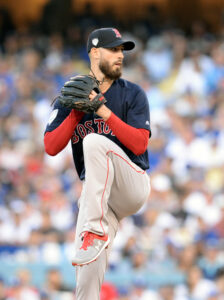
“I wanted to be with my family,” said Porcello, who also tells Bradford that he and his brother built a house together in the two years since he’s last taken a big league mound. “I wanted to get back into that type of lifestyle and be around them because every year that you’re gone is another year where your parents are getting older, and your brothers are getting older.”
Porcello acknowledged that his struggles in his final two Major League seasons muted interest during the 2020-21 offseason, though it’s known that he at least drew some interest in a potential reunion with the Tigers that winter. No deal ever materialized, however, and Porcello has now apparently opted to dedicate his time and efforts to his family and to helping grow youth baseball in Vermont, where he and his brother built their aforementioned home. In addition to the full audio of the interview, Bradford has several lengthy quotes from Porcello on his decision to retire, on his struggles in 2019-20, on building that house and on his commitment to youth baseball in his column at WEEI.
Though his final game came in his age-31 season, Porcello still pitched a dozen full seasons in the Majors, thanks largely to the fact that he debuted as a 20-year-old rookie less than two years after the Tigers selected him with the No. 27 overall pick in the draft. Porcello finished third in 2009’s American League Rookie of the Year voting on the heels of a 3.96 ERA that he spun over the life of 170 2/3 innings.
Porcello was briefly optioned to Triple-A Toledo the following summer but otherwise never returned to the minors and practically never missed a start due to injury. The right-hander landed on the injured list just once in his 12-year career — a three-week absence due to a minor triceps strain in Aug. 2015. Porcello was the consummate workhorse, averaging 31 starts and 185 innings per season from 2009-19. He worked to a 4.36 ERA in 2037 1/3 innings along the way, and for a few years in the midst of that span, he peaked as one of baseball’s better pitchers.
At age 25 in 2014, Porcello enjoyed a breakout season, tallying a then-career-high 204 2/3 innings with a 3.43 ERA. Strikeouts were never a big part of the sinker specialist’s game, but Porcello thrived that season due to a tiny 4.9% walk rate, a strong 49% grounder rate and an average of just 0.79 homers per nine innings pitched. The Tigers, looking for some extra punch in their lineup, traded Porcello to the Red Sox in a deal that netted Yoenis Cespedes, Gabe Speier and Alex Wilson at the 2014 Winter Meetings, when both Porcello and Cespedes were just a season away from free agency.
However, Boston apparently had little intent of simply “renting” Porcello for a year, as the Sox inked him to a four-year, $82.5MM contract extension that spring. Porcello’s first season at Fenway set off alarm bells, as he tied a career-worst 4.92 ERA. The red flags disappeared when he not only rebounded in 2016 but shattered all of his career rate stats en route to a 3.15 ERA, an MLB-best 5.91 strikeout-to-walk ratio and a narrow win over former teammate Justin Verlander in 2016 American League Cy Young voting.
That season proved to be Porcello’s individual peak, but Porcello called the 2018 season “the crowning achievement in my career” due to a more team-oriented accolade, as he and the Red Sox shook off a pair of ALDS exits in 2016-17 to take home a World Series title. Porcello started 28 games for the ’18 Red Sox and pitched to a 4.28 ERA, adding 15 1/3 frames of 3.52 ERA ball in the postseason that year — including a Game 4, series-clinching ALDS victory at Yankee Stadium in which he held Boston’s archrivals to one run in five strong innings.
The following season, 2019, marked the beginning of the end for Porcello’s run in the Majors. He was tagged for a 5.52 ERA in 174 1/3 innings before heading out into free agency and signing a one-year deal with the Mets. True to form, he took the ball every fifth day for the Mets during the pandemic-shortened season and started a dozen of their 60 games, but Porcello’s struggles continued as he logged a 5.64 ERA in 59 innings.
In chatting with Bradford, Porcello acknowledged unsuccessfully trying to keep up with leaguewide changes that saw four-seam fastballs and sliders become increasingly en vogue; indeed, he threw a career-high 31.1% four-seamers and career-low 24.5% sinkers in 2019, and in 2020 he threw a career-high 29.2% sliders. None of those tweaks worked in his favor, and Porcello added that the pandemic afforded him “new perspective on life” and played a role in his decision to prioritize time spent with family rather than seek out a rebound campaign on the mound.
Though he’s retired at a young age, Porcello accomplished plenty in his 12 big league seasons. He’ll walk away from the game with a 150-125 record, a 4.40 ERA, 1561 strikeouts and just 489 walks in 2096 1/3 big league innings (plus another 40 innings of 4.73 ERA ball in the playoffs). Porcello was a top-three Rookie of the Year finisher, a Cy Young winner and a World Series champion in a career that FanGraphs valued at 29.6 wins above replacement. Between his original contract out of the draft (back when MLB deals were allowed for draftees), his arbitration earnings, his Red Sox extension and his Mets free-agent deal, Porcello earned more than $128MM. Best wishes to Porcello and his family in life after baseball.
Catching Market Rumors: Blue Jays, Contreras, Royals, Pirates
Sean Murphy stands at the center of the offseason trade market for catchers, and the Oakland star is drawing plenty of interest. The Guardians, White Sox, Rays, Red Sox, Cardinals and even the Braves have all been linked to him recently, but the A’s are just one of two teams widely expected to trade a catcher this winter. The Blue Jays, who have a trio of Major League-caliber catchers on the roster — Danny Jansen, Alejandro Kirk and Gabriel Moreno — are also pondering the possibility of trading from that depth to address areas of need on the roster.
A trade involving one of the Toronto backstops, however, might not come together particularly quickly. In writing about the Twins’ desire to add to their catching corps, Dan Hayes of The Athletic reported this week the Jays appear to be intent on waiting until some of the top names on the free-agent market have signed before they begin more earnestly engaging in talks with teams that miss out on their top targets. Jansen, with two years of club control remaining (as opposed to Kirk’s four and Moreno’s six), is the most logical trade option of the trio, but all three should draw considerable interest and prompt offers of some extent.
It’s worth bearing in mind, too, that one offer could accelerate the Jays’ willingness to make a deal, so even if their current preference is to let the market play out, that’s not a guarantee they’ll wait until Willson Contreras, Christian Vazquez and perhaps Murphy all have new teams before making a swap.
A few notes on the rest of the catching market…
- The Marlins made an inquiry with Willson Contreras‘ representatives but aren’t expected to be prominent players in his market, per the New York Post’s Jon Heyman. Unsurprisingly, Heyman suggests that Contreras’ price tag was deemed too steep for the Fish, who received underwhelming production from Jacob Stallings after acquiring him from the Pirates last offseason. Miami has been linked to trade interest in Contreras at multiple points in the past, so it’s only logical they’d at least gauge his price tag now that he’s on the open market. The 30-year-old is the top catcher available in free agency and seems likely to command a guarantee of four-plus years after a .243/.349/.466 showing with the Cubs. He rejected a qualifying offer from Chicago, so he’d cost any signing team a draft choice.
- The Royals have drawn some trade interest in young catcher/outfielder MJ Melendez, reports Ken Rosenthal of the Athletic. The 24-year-old made his major league debut this year and hit .217/.313/.393 with 18 home runs across 534 plate appearances. That’s roughly league average output once one accounts for the diminished offensive environment and Kansas City’s cavernous ballpark, by measure of wRC+. Melendez, a recent top prospect, showed a promising combination of power and plate discipline while splitting his time between catcher, the corner outfield and designated hitter. Kansas City can control Melendez for six seasons and seems unlikely to deal him, although his path to everyday reps behind the plate is blocked by face of the franchise Salvador Perez. The seven-time All-Star is under contract through 2025, and the deal contains a club option for the ’26 season. Rosenthal unsurprisingly writes that Kansas City has no interest in trading Perez.
- Roberto Perez’s first season with the Pirates was cut short after 21 games by a severe hamstring strain that required season-ending surgery. The veteran backstop, soon to turn 34, is back on the open market. Jason Mackey of the Pittsburgh Post-Gazette speaks with a number of members of the Bucs’ pitching staff who hope the team re-signs Perez. Hurlers like JT Brubaker and Chase De Jong raved to Mackey about the longtime Cleveland backstop’s ability to connect with his pitchers and call a game. Perez has never been an impactful hitter, but he’s a two-time Gold Glove winner. The Pirates are sure to bring in some catching help this winter, as prospect Endy Rodriguez is currently the only player at the position on the 40-man roster.
Diamondbacks To Sign Miguel Castro
9:22pm: The 2024 option would vest at $5MM if Castro appears in 60 games next year and passes a physical at the end of the season, reports Ken Rosenthal of the Athletic (Twitter links). Should Castro finish 40 games next season, it’d become a player option. The deal also contains various incentives based on appearances and games finished that could tack on as much as $2.75MM per season to the deal.
9:00am: The Diamondbacks have agreed to a one-year deal with free-agent righty Miguel Castro, Robert Murray of FanSided reports (via Twitter). The Ballengee Group client will be guaranteed $3.5MM. Jon Heyman of the New York Post adds that the one-year deal also contains incentives to boost that guarantee, as well as an option for the 2024 season.
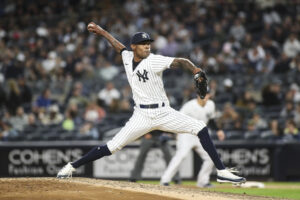
Castro, 28 next month, is one of the youngest free agents on this year’s market, which surely appealed to the D-backs and other interested parties. However, he’s also coming off an injury-marred season in which a shoulder strain limited him to just 29 innings for the Yankees. That injury sidelined Castro for most of July and for all of August and September, though he did return to toss two innings in October. He added another pair of scoreless frames during the ALCS.
Since making his Major League debut with the Blue Jays as a 20-year-old back in 2015, Castro has been traded multiple times and struggled to find consistent success. The flamethrowing righty, who averaged 97.9 mph on his sinker in 2022, has at times looked brilliant but has also battled high walk rates and been occasionally susceptible to home runs. His 2022 season in the Bronx was solid, as he pitched to a 4.03 ERA with above-average strikeout and ground-ball rates (23.7% and 47.5%, respectively) in his 29 frames. However, Castro walked 11.5% of his opponents in his lone season as a Yankee — the fifth straight year in which he’s logged at least an 11% walk rate.
For all the ups and downs with his command, Castro has logged a composite 3.93 ERA in 350 innings across the past six Major League seasons while pitching for the Orioles, Mets and Yankees. His strikeout rate has trended upward over the past three seasons, in particular, sitting at 26.6% in that time. That’s backed up by an above-average 12.8% swinging-strike rate, and Castro has added a hearty 50.8% grounder rate in that time.
Between his age, velocity, ground-ball rate and ability to miss bats, there’s plenty to like in Castro’s game even if his command never turns a corner. The D-backs will surely hope to curtail his proclivity for free passes, but Castro has pitched for five different Major League teams and only once turned in a walk rate under 10% — and that came in 2016 when he threw just 14 2/3 innings with the Rockies. Listed at a lanky 6’7″ and 205 pounds, Castro’s long levers give him excellent extension on his pitches (77th percentile, per Statcast) which can make his perceived velocity even stronger than his already impressive 98mph average — but maintaining control over those long levers has been a persistent challenge that no team has been able to help him overcome to this point.
Castro is the second addition to the Arizona bullpen in the relatively young offseason, as the Snakes also claimed righty Cole Sulser off waivers from the Marlins late last month. Improving a suspect bullpen has been a stated priority for the D-backs, and Castro will give them a youthful veteran to pair with incumbent options Joe Mantiply, Kyle Nelson, Kevin Ginkel and Mark Melancon, the latter of whom will be seeking a rebound after a frustrating 2022 campaign that saw him lose his grip on the closer’s job in Arizona.
Castro’s $3.5MM guarantee will nudge the Diamondbacks’ projected payroll north of $100MM for what would be just the fourth time in franchise history and the first time since 2019. General manager Mike Hazen recently cast doubt on whether ownership would take payroll back to that 2018-19 level ($131MM in 2018, $124MM in 2019), but he did suggest that a bump over last year’s $90MM Opening Day mark was likely. It stands to reason that the D-backs will remain in the market for further bullpen help, and Hazen has previously spoken about the possibility of finding an offensive upgrade behind the dish and perhaps adding a right-handed bat to the lineup.
Mariners Acquire Kolten Wong For Jesse Winker, Abraham Toro
The Mariners and Brewers announced a trade sending second baseman Kolten Wong and cash considerations from Milwaukee to Seattle in exchange for outfielder Jesse Winker and infielder Abraham Toro. The Brewers are reportedly sending about $1.75MM to the Mariners, which effectively makes this a cash-neutral swap.
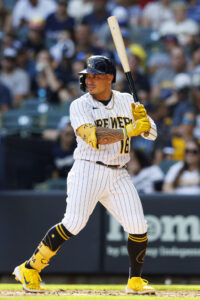
The 32-year-old Wong is owed a $10MM salary after the Brewers exercised a club option on him following the season. He’ll be a free agent next winter. Winker, meanwhile, is owed $8.25MM in 2023 after inking a two-year deal covering his final arbitration seasons last year. Like Wong, he’s ticketed for free agency next winter. Toro, on the other hand, is not yet arbitration-eligible and can be controlled for another four seasons.
Wong was a natural target for the Mariners, given their lack of an obvious starter at second base and their desire to add some balance to a lineup that skews a bit right-handed. He’ll give the M’s a steady presence, quite possibly atop the lineup, on the heels of the two best offensive seasons of his career. During his two years as a Brewer, Wong slashed a combined .262/.337/.439 with 29 home runs, 56 doubles, six triples and 29 steals.
With the Brewers, Wong seemingly made a concerted effort to begin elevating the ball with more frequency. His ground-ball rate, which had sat around 47% in St. Louis, dropped to a career-low 41.8% this past season, and Wong made noticeable gains in both his line-drive rate and especially his fly-ball rate as a member of the Brewers. As one would expect, the increased number of balls in the air also increased Wong’s power output. His .177 ISO (slugging percentage minus batting average) in two years with the Brewers was substantially higher than the .123 mark he carried in parts of eight seasons with the Cardinals.
On the defensive side of the game, however, the 2022 season was a bizarre and borderline nightmarish one for Wong. Typically one of the game’s best defenders at his position, Wong made a stunning 17 errors — more than he’d totaled in the three prior seasons combined. When his option was picked up, Wong told the Milwaukee Journal-Sentinel’s Todd Rosiak that his legs weren’t fully healthy in 2022, which he felt contributed to his surprising defensive shortcomings (Twitter links). Wong missed time in June with a calf strain that sent him to the injured list, and it’s certainly plausible that his legs cost him some of his typical defensive excellence.
It was a similar tale for Winker in 2022, as injuries weighed down his production in what will now be his lone season as a Mariner. Acquired alongside Eugenio Suarez in a trade that sent pitching prospect Brandon Williamson, outfielder Jake Fraley and righty Justin Dunn to Cincinnati, Winker (perhaps literally) limped through the weakest offensive season of his career before undergoing left knee surgery and a second procedure to address a bulging disc in his neck back in October.
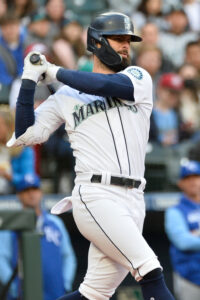
The extent to which those injuries dogged Winker can’t be known for certain, but the former Reds slugger went from one of the game’s best hitters against right-handed pitching to a lackluster .219/.344/.344 batting line with the Mariners in 2022.
Winker’s defense was also impacted; he’s never been considered a plus defender in the outfield corners, but he logged career-worst marks in Defensive Runs Saved (-16), Ultimate Zone Rating (-7.2) and Outs Above Average (-10) in the Emerald City. Beyond Winker’s deteriorating performance on the field, Ryan Divish of the Seattle Times reported in October the manner in which Winker had fallen out of favor in the Seattle clubhouse.
The decline was swift and fairly stunning. In the two seasons prior to being acquired by the Mariners, Winker was one of the game’s three best hitters against right-handed pitching, trailing only Juan Soto and Bryce Harper in terms of wRC+. He posted a video game-esque .321/.417/.619 batting line in 509 plate appearances against righties in that span, and while his production against fellow lefties was nowhere near that level, he still walked at a 12% clip against them, resulting in a .314 OBP. His .199 average and .338 slugging against lefties were dismal, but at the very least, Winker could get on base at a near-average clip even in disadvantageous platoon matchups.
The Brewers’ hope will be that the pair of surgeries and an offseason of rest and rehab will get Winker back to the form he showed when he was a thorn in their side as a member of the division-rival Reds. Only time will tell, however, whether Winker is indeed able to rebound.
If Winker is unable to return to form, the Brewers can still pin some hopes on Toro — another rebound candidate looking to benefit from a change of scenery. The switch-hitting 25-year-old (26 later this month) was one of the top prospects in the Astros’ system for several years but never got the opportunity to establish himself for a Houston club that had Alex Bregman at third base and Jose Altuve at second base — Toro’s primary positions. The Astros traded Toro and veteran reliever Joe Smith to the Mariners in a controversial deadline swap that saw Seattle send then-closer Kendall Graveman and righty Rafael Montero to Houston in return.
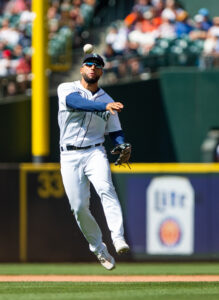
There were plenty of parallels between that Toro trade and the 2022 trade that saw the Brewers send Josh Hader to San Diego. As was the case with Brewers fans this year, Mariners fans — and the clubhouse — were angered to see the closer of a contending club traded to another postseason contender, even though both the Mariners (Smith, Toro) and Brewers (Taylor Rogers, Esteury Ruiz, Robert Gasser) received some immediate MLB help and long-term prospect value in the return.
Unfortunately for the Mariners, Toro wasn’t ever able to fully cement himself as a regular fixture in the lineup. He caught fire with the Mariners immediately following the trade, even connecting on a memorable go-ahead grand slam against Graveman himself just one month after the trade. The 2022 season, however, saw Toro receive infrequent playing time and struggle to a .185/.239/.324 slash in 352 plate appearances. That said, he’s not far removed from being a well-regarded prospect, is still in his mid-20s, and carries a career .343/.451/.545 batting line in Triple-A, so there’s reason to hope he could yet break through.
Toro does have a minor league option remaining, so it’s not a lock that he’ll open the ’23 season on the Brewers’ roster, but he’ll head to Spring Training competing for time at either second base or third base. Both he and Luis Urias have ample experience at both positions, but the ideal defensive alignment would be Toro at third base and Urias at second base. Of course, it’s possible that the Brewers will deepen their infield mix with further moves this offseason, and top infield prospect Brice Turang could factor into the mix at second base early in the season, too, after hitting .286/.360/.412 in Triple-A last season.
In all likelihood, the trade is just one amid a series of moves for both clubs involved. The Mariners were open to adding another outfield bat even before trading Winker, and they could now even more clearly accommodate a notable bat in left field or at designated hitter. The Brewers, meanwhile, have focused thus far on trimming the margins of the payroll and extracting some modest value for players whom they feel they’re able to replace in-house (e.g. Wong, Hunter Renfroe).
It’s no doubt been a frustrating start to the winter for many Milwaukee fans, but the Brewers have thus far moved on from players who were controllable through 2023 only. They’ve scaled back payroll to an extent in doing so, and the question will now be one of how — or if — they reallocate those dollars. It’s possible they’ll even turn and flip Winker to another club, but they’ve not yet shown any indication of a full-on rebuild, so at some point it seems likely the Brewers will make some at-least modest upgrades to the roster.
Jon Heyman of the New York Post was first to report the Brewers and Mariners were in discussions about a trade involving Wong and Winker. Ken Rosenthal of the Athletic reported the Mariners were acquiring Wong for Winker and Toro. Jeff Passan of ESPN reported the Brewers were including roughly $1.75MM in the deal.
Images courtesy of USA Today Sports.
Phillies Claim Jake Cave
The Phillies have claimed outfielder Jake Cave off waivers from the Orioles, per announcements from both teams. The addition of Cave brings Philadelphia’s 40-man roster to a total of 38 players.
Cave, who’ll turn 30 on Sunday, never suited up in a game for the Orioles. Baltimore had claimed him off waivers from the Twins earlier this season and apparently tried to sneak him through waivers themselves in hopes of keeping him without allocating a 40-man roster spot to the longtime Twins backup.
Cave has appeared in parts of five big league seasons, all coming with the Twins, who acquired him from the Yankees in a 2018 trade that sent Luis Gil to New York. Cave was an outstanding fourth outfielder for the Twins in 2018-19, appearing in 163 games, taking 537 plate appearances and batting .262/.329/.466 with 21 homers, 27 doubles and four triples.
In 2020, Cave’s production fell off, however, and he’s never regained his form. Over the past three seasons, he’s turned in a tepid .206/.252/.352 batting line while punching out in 32.4% of his plate appearances. As is so often the case, injuries are at least partly to blame for the downturn in production; Cave landed on the injured list with a fracture in his lower back in May of 2021 and missed multiple months as a result of the injury.
Cave was arbitration-eligible this offseason, but the Orioles proactively signed him to a split Major League contract for the 2023 season. That contract, which contains different rates of pay for time in the Majors versus time in Triple-A, was surely signed by the Orioles with an eye toward getting Cave through waivers and keeping him as a depth piece. The O’s opted for the same tactic with catcher Anthony Bemboom and had success with it, passing him through waivers mere weeks after agreeing to terms on a 2023 contract. It (clearly) did not work that way in the case of Cave.
The general idea behind such a move is seemingly to offer slightly larger rates of pay that both discourage other teams from claiming depth options the Orioles value and hope to stash in the upper minors and to also encourage those players to accept outright assignments. Both Bemboom and Cave have previously been outrighted and thus are thus able to refuse outright assignments, but the larger rates of pay on the split deal serve as incentive to instead accept the outright. (Since neither player has five years of Major League service, refusing the outright assignment in favor of free agency would mean forfeiting any money owed to them on that split deal, and a new contract with a new team would likely come at a lower rate.)
Instead, for Cave, things will work out even better, as he’ll land on a team that perhaps has greater designs on carrying him on its MLB roster. He’s capable of playing all three outfield spots, has some power and will give the team a potential late-game defensive option in lieu of sluggers Kyle Schwarber and Nick Castellanos when both are in the lineup and starting in the outfield corners. It’s possible the Phillies will try to pass Cave through waivers themselves or designate him for assignment if they acquire someone they deem to be a better option as a backup outfielder, but for now, Cave appears likely to occupy a spot on manager Rob Thomson’s bench in 2023.
Orioles Claim Lewin Diaz
The Orioles have claimed first baseman Lewin Diaz off waivers from the Pirates, reports Craig Mish of SportsGrid and the Miami Herald (Twitter link).
Diaz, 26, was a fairly high-profile amateur signing by the Twins back in 2013, inking a $1.4MM bonus and headlining their 2013-14 international free agency class. He ranked among Minnesota’s top prospects for several years due to his power potential and a plus glove at first base, but the Twins flipped him to Miami in a 2019 trade that netted them veteran reliever Sergio Romo and pitching prospect Chris Vallimont.
With the Marlins, Diaz elevated his profile early on before scuffling through parts of three Major League auditions. He’s logged big league time each season since 2020 but produced only a .181/.227/.340 batting line with a 28.9% strikeout rate against just a 5.5% walk rate. Despite his 6’4″ frame and considerable raw power potential, Diaz hasn’t yet hit the ball with much authority in the Majors; he does have 13 home runs in 343 plate appearances, but Diaz’s average exit velocity (88.1 mph), barrel rate (8%) and hard-hit rate (32.6%) are all pedestrian, at best. He’s also been quite prone to pop-ups, with more of his fly-balls (14.4%) registering as infield flies than as home runs (11.7%).
That said, Diaz only just turned 26 years old and has at least one demonstrably excellent skill that’ll play at the Major League level: his glove. He’s only logged 753 Major League innings at first base but still has eye-popping totals in Defensive Runs Saved (16) and Outs Above Average (9). The offensive profile is still quite clearly a work in progress, but Diaz is a .250/.325/.504 hitter in two Triple-A seasons.
The Orioles have been looking for a left-handed bat who can play some first base and perhaps in the outfield corners, per MASNsports.com’s Roch Kubatko. Diaz won’t help in the latter regard, but he’ll give them a lefty bat who can spend some time at first base — if he makes it to Spring Training on the 40-man roster, that is. He’s already been jettisoned from a pair of teams so far this offseason, and it’s possible the O’s consider him a temporary safety net while they continue to hunt for a more established option (as was seemingly the case with the Pirates, who designated Diaz for assignment after signing Carlos Santana).
Diaz is out of minor league options, so he’ll either have to make a team’s Opening Day roster next year or eventually be passed through waivers unclaimed, at which point that team could then stash him Triple-A without committing a 40-man roster spot.
Latest On Mitch Haniger’s Market
Next week’s Winter Meetings are expected to open the floodgates for some hot stove activity, and among the free agents drawing substantial interest leading up to those meetings is longtime Mariners outfielder Mitch Haniger. The 31-year-old (32 next month) has a “robust” market, per ESPN’s Jeff Passan, and colleague Buster Olney tweets that there’s a growing belief he’ll be able to secure a three-year contract — perhaps in the vicinity of $15MM per year.
Haniger has, to this point in the offseason, been linked to each of the Red Sox, Dodgers, Angels, Giants, Rangers and the Mariners, who are open to adding another outfielder even after acquiring Teoscar Hernandez from the Blue Jays last month. The Halos’ interest, it should be noted, was reported prior to their acquisition of Hunter Renfroe. It seems likely that move probably put an end to their pursuit of Haniger; the Angels also have Mike Trout and Taylor Ward locked into outfield spots and Shohei Ohtani at DH, of course.
Even presuming the Angels are out of the running, that’d leave at least five teams — and quite likely a few more — in the mix for Haniger, who missed substantial time this season due to a high ankle sprain but has generally been an above-average to excellent hitter when healthy enough to take the field. Dating back to 2017, Haniger boasts a .263/.337/.480 batting line — 24% better than league average by measure of wRC+, which weights for his pitcher-friendly home park. Haniger belted 39 home runs in a season as recently as 2021 and is one of the few outfielders on this offseason’s market who can be viewed as a viable 30-homer threat.
Of course, the knock on Haniger has been his ability to remain on the field — or rather, his lack thereof. Haniger’s 2019 season was cut short when he sustained a ruptured testicle after a poorly placed foul ball off his own bat. Just two months later, while rehabbing from the subsequent surgery, Haniger experienced back discomfort and learned that he’d torn an adductor muscle off the bone. The fallout from that second injury snowballed and ultimately saw Haniger require core muscle/hernia surgery and a microdiscectomy operation.
It was one of the more bizarre and also fluky sequences of injuries for any player in recent memory, but the end result was still a 22-month absence from the playing field for Haniger. He returned with that aforementioned 39-homer campaign, however, and has posted a combined .251/.316/.47o slash with 50 homers in 938 trips to the plate since coming back from that nightmarish run of health troubles. Haniger’s once-premium defensive ratings dipped in 2021, but he posted positive marks in both Defensive Runs Saved (3) and Outs Above Average (2) in this year’s small sample of 396 innings.
Heading into the offseason, MLBTR ranked Haniger 20th on our Top 50 Free Agent list, predicting a three-year contract at an annual rate of $13MM. Olney’s report suggests that Haniger’s market could be reaching if not pushing a bit beyond that level. If interest is indeed ramping up to that extent, it stands to reason that Haniger could be one of many free agents to come off the board during next week’s Winter Meetings or shortly thereafter.