
Rangers Among Clubs With Interest In Yandy Díaz
Rays infielder Yandy Díaz has been on the restricted list for almost a week while attending to an undisclosed personal matter, but the Rays announced that they reinstated him today. They already had three vacancies on their 40-man roster, so this move brings their count to 38. Marc Topkin of the Tampa Bay Times relayed on X earlier that the club was hopeful of Díaz returning tonight. Ken Rosenthal of The Athletic reported last night that the Rangers are interested in adding him to their lineup. Mark Feinsand of MLB.com says on X that the Astros, Mariners and Pirates are possible suitors, though it’s unclear if any of those clubs have engaged with the Rays.
Díaz, now 32, has been a fixture of the Rays for many years. He came to Tampa from Cleveland heading into 2019 as part of the three-team trade and quickly worked his way into being a regular for the Rays. From the start of 2019 to the present, he has drawn walks in 11.6% of his plate appearances while only striking out 14.5% of the time. His .288/.375/.439 batting line translates to a 133 wRC+, indicating he’s been 33% better than league average overall.
That offense is his best attribute. He’s not a burner on the basepaths and his third base defense was poorly regarded, though he’s been closer to average at first base and has been more or less permanently moved to that side of the diamond. But the 133 wRC+ that Díaz has put up from 2019 to the present is one of the top 15 marks in baseball among qualified hitters, highlighting that such consistently above-average production is hard to find.
Here in 2024, his season-long stats look mildly disappointing, a .273/.329/.396 line and 111 wRC+, but that’s mostly due to a brutal start that he has put behind him. He hit .211/.279/.276 through May 1 but his line of .302/.354/.453 since that time leads to a 134 wRC+, right in line with his overall track record.
The Rays don’t strictly have to move him but their behavior suggests he’s available. Going into 2023, he and the Rays signed an extension that runs through 2025 with a club option for 2026. He’ll make $10MM next year with the option valued at $12MM.
Tampa could certainly keep him but they have shown, both recently and in the past, that they are generally unafraid to move players nearing free agency. Although they are 52-51 this year and just four games out of a playoff spot, they have already traded Aaron Civale, Phil Maton and Randy Arozarena in recent weeks.
Some recent reporting suggested the Rays were more likely to trade arbitrations players than those signed to long-term deals, but that contradicts their past behavior. Players like Evan Longoria, Blake Snell, Tyler Glasnow and Manuel Margot have all signed extensions and then been traded before those contracts ended, so there’s no real reason to believe the Rays won’t be open to trade offers on Díaz.
Doing so wouldn’t even be a signal that the club is giving up on 2024, as players like Isaac Paredes and Curtis Mead could fill in at first base. Jonathan Aranda is currently hurt but could be in the mix later. Infielders like Junior Caminero, Austin Shenton and Osleivis Basabe could be called up to fill in elsewhere around the infield. In the long term, Xavier Isaac is a first baseman and considered one of the top 50 prospects in the league, though he’s yet to reach Double-A.
For the Rangers, Rosenthal relays that they are looking for “either a left-handed hitting outfielder/DH or a platoon-neutral right-handed hitter.” Díaz is better against lefties but isn’t a liability without the platoon advantage. He has a 148 wRC+ against southpaws in his career and a 121 wRC+ against righties. It’s a far wider split of 151 and 99 this year, though in a much smaller sample size.
Texas hitters have a collective line of .237/.309/.378 against right-handed pitching, with that line leading to a 93 wRC+, putting them ahead of just seven clubs in that split. They have Nathaniel Lowe at first base but don’t really have a regular designated hitter and should be able to fit both him and Díaz into the same lineup.
The Rays and Mariners already lined up on one deal, sending the aforementioned Arozarena to Seattle as the M’s look for more offense. Díaz could further augment their lineup, especially with the struggling Ty France have been recently designated for assignment and leaving an opening at first base. They have plugged Tyler Locklear into that spot but he has only 40 major league plate appearances thus far.
The Astros also cut ties with a struggling first baseman, releasing José Abreu earlier this year. They have mostly used Jon Singleton to fill that hole but he’s hitting just .231/.319/.343 this year for a 93 wRC+.
The Pirates have a bit less of a dire need as they held onto their struggling first baseman and were rewarded with a bounceback. Rowdy Tellez was hitting .177/.239/.223 through the end of May but has a line of .328/.364/.588 since the calendar flipped to June. His season-long line is still subpar thanks to that early slump but the Pirates probably feel less inclined to replaced Tellez on the heels of his hot streak this summer. They have Andrew McCutchen in the designated hitter spot most days, which makes the lineup fit a bit less clean unless they plan on moving on from Tellez, who is a free agent at season’s end.
Both the Astros and Rangers are set to pay the competitive balance tax at season’s end, so they may have to consider the taxes involved in taking on the Díaz contract. The Astros are set to be a first-time payor and have a base rate of 20% but RosterResource has their CBT number at $256MM. Crossing over the $257MM second tier would increase their tax rate to 32% for spending beyond that line. Recent reporting suggested they are trying to move Rafael Montero‘s contract to lessen their tax burden but doing so will be difficult given his poor results of late. RosterResource has the Rangers at $249MM but they are set to be a second-time payor and have a base tax rate of 30%.
Mariners Still Active In Trade Market
The Mariners’ acquisition of Randy Arozarena last night is perhaps the most notable swap of the season thus far, but Seattle isn’t content with that lone acquisition. MLB.com’s Jon Morosi tweets that the M’s are still talking to other clubs, looking to add another bat and a high-leverage reliever. Adam Jude of the Seattle Times adds some context on the team’s search for bats, reporting that two of the top bats on the market — Oakland’s Brent Rooker and Chicago’s Luis Robert — may not be likely to land in Seattle. The A’s have been reluctant to trade with Seattle, per Jude, while an acquisition of Robert is considered “highly unlikely at this point.”
Both Rooker and Robert would add a controllable, high-end bat to what has been a stagnant Mariners offense. Rooker is arb-eligible for the first time this offseason and controlled three more years. Robert is signed through the 2025 season, and his contract contains a pair of $20MM club options.
The A’s haven’t always been reluctant to deal within the AL West, but the last time they completed a trade with the Mariners came back in 2017, when the two clubs swapped Emilio Pagan for Ryon Healy. In fact, the only trade they’ve made with a division rival in the past three years was this April’s acquisition of righty Brandon Bielak in a deal that sent cash back to the Astros. It’s always possible there’ll be a change in direction, but their once-frequent intra-division trades (e.g. Elvis Andrus, Khris Davis, Jed Lowrie, Jurickson Profar, Pagan, Healy) have dried up in recent years.
With regard to Robert, there’s no intra-division component to be considered, but traction on Robert hasn’t really picked up, it seems. ESPN’s Jeff Passan writes that the White Sox have set a high asking price and haven’t yet seen potential trade partners willing to meet it or even come particularly close.
The mere mention of Rooker and Robert aligns largely with the latest reporting from Daniel Kramer of MLB.com, who suggests that Seattle’s front office has been “aggressive” in trying to add multiple impact bats. Arozarena checks one box, but the Mariners’ lineup could use upgrades at multiple spots.
It’s even possible the M’s and Rays could line up on another deal; Kramer writes that the two teams discussed infielders Isaac Paredes and Yandy Diaz in the offseason. Mark Feinsand of MLB.com tweets that the Mariners are again a potential landing spot for Diaz, who is drawing trade interest and was reinstated from the restricted list within the past hour after a week-long absence to tend to an undisclosed family matter.
Like Arozarena, the 32-year-old Diaz got out to a slow start in 2024 but has heated up in recent months. Over his past 280 plate appearances, he’s slashing a robust .302/.354/.453 with seven homers, 16 doubles, a triple and just a 13.9% strikeout rate. He’d give the Mariners an upgrade over the recently designated Ty France and simultaneously accomplish the team’s ongoing goal of reducing their MLB-worst strikeout rate. He’s earning $8MM the second season of a three-year, $24MM contract extension and is owed $10MM in 2025 before the team must decide on a $12MM option for the 2026 season.
Paredes, 25, is arguably one of the most appealing possibilities on the entire trade market. He’s played third base primarily of late, but the versatile infielder can handle all four infield positions and has emerged as a genuine middle-of-the-order slugger. Dating back to Opening Day 2023, he’s slashed .250/.353/.469 with 47 homers in 241 games. He’s earning only $3.4MM this season in the first of four arbitration seasons (as a Super Two player). Paredes’ versatility, productive bat, remaining control and currently affordable price tag could make the prospect cost to acquire him prohibitive, but the Rays are generally open to listen on anyone — and teams have been at least inquiring on Paredes recently.
Mariners Acquire Randy Arozarena
The Mariners landed a much-needed lineup upgrade on Thursday night. Seattle announced the acquisition of Randy Arozarena from the Rays in exchange for two prospects — outfielder Aidan Smith and right-hander Brody Hopkins — as well as a player to be named later. Seattle had an opening on their 40-man roster after designating Ty France for assignment earlier this week, so no additional move was necessary.
Arozarena had an excellent four-plus year run in Tampa Bay. The Rays acquired him from the Cardinals over the 2019-20 offseason in a deal sending top pitching prospect Matthew Liberatore to St. Louis. Arozarena had made a brief MLB debut the prior season, but the 2020 postseason represented his true emergence as a star. He mashed 10 home runs in 20 games, snagging ALCS MVP honors and helping the Rays reach the World Series.
Despite that breakout playoff performance, Arozarena retained rookie eligibility into 2021. He cruised to Rookie of the Year honors behind a .274/.356/.459 slash with 20 homers and stolen bases apiece. That was the first of three straight 20-20 campaigns for the Cuban outfielder. He swiped a career-high 32 bases in ’22 and reached 23 longballs in his first All-Star season last year.
Arozarena appeared in 445 games between 2021-23. He hit .264/.349/.443 with 63 homers in a little more than 1900 plate appearances. That production was 26 percentage points above league average, as measured by wRC+, putting him among the best left fielders in the game. Arozarena’s accolades and consistency led to quickly escalating arbitration salaries. That fueled chatter that the low-payroll Rays could deal him last offseason.

Tampa Bay obviously rebuffed whatever trade offers they received over the winter. They certainly hoped Arozarena would anchor their lineup and help them to a sixth straight playoff berth. He and the team got off to a cold start, however, putting them in a hole from which they’ve never really recovered.
Arozarena hit .158/.257/.312 through the end of May. Some of that was the result of an unsustainably poor .186 average on balls in play, but his strikeout rate spiked to a near-29% rate. Arozarena has turned things around following that disastrous stretch. He’s raking at a .290/.402/.517 clip over the past two months. He has dramatically cut back on the swing-and-miss (down to 19.5%) and slightly increased his walk percentage. The results have been far more in line with his career track record.
In aggregate, Arozarena’s season numbers are pedestrian. He’s hitting .211/.318/.394 with 15 homers through 409 plate appearances. That’s only marginally better than average and would be the worst numbers of his career. Given his overall track record and recent form, it seems fair to view his early-season struggles as more of an anomaly than a worrying trend. Getting anything close to the 29-year-old’s career production would be a major boost for a Seattle lineup that has hit .216/.298/.362 on the year. Only the White Sox have scored fewer runs this month, the biggest reason the M’s have watched their 10-game cushion in the AL West evaporate.
The Mariners are only a half-game ahead of the Rays in the American League standings. It’s rare to see a team trade an impact player to another club that close to them in the playoff picture. Seattle is in better shape than Tampa Bay with regards to snagging a playoff berth, though. The Rays need to jump three teams and erase a four-game deficit in the Wild Card mix. Seattle has a much more realistic path to a division title, as they’re only one game behind the Astros and hold a 1.5 game edge on the third-place Rangers.
While Tampa Bay isn’t going to completely tear things down, they could dangle a number of veteran players in the next few days. The Rays had already moved Aaron Civale and Phil Maton. Dealing Arozarena seems to increase the likelihood of them moving the likes of Brandon Lowe, Yandy Díaz, Zach Eflin and Zack Littell. The Rays could also try to acquire upper minors or MLB-ready talent to aid a long shot playoff push this season and help them for a return to contention next year.
Seattle is in much more traditional buyer mode. Their offense was reeling even before losing Julio Rodríguez and J.P. Crawford to injury this week. Arozarena is one of what is likely to be multiple upgrades to their lineup as they try to capitalize on arguably MLB’s best starting rotation. The M’s have relied on another former Ray, Luke Raley, as their primary left fielder. Raley has been an average hitter on the season overall, but he has fanned 22 times with a .119/.224/.254 slash in 67 plate appearances this month.
Arozarena is playing this season on an $8.1MM salary. The M’s take on around $2.83MM for the stretch run, which will push their estimated player payroll to around $143MM (as calculated by RosterResource). Managing partner John Sherman said last month that the front office had the spending capacity to add players at the deadline. They’ve put that into practice here and could do so again before Tuesday. Seattle controls Arozarena through arbitration for two more seasons. He’ll likely earn a boost into the $12-14MM range next year and could approach a $20MM salary for the ’26 campaign.
The Rays, a team that entered the season with a player payroll below $100MM, probably weren’t eager to commit to those 2025-26 salaries. A trade by next offseason always seemed likely. They’re sufficiently intrigued by the prospect package to make the move a few months early, even if it deals a hit to their already slim playoff chances.
Smith and Hopkins each ranked in the middle tiers of a Seattle farm system that is arguably the best in the league. They respectively checked in 14th and 15th on Baseball America’s most recent organizational list. Smith, 20, was a fourth-round pick out of a Texas high school last summer. He signed for an overslot $1.2MM bonus.
The righty-hitting outfielder has posted huge numbers for Low-A Modesto. Smith is hitting .284/.402/.470 with 26 doubles, a triple and nine homers across 358 plate appearances. He’s drawing walks at a massive 14.5% clip against a slightly elevated 24.3% strikeout rate. BA praises Smith’s athleticism and defensive instincts in center field. He has significant power potential in a 6’3″ frame, though there are still questions about his pure hitting ability.
Hopkins was a sixth-round draftee out of Winthrop last year. The 6’4″ righty has been one of the big risers in the system this year. He owns a 2.90 ERA over 83 2/3 innings with Modesto. Hopkins has fanned 26.5% of batters faced while issuing walks at an 11.1% clip. He has hard a tough time throwing strikes dating back to his time in college, but Baseball America credits him with a plus fastball/slider combination from a lower arm angle that’s especially tough for same-handed hitters. He could project to a bullpen future but should continue to start for the time being.
Neither Smith nor Hopkins are close to the majors or to Rule 5 eligibility. Pending the revelation of the PTBNL (who cannot be on Seattle’s 40-man roster or one of this year’s draftees), it’s a future-oriented package for Tampa Bay. The next few days should reveal whether the Rays are focusing their deadline hauls on lower minors prospects or simply liked Smith and Hopkins enough to overlook their distance from the big leagues.
Francys Romero first reported the Rays were trading Arozarena to Seattle. Mark Feinsand of MLB.com reported the Rays were acquiring two prospects and a player to be named later. Marc Topkin of the Tampa Bay Times was first to report that Smith and Hopkins were the prospects.
Image courtesy of USA Today Sports.
Astros, Braves, Cardinals Reportedly Interested In Zach Eflin
The Rays have been open to trading from their rotation this year and could do so again, with right-hander Zach Eflin one of the possible candidates. Marc Topkin of the Tampa Bay Times reports that the Astros, Braves and Cardinals are “among the teams expected to have strong interest” in the righty.
The Rays aren’t fully in the seller camp as they are currently 51-51 and just 4.5 games back of a playoff spot. However, their rotation health has improved as the season has gone along and given them a relative surplus. That has allowed them to explore deals that either address another area of the roster, bolster the prospect depth, save some money or some combination of those goals.
Each of Shane Baz, Jeffrey Springs and Drew Rasmussen began the season recovering from past arm surgeries. The Rays had a rotation of Eflin, Taj Bradley, Ryan Pepiot, Zack Littell and Aaron Civale for most of this year. Once they were ready to put Baz back into the rotation, they flipped Civale to the Brewers for a prospect and called up Baz.
A similar trade could make sense in the coming days. Pepiot is currently on the injured list with a knee infection but isn’t expected to be out for too long, while the Rays have Springs and Rasmussen both currently on rehab assignments. It’s therefore possible that they could trade a pitcher or two and still go through the stretch run with a healthy rotation. They have Tyler Alexander and Jacob Lopez around as depth and then Shane McClanahan should be back in the mix next year, after he recovers from his own elbow surgery.
Most of the pitchers in Tampa’s rotation mix are controllable for many years but Eflin and Littell are each slated for free agency after 2025. Eflin is a particularly sensible candidate for the budget-conscious club due to his contract. He signed a three-year, $40MM deal with Tampa going into 2023, with that deal being backloaded. He made $11MM last year and has that salary again here in 2024, with a jump to $18MM next year.
That is vaguely reminiscent of the extension that the Rays signed with Tyler Glasnow. While he was recovering from Tommy John surgery, Glasnow signed a two-year extension with the Rays which was also heavily backloaded. He was paid $5.35MM in 2023, his final arbitration season and a year in which he was expected to return from the surgery. The Rays also gained an extra year of control over him by giving him a $25MM salary for 2024.
He ended up returning in 2023 as expected, tossing 120 innings with a 3.53 earned run average. But before the big salary jump kicked in, he was traded to the Dodgers in a four-player deal that brought back Pepiot.
With Eflin set for a big raise next year and the Rays having plenty of other rotation options, he could be on the move shortly and should have plenty of suitors. He’s been a solid rotation stalwart for several years now, first with the Phillies and then with the Rays since signing his aforementioned deal. Dating back to the start of 2018, he has a 4.01 ERA in over 800 innings. His 22.2% strikeout rate in that time is close to par but he’s limited walks to a tiny rate of 4.9%.
Health has been an issue for Eflin, largely due to knee problems. He was limited to just 181 1/3 innings over 2021 and 2022, his final two years in Philadelphia, but has managed to stay on the mound more in Tampa. He logged 177 2/3 innings over 31 starts last year with a 3.50 ERA. This year, he’s already up to 19 starts and 110 innings with a 4.09 ERA. He had brief stints on the IL both years due to lower back issues but otherwise kept the train on the tracks.
That type of solid performance would have plenty of appeal and the listed teams each make sense as a landing spot. Atlanta lost Spencer Strider to UCL surgery and also saw Max Fried head to the injured list recently, along with depth options like Huascar Ynoa and Hurston Waldrep.
Currently, their rotation consists of Chris Sale, Reynaldo López, Charlie Morton and Spencer Schwellenbach, with various guys rotating through the back end. Bolstering that group with an external addition or two is plenty logical. Fried could perhaps be back but there’s risk in the current composition. Sale has a lengthy injury history and the club might want to hedge against him getting hurt again, even though he’s stayed healthy this year. López was just returned to a starting role after working as a reliever for a few years and could perhaps run out of gas later in the year. Morton’s gas tank might also be a factor just because he’s now 40 years old. Schwellenbach has been performing well but has just nine career starts in the majors.
The fact that Eflin is under contract for next year is likely appealing to Atlanta as well. Fried and Morton are both impending free agents, with the latter a possibility to consider retiring at season’s end. Strider will still be out of action by the start of 2025 so the on-paper rotation for next year will be Sale, López and a few question marks. Schwellenbach and some of the other young guys could step up and fill that in, but it’s no guarantee, so adding Eflin into the group would make sense.
The competitive balance tax may be a concern, as Atlanta is currently at $273MM, per the calculations of RosterResource. If they cross the third threshold of $277MM, they would not only incur a higher tax rate but their top pick in next year’s draft would also be moved back ten spots. Given where they are, they probably prefer to stay south of that line.
Eflin’s CBT hit is currently $13.33MM, based on the average annual value of his three-year, $40MM deal. However, a player’s CBT hit is recalculated when he is traded. If a deal comes together in the next few days, he would have about a third of this year’s $11MM salary remaining, in the ballpark of $3.67MM. Combined with his $18MM salary next year, that’s $21.67MM over a season and a third, making for a CBT hit of $16.3MM. If Atlanta acquires him for the final two months of the season, they would put a third of that figure on their CBT calculation for this year, or $5.43MM.
Assuming the RR calculations are close to correct, taking on Eflin’s entire contract might be problematic for Atlanta, so they might try to get creative and have Tampa eat a portion of the deal. Next year’s CBT hit is far lower, currently at $185MM, but they will undoubtedly add to that with some offseason moves.
The Astros have also had their share of rotation challenges this year, with Cristian Javier and José Urquidy both requiring Tommy John surgery. Luis Garcia has yet to return from his own TJS operation from last year while Lance McCullers Jr. is still trying to get back from his own elbow procedure. Justin Verlander is also on the shelf with a neck injury.
Their current rotation consists of Framber Valdez, Hunter Brown, Ronel Blanco, Spencer Arrighetti and Jake Bloss. Brown has recovered from an awful start to the season but each of Blanco, Arrighetti and Bloss is lacking in experience. Blanco only recently moved to the rotation after years of bullpen work while Arrighetti and Bloss are rookies who both have ERAs north of 5.60 so far this year.
Like Atlanta, Houston is set to pay the CBT this year but they have far more wiggle room. Houston’s CBT number is currently at $256MM, per RR. That’s just shy of the $257MM second line but crossing that only comes with a slight bump in tax rate and no draft pick penalties.
The Cardinals have a solid rotation front four consisting of Sonny Gray, Lance Lynn, Kyle Gibson and Miles Mikolas. With Steven Matz injured, they have had Andre Pallante holding down the fifth spot lately. Pallante has a decent 3.42 ERA in his nine starts but he has a subpar strikeout rate of 19.8% and a limited track record overall.
Adding Eflin could bolster that group for this year and 2025 as well. Both Gibson and Lynn are on one-year deals and could be free agents this winter. They both have club options on their deals but it’s not a guarantee that the Cardinals would pick either of those up. Unlike Atlanta and Houston, the CBT is not a huge concern in St. Louis. RR currently has the Cards at $215MM, which is $22MM south of the $237MM base threshold.
MLBTR Podcast: Trade Deadline Preview
The latest episode of the MLB Trade Rumors Podcast is now live on Spotify, Apple Podcasts, and wherever you get your podcasts! Make sure you subscribe as well! You can also use the player at this link to listen, if you don’t use Spotify or Apple for podcasts.
This week, host Darragh McDonald is joined by Tim Dierkes, Steve Adams and Anthony Franco of MLB Trade Rumors to discuss…
- Is the lack of sellers going to be an issue this year and going forward with the expanded playoffs? (2:10)
- The White Sox could sell Garrett Crochet, Luis Robert Jr., Erick Fedde, Michael Kopech, John Brebbia and others (6:30)
- The Marlins have Jazz Chisholm Jr., Tanner Scott, A.J. Puk, Bryan De La Cruz, Jesús Sánchez and others possibly available (16:40)
- Will the Athletics move Brent Rooker and what is his value? (22:35)
- Will the Rockies trade Cal Quantrill, Austin Gomber and others? (36:00)
- Will the Angels trade Taylor Ward, Luis Rengifo, Tyler Anderson, Griffin Canning? (49:05)
- The Cubs and Jameson Taillon (51:35)
- The Tigers and Jack Flaherty and Tarik Skubal (59:55)
- Would the Orioles get Flaherty again? If not him, what other impact starting pitchers are possibly available? (1:05:35)
- The Rays and Randy Arozarena, Isaac Paredes, Pete Fairbanks, Zach Eflin, Zack Littell and others (1:15:10)
- The Blue Jays will trade rentals but what about Vladimir Guerrero Jr., Chris Bassitt, Kevin Gausman or George Springer? (1:22:00)
- How will the Yankees approach the deadline? Will they remake their infield? If so, how? (1:30:40)
- How aggressive will the Orioles be at the deadline? (1:40:10)
- How useful his ERA these days? (1:46:55)
- The Braves and the deadline (1:51:20)
- The Dodgers and the Phillies (1:53:30)
- The Guardians and Brewers (1:56:25)
- The Twins and the deadline (1:58:20)
- The Royals and their outfield (1:59:40)
- The Pirates (2:03:30)
Check out our past episodes!
- Top Trade Candidates, Hunter Harvey To KC And The Current State Of The Rays And Mets – listen here
- Brewers’ Pitching Needs, Marlins Rumors And The Nats Prepare To Sell – listen here
- The Rays Could Deal Starters, Garrett Crochet, James Wood And Free Agent Power Rankings – listen here
The podcast intro and outro song “So Long” is provided courtesy of the band Showoff. Check out their Facebook page here!
Kevin Kiermaier To Retire After 2024
Outfielder Kevin Kiermaier is planning to retire after the current season, he tells Marc Topkin of the Tampa Bay Times. “This is it, 2024 is it for me,” Kiermaier said today. “This next week will be very interesting (in terms of a potential trade). But this will be my last year playing. I’m going to give it my all the rest of the year regardless of what situation I’m in. But my body is talking to me now more than ever.”
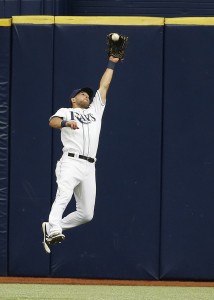 Kiermaier, now 34, began his career in fairly humble fashion. The Rays selected him in the 31st round in 2010, a portion of the draft that no longer exists, and gave him a $75K signing bonus. He was up in the majors by 2013 and quickly drew attention with his hard-nosed style of play, running the bases aggressively while also crashing his body into walls and the ground in order to make highlight reel catches.
The reckless abandon that he had for his own health was simultaneously his greatest asset and also the thing that most frequently held him back. He has been known as one of the best defenders of the most recent era of baseball while also often missing time due to injuries.
By the end of the 2016 season, he had appeared in 365 games for the Rays. He hit 32 home runs in that time and slashed .258/.313/.425 for a wRC+ of 105. He also stole 44 bases in that stretch and received some of the strongest defensive grades in the league.
Having established himself as a solid piece of the Rays’ roster, the two sides agreed to an extension going into 2017. Kiermaier had qualified for arbitration as a Super Two player and still had four years of club control remaining at that time. The deal was a six-year pact with a $53.5MM guarantee and a $13MM club option for 2023 that included a $2.5MM buyout.
Over the life of that deal, Kiermaier continued contributing in roughly the same way that he had before. He was solid though not elite at the plate while stealing bases and providing superlative defense, though the injury concerns would mount over time. From 2017 to 2022, the six guaranteed years of his extension with the Rays, he never once reached 130 games played in a season and he only hit the 100-game mark twice. One of those years was the shortened 2020 campaign but Kiermaier spent time on the injured list due to a right hip fracture, a torn ligament in right thumb, a left thumb sprain and a left wrist sprain.
In 2022, he dealt with a torn labrum in his left hip that ultimately required season-ending surgery in July. That led the Rays to go for the $2.5MM buyout instead of picking up his $13MM club option, sending him to free agency for the first time in his career.
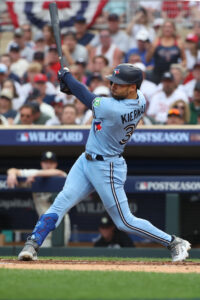
He was able to land a one-year, $9MM deal with the Blue Jays and then engineered a solid bounceback campaign. He slashed .265/.322/.419 for a wRC+ of 104, stole 14 bases and continued to provide his customary excellent glovework. He did go on the injured list once, suffering a right elbow laceration crashing into the outfield wall attempting to make a catch, but got into 129 games for the Jays.
He re-signed with the Jays on another one-year deal, this time securing a $10.5MM guarantee, but his results have fallen off significantly here in 2024. He did go on the IL once due to left hip flexor inflammation, returning after a minimum stay. In his 77 games for the Jays this year, he’s hit just .195/.239/.314 for a wRC+ of 55.
“The way I reflect on it, the product I put on the field now still can be good, but the effort it takes to get it to what I’ve been used to all those years, with my speed and defense and arm and everything, it’s tough,” he said to Topkin today. “I knew this year was going to be tough just with how I felt last year, and I know as the years go by it’s going to get tougher and tougher. I have my third kid coming in December, and it’s time for me to be a dad and let my body recover.” He continued: “I’m very proud and very happy,” Kiermaier said, “and it’s just been the best journey I could ever ask for. … It’s been incredible.”
Though retirement is just over the horizon, Kiermaier still has the 2024 season to get through and it remains to be seen where he will finish his career. The Jays are 45-55 at the moment and ten games back of a playoff spot, making them clear sellers prior to the July 30 trade deadline. Even before announcing his upcoming retirement, Kiermaier was a logical trade candidate as an impending free agent.
However, his value is at a low ebb, given his salary and struggles at the plate this year. A couple of weeks ago, the Jays placed him on waivers in the hopes that some other club would take the contract off their hands but they all passed. Despite clearing waivers, Kiermaier wasn’t removed from Toronto’s roster and could still be traded in the next week, though the Jays would have to eat some of his remaining salary to facilitate a deal. Despite the tepid offense this year, Kiermaier’s defensive grades are still strong and the Reds are one club that reportedly has some interest in him.
He will have a few more months to add to his career totals but has thus far played in 1,120 major league games with 890 hits. That includes 94 home runs, 59 triples and 167 doubles. He has scored 491 runs, driven in 370 and stolen 131 bases.
But he will of course be most remembered for that superb defense. From 2014 to the present, he has accrued 159 Defensive Runs Saved as a center fielder so far. That’s the most of any player in baseball at any position and doesn’t even include the 13 DRS he had in right field prior to establishing himself as Tampa’s regular in center. His 88 Outs Above Average in center that time frame are tops among outfielders and behind only infielders Francisco Lindor, Nick Ahmed and Nolan Arenado. (His time as a right fielder predated the invention of Outs Above Average.)
We at MLBTR salute Kiermaier on a fine career and wish him luck in the remainder of his playing career as well as his post-playing days.
Astros Among Teams Interested In Isaac Paredes
The Astros, looking to lengthen their lineup and get more production out of first base, are among the teams with interest in Rays infielder Isaac Paredes, reports Chandler Rome of The Athletic. As Rome explains, the bottom third of Houston’s lineup has produced a disastrous .254 OBP since Kyle Tucker went on the injured list 40 games ago, shortening the lineup and leaving a lot of pressure on the top of the batting order.
Paredes is a natural fit for the Astros, though between his affordable $3.4MM salary, his three additional years of club control, his defensive versatility and this year’s .250/.352/.445 slash, he’d fit on the majority of contenders around the league. Paredes has been Tampa Bay’s primary third baseman this season, but he has considerable experience at both second base and first base as well, and he’s even played 50 innings of shortstop in the majors. He’s probably not cut out for long-term shortstop work, but Statcast feels he’s been average or better at each of the three other infield spots.
Among the 148 qualified hitters in MLB this season, only one has a higher pull rate than Paredes: Houston’s own Jose Altuve. That pull-happy approach from a righty power bat like Paredes makes the Astros’ Minute Maid Park — and the short left field porch in the Crawford Boxes — a particularly interesting fit. Paredes popped 31 homers last season and has 16 so far in 2024.
The Astros have gotten virtually nothing out of first base this season. Jose Abreu was released in the second season of an ill-fated three-year contract. Jon Singleton has been the primary option since. He’s hitting .230/.321/.345 on the season. That’s seven percent worse than league-average, by measure of wRC+, at a position where above-average offense is typically expected. Singleton also grades as a poor first base defender and poor baserunner.
Swapping Singleton out for Paredes and then pairing him with Tucker’s eventual return could have a transformative impact on the Houston lineup. The benefits of adding Paredes would be further reaching in the long-term, too. Alex Bregman is slated to become a free agent this offseason, and while the Astros figure to be part of his offseason market, he’s hardly a guarantee to re-sign. Keeping Bregman could require a longer and more lucrative contract than the ‘Stros have given out to anyone under owner Jim Crane; Yordan Alvarez‘s six-year, $115MM deal is the longest contract issued under Crane, while Altuve’s 2018 extension that guaranteed him $151MM in new money is the largest guarantee. If Bregman doesn’t stay in Houston, Paredes could shift across the diamond to third base in 2025.
For all the reasons just listed, however, Paredes will be extremely expensive to acquire — at least in terms of prospects/young talent. Any of the Yankees, Dodgers, Mariners and Red Sox (among others) stand as obvious fits and suitors for him. The market will be competitive. And, since Paredes is controllable through the 2027 season and should earn under $10MM next season in arbitration, the Rays likely don’t feel a need to move him. They’ll listen, as they do on all of their players, but it’ll take a genuinely compelling offer to pry three-plus years of one of the game’s most underrated infielders from their grasp.
That said, the Rays have sufficient infield depth to withstand the loss of Paredes. Third baseman Junior Caminero ranks as one of the sport’s top five prospects and is ready for a look in the majors. Caminero’s presence alone doesn’t make Paredes expendable — he could easily move to another infield position or just bounce between multiple slots on a regular basis — but having a ready-made replacement does make it a bit easier to move him than if the cupboard behind him were bare. Other, more expensive veterans on the Rays (e.g. Zach Eflin, Randy Arozarena) seem likelier to move between now and next Tuesday’s deadline, but Paredes should draw heavy interest in his own right and likely could be had with a substantial enough offer.
Dodgers Interested In Randy Arozarena
The Dodgers have made clear they’re looking to make a splash at the top of the trade market. Most of the focus has been on the pitching side — general manager Brandon Gomes said just last night the front office is seeking “an impact-type arm” — and it seems they’re taking a similar approach to the position players.
Mark Feinsand of MLB.com reports that Los Angeles is seeking a significant offensive upgrade in the outfield. The Dodgers have already been tied to White Sox star Luis Robert Jr. Feinsand writes that Rays left fielder Randy Arozarena is also on L.A.’s radar. The Dodgers had been loosely linked to Arozarena over the offseason.
The fit is rather straightforward. Teoscar Hernández could handle right field if the Dodgers added an everyday player in left. Andy Pages could play center field regularly while Jason Heyward would move into a fourth outfield role. Each of Hernández, Arozarena and Pages hit from the right side, meaning Heyward should be able to rotate in against right-handed pitching fairly frequently to keep everyone fresh.
Arozarena started the season terribly. The former All-Star carried a .158/.257/.312 batting line into June. He has caught fire over the past couple months, raking at a .286/.392/.514 clip through his most recent 166 plate appearances. The dreadful spring is taking a toll on Arozarena’s season line, which sits at a pedestrian .211/.313/.395 mark. Considering he’d been a well above-average hitter over his first three and a half years in the big leagues, most teams will probably view his April/May performance as an anomaly.
That’s also true of the Rays, who are shaping up as one of the most interesting teams to watch over the next week. Tampa Bay isn’t out of playoff contention, but they’re sitting at .500 with a 5.5 game deficit in the Wild Card race. A playoff push this year is possible but unlikely. While the Rays aren’t going to orchestrate a complete teardown, they’ll likely consider offers on a host of productive veterans (e.g. Brandon Lowe, Zach Eflin, Zack Littell, Isaac Paredes, Pete Fairbanks). Whether to trade Arozarena is one of the biggest questions facing the front office.
The 29-year-old outfielder is playing on an $8.1MM salary, a little less than $3MM of which is yet to be paid. He’s set for two more arbitration raises before getting to free agency during the 2026-27 offseason. The Dodgers are in the highest tier of luxury tax penalization and face escalating penalties for exceeding the CBT threshold in at least three straight years. They’d owe a 110% tax on any contracts they absorb.
Rays Claim Joel Kuhnel From Brewers
The Rays announced that they have claimed right-hander Joel Kuhnel off waivers from the Brewers. Milwaukee designated him for assignment a couple of days ago. The Rays already had three vacancies on their 40-man roster, so their count climbs to 38.
Kuhnel, 29, has been featured in the pages of MLB Trade Rumors plenty of times this year but hasn’t been able to factor into many MLB games. He started 2024 on the Astros’ roster but was designated for assignment, outrighted and elected free agency before re-signing with Houston on a minor league deal by the end of January. He was selected back onto their roster in April but then designated for assignment again later that month.
He then went to the Blue Jays in a cash deal but that club kept him on optional assignment for a few weeks before he was designated for assignment and elected free agency once again. He landed with the Brewers on a minor league deal and was twice selected to that club’s roster but both stints resulted in him being designated for assignment without him pitching in a game.
Around all of those transactions, he only has one appearance in the big leagues this year, when he allowed four earned runs in two innings for the Astros. But in his 27 1/3 minor league innings, he has a 2.30 earned run average. His 15% strikeout rate is subpar but he’s racked up huge numbers of ground balls.
That’s generally been the recipe for Kuhnel in his career. He has 85 2/3 big league innings overall, most of that with the Reds. His 6.30 ERA in that time obviously isn’t great, nor is his 19% strikeout rate, but he has kept 52.2% of balls in play on the ground and has clearly attracted the attention of several clubs around the league.
The Rays have a bunch of open roster spots right now. In the past month, they have traded Aaron Civale and Phil Maton. They also designated Chris Devenski for assignment and put Yandy Díaz on the restricted list due to an undisclosed personal matter. Tyler Zuber was selected to take one of those spots but they still had three available and have now used one of them on Kuhnel.
Kuhnel averages in the mid-90s with both of his fastballs and also throws a slider and a changeup. Given that velocity and pitch mix, perhaps clubs around the league believe there’s room to coax some more strikeouts out of him, in addition to his ground ball tendencies. He is also in his final option year and can therefore be sent to the minors for the rest of this season. His service time count is between one and two years, so he could be a long-term piece if things break right.
Latest On Rays’ Deadline Approach
The Rays are among the more interesting bubble teams with the deadline eight days off. Tampa Bay entered today’s series finale with the Yankees at 50-49. They dropped the game 9-1, putting them back to .500.
Today’s loss knocked Tampa Bay five games behind the Royals, who hold the final Wild Card spot in the American League. The Red Sox and Mariners also sit between the Rays and the last playoff spot. They’re 10.5 back with three teams to jump in the AL East, so it’s almost certainly Wild Card or bust. A five-game deficit certainly isn’t insurmountable, but it’s not an easy gap to close either (especially with multiple teams to jump).
MLB.com’s Mark Feinsand tweeted last night that the Rays are expected to both buy and sell at the deadline. Presumably, that’d take the form of shopping players on more expensive salaries and/or a dwindling control window while exploring acquisitions of MLB-ready talent that could aid the Rays in a longer shot playoff push this season and contribute to the 2025 roster. Tampa Bay’s front office is plenty familiar with trying to strike that balance as they look to remain annually competitive despite bottom five player payrolls.
The Rays have no shortage of veterans who’d generate interest. The Rays had five players on MLBTR’s initial list of Top 50 trade candidates last week: Zack Littell, Zach Eflin, Pete Fairbanks, Randy Arozarena and Jason Adam. There’d be a ton of interest in Isaac Paredes if the Rays genuinely considered moving their All-Star third baseman. SNY’s Andy Martino wrote last week that the Rays are willing to listen on Paredes, though there’s nothing to suggest that’s more than the organization’s standard openness to talking about every player.
Brandon Lowe and Yandy Díaz are each making between $8MM and $9MM and would be appealing targets in a light infield market. Amed Rosario has had a nice rebound season after signing a surprisingly low $1.5MM free agent deal. He’s headed back to free agency next winter and offers multi-positional versatility and plus contact skills from the right side. Virtually every contender could squeeze him onto the roster and in their payroll ledger.
Tampa Bay certainly isn’t going to trade everyone from that group. The Rays have never been keen on completely tearing down the roster and embarking on multi-year rebuilds. They’re not far enough from the playoff mix to make that advisable regardless. Yet it’d be surprising if the Rays didn’t at least move one or two veterans. Rosario, as their only impending free agent of note, is the most obvious candidate. The front office is clearly willing to deal some players under team control beyond this season, as evidenced by their trade of starter Aaron Civale (who is eligible for arbitration for the final time next winter) to Milwaukee.
Patrick Mooney, Ken Rosenthal and Will Sammon of the Athletic wrote this morning that the Rays could be more apt to trade players who are going yearly through arbitration than to deal those playing on guaranteed contracts. Arozarena, Paredes, Littell and Adam fall into the first bucket. Fairbanks, Díaz and Lowe have signed extensions, while Eflin joined Tampa Bay on a three-year free agent deal. There’s not much difference between players on guaranteed contracts versus arbitration salaries in practice, but The Athletic writes that the Rays could feel more of an obligation to hold the players who have committed to the franchise for multiple seasons.
While that’s a possible factor, it’d be surprising if the Rays drew too rigid a distinction. Tampa Bay traded Tyler Glasnow and Manuel Margot — each of whom had signed an extension — to the Dodgers last winter. Glasnow’s deal sent him close to home on the West Coast and came in conjunction with another extension with L.A.; the Dodgers flipped Margot to Minnesota within a few weeks. Tampa Bay traded Blake Snell within two years of signing him to a five-year extension back in December 2020.
Eflin ($11MM), Lowe ($8.75MM) and Díaz ($8MM) have the highest salaries among players on multi-year deals. Arozarena’s $8.1MM salary is by far the highest of Tampa Bay’s group of players on arbitration deals. Eflin will make $18MM next year in the final season of his backloaded contract. Díaz is set to make $10MM next season on a deal that has a $12MM team option for 2026. The Rays hold club options on Lowe (valued at $10.5MM and $11.5MM, respectively) for the next two seasons.
Arozarena is set to go through arbitration twice more, while Paredes is eligible for arbitration through the ’27 campaign. He’ll certainly be in line for a lofty raise on this year’s $3.4MM salary. Fairbanks, Adam, Rosario and Littell are all on modest salaries; Fairbanks’ $3.666MM figure is the highest of the bunch. All but Rosario are under contract or club control for at least another season.
If the Rays ultimately straddle the line between buying and selling, they’re fairly well positioned to deal from their rotation and infield. Shane Baz’s return from Tommy John surgery was one motive for the Civale trade. The Rays could welcome back Jeffrey Springs and Drew Rasmussen over the next couple months and will get Shane McClanahan back in 2025 — perhaps lessening the sting of a deal involving Eflin or Littell. Upper level infielders like Curtis Mead and top prospect Junior Caminero could make it easier to part with Lowe. That’s arguably also true of Paredes, although it’d have been an easier sell if Caminero hadn’t had two extended injured list stints in Triple-A this year because of quad issues.
Tampa Bay doesn’t have as much long-term stability in the outfield, particularly if they move Arozarena at some point. At catcher, they’ve gotten good production this year out of Ben Rortvedt but could still look for a clearer long-term answer. Tampa Bay’s typically excellent bullpen has been an unexpected issue this season, so that’s another area where the Rays may look to add.