
A 4-Year-Old Trade That Could Have Long-Term Effects
For the most part, if one team trades you to another for cash considerations, odds are you aren’t going to amount to much in Major League Baseball. But it was four years ago today that the two Missouri-based franchises – the Royals and Cardinals – came together on a cash/player trade that made an impact in the ensuing couple years and could continue to have a long-term effect. On May 25, 2016, the Cardinals acquired outfielder Jose Martinez, whom the Royals had recently designated for assignment to clear roster space for a guy named Whit Merrifield, for money.
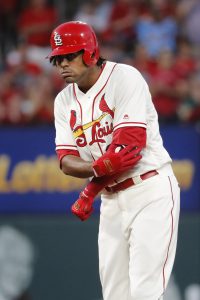
Back when the trade occurred, MLBTR’s Jeff Todd wrote of Martinez: “He’s a ten-year minor-league veteran who has yet to crack the majors. In parts of two seasons at Triple-A, Martinez owns a productive .359/.431/.525 batting line over 556 plate appearances. He hasn’t quite maintained the pace he set last year at Omaha, but will nevertheless provide the Cards some outfield depth in the upper levels of their system.”
Indeed, Martinez didn’t look as if he’d make a mark in the majors when the Cardinals got him. After all, along with the Royals, the White Sox and Braves gave up on Martinez earlier in his career. But following a couple months in the Cardinals’ system, the club recalled him Sept. 6, 2016, for his long-awaited major league debut. Martinez has defied the odds and gone on to a pretty successful offensive career since then.
In 2017, his first extensive action in the bigs, Martinez batted a hearty .309/.379/.518 (136 wRC+) with 14 home runs in 307 plate appearances. The good times continued the next season in an even larger role, as Martinez hit .305/.364/.457 (127 wRC+) and put up 17 HRs over 590 trips to the plate. As solid as Martinez was as a hitter then, though, defensive questions have consistently dogged him. He posted minus-13 Defensive Runs Saved and a minus-5.3 Ultimate Zone Rating as a corner outfielder from 2017-18, preventing him from maxing out his value as a hitter. By fWAR, Martinez was roughly an average contributor during that span, though he was passable as a first baseman in 675 innings in ’18 (minus-1 DRS, minus-3.2 UZR).
If you struggle as a defender, you have to hit in order to be of much use to your team, but Martinez even had difficulty doing that last year. On the heels of two impressive seasons in a row, he stumbled to a low-power line of .269/.340/.410 (101 wRC+) and managed just 10 homers in 373 PA. Between that and more subpar outfield defense (minus-10 DRS, minus-4.6 UZR), Martinez was close to a replacement-level player.
Despite his underwhelming output in 2019, as someone whom they gave up almost nothing to acquire, Martinez provided St. Louis more value than it could have realistically expected when it landed him. However, the Cardinals bid goodbye to Martinez last offseason, sending him, outfielder Randy Arozarena and a Competitive Balance Round A draft pick to the Rays in a deal that netted the Redbirds left-hander Matthew Liberatore, Tampa Bay’s Competitive Balance Round B selection and catcher Edgardo Rodriguez.
In the 31-year-old Martinez, the Rays got a player who, as mentioned, has typically fared well at the plate. Plus Martinez is under affordable control for the next three seasons, which is important for a low-budget club. It remains to be seen whether any of the younger talent in the swap will pan out, but it seems Liberatore stands the best chance. The 20-year-old currently ranks as the game’s 42nd-best prospect at Baseball America, which contends that he has “mid-rotation or better” upside.
Unlike the original Martinez trade, which was a win for St. Louis, we don’t yet know how the Cardinals-Rays one will go. Regardless, the Royals-Cards trade from four seasons ago is another sign that deals which may look insignificant at the time are capable of affecting teams for years.
Photo courtesy of USA Today Sports Images.
Have The Royals Found Another Rule 5 Gem?
After selecting Joakim Soria out of the Padres’ farm system in the 2006 Rule 5 Draft, it could be argued that the Royals are still in the “playing with house money” honeymoon phase of the Rule 5 process. After all, even landing a Rule 5 player who can stick on a Major League roster for an entire season is a success, never mind landing a two-time All-Star like Soria through his 2007-11 heyday as Kansas City’s closer.
Eleven years after drafting Soria, it seems like the Royals again struck gold via the Rule 5 process. While Brad Keller has yet to reach All-Star levels, the right-hander has already enjoyed enough success over his first two MLB seasons that he looks like a solid building block for a young K.C. team.
Keller was an eighth-round pick for the Diamondbacks in the 2013 draft, and through five pro seasons had compiled some decent but unspectacular numbers in the Arizona farm system. Over 130 1/3 innings for Double-A Jackson in 2017, Keller posted a 4.68 ERA, 7.6 K/9, and 1.95 K/BB rate, which wasn’t quite good enough for him to make the grade amidst something of a 40-man roster crunch for the D’Backs.
Coming off a 93-win season and a NLDS appearance in 2017, the Diamondbacks were focused on using much of their available 40-man spaces on players who could potentially provide immediate help in 2018, as GM Mike Hazen explained to the Arizona Republic’s Nick Piecoro two years ago. “Our scouts liked [Keller]. We liked him,” Hazen said. “We made the conscious decision not to add him because of where he was in proximity to the Major League team, where we were in the cycle, what we wanted to use our 40-man spots for, we wanted to be aggressive in the offseason in claiming guys…that were closer to the big leagues in our mind.”
So, the D’Backs left Keller unprotected in December 2017 draft, and it didn’t take long for another team to pounce on the right-hander. However, that other team wasn’t actually the Royals, whose spot in the Rule 5 draft order didn’t fall until the #18 spot that year. Instead it was the Reds who took Keller with the fifth pick, and then promptly dealt him to Kansas City for cash considerations. (The Royals swung a similar move just one pick later, acquiring sixth pick Burch Smith for cash from the Mets after New York selected Smith out of Tampa Bay’s farm system.)
Smith also ended up spending the entire 2018 season on the K.C. roster, though he was cut loose after posting a 6.92 ERA over 78 innings. Keller, on the other hand, was much more of an immediate success. After posting a 2.01 ERA over his first 22 1/3 frames of work out of Kansas City’s bullpen in 2018, Keller was promoted to the rotation and continued to succeed. The righty had a 3.28 ERA over his 20 starts, striking out 83 batters (against 43 walks) over 118 innings.
Keller’s sophomore year wasn’t quite as impressive, though he still managed a quite respectable 4.19 ERA, 1.74 K/BB, and 6.6 K/9 over 165 1/3 frames, all as a member of the Royals rotation. It could be argued that Keller was perhaps fortunate to manage that 4.19 mark, as some ERA predictors (4.94 xFIP, 5.23 SIERA) were significantly higher, and batters made much more solid contract off him in 2019 than in 2018. The Statcast metrics also took a dim view of Keller’s 2019 performance, with a whole lot of blue — as in, below-average — numbers for Keller in comparison to other pitchers in exit velocity, xwOBA, strikeout percentage, and several other categories.
That said, advanced metrics don’t tend to favor low-strikeout hurlers like Keller who specialize in keeping the ball on the ground. Among pitchers with at least 300 innings tossed over the last two seasons, Keller has the lowest (8.4%) home run rate in baseball, and the second-highest (52%) grounder rate. These outstanding numbers are particularly valuable in this era of the lively ball, and Keller could further benefit from some improved defense behind him, should Maikel Franco provide any sort of upgrade at third base.
All told, 4.8 fWAR over two seasons already represents a very nice return on the Royals’ initial minor cash outlay to Cincinnati. Keller doesn’t turn 25 until July, and he doesn’t reach arbitration eligibility until this coming offseason, putting him under the Royals’ control through the 2023 campaign. Under normal circumstances, Keller could be a player the Royals might have already locked up to a contract extension, and while all extension talks are halted under the current transactions freeze, it wouldn’t be a surprise if K.C. began some talks with Keller’s representatives once regular business gets back underway.
While truly major Rule 5 Draft success stories are relatively few and far between these days, a team only needs to hit on one pick to make the enterprise worthwhile. Finding a big league talent for virtually nothing is a win for any team, and if that talent is a mid-20’s starting pitcher who looks like he can hang in at least the middle of a big league rotation, the Royals got a valuable boost to their latest rebuilding effort.
Zack Greinke’s Great Hot Stove Adventure
Every player that reaches the majors has a hot-stove tale to tell. They’re drafted or signed into the pro ranks to start out. Quite a few are traded or move via free agency even before reaching the bigs. You have to be selected or signed onto a 40-man roster before you can put on a uniform in a MLB contest. And then there’s the inevitable moment when it all goes away … whether through retirement at the end of a lengthy career or, in many cases, a trip into DFA limbo.
All of these stories are etched on the pages of MLBTR. Some are more interesting than others. A few of these transactional career arcs touch upon many major elements of the hot stove league — the front office game that shapes the underlying sport that we watch on TV.
The transactional saga of Zack Greinke, the venerable right-hander whose latest stop is the Houston Astros, is certainly among the most notable in recent memory …
Professional Entry
- The Royals took Greinke, an unusually polished high-school hurler, with the sixth overall pick of 2002 draft.
Prospect Status
- Greinke quickly emerged as one of the game’s top prospects.
- Baseball America rated Greinke 54th overall ahead of the 2003 season and 14th overall in advance of 2004.
Early Career
- At just 20 years of age, Greinke turned in in 24 starts of 3.97 ERA ball in his debut season of 2004. But he struggled badly in his sophomore season.
- Greinke battled mental health issues and was ultimately diagnosed with depression and social anxiety disorder. At the time, his outlook as a professional baseball player was of secondary concern. SI.com’s John Donovan wrote: “Greinke’s tortured story is, on the one end, a sad one, but on this side there is hope that it may yet turn out well.”
Extension
- Greinke reemerged in 2007, then turned in a breakout 2008 season.
- The Royals signed Greinke to a four-year, $38MM extension in advance of the 2009 season, adding two years of team control. He won the American League Cy Young Award in the ensuing campaign.
2010 Blockbuster
- The Royals decided to entertain trade offers on Greinke, by then regarded as one of the game’s best pitchers, in the 2010-11 offseason. Greinke later indicated his desire to be traded.
- A monumental set of Winter Meetings trade talks ensued. Royals Review has exhaustively documented the contemporaneous rumor mill. Greinke reportedly indicated he would exercise his no-trade rights to block a deal to the Nationals.
- The Brewers eventually acquired Greinke and Yuniesky Betancourt, and $2MM from the Royals for Lorenzo Cain, Alcides Escobar, Jeremy Jeffress, and Jake Odorizzi.
- Greinke ended his tenure with the Royals with a 3.82 ERA in 1,108 innings over seven seasons.
2012 Trade Deadline Swap
- Greinke continued to perform well in Milwaukee, but the Brewers stumbled.
- In July of 2012, the Angeles acquired Greinke for Jean Segura, Ariel Pena and John Hellweg.
- Greinke ended his tenure with the Brewers with a 3.67 ERA in 294 2/3 innings over two seasons.
2012-13 Free Agency
- Greinke entered the market as the top player available and drew interest from numerous big-market teams.
- During the Winter Meetings, the Dodgers signed Greinke to a six-year, $147MM contract.
- Greinke ended his tenure with the Angels with a 3.53 ERA in 89 1/3 innings over one season.
2015-16 Free Agency
- Greinke opted out of his contract after a 2015 season in which he led the National League with a 1.66 ERA.
- Expectations were that he would re-sign with the Dodgers, but the Diamondbacks suddenly entered the market with a massive offer.
- The Diamondbacks signed Greinke to a six-year, $206.5MM contract, setting a new record for average annual value ($34.42MM).
- Greinke ended his tenure with the Dodgers with a 2.30 ERA in 602 2/3 innings over three seasons.
2019 Trade Deadline Swap
- After a rough initial season in Arizona, Greinke continued to produce excellent results even as he entered his mid-thirties.
- In a last-minute agreement consummated just before the trade deadline, the Astros acquired Greinke for Corbin Martin, J.B. Bukauskas, Seth Beer, and Joshua Rojas.
- Greinke ended his tenure with the Diamondbacks with a 3.40 ERA in 714 2/3 innings over four seasons.
Future
- Greinke’s contract runs through 2021. The Astros took on $53MM of the remaining salary obligations.
- With the Astros, Greinke has a 3.02 ERA in 62 2/3 innings over one season.
Which 15 Players Should The Royals Protect In An Expansion Draft?
In a few weeks, we’ll be running a two-team mock expansion draft here at MLBTR. Currently, we’re creating 15-player protected lists for each of the existing 30 teams. You can catch up on the rules for player eligibility here.
So far, we’ve done the Tigers, Indians, White Sox, Rays, Yankees, Red Sox, Blue Jays, and Orioles. The Royals are next.
We’ll start by removing free agents Ian Kennedy, Alex Gordon, and Trevor Rosenthal.
I’ll lock down six players: Jorge Soler, Whit Merrifield, Adalberto Mondesi, Hunter Dozier, Brad Keller, and Salvador Perez. While there’s a case for leaving Perez unprotected, I don’t think the Royals would do that. Here’s the initial protected group:
Jorge Soler
Whit Merrifield
Adalberto Mondesi
Hunter Dozier
Brad Keller
Salvador Perez
That leaves nine spots for the following 25 players:
Chance Adams
Scott Barlow
Danny Duffy
Maikel Franco
Jesse Hahn
Tim Hill
Cam Gallagher
Kelvin Gutierrez
Jakob Junis
Jorge Lopez
Nicky Lopez
Richard Lovelady
Ryan McBroom
Kevin McCarthy
Mike Montgomery
Jake Newberry
Ryan O’Hearn
Brett Phillips
Randy Rosario
Glenn Sparkman
Gabe Speier
Bubba Starling
Josh Staumont
Meibrys Viloria
Kyle Zimmer
With that, we turn it over to the MLBTR readership! In the poll below (direct link here), select exactly nine players you think the Royals should protect in our upcoming mock expansion draft. Click here to view the results.
Royals Have Reduced Future Payroll Commitments To Under $40MM
2020 salary terms are set to be hammered out in the coming days. But what about what’s owed to players beyond that point? The near-term economic picture remains questionable at best. That’ll make teams all the more cautious with guaranteed future salaries.
Every organization has some amount of future cash committed to players, all of it done before the coronavirus pandemic swept the globe. There are several different ways to look at salaries; for instance, for purposes of calculating the luxury tax, the average annual value is the touchstone, with up-front bonuses spread over the life of the deal. For this exercise, we’ll focus on actual cash outlays that still have yet to be paid.
We’ll run through every team, with a big assist from the Cot’s Baseball Contracts database. Next up is the Royals:
(click to expand/view detail list)
Royals Total Future Cash Obligation: $38.75MM

Alex Gordon Hopes To Play “A Few More Years”
Royals icon Alex Gordon was at least pondering retirement within the past year, but the 36-year-old now tells Lynn Worthy of the Kansas City Star that he’d like to play “at least a few more years.” Like many other veterans who’ve had additional time to reflect thanks to the COVID-19 shutdown, Gordon wants to go out on his own terms rather than letting the health crisis dictate when he hangs it up. “I’ll tell you I definitely don’t want to end like this,” says Gordon.
Gordon also notes that he sees similarities between the current Royals and the group that blossomed into Kansas City’s World Series clubs from 2014-15. The seven-time Gold Glover spoke fondly of how “special” it is to be a part of a group that grows together through a rebuild and comes out the other side as a postseason contender. Gordon “definitely” wants to see at least one more postseason run in his career, he adds.
There’s no talk of playing anywhere else in Gordon’s interview with Worthy, which K.C. fans in particular will want to read in full. Gordon said almost one year ago to the day that he plans to finish his career in Kansas City and retire as a Royal. “I’ve established my family here with my kids,” he said at the time. “This is home.”
If Gordon’s postseason aspirations are to come true, he’ll likely need another couple of years at least. The Royals have an increasing number of intriguing bats in the lineup, with Adalberto Mondesi, Hunter Dozier, Whit Merrifield and Jorge Soler all blossoming in recent years. (Soler will be a free agent after 2021, though the club hopes to extend the slugger.) The pitching side of things is a bit further behind, but the Royals have several quality young arms bubbling up toward MLB readiness. Brady Singer, Daniel Lynch, Jackson Kowar and Kris Bubic all could’ve conceivably debuted in the big leagues this year, although that timeline is a bit less certain given the circumstances. All four appeared on various top-100 prospect lists prior to the 2020 season.
Gordon himself remains a reasonably productive player, having batted .266/.345/.396 with 13 home runs, 31 doubles and a triple in 2020 to go along with above-average glovework. Defensive metrics weren’t as bullish on him in 2019 as they were in an excellent defensive 2018 campaign, but Gordon has never rated below average in either Defensive Runs Saved or Ultimate Zone Rating since moving from third base to left field a decade ago. And while those offensive numbers are just shy of league average, Gordon was mostly solid in ’19 outside of a disastrous month of August (.167/.238/.219). Setting aside that brutal month, he kept his OPS above the .800 mark. We of course can’t simply ignore that woeful August showing, but it’s only fair to point out that he was a largely solid at the plate otherwise.
Gordon is on a one-year, $4MM deal with the Royals, so this winter, he’ll need to once again negotiate a new contract with the only club he’s ever known. But general manager Dayton Moore has made perfectly clear how important Gordon is to the team and clubhouse, and his teammates have offered similar sentiments. Merrifield, for instance, gushed to Worthy about how vital Gordon has been in his own career and what his leadership means to the Kansas City roster.
On The Royals’ Pair Of Potential Stars
The Royals are trying to pull off a tough feat: a quick, low-pain rebound in place of a lengthy slog of a rebuild. That’s a tall task for any organization, but especially for a small-market franchise that pushed a lot of chips onto the table as part of a successful effort to maximize a recent window of contention.
As you might expect, the development of existing players is critical to this effort — as much or more than prospects, the younger big leaguers who’ll be relied upon to produce in the next few seasons. It’s absolutely critical for the K.C. organization to find some big-time production from players who aren’t commanding big salaries. Otherwise, deciding to hang onto Whit Merrifield, Salvador Perez, and other veterans could really sting in the long run.
The Royals have a pair of pre-arbitration players whose up-and-down careers to this point suggest equal parts upside and uncertainty. At times, shortstop Adalberto Mondesi and corner outfielder/infielder Hunter Dozier have performed like stars. But can they do so sustainably?
There’s plenty at stake for all parties. Both Mondesi and Dozier enter the 2020 season with two full years of MLB service, but not enough to reach Super Two status. Accordingly, they’ll be playing for their first big payday — as first-time arbitration-eligible players — whenever this campaign gets underway.
These two players have notable lineages and abundant physical ability. Mondesi’s dad had a long and excellent MLB career. Dozier was the eighth overall pick in the 2013 draft.
Their careers have certainly seen some peaks and valleys from those starting points. Mondesi shot up onto top-prospect rankings and burst onto the MLB scene with his first extended action in 2018, when he showed a rare blend of power (14 home runs in 291 plate appearances) and speed (32 stolen bases). But he took a step back at the plate last year — he posted an 82 wRC+ and Statcast credited him with a putrid .282 xwOBA — and ended up being shelved late in the season with shoulder surgery that he’s still fully recovering from.
Dozier’s dip came earlier in his professional career, as he struggled to convert promise into production in the minors. Health issues also intervened. By the end of the 2018 campaign, Dozier seemed likely to be a bust. He had reached but struggled at the MLB level and wasn’t hitting much in the upper minors. And then came 2019 … when Dozier suddenly broke out at the game’s highest level. He launched 26 long balls and posted a .279/.348/.522 slash line over 586 plate appearances, producing 85th percentile exit velocity and 80th percentile sprint speed. While Statcast still saw some good fortune in the batted-ball outcomes (.337 xwOBA vs. .360 wOBA), that hardly took the sheen off of a breakthrough campaign.
I’m not going to tell you I know what to expect from this duo. Each has struggled with swings and misses at some points, but also shown an ability to produce despite occasionally hefty strikeout rates. Their respective power potential has likewise alternately shown up and fallen off.
The upside here is tremendous. At his best, in 2018, a 22-year-old, switch-hitting Mondesi produced 2.5 rWAR and 2.8 fWAR in less than a half-season. He could be a true superstar if he can return to that level of output over a full campaign. Dozier was a 3.2 rWAR/3.0 fWAR performer in 139 games last year. That also reflects poor baserunning numbers and defensive grades at third base. Dozier graded better in right field, where he’ll appear primarily in 2020. Perhaps there’s still more upside in that regard.
There’s a load of overall uncertainty in Kansas City, but also some intriguing talent. The team’s other obvious boom-or-bust players — Maikel Franco, Jorge Soler, Danny Duffy — are set for free agency after 2021. Then there’s a host of younger players and prospects that have yet to put down much or any track record in the majors. Mondesi and Dozier occupy a middle ground of experience and contractual control that makes the 2020 season particularly pivotal for them and the team. If these two can settle in as steady stars, the Royals could be looking at three more campaigns apiece of cost-controlled quality to build around.
Merrifield Or Kingery?
Scott Kingery and Whit Merrifield aren’t exactly at the same place in their careers.
Merrifield, 31, led his team in bWAR last season and is considered by many as the best player on their rebuilding club. He’s a late-bloomer, but on the wrong side of thirty nonetheless, with 3.5 seasons under his belt as an above-average player. MLBTR’s Mark Polishuk recently wrote this of Merrifield: “The 31-year-old is one of the better all-around veteran assets in the game, considering his ability to play multiple positions, his inexpensive contract that could extend through the 2023 season, and his three consecutive seasons of strong production.” He boasts a career batting line of .296/.344/.445, good for 109 wRC+.
Kingery, 26, disappointed in a major way in his first shot at the big leagues, but he rebounded last year with an honest effort as a multi-positional asset for the contending Phillies. In just his age-25 season, Kingery posted a line of .258/.315/.474 across 500 plate appearances while socking 19 long balls. MLBTR’s Jeff Todd recently wrote this: “Kingery had some ups and downs in his second season in the bigs, but ultimately made huge strides and turned in a league-average offensive season.” To this point, Kingery’s career line stands at just .242/.291/.407 – but the former 2nd round pick produced a 101 wRC+ last season. At a similar age, Merrifield was splitting his time between Double and Triple A.
Financially-speaking, both are signed to long-term deals. Because Merrifield debuted on the older side, he signed a very team-friendly deal through potentially his age-34 season. He’ll make $5MM in 2020, $6.75MM in 2021, just $2.75MM in 2022, and the Royals hold a team option for $10.5MM in 2023. Many thought Merrifield would be traded to a contending team this winter, but the Royals love him, and given his contract, there’s no particular rush to move him. By not moving him, they’re missing out on the opportunity to add young talent to the organization, but Merrifield is producing now, and his story is one that might give many Kansas City farmhands hope.
Kingery is signed even longer. The Phillies will pay him $1.75MM in 2020 (in theory), $4.25MM in 2021, $6.25MM in 2022, and $8.25MM in 2023. Philadelphia also holds three team options: $13MM in 2024, $14MM in 2025, and $15MM in 2026.
Kingery’s deal brings a lot more upside, with Merrifield likely brings more near-term value. Given the current standings of the Phillies and Royals, an argument could be made that a straight-up swap of the two multi-positional right-handers makes a lot of sense. Kingery has yet to prove that he can produce a season like Merrfield’s 5.2 bWAR effort in 2018, but he’s also five years younger and signed for a longer period. Their deals, meanwhile, converge in 2023, where a 34-year-old Merrifield would be making more on a one-year deal than the 29-year-old Kingery, who at that point will have three relatively reasonable team options remaining.
Both players boast well-rounded games, with Kingery bringing a bit more pop potential, while Merrifield has superior bat skills. Kingery has swiped 25 bases while only being caught 7 times over his two seasons, while Merrifield led the AL in stolen bases in both 2017 and 2018. Last year, Merrifield’s volume and efficiency fell off a bit as he swiped just 20 bases in 30 chances. Both players have capably moved around the diamond, both infield and outfield. The gap between Merrifield’s 110 wRC+ last season and Kingery’s 101 wRC+ isn’t as great as the perceived talent gap between the two players. If nothing else, assume some age-related regression for Merrifield, while Kingery develops further as he grows into his prime, and don’t these two inch just a little closer?
Merrifield is the quick-trigger choice, but given a comprehensive look at both players, an argument can be made that Kingery is the better asset. All in, which would you prefer to have on your team: Merrifield’s proven qualities or Kingery’s rising upside? Put another way, who has the better asset: the Royals or Phillies?
Whit Merrifield Or Scott Kingery?
-
Whit Merrifield 58% (3,206)
-
Scott Kingery 42% (2,287)
Total votes: 5,493
Offseason In Review: Kansas City Royals
It was a pretty quiet offseason in Kansas City, though the Royals brought two franchise icons back into the fold and took a flier on a potential post-hype breakout candidate for third base.
Major League Signings
- Alex Gordon, OF: One year, $4MM
- Maikel Franco, 3B: One year, $2.95MM
- Jesse Hahn, RHP: One year, $600K (Hahn was re-signed after originally being non-tendered)
- Total spend: $7.55MM
Trades And Claims
- Acquired RHP Chance Adams from the Yankees for minor league SS Cristian Perez
- Selected RHP Stephen Woods Jr. from the Rays in the Rule 5 Draft
Notable Minor League Signings
- Trevor Rosenthal (contract was selected to MLB roster, guaranteeing Rosenthal’s $2MM salary), Greg Holland, Humberto Arteaga, Braden Shipley, Matt Reynolds, Erick Mejia
Notable Losses
The Royals began their offseason by making the expected hire of Mike Matheny as the team’s new manager. It was widely assumed that Matheny (brought into the organization the previous winter as a special advisor) would succeed Ned Yost in the dugout, and the former Cardinals skipper will now take over Missouri’s other MLB club after a somewhat turbulent ending to his tenure in St. Louis.
Whit Merrifield drew trade interest from the Padres and Cubs over the course of the winter, and it’s safe to assume that the Royals fielded calls from at least a few other teams given Merrifield’s overall value. The 31-year-old is one of the better all-around veteran assets in the game, considering his ability to play multiple positions, his inexpensive contract that could extend through the 2023 season, and his three consecutive seasons of strong production.
And yet, Merrifield is still wearing the K.C. blue heading into whatever becomes of the 2020 season. The same is true of left-hander Tim Hill, who drew interest from the Athletics, Yankees, and other clubs in the wake of two impressive years of work in the Royals’ bullpen. There wasn’t as much buzz about Danny Duffy and Ian Kennedy (set to be the club’s highest-paid players in 2020), yet the two hurlers are also still in the fold, as the Royals didn’t pursue any salary-dump types of moves.
In short, it was a pretty stand-pat type of offseason for GM Dayton Moore, as the Royals didn’t make any truly significant steps towards either trying to build a contender or in further rebuilding. Despite losing 207 games over the 2018-19 seasons, Kansas City has resisted undergoing a full overhaul, and upper management seems to believe that the Royals’ core group of talent isn’t too far away from bringing the club back into the postseason hunt.
Speaking of upper management, the winter saw a change at the very top of the organization, as the franchise was sold to Kansas City businessman John Sherman. Formerly a minority owner of the Indians since 2016, Sherman’s direction for the Royals has yet to be determined, though much of the fanbase naturally hopes that Sherman will be more willing to spend on payroll. Unfortunately, it may yet be months or even years before we get an answer to that question, given how the COVID-19 shutdown and the threat of a canceled 2020 season equals a massive revenue loss for every MLB team.
Even before the league hit the pause button, there wasn’t much in the way of splashy roster moves, as Moore pursued low-cost upgrades. The most notable new face in the mix is Maikel Franco, the former top Phillies prospect who was non-tendered in December (Philadelphia decided against paying Franco a projected $6.7MM arbitration salary). The Royals ended up signing Franco for a one-year, $2.95MM deal, choosing Franco over another infield option in former Brewer Travis Shaw.
Franco has shown only flashes of potential at the Major League level, hitting .249/.302/.431 with 102 home runs over 2539 career plate appearances with the Phillies. The Royals already believe they have found some correctable flaws in Franco’s swing, however, making him an intriguing low-risk option for Kansas City at that price tag. Franco is also just 27 years old and controllable through 2021 via arbitration.
In an absolute best-case scenario, K.C. hopes Franco can deliver anything close to the big breakout Jorge Soler just enjoyed in his own age-27 season, as Soler led the American League with 48 homers in 2019. That performance instantly turned Soler into a potential franchise cornerstone, putting him along with Merrifield, Adalberto Mondesi, and Hunter Dozier as what the Royals hope will be the building blocks of their next winning team. Soler is a free agent after 2021. A long-term deal seems a possibility, though the sides didn’t tie one up before the season was paused.
Franco’s installation at third base set off a chain reaction within the Royals’ everyday lineup. Dozier saw the majority of action at the hot corner last season, though he will now be penciled in as the regular right fielder, with Merrifield moving to center. First base will be manned by the “soft platoon” of Ryan O’Hearn and Ryan McBroom, while Nicky Lopez will take over the starting second base job now that Merrifield is slated for outfield duty.
The Royals also have in-game flexibility thanks to Merrifield and Dozier’s positional versatility, and the open question about who would serve the utility infield role may not be as pressing as it was early in Spring Training since expanded rosters will almost surely be part of any 2020 season. Humberto Arteaga, Kelvin Gutierrez, Erick Mejia, and new signing Matt Reynolds could all see some bench time as part of a larger roster. Likewise, the decision of which of Bubba Starling or Brett Phillips would win the backup outfield job is now probably a moot point, since the Royals will have roster space for both out-of-options players.
Speaking of the K.C. outfield, longtime Royals fixture Alex Gordon decided to return for a 14th Major League season, signing a one-year, $4MM pact. Gordon had a bit of a resurgence at the plate in 2019 — his 96 OPS+ and wRC+ were his highest since 2015 — and he still offers a very solid left field glove and a highly-respected veteran voice in the clubhouse. After flirting with retirement, it isn’t yet known if Gordon intends 2020 to be his last season, which creates the unfortunate possibility that we may have already seen his last game if the 2020 season never gets underway. (Or, if all of MLB’s games this season are played in Arizona and/or Florida, Gordon might not get another chance to play in front of the Kansas City fans.)
Gordon, Duffy, and Salvador Perez (who’s returning from Tommy John surgery) are the only remaining members of the Royals’ 2015 World Series-winning team, though there seems to be a chance Greg Holland could rejoin them. Holland signed a minors contract with the Royals, and the league shutdown and subsequent transactions freeze has left the right-hander in something of a limbo state. Kansas City did select the contract of another minor league bullpen signing in Trevor Rosenthal prior to the freeze, which could hint that the Royals have already made their choice between the two veteran relievers.
Looking to rebound after a pair of rough seasons, Holland hasn’t been a truly dominant relief arm since prior to his 2015 Tommy John surgery, when he was the closer of Kansas City’s old “Law Firm” bullpen trio that also consisted of Kelvin Herrera and Wade Davis. If the Royals decide they better call Holl to the big league roster, it would only add another $1.25MM to the payroll, and Holland has still been able to amass a lot of strikeouts even while struggling to limit walks and home runs.
Holland is hoping to join Rosenthal and Rule 5 pick Stephen Woods Jr. as new faces in the K.C. bullpen, with minors signing Braden Shipley and the re-signed Jesse Hahn also competing for jobs. Hahn has mostly worked as a starter at the big league level, but his six appearances last season after returning from Tommy John surgery came as a relief pitcher.
Newly-acquired Chance Adams also mostly pitched as a starter during his heyday as a top-100 prospect, though the former Yankee seemingly hit a wall over the last two seasons at both the Triple-A level and in 33 big league innings with New York. Adams looked good (1.69 ERA, six strikeouts, no walks) over 5 1/3 Spring Training frames, making him a possibility to eventually see work in the Royals’ bullpen, or perhaps even get another look as a starter.
While Duffy, Brad Keller, Jakob Junis, and Mike Montgomery had the first four spots in Kansas City’s rotation spoken for, the fifth starter competition seemed wide open before spring camp ended. The most interesting candidate was top prospect Brady Singer, even if the odds were on the former 18th overall pick beginning the season in the minors considering Singer has yet to pitch past the Double-A level. Since there now might not be a minor league season in 2020, however, the Royals could opt to give Singer and several other arms who were on the borderline of winning jobs some playing time on an expanded roster.
2020 Season Outlook
The Royals were hoping to see breakouts or further progress from several players (including Mondesi, Lopez, O’Hearn, McBroom, Franco, and Junis) in order to see where they really stood in the rebuild process, and whether or not the club could start to make a concerted effort to compete as early as 2021. Even with a new owner, it’s probably unlikely that K.C. would ever become a truly big spender, though a good chunk of money will come off the books once Kennedy’s contract is up after the season.
The specter of a shortened MLB season and potentially an entirely-canceled minor league season will now cost the Royals some crucial development time for their young players, and the transactions freeze may have also erased the possibility of the club working out a contract extension or two prior to Opening Day. Extension talks could resume once the freeze is lifted, of course, though the nature of such negotiations could be entirely different given the state of a post-shutdown baseball world.
As to what the Royals did accomplish over the winter, it wasn’t a long list of moves by any means, and K.C. is likely to be battling the Tigers for fourth place in the AL Central even in the anything-can-happen realm of an abbreviated season. A new owner and a new manager are indicative that a new era has indeed begun in Kansas City, even if the club is still figuring out what roster pieces can be carried forward into this next phase.
How would you grade the Royals’ offseason moves? (Link for app users)
How would you grade the Royals' offseason moves?
-
C 42% (665)
-
D 31% (496)
-
B 14% (220)
-
F 10% (159)
-
A 3% (44)
Total votes: 1,584
Quick Hits: Puig, Giants, Daniels, Starling
Let’s check in on three of the majors’ franchises…
- A report over the weekend all but placed free-agent outfielder Yasiel Puig in a Giants uniform. Henry Schulman of the San Francisco doesn’t seem nearly as confident a deal will come together, though, and Giants president of baseball operations Farhan Zaidi told Andrew Baggarly of The Athletic via text, “We are not having any conversations (internal or external) about player transactions at this point.” However, as Baggarly notes, that doesn’t mean a Puig signing isn’t under consideration. There’s a freeze on transactions because of the coronavirus, so even if the Giants do intend to pick up Puig, they’ll have to continue to wait to make the move. For what it’s worth, it wasn’t long ago that the Giants reportedly showed interest in Puig, who has a couple important connections in San Francisco. Zaidi and manager Gabe Kapler were both members of the Dodgers organization during at least part of Puig’s run with the Giants’ archrivals from 2013-18.
- Optimism about a 2020 season getting underway seems to be growing. One idea that came to the forefront last week includes a three-state plan in which Arizona, Florida and Texas would divvy up the games. Rangers president of baseball operations Jon Daniels spoke about that with Evan Grant of the Dallas Morning News, saying: “For a variety of factors, it makes a lot of sense. We’ve had some involvement from a due diligence standpoint, but I would not want to overstate that piece of it. I think [Dodgers president] Stan Kasten said about one percent of all ideas have become public; there have been a lot of ideas. That’s just one.” If a season does occur, the Rangers – after a fairly aggressive winter – will look to bounce back from three straight sub-.500 campaigns. Their roster doesn’t seem likely to undergo any more significant changes before a potential season happens. Asked how much time the Rangers have recently spent talking to other teams about upgrading their club, Daniels told Grant, “Very little; close to none.”
- Lynn Worthy of the Kansas City Star details how Royals outfielder Bubba Starling is dealing with the COVID-19 pandemic. As you’d expect, Starling is hoping to return to the field as soon as possible. The out-of-options 27-year-old had been competing to earn a roster spot before spring training shut down. Starling’s a former No. 5 overall draft pick in 2011 who had a run as an outstanding MLB prospect, but his career hasn’t gone according to plan thus far. He debuted in the majors last year and batted just .215/.255/.317 over 197 plate appearances. Starling also hasn’t been very productive in Triple-A ball, where he has hit .255/.305/.376 in 805 attempts, but he could still make a rebuilding KC team that’s in position to give chances to unproven players.