
Dodgers Re-Sign Kiké Hernández
1:10pm: The Dodgers have formally announced the deal. Phillips was indeed moved to the 60-day IL to open roster space.
12:06pm: The Dodgers are bringing Kiké Hernández back for the 2026 season. The utilityman first announced the agreement on social media. It’s a one-year, $4.5MM deal for the Wasserman client, reports Fabian Ardaya of The Athletic. The Dodgers will need to open a spot on the 40-man roster once the signing is final, though they can do so by placing newly re-signed reliever Evan Phillips on the 60-day injured list.
Hernández has spent the past two and a half seasons in L.A. He sandwiched a few seasons in Boston in between but has spent the majority of his career with the Dodgers. Hernández was a high-end utility player earlier in his career, playing plus defense everywhere on the diamond while hitting left-handed pitching well. His offensive production has tailed off over the past few years, but the Dodgers love him as a clubhouse presence and he remains a versatile defender.
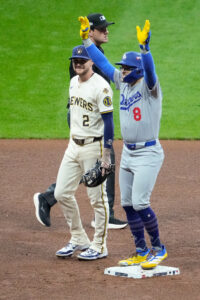
The 34-year-old Hernández is coming off a .203/.255/.366 showing across 256 regular season plate appearances. He popped 10 home runs in 93 games but struck out at a career-high 26.6% clip. Since returning to L.A. at the 2023 trade deadline, he’s a .228/.279/.382 hitter in a little over 800 trips to the plate. His .220/.278/.393 line against left-handed pitching is well below what he did against southpaws earlier in his career.
Hernández does have a strong postseason track record, compiling an .826 OPS over 103 games in October. That didn’t really materialize last season, when he hit .250/.290/.359 with one homer in 69 plate appearances. He nevertheless clearly had the trust of skipper Dave Roberts, who penciled Hernández into the lineup for every game of their World Series run. He played mostly left field as the Dodgers lost faith in the slumping Andy Pages. That ended in triumph with the third World Series of his career, as he was also part of the 2020 and ’24 clubs.
There’s no room in the starting lineup entering the season. They signed Kyle Tucker to play right field, pushing Teoscar Hernández to left. Kiké Hernández can take some center field reps but hasn’t been a regular there since 2022. That’ll probably fall to Pages and potentially Tommy Edman, depending on how the Dodgers feel about him covering a lot of ground coming off ankle surgery. Hernández will be available off the bench and can take a few at-bats from Max Muncy at third base against left-handed pitching. He’ll offer a more defensively minded alternative to Teoscar Hernández as a late-game substitute.
Hernández and Miguel Rojas are locks for bench roles, as is a backup catcher (very likely Dalton Rushing). That’d leave one spot which will probably go to Hyeseong Kim if Edman is ready for Opening Day. Should Edman require an IL stint, Kim will draw in at second base and there’d be one spot available for Alex Call, Ryan Ward or Alex Freeland.
The Dodgers are taxed at a 110% rate as third-time payor with a CBT number above $304MM. RosterResource calculates their luxury tax payroll above $400MM. The Hernández signing will cost them $9.45MM between his salary and the accompanying $4.95MM tax bill.
Image courtesy of Michael McLoone, Imagn Images.
Dodgers Re-Sign Evan Phillips, Designate Ben Rortvedt
The Dodgers announced Wednesday that they’ve re-signed reliever Evan Phillips to a one-year deal worth $6.5MM. Catcher Ben Rortvedt was designated for assignment to open a spot on the 40-man roster. Phillips, a client of Apex Baseball, was non-tendered by the Dodgers in November after undergoing Tommy John surgery late last May but will return on a new one-year deal.
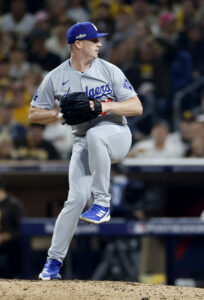
Phillips, 31, came to the Dodgers via a 2021 waiver claim out of the Rays organization. He pitched well enough down the stretch in ’21 to stick on the roster throughout that offseason, but Phillips didn’t immediately look like a waiver heist in the initial months following his claim.
That changed in 2022. A then-27-year-old Phillips erupted for 63 innings with a microscopic 1.14 ERA. He set down 33% of opponents on strikes and walked only 6.4% of the batters he faced, averaging better than 96 mph on his four-seamer and sinker alike. Phillips picked up 19 holds that year, but by 2023 he’d stepped into the closer’s role in L.A. — a job he handled with aplomb. Phillips turned in another dominant season, recording a 2.05 ERA with 24 saves, six holds, a 28.2% strikeout rate and a 5.6% walk rate.
For three full seasons from 2022-24, Phillips was a wipeout late-inning reliever. He combined for a 2.21 ERA with 44 saves, 34 holds and only nine blown saves, whiffing 29.6% of opponents with a 6.5% walk rate. His 2025 campaign got out to a strong start as well, with 5 2/3 shutout frames and six strikeouts. Phillips hit the injured list early in the year, however, and by late May the team announced that he’d require a Tommy John procedure, sidelining him for what’ll likely be 13 to 14 months.
Phillips figures to aim for a return around the All-Star break, give or take a couple weeks. If he’s able to do so, he’ll be a prominent midseason boon to the bullpen — effectively the same as picking up a prominent reliever ahead of the trade deadline. There’s risk in any pitcher coming back from major surgery, but if it works out, he’ll be healthy for October, which has been the Dodgers’ primary concern (relative to the regular season) with all their higher-end pitchers in recent seasons.
The Dodgers are an annual luxury tax payor and are well into the top bracket of penalization. Phillips will come with the maximum 110% tax on his salary, meaning he’ll cost the Dodgers $13.65MM overall. It’s a steep price to pay, particularly relative to the risk, but the Dodgers’ spending knows virtually no bounds.
As for Rortvedt, he’ll likely head back to the waiver wire on the heels of his latest DFA. He ended the season on the Dodgers’ 40-man roster and quickly inked a $1.25MM deal to avoid arbitration. The Dodgers then placed him on waivers, hoping he’d clear and could then be stashed in Triple-A Oklahoma City as upper-level depth. Ideally, the $1.25MM salary would’ve dissuaded other clubs from claiming him while also giving Rortvedt a reason to accept the minor league assignment; he has enough service time to reject an outright in favor of free agency but not enough to do so while retaining his guaranteed salary.
The Reds scooped Rortvedt up anyhow and carried him on the 40-man roster for much of the offseason. When he was designated for assignment earlier this month, the Dodgers placed a claim to bring Rortvedt back to the organization. They’ll now hope to pass him through waivers, as they initially planned.
It’s easy to see why clubs would be happy to have the out-of-options Rortvedt in the upper minors but might be wary of carrying him on the big league roster. He’s a plus defender behind the plate whose keen eye typically lends itself to strong walk rates. Rortvedt is strikeout-prone and consistently hits for a low average, however, and he has little in the way of in-game power. He’s a career .190/.279/.270 hitter in 633 MLB plate appearances and a .239/.328/.412 hitter in 574 Triple-A plate appearances.
The Dodgers can trade Rortvedt or place him on waivers at any point within the next five days. Waivers are a 48-hour process, so his DFA will be resolved within a maximum of one week.
Dodgers Sign Seby Zavala, Jordan Weems To Minor League Deals
The Dodgers announced their full slate of 32 non-roster invitees to Spring Training. The majority of the group are from the farm system or playing on minor league contracts that had already been reported, but the team revealed a couple unknown names who evidently signed minor league deals. Catcher Seby Zavala and reliever Jordan Weems are among those in camp, according to the team.
Weems, 33, is a righty who has pitched in MLB in six consecutive seasons. He was limited to four appearances with the Astros last year, allowing seven runs across 4 1/3 innings. That brought his career earned run average to 5.51 over 160 frames. Weems spent the majority of the season between the Triple-A clubs of the Astros and Braves, pitching to a 4.44 ERA in 46 2/3 innings. He struck out a solid 24% of batters faced with an elevated 11.2% walk rate.
Zavala is a right-handed hitting catcher who joins Chuckie Robinson as non-roster backstops who have MLB experience. The 32-year-old is a glove-only depth type who owns a .205/.271/.342 line in 194 career games. Zavala spent last season in Triple-A with the Red Sox, limping to a .164/.273/.333 line while striking out 36% of the time.
The Dodgers recently re-claimed Ben Rortvedt from Cincinnati. He’s out of options and trying to win the backup job behind Will Smith, though second-year player Dalton Rushing enters camp as the favorite for that spot. There’s a decent chance the Dodgers lose Rortvedt again if he doesn’t break camp and needs to go on waivers, which would leave Zavala and Robinson as their most experienced third catching options.
Also receiving non-roster invites are relievers Wyatt Mills, Carlos Duran and Antoine Kelly. Mills, who posted a 6.21 ERA in 38 appearances with the Mariners and Royals between 2021-22, signed a minor league deal last August but was assigned to the complex and did not pitch in an affiliated game. He remains in the organization, as does former #2 overall pick Nick Senzel. The infielder signed a minor league contract last May and hit .252/.341/.408 at Triple-A Oklahoma City. It seems that was a two-year minor league deal, as Senzel did not elect free agency at season’s end and will be in camp.
Duran and Kelly were early offseason signees. They’re power arms who’ll serve as bullpen depth. Duran spent the majority of his career in the L.A. system but was traded to the A’s last April for Esteury Ruiz. He made his MLB debut with the A’s last May but gave up three runs to the Angels while recording one out. The 6’7″ righty walked almost 19% of Triple-A opponents last year. Kelly is a 6’5″ lefty with a 96-97 MPH heater but untenable command. He walked 14% of batters faced while posting a 5.63 ERA in 34 games for the Rockies’ top affiliate a year ago.
Dodgers Hire Michael Hermosillo, David Dahl As Minor League Coaches
The Dodgers announced their minor league coaching staffs on Thursday, with two recently-retired MLB players joining the ranks. David Dahl is joining the Triple-A Oklahoma City staff as an outfield coach and assistant hitting coach, while Michael Hermosillo will be an outfield and baserunning coach for the high-A ball Great Lakes Loons.
In Hermosillo’s case, the news seems to act as a retirement announcement for the former outfielder, who just turned 31 last month. Hermosillo hasn’t played anywhere since suiting up in the Mexican Winter League during the 2023-24 offseason, and his last taste of affiliated ball came in the form of 66 games with the Yankees’ Triple-A affiliate in 2023.
A 28th-round pick for the Angels in the 2013 draft, Hermosillo spent his first three (2018-20) big league seasons in a Halos uniform. The Angels outrighted Hermosillo following the 2020 campaign, and after signing with the Cubs, Hermosillo made 47 appearances for Chicago over the next two seasons. All in all, Hermosillo hit .167/.268/.283 over 229 Major League plate appearances.
While not considered a top prospect during his time in the minors, Hermosillo got himself onto the radar with some strong numbers on the farm, including a .262/.355/.492 slash line, 56 home runs, and 42 steals (in 59 tries) over 1194 PA at the Triple-A level. Between his speed and all-fields ability in the outfield, Hermosillo seems well-suited to impart his wisdom with the next generation of Dodgers prospects. We at MLB Trade Rumors congratulate Hermosillo on his career achievements, and we wish him in the best in his coaching endeavors.
Dahl announced his retirement in December, officially closing the door on a career that included seven MLB seasons and an All-Star nod in 2019 during his time with the Rockies. This coaching gig is Dahl’s second stint in the Dodgers organization, as he signed a minor league deal with the team in June 2023 that didn’t result in any big league playing time, but Dahl did play in 54 games with Oklahoma City.
Dodgers Designate Anthony Banda For Assignment
The Dodgers announced that they have designated left-hander Anthony Banda for assignment. That’s the corresponding move for their claim of catcher Ben Rortvedt, a move that was previously reported.
It’s a little bit of a surprise to see Banda losing his roster spot. He’s been a serviceable member of the Dodger bullpen for a couple of years now, even making multiple playoff appearances over the past two years. The Dodgers also tendered him a contract for 2026, agreeing to a $1.625MM salary last month.
But there were also some worrying trends in his 2025 performance. In 2024, he had given the Dodgers 49 2/3 innings with a 3.08 earned run average, 23.9% strikeout rate, 8.6% walk rate and 44.4% ground ball rate.
His ERA mostly held steady last year, climbing marginally to 3.18, but with more concern under the hood. His strikeout rate dropped to 22.8%. His walk rate shot up to 12.7%. He only induced grounders on 39.4% of balls in play. His ERA would have climbed more if not for a .227 batting average on balls in play and 83.1% strand rate, both very fortunate numbers. His 4.52 FIP and 4.39 SIERA suggested he deserved far worse. He then got lit up in the playoffs, allowing six earned runs in 5 2/3 innings.
The Dodgers also have plenty of other lefty options. Banda probably wouldn’t have pitched in the playoffs so much if not for Tanner Scott and Alex Vesia being unavailable, Scott due to injury and Vesia due to a family matter. Both Scott and Vesia are expected to be back next year. The Dodgers have also seen young guys like Jack Dreyer and Justin Wrobleski take steps forward.
On top of Banda’s performance and the other lefties on hand, Banda is also out of options, which surely helped nudge him off the roster. The Dodgers tendering him a contract perhaps suggests they are hoping to pass him through waivers unclaimed, which would therefore allow them to keep him as non-roster depth.
It wouldn’t be the first time they tried that this winter. They signed Ben Rortvedt and Andy Ibáñez to modest deals of just over $1MM then later put both on waivers, seemingly hoping that no other club would take on the modest salaries. It didn’t work in either case. Rortvedt was claimed by the Reds in November, though the Dodgers claimed him back today. Also earlier today, Ibáñez was claimed by the Athletics.
It seems likely that Banda would be claimed as well, despite his shaky 2025. He has some major league success and the salary is not massive. He could also be retained via arbitration for the 2027 season by any acquiring club. Given the weak bullpens of some clubs around the league, especially the rebuilding ones, it seems unlikely that 29 clubs would pass on him.
DFA limbo can last as long as a week. The waiver process takes 48 hours, so the Dodgers could take five days to field trade interest. If the interest is decent enough, perhaps they can find a club willing to part with some cash considerations or a lottery-ticket prospect. If they plan to put him on waivers, they should probably do so sooner rather than later. The 60-day injured list opens up next week, which will give most clubs some extra roster flexibility for moves such as waiver claims.
Photo courtesy of Jayne Kamin-Oncea, Imagn Images
Dodgers Claim Ben Rortvedt
The Reds announced that catcher Ben Rortvedt has been claimed off waivers by the Dodgers. Cincinnati designated him for assignment when they signed Eugenio Suárez earlier this week. The Dodgers have a full 40-man roster and will need to open a spot for Rortvedt.
The Dodgers clearly like Rortvedt as a depth catcher. They acquired him at last year’s deadline and he got some playing time down the stretch when Will Smith was hurt. After the season, he and the Dodgers avoided arbitration by agreeing to a $1.25MM salary for 2026.
They then tried to sneak him through waivers, hoping that the salary would be enough to make other clubs pass, therefore allowing Rortvedt be in the minors as non-roster depth. They tried a similar move with infielder Andy Ibáñez, signing him to a $1.2MM deal and then putting him on the wire. It didn’t work in either case. The Reds claimed Rortvedt in November and the Athletics claimed Ibáñez today.
The Dodgers are taking this chance to bring Rortvedt back again. For now, he appears to be the clear #3 catcher behind Smith and Dalton Rushing. They could option Rushing to the minors but seemingly don’t think he has anything left to prove there, which is why they called him up last year and moved on from Austin Barnes.
Assuming Rortvedt is indeed third on the chart, he could be bound for the waiver wire again in the future. He is out of options and would have to be nudged off the 40-man if he’s not going to be on the active roster.
Time will tell how that plays out. For now, he’s back with the champs. His performance has been up and down in recent years. With the Rays in 2024, he posted a .228/.317/.303 line in 328 plate appearances. His 87 wRC+ indicated he was 13% below league average but that’s not bad for a part-time catcher. Thanks to some solid defense, FanGraphs credited him with 1.4 wins above replacement in that role.
Things turned sour in 2025. He slashed .095/.186/.111 and got outrighted to the minors. As mentioned, he was traded to the Dodgers and got some time filling in for Smith. In his 58 plate appearances, he hit .224/.309/.327, somewhat similar to his 2024 production. Teams clearly view him as a useful depth catcher but what remains to be seen is if he can hold onto a roster spot or if he can be passed through waivers.
Photo courtesy of Jayne Kamin-Oncea, Imagn Images
Athletics Claim Andy Ibañez
The A’s have claimed infielder/outfielder Andy Ibañez off waivers from the Dodgers, Francys Romero of BeisbolFR reports. Los Angeles signed Ibañez to a one-year, $1.2MM deal last month and then tried to pass him through waivers in order to stash him in Triple-A as a depth option. Instead, the A’s will pick up that $1.2MM bill and add the versatile lefty masher to their infield mix.
Ibañez, 32, is out of minor league options, so when the Dodgers signed him to a low-cost deal despite a crowded infield/bench group, it always seemed possible that they could try to sneak him through outright waivers to keep him as non-roster depth. Ibañez doesn’t have the service time needed to reject an outright assignment in favor of free agency and retain any guaranteed money on his contract, so if he’d passed through waivers he would surely have accepted the assignment.
That won’t be the case. He’ll now head north to West Sacramento and call the Athletics’ hitter-friendly temporary digs at Sutter Health Park his home park. The A’s don’t have a clear answer at third base, so Ibañez will compete for at-bats there while also providing a credible backup around the diamond.
In parts of five major league seasons, Ibañez is a .254/.304/.389 hitter. That includes sub-par work in right-on-right situations, but he’s feasted on lefties, hitting them at a .280/.372/.452 clip. He’ll compete with Darell Hernaiz, Brett Harris, Max Schuemann and (the other) Max Muncy for time at third base, but Ibañez has 5300 professional innings at second base, 724 at first base, 242 at shortstop and 186 in the outfield corners. He’s also the only member of that group of infield candidates who is out of minor league options, so he’s very likely to crack the Athletics’ Opening Day roster.
It’s still possible the A’s will make another move to bring in a third baseman. They had an agreement in place to acquire Nolan Arenado from the Cardinals, but Arenado (who had a full no-trade clause) preferred to go to the D-backs, with whom St. Louis had also been negotiating. There aren’t many third base options left on the market, but someone like Luis Rengifo might feel Sutter Health Park is a good place to try to rebound. The trade market also still has a few viable options (e.g. Mark Vientos, Alec Bohm), and any number of less-proven names could find themselves on waivers this spring as teams make final tweaks to their rosters.
Ibañez has 3.133 years of major league service time, making him controllable via arbitration for another three seasons. He’ll need to rebound from last year’s down showing at the plate for the A’s to keep him around long term, but he’s landed in a better hitters’ environment with a club that has a clearer path to playing time than he’d have had in Los Angeles.
David Peralta Announces Retirement
Longtime Diamondbacks outfielder David Peralta is formally retiring from baseball. He provided a statement to MLBTR announcing the news:
“I want to formally announce my retirement from baseball. I want to thank God for all of the blessings he has given me, for giving me the best parents and sisters who always supported me. For my wonderful wife and beautiful kids who were always with me and supported me unconditionally. Thank you to the Arizona Diamondbacks organization for making my dreams come true, believing in me and giving me the opportunity to play the best baseball in the world — MLB. I also want to thank all of the other organizations that were a part of my career; Tampa Bay Rays, Los Angeles Dodgers and San Diego Padres. Thank you to Dave McKay for making me a Gold Glover, and thank you to Jose Amado for making me a Silver Slugger. And of course, thank you to all of the fans were always so special with me.
It was a lot of years of hard work, dedication and discipline, and I can now say with my head up that ‘I did it.’ The Freight Train has reached his final destination — HOME. Thank you baseball!”
Peralta took a winding road to what would prove to be a very productive career. He signed with the Cardinals as a left-handed pitcher out of his native Venezuela in 2004. Control issues and a pair of shoulder surgeries prevented him from getting out of rookie ball. By the time St. Louis released him, he was 21 years old and hadn’t made it to Low-A.
Peralta went into the independent ranks and reinvented himself as a hitter. It was a career-changing transition. He raked against indie ball pitching for two seasons, intriguing the Diamondbacks enough that they purchased his contract midway through the 2013 campaign. He remained on a tear in High-A and made the jump to Double-A the following season. By the middle of June, the Snakes had pushed him all the way to the big leagues. He hit .286/.320/.450 over 88 games and went into the next year as an everyday player.
Peralta’s first full MLB season was arguably the best of a strong career. He slashed .312/.371/.522 while connecting on 26 doubles, 10 triples, and 17 home runs. Peralta worked alongside AJ Pollock and Ender Inciarte in what was quietly one of the best outfields in the league. The D-Backs traded Inciarte the following offseason in the ill-fated Shelby Miller deal, while Peralta battled injuries and was limited to 48 games in 2016.
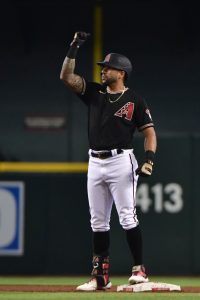
Peralta rebounded to hit .293 in consecutive seasons after that, helping the D-Backs to a playoff berth in the first of those years. He connected on 30 home runs in 2018, setting career marks in both homers and RBI (87). Peralta was one of four National League outfielders with 30+ homers and ranked sixth among the group with an .868 OPS. He was named a Silver Slugger alongside Christian Yelich and Nick Markakis.
The 2019 season saw Peralta earn the award on the other side of the ball. He led NL left fielders with +9 Defensive Runs Saved en route to a Gold Glove. He turned in a second straight season with an OPS above .800 as well, batting .275/.343/.461 with 29 doubles before undergoing season-ending shoulder surgery. His production began to trend down after that, although he hit .300 during the shortened 2020 season for the second time of his career.
Arizona signed Peralta to a three-year, $22MM extension in advance of what would have been his walk year in 2020. That kept him in the desert for an extra season and a half, but the team’s underperformance led to him being on the trade block by the ’22 deadline. The Snakes traded him to the Rays in advance of his hitting free agency for the first time.
Peralta finished his career back in the NL West. He signed a one-year contract with the Dodgers in 2023 and spent the final four months of the ’24 season on the Padres roster after signing a minor league deal. Although he was more of a complementary player by that point, he finished his career with a respectable .267/.335/.415 showing over 91 games for San Diego. Getting back to the majors that year also got him to the 10-year service milestone.
His teams made the postseason each year from 2022-24. Peralta went 4-for-13 with a homer off Jack Flaherty in a five-game NLDS loss to the Dodgers in what would be his final major league action. He didn’t sign for the 2025 season, although he made a brief comeback in the Venezuelan Winter League this year.
The left-handed hitter finishes his career with a .278/.335/.448 batting line. He hit 125 home runs and topped 500 runs scored and RBI apiece. Peralta tallied 1166 hits and twice led the National League in triples. FanGraphs and Baseball Reference each credited him with roughly 17 wins above replacement, while B-Ref calculates his career earnings north of $40MM.
Peralta is one of the most successful indie ball signees ever, and he’s among the better players in Arizona’s 28-year team history. He trails only Luis Gonzalez, Paul Goldschmidt and Ketel Marte in games and hits in a D-Backs uniform, while he ranks among the top 10 in homers, RBI, and WAR among position players. Congratulations to Peralta on a fine career and all the best in his post-playing days.
Image courtesy of Imagn Images.
Dodgers Claim Michael Siani, Designate Andy Ibanez
The Dodgers announced Tuesday that they’ve claimed outfielder Michael Siani off waivers from the Yankees. Infielder Andy Ibanez, who just signed a one-year $1.2MM deal with L.A. earlier in the offseason, has been designated for assignment to open a roster spot. As is relatively common around the league, they’ll now hope that guaranteed salary helps sneak Ibanez through waivers unclaimed, so he can be stashed in Triple-A as a depth piece.
To call the 2025-26 offseason a whirlwind for Siani, an over-slot fourth-round pick of the Reds back in 2018, would be an understatement. He began the offseason as a Cardinals but has since bounced to the Braves, Dodgers, Yankees and now back to the Dodgers via a series of DFAs and waiver claims.
With pitchers and catchers slated to report to spring training next week, Siani could finally have a path to stick on a 40-man roster. Once camp opens, teams will be able to place injured players on the 60-day IL, even if it’s not with the Dodgers. Los Angeles could need a 60-day spot for Brock Stewart, depending on his recovery from September shoulder surgery. That could give him a little bit of cushion, but if L.A. needs to open a 40-man spot and once again designates him, Siani could land with another team that has more 60-day IL candidates and thus more flexibility to keep him on the 40-man.
Siani, 26, has spent his entire big league career with the Reds and Cardinals. In parts of four major league seasons, he carries a tepid .221/.277/.270 batting line (58 wRC+). However, he’s drawn excellent grades for his defense and baserunning. He’s played 1014 major league innings in the outfield — primarily in center but with fleeting corner appearances mixed in — and been credited with outstanding marks from Statcast’s Outs Above Average (16) and from Defensive Runs Saved (7). He’s also gone 21-for-26 in stolen base attempts, giving him a success rate of nearly 81%.
Siani has a minor league option remaining, which helps to explain why teams continue to claim him; if he ever makes it to the season with one club, he’s a nice fourth or fifth outfielder who can be stashed in the minors without needing to pass through waivers.
The 32-year-old Ibanez signed a major league deal in mid-January. It’s rare to see a player sign as a free agent and then be designated for assignment three weeks later, but since he’s out of options and signed a low-cost deal, Ibanez always felt like a candidate for this sort of move. Other clubs might be reluctant to claim him when he’s making more than the league minimum and rosters around the game are generally at capacity. If he clears waivers, he’d have the right to reject a minor league assignment in favor of free agency, but doing so would mean forfeiting the remainder of any guaranteed money, so he’d surely accept.
Ibanez has played in parts of five major league seasons, all as a Ranger or Tiger. He’s a .254/.304/.389 hitter overall but a .280/.372/.452 hitter against left-handed pitching, specifically. Add in that he can capably handle first base, second base, third base or left field, and he’s a nice bench piece for a contender (particularly if he can be stashed as Triple-A depth). Ibanez did have a down season in 2025, even against left-handed pitching, slashing a roughly average .258/.311/.403 when holding the platoon advantage.
Since he signed as a free agent on a major league deal, Ibanez can’t be traded without his consent before June 15. He’ll very likely be placed on waivers at some point within the next five days, at which point he’d go through a 48-hour waiting period before learning whether he was claimed by another club or outrighted to Triple-A Oklahoma City.
Players Who Could Move To The 60-Day IL Once Spring Training Begins
Most of the clubs in the league currently have a full 40-man roster, which means that just about every transaction requires a corresponding move. Some extra roster flexibility is on the way, however. The 60-day injured list goes away five days after the World Series but comes back when pitchers and catchers report to spring training.
Most clubs have a slightly earlier report date this year due to the World Baseball Classic. Last year, the Cubs and Dodgers had earlier report dates because they were had an earlier Opening Day than everyone else as part of the Tokyo Series. Gavin Stone was the first player to land on the 60-day IL in 2025, landing there on February 11th. According to MLB.com, every club has a report date from February 10th to 13th this year.
It’s worth pointing out that the 60 days don’t start being counted until Opening Day. Although a team can transfer a player to the 60-day IL quite soon, they will likely only do so if they aren’t expecting the player back until late May or beyond. A team also must have a full 40-man roster in order to move a player to the 60-day IL.
There are still plenty of free agents still out there, including big names like Framber Valdez, Zac Gallen, Justin Verlander, Chris Bassitt, Lucas Giolito, and more. Perhaps the extra roster flexibility will spur some deals to come together. It could also increase the ability of some clubs to make waiver claims or small trades for players who have been designated for assignment. If a team wants to pass a player through waivers, perhaps they will try to do so in the near future before the extra roster flexibility opens up.
Here are some players who are expected to miss some significant time or who have uncertain recovery timelines from 2025 injuries.
Angels: Anthony Rendon, Ben Joyce
Rendon’s situation is unique. He underwent hip surgery a year ago and missed the entire 2025 season. He is still on the roster and signed through 2026. He and the club have agreed to a salary-deferment plan and he is not expected to be in spring training with the club. His recovery timeline is unclear, but general manager Perry Minasian said earlier this month that Rendon would be “rehabbing at home,” per Alden González of ESPN. If they were going to release him, they likely would have done so by now, so he seems destined for the injured list.
Joyce underwent shoulder surgery in May and missed the remainder of the 2025 season. His current status is unclear. In August, he told Jeff Fletcher of the Orange County Register that he didn’t know if he would be ready for spring training. He would only land on the 60-day IL if the Halos don’t expect him back before the end of May.
Astros: Hayden Wesneski, Ronel Blanco, Brandon Walter
All three of these pitchers underwent Tommy John surgery in 2025. Wesneski was first, with his surgery taking place on May 23rd. Blanco followed shortly thereafter in early June. They will likely be targeting returns in the second half. Walter’s procedure was in September, meaning he will likely miss the entire season. All three should be on the 60-day IL as soon as Houston needs roster spots for other transactions.
Athletics: Zack Gelof
Gelof underwent surgery to repair a dislocated shoulder in September, with the expectation of him potentially being healthy for spring training. At the end of December, general manager David Forst told Martín Gallegos of MLB.com that Gelof would be “a little bit behind” in spring. He would only land on the 60-day IL if the A’s think he’ll be out through late May.
Blue Jays: Jake Bloss
Bloss underwent surgery on the ulnar collateral ligament in his elbow in May. He was on optional assignment at the time and stayed in the minors for the rest of the season. Going into 2026, the Jays could keep him in the minors but they could also call him up and place him on the major league IL. Doing so would open up a roster spot but would also mean giving Bloss big league pay and service time.
Braves: Ha-Seong Kim, AJ Smith-Shawver, Danny Young, Joe Jiménez
Kim recently fell on some ice and injured his hand. He underwent surgery last week, and the expected recovery time is four to five months. The shorter end of that window only goes to mid-May, so perhaps Atlanta will hold off on making a decision until they watch his recovery, especially since they have other guys with clearer injury timelines.
Smith-Shawver underwent Tommy John surgery in June, so he shouldn’t be back until the second half and is therefore a lock for the 60-day IL once Atlanta needs a spot. Young underwent the same procedure in May, so he should also be bound for the IL.
Jimenez is more of a question mark. He missed the 2025 season due to left knee surgery. He required a “cleanup” procedure on that knee towards the end of the season. His timeline isn’t currently clear.
Brewers: None.
Cardinals: None.
Cubs: Justin Steele
Steele will probably be a bit of a borderline case. He underwent UCL surgery in April but it wasn’t a full Tommy John surgery. The Cubs described it as a “revision repair”. Steele had undergone Tommy John in 2017 as a minor leaguer.
Since Steele’s more recent procedure was a bit less serious than a full Tommy John, the club gave an estimated return timeline of about one year, putting him in line to potentially return fairly early in 2026. Given his importance to the Cubs, they would only put him on the 60-day IL if his timeline changes and he’s certain to be out through late May.
Diamondbacks: Corbin Burnes, Lourdes Gurriel Jr., A.J. Puk, Justin Martínez, Blake Walston, Tyler Locklear
The Snakes were hit hard by the injury bug in 2025. Burnes, Walston and Martínez all underwent Tommy John surgery. Burnes and Martínez had their procedures in June, so they should be targeting second-half returns and be easy calls for the 60-day IL. Walston would be a bit more borderline because his surgery was around Opening Day in late March last year. Puk had the slightly less significant internal brace procedure in June, so he could also be a borderline case.
Turning to the position players, Gurriel tore the anterior cruciate ligament in his right knee in September. He required surgery which came with a return timeline of nine to ten months, so he should be out until around the All-Star break.
Locklear should be back sooner. He underwent surgery in October to address a ligament tear in his elbow and a labrum injury in his shoulder. The hope at the time of that procedure was that he would be game ready to go on a rehab assignment around Opening Day and would therefore miss only about the first month. He would therefore only hit the 60-day IL if he doesn’t meet that timeline for some reason.
Dodgers: Brock Stewart
Stewart underwent shoulder debridement surgery in September. His timeline for 2026 isn’t especially clear. He will likely start the season on the IL but it’s unclear if he’ll be out long enough to warrant landing on the 60-day version.
Giants: Randy Rodríguez, Jason Foley
Rodríguez underwent Tommy John surgery in September, so he’s a lock for the 60-day IL and might even miss the entire 2026 campaign. Foley’s status is a bit more murky. He underwent shoulder surgery in May while with the Tigers. Detroit non-tendered him at season’s end, which allowed the Giants to sign him. He is expected back at some point mid-season. The Giants may want to get more clarity on his progress during camp before deciding on a move to the IL.
Guardians: Andrew Walters, David Fry
Neither of these guys is a lock for the 60-day IL. Walters had surgery to repair his right lat tendon in June with a recovery estimate of eight to ten months. Fry underwent surgery in October due to a deviated septum and a fractured nose suffered when a Tarik Skubal pitch hit him in the face. His timeline is unclear. It’s possible one or both could be healthy by Opening Day, so relevant updates may be forthcoming when camps open.
Mariners: Logan Evans
Evans required UCL surgery just last week and will miss the entire 2026 season. He was on optional assignment at the end of 2025, so the Mariners could keep him in the minors. Calling him up and putting him on the big league 60-day IL would open up a 40-man spot but would also involve Evans receiving big league pay and service time for the year.
Marlins: Ronny Henriquez
Henriquez underwent internal brace surgery in December and will miss the entire 2026 season, so he’s a lock for the 60-day IL.
Mets: Tylor Megill, Reed Garrett, Dedniel Núñez
All three of these pitchers underwent Tommy John surgery late in 2025 and are likely to miss the entire 2026 season, making them locks for the 60-day IL. Núñez went under the knife in July, followed by Megill in September and Garrett in October.
Nationals: Trevor Williams, DJ Herz
Williams underwent internal brace surgery in July. That’s a slightly less serious variation of Tommy John but still usually requires about a year of recovery. Herz underwent a full Tommy John procedure in April. Since that surgery usually requires 14 months or longer to come back, both pitchers are likely out until around the All-Star break and therefore bound for the 60-day IL once the Nats need some roster spots.
Orioles: Félix Bautista
Bautista underwent shoulder surgery in August, and the club announced his recovery timeline as 12 months. He’s a lock for the 60-day IL and may miss the entire season if his recovery doesn’t go smoothly.
Padres: Yu Darvish, Jhony Brito, Jason Adam
Darvish underwent UCL surgery in November and will miss the entire 2026 season. Instead of going on the IL, he may just retire, but it seems there are some contractual complications to be ironed out since he is signed through 2028.
Brito and Adam could be borderline cases. Brito underwent internal brace surgery in May of last year. Some pitchers can return from that procedure in about a year. Adam ruptured a tendon in his left quad in early September. In November, he seemed to acknowledge that he wouldn’t be ready for Opening Day. As of now, a trip to the 60-day IL seems unlikely unless he suffers a setback.
Pirates: Jared Jones
Jones required UCL surgery on May 21st of last year. The Bucs announced an expected return timeline of 10 to 12 months. The shorter end of that window would allow Jones to return fairly early in 2026. If it looks like he’ll be on the longer end of that time frame, he could wind up on the 60-day IL.
Phillies: Zack Wheeler
Wheeler underwent surgery to address thoracic outlet syndrome in September, with a timeline of six to eight months. As of now, it seems unlikely Wheeler would require a trip to the 60-day IL, but it depends on how his ramp-up goes. He’s also approaching his 36th birthday, and the Phils could slow-play his recovery.
Rangers: Cody Bradford
Bradford required internal brace surgery in late June of last year. He recently said he’s targeting a return in May. That’s a pretty aggressive timeline, but perhaps the Rangers will delay moving him to the 60-day IL until that plan is strictly ruled out.
Rays: Manuel Rodríguez
Rodriguez underwent flexor tendon surgery in July of last year and is targeting a return in June of this year, so he should be a lock for the 60-day IL.
Reds: Brandon Williamson, Julian Aguiar
Both of these pitchers required Tommy John surgeries late in 2024, Williamson in September and Aguiar in October. They each missed the entire 2025 season. Presumably, they are recovered by now and could be healthy going into 2026, but there haven’t been any recent public updates.
Red Sox: Tanner Houck, Triston Casas
Houck is the most clear-cut case for Boston. He had Tommy John surgery in August of 2025 and will miss most or perhaps all of the 2026 season. Casas is more borderline. He’s still recovering from a ruptured left patellar tendon suffered in May of last year. It doesn’t seem like he will be ready by Opening Day, but his timeline apart from that is murky.
Rockies: Jeff Criswell, Kris Bryant
Criswell required Tommy John surgery in early March of last year. With the normal 14-month recovery timeline, he could be back in May. Anything slightly longer than that would make him a candidate for the 60-day IL. Bryant’s timeline is very difficult to discern. He has hardly played in recent years due to various injuries and is now dealing with chronic symptoms related to lumbar degenerative disc disease. Updates will likely be provided once camp opens.
Royals: Alec Marsh
Marsh missed 2025 due to shoulder problems and is slated to miss 2026 as well after undergoing labrum surgery in November.
Tigers: Jackson Jobe
Jobe required Tommy John surgery in June of last year. He will miss most or perhaps even all of the 2026 season.
Twins: None.
White Sox: Ky Bush, Drew Thorpe, Prelander Berroa
These three hurlers all required Tommy John surgery about a year ago, Bush in February, followed by Berroa and Thorpe in March. Given the normal 14-month recovery period, any of them could return early in 2026, but they could also end up on the 60-day IL if the timeline pushes slightly beyond that.
Yankees: Clarke Schmidt, Gerrit Cole, Carlos Rodón, Anthony Volpe
Schmidt is the only lock of this group. He required UCL surgery in July of last year and should miss the first half of the 2026 season. Cole is recovering from Tommy John surgery performed in March of last year. His target is expected to be late May/early June, so he has a decent chance to hit the 60-day. However, given his importance to the club, the Yankees probably won’t put him there until it’s certain he won’t be back by the middle of May.
Rodón had surgery in October to remove loose bodies in his elbow. He’s expected to be back with the big league club in late April or early May, so he would only hit the 60-day IL if his timeline is pushed. Volpe required shoulder surgery in October. He’s not expected to be ready by Opening Day, but his timeline beyond that doesn’t seem concrete.
Photo courtesy of Allan Henry, Imagn Images