
Josh Bell’s Turnaround Started Before His Trade To Marlins
The deadline swap that saw the Marlins and Guardians exchange Jean Segura and Josh Bell was generally viewed as an exchange of bad contracts. The Marlins were getting the more productive hitter of the two, though that wasn’t saying much. Bell hit .233/.318/.383 as a member of the Guardians after signing a two-year, $33MM deal in the offseason. Segura hit just .219/.277/.279 with Miami after signing his own two-year deal (worth $17MM) and was immediately released by Cleveland. The Guards used the trade to effectively purchase former first-round pick Kahlil Watson from Miami, who sold low on the former top prospect and took on some cash as a means of adding some life to the lineup.
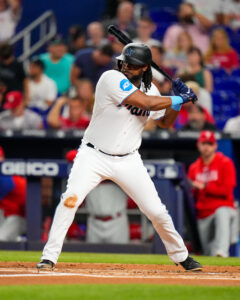
Bell has absolutely exploded in South Florida, however. He turned in below-average offense during his time with Cleveland but has mashed at a .271/.351/.586 pace in a still-small sample of 97 Marlins plate appearances. The eight dingers he’s swatted with the Marlins is already nearly as many as the 11 he totaled in more than quadruple the plate appearances with the Guardians. It’s not as though Bell simply moved to a bandbox either; Miami’s loanDepot Park has been the fourth-worst for home runs over the past three seasons, per Statcast.
The switch-hitting Bell looked wholly unremarkable in more than three months with the Guardians but has not only been one of the National League’s best hitters since the trade — he’s had one of the best months of his entire career. So, what gives? This is perhaps an oversimplification, but the Marlins have succeeded where basically no other club has to date: Bell is finally hitting the ball in the air. A lot. The 45.2% fly-ball rate he’s posted this month is the first month in his entire career that he’s posted a fly-ball rate that high.
The change, however, began well before Bell was traded to Miami. Whether the Marlins keyed in on this or merely jumped at the opportunity to purge Segura’s contract isn’t clear, but the numbers are pretty easy to see. Bell entered the current season with a 50% ground-ball rate in his career and just a 31.9% fly-ball rate — a ridiculous number for a 6’4″, 261-pound first baseman. Bell has never had good speed, and the idea that half of his career batted balls have been beaten into the ground is counterintuitive. He’s far from the only should-be slugger with this type of problem — Eric Hosmer is also a member of this club, for instance — but Bell’s penchant for grounders has regularly undercut his well above-average bat-to-ball skills and what’s clearly above-average or even plus raw power. This is a player who bashed 37 home runs in 2019, after all. Juiced ball or not — that’s a big number.
A look at Bell’s month-to-month splits this year reveals some familiar trends. In April he put a ridiculous 62.3% of his batted balls on the ground, against a 28.6% fly-ball rate. In May, it was 51.6% and 26.6% (with a noted uptick in line drives). If you look in late May, Bell had a stretch of five games where he didn’t hit a single fly-ball. He hit three line drives, and the other 81.8% of his balls in play were grounders. Whether this was a wakeup call or the beginning of Bell trying to make a conscious adjustment, things began to change.
In June, Bell’s fly-ball rate jumped to 37%. In July, it climbed a notch higher, to 38.4%. It’s up to 45.2% in August, and Bell is absolutely mashing. Those might sound like arbitrary numbers, and to some extent they are. However, using that arbitrary 37% cutoff point (his June 2023 fly-ball rate), I scanned back through Bell’s monthly splits for his entire career. He’s only had a monthly fly-ball rate of 37% four times in his career … all coming in 2019, when he hit 37 home runs and posted his career-best .277/.367/.569 batting line.
The results weren’t necessarily there as Bell began elevating the ball more regularly. From May 28 (the first day after that stretch of five games with no fly balls), Bell hit .251/.309/.440. That’s only about seven percent better than league average, by measure of wRC+, but it’s a massive improvement over the .215/.327/.326 slash he produced while pounding an incredible (not in a good way) 59.7% of his batted balls into the ground. At the very least, Bell looked like a hitter on the upswing due to a tangible change in his approach. The Marlins might’ve hoped they were acquiring that somewhat above-average hitter, but Bell has been much, much more than that in Miami. He’s been 50% better than the league-average hitter since being traded.
Of course, it’s an open question whether Bell can sustain this pace. He had four months of fly-ball production in 2019 and then quickly reverted back to the grounder-happy plodder who has often looked on the cusp of stardom but never sustained his pace. It’s encouraging, however, that he’s reeled off three straight months of this fly-ball approach. Even in his career year in 2019, he still posted a 46% grounder rate from July through August. This year, in that same span, he’s at 39.7%. This current stretch is the least grounder-driven span of Bell’s career.
Bell spoke to Craig Mish and Barry Jackson of the Miami Herald about his surge at the plate in Miami, attributing plenty of the success to the manner in which hitting coach Brant Brown preps for games with hitters.
“We watch video together and decide there how the attack plan is going to go and I can work on that in batting practice and it tends to show up in the games,” said Bell, who called Brown’s prep work with Marlins hitters “advanced.” Bell also spoke favorably of loanDepot Park, noting that while the dimensions are pitcher-friendly, the consistency from playing in a stadium with a roof can be advantageous. “With the turf, and with the consistency of the dome, you’ve got the same lighting every inning, every at-bat, and it’s easy to get hits.”
Bell noted to the Herald that his focus has been simply on hitting line drives, but it seems those efforts have translated more into fly balls than the intended liners. His 12.9% line-drive rate with the Fish is actually lower than it was in Cleveland (19%) by a wide margin. Bell is simply elevating the ball at a strong, albeit not elite rate. His 45.2% fly rate since the trade ranks 35th of 173 hitters (80th percentile). But Bell is a big man with plenty of power; when he elevates the ball, good things happen.
Bell’s surge has been a boon for the Marlins and also creates a fascinating scenario to watch down the stretch. If he can continue putting the ball in the air close to this frequently and continue to produce at well above-average levels, the player option he once looked like a lock to exercise could become a borderline call — or, with a strong enough finish, a relatively easy one to decline. The upcoming free agent class is light on hitters, and Bell is flat out raking thanks to a noticeable change in his batted-ball profile. This version of Bell would fetch far more than $16.5MM in free agency, particularly since he can’t be saddled with a qualifying offer and thus won’t be tied to draft pick compensation.
If Bell does decline his player option, it’d wind up looking like a rather deft swap of contracts for the Marlins; at the time of the swap, Miami was effectively surrendering Watson and paying about $9.25MM ($3.25MM in ’23, $6MM in ’24) to upgrade from Segura to Bell. That sum would drop to just $3.25MM in added salary if Bell opts out — all of it coming in 2023 — and a hefty $10.5MM of savings beyond the current season. The Marlins would be off the hook entirely next year, while the Guards would remain on the hook for Segura’s $8.5MM salary and $2MM buyout on a $10MM club option for 2025. It’s doubtful even Marlins GM Kim Ng and her staff expected Bell to perform this well early on, but their ostensible bet on Bell’s change in approach is already a boost to the team’s playoff hopes and now has the possibility to provide substantial payroll benefit in the future.
Jorge Soler Interested In Extension With Marlins
1:25pm: Mish now tweets that Soler’s agent, Dan Lozano of the MVP Sports Group, tells him there have not yet been any formal extension discussions with the team. Mish adds that Soler is interested in remaining with Miami, however.
11:47am: The Marlins and designated hitter Jorge Soler have held “preliminary” talks about a potential contract extension, Barry Jackson and Craig Mish of the Miami Herald report. Soler’s contract calls for him to earn $12MM next year — a number that’ll soon jump to $13MM when he tallies his 550th plate appearance — but that’s a player option. Soler, unsurprisingly, is likely to decline that player option and return to the open market if a new deal isn’t reached, per the report.
The 31-year-old Soler is in the midst of a rebound season at the plate, having slashed .241/.328/.516 with 35 home runs in 525 trips to the plate. It’s a stark turnaround from the 2022 season — his first in Miami — during which he batted just .207/.295/.400 during an injury-marred campaign. Soler has slightly improved on his walk rate in ’23 (10.7%), and his strikeout rate has fallen from an ugly 29.4% last year to a more manageable 24.6% in 2023.
Soler’s 91 mph average exit velocity (76th percentile), 15.1% barrel rate (93rd percentile) and 47.5% hard-hit rate (82nd percentile) all lend some credence to his rebound effort at the plate. His 35 home runs tie him with Mookie Betts for fifth in the Majors. He’s held his own against right-handed pitching (.229/.310/.458) and absolutely decimated left-handed opponents (.282/.380/.718). As such, teams that have struggled against southpaws could have particular interest in Soler this winter.
Between that success at the plate and a woefully thin class of free-agent position players this winter, it’s only logical that Soler would exercise his right to opt back into free agency. His Herculean run with the Braves following a 2021 trade from Kansas City to Atlanta set the stage for Soler to land his current three-year, $36MM deal in free agency. And while Soler is now a couple years older, of course, his 2023 campaign at the plate has been a more consistent and complete year overall than he had in 2021 (.223/.316/.432 between the Royals and Braves).
One potentially complicating factor this time around would be a qualifying offer. Soler was ineligible to receive a QO last time he reached free agency, due to the fact that he was traded midseason. He’ll spend the entire 2023 season with one team and, as a player who hasn’t previously received a QO, will be eligible for one this winter. The QO value figures to increase from last year’s $19.65MM, likely surpassing $20MM this time around. As is frequently the case, Soler probably won’t match that AAV on a multi-year deal, but he could earn more than double the QO value in guaranteed money on a multi-year deal in free agency.
There will be fewer impact bats available in free agency this offseason than perhaps at any point in recent history. Shohei Ohtani and Cody Bellinger topped the most recent edition of MLBTR’s Free Agent Power Rankings, and Jeimer Candelario is having his third strong season in his past four years.
There’s little in the way of productive, prime-aged hitters reaching the market thereafter. Matt Chapman‘s bat has cooled considerably since a torrid start to the season. Teoscar Hernandez is having his least-productive campaign since 2018. Neither Michael Conforto nor Hunter Renfroe is hitting anywhere close to previous peak levels. Rhys Hoskins tore his ACL in spring training. Justin Turner seems likely to decline his own player option, but he’ll turn 39 this winter. J.D. Martinez is having a strong season but has twice been on the injured list and just turned 36.
Jackson and Mish write that Soler has enjoyed his time in Miami and has interest in working out a longer-term arrangement. That said, between his age and this year’s production, Soler will have a case as one of the more appealing bats on a thin market. Given his proximity to free agency, it seems unlikely he’d take a substantial discount. The Marlins already outbid the field to sign Soler once, when signing him to his current contract, but it’d not yet clear if they’ll be comfortable putting forth another market-value offer when Soler’s stock is presumably higher than it was last time around.
NL East Notes: Robertson, Albies, Nationals
When the Marlins shipped a pair of intriguing young prospects to New York in order to acquire veteran right-hander David Robertson from the Mets, it was a statement of intent to contend by Miami, as they acquired perhaps the top rental reliever available at this year’s trade deadline. It was Robertson’s second time being dealt at the deadline in as many years, as the 38-year-old veteran was swapped from the Cubs to the Phillies in exchange for pitching prospect Ben Brown 13 months ago. Sporting a 2.23 ERA in 40 1/3 innings of work at the time of that deal, Robertson went on to post similarly excellent numbers in Philadelphia with a 2.70 ERA in 22 regular season appearances down the stretch and just one run allowed in his eight postseason appearances as the Phillies headed to the World Series for the first time since 2009.
At the time of this year’s deal, Robertson was having an even better season, with a 2.05 ERA in 44 innings of work with a 27.9% strikeout rate. Unfortunately for the Marlins, he hasn’t been the shutdown closer they were expecting in ten appearances with the club. He’s posted a brutal 7.20 ERA and 6.17 FIP in ten innings since joining Miami, with just four saves in seven chances. Those brutal results have led the Marlins to remove their veteran deadline addition from the closer role entirely, according to Craig Mish of the Miami Herald. Mish suggests Tanner Scott, who sports a 2.59 ERA and 2.12 FIP in 59 innings of work this season, could replace Robertson as the club’s closer moving forward.
The move reflects the dire situation Miami finds itself in after a difficult August; at the time of the Robertson deal, the club was 54-49 and firmly in the mix for one of the NL Wild Card spots. Since then, the Marlins have gone just 12-16, falling to 65-64 and three games back of the third Wild Card spot. While that’s hardly an insurmountable deficit with more than a month to go in the season, the club is facing playoff odds of just 19.4% at this point per Fangraphs, far worse than their 49.3% odds on the day of the Robertson deal.
More from the NL East…
- Braves second baseman Ozzie Albies has been on the 10-day injured list since earlier this month with a hamstring strain, but could already be nearing a return. Justin Toscano of the Atlanta Journal-Constitution relayed an update regarding Albies this evening, indicating that Atlanta will “see just how well he feels” tomorrow after a successful workout this afternoon. When Albies is ready to go, it seems he’ll be activated from the injured list directly, as Toscano notes that manager Brian Snitker has previously indicated the infielder won’t require a rehab assignment before returning to action. Albies, who sports a 121 wRC+ in 510 trips to the plate this season, has been covered for by Nicky Lopez and Vaughn Grissom at the keystone while he’s been on the shelf.
- The Nationals announced this afternoon that the club had optioned outfielder Blake Rutherford to Triple-A. Rutherford, a 26-year-old journeyman and former first-round pick by the Yankees who made his MLB debut with Washington earlier this month, slashed just .182/.206/.182 in 34 trips to the plate with the Nationals prior to his demotion. Rutherford’s demotion sparked rumors regarding who would replace him on the active roster, with both Bobby Blanco and Mark Zuckerman of MASN indicating that the club could look to promote catching prospect Drew Millas. Millas, the club’s 23rd-best prospect per MLB Pipeline, is a defensive-first catcher who has impressed with the bat this season, batting .291/.390/.442 in 328 trips to the plate this season between the Double-A and Triple-A levels.
Marlins Reinstate Tommy Nance, Place Avisaíl García On IL
The Marlins made some roster moves today, per Jordan McPherson of the Miami Herald. Right-hander Tommy Nance has been reinstated from the 60-day injured list and infielder/outfielder Garrett Hampson recalled from Triple-A. In corresponding transactions, outfielder Avisaíl García has been placed on the 10-day IL due to a left hamstring strain and left-hander Ryan Weathers has been optioned. There was already a vacancy on the 40-man roster for Nance’s activation.
Nance, 32, began the season on the injured list due to a strain in his throwing shoulder, an injury that has kept him away from the major league team until today. Now that he’s back, he’ll look to build off a solid showing last year. He tossed 43 2/3 innings for the Marlins, allowing 4.33 earned runs per nine frames. He issued walks at a high rate of 10.7% but also struck out 29.1% of batters faced and kept the ball on the ground at a 46.4% clip.
For Garcia, 32, this continues an incredible frustrating season. He’s only been able to play 37 games this year, missing almost all of the May-July portion of the season due to a back injury. When healthy enough to take the field, he’s hit just .185/.241/.315. It’s the second straight disappointing season for the outfielder since signing a four-year, $53MM contract with the Marlins, as he hit .224/.266/.317 in 2022 while being limited by various injuries to 98 games. He still has another two years and $29MM left on that contract.
Marlins, Jorge Alfaro Agree To Minor League Deal
The Marlins have agreed to a minor league contract with veteran catcher Jorge Alfaro, reports Jordan McPherson of the Miami Herald (Twitter link). The CAA client will return for a second stint with the Fish, having previously spent the 2019-21 seasons in Miami. He’ll be assigned to Triple-A Jacksonville.
Alfaro, 30, originally signed with the Rangers as an amateur out of Colombia but was traded to the Phillies in the Cole Hamels blockbuster and then to the Marlins as part of Miami’s return for J.T. Realmuto. Alfaro logged 876 plate appearances in his three seasons with the Marlins, batting a combined .252/.298/.386 before being traded to the Padres in exchange for cash in Dec. 2021.
The 2023 season has seen Alfaro pinball around the league. Alfaro signed a minor league deal with the Red Sox in January but opted out of that deal in June after a big start to his season in Triple-A. He landed with the Rockies on a new minor league deal but was quickly selected to the Majors, where he hit .161/.188/.387 in a tiny sample of 32 plate appearances. Cut loose by Colorado, Alfaro returned to the Red Sox — this time on a big league deal. He went 2-for-17 and lasted just eight games in Boston before being designated for assignment and again electing free agency.
Now back with the Marlins, Alfaro will serve as some experienced catching depth in the upper minors. He’s never really delivered on his longstanding status as a top prospect, batting .252/.303/.393 in 1710 plate appearances at the big league level between five teams. However, Alfaro has a solid track record in Triple-A and is enjoying a big year there in 2023, posting a combined .323/.366/.524 line between the top affiliates for the Rox and Sox.
Catching help has been a perennial need for the Marlins since they traded Realmuto, as neither Alfaro nor his successor (fellow trade acquisition Jacob Stallings) has taken the job and run with it. Stallings is sporting a dismal .188/.290/.250 batting line on the current season, and fellow backstop Nick Fortes has only been marginally better at .221/.270/.312. Both have delivered sound defensive grades — Fortes, in particular, has been strong — but the lack of offense is glaring. Stallings and Fortes have combined for a .207/.280/.288 output at the plate, and the resulting 60 wRC+ (suggesting they’ve been 40% below league-average at the plate) ranks 29th in the Majors, leading only the Guardians.
Marlins Outright José Castillo
The Marlins have outrighted left-hander José Castillo to Triple-A Jacksonville, per Jordan McPherson of the Miami Herald. There had been no previous indication that the club had designated him for assignment, but they evidently passed him through waivers in recent days. The club’s 40-man roster count drops to 39.
Castillo, 27, has only been a member of the organization for a short time, having been acquired from the Padres in a cash deal just over two weeks ago. He had a solid major league debut with the Friars back in 2018, tossing 38 1/3 innings while allowing 3.29 earned runs per nine frames. He struck out 34.7% of the batters that came to the plate while walking 8% of them.
Unfortunately, injuries have prevented him from building off that strong first impression. A torn ligament in his hand limited him to just two thirds of an inning in 2019, then a lat strain wiped out his 2020. He then required Tommy John surgery in March of 2021, which kept him on the shelf until last summer, with the Padres mostly keeping him in the minors for the final months of the year. He finished 2022 with a strong 2.91 ERA in 43 Triple-A appearances.
But here in 2023, a left shoulder strain put him on the IL to start the year and he made just one major league appearance in early July, allowing four earned runs in a third of an inning. His work in Triple-A hasn’t been pretty this year either, with a 12.27 ERA in 22 frames at that level between the two organizations.
Those injuries and poor recent results likely helped him slip through waivers unclaimed. He’s also in his final option year, meaning he’ll be out of options for 2024. He has the right to reject this assignment since he has over three years of major league service time. However, he lacks the five years of service necessary to reject it and also retain his salary.
He and the Padres avoided arbitration in the winter by agreeing to a $730K salary for 2023, with about $240K left to be paid out. He would have to leave that money on the table for the right to pursue other opportunities, so perhaps he will stick with the Marlins to provide them with some depth but without using a spot on the 40-man roster. He’ll qualify for minor league free agency at season’s end if he still doesn’t have a roster spot at that time.
The Marlins’ Quartet Of Lefty Relievers
Heading into the 2023 season, most fans would’ve expected the NL East to contain at least three legitimate playoff contenders. Few, however, pegged that trio to include the Braves, Phillies and … the Marlins. Conventional wisdom said that the Mets’ $350MM+ payroll, the Braves’ perennial excellence and the Phillies’ 2022 World Series appearance made them the teams to watch in the division. But, here are the Marlins, sitting 60-56 on Aug. 9 and tied with the Cubs for a share of the final Wild Card spot in the National League.
Much of that success has been attributable to Miami’s strong showing in one-run games. At 26-10 in such contests, the Marlins have been baseball’s best team by a wide margin. Their .722 winning percentage in one-run contests leads the Brewers (21-10, .677) and Orioles (20-11, .645) and is rather comfortably the best in the game. Heck, as I was writing this, the Marlins won another one-run game, thanks to some late heroics from deadline acquisition Josh Bell and the underrated Bryan De La Cruz.
There are certain traits that make a team likely to compete and succeed in large number of closely contested games. A lineup that struggles to score runs in bulk and is heavily reliant on station-to-station baseball — as if the case in Miami — is bound to play in a lot of close games. That’s been an apt description of the Marlins so far in 2023; they entered play Wednesday 26th in MLB with 465 runs scored and 27th with 106 home runs.
A strong bullpen that’s capable of holding the too-often narrow leads afforded to the pitching staff is also a key factor in mastering one-run victories. Again, that’s been the case in Miami for much of the season. While the Marlins shook up their bullpen prior to the deadline, swapping out Dylan Floro for Jorge Lopez (an exchange of struggling change-of-scenery candidates) and trading a pair of prospects for David Robertson, the Marlins have generally had a solid relief corps in 2023. Or rather, they’ve had a strong top half of a top-heavy bullpen. Adding Robertson to help deepen the group makes the team better, to be sure, but Miami was already had a strong bullpen group thanks in large part to a quartet of left-handers whom they acquired at virtually no cost.
Chief among that group is hard-throwing 29-year-old Tanner Scott. Long one of the most touted arms in the Orioles’ farm system, Scott was traded to Miami alongside righty Cole Sulser just before Opening Day 2022. The O’s deserve plenty of credit for the team they’ve put together, but this swap is probably one that Baltimore GM Mike Elias would like back. The Fish landed Scott and Sulser in a trade that sent a trio of low-level minor leaguers — Kevin Guerrero, Antonio Velez and Yaqui Rivera — to the Orioles. None of that trio ranks among the Orioles’ top 30 prospects at Baseball America, MLB.com or FanGraphs.
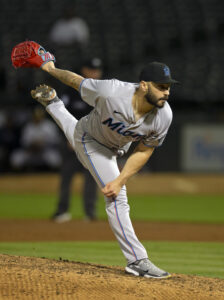
Sulser has already departed the Marlins organization — the D-backs claimed him on waivers last November — but Scott has emerged as one of the best lefties in the game. His power arsenal was always tantalizing, but Scott’s lack of command continually proved frustrating for the O’s. That continued into the 2022 season, his first in Miami, but the 2023 campaign has been another story. After logging a 4.31 ERA, 31.1% strikeout rate and ghastly 15.9% walk rate last year, Scott is now touting a 2.80 ERA, a 36.4% strikeout rate and a vastly improved 10% walk rate. Yes, it’s still too many free passes, but he’s improved it as the season has gone on. Over his past 32 frames, Scott has walked only 7% of his opponents.
Scott entered play Wednesday with a mammoth 17.2% swinging-strike rate and 36.2% chase rate — and that’s before he struck out the side against the Reds in this afternoon’s inning of work. There are only three pitchers in baseball who’ve thrown 50-plus innings and have a higher swinging-strike rate. Scott isn’t working in low-leverage mop-up settings, either. He’s piled up 22 holds and a pair of saves, and only four qualified relievers top him in terms of win probability added (WPA). The Fish are paying him a bargain $2.825MM this season and control him through the 2024 season.
Many clubs would be thrilled to simply have one quality southpaw of this caliber, but the Marlins are deeper than any club in MLB when it comes to lefty relievers. Scott might be the biggest name of the bunch, but the Fish are swimming (sorry, sorry) in quality southpaws. Andrew Nardi might be the most anonymous member of the group, but he’s been nothing short of outstanding this season.
A former 16th-round pick by Miami, Nardi had an inauspicious MLB debut in 2022, pitching 14 2/3 innings but allowing 16 runs in that time. Few fans looked at him and saw a breakout candidate, but in 39 2/3 innings this year, he’s sporting a 2.95 ERA, 33.1% strikeout rate and 6.9% walk rate. He’s been limited by a triceps injury this summer but was reinstated from the IL earlier this month and is back working in a high-leverage capacity. Since picking up his first big league save back on May 7, he’s pitched to a 1.80 ERA with a 36-to-6 K/BB ratio in 25 innings. He’s grabbed eight holds and a pair of saves along the way — and both numbers would be higher had he not spent a month on the injured list in that span.
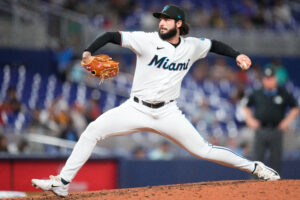
Nardi’s 14.3% swinging-strike rate is excellent, and his 35% chase rate is even better. Virtually no one can square up the ball against the 24-year-old; he sits in the 99th percentile of big league pitchers in terms of average exit velocity and the 98th percentile in overall hard-hit rate. Nardi doesn’t even have a year of Major League service yet, so the Marlins can control him all the way through the 2028 season, and he won’t even reach arbitration until after the 2025 campaign.
There’s also 32-year-old Steven Okert to consider — a gem unearthed in minor league free agency. The left-hander came to Miami on a minor league deal in the 2020-21 offseason and, at the time, had just 48 1/3 innings of 4.28 ERA ball under his belt — all coming from 2016-18 with the Giants. In three seasons with Miami, Okert has graduated from a generic depth signing to a stalwart member of a talented relief corps. He’s logged 129 1/3 innings with a 2.85 ERA since relocating to South Florida, punching out 30% of his opponents against a 10.6% walk rate.
Again, the walks are a bit too high, but it should be noted that Okert has boosted his strikeout rate to a career-high 33.5% in 2023 while dropping his walk rate to 9% — his lowest mark in three years with the Fish. His velocity has ticked up each season, and the Marlins have scrapped three of his five pitches, turning him solely into a four-seam/slider reliever. Okert pitches more in the middle innings than Scott and Nardi, but he’s still picked up 10 holds. The results are outstanding, and he can be controlled cheaply for three years beyond the current season. Not too shabby for someone signed to a minor league deal three offseasons ago.
Left-hander A.J. Puk might be the most recognizable name of the bunch, thanks to both his lofty draft status (No. 6 overall in 2016) and his inclusion in a reasonably high-profile trade this offseason (sending former No. 4 overall pick JJ Bleday back to Oakland). Puk’s 4.62 ERA is by far the least impressive of the group, but the underlying numbers are far more impressive. He’s fanned 30.9% of his opponents against just a 4.9% walk rate while recording a swinging-strike rate just shy of 15%. Puk had a sub-3.00 ERA himself in early June before a rough patch that saw him allow runs in six of nine appearances. He’s since rebounded with four straight scoreless outings, whiffing five hitters without issuing a walk in 3 1/3 innings.
Puk has been hampered by a .337 average on balls in play and an abnormally low 63.1% strand rate, prompting metric like FIP (3.41) and SIERA (2.66) to cast a far more favorable light on the lefty than his earned run average does. Puk certainly wasn’t flawless in serving as the Marlins’ primary closer — 15-for-21 in save opportunities — and that, coupled with his rough stretch last month, might have nudged Miami to acquire Robertson. That said, lefties who average 96 mph don’t grow on trees, and Puk’s blend of elite strikeout and walk rates signals better days ahead.
In fact, Marlins relievers as a whole are among the best in baseball when it comes to both piling up strikeouts and limiting free passes. Each of the four lefties profiled here rank in the top 10 of all qualified relievers in terms of differential between strikeout rate and walk rate (i.e. K-BB%). The Marlins are sixth in all of baseball as a collective group in that category, and adding Robertson for the final two months of the season should help them out.
There are plenty of reasons for the Marlins’ success this season. Luis Arraez‘s surefire batting title, big steps forward from Jesus Luzardo and Braxton Garrett, a dominant debut season from Eury Perez and a rebound effort from Jorge Soler have all helped drive this unlikely playoff push. But heading into the season, few would’ve pegged the Marlins to receive this type of output from their left-handed bullpen corps. Add in the fact that they came to the organization via a minor league deal, a 16th-round pick, and trades sending out three marginal prospects and a former first-rounder who’s still struggling in Oakland — and the core of this bullpen is even more impressive. They’ll all return for the 2024 season at least, and with Robertson helping lead the charge down the stretch in ’23, the Marlins will continue to be dangerous in tightly contested games.
Marlins Outright Devin Smeltzer
Marlins left-hander Devin Smeltzer cleared waivers following last week’s DFA and has been assigned outright to Triple-A Jacksonville, Jordan McPherson of the Miami Herald tweets.
This was the third time in 2023 that the Marlins have designated Smeltzer for assignment, and it’s now the third time he’s passed through waivers and been outrighted. His prior outright assignments give him the right to reject an assignment in favor of free agency, but Smeltzer accepted an outright assignment following each of his two prior DFAs in Miami.
The 27-year-old Smeltzer’s most recent stint with the Fish was his most successful of the season. He appeared in two games and fired three shutout innings with five strikeouts and no walks. Overall, he’s pitched to a 5.79 ERA with an 18.1% strikeout rate and 4.8% walk rate through 18 1/3 innings since signing with Miami on a minor league contract over the winter. He’s spent the bulk of the season in Jacksonville, where he’s worked out of the rotation but turned in a shaky 5.95 ERA with an 18.4% strikeout rate and an uncharacteristically high 12.6% walk rate.
Smeltzer spent the four prior season in Minnesota, pitching to a 3.99 ERA in 140 innings between the Twins’ rotation and bullpen, fanning a well below-average 16.6% of his opponents against a strong 6.4% walk rate.
Marlins Select Geoff Hartlieb
Prior to today’s game with the Rangers, the Marlins selected Geoff Hartlieb‘s contract from Triple-A Jacksonville. Left-hander Ryan Weathers was optioned to Triple-A in the corresponding transaction.
The move brings a fresh arm into Miami’s bullpen, as Weathers threw 3 2/3 innings of relief on Saturday and was hit hard, allowing six earned runs against the powerful Texas lineup. It is possible Hartlieb’s stint in the majors lasts for only a day until the Marlins need a roster spot to bring Eury Perez back to the Show, but Hartlieb pitched an inning against the Rangers, marking his first MLB appearance since 2021.
Hartlieb signed a minor league deal with Miami during the winter and has spent the entire season in Jacksonville, though injuries kept him on the shelf until May. This late start might’ve cost the right-hander an earlier look on the big league roster, as Hartlieb has a 3.18 ERA over 34 relief innings and some solid peripherals (25.5% strikeout rate, 9.2% walk rate, 47.2% grounder rate).
A 29th-rounder for Pittsburgh in the 2016 draft, Hartlieb tossed 66 1/3 innings over 57 games with the Pirates and Mets from 2019-2021, posting a 7.46 ERA. The Red Sox acquired him via waiver claim in September 2021 but he didn’t receive any Major League action in over a year in the organization, as Hartlieb had a 5.16 ERA over 61 innings for Boston’s Triple-A affiliate in 2022.
East Notes: Red Sox, Verdugo, Severino, Narvaez, Perez
The Red Sox issued a positive update regarding the status of right-hander Garrett Whitlock today, with manager Alex Cora (as relayed by MassLive’s Christopher Smith) indicating that he’s poised to begin a minor league rehab assignment next week. Whitlock has been on the 15-day injured list due to a bone bruise in his elbow for just over a month. Meanwhile, both right-hander Tanner Houck and left-hander Chris Sale could also be nearing returns, with Houck expected to make three rehab starts before rejoining the club while Sale will be evaluated tomorrow as he nears a return to the majors.
Whitlock’s return to the Red Sox, according to Cora, could come with a change of role, as the manager indicated there was “a good chance” that Whitlock would be used in a multi-inning relief role rather than as a member of the rotation. That’s a role that has suited Whitlock quite well throughout his career, as he owns a sterling 2.24 ERA in 112 2/3 innings of work out of the bullpen, a far more impressive figure than his rather pedestrian 4.76 ERA in 19 starts as a member of the rotation.
Even with Whitlock seeming ticketed for the bullpen, the impending returns of Houck and Sale could create a logjam in Boston’s rotation. With the aforementioned trio on the shelf, the club was recently forced to move right-hander Nick Pivetta back into the rotation alongside regular starters James Paxton, Brayan Bello, and Kutter Crawford despite the fact that Pivetta sported a dominant 1.98 ERA in 41 innings coming out of the bullpen since he was removed from the rotation back in May.
With Paxton, Bello, and Sale all likely locked into rotation spots when healthy, the Red Sox will have to pick one of Pivetta, Houck, or Crawford to join Whitlock in the rotation unless the club plans on moving to a six-man rotation upon the return of Sale and Houck to starting action. While Pivetta’s 5.98 ERA coming out of the rotation is the weakest figure of that trio, his 7 1/3 inning, three-run outing in his return to the starting rotation may to have given Red Sox brass renewed confidence in him as a starting option going forward.
More from around MLB’s East divisions…
- Sticking with the Red Sox, outfielder Alex Verdugo was scratched from today’s lineup shortly before the game started. Following the game, Cora briefly discussed Verdugo’s situation with reporters, including Smith. In his comments, Cora indicated that Verdugo’s absence from the lineup was not injury-related. While neither Cora nor Verdugo commented on the specifics of the situation, Cora stressed that it was “the manager’s decision”, saying: “We need everybody available. I decided the reason that he didn’t play. But he wasn’t available today. He was ready to play but he wasn’t available. … The manager decided not to play him today. And he has his reason. I’m not going to go into details or whatever.” After a hot start to the 2023 campaign, Verdugo has slashed just .157/.245/.277 in 94 trips to the plate since the start of July.
- Yankees manager Aaron Boone indicated to reporters, including The Athletic’s Chris Kirschner, that “everything is on the table going forward” regarding right-hander Luis Severino, including a move to the bullpen. Once a rising star in the game as a reliable, front of the rotation arm, Severino has struggled massively in 13 starts this season with a 7.74 ERA and 6.56 FIP. Severino has made fifteen appearances out of the bullpen during his career to excellent results. He’s posted a microscopic 0.31 ERA with a 30.6% strikeout rate in 29 1/3 innings of work as a reliever. If Severino were to exit the rotation, that could open up starts for a younger arm like Jhony Brito or Randy Vasquez.
- Sticking to New York, Mets catcher Omar Narvaez indicated to Will Sammon of The Athletic that he would “probably be back next season” when discussing his upcoming $7MM player option for 2024. Narvaez opened the season as the club’s starting catcher but suffered a calf strain early in the season. While Narvaez was on the shelf, youngster Francisco Alvarez emerged as the club’s everyday player behind the plate, leaving Narvaez in a part-time role upon his return. In addition to his diminished role, Narvaez has struggled badly at the plate this season, slashing just .189/.281/.245 with a wRC+ of 54 in 24 games this year.
- The Marlins figure to welcome young right-hander Eury Perez back to the rotation on Monday, according to Craig Mish of the Miami Herald. Perez made his last big league start on July 6 before being optioned to the minors in an effort to manage his innings and keep him fresh for the stretch run. Perez’s return figures to be a significant boost to the Marlins rotation, as he impressed with a 2.36 ERA and 3.70 FIP in eleven starts during his first stint in the majors earlier this season. The Marlins currently sport a 58-54 record and are just half a game out of the final NL Wild Card spot. That spot is currently occupied by the Reds, against whom Perez is slated to make his return on Monday.