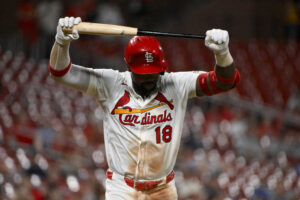
Poll: Who Had The Best Deadline In The NL East?
The trade deadline has come and gone. While trade season was slow to get started this year, when all was said and done, there were several dozen trades made in a flurry of movement over the final few days before the deadline arrived. The full impact of these trades won’t be known for years to come, but that doesn’t mean we can’t analyze the deals and decide whose haul looks the best right now. Over the next week-plus, MLBTR will be running a series of polls asking which club in each division had the best deadline, starting today with the National League East. A look at each of the five clubs, listed from best to worst record in 2025:
Philadelphia Phillies
The Phillies made one of the biggest trades of the entire deadline when they landed closer Jhoan Duran from the Twins. With a 1.93 ERA and 18 saves this season, Duran figures to fortify the back of the bullpen and checks off the biggest need for Philadelphia. The club made a few more deals, but none were quite as impactful as adding Duran. Harrison Bader should provide a strong complement to Brandon Marsh and Max Kepler in the outfield against left-handed pitching while also improving the club’s defense. Matt Manning and Brewer Hicklen are purely depth additions who are not on the club’s active roster but could offer some protection against injury. Losing Mick Abel and Eduardo Tait from the farm system in order to bring in Duran is a blow, but the value an elite closer like Duran could provide over the next two-plus years figures to justify that cost.
New York Mets
The Mets took nearly the opposite approach to their primary rival for the division title this deadline, as they made a number of mid-level additions without swinging any one massive blockbuster. They added a second All-Star closer to the roster when they scooped up Ryan Helsley in a deal with the Cardinals to serve as the top setup man for closer Edwin Diaz, and further fortified their bullpen with trades for Tyler Rogers and Gregory Soto. They capped their deadline off by adding Cedric Mullins to the outfield in a move that could be game-changing for a club that was forced to rely on Tyrone Taylor (55 wRC+) as their regular center fielder throughout the first half. A legitimate starting-caliber player in center field and one of the best bullpens in the league should leave most Mets fans pretty happy with these additions, but the cost was significant. The Mets surrendered their #6, #10, #14, #22, #25, #27, and #28 prospects (according to Baseball America) in these trades alongside big league reliever Jose Butto. The club’s top five prospects remained untouched, but it’s still a steep price to pay for a package of players who are all ticketed for free agency this winter.
Miami Marlins
The Marlins had a rather quiet deadline where their headline move was shipping outfielder Jesus Sanchez to the Astros in exchange for a package of three players headlined by young starter Ryan Gusto. Aside from that, the fish dealt catcher Nick Fortes to the Rays for Double-A outfielder Matthew Etzel in a move that opens up playing time behind the plate for Agustin Ramirez and Liam Hicks and picked up depth reliever Michael Petersen from the Braves in a cash deal. The Sanchez move was a solid one that brings a young pitching talent into the fold for a club with a knack for developing young arms, but the most notable thing about Miami’s deadline is what they didn’t do: trade Sandy Alcantara and Edward Cabrera. A run to the postseason this year is still very unlikely, but the quiet trade deadline gave the 55-55 Marlins a chance to see if they can keep up their recent torrid pace for another two months.
Atlanta Braves
Atlanta had something of a perplexing deadline. Like the Marlins, the biggest storyline here isn’t about the moves they made but rather about their decision to keep Raisel Iglesias and Marcell Ozuna in the fold. While Alcantara and Cabrera both have multiple seasons of control remaining with the Marlins, Iglesias and Ozuna are pending free agents who cannot even be extended Qualifying Offers this November. It was puzzling to see Atlanta shy away from dealing either of them and instead make a small handful of pitching additions. Erick Fedde, Dane Dunning, Tyler Kinley, Carlos Carrasco, and Hunter Stratton were added to help fortify a beleaguered pitching staff, and the trio of Fedde, Dunning, and Carrasco should help protect the club’s young arms from overuse down the stretch. The Rafael Montero trade stands as the club’s biggest sell-side move, however, while only Stratton (and perhaps Kinley or Dunning) will impact the club beyond the 2025 campaign of the team’s acquisitions.
Washington Nationals
The Nationals were the most aggressive sellers in the division as they shipped out Amed Rosario, Alex Call, Kyle Finnegan, Michael Soroka, Andrew Chafin, and Luis Garcia. Of that group, only the 30-year-old Call was controlled beyond the 2025 season. With a lackluster 44-67 record, it’s understandable that the Nationals would sell off a number of pieces, though they did hold onto some of their controllable pieces with higher potential for impact like MacKenzie Gore and Nathaniel Lowe. Former top prospects Jake Eder and Clayton Beeter are perhaps the most recognizable names from the haul the Nats received for their veteran pieces, but they received ten prospects and young players in total. According to MLB Pipeline, the club’s #10 (Sean Paul Linan), #11 (Christian Franklin), #12 (Eriq Swan), #13 (Ronny Cruz), #23 (Josh Randall), and #24 (Beeter) prospects were all acquired in this sell-off. That should keep their farm system fairly well-stocked headed in the first offseason of the post-Mike Rizzo era of Nationals baseball.
The NL East’s teams ran the gamut between buying and selling this year. The Phillies and Mets were both aggressive buyers, but took different approaches as the Phillies prioritized a controllable star while New York focused on the short-term. The Marlins and Braves were mostly quiet this summer, while the Nationals bolstered their farm system through several trades of veteran players. Who do MLBTR readers think had the best deadline of the division? Have your say in the poll below:
Which NL East team had the best deadline?
-
Philadelphia Phillies 50% (1,992)
-
New York Mets 35% (1,383)
-
Washington Nationals 7% (286)
-
Miami Marlins 4% (148)
-
Atlanta Braves 4% (143)
Total votes: 3,952
How To Acquire Players After The MLB Trade Deadline
It still wasn’t that long ago that MLBTR kicked off by reminding longtime MLB fans (or explaining to new fans) how the dizzying rules regarding August trade waivers worked. It was a convoluted process — one that saw nearly every player in the league placed on revocable trade waivers at some point (heavy emphasis on “revocable”) — but one that front offices increasingly used as creative means to pull off significant acquisitions after the supposed “deadline.”
In reality, under the old rules, the first “trade deadline” was never the actual deadline — it just wasn’t as catchy to use the full term, “non-waiver trade deadline.” As time progressed, the month of August increasingly served as a means of swapping out higher-priced talents in waiver trades that were still quite noteworthy. If you’re seeing Justin Verlander, Andrew McCutchen, Josh Donaldson and others change hands in late August, just before the deadline for postseason eligibility — was the non-waiver deadline really a trade “deadline” at all? Not so much.
Back in 2019, Major League Baseball opted to quash the ever-growing process of August roster reconstruction. The league put an end to waiver trades that often served as a means of teams hitting the “eject” button on notable contracts and saw larger-payroll clubs take on those deals simply because they possessed the financial wherewithal to do so. MLB implemented a more concrete “true” trade deadline that prohibited players on Major League contracts — or any who were on a Major League contract but had been outrighted — from being traded after the deadline.
Does that mean teams can no longer acquire new players or address injuries as they arise? No, but their avenues to do so are substantially narrower. Here’s a look at how Major League front offices can still augment their roster now that the “true” trade deadline has passed:
1. Trades!
Wait, what? I thought we just–
Yes, we did. But it turns out that the “true” trade deadline is really only the “true” trade deadline for Major League players! Fun how that works, right? In all likelihood, you’ll still see several players change hands this month, they just won’t be very exciting. But, veterans who’ve been playing the entire season on a minor league contract and haven’t at any point had that contract selected to the 40-man roster or been on the Major League injured list are still fair game to be traded.
Will you see any huge, blockbuster names flipped? Of course not — but there are still some recognizable names eligible to be traded. Among the position players in Triple-A who have been enjoying above-average production are Christian Arroyo (Phillies), Ben Gamel (Angels), Yonny Hernandez (Mets) and Trey Mancini (D-backs) — just to name a few. It’s obviously not a star-studded collection of talent, but it’s feasible enough that a team could get some big league value from someone in this group (or from one of the numerous other former big leaguers who has yet to appear on a 40-man roster).
Those are just some of the former big leaguers who are eligible to be traded, so long as any player(s) going back the other way have also not been on a 40-man roster or Major League injured list. It’s common for August deals to be simple cash swaps, as well.
There were a handful of post-deadline swaps in 2024, though the majority of them involved minor leaguers who didn’t reach the majors. That wasn’t true across the board, however. Right-hander David Buchanan went from the Phillies to the Reds in exchange for cash. He wound up pitching a tiny sample of 3 1/3 innings in Cincinnati. On Aug. 31, the Braves traded Yuli Gurriel to the Royals, who immediately selected his contract and plugged him onto the roster. Gurriel appeared in 18 games for K.C. and slashed .241/.338/.296 in 65 regular season plate appearances; he made their playoff roster.
The most interesting post-deadline deal in 2024 actually came even beyond August. The Braves acquired utilityman Cavan Biggio from the Giants in exchange for cash. It was a surprising move, if only because Biggio actually had appeared in the majors that season. While many — MLBTR included — were of the belief that under the current rule setup, that prevented him from being traded, that wasn’t technically the case.
Biggio had been on a 40-man roster but had been designated for assignment by the Dodgers and released. Upon clearing release waivers, he signed a new minor league deal with San Francisco. Since that new minor league contract had not been selected to the roster at any point in the season — and was not a major league contract that had been passed through waivers and then assigned outright to a minor league affiliate — he again met the criteria to be traded. In theory, that makes any player who is released and signed to a minor league deal with a new organization eligible to be traded post-deadline.
Just to speculate a bit — and we haven’t seen this in the past, but it’s technically possible — teams can engineer minor league trades, so long as the players involved have not been on the 40-man roster at any point in a given season. It’s doubtful we’ll see any top prospects change hands in this regard, but it’s not expressly forbidden, either.
And, just to rain on your parade, no — teams cannot game the system using players to be named later. The rules pertaining to the “true” trade deadline made sure to include the following language:
“The Commissioner’s Office will prohibit any transaction (or series of transactions) that, in the judgment of the Commissioner’s Office, appears (or appear) designed to circumvent the prohibitions of Rule 9(b).”
Nice try, folks, but don’t get your hopes up.
Just remember, anyone acquired after Aug. 31 isn’t postseason-eligible with his new club, so minor swaps of any relative note will likely take place before the calendar flips to September.
It won’t lead to any exciting trades, but we’ll likely still see some trades this month. You’ll just have to wait until the offseason for the chatter on Sandy Alcantara, Mitch Keller, Joe Ryan, Pete Fairbanks, Jarren Duran and others.
2. Outright and Release Waivers
Revocable trade waivers are no longer a thing, but regular old outright waivers and release waivers are alive and well. Any time a player is designated for assignment now, the team’s only recourse will be to place him on outright waivers or release waivers. At that point, the other 29 teams will have the opportunity to claim that player … and the entirety of his remaining contract.
Of course, a team doesn’t need to announce a DFA or even announce that a player has been put on waivers. It’s fairly common for a team to just announce that a player cleared waivers and was outrighted to a minor league affiliate without ever publicly declaring a DFA. Players who are placed on outright waivers without being designated for assignment can continue to play in their team’s games. And, if a player clears waivers, he does not necessarily need to be assigned outright to a minor league affiliate. He can return to the active roster. In that sense, teams can use outright waivers as a means to try to jettison some unwanted money without necessarily committing to cutting the player if no other club bites. The 2021 Pirates did this with Gregory Polanco (granted, before simply designating him for assignment and releasing him a few days later).
An important reminder on waivers now that it’s the primary means of acquiring talent from another organization: waiver priority is determined based on overall record (worst record to best record) and, unlike the now-retired “revocable trade waivers,” is not league-specific. If the Rockies want outfielder Dustin Harris or lefty Bryan Hudson — designated for assignment by the Rangers and Brewers, respectively, following the deadline — they’ll have first crack. Next up would be the White Sox, Nationals, Braves, Pirates and so on — all based on the reserve order of the MLB-wide standings at the time (which is to say… the 28-80 Rockies are going to have first dibs all month long).
Teams who didn’t find sufficient interest in veteran players prior to the trade deadline and thus held onto them could eventually place those players on outright waivers in August, hoping another club will claim said player and simply spare the waiving team some cash. This is likelier to happen late in the month — when there’s less cash owed on those veteran contracts.
In 2023, we saw the Angels undergo a mass sell-off in hopes of dipping under the luxury tax. The Halos placed more than a quarter of their roster on waivers, with Lucas Giolito, Reynaldo Lopez, Matt Moore, Randal Grichuk, C.J. Cron, Hunter Renfroe, Dominic Leone and Tyler Anderson all hitting waivers. Giolito, Lopez, Moore, Renfroe and Leone were all claimed by new teams. Anderson, as with Polanco in ’21, went unclaimed and simply returned to the Angels’ roster. He’s still there two years later.
The 2023 Angels stand as an extreme example, but it’s feasible that a current fringe contender who’s not far over the luxury tax (or who simply wants to save some money) could do so again late this month.
As with any minor league trades, players claimed off waivers will only be postseason-eligible with their new club if claimed before 11:59pm ET on Aug. 31.
3. Sign Free Agents
Same as ever. Anyone who gets released or rejects an outright assignment in favor of free agency will be able to sign with a new team and, so long as the deal is wrapped up prior to Sept. 1, they’ll be postseason-eligible with a new team. It’s certainly feasible that a once-productive veteran enjoys a hot streak with a new club or fills a useful part-time role.
There aren’t many free agents of note still on the market — not after David Robertson signed with the Phillies last month. However, designated hitter J.D. Martinez has reportedly stayed in shape and remained open to signing. The Rangers are said to have made him a minor league offer earlier this summer. A contending club that either incurs an injury this month or simply didn’t find a deadline upgrade to its liking could conceivably roll the dice on Martinez.
The same postseason eligibility date applies to incoming free agents as well. As long as Martinez or any other free-agent additions are with their new organizations prior to Sept. 1 — they do not need to be on the 40-man roster at that point — he could make his way onto a postseason roster.
4. Scour the Independent Leagues
Roll your eyes all you want, but the Atlantic League, Frontier League and American Association (among other indie circuits) are all teeming with former big leaguers. Need a speedy fourth outfielder who can provide some late-game defense and baserunning during September roster expansion? A platoon bat off the bench? An extra southpaw to stash in the bullpen? There will be experienced names to consider.
Look up and down the Atlantic League leaderboards and you’ll find former big leaguers like Kyle Barraclough, Phillip Diehl, Dalton Guthrie and even Pablo Sandoval still rolling along. It’s unlikely anyone finds a true impact player on the indie scene, but then again, people cracked jokes when the 2015 Red Sox signed Rich Hill away from the Long Island Ducks as a 35-year-old. He’s earned nearly $80MM and tossed more than 900 innings in the majors since joining the Red Sox under similar circumstances to the ones described here.
5. Look to Foreign Leagues
We don’t often see players return from the KBO, NPB or CPBL to sign with big league clubs midseason, but there’s precedent for it happening. There are also quite a few former big leaguers playing down in the Mexican League, creating another area for front offices to scout as they mine for depth options. Interest won’t be limited solely to former big leaguers, either. In 2022, the Mariners signed lefty Brennan Bernardino after a strong nine-start run in Mexico, watched him dominate through 12 2/3 innings in Triple-A Tacoma, and selected him to the Major League roster by the end of July. He made his MLB debut with Seattle in ’22, was claimed off waivers by the Red Sox earlier in ’23, and now carries a combined 3.47 ERA in 145 1/3 innings for the Red Sox from 2023-25. You never know!
Inside the Deadline War Room: What Really Happens When GMs Make Their Moves
Zack Scott is a 4x World Series Champion with the Red Sox and former Mets Acting GM who applies championship leadership principles across professional sports and corporate environments. As Founder & CEO of Four Rings, he consults with teams like the 2023 World Series Champion Texas Rangers while coaching senior executives at growing companies to build winning leadership cultures. He also founded The Sports Ops Launchpad, helping aspiring sports ops pros break into the industry with a proven 20x success rate.
I’ve been in war rooms where a single phone call can change three franchises, end careers, or create legends. Most of the time, though, absolutely nothing happens.
I spent 20 consecutive years in trade deadline war rooms, including 17 with the Red Sox and one each with the Mets, Pirates, and Rangers. The reality is more mundane and less dramatic than fans probably expect.
How the War Room Works
The real work starts weeks before the deadline. For much of my career, a big part of the job was ensuring decision-makers were prepared when deals started moving. We gathered performance analyses, scouting evaluations, contract data, medical history, makeup reports, and intelligence on who was buying, who was selling, and what each team wanted.
The trade deadline has a unique rhythm. Long stretches of nothing, then everything happens at once.
You’ll sit in a conference room, which typically includes the GM, assistant GMs, scouts, analytics staff, and other baseball ops folks, for hours making small talk, going over the same reports, and waiting for phones to ring. Some GMs set up too early, and you end up with a room full of people staring at each other for weeks.
Most of the time, we’re doing exactly what fans do: refreshing MLBTR and X, hoping to catch something we missed.
But then something shifts in those final hours. Teams that were “just checking in” suddenly get serious. The pace picks up, conversations get urgent, and that’s when the real drama begins.
When Every Second Counts
People think the 6 PM deadline is just a formality. It’s not.
I’ll never forget when we traded Nomar Garciaparra. Hours of waiting, scattered conversations, then suddenly we’re in a four-team deal with the clock ticking down to the final minute.
This was the face of the franchise, with multiple teams trying to coordinate. Someone called out: “We’ve got ten minutes!” You have people on phones with different teams, trying to ensure everyone’s on the same page while the minutes disappear.
We got it done, but barely. Those kinds of deadline deals show you who can handle pressure and who can’t.
The Human Side of Historic Trades
Not every great trade comes from sophisticated analysis. Sometimes it’s about delegating and setting others up to succeed.
The Dave Roberts trade almost didn’t happen. And if it hadn’t, the 2004 Red Sox probably wouldn’t have become the first team in history to come back from down 3-0.
Theo Epstein asked an intern to research available outfielders. The initial list was terrible, but instead of dismissing it, he challenged the young staffer to think differently. That’s when the intern heard the Dodgers were trying to acquire Steve Finley. Since they already had plenty of outfield talent, maybe they’d be willing to trade away Dave Roberts. The intern rushed to Theo’s office with the idea. Within hours, we’d made the trade.
You know how that story ended—bottom of the ninth, Game 4 of the ALCS. Roberts steals second, scores the tying run, and we complete the greatest comeback in baseball history. That trade happened because Theo had created an environment where everyone’s input was valued.
When Deals Fall Apart
But not every story has a happy ending. You can get so close to a franchise-changing trade, then watch it disappear overnight.
In 2009, we had a three-team deal almost done: Adrian Gonzalez from San Diego to Seattle, Felix Hernandez from Seattle to us, and several young players, including Josh Reddick, Daniel Bard, and Justin Masterson, going to the Padres.
Seattle’s GM slept on it, then decided he couldn’t move the King. Just like that, a deal that could have changed three franchises was dead.
When Everything Gets Complicated
The complexity isn’t always about multiple teams. It can be about competing priorities and external pressure.
In 2008, we had to move Manny Ramirez. He was threatening not to play for us if we didn’t trade him. As defending champs with aspirations to repeat, we couldn’t just give away a great hitter. We needed to find another impact player to replace him.
That’s how Jason Bay entered the picture, but it required multiple teams to make it work. We had two options: get an established impact player like Bay, or ask for a prospect who wouldn’t help us immediately. At one point, we even asked the Marlins for 18-year-old Mike Stanton (now Giancarlo) straight up for Manny. That move would have hurt us immediately but helped us in the long term. That took huge stones to even consider.
The situation became a stalemate that required Commissioner Selig to mediate. We finished after the deadline, but Selig allowed it because he felt it was in the best interest of the game. We got it done: Manny to LA, Jason Bay to us, and prospects to Pittsburgh.
When I Finally Ran a War Room
When I became Acting GM at the Mets in 2021, I finally got to run a war room. After 17 years of observing various approaches, I had developed clear ideas about how to do it effectively.
I kept multiple conversations going simultaneously because more opportunities meant a better chance of finding the right deals. I also made sure we had a room packed with people, because I’d learned that good ideas can come from anywhere. But instead of letting people sit idle, I came prepared with specific questions and tasks for each staff member throughout the day.
The challenge was that we were working with incomplete information: missing projection systems, gaps in scouting reports, and limited data on our own prospects. We were trying to rebuild these systems while competing for a playoff spot.
That pressure led to trading Pete Crow-Armstrong for Javy Baez and Trevor Williams, players who made a positive short-term impact. Even with our limited information, the underlying intelligence suggested the long-term risk was higher than the expected short-term gain. But being in first place created enormous pressure to improve immediately. I chose the short-term need over long-term value, and I own that decision.
It taught me that no matter how well you structure your war room, external pressure can still override your process.
What Really Matters
A trade deadline war room is loaded with technology, including multiple screens, databases, and video systems. But here’s what I learned after 20 years. The deadline isn’t just about having the best information. It’s about creating an environment where the best ideas can come from anywhere.
The deals that change franchises often come from unexpected places. That’s what makes it electric and maddening all at once.
6 Former Prospects Who Now Look Like Change-Of-Scenery Candidates
It's easy this time of year to focus on the most obvious trade candidates among the bunch. Players on expiring contracts -- or perhaps with one more year of club control -- who play for rebuilding teams or playoff hopefuls who've fallen short of expectations tend to dominate the conversation. That's understandable. Even the short windows of control over those seasoned veterans can be huge difference-makers with regard to the postseason fortunes of those teams that are still in the race.
On the other side of the coin, fans of those rebuilding clubs or disappointing teams can scour prospect rankings for contending clubs, hoping to get a glimpse of what the future might hold and what their soon-to-be-traded stars and mainstays might net.
Somewhere in between those two extremes, however, there are plenty of players who hold appeal. The reception when one of these players is included in a trade isn't always great among the fanbase. White Sox fans weren't exactly thrilled last year when the main return in the team's trade of Erick Fedde and Michael Kopech was infielder Miguel Vargas, for instance. Vargas wasn't far removed from being a consensus top-100 prospect and was only 24 at the time of the swap, but he no longer carried that shiny "top prospect" label or as much of the allure of the unknown. Instead, he was a young big leaguer who'd struggled to establish himself in three short, partial MLB seasons.
Vargas hasn't exactly broken through to superstardom in 2025 -- far from it -- but he's been a regular at the infield corners in Chicago and provided league-average offense on the whole, including a .246/.325/.458 slash (117 wRC+) over his past 320 plate appearances. He's walked in nearly 10% of those plate appearances, punched out at only a 14.7% clip and increasingly has the look of a solid regular.
Though he'd lost some of the luster from his prospect status, Vargas --who's controlled all the way through 2029 -- could yet wind up being a nice piece for the White Sox.
With that very recent example in mind, and with so much focus on the Eugenio Suarez-es and Spencer Jones-es of the world (i.e. rental veterans and hot-hitting prospects who are the talk of the deadline), it seemed like a worthwhile endeavor to try to pinpoint some once-ballyhooed prospects whose star has dimmed and who perhaps no longer have a clear path to an everyday role in their current organization.
Here's a look at six former top prospects who have exhausted that "prospect" designation but are hitting well in the upper minors without much of a path to playing time on their current club...
JJ Bleday, OF, Athletics (controllable through at least 2028)
Bleday was the No. 4 overall pick out of Vanderbilt by the Marlins back in 2019. Miami traded him to the A's in exchange for lefty A.J. Puk -- a swap of former top-10 picks who hadn't panned out as hoped with their original clubs.
Bleday's first year with the A's in 2023 was a disappointment. He hit .195/.310/.355 while Puk pitched well down in South Florida. It looked like a flop. At least, that was the case until 2024. Bleday was miscast as a center fielder last year -- he should clearly be in a corner -- but was still worth more than two wins above replacement despite terrible defensive grades. He hit .243/.324/.437 with a career-low 19.5% strikeout rate and popped 20 homers in 159 games. Factor in the cavernous confines of his former home at the Coliseum, and Bleday was 20% better than league average at the plate, by measure of wRC+.
This year, Bleday's numbers dipped. He hit .191/.288/.358 in 233 plate appearances in the majors. The A's have optioned him twice. Bleday still walked in 12% of those MLB plate appearances, though his strikeout rate crept back up and he became more prone to infield flies. His overall hard-hit rate increased, however, and he's currently hitting .354/.393/.584 in 122 Triple-A plate appearances.
Unfortunately for Bleday, he increasingly looks like a player without a role on the A's. Lawrence Butler signed a long-term extension in right field. Nick Kurtz's emergence at first base has pushed Tyler Soderstrom to left field. Denzel Clarke hasn't hit in the majors but has been maybe the best defensive player on the planet in his short time in the majors.
It's possible there's still a role for Bleday with the A's -- Butler can play center field, and Clarke can't keep striking out at a 38.4% clip and continue playing regularly -- but a team with playing time to spare in the outfield could try to buy low.
Unlock Subscriber-Exclusive Articles Like This One With a Trade Rumors Front Office Subscription
- Access weekly subscriber-only articles by Tim Dierkes, Steve Adams, and Anthony Franco.
- Join exclusive weekly live chats with Anthony.
- Remove ads and support our writers.
- Access GM-caliber tools like our MLB Contract Tracker
Top 50 Trade Candidates For The 2025 Deadline
We’re now less than a week from Thursday evening. The activity should begin really ramping up in the two days preceding the deadline, but the bubble teams that waited until the end of the month to finalize a direction are out of time. Since we began writing this list on Thursday morning, we’ve already seen three players who were locks to be on here — Josh Naylor, Gregory Soto, and Ryan McMahon — change hands. Naylor and McMahon would have landed comfortably within the top 10.
As is the case for all our trade candidate lists, we’re trying to strike a balance between the player’s appeal and the likelihood that they’ll move. This isn’t purely a ranking of trade value or talent. There are players in the back half of the list who’d vault to the top if it were clear that they’d be traded. It’s an inherently subjective exercise.
This is a league-wide summary, but we also drilled down more specifically into each team with our new Deadline Outlook series for Front Office subscribers that rolled out over the past few weeks.
Stats through play on July 26.
1. Eugenio Suárez, 3B, Diamondbacks ($15MM in 2025, free agent at season’s end)
Suárez is the best rental bat available. He leads the majors with 87 RBI and trails only Shohei Ohtani among NL hitters with 36 homers while running a .249/.321/.587 slash line. The D-Backs are resigned to selling after being swept by the Astros this week and already made on big trade. While they could hold Suárez and make a qualifying offer, they’ll be able to find a stronger trade return — ideally one that nets upper level starting pitching with club control. The Mariners, Cubs, Yankees, Mets, Reds and Phillies have been tied to Suárez and it stands to reason that Arizona has heard from plenty more teams on the best power hitter who’ll change hands.
2. Mitch Keller, RHP, Pirates ($15MM in 2025, $16.5MM in 2026, $18MM in 2027, $20MM in 2028)
Keller is a steady mid-rotation starter who is signed for another three years. His salaries ranging from $15-20MM are notable but good value compared to a free agent market where aging or reclamation starters often command eight figures. Keller is sitting on a career-best 3.53 earned run average while averaging nearly six innings per start. His 18.7% strikeout rate is down from peak levels, but he’s averaging 94 MPH on his fastball while showing plus command. Keller fits as a #3 arm and playoff-caliber starter on a contender. While Ken Rosenthal of The Athletic reported last night that the Pirates are uncertain about moving him, he’s still their best realistic trade chip to add controllable hitting talent. The Yankees, Blue Jays, Cubs and Mets have all been tied to the 29-year-old righty.
3. Sandy Alcantara, RHP, Marlins ($17MM in 2025, $17MM in 2026, $21MM club option/$2MM buyout for 2027)
The former Cy Young winner has had a wobbly first season back from Tommy John surgery. His 6.66 ERA and 16.7% strikeout rate through 104 innings aren’t close to his peak level. The lack of whiffs is a real cause for concern, but Alcantara’s fastball is back above 97 MPH on average. He’s coming off his best start of the season — seven innings with one unearned run and four strikeouts against San Diego — in what could be the final time he takes the mound as a Marlin. Alcantara is signed relatively affordably for another season and a half with a ’27 club option that could be a bargain if he manages to get on track.
4. David Bednar, RHP, Pirates ($5.9MM in 2025, arbitration-eligible through 2026)
Bednar had a terrible 2024 and started this season poorly enough that the Pirates optioned him to Triple-A. He’s been nothing short of dominant since coming back up on April 19, posting a 1.54 ERA with a 35.3% strikeout rate across 35 innings. He’s averaging north of 97 MPH on his heater and looks like the two-time All-Star closer he was at his peak. Bednar might be a hair behind the best relievers in MLB but he’s a near-lock to get moved and remains controllable for a season beyond this one.
5. Edward Cabrera, RHP, Marlins ($1.95MM in 2025, arbitration-eligible through 2028)
There aren’t a ton of available pitchers who have a top-of-the-rotation ceiling. Teams could see Cabrera as an exception. He’s a 27-year-old former top prospect with a 97 MPH fastball. Cabrera’s command has let him down in the past, but he owns a career-low 8.1% walk rate this season. Following a shaky April, he sports a 2.47 ERA with a 25.7% strikeout rate while walking fewer than 7% of opponents over his past 13 starts. His sub-$2MM salary and three and a half remaining seasons of arbitration control only add to the appeal. The Marlins aren’t under any financial pressure to move him. They’re nevertheless willing to hear teams out because of his lack of track record and a history of pre-2025 shoulder injuries that have prevented him from reaching 100 MLB innings in a season.
6. Zac Gallen, RHP, Diamondbacks ($13.5MM in 2025, free agent at season’s end)
Gallen is another of Arizona’s impending free agents. He’d also be a qualifying offer candidate if not traded but seems unlikely to re-sign. The 29-year-old righty hasn’t had a good season. He has allowed 5.58 earned runs per nine across 21 starts and surrendered an NL-most 23 home runs. His strikeouts have dipped to a league average 22.2% rate, the lowest of his career. Teams could bet on the multi-year track record. Gallen had been a #2/3 type starter throughout his career up to this year. In a market light on starting pitching, there’ll be teams that believe he’s a tweak away from putting things back together.
7. Ryan O’Hearn, 1B/OF, Orioles ($8MM in 2025, free agent at season’s end)
O’Hearn once looked like the best rental bat available. He has certainly fallen behind Suárez and probably back of Naylor in that regard. O’Hearn hasn’t done much since the beginning of June (.208/.315/.328), but he mashed for the first two months of the season. He still carries a strong .280/.374/.451 line with 12 homers on the year. He takes walks, hits the ball hard, and has dramatically cut his strikeout rate over the past two seasons. O’Hearn is playing on a bargain $8MM salary and almost guaranteed to move with the Orioles out of contention and needing to get a look at Coby Mayo.
8. Merrill Kelly, RHP, Diamondbacks ($7MM in 2025, free agent at season’s end)
Kelly is yet another of Arizona’s impending free agents of significance. He has had a better season than Gallen, working to a 3.32 ERA across 122 innings. The 36-year-old righty has punched out 24% of batters faced against a solid 7.6% walk rate. It’s his third season in the past four years with an earned run average in the low-3.00s. If the D-Backs go scorched earth, Kelly would be a sensible target for teams seeking a #3 type starter. Kelly has already signed two affordable contracts over a seven-year run in Arizona. His age would probably limit him to two years on his next deal. He seems likelier than Gallen to be in Arizona’s price range on an extension.
9. Dylan Cease, RHP, Padres ($13.75MM in 2025, free agent at season’s end)
Cease has come up in plenty of rumors over the past few days, with the Cubs and every contender in the AL East among those interested. Trading one of their two best healthy starters would be a big decision for a club occupying a playoff spot. The Padres have never shied away from acting boldly, though, and they’re seemingly open to moving the impending free agent Cease while reallocating money and prospects elsewhere on the roster (e.g. controllable starting pitching, left field). This hasn’t been a banner year for the 29-year-old righty, who carries a 4.59 ERA over 113 2/3 innings. He’s still striking out nearly 30% of opponents while averaging north of 97 MPH on his fastball, so there’ll be plenty of teams willing to bet on him returning to his typical #2 caliber form for the stretch run.
10. Seth Lugo, RHP, Royals ($15MM in 2025, $15MM player option for 2026)
The Royals still seem to be on the fence about moving Lugo, who’ll decline his $15MM player option for next season unless he gets hurt. Kansas City could hold him for a potential long shot playoff push, then make him a qualifying offer or try to sign him to a new multi-year deal. Alternatively, they could cash him in for controllable hitting talent (especially in the outfield). Lugo has mostly matched last year’s Cy Young runner-up performance. He owns a 2.95 ERA with slightly better than average strikeout and walk rates across 19 starts. He doesn’t have typical ace stuff, but it’s tough to argue with a 2.98 earned run average in 52 starts since he signed with Kansas City. Teams would view him as a no-doubt playoff starter. Midseason trades of players who can opt out at year’s end are complicated, but Lugo’s salary is affordable enough that teams should be able to make it work if K.C. sells.
11. Luis Robert Jr., OF, White Sox ($15MM in 2025, $20MM club options/$2MM buyouts for 2026-27)
Robert has underperformed offensively for most of the season. He’s still a plus center fielder who steals bases and crushes left-handed pitching (.294/.422/.544 on the year). Robert has been terrible against right-handers, but he has gone on a well-timed hot streak just before the deadline. The Sox aren’t going to get the huge return they once envisioned, but they should pull the trigger on a trade this month. Robert is controllable via $20MM club options for two more seasons that are borderline at best. He’s probably more of a complementary piece on a contender, yet he has the highest ceiling of any center fielder who is likely to move.
12. Ryan Helsley, RHP, Cardinals ($8.2MM in 2025, free agent at season’s end)
Helsley isn’t having his best season but remains a high-end reliever. He’s pitched to a 3.00 ERA with a 26.1% strikeout rate against an 8.9% walk rate while tallying 21 saves in 26 chances. The five blown saves are more than he had all last season, and his strikeout rate has dipped for a third straight year. The Cards would’ve gotten a bigger return had they dealt Helsley over the winter, but he’ll still command plenty of interest. Helsley himself said this week that while he’d love to stay with the Cardinals, he thinks there’s about a “90 percent chance” he’s traded.
13. Willi Castro, INF/OF, Twins ($6.4MM in 2025, free agent at season’s end)
Castro is a switch-hitting utilityman who should appeal to a number of teams. He’s hitting .254/.342/.423 with 10 homers and league average strikeout and walk numbers. Castro isn’t a great defender anywhere, but he can play second base, third base, and both corner outfield spots (and handle shortstop in a pinch). He’s a better hitter against left-handed pitching but more than holds his own from either side of the plate. As a versatile and affordable impending free agent on a Minnesota team that looks like a seller, he should be on a lot of teams’ target lists. The Yankees are reportedly among the clubs with interest.
14. Dennis Santana, RHP, Pirates ($1.4MM in 2025, arbitration-eligible through 2026)
Not a lot has gone right for the Pirates in recent years, but last June’s waiver claim of Santana has panned out brilliantly. The hard-throwing righty had flashed potential at various points but never put it all together until joining the Buccos. Since landing in Pittsburgh, the 29-year-old righty has pitched 87 2/3 innings of 1.95 ERA ball with a 25.3% strikeout rate and 6% walk rate. That includes a sterling 1.45 ERA and 5.5% walk rate this season. Santana isn’t piling up strikeouts this year (21.3%), but his 13.1% swinging-strike rate is a plus mark that suggests more punchouts could be in the tank. Because of his modest pre-Pirates track record, he’s making only $1.4MM this year — and he’s controllable through the 2026 season.
15. Raisel Iglesias, RHP, Braves ($16MM in 2025, free agent at season’s end)
Atlanta’s closer got out to an awful start in 2025 and had one recent blow-up, but he’s still looking far more like his vintage self lately than his baseline numbers would indicate. Iglesias’ 4.99 ERA is an eyesore, but since June 1 he’s turned in 15 2/3 innings with a 2.30 ERA and 21-to-3 K/BB ratio. All four of the runs he’s allowed in that time came in one ugly outing against the Yankees on July 19. His $16MM salary is steep — there’s about $5.6MM of it yet to be paid out — but the 35-year-old increasingly appears to be rounding into form at the right time for a Braves club that seems quite likely to sell off its impending free agents.
16. Marcell Ozuna, DH, Braves ($16MM in 2025, free agent at season’s end)
Speaking of Braves impending free agents — Ozuna also seems quite likely to go. He’s earning the same salary and thus has the same ~$5.6MM to be paid out. His season has been the inverse of Iglesias’, however. After a strong start to the year, Ozuna’s bat cratered beginning in June. He’s hitting just .174/.266/.297 across his past 159 plate appearances and has lost his starting role in Atlanta. Ozuna was hobbled by some hip troubles earlier in the year but said recently he’s healthy now. It’s possible, though, that his mechanics were impacted by that hip issue and he’s still working to correct some things. Ozuna’s track record is well known, and in a thin market for bats he should still draw interest, particularly if Atlanta is willing to pay down some of his salary.
17. Charlie Morton, RHP, Orioles ($15MM in 2025, free agent at season’s end)
Morton’s atrocious April has tanked his season numbers and resulted in a brief move to the bullpen. The veteran righty has been far better since returning to the rotation on May 26, rattling off a 3.81 ERA with a 24.5% strikeout rate over his past 10 starts. He looks like the mid-rotation Morton of the past few seasons, and his stuff has held steady despite his age. He’s now the top trade chip of Baltimore’s trio of rental starting pitchers. His $15MM salary will be an impediment to some teams, but Baltimore could pay that down a bit to get a mid-level prospect in return.
18. Ramon Laureano, OF, Orioles ($4MM in 2025, $6.5MM club option for 2026)
Laureano has been a nice pickup for Baltimore on a $4MM free agent deal. He has drilled 14 homers with a .273/.332/.512 slash line in 268 plate appearances. This is the best he’s looked since his strong first two seasons with the Athletics. He’s a right-handed hitter who has generally been better against lefty pitching over his career. He’s hitting pitchers of either handedness this season, and there’s a cheap club option for next year that adds to the appeal. Baltimore should take the opportunity to flip him to a club that needs a left fielder.
19. Harrison Bader, OF, Twins ($4MM in 2025 plus $1.5MM buyout on mutual option for 2026)
Bader’s glove remains as excellent as ever, and he’s arguably in the midst of a career season at the plate. In 291 turns at the dish, he’s slashed .250/.333/.434 (115 wRC+) with a dozen homers — already matching his total from last year in a much larger sample of 437 plate appearances. Bader has played primarily left field in deference to Byron Buxton but is a plus-plus defender all over the outfield. He’s 9-for-13 in stolen bases. He should appeal to any team looking for center field help or a right-handed bat to complement a set of lefty-swinging outfielders. The mutual option on his contract is a moot point; it’s been more than a decade since both team and player exercised a mutual option anywhere in MLB. He’ll be a free agent.
20. Jeffrey Springs, LHP, Athletics ($10.5MM in 2025, $10.5MM in 2026, $15MM club option/$750K buyout for 2027)
The A’s traded a Competitive Balance draft pick (Round A), righty Joe Boyle and a pair of prospects for three years of control over Springs this past offseason. He broke out as a strong reliever with the 2021 Rays and, upon moving to the rotation in 2022, pitched like a borderline ace for 151 innings before requiring Tommy John surgery early in ’23. Springs looked great in his late-season return last year, but he’s pitched more like a fourth starter in ’25, with a 4.13 ERA, 18.9% strikeout rate and 7.8% walk rate in 120 innings. Even if he’s “only” a mid-rotation or back-end arm, he’s still priced well below market value and has two full seasons of control following the 2025 season. The A’s need pitching, but they also need younger, more controllable arms to align with their impressive collection of young bats. Trading Springs could net just that while clearing payroll to shop in the middle tiers of the free agent pitching market.
21. JP Sears, LHP, Athletics (pre-arbitration, controllable through 2028)
Sears is a more affordable A’s starter whom the club controls for three seasons beyond this one. They’d need a stronger return to move him than they would to deal Springs. Still, he’s a 29-year-old lefty who has leveled off as a fourth/fifth starter. Sears hasn’t missed a start in the past three seasons and has plus command. He sits in the low-90s with below-average whiff rates and gives up a lot of home runs — an already existing issue exacerbated by the temporary move to a hitter-friendly park in Sacramento.
22. Zack Littell, RHP, Rays ($5.72MM in 2025, free agent at season’s end)
The Rays find themselves on the bubble and could straddle between buying and selling. If they do, Littell is their most straightforward trade candidate. They could weather his loss in the rotation, particularly if Shane McClanahan can make a late-season return from various arm injuries, while getting something in return for an impending free agent. Littell has elite control that allows him to find success despite subpar whiff and home run rates. He wouldn’t be a consideration for a qualifying offer and might not crack Tampa Bay’s playoff rotation if they qualify. Flipping him to another contender that needs a more stable fourth/fifth starter for a modest return makes sense.
23. Adrian Houser, RHP, White Sox ($1.35MM in 2025, free agent at season’s end)
The Sox signed Houser to a cheap one-year deal in May after he’d opted out of a minor league contract with Texas. He has turned in a 2.10 ERA over 11 starts, averaging more than six innings per appearance along the way. Houser has managed nine quality starts despite a below-average 17.1% strikeout rate. Teams aren’t going to buy the journeyman righty as a newfound ace, but he has pitched well enough to net the Sox a lottery ticket prospect.
24. Michael Soroka, RHP, Nationals ($9MM in 2025, free agent at season’s end)
Soroka’s return to a starting rotation this year hasn’t been entirely smooth. He’s sitting on a 4.85 ERA and averaging barely over five innings per start. That said, he’s gotten stronger as the season has worn on, pitching to a more respectable 4.21 ERA over his past nine trips to the hill. Much of the damage in that span came in one seven-run shellacking at the hands of the Red Sox. Over his past nine turns, he’s also fanned 28% of his opponents. Soroka was excellent as a reliever after the White Sox put him in the ‘pen last summer, and a contending team could look to do the same this time around — though some teams may still covet him as a back-end starter with a tinge of upside.
25. Cedric Mullins, OF, Orioles ($8.725MM in 2025, free agent at season’s end)
One of the few viable center fielders on the market, the 30-year-old Mullins got out to the best start of his career with a torrid April but has slumped through three sub-par months since, leaving him with a pedestrian .215/.293/.396 batting line (93 wRC+) on the season. Even with the downturn at the plate, Mullins has a nice blend of power and speed — 13 homers, 14 steals — in addition to a track record as at least an average hitter (with 30-30 upside at his 2021 peak).
26. Pierce Johnson, RHP, Braves ($7MM in 2025, $7MM club option/$250K buyout for 2026)
Atlanta is reportedly prioritizing moving their three rentals — Igleisas, Ozuna and middle reliever Rafael Montero. Johnson may be their biggest exception in a willingness to listen on players who are controllable past this season. He’s a 34-year-old reliever in the middle of his best season: a 2.70 ERA with a 27% strikeout rate and a career-low 7% walk percentage. The veteran righty has a multi-year track record as a solid seventh/eighth inning type. Next year’s affordable club option should make him a nice trade chip, and while Atlanta could hold him and exercise the option themselves, it makes more sense to flip him to a team that could get two playoff races out of him.
27. Seranthony Dominguez, RHP, Orioles ($8MM in 2025, free agent at season’s end)
One of the hardest-throwing relievers on the market, the 30-year-old Dominguez is averaging 97.7 MPH on his four-seamer and 97.9 MPH on his sinker. He’s punched out 31% of his opponents while working to a 3.32 ERA and collecting 13 holds and a pair of saves. Dominguez has had command troubles at times in the past, but his location has been particularly scattershot in 2025, when he’s posted a 14% walk rate and tossed nine wild pitches. He can be erratic, but a new team would have two months to get his command back on track — Dominguez had a much more manageable 9% walk rate from 2023-24 — and this is the type of power arm that contenders covet to get pivotal postseason outs. Baltimore already moved lefty Gregory Soto, and Dominguez is sure to follow.
28. Danny Coulombe, LHP, Twins ($3MM in 2025, free agent at season’s end)
On the surface, a soft-tossing 35-year-old lefty reliever doesn’t sound like a huge difference-maker … but Coulombe’s 0.90 ERA, 25.6% strikeout rate and 6.8% walk rate in 30 innings all suggest otherwise. Even though he averages just over 90 MPH on his four-seamer, Coulombe boasts a terrific 13.8% swinging-strike rate. His splits against righties and lefties are practically identical. No one’s hitting him this year, and he’s quietly been terrific since 2020 (2.36 ERA in 160 1/3 innings). He may not be a big name, but he’s been a big performer for several years now and can help any contender’s bullpen.
29. Phil Maton, RHP, Cardinals ($2MM in 2025, free agent at season’s end)
Maton is one of the likeliest players in the league to be dealt. He’s an impending free agent setup man who’d fit every team’s budget on a bargain $2MM salary. He carries a 2.35 ERA with excellent strikeout (30.4%) and ground-ball (50.6%) rates. The league has never valued Maton as highly as his statistical track record probably merits. His fastball barely gets above 90 MPH, but he shows year after year that he’s capable of missing bats and avoiding hard contact behind a mid-70s curveball.
30. Kyle Finnegan, RHP, Nationals ($6MM in 2025 [$4MM deferred], free agent at season’s end)
The Nationals opted not to trade Finnegan at last year’s deadline, and he struggled through a brutal second half before being non-tendered in the offseason. The Nats wound up re-signing him after a market to Finnegan’s liking never truly materialized. He’s run into a brutal stretch recently, with 10 runs allowed over his past 2 2/3 innings, but prior to that he’d turned in a 2.36 ERA. Finnegan has never missed bats like you’d expect from someone with his velocity (96.2 MPH average fastball in ’25 but 97.2 MPH from 2022-24). Other clubs surely feel he’s better suited in a middle relief or setup capacity than in the highest-leverage spot in a bullpen, as the Nats have used him. An affordable power arm with some late-inning track record for a last place team feels like someone who should change hands this time around.
31. Ke’Bryan Hayes, 3B, Pirates ($7MM annually in 2025-27, $8MM annually in 2028-29, $12MM club option/$6MM buyout in 2030)
A little over three years ago, Hayes signed a $70MM extension that was then the largest investment in Pirates history. They certainly expected it to age better than it has. Hayes was then and remains one of the best defensive third basemen in the game. He’d been a slightly below-average hitter for his first few seasons, but his bat has completely tanked over the past two years. Hayes had a .573 OPS last season and has a similarly bleak .240/.285/.297 slash line this year. He spent time on the injured list each season between 2022-24 due to recurring back injuries.
Hayes hasn’t needed any time on the IL this year, but it’s increasingly difficult to see much untapped offensive upside. He’s in his age-28 season and has managed a combined six home runs over the past two seasons. Pittsburgh slightly frontloaded his extension, so he’ll make between $7-8MM per season for the next four and a half years. That’s a manageable amount and arguably still has some surplus value based on the strength of his glove, but it appears the Pirates are willing to move on as they continue to search for ways to improve the offense.
32. Taj Bradley, RHP, Rays (pre-arbitration, controllable through 2029)
While a Littell trade would be the simplest move if the Rays deal from their rotation, they’ve reportedly made Bradley available as well. The 24-year-old righty and former top prospect has had an inconsistent season, posting a 4.61 ERA with slightly worse than average peripherals over 111 1/3 innings. He failed to get past the second inning while allowing four runs against the White Sox his last time out. That cost him his spot on the active roster, as the Rays demoted him to Triple-A to clear a rotation spot for Joe Boyle. The Rays still control Bradley for three and a half seasons, so they’re not facing any urgency to move him even if they’ve soured on his long-term future. In a market with limited controllable starting pitching available, they should get plenty of calls from teams hoping he can unlock mid-rotation upside.
33. Emmanuel Clase, RHP, Guardians ($4.5MM in 2025, $6MM in 2026, $13MM club options/$2MM buyouts for 2028-29)
A 10-game losing streak shortly before the All-Star Break dropped the Guardians out of playoff position. They’ve played well over the past couple weeks to pull back into the mix, currently sitting 2.5 back of the final Wild Card spot. They’re hardly surefire sellers, especially with one of the easier schedules the rest of the way. They’re nevertheless at least willing to hear teams out on Clase, which is in line with their general operating procedure. He’s arguably the sport’s best reliever and is signed at bargain rates for the next season and a half with manageable club options for another two years after that. The Guardians could view Cade Smith as a closer in waiting. It’d take a massive haul, but it’s at least worth considering whether another club is willing to blow them away with controllable outfield or starting pitching talent.
34. Jhoan Duran, RHP, Twins ($4.125MM in 2025, arbitration-eligible through 2027)
35. Griffin Jax, RHP, Twins ($2.365MM in 2025, arbitration-eligible through 2027)
Duran and Jax have been tied together in trade rumors as late-inning weapons in Minnesota. It’s highly unlikely that the Twins would trade both — even moving one is far from guaranteed — but they’re at least hearing teams out to see if anyone is willing to meet their ask of multiple top prospects. The 27-year-old Duran throws harder than anyone aside from Mason Miller and has a 1.90 ERA with 16 saves in 18 chances.
Jax, a 30-year-old setup man, isn’t as consistently dominant as Duran but misses even more bats. He has punched out 37% of opponents this year after fanning 34% of batters faced a season ago. A .375 average on balls in play against him has led to an even 4.00 ERA across 45 innings. Teams, including the Twins, will expect that to level out and continue to view Jax as an elite back-end arm.
36. Jake Bird, RHP, Rockies (pre-arbitration in 2025, controllable through 2028)
The Rox are more open to selling controllable pieces than they’ve been in years past. That’s been reported for weeks and was proven true by the McMahon trade. Bird, a 29-year-old middle reliever with three and a half seasons of arbitration control, should bring back a solid return. He has struck out 27% of opponents this season and gotten strong ground-ball rates throughout his career. Bird carried a 2.06 earned run average as recently as a month ago. That has climbed to 4.05 thanks to a brutal stretch of 14 earned runs allowed in his last 9 2/3 innings. It’s an inopportune time for him to struggle, but the excellence of his first three months should still have him on contenders’ radars.
37. Jesus Sanchez, OF, Marlins ($4.5MM in 2025, arbitration-eligible through 2027)
Sanchez has been a league average right fielder for the past couple seasons. He’s a solid but unexceptional hitter who plays competent defense but isn’t a fit for more than stopgap work in center field. The lefty-hitting outfielder owns a .261/.324/.419 line with nine homers in 321 plate appearances this year. He’s controllable for two seasons beyond this one but his arbitration salaries won’t be particularly strong bargains.
38. Anthony Bender, RHP, Marlins ($1.42MM in 2025, arbitration-eligible through 2027)
The Marlins are playing well of late but should still be open to offers on Bender, a 30-year-old setup man. His 1.87 ERA over 43 1/3 innings isn’t supported by this year’s below-average strikeout (19.7%) and walk (10.4%) rates, but he’s only a season removed from striking out 26% of opposing hitters. Bender gets ground-balls, has a plus sweeper, and sits close to 97 MPH on his fastball. He hasn’t accrued much in arbitration earnings because a back injury and subsequent Tommy John surgery wiped out almost all of his 2022-23 seasons. He should be a controllable matchup piece in the middle innings for a contender.
39. Andrew Kittredge, RHP, Orioles ($9MM in 2025, $9MM club option/$1MM buyout in 2026)
Kittredge lost the first two months of the season to a left knee injury that required minor surgery. He has been healthy since May and turned in a 3.81 ERA while striking out just under a quarter of opponents in 28 1/3 innings. He’s playing on a $9MM salary and has a matching club option that isn’t unreasonable. Baltimore should move the 35-year-old righty even though he’s not strictly a rental. Kittredge has plenty of leverage experience and is a season removed from leading the National League in holds for St. Louis.
40. Zach Eflin, RHP, Orioles ($18MM in 2025, free agent at season’s end)
Eflin would have been a highly sought after rental starter a couple months ago. That’s not so much the case anymore, though the O’s will be motivated to find a taker for at least a portion of what remains on his hefty $18MM salary. Eflin tossed three straight quality starts to begin the season before suffering a lat strain. He was bombed for an ERA north of 7.00 in nine appearances after his return, then suffered a back injury that sent him to the IL again. He made his return on Wednesday and held the Guardians to two runs with five strikeouts in as many innings. For what’d be a modest prospect return, a contender should take a flier on a pitcher who had an ERA around 3.50 in each of the previous two seasons.
41. Adolis Garcia, OF, Rangers ($9.25MM in 2025, arbitration-eligible through 2026)
Garcia’s numbers have tanked since his career-best 2023 season. He has been a below-average hitter in consecutive seasons. That includes a .228/.271/.397 line across 399 plate appearances this year. Texas has limited payroll flexibility under the luxury tax and could try to shed the remaining portion of Garcia’s $9.25MM salary to clear space for a run at a bigger bat.
42. Mike Tauchman, OF, White Sox ($1.95MM in 2025, arbitration-eligible through 2026)
Tauchman is a strong-side platoon corner outfielder. He’s signed for less than $2MM and hitting .283/.370/.462 with six homers across 211 plate appearances for a rebuilding Sox team. Tauchman has reached base at greater than a .350 clip in three consecutive seasons. He should fetch the Sox a lottery ticket prospect and comes with another season of arbitration control.
43. Luis Severino, RHP, Athletics ($15MM in 2025, $20MM in 2026, $22MM player option for 2027)
Severino’s franchise-record free agent contract has not started well. The veteran righty has publicly expressed his displeasure with the A’s playing at a minor league home park — a bizarre stance for a player who was aware of the stadium situation when he signed there for more money than most expected last offseason. There’s been a lot of attention to Severino’s dramatic home/away ERA splits. He’s allowing 6.68 earned runs per nine in Sacramento versus a 3.03 mark on the road. That superficial analysis doesn’t account for Severino’s well below-average 15.2% strikeout rate away from home. The A’s would probably welcome the opportunity to move on, but his escalating salaries and the ability to opt out after next season make this a tough contract to trade.
44. Alek Thomas, OF, Diamondbacks (pre-arbitration, controllable through 2028)
The Diamondbacks may be more focused on rentals, but they could also trade a controllable outfielder if it allows them to net upper minors pitching. Thomas, 25, is a former top prospect who hasn’t developed as hoped offensively. He’s hitting .246/.294/.366 with five homers and a career-worst 26.4% strikeout rate in 292 plate appearances. Thomas is viewed as a strong defensive center fielder and is under club control for another three seasons. Teams could view him as a developmental project at the plate who’d at least come with a solid floor for his glove.
45. Max Kepler, OF, Phillies ($10MM in 2025, free agent at season’s end)
Signing Kepler to a $10MM free agent deal has been a disappointment for the Phillies. He’s hitting .201/.300/.362 with 11 homers in 338 plate appearances. The left-handed hitting Kepler expressed some dissatisfaction with his lack of opportunities against lefty pitching. He hasn’t hit right-handed pitching well this year either, so the Phils are searching for an upgrade in left field. Even if they don’t land one on the trade market, former first-round pick Justin Crawford looms in the upper minors. They could try to get out from the final few million dollars of Kepler’s contract.
46. Robert Suarez, RHP, Padres ($10MM in 2025, can opt out of annual $8MM salaries for 2026-27)
MLB’s saves leader with 29, Suarez is at the back of a fantastic San Diego bullpen. His 3.46 ERA across 41 2/3 innings is more solid than dominant, but that’s mostly due to a pair of blow-ups in a relatively small sample. Suarez is reliable on most nights and has plus velocity with strong strikeout and walk numbers. A trade is a long shot but would follow a similar logic to the reason to listen on Cease. He’s likely to become a free agent — though he has the safety net of two years and $16MM if he suffers a late-season injury — and San Diego could flip him for help elsewhere on the roster and a few million dollars in cost savings. One of Jeremiah Estrada or Jason Adam could step into the ninth inning in that situation.
47. Shane Bieber, RHP, Guardians ($10MM in 2025, $16MM player option/$4MM buyout for 2026)
Cleveland is reportedly open to offers on Bieber, who has yet to make his big league return from last season’s Tommy John procedure. He’s on a rehab assignment and could be back for the final month or so of the year. He’s a wild card in terms of both health and performance. The former Cy Young winner had looked more like a #3 starter in his last full healthy season in 2023, but he’d reeled off a pair of brilliant starts to begin last year before his elbow blew out.
48. Brendan Donovan, 2B/OF, Cardinals ($2.85MM in 2025, arbitration-eligible through 2027)
The Cardinals are reportedly willing to listen on Donovan, who is controlled for two more seasons. The Dodgers are among the teams that have shown interest. The asking price is predictably high, as one would expect for a versatile left-handed hitter with a .293/.360/.428 slash line. Donovan has been a well above-average bat in all four seasons of his career.
49. Steven Kwan, OF, Guardians ($4.175MM in 2025, arbitration-eligible through 2027)
If the Guardians made him available, Kwan would be a top target for teams in need of an outfielder. He’s probably the sport’s best defensive left fielder. He walks more often than he strikes out and is an ideal leadoff hitter. Kwan carries a .287/.352/.410 slash through 424 plate appearances this season. He’s cheaply controllable for another two years. The Guardians would demand a monster haul to consider moving him.
50. Joe Ryan, RHP, Twins ($3MM in 2025, arbitration-eligible through 2027)
If the Twins are seeking multiple top prospects for Duran and Jax, one can only imagine the asking price on Ryan. He’s a high-end #2 starter who is cheaply controllable for two and a half seasons. Ryan is in the middle of a career season: a 2.63 ERA with a 29.2% strikeout percentage and a 5.1% walk rate across 116 1/3 innings. Even if the Twins feel they’re out of contention, they won’t be keen on parting with a pitcher who should anchor their 2026-27 rotations.
Others To Watch
A’s: Mason Miller, Sean Newcomb, Tyler Soderstrom, Luis Urias
Angels: Tyler Anderson, Kenley Jansen, Yoan Moncada, Luis Rengifo, Taylor Ward
Astros: Chas McCormick
Braves: Aaron Bummer
Brewers: Nestor Cortes, Jose Quintana
Cardinals: Erick Fedde (currently in DFA limbo), Nolan Gorman, John King, Steven Matz, JoJo Romero, Jordan Walker
Diamondbacks: Jalen Beeks, Kevin Ginkel, Randal Grichuk, Lourdes Gurriel Jr., Jake McCarthy, Shelby Miller
Dodgers: Dustin May
Guardians: Carlos Santana, Paul Sewald (currently on IL), Cade Smith
Marlins: Calvin Faucher, Nick Fortes, Ronny Henriquez, Dane Myers, Cal Quantrill
Nationals: Josh Bell, Andrew Chafin, Jose A. Ferrer, MacKenzie Gore, Nathaniel Lowe, Amed Rosario
Orioles: Keegan Akin (currently on IL), Ryan Mountcastle (currently on IL), Trevor Rogers, Gary Sanchez (currently on IL), Tomoyuki Sugano, Ramon Urias
Phillies: Nick Castellanos
Pirates: Oneil Cruz, Bailey Falter, Caleb Ferguson, Andrew Heaney, Isiah Kiner-Falefa, Tommy Pham, Bryan Reynolds
Rangers: Jon Gray, Jonah Heim
Rays: Yandy Diaz, Danny Jansen, Brandon Lowe, Christopher Morel, Pete Fairbanks
Red Sox: Walker Buehler, Jarren Duran, Masataka Yoshida
Rockies: Thairo Estrada, Jimmy Herget, Victor Vodnik
Royals: Kris Bubic, John Schreiber
Twins: Ryan Jeffers, Trevor Larnach, Chris Paddack, Brock Stewart, Christian Vazquez
White Sox: Andrew Benintendi, Aaron Civale, Grant Taylor
Poll: Will The Pirates Be Able To Trade Ke’Bryan Hayes?
The Pirates have been one of the league’s most obvious sellers for quite some time now. Most of the attention has been on pieces like Mitch Keller and David Bednar, both of whom could bring back substantial returns as quality pitchers with multiple years of team control. With that being said, third baseman Ke’Bryan Hayes has found his name in the rumor mill on occasion this summer. Noah Hiles of the Pittsburgh Post-Gazette noted earlier this week that the Pirates have a “notable desire” to move on from Hayes, who will have $36MM left on his deal after this season, in addition to the balance of this year’s $7MM salary.
It’s not hard to see why Pittsburgh might like to part ways with their former top prospect. Hayes’s salary isn’t exactly pricey, but for a small market club like the Pirates, even a relatively cheap contract that’s underwater relative to the player’s production can be an issue. The 28-year-old has rarely been healthy throughout his big league career, and even when healthy has struggled on offense. This year, he’s slashing a paltry .234/.288/.300 with a wRC+ of 61. He’s striking out at a 20.9% clip, walking just 4.8% of the time, and offers virtually no power with the lowest ISO among all qualified hitters this year. He hits the ball hard but into the ground far too often.
While the Pirates wanting to move on from Hayes as they look to build a more potent offense around a strong rotation led by Paul Skenes makes plenty of sense, it’s an open question whether or not the club will be able to find a taker on his services. A player with virtually no offensive value and a long-term guaranteed contract isn’t exactly an attractive trade asset, after all. Hayes’s glove at third base is elite, with an incredible +14 Outs Above Average this year, but a glove-only player at a corner position is still a questionable fit on most contenders.
The Cubs, Yankees, and Tigers have all been connected to Hayes in at least some capacity, but it’s a somewhat open question as to how serious that interest may actually be. The Cubs have rookie Matt Shaw currently installed at the hot corner, and while his 79 wRC+ has been disappointing, Hayes would actually be a downgrade for Chicago offensively. Colt Keith and Zach McKinstry have been handling third base for Detroit and have both been above-average offensive contributors this year, meaning Hayes would hardly be a clear upgrade for them either. Hayes would actually be a clear upgrade for the Yankees, as both Jorbit Vivas and Oswald Peraza are less valuable than him on both defense and offense. That said, the Yankees are known to have eyes on a number of other possible third base options like Eugenio Suarez and Ryan McMahon who are likely more attractive than Hayes.
That all makes it difficult to imagine the Pirates swinging a trade involving Hayes, but one thing working in the club’s favor is that Hiles suggesting that they’re “likely” to prioritize simply getting Hayes’s contract off their books in any deal. Perhaps a club that isn’t interested in parting with precious prospect capital that has some money to spare in the budget could then see Hayes as a viable option to improve their infield or bench mix who won’t cost them much of anything. With that said, Hayes’s contract would be quite expensive for a bench player, meaning it could be difficult to convince a club to take him on without the Pirates absorbing some salary unless the acquiring team believes in Hayes as a starter.
One possible solution could be attaching Hayes to a more attractive trade asset like Keller or Bednar, but doing so would likely force them to lower their asking price for that asset considerably. Even for a team with as low of a budget as Pittsburgh, lowering the trade value of a major piece just to save money in a salary dump would be a difficult pill to swallow for fans. And it may not even be an attractive proposition for a front office that clearly hopes to contend while Skenes is still in town and will need to acquire as much offensive talent as possible in order to make that happen. On the other hand, perhaps the $36MM guaranteed Hayes is due in 2026 and beyond could be reallocated to upgrading the offense via free agency. Just for an example, Paul Goldschmidt, Gleyber Torres, Austin Hays, and Mike Tauchman signed one-year deals for a combined $34MM in free agency this past winter and each would’ve represented a substantial upgrade to the Pirates’ offense.
What do MLBTR readers think is next for Hayes and the Pirates? Will Pittsburgh manage to trade Hayes? If so, will they be able to do so without eating significant salary or attaching him to another more valuable player? Or will Hayes still be in town on August 1? Have your say in the poll below:
Will The Pirates Find A Taker On Ke'Bryan Hayes?
-
No, Hayes will remain in Pittsburgh on August 1. 45% (1,584)
-
The Pirates will trade Hayes, but they'll have to retain a portion of his salary or attach him to a more valuable player in order to get it done. 34% (1,214)
-
The Pirates will trade Hayes and won't need to eat salary or attach his contract to another player in order to do so. 21% (757)
Total votes: 3,555
Poll: Who’s The Best Rental Reliever Available?
Virtually every contender is on the lookout for bullpen help at the deadline, and this summer should be no exception. The Dodgers, Tigers, Phillies, Yankees, Cubs, and Mets have all been connected to the relief market already this summer, and plenty of other clubs will surely be searching for upgrades to their relief corps as well. An unusual quirk of this summer’s trade market, however, is that the majority of the most frequently discussed names are elite arms controllable beyond the 2025 season. Jhoan Duran, Emmanuel Clase, Mason Miller, David Bednar, and Pete Fairbanks are just a handful of the high-end relievers with multiple years of team control who have found themselves in the rumor mill this July.
Many of those big names likely won’t be moved, however, and the ones that do get traded are likely to come with hefty price tags. For teams with less prospect capital to spend or other areas they’ll need to balance upgrading, perhaps adding rental relief help at a lower price could be a more attractive path to take. Who’s the most interesting pending free agent available to help a contender’s bullpen this summer? A look at some of the options:
Coulombe, 35, has long been one of the better left-handed setup men in the game when healthy. With that being said, for the majority of his career the southpaw has carried a hefty platoon split. He’s a career 2.13 ERA arm against same-handed pitching, but righties have managed to post a 4.14 figure against him over the years. That has limited Coulombe’s abilities as a shutdown set-up man over the years, but he’s changed that narrative with the Twins this year. Not only has he posted a microscopic 0.63 ERA in 28 2/3 innings of work, he’s done so with a 1.23 ERA and a 1.93 FIP against right-handed hitters. Those utterly dominant numbers would be welcome in any contender’s bullpen, though Coulombe’s shaky track record against opposite-handed batters and his small sample of work this year could make him less attractive than his rate numbers would otherwise imply.
Helsley was one of the most talked about trade candidates in baseball for much of last offseason, though the Cardinals ultimately opted to hold onto him. Now that the club appears to be signalling that a sell-off could be in the cards this summer, however, Helsley appears more likely to be moved than ever before. The only problem is that he’s currently in the midst of by far his weakest season since his breakout All-Star campaign in 2022. While he posted a sterling 1.83 ERA, 2.35 FIP, and 34.6% strikeout rate across his last three seasons, Helsley’s 2025 hasn’t been nearly that special. His 3.18 ERA in 34 innings of work is still 32% better than league average, but a 3.77 FIP is downright pedestrian thanks in large part to a massive drop in strikeout rate. He’s punching out just 24.8% of his opponents this year, all while walking 9.4% of batters faced. The 30-year-old still offers premium velocity and is clearly an above-average arm with plenty of closing experience, but he’s not quite the slam-dunk superstar he would’ve been this time last year.
Iglesias isn’t having an amazing season on the whole but is in a strong groove at the moment. He has a 5.12 ERA on the season but most of the damage came earlier in the year. From June 9th until July 18th, he tossed 13 2/3 scoreless innings with a 37.5% strikeout rate and 2.1% walk rate. His most recent outing was a four-run clunker, but that still leaves him with a 2.45 ERA over his past 14 2/3 innings. Though it’s not his best year, he has 235 saves and a 2.99 ERA in his decade-plus career, so he’ll certainly garner interest.
In the midst of his 16th big league season, the 37-year-old Jansen has begun to show his age with declining peripherals (4.24 FIP, 4.43 xFIP) but has generally remained as effective as ever at closing out games when looking at pure results. His 3.28 ERA across 35 2/3 innings of work has been enough to allow him to convert 17 of his 18 save chances, and virtually all of the damage he’s allowed this year was part of a six-run, two-out blow-up back on May 2. He had made eight appearances without surrendering a run prior to that outing, and since then he’s posted a 2.33 ERA and 3.02 FIP across 27 innings of work. It’s hardly reasonable to ignore that meltdown earlier this season entirely, but given Jansen’s Hall of Fame caliber track record and strong performance in every other outing this season, it’s not hard to imagine contending clubs believing he’ll be more valuable than his season-long peripherals might otherwise suggest.
The 34-year-old Matz stands out from the rest of the rental relief crowd as a hurler with plenty of starting experience who was used as a multi-inning reliever and spot starter as recently as earlier this season. His 3.29 ERA and 2.90 FIP across 52 innings of work this year are certainly impressive on paper, but a closer look at his numbers reveals some reason for pause. Since the start of May, Matz has been used exclusively in short relief and hasn’t exactly taken to the role change well with a 4.82 ERA and 3.73 FIP in 28 innings of work over his last 20 appearances. Perhaps an interested club would look at that improved peripheral and see potential, but it should be noted that Matz carries a massive platoon split this year; while lefties have been held to a .182/.222/.234 against him this year, righties have slashed a much more robust .290/.321/.435. That’s not exactly what you want from a late-inning reliever, but Matz could still provide unique value to clubs as a dominant hurler against lefties who could be stretched out for longer appearances as needed.
Other Options
The aforementioned five names are hardly the only options worth considering. Caleb Ferguson of the Pirates, Seranthony Dominguez of the Orioles, and Jakob Junis of the Guardians are among a number of set-up men in the midst of solid seasons, though none have numbers or track records quite as impressive as the group listed above. Kyle Finnegan of the Nationals has a long track record of success in the ninth inning but didn’t get much interest in free agency this winter and he now has a 4.62 ERA this year. Diamondbacks closer Shelby Miller would have a strong argument as one of the top options on this list if not for a forearm strain suffered early this month that could require surgery, though a return later this year has not yet been ruled out.
Who do MLBTR readers view as the best rental reliever available this summer? Should teams prioritize the strong track records of Helsley, Iglesias and Jansen, or the recent excellence of Coulombe? Or perhaps Matz’s flexibility to be used in multiple roles makes him most attractive of all? Have your say in the poll below:
Who's the best rental reliever available this summer?
-
Ryan Helsley 57% (3,183)
-
Raisel Iglesias 14% (785)
-
Kenley Jansen 12% (677)
-
Danny Coulombe 12% (661)
-
Steven Matz 5% (298)
Total votes: 5,604
Poll: Will The Angels Sell This Summer?
The Angels have been mired in mediocrity for more than a decade now, despite employing both Mike Trout and Shohei Ohtani at the peak of their powers in that time. It’s been tough to be an Angels fan for a very long time, but this year has offered the Anaheim faithful at least some hope. The team, while two games under .500, is still at least nominally in the Wild Card race as they sit just four games back of a playoff spot in the expanded postseason field.
It wouldn’t be the first time the club has been aggressive in spite of long postseason odds. They bought aggressively at the 2023 trade deadline, adding a group of players headlined by Lucas Giolito as they fought to make the playoffs during Ohtani’s final year under club control despite Fangraphs giving the club just a 19.5% chance at the postseason on July 31 of that year. The Angels find themselves in a situation with at least some parallels to that season now.
While Trout remains under club control for quite some time, he has a chance to finish this season healthier than he’s been at any point in his thirties and has looked very much like the player he was throughout the 2010s since returning from his latest IL stint at the end of May. In 45 games since being activated, Trout has hit a robust .279/.424/.468 (147 wRC+) and tied Juan Soto for the highest walk rate in all of baseball. His .397 xwOBA this season is the eleventh-highest figure in the sport among qualified hitters, suggesting even better days could be ahead if he can just stay on the field. For a team that hasn’t made the postseason since Trout was 22 years old, any opportunity to get their franchise face and future Hall of Famer onto the sport’s biggest stage is one that the Angels should take seriously.
On the other hand, Trout’s continued health is obviously far from a guarantee. It’s already unknown when he’ll be ready to do more than DH. And after the past half decade, no one should be surprised if another injury were to sideline him down the stretch. What’s more, the Angels are simply not in the same position they found themselves in back in 2023. They’re four games out of a playoff spot entering play today, compared to just half a game out on July 31 of 2023. Only five teams in all of baseball have a lower run differential than Anaheim, which has allowed 61 more runs than it’s scored this year, and Fangraphs gives the Halos just a 4.8% chance of the postseason entering play today.
Perhaps the course of action for the Angels is simply to stand pat. Luis Rengifo is in the midst of a brutal season, leaving the player who would otherwise be their top trade chip unlikely to bring much value to the table. Kyle Hendricks, Yoan Moncada, and other rentals on the club have not done much to position themselves as top-of-the-line trade pieces, meaning closer Kenley Jansen could be the only rental piece on the roster with a substantial market. Trading longer-term pieces like Yusei Kikuchi and Reid Detmers could bring back more value, but would signal a willingness to forgo mid-term competitiveness despite the fact that Trout is already in his age-33 season. That would be something of a shock for Angels ownership to sign off on, given their previous tendencies.
How do MLBTR readers think the Angels will approach this coming deadline? Will they engage in a proper selloff, or could they instead stand pat in hopes of making a postseason run—or perhaps even do some light buying? Have your say in the poll below:
Are the Angels going to sell at the trade deadline this year?
-
Yes, they'll sell but only deal rental pieces in hopes of staying competitive in the short-term. 37% (1,230)
-
No, they'll mostly stand pat without doing much buying or selling. 31% (1,051)
-
No, they'll focus on adding pieces and hope to make the playoffs in 2025. 20% (653)
-
Yes, and they'll part ways with some longer-term pieces in a larger teardown of the roster. 12% (405)
Total votes: 3,339
Poll: Will David Robertson Be Enough For The Phillies’ Bullpen?
The Phillies agreed to a one-year deal with veteran closer David Robertson yesterday and will pay him the prorated portion of a one-year, $16MM contract to step into their bullpen down the stretch. Clubs around the game balked at the 40-year-old’s asking price in free agency over the offseason, but with the trade deadline looming, teams began to circle back as they now viewed Robertson as a way to upgrade their roster without surrendering prospect capital.
It’s not hard to see why the Phillies would find Robertson attractive. Philadelphia’s bullpen was a major strength last year but they entered 2025 with a significantly weaker group after both Jeff Hoffman and Carlos Estevez departed for the AL via free agency. Offseason addition Jordan Romano has an ugly 6.88 ERA across 39 appearances in a Phillies uniform after being added to serve as the club’s closer. Jose Alvarado‘s excellent start to the 2025 season was shut down abruptly when he tested positive for PEDs. That resulted in an 80-game suspension and also leaves him ineligible for the postseason, meaning the Phils would have had to rely on Matt Strahm and Orion Kerkering as their back-end tandem in the playoffs this year. Both are impressive relievers in the midst of solid seasons, but neither profiles as a true shutdown closer.
Robertson can offer that sort of pedigree. A veteran of 16 MLB seasons who first got his start back in 2008 as a member of the Yankees, Robertson has collected 177 saves in his career with a 2.91 ERA and 2.94 FIP. His work in his late thirties was somehow even more impressive, as he posted a 2.82 ERA with 40 saves, a 3.24 FIP and a 31.1% strikeout rate across his age-37, -38, and -39 campaigns in the last three years. Last season’s campaign with the Rangers saw him look as sturdy as ever; he struck out 33.4% of his opponents while pitching to a 3.00 ERA and 2.65 FIP in a setup role for closer Kirby Yates. Those are the numbers of a star reliever, the sort of player who can anchor a pitching staff in the postseason, and exactly the sort of player the Phillies need right now.
With that being said, the addition is not one that comes without risk. No pitcher on the wrong side of his 40th birthday is a slam-dunk to repeat his prior performance, and while Robertson could still be an excellent late-inning reliever even if he took a step back this year, it’s worth wondering how much he’ll be able to offer. Perhaps taking the first half off will allow Robertson to pitch like a younger man down the stretch and into the postseason, but there’s plenty of examples of pitchers who have struggled following an extended layoff.
That’s even more true when it comes to generally healthy players who miss Spring Training and don’t get a proper ramp-up for contractual reasons. Likely future Hall of Famer Craig Kimbrel had one of the worst seasons of his career as a member of the Cubs back in 2019 when he waited until after the draft in June to sign so he wouldn’t be attached to draft pick compensation. Just this year, stalwart veteran Kyle Gibson surrendered 23 runs in four starts for the Orioles after signing during the season and requiring an accelerated ramp-up process. Perhaps some of those woes can be avoided by giving Robertson plenty of time to prepare in the minor leagues, but any time he spends ramping up is time the big league club will have to spend without a much-needed closing option.
Between a potentially lengthy ramp-up and the uncertainty surrounding any midseason signing, should the Phillies continue to be aggressive about adding to their bullpen over the coming days? They waited long enough to sign Robertson that he surely won’t be in Philadelphia ahead of the July 31 trade deadline, so any acquisition they make will have to happen before they have full information on Robertson’s readiness to face big league pitching. The price of late-inning relief pitching figures to be exorbitant this summer with so few true sellers, and a recent injury to Alec Bohm in conjunction with the struggles faced by Max Kepler and Johan Rojas this year leave the Phillies in need of another bat this summer as well.
Any resources dedicated to adding additional relief help would limit the resources available to add another bat at third base or in the outfield, so it’s fair to wonder if president of baseball operations Dave Dombrowski would be best served hoping Robertson can lock down the ninth and focusing on the offense. On the other hand, a number of key players (Ranger Suarez, Kyle Schwarber, J.T. Realmuto) are all ticketed for free agency after the 2025 season. This year could be Philadelphia’s best shot at winning a World Series with this core of players, and hinging those aspirations on a question mark in the ninth inning could be hard to stomach for fans.
How do MLBTR readers think Philadelphia should approach the deadline with Robertson now in the fold? Should they consider the bullpen more or less settled and prioritize adding offense, or is Robertson too much of a risk to count on? Have your say in the poll below:
Should The Phillies Keep Adding Bullpen Help?
-
Yes, the Phillies should be aggressive about adding another late-inning reliever rather than banking on Robertson to produce at a high level. 75% (2,676)
-
No, Robertson is steady enough that the Phillies should prioritize other areas of the roster over adding another late-inning relief arm. 25% (878)
Total votes: 3,554
Trade Deadline Outlook: Kansas City Royals
The Royals are running out of time. After starting the second half by losing two of three games to the Marlins, Kansas City is now 48-52, and 5.5 games back of the final AL wild card position. While the club's recent transactions indicate that they're not ready to wave the white flag just yet, it may be more likely that the Royals ultimately end up hedging by both buying and selling prior to the July 31st deadline.
Record: 48-52 (8.3% playoff probability, per FanGraphs)
For other entries in this series, see this post.
Buy Mode
Potential needs: Hitting of any kind, outfield help, designated hitter, left-handed relief pitching
We know the Royals are still in buy mode because, well, they just bought someone. The club brought Adam Frazier (a member of Kansas City's 2024 team) back into the fold in an All-Star break trade that sent minor league infielder Cam Devanney to the Pirates. While Frazier only has an 85 wRC+ in 264 plate appearances this season, most of his struggles came in the first seven weeks. He has hit .306/.363/.405 over his last 125 plate appearances. Frazier hasn't been a consistent offensive force since the first half of the 2021 season, but as a left-handed hitter who can play second base and both corner outfield slots, he checks several boxes for a K.C. team needing help in all those categories.
If Frazier isn't the most eye-popping addition on paper, he should still boost an outfield mix that has nowhere to go but up. Kansas City has far and away the least productive outfield in baseball, combining for -3.1 bWAR this season. By comparison, the Rockies' outfielders are second-worst on the list with -1.8 bWAR. The Royals have already tried an in-season overhaul by releasing Hunter Renfroe, optioning MJ Melendez to Triple-A, and calling up top prospect Jac Caglianone less than a year after he was selected sixth overall in the 2024 draft. As much as the Royals have tried to shuffle the deck, nothing has worked. Kyle Isbel's strong center field glove is basically the only positive from the group.
Before landing Frazier, the Royals reportedly had talks with the Pirates about a more high-profile outfielder in Bryan Reynolds. That kind of big trade piece would help K.C. both now and in the future, as Reynolds is under contract through at least the 2030 season, though at the significant price of roughly $80MM remaining on his deal.
Unlock Subscriber-Exclusive Articles Like This One With a Trade Rumors Front Office Subscription
- Access weekly subscriber-only articles by Tim Dierkes, Steve Adams, and Anthony Franco.
- Join exclusive weekly live chats with Anthony.
- Remove ads and support our writers.
- Access GM-caliber tools like our MLB Contract Tracker