
Trade Market For Catchers
The Rays, Twins, Angels and Rangers all represent teams that above or near the .500 mark despite scarce production from the catcher position. Beyond that quartet, the Mariners, Marlins, Braves and White Sox have all received poor production, with none of the four definitively declaring itself a selling club yet. Many teams are in need of catching reinforcements, be it an upgrade of their primary catcher or an improved reserve option. We’ll kick off the 2015 Trade Market series here at MLBTR by running down a list of some players that could reasonably stand out as trade chips:
Starters
Jonathan Lucroy (Brewers), Stephen Vogt (Athletics), Derek Norris (Padres), Austin Hedges (Padres), Nick Hundley (Rockies), A.J. Pierzynski (Braves), Brayan Pena (Reds), Kevin Plawecki (Mets), Andrew Susac (Giants)
- Lucroy’s offense in 2015 has been slowed somewhat a broken toe he suffered early on, but his track record and team-friendly contract make him a highly desirable asset. He’s earning $3MM in 2015, $4MM in 2016 and has a $5.25MM club option for 2017. The Brewers aren’t going anywhere this year and could be a long shot to contend in 2016, so listening to offers makes sense. Lucroy has batted .291/.345/.370 since coming off the DL.
- Vogt has homered just twice since June 1 and slashed .245/.336/.355 in that time. Even that production is solid for a catcher, though, and his season line is still a robust .290/.380/.502. He’s homered 13 times despite calling O.Co Coliseum home, and Vogt is controllable through 2019. Though he’s been speculatively mentioned as a trade chip, those hoping to acquire the slugger (and the epic “I believe!” chants that come with him) may be doing some wishful thinking; GM Billy Beane has candidly said he’s not trading Vogt. Skeptics will point out that Beane’s comment is more than a month old and that the A’s expressed similar reservations about dealing Josh Donaldson last October. (Granted, those comments were made anonymously and not on-record by the GM.) I find a trade unlikely.
- The 26-year-old Norris might be another long shot to be moved, as he’s controllable through 2018. The Padres parted with Jesse Hahn and R.J. Alvarez to land Norris this offseason, and he’s provided league-average offense for a San Diego club that is further down the standings than they’d hoped to be. GM A.J. Preller has proven to be quite aggressive and could conceivably move Norris, paving the way for Hedges as the catcher of the future.
- Hedges hasn’t hit a lick in the Majors, but he’s a premium defender who hit quite well in 21 Triple-A games this year prior to his call-up. Some scouts have questioned whether or not he’ll ever hit in the Majors, however, and he wasn’t terribly impressive at the plate in Double-A last season. The Pads could theoretically move Hedges over Norris if they don’t feel that Hedges will develop at the plate enough to profile as a starter.
- Hundley’s a classic trade candidate — a veteran hitter on a short-term deal that is enjoying a productive season for a last-place club. Signed to an affordable two-year, $6.25MM deal this offseason, Hundley’s slashing .296/.341/.458 with six homers. Most of that production has come at Coors Field, of course, but his road line of .264/.319/.364 is above average for a catcher.
- The Braves are in contention, so trading Pierzynski may not be high on their to-do list, but he’s a productive veteran on a one-year, $2MM deal, so it has to be mentioned. Atlanta could flip Pierzynski and re-install Christian Bethancourt behind the plate. They could also move Pierzynski and acquire a different young catcher, as they’ve reportedly been asking rival clubs about young backstops. Either way, Pierzynski, who is hitting .267/.304/.416, isn’t a long-term piece.
- Pena’s not an elite option, but he’s in the final season of a two-year deal with the struggling Reds and has a track record of hitting for a decent average. This season’s been arguably his best; Pena is batting .298/.366/.340 in 215 plate appearances and has a modest $1.4MM salary.
- Plawecki and Susac make the list only because their team has other long-term options on the roster. Both strike me as long shots to be moved, but either could be used as a major chip in acquiring an established veteran to fill a need for his current club. Buster Posey can continue to handle catcher in the short-term for San Francisco (even though some feel he’ll eventually move to an infield corner full-time), and Travis d’Arnaud may still be the favored long-term option in Queens. d’Arnaud is currently injured but could return this month.
Backups/Struggling Veterans/Former Starters
Michael McKenry (Rockies), Carlos Ruiz (Phillies), Alex Avila (Tigers), Geovany Soto (White Sox), Dioner Navarro (Blue Jays), Jarrod Saltalamacchia (D-Backs)
McKenry finds himself in a similar situation to teammate Hundley; he’s an affordable option that is hitting well for a last-place team. His production comes mostly against left-handed pitching. Navarro’s DHing for the Blue Jays but has voiced a preference to return to full-time catching, even if it means via trade. The Jays could probably use an upgrade over his bat at DH anyhow. Avila’s future at catcher is cloudy due to his concussion issues, and the Tigers could turn things over to James McCann full-time if he’s moved. Ruiz, Soto and Saltalamacchia aren’t hitting much but have done so in the past and could be change-of-scenery candidates that can be had on the cheap.
Currently in the Minors
Steve Clevenger (Orioles), Christian Bethancourt (Braves), Josmil Pinto (Twins), Gary Sanchez (Yankees), Austin Romine (Yankees), Austin Barnes (Dodgers), Max Stassi (Astros), Tony Sanchez (Pirates), George Kottaras (White Sox)
Clevenger’s excelled against Triple-A pitching in 2015 and reportedly improved his throwing, but the Orioles don’t have a spot behind Matt Wieters and Caleb Joseph. It seems like a waste for him to be in Triple-A, though there’s value in quality depth. Bethancourt looked like a building block for the Braves, but their reported interest in acquiring a young catcher could indicate that their restructured front office isn’t as high on him as the previous regime. Gary Sanchez is blocked by Brian McCann, but some feel he’s not defensively sufficient behind the plate anyhow. The same could be said of Pinto, who is currently sidelined by a concussion but has raked in the minors when healthy. The out-of-options Romine cleared outright waivers earlier this year but is hitting well at Triple-A. Barnes is another promising young catcher who is blocked on his Major League roster (Yasmani Grandal). Stassi, 24, has ranked among the top 20 prospects for the A’s and Astros for six seasons (per Baseball America), but he’s blocked by Jason Castro and Hank Conger, and he’s struggling at Triple-A this year. Tony Sanchez has never lived up to his No. 4 draft slot and hasn’t hit much in the upper minors, but he could be a buy-low or backup option. The veteran Kottaras is no stranger to the bigs and is enjoying a monster season at Triple-A.
MLBTR Originals
A look back at the original reporting and analysis found on MLBTR the last seven days:
- On this week’s edition of the MLB Trade Rumors Podcast, Jeff Todd spoke with MLBTR founder Tim Dierkes about fantasy baseball strategy. A new episode of the MLB Trade Rumors Podcast will be released every Thursday and can be accessed on iTunes, SoundCloud, and Stitcher.
- Tim was the first to report that the Pirates had claimed Travis Ishikawa from the Giants.
- If you haven’t already, sign up for the new MLB Trade Rumors newsletter! Each week, Tim sends an exclusive article to subscribers. This week, Tim predicted trade destinations for top starting pitchers. He thinks Cole Hamels will go to the Blue Jays, with Jeff Samardzija heading to the Rangers.
- Steve Adams looked at which players from last year’s Rule 5 Draft remained with their new teams. That group includes Rangers outfielder Delino DeShields, Jr., Athletics first baseman Mark Canha, Twins reliever J.R. Graham and Phillies outfielder Odubel Herrera.
- Steve examined what the Marlins might be able to get on the trade market for starter Mat Latos. It’s been a disappointing season for both parties, but Steve points out that Latos’ velocity has returned lately, perhaps making him a good candidate to help a team down the stretch.
- Steve hosted this week’s MLBTR chat, offering views on a variety of trade possibilities that could unfold later this month.
Trade Candidate: Mat Latos
An offseason trade that sent Mat Latos from Cincinnati to Miami in exchange for young righty Anthony DeSclafani and catching prospect Chad Wallach was supposed to be one of the key moves for a Marlins team that was making a push to contend in 2015 on the heels of a record-setting Giancarlo Stanton extension. Things have not gone according to plan in Miami, however.
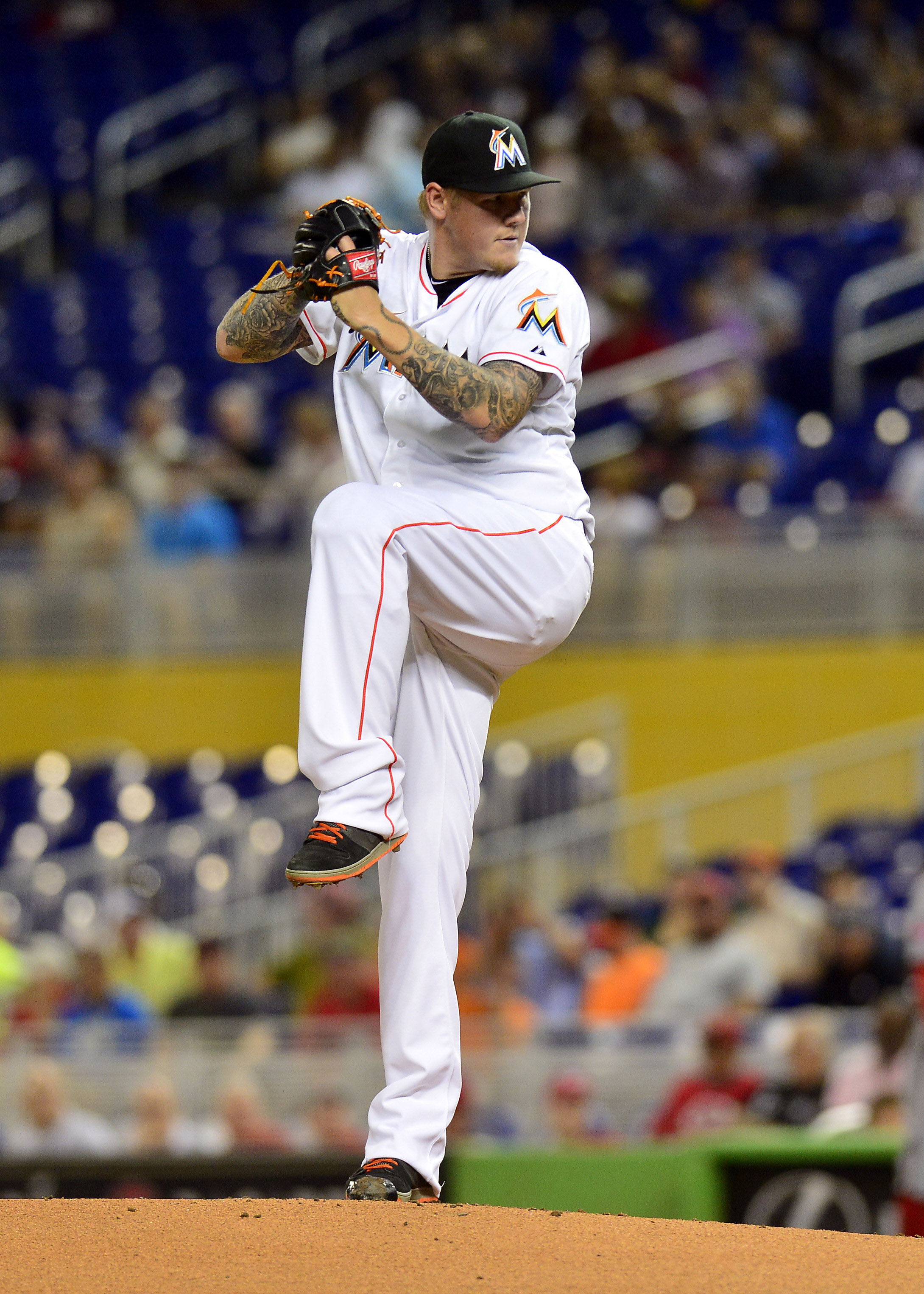
The Marlins currently sit at 34-46, a disappointing 9.5 games back from both the division lead and a Wild Card playoff berth. Mike Redmond has been fired and replaced as the on-field manager by former GM Dan Jennings. Stanton is on the disabled list with a broken hand, where he’s joined by Opening Day starter Henderson Alvarez as well Opening Day starters Mike Morse and Martin Prado. Miami has yet to throw in the towel according to multiple reports, but their starters are drawing interest from pitching-hungry teams. All of this brings us back to Latos, whose own 2015 shortcomings have contributed to the Marlins’ sub-par start.
Latos, 27, entered the season with a career 3.34 ERA at the Major League level despite spending three seasons with the Reds, whose home park is among the most hitter-friendly environments in the game. However, as of this writing, Latos is sporting a 5.27 ERA with the highest BB/9 rate he’s posted since debuting with the Padres in 2009. He’s earning $9.4MM after losing an arbitration hearing to the Marlins this winter and is slated to hit free agency at the end of the year. Of that $9.4MM, about $4.83MM remains, and Latos has already missed time this season due to inflammation in his left knee.
None of this paints Latos as a very flattering trade candidate, but there’s still a compelling case to be made that says he can help a team in need of pitching. Latos opened the 2014 season on the DL as he recovered from spring surgery on his left knee — the same knee that sidelined him in 2015. From the time of his activation in 2014 to the time he was placed on the DL in 2015, Latos averaged about 90.7 mph on his fastball — two full miles below the 92.7 mph he averaged from 2011-13.
However, since he’s come off the disabled list, Latos’ missing velocity has suddenly returned. A look at his velocity stats on BrooksBaseball.net indicates that his four-seamer is averaging 93.66 mph over his past four starts, and his sinker is averaging 92.95 mph. Both marks are two miles per hour faster than he averaged prior to hitting the DL. In fact, if you break down his average velocity on a game-by-game basis, his slowest average fastball in a start since coming off the DL is 92.42 mph. That mark is still better than even his best pre-DL days, in terms of radar readings.
Perhaps, then, it shouldn’t be surprising to see that Latos has worked to a much more palatable 3.86 ERA in his small sample of work since being activated. He’s whiffed 24 hitters against just six walks in 25 2/3 innings — each a significant improvement over his K/9 and BB/9 rates earlier in the year when working with diminished velocity. Latos has seen significant jumps in his whiff rate on both pitches since adding velocity, and the same holds true for his splitter as well.
It’s not known for certain whether Latos’ knee will hold up, nor can we definitively say that his velocity increase is sustainable. However, interested clubs will be able to watch another four weeks’ worth of his starts in order to make that determination for themselves. If Latos is back to the form that most came to expect of him from 2010-14, then suddenly, committing $4-5MM to him over the remainder of the season no longer looks to be an unreasonable undertaking.
The Marlins, in fact, could have good reason deal Latos even if they don’t otherwise act as sellers on the upcoming market. Aside from the obvious up-front financial savings that hold more value to a tight-budgeted team like Miami than a larger-payroll club, the Marlins may be reluctant to extend a qualifying offer to Latos following the season. The value of last year’s QO was a hefty $15.3MM, and that number figures to increase in 2015. A payroll-conscious team such as Miami could be reluctant to roll the dice on Latos remaining healthy for the rest of the season. If he re-injures the knee, the Fish would likely be too apprehensive to make a QO to an injured pitcher. Even if Latos remains healthy and looks like a good bet to reject the QO, Miami might find the small chance that he accepts somewhat risky. Trading him now, especially in a market that is currently tilted in favor of teams willing to sell assets, would be one way to ensure that they receive some long-term value in exchange for their relatively significant offseason investment in Latos.
The Marlins have the depth to replace Latos, as Jose Fernandez is now healthy and joined in the rotation by Dan Haren, Tom Koehler, Jarred Cosart and Latos. Even if Latos is dealt, David Phelps and Brad Hand both have experience starting in the Majors, and Alvarez is expected off the DL later this season. Jose Urena and Justin Nicolino represent rotation options in the upper minors.
The Tigers are said to have scouted Miami’s starters recently, though no interest in specific pitchers was mentioned, so it’s probably best not to read too much into that bit of info. (Multiple teams, after all, figure to be scouting Miami’s starters.) In addition to Detroit, though, plenty of other clubs are interested in adding to their rotation. The Blue Jays, Dodgers, Astros, Royals, Rangers, Yankees and Pirates are among teams that have been connected to pitching upgrades or speculated to eventually be in the market for rotation help.
Which Rule 5 Picks Are Still With Their New Teams?
There were 13 players selected in the Major League phase of the 2014 Rule 5 Draft, and nearly halfway through the year, a surprising percentage remain with their new clubs. Here’s a look at each of the Rule 5 picks, where they’re currently playing and if they have a chance to remain with their team…
- Oscar Hernandez, C, Diamondbacks: Selected out of the Rays organization despite never having appeared above Class-A, Hernandez broke his hamate bone in Spring Training and has been on the DL all season. As MLBTR’s Jeff Todd noted at the time, that actually made it a bit easier to get some time to evaluate Hernandez, as the D-Backs can see him on a Minor League rehab assignment and don’t have to roster such an inexperienced bat all season. Hernandez is on his rehab assignment now, and the early returns at the plate aren’t good (.200/.259/.280 in nine games). Jarrod Saltalamacchia‘s hit poorly, though, so perhaps the team will prefer Hernandez’s big arm for that spot.
- Mark Canha, 1B/OF, Athletics: Selected by Rockies out of the Marlins organization, Canha was immediately traded to Oakland for right-hander Austin House and cash. Canha hasn’t been great for the A’s, but he’s provided league-average production at the plate to go along with passable corner defense. At this point, it would be a surprise if Canha didn’t finish the season with the team.
- Delino DeShields, Jr., OF, Rangers: The Rangers plucked the former No. 8 overall pick out of the Astros organization, perhaps hoping that DeShields could be a speedy bench piece. DeShields, like the Rangers club as a whole, has been far better than most expected, hitting .269/.358/.386 and going 13-for-15 in stolen base attempts. A hamstring injury has had him on the DL for much of June, but he’s on a rehab assignment right now and should return to the team in short order. DeShields’ .368 BABIP will likely regress, but he’s been the game’s second most-valuable baserunner, per Fangraphs, despite his limited playing time. He certainly seems likely to remain with the Rangers.
- Jason Garcia, RHP, Orioles: The Astros were the team to technically select Garcia out of the Red Sox organization, but Houston quickly traded him to Baltimore for cash. Garcia pitched poorly in 13 innings to open the season before landing on the disabled list with a shoulder injury that has since seen him transferred to the 60-day DL.
- J.R. Graham, RHP, Twins: A former top prospect with the Braves, Graham was selected by the Twins on the heels of an injury-shortened 2014 season. He’s seen a lot of time in mop-up duty, but Graham has delivered a solid ERA, albeit with less encouraging peripherals. In 35 2/3 innings, hs has a 3.03 ERA with 6.8 K/9, 2.8 BB/9 and a 39.1 percent ground-ball rate. The Twins have said they plan to retain Graham, who’s averaging better than 95 mph on his fastball.
- Jandel Gustave, RHP: Gustave was selected by the Red Sox out of the Astros organization, then traded to the Royals. Kansas City tried to put him through waivers this spring but lost him to the Padres, who ultimately returned him to Houston. He has a 2.54 ERA but a 17-to-13 K/BB ratio in 28 1/3 innings with Houston’s Double-A affiliate.
- Taylor Featherston, INF, Angels: The Angels acquired Featherston for cash considerations after the Cubs selected him from the Rockies. The Halos seem committed to keeping Featherston, as he’s still on their roster despite just 60 plate appearances this season. The 25-year-old hasn’t hit — .127/.169/.218 — but he’s provided sound defense at three positions late in games and in his rare starts.
- Odubel Herrera, CF, Phillies: The Phillies nabbed Herrera out of the Rangers’ organization after a strong Double-A showing in 2014, and the infielder-turned-outfielder has seen the bulk of time in center for the Phils. He’s hitting just .251/.282/.359, but the Phillies are the exact kind of team that can afford to give a Rule 5 pick regular at-bats as opposed to costing him valuable reps via limited usage. He’ll remain with the team.
- Andrew McKirahan, LHP, Braves: The Marlins were the team to select McKirahan, but the Braves claimed him off waivers in Spring Training. McKirahan cracked the Opening Day roster with the Braves, but he pitched just 4 1/3 innings before being suspended 80 games for a positive PED test. The Braves will get a second look at him on a rehab stint in the minors before they have to make a call. He’s eligible to be activated on July 20.
- Sean Gilmartin, LHP, Mets: The Mets took Gilmartin out of the Twins organization and converted the former first-round pick (Braves, 2011) from a starter into a reliever. The result has been a 1.88 ERA with 6.8 K/9, 3.8 B/9 and a 50 percent ground-ball rate in 24 innings. Curiously, Gilmartin has significant reverse platoon splits in his first taste of big league action.
- Daniel Winkler, RHP, Braves: Winkler was the Braves’ actual selection out of the Rule 5. Winkler is recovering from 2014 Tommy John surgery and has yet to pitch in 2015 at any level. He’s on Atlanta’s 60-day DL.
- David Rollins, LHP, Mariners: Seattle took Rollins out of the Astros organization, and the lefty made a strong case in Spring Training to break camp with the team’s bullpen. However, he was suspended 80 games for PED usage and wound up on the restricted list. Rollins is on a rehab assignment now and could still pitch with the Mariners in 2015. Rollins has tossed 7 1/3 innings of scoreless ball in rehab and will have served his suspension after four more games.
- Logan Verrett, RHP: The only other player to be returned to his team at this point, Verrett was selected by the Orioles out of the Mets organization. Baltimore lost him on waivers to the Rangers, who carried him on the roster briefly before eventually returning him to the Mets. Since being returned, Verrett has debuted with his original organization at the big league level.
MLBTR Originals
A look back at the original reporting and analysis found on MLBTR the last seven days:
- On this week’s installment of the MLB Trade Rumors podcast, host Jeff Todd spoke with Grantland’s Jonah Keri to talk about the Diamondbacks’ recent decision making, as well as trade deadline possibilities for several other teams. A new episode of the MLB Trade Rumors Podcast will be released every Thursday and can be accessed on iTunes, SoundCloud, and Stitcher.
- On Saturday, Charlie Wilmoth took a detailed look at the Marlins’ trade chips. With Giancarlo Stanton out four to six weeks with a broken hamate bone, Miami now seems more likely than ever to sell this summer. Miami is short on top-notch trade chips, but rentals like Dan Haren and Mat Latos could draw some level of interest if they put together a couple of good starts in July. Veteran Martin Prado, if he shows that he’s healthy, could also get Miami something thanks to his versatility.
- In this week’s edition of the MLBTR chat, Steve Adams fielded a ton of questions, including inquires about Cole Hamels, Dillon Gee, Carlos Gomez, and much more. You can chat with Steve every Tuesday on MLBTR at 2pm CT.
A Look At The Marlins’ Trade Chips
As others have noted today, the news that Giancarlo Stanton will miss four to six weeks with a broken hamate bone increases the likelihood that the Marlins will reach a conclusion that they might have reached anyway: 2015 doesn’t appear to be their year. Under owner Jeffrey Loria, the Marlins have never been shy about change — they’ve traded players, replaced managers and changed organizational directions far more rapidly than other franchises might. Their 31-45 start already seemed likely to lead them to sell, even before Stanton’s injury.
In fact, this year’s Marlins team bears certain similarities to their 2012 club. The 2012 team headed into the offseason intending to make a splash. Instead, they flopped, and in July, they dealt Carlos Lee, Anibal Sanchez, Omar Infante, Hanley Ramirez, Randy Choate, Edward Mujica and Gaby Sanchez.
What do the 2015 Marlins have to sell, though? This year’s team doesn’t appear to be primed for a complete rebuild, and thus it doesn’t have many top-quality trade chips like Ramirez or Anibal Sanchez. The Marlins still have Stanton and Christian Yelich signed to long-term deals, and Jose Fernandez is cost-controlled and is clearly an elite pitcher when healthy. The Marlins seem highly likely to keep those players, even though Yelich is having a disappointing season and Fernandez is only on the verge of returning from Tommy John surgery. Here’s a look at who the Marlins could consider trading.
- Dan Haren and Mat Latos are eligible for free agency after the season, so they seem like obvious trade candidates. The question is what the Marlins will be able to get back. Haren is having a solid season, but he seemed mostly unwanted as of last winter, and his age (34) and stuff (Haren’s admirably self-effacing “Ithrow88” Twitter handle isn’t even accurate anymore, since his fastball has averaged 86 MPH this season) suggest he won’t fetch much now, either. Still, useful starting pitching is useful starting pitching, and the Marlins might try convincing a team in a homer-suppressing ballpark to give up a prospect or two for Haren. The Phillies got two fairly good lottery tickets in Victor Arano and Jesmuel Valentin for Roberto Hernandez last year — that might provide a good template, even though the stock of both players has slipped in 2015. The Marlins might also have to convince Haren to play for the team they trade him to if it’s not a West Coast team, given that he considered retiring last offseason rather than heading to Miami.
- Latos currently has a 5.49 ERA and missed time due to a knee injury, so his trade value would appear very limited. Since he would only be a rental, there would be little point in a contending team taking him on as a project, even though his peripherals suggest he should be somewhat better than that ERA. The curse of struggling teams trying to become deadline sellers is that they typically mostly have disappointing players to sell, and Latos is a case in point. It’s not impossible, though, that Latos could raise his trade value by pitching well over the next month.
- As the New York Post’s Joel Sherman pointed out today, Martin Prado‘s versatility could make him an interesting trade chip next month, since he can play third base, second base and both outfield corners. First, though, he’ll have to show he’s healthy — he’s currently on the disabled list with a shoulder injury. He’s owed $11MM both this year and next, although the Yankees are paying $3MM in each of those years.
- Pitchers Tom Koehler and Brad Hand were both recently the subject of rumors. Koehler missed a start last week with neck and back pain, but his successful return today should help the Marlins’ cause if they choose to trade him. The problem is that neither Koehler nor Hand are the kinds of difference-makers most appealing to contenders — a contending team likely wouldn’t want either one of them starting a playoff game. And since they’re also cheap and capable of eating innings, they could have value to the Marlins as they retool. David Phelps, who has been solid but not outstanding in his first season in Miami, falls into the same category.
- Mike Dunn isn’t having a good season by traditional measures, with a 4.68 ERA, but his strikeout rate (9.0 K/9 in 2015) and velocity remain intact, so a contender might view him as a sneaky way to upgrade the left side of its bullpen, especially since his contract is reasonable. He’s signed through next season, though, so the Marlins could also decide the better route might be to keep him around for another year and hope he rebounds.
- Like Dunn, Steve Cishek has a poor ERA this year. Unlike Dunn, though, Cishek isn’t cheap, at $6.65MM, and his control issues are a key reason for his downturn in performance. It would likely be hard for the Marlins to deal Cishek without taking on salary, despite his closer pedigree.
- Infielder Jeff Baker is a career .297/.352/.513 hitter against lefties, so he could conceivably help a contender in need of a right-handed bat. He’s mostly limited to first base at this point, however, so his utility is limited.
Other Marlins veterans, like Michael Morse and Ichiro Suzuki, probably have even less trade value than most of the players mentioned above. The Marlins could, of course, make outside-the-box trades involving some of their better, younger players (Dee Gordon, Adeiny Hechavarria, Marcell Ozuna), and given the Marlins’ history, it would be unwise to discount that possibility. (Relievers A.J. Ramos and Carter Capps would make very interesting trade pieces if the Marlins were to make them available.) Unlike the 2012 team, though, the 2015 Marlins don’t have many veteran trade candidates who appear likely to command a significant return.
MLBTR Originals
A look back at the original reporting and analysis found on MLBTR the last seven days:
- On this week’s installment of the MLB Trade Rumors podcast, host Jeff Todd spoke with Steve Adams to discuss the growing departure from traditional “buyers” and “sellers” in baseball. Jeff then theorized about the Reds moving Aroldis Chapman. A new episode of the MLB Trade Rumors Podcast will be released every Thursday and can be accessed on iTunes, SoundCloud, and Stitcher.
- Earlier today, MLBTR was the first to learn that Royals catcher Erik Kratz was claimed off waivers. Minutes later, the Red Sox announced that they were the claiming team.
- If you haven’t already, sign up for the MLB Trade Rumors newsletter today! Every week, site owner Tim Dierkes delivers an exclusive article to newsletter subscribers. The most recent entry is entitled, “How The Red Sox Should Have Rebuilt Their Rotation.” To check out the next in-depth piece, simply provide us with your email address. We will never sell your email address or market anything to the mailing list, and you can unsubscribe easily.
- In this week’s edition of the MLBTR chat, Steve Adams fielded a ton of questions, including inquires about the Padres’ managerial opening, Ryne Sandberg’s job security, Johnny Cueto‘s trade candidacy, the possibility of a Bryce Harper extension, and more. You can chat with Steve every Tuesday on MLBTR at 2pm CT.
Red Sox Claim Erik Kratz Off Waivers
12:56pm: The Red Sox announced that they have claimed Kratz off waivers. Kratz will provide the team with depth now that Blake Swihart is listed as day-to-day with a sprained left foot.
12:28pm: Erik Kratz has been claimed off waivers by an unknown team, MLBTR has learned. The catcher was designated for assignment by the Royals on June 11th.
The claiming team is currently unknown, but the Mets and Red Sox both saw catchers leave the game with injury yesterday. The Mets, however, already have depth behind the plate in Kevin Plawecki and Anthony Recker, so the Red Sox might be the more probable destination.
Most of Kratz’s career has been spent with the Phillies, but he’s also had brief stints in Toronto and Kansas City. All told, Kratz has shown nice power but low batting average and on-base capabilities, as evidenced by a .217/.270/.400 batting line. He’s also a skilled pitch-framer, however, and he’s thrown out 32 percent of attempted base-stealers in his big league career.
Kratz was scheduled to return from the 15-day disabled list earlier this month but was designated for assignment before he could be called back into action for KC. Kratz would have served as Salvador Perez‘s backup in Kansas City had he stayed on board, but that job has gone to Drew Butera instead.
MLBTR Originals
A look back at the original reporting and analysis found on MLBTR the last seven days:
- On this week’s installment of the MLB Trade Rumors podcast, host Jeff Todd spoke with right-hander Barry Enright about his journey through the game, which took him to the big leagues and has most recently brought him to the Mexican League’s Tijuana Toros. Then, Jeff checked in with Joe Sheehan of Sports Illustrated and the Joe Sheehan Newsletter to talk about the Red Sox and more. A new episode of the MLB Trade Rumors Podcast will be released every Thursday and can be accessed on iTunes, SoundCloud, and Stitcher.
- Earlier today, MLBTR was the first to report that Jo-Jo Reyes signed a minor league deal with the Angels. Reyes, who was named an All-Star in the Mexican League two weeks ago, will report to Triple-A Salt Lake. Reyes aims to return to the majors for the first time since 2011.
- Prior to the start of the draft on Monday, Steve Adams put together a comprehensive primer to get fans up to speed.
- Hey, sabermetricians! MLBTR is looking for someone to spearhead a paid statistical research project. Click here for details.
Angels Sign Jo-Jo Reyes
The Angels have signed Jo-Jo Reyes, a source tells MLBTR. The veteran left-hander will report to Triple-A Salt Lake.
Reyes, 30, was previously with Campeche of the Mexican League and was named an All-Star there roughly two weeks ago. Reyes last appeared in the big leagues in 2011 and will work towards reaching the majors once again in 2015. In that 2011 season, Reyes pitched to a 5.57 ERA in 25 starts and four relief appearances for the Blue Jays and Orioles. He posted a 5.6 K/9 rate versus a 3.1 BB/9.
He’s also quite familiar with the Triple-A level, having spent parts of seven seasons there. Reyes owns a 3.68 ERA with 7.2 K/9 and 2.7 BB/9 in Triple-A for multiple teams.