
Guardians Claim Ramon Laureano
The Guardians announced that they’ve claimed veteran outfielder Ramon Laureano off outright waivers from the A’s. He was designated for assignment by Oakland over the weekend.
As a reminder, Major League Baseball did away with revocable August trade waivers five years ago. Laureano was claimed off (irrevocable) outright waivers. He’s now under Guardians club control through the 2025 season, and Cleveland will pick up the remainder of this year’s $3.55MM salary. The Guards currently have MLB’s tenth-worst record, indicating that the eight non-A’s clubs ahead of them — Royals, Rockies, White Sox, Cardinals, Nats, Tigers, Mets, Pirates — all passed on putting in a claim.
Just two years ago, the notion of Laureano being placed on waivers would’ve seemed difficult to fathom. From 2018-21, the now-29-year-old Laureano was a core piece in Oakland, batting a combined .263/.335/.465 (119 wRC+) and coupling that production with strong baserunning, respectable glovework in center and plus defense in right field.
Laureano, however, was hit with an 80-game PED suspension midway through the ’21 campaign and has never regained his footing. He was suspended for the final couple months of play in 2021, and that ban lingered into the 2022 season. He’s since missed time with oblique, groin and hamstring strains, as well as a fractured hand. Since returning from that PED suspension, Laureano has four IL trips and a collective .212/.285/.371 batting line in 158 games/629 plate appearances — effectively one full season’s worth of games.
The A’s have surely had varying levels of trade interest in Laureano over the past couple years, but they’ve understandably opted against selling low on a player whose value was once considerable. Unfortunately for the club, they’ll now lose Laureano for nothing more than the $1.07MM in salary relief they’ll gain with Cleveland claiming the outfielder and his contract. It’s a sub-par outcome that’ll draw ire from fans and criticism from pundits — particularly given the lackluster results of the current rebuilding effort. Laureano would likely have been non-tendered rather than given a raise this winter, so once a trade failed to materialize prior to the deadline, the A’s apparently shifted gear and simply looked to recoup some of salary obligation.
The final two months of the season will serve as an audition for Laureano in Cleveland, where outfield production is a near-annual concern. Guardians outfielders are batting a combined .248/.310/.342 this season, and the resulting 81 wRC+ (i.e. 19% worse than the MLB-average hitter) places the Cleveland outfield 29th of all 30 teams, leading only the last-place Royals. Steven Kwan is the only Guardians outfielder with even average offensive output at the plate this season, so the chance to buy low on Laureano for a cost of just over $1MM is a sensible roll of the dice for the team.
Laureano will at the very least provide a right-handed-hitting complement to lefty-swinging Will Brennan in right field, but the production (or lack thereof) from Brennan and center fielder Myles Straw is glaring enough that there ought to be an opportunity for Laureano to claim a larger role if the change of scenery proves beneficial.
Cole Hamels Retires
The Padres announced Friday that veteran left-hander Cole Hamels, who’d signed a minor league deal in hopes of working his way back to the Majors in San Diego, has ended that comeback bid and retired.
Hamels, 39, was drafted by the Phillies with the No. 17 overall pick out of San Diego’s Rancho Bernardo High School back in 2002. By the time he’d wrapped up his first professional season — with 101 innings of 1.34 ERA ball — he’d vaulted up prospect rankings, checking in as the game’s No. 17 farmhand on Baseball America’s top-100.
While many first-round picks and top prospects fail to live up to those billings, Hamels shattered expectations and went on to become one of the generation’s finest pitchers. Despite being drafted out of high school, he reached the Majors less than three years after his selection, debuting with five shutout innings against the Reds in May 2006. Hamels posted a modest 4.08 ERA in 132 1/3 innings as a rookie but broke out with an All-Star season that saw him finish sixth in NL Cy Young voting the following year.
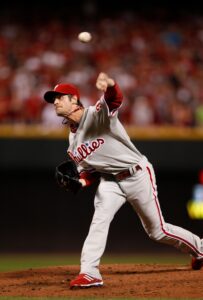
From 2006-15, Hamels starred for the Phillies. He and teammates Chase Utley, Ryan Howard and Jimmy Rollins became synonymous with the Phillies organization during their halcyon days, serving as the foundation that ultimately brought a World Series title to the city in 2008. Hamels was sensational that season, firing 227 1/3 innings of 3.09 ERA ball, but he saved his best work for the postseason. On the game’s biggest stage, Hamels pitched 35 innings with a 1.80 ERA, compiling a 4-0 record and taking home MVP honors in both the National League Championship Series and in the World Series.
Hamels helped the Phils back to the postseason in each of the following three years. They repeated as NL champs in 2009 before dropping the World Series to the Yankees. Hamels had a relative down season in ’09 but rebounded to fire 208 2/3 frames of 3.06 ERA ball the next year. He secured his second All-Star nod and a fifth-place Cy Young finish with a 2.79 ERA over 216 frames in 2011.
The Phillies’ run of team success came to a close after that season. Philadelphia wouldn’t make the playoffs again until last year’s club took home another pennant. The down stretch of Philadelphia baseball was no fault of Hamels. He reached 30 starts each season from 2012-14 and posted an ERA below 3.60 in every year. Hamels secured another All-Star nod in 2012 and down-ballot Cy Young votes in two of those three years.
Midway through the 2012 campaign, the Phils signed him to a $144MM contract extension. While Hamels more than lived up to that investment, the team’s descent into a rebuild eventually led them to put him on the trade market. At the 2015 deadline, Philadelphia sent Hamels to Texas for a prospect package including Jorge Alfaro, Nick Williams and Jerad Eickhoff.
The young talent never really panned out for the Phils, but Hamels kept producing in Texas. He’d throw 546 2/3 frames of 3.30 ERA ball as a Ranger, securing a fourth All-Star nod in 2016 and helping Texas to a pair of playoff berths. At the 2018 deadline, a then-rebuilding Texas club shipped him to the Cubs. Hamels provided Chicago with 12 starts of 2.36 ERA ball for the stretch run. The Cubs brought him back on a $20MM club option; he’d pitch to a 3.81 ERA over 27 starts the following season.
Hamels signed with the Braves over the 2019-20 offseason. Shoulder injuries limited him to one 3 1/3 inning appearance during the shortened schedule — which would unfortunately prove his final MLB outing. Shoulder injuries have derailed subsequent comeback attempts with the Dodgers and San Diego over the last three years.
While injuries robbed Hamels of his final couple seasons, he was one of the sport’s most durable and effective pitchers for well over a decade. The southpaw had 10 years in which he reached at least 190 innings, including eight seasons of 200+ frames. Only Justin Verlander logged a higher workload between 2006-19. Hamels posted a sub-4.00 ERA in 11 of his 14 seasons (excluding his one-start 2020), a remarkable stretch of consistency.
All told, Hamels threw just under 2700 innings while allowing 3.43 earned runs per nine. He won 163 games, struck out 2560 hitters and threw 17 complete games. He had a 3.41 ERA over 100 1/3 career postseason frames — highlighted by the aforementioned 2008 run to a title and World Series MVP. MLBTR congratulates Hamels on a fantastic career and wishes him the best in retirement.
Image courtesy of USA Today Sports.
Padres Shut Down Joe Musgrove With Shoulder Inflammation
The Padres are shutting down starter Joe Musgrove for three weeks after an MRI revealed inflammation in the capsule of his throwing shoulder, the team informed reporters (including Dennis Lin of the Athletic). While the club is hopeful he’ll be able to return at some point this season, he doesn’t figure to be back until well into September at the earliest.
San Diego placed Musgrove on the 15-day injured list before today’s matchup with the Dodgers. Trade pickup Rich Hill takes his spot on the active roster. San Diego also reinstated Eguy Rosario from the 60-day injured list and optioned him to Triple-A. The Friars cleared a 40-man spot by designating Brent Honeywell for assignment a couple days ago.
Musgrove began the season on the IL after breaking his toe in a Spring Training weight room accident. He was back on the Petco Park mound by late April and has again been one of the sport’s better starters. Over 17 appearances, the righty has tallied 97 1/3 innings of 3.05 ERA ball. He’s striking hitters out at a 24.3% clip against a tidy 5.3% walk rate.
It’s the kind of production the Friars have come to expect from the 30-year-old righty. Musgrove has an ERA of 3.18 or better in each of the past three seasons. He posted a career-low 2.93 mark over 30 starts last season. Midway through the year, the San Diego native signed a $100MM extension — seemingly sacrificing some earning upside to stick with his hometown club.
It doesn’t seem the Friars were aware of the seriousness of Musgrove’s injury at the deadline. The club scratched him from his scheduled start Wednesday morning but initially hoped he’d return to the mound next week. That won’t happen but makes their Tuesday acquisition of Hill all the more important. The former Pirate will assume a rotation role behind Blake Snell, Yu Darvish, Seth Lugo and perhaps Nick Martinez. Righty Michael Wacha is also on the shelf with a shoulder issue.
Rosario, 23, debuted with seven games for the Friars last season. He’d missed the first four months after breaking his ankle over the offseason.
Mariners Release Kolten Wong
The Mariners announced Friday that infielder Kolten Wong has cleared waivers and been released. Seattle had designated the veteran second baseman for assignment in the waning hours before the trade deadline.
That DFA officially ended a disappointing Seattle tenure. The M’s acquired Wong from the Brewers last offseason, sending Jesse Winker and Abraham Toro to Milwaukee in a change-of-scenery deal that hasn’t worked for anyone involved. Wong opened the season as the M’s second baseman but played his way to the bench with a career-worst showing.
Over 67 games, the veteran hit .165/.241/.227 with just a pair of home runs. His walk and strikeout numbers each went in the wrong direction, while his rate of hard contact plummeted by ten percentage points. Wong’s bat-to-ball skills and strike zone awareness remained slightly above-average, but he rarely made an impact when he put the ball in play.
While power has never been Wong’s strong suit, he’s topped double-digit homers on five occasions — including each of his two years in Milwaukee. He’s stolen only one base after swiping 17 last season. The Mariners have turned to rookie José Caballero as their primary second baseman of late and acquired left-handed hitting Josh Rojas as a versatile infield piece in the Paul Sewald deal.
Wong’s defense has also dropped over the past couple seasons. A two-time Gold Glove winner, he was one of the sport’s top keystone defenders at his peak. Public defensive metrics rated him well below-average last season, however. Wong said late in the year he’d been playing through a leg issue that sapped some of his mobility. That offered some hope for a defensive rebound that hasn’t really materialized. Wong logged 513 1/3 innings at second base for Seattle. Defensive Runs Saved pegged him five runs below par, while Statcast estimated him one run worse than average.
In the immediate aftermath of Wong’s DFA, reports suggested the Red Sox had engaged the M’s in trade talks. No deal came to fruition by the deadline, making a release an inevitability. Wong long surpassed the five-year service threshold which allows players to refuse a minor league assignment while retaining the guaranteed money on their contract.
Wong is playing on a $10MM option, which the Brewers had exercised before trading him. Seattle took on that money in the deal. He is due around $3.12MM through season’s end. The M’s will pay virtually all of that sum. Any team that signs Wong would owe him the prorated $720K minimum rate for time spent on the big league roster, which comes out of Seattle’s obligations.
Rays To Promote Curtis Mead
The Rays are planning to call up top infield prospect Curtis Mead for his Major League debut today, reports Marc Topkin of the Tampa Bay Times. He’ll take the roster spot that was vacated when ace Shane McClanahan was placed on the injured list yesterday. Mead is already on Tampa Bay’s 40-man roster.
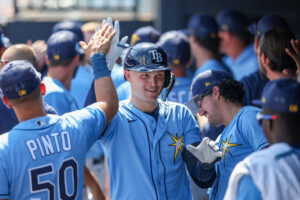
Mead, 22, came to the Rays in what originally looked like a minor swap with the Phillies but could end proving impactful for both clubs. Tampa Bay sent lefty Cristopher Sanchez to Philadelphia back in November of 2019, and while he’s has reached the Majors and contributed quite nicely this season (2.66 ERA in nine starts), Mead is widely regarded as one of the game’s most advanced hitting prospects. He checks in at No. 31 on MLB.com’s ranking of the sport’s top 100 prospects and also checks in at No. 67 over at Baseball America and No. 20 at FanGraphs. The Australian-born infielder has spent time at third base, second base and first base throughout his time in the minors, with many scouting reports on him pegging him as a long-term second baseman due to questions about his arm strength at third base.
There’s little questioning Mead’s hit tool, however. He’s punched out in just 12.8% of his plate appearances at Triple-A and just 15.7% of his minor league plate appearances overall. He’s hitting .291/.379/.453 this season, albeit with just three home runs on the year. He’s tacked on 16 doubles and a pair of triples as well, and his impressive 12.8% walk rate couples with that high-end hit tool to drive that strong on-base percentage.
Despite the meager power output in 2023, scouts still give Mead anywhere from above-average (55) to plus (60) raw power on the 20-80 scale. He missed the second half of the 2022 season with an elbow strain and he also missed time earlier this year after being plunked on the wrist. It’s quite possible those injuries have tamped down his power somewhat this year; he swatted 13 home runs in 331 plate appearances last season before hitting the injured list.
FanGraphs’ Eric Longenhagen calls Mead “one of the more dangerous hitters in the minor leagues,” touting his simple swing, his all-fields power and a rapidly improving approach at the plate that makes him a more complete hitter. Jim Callis and Jonathan Mayo of MLB.com credit him with a hefty 65-grade hit tool on the 20-80 scale and peg him for an eventual 20 to 25 home runs on an annual basis. Baseball America is even higher on the offensive profile, tabbing him with a 70 hit tool and projecting 25-plus homers per year. All three outlets raise concerns about his throwing strength and his eventual position, but there’s a strong consensus that Mead’s bat will make him a productive everyday player regardless.
As with just about any Rays prospect, Mead’s exact role with the big league team probably will be difficult to peg. Tampa Bay has Yandy Diaz at first base, Brandon Lowe at second base and Isaac Paredes enjoying a breakout season at third base. There are certainly at-bats to be had at designated hitter, where the team has used a rotating cast of characters — Harold Ramirez chief among them. Manager Kevin Cash will probably work Mead into the mix at various positions for the time being, while Mead’s ongoing defensive development will determine where he lands on the diamond in the long-term.
As things currently stand, Mead can be controlled all the way through the 2029 season and won’t be arbitration-eligible until after the 2027 campaign, although future optional assignments can alter those timetables.
Yankees Place Domingo Germán On Restricted List Due To Alcohol Abuse
August 3: Germán’s entry into a treatment program was preceded by an incident in the Yankees’ clubhouse, reports Lindsey Adler of the Wall Street Journal. According to the report, the pitcher was apparently intoxicated when he entered the clubhouse in preparation for the Yankees’ game on Tuesday. Adler writes that Germán argued with teammates and manager Aaron Boone and flipped a couch amidst those confrontations. He eventually went into the stadium nap room while the rest of the team prepared for the game.
August 2: “Domingo Germán has agreed today to voluntarily submit to inpatient treatment for alcohol abuse,” the Yankees said in a press release today. “He will be placed on the restricted list for the time that he is away from the club. It is critical that Domingo completely focuses on addressing his health and well-being. We will respect his privacy as he begins this process.”
General manager Brian Cashman met with reporters this evening (relayed by Bryan Hoch of MLB.com and Andy Martino of SNY). The GM said Germán has battled alcohol issues in the past and had an incident — about which he declined to go into detail — yesterday. As the team did in its statement, Cashman expressed that his foremost concern is for Germán and his family. The right-hander will not return to the playing field this season.
Germán, 30, has pitched for the Yankees since 2017. He was suspended for the entire shortened 2020 schedule after violating the MLB – MLBPA domestic violence policy the preceding September. He returned to the club in ’21 and has worked mostly out of the rotation in the three years since then. Germán etched his name into the history books six weeks ago, throwing a perfect game in Oakland on June 28.
Altogether, Germán carries a 4.56 ERA through 20 appearances on the season. Players on the restricted list aren’t paid or credited with MLB service, so Germán will forfeit what remains of this year’s $2.6MM salary (roughly $838K). He’d been on track to surpass five years of service this season but seems likely to now fall a bit shy of that mark. He’ll be eligible for arbitration again during the upcoming offseason.
Rays Place Shane McClanahan On Injured List
6:40pm: Tampa Bay has officially placed McClanahan on the IL, Topkin tweets. The club said they are “in the process of gathering further information” and will provide updates when they become available.
6:13pm: The Rays plan to place Shane McClanahan on the 15-day injured list, tweets Marc Topkin of the Tampa Bay Times. The two-time All-Star felt some soreness on the outside of his forearm during yesterday’s start against the Yankees.
Tampa Bay sent McClanahan for imaging this morning. Topkin that the Rays still don’t have a set diagnosis from initial testing. The 6’1″ left-hander is slated for further evaluation in the coming days but will need at least two weeks on the shelf.
Until there’s more clarity on the issue, the overall timetable remains unknown. Yet even a best-case scenario for the Rays sees them lose arguably their best pitcher for a couple weeks while they battle for a division title. Tampa Bay has gone 26-27 since the start of June, a couple months of average play after their league-best performance through May. As a result, they’ve dropped two games back of the Orioles in the AL East.
They’re still in great shape to secure a playoff spot. The Rays sit three games clear of the second-best Wild Card team and 7.5 up on the top non-playoff club. They’ll need to track down Baltimore to snag a first-round bye, though, and any extended absence from McClanahan would only make that more challenging.
The 26-year-old was on a Cy Young pace last year before a late-season shoulder impingement knocked him to sixth in the voting. He hasn’t been quite as good this season but remains one of the top pitchers in the sport. Through 115 innings, McClanahan carries a 3.29 ERA with a strong 25.8% strikeout rate. He missed a couple weeks earlier in the season with back tightness but returned not long after a minimal stay on the shelf.
Pitching injuries have been an all too familiar occurrence for Tampa Bay this year. The Rays were without Tyler Glasnow early and lost Jeffrey Springs and Drew Rasmussen to season-ending surgeries midway through the season. They dealt top first base prospect Kyle Manzardo to Cleveland for Aaron Civale to fortify the starting staff. That acquisition could take on even more importance if McClanahan misses a notable chunk of time. Tampa Bay optioned rookie Taj Bradley to Triple-A after acquiring Civale; he’d seem the likeliest candidate for a recall to take McClanahan’s active roster spot.
Liam Hendriks Undergoes Tommy John Surgery
The White Sox announced this evening that star closer Liam Hendriks has undergone Tommy John surgery. According to the club, he’ll require a 12-14 month recovery timeline.
Hendriks has been on the injured list since the second week of June with what the team initially called elbow inflammation. There’d been no prior indication surgery was under consideration. As of a couple weeks ago, the righty had been throwing simulated games. He apparently suffered a setback during that rehab work and will now miss the majority or all of next season.
It’s a disheartening blow. Hendriks’ quick return from an offseason non-Hodgkin’s lymphoma diagnosis has been one of the best stories of the 2023 season. He announced his diagnosis in early January. Within roughly three and a half months, he’d completed chemotherapy and been declared cancer-free. He was remarkably back on a major league mound by May 29.
Certainly, the revelation he’d require elbow surgery pales in comparison to the life-threatening news he’d gotten (and overcome) just months before. Yet it’s an obviously tough development for his playing career. Hendriks turns 35 next February. There’s a good chance he’s unable to return to pitching until his age-36 campaign.
Between the late start to the season and the subsequent elbow injury, the three-time All-Star only made five MLB appearances this year. He was one of the top handful of relievers in the sport between 2019-22. Hendriks broke out late in his career with Oakland and maintained that elite performance for his first two seasons with the Sox. Over that four-year stretch, he posted a 2.26 ERA with an elite 38.8% strikeout rate across 239 innings.
With this revelation, it’s possible Hendriks has thrown his last pitch for Chicago. His three-year, $54MM free agent contract contained a $15MM club option for 2024. The deal came with a matching buyout figure — it was built in largely as an accounting measure to frontload the contract’s competitive balance tax hit — that’ll now come into play. If the Sox buy Hendriks out, they’ll be able to defer that payment over the next 10 years.
That’s the course of action they’ll almost certainly take. With Hendriks unlikely to pitch in 2024 regardless, there’s little reason for the Sox not to pay the $15MM in installments. Hendriks figures to return to free agency next winter, where he could field two-year offers from teams with an eye towards the 2025 campaign.
Scherzer: Mets Planning 2024 As “A Kind Of Transitory Year” With Focus On 2025-26
The Mets had a Major League record payroll of close to $357MM on Opening Day, as they followed up their 101-win season in 2022 with an incredibly aggressive offseason. However, just as the Mets broke new ground in building their roster, they have also been as aggressive in pivoting in the wake of a very disappointing four months.
With just a 50-55 record entering today’s action, the Mets have been one of the trade deadline’s busiest teams, unloading both major and minor names, rental players and some players controlled beyond the 2023 season. The long list of players departing Queens in the last six weeks includes Max Scherzer, Justin Verlander, David Robertson, Tommy Pham, Mark Canha, Dominic Leone, and Eduardo Escobar, as the Mets have pursued a strategy of absorbing most of the salaries of those departed players in order to obtain more young talent in return.
As Scherzer told The Athletic’s Ken Rosenthal, the Mets’ plan apparently extends to rebuilding not for the 2024 season, but for future seasons. Scherzer had to waive his no-trade protection in order to be dealt to the Rangers, and before making his decision, the ace first spoke with GM Billy Eppler and the Amazins’ longer-term plans.
According to Scherzer, “I was like, ‘OK, are we reloading for 2024?’ [Eppler] goes, ‘No, we’re not. Basically our vision now is for 2025-2026, ’25 at the earliest, more like ’26. We’re going to be making trades around that.’ I was like, ‘So the team is not going to be pursuing free agents this offseason or assemble a team that can compete for a World Series next year?’ He said, ‘No, we’re not going to be signing the upper-echelon guys. We’re going to be on the smaller deals within free agency. ‘24 is now looking to be more of a kind of transitory year.’ ”
A follow-up chat between Scherzer and Mets owner Steve Cohen took the same tack, which inspired Scherzer to waive his no-trade clause and approve the deal to the Rangers. “That’s basically what Steve said: ‘I never thought in a million years we’d be in this situation, being at the deadline and we’re actually selling. But the math is the math. And the math says this organization needs to retool.’ That was Steve saying that. I said, ‘I get it. I’m not here to say you’re wrong.’ It is what it is. I understand from Steve’s perspective that’s the direction he wants to take the team based on where everyone is at within their contracts, arbitration, free agency. That was the new vision for the Mets.”
However, Scherzer also noted that “if they had said, ‘We’re going to hold on to all the ‘24 pieces,’ that would have been a different story.”
“But they were saying no, we’re going to be moving players that are under contract for 2024 before the deadline. We walked through some players I had in mind who would be that. It turned out it was much more extensive than that. The players we ended up talking about who are free agents after ‘24, they were more substantial names. Any player who was a free agent after 2024 at the right price could be moved right now at the deadline. That’s a completely different vision from what everybody had in the clubhouse. All the players had a vision of, we reload for 2024. That was no longer the case.”
Scherzer (who had an opt-out clause), Canha ($11.5MM club option for 2024), and Verlander were the only players controlled beyond 2023 who ended up being moved, as the likes of Jose Quintana and other club-option players like Brooks Raley, Omar Narvaez, and Adam Ottavino are all still with New York. Still, obviously moving two cornerstone aces like Scherzer and Verlander marked a severe change in direction for the Mets’ plans, as trading either pitcher in a deadline deal would’ve seem far-fetched given the hefty investment made in both future Hall-of-Famers over the last two winters. Verlander was signed to a two-year, $86.67MM with a conditional player option for 2025, while Scherzer came to Queens in the 2021-22 offseason on a three-year, $130MM pact.
In the wake of Scherzer’s trade, Eppler stated to reporters that “I do want to be clear that it’s not a rebuild. It’s not a fire sale. It’s not a liquidation. This is just a repurposing of Steve’s investment in the club, and kind of shifting that investment from the team into the organization.” Talking with media (including SNY’s John Flanigan) today, Eppler didn’t comment on Scherzer’s statements to Rosenthal, but expanded on his previous statement and reiterated that the Mets weren’t going to tank.
“One of the goals here is to expedite the longer-term goal. We’re trying to restock and reload the farm system,” Eppler said. “You have to go through a little pain to get where we want to go, but I feel like the organization is making strides towards a better future…..Going into 2024 we don’t see ourselves having the same odds that we did in 2022 and 2023, but we will field a competitive team.”
Cohen made similar remarks in a text to Jon Heyman of the New York Post, saying “We will be competitive in ’24 but I think 25-26 is when our young talent makes an impact. Lots of pitching in free agency in ’24. More payroll flexibility in ’25. Got a lot of dead money in ’24.”
Since buying the Mets in November 2020, Cohen has been quite open about his bigger-picture dream for the club — citing the Dodgers as the model, Cohen wanted to field a consistent contender with the resources to acquire premium free agents or trade targets, but largely fueled by star talent developed by the Mets’ own farm system. Cohen didn’t want to wait for that prospect base to be fully built before the Mets started winning, however, and said that he would spend heavily to make the team a contender in the interim.
As it has turned out, this initial plan might just result in one winning season in Cohen’s first three years running the club. The Mets were 77-85 in 2021, are on pace for a losing record this year, and even the 101-win performance last year was muted when the Padres ousted them in the wild card series. Rather than splurge again to restock a flawed roster for 2024, it makes sense that Cohen and Eppler might view taking a step back in order to hopefully two steps forward in 2025 or 2026, rather than continue to tread water in a competitive NL East. The Braves look like surefire contenders for years to come, the Phillies won the NL pennant last year, and the Marlins have also gotten themselves back into the playoff race.
The new direction opens a wealth of new possibilities for the Mets this coming offseason. It can be assumed that highly-touted youngsters Francisco Alvarez and Brett Baty aren’t going anywhere, if New York wants to expand its young core. Players recently signed to longer-term contracts or extensions (i.e. Francisco Lindor, Kodai Senga, Jeff McNeil, Brandon Nimmo, Edwin Diaz) aren’t likely to be moved either, since this group will all still be around during the Mets’ new timeline for contention.
Beyond that core, it’s fair to wonder if any other Mets player might be on the trade market this winter. That includes Jose Quintana (signed through 2024) and Starling Marte (signed through 2025), as while neither has amassed much of a track record in 2023, the Mets have shown that they’re more than willing to eat money to accommodate trades. The biggest question mark might hang over Pete Alonso, as the slugger has one final arbitration-eligible year remaining before he enters free agency following the 2024 campaign.
Roster Resource projects that New York has roughly $204.2MM on the books for 2024 already, but a step back from contention might also logically mean a desire for the team to reset its luxury tax status. The Mets obviously blew past the highest tax levels in both 2022 and 2023, but getting out of tax territory entirely ($237MM is the lowest threshold level in 2024) would both reduce the team’s financial penalty, and more importantly the asset-related penalties attached with tax overages. For instance, the Mets would be able to sign qualifying-offer free agents for a lesser cost of draft picks, while also netting a higher draft return for any of their own free agents who reject a QO and sign elsewhere. In other punishment for incurring such a high tax bill in 2022, the Mets also had their first pick in the 2023 draft pushed back by ten slots, and their international signing pool was reduced.
If the Amazins aren’t planning to be big spenders this winter, that naturally has a big impact on this offseason’s free agent class, given how Cohen’s largesse has driven the market over the last two years. Given the relatively thin nature of the 2023-24 class, the Mets front office might be planning to capitalize by using some of their roster as trade chips, as rival clubs might not find what they’re looking for in free agency. As Cohen noted, there are plenty of interesting pitchers available following the 2024 season if the Mets do intend only a one-year step back, such as Scherzer again, Max Fried, Zack Wheeler, Corbin Burnes, Brandon Woodruff, and many others.
Speaking Burnes and Woodruff, it would remiss if we didn’t mention the persistent rumors that the Mets will pursue David Stearns as the next president of baseball operations, as Cohen said last month that he is still looking to install a new executive above Eppler on the decision-making pyramid. Stearns’ contract with the Brewers is up after the season, and if the speculation is true and he does head to New York for his next job, it might make sense if Stearns eventually pursues some of his old Milwaukee players. That said, whether Stearns or someone else is the new president, it would make sense that the Mets gives the new hire at least a year to fully assess the organization, before turning back towards contending in 2025 or 2026.
Astros Acquire Justin Verlander From Mets
Justin Verlander is back in Houston. The Astros re-acquired the defending Cy Young winner and cash for outfield prospects Drew Gilbert and Ryan Clifford. Houston designated infielder Joe Perez for assignment in a corresponding 40-man move.
The Mets are paying a combined $35MM of Verlander’s 2023-24 salary. They’d pay half of his $35MM salary in 2025 if his option vests. In all, they’re paying as much as $52.5MM of the nearly $93MM that could still be paid out on his deal, pending that option.
Verlander, 40, was with the Astros from 2017-22 and departed as a free agent this offseason to sign for a record-tying annual value in Queens. His two-year, $86.666MM contract tied his former Tigers teammate Max Scherzer‘s $43.333MM AAV on a three-year deal with the Mets, but the reunion between the two future Hall of Famers will only prove to last a few months before being spun into a rivalry. The Mets shipped Scherzer to the Rangers on Saturday and will now send Verlander to Texas’ top division rival.
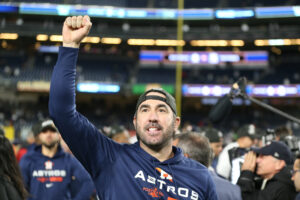
The 2023 season began on a sour note for Verlander, who missed the first five weeks of the year after suffering a strained teres major near the end of spring training. He’s in the midst of yet another strong season, though his performance in 2023 isn’t to the same level as it was in 2022, when he stunned the baseball world by capturing his third Cy Young Award as a 39-year-old in his first season back from Tommy John surgery. Verlander logged a ridiculous 1.75 ERA with a 27.8% strikeout rate and 4.4% walk rate in 175 innings last season. He’s pitched to a 3.15 ERA with a 21% strikeout rate and 8% walk rate in 96 innings this year, and seen slight steps back in his average fastball (from 95.1 mph to 94.6mph), swinging-strike rate (11.6% to 10%) and opponents’ chase rate (36.9% to 35%).
That said, even if Verlander’s overall season numbers aren’t quite as dominant as in 2022, there’s little doubt that he’s a major upgrade to an Astros staff that has lost right-handers Lance McCullers Jr. and Luis Garcia for the season. Righty Cristian Javier also hit a wall recently and has been struggling, and the ‘Stros lost right-hander Jose Urquidy for three months due to shoulder troubles. Verlander’s return will add one of the most talented arms of the entire generation back to the front of a staff, where he’ll join Cy Young candidate Framber Valdez, standout rookie Hunter Brown, Javier and rookie J.P. France. When Urquidy returns in the near future, it’s possible the Astros will go to a six-man rotation to help monitor the workloads of Brown and France.
For the Mets, Verlander becomes the fourth notable veteran they’ve shipped out in the past week, joining Scherzer, David Robertson and Mark Canha. The Mets have picked up a strong package of prospects in doing so but also waved a white flag on a season in which their $350MM+ payroll was expected to make them legitimate World Series contenders. They’ve also completely wiped out their rotation, which now consists of Jose Quintana (a trade candidate himself), Carlos Carrasco, Kodai Senga and David Peterson. Tylor Megill and Joey Lucchesi are candidates to step back into the starting staff.
The only near-term pitching prospect the Mets added in that slate of deals was righty Justin Jarvis, who came over from the Brewers and had been ranked near the back of their top 30 prospects on most publications. Given Carrasco’s status as a pending free agent and the unproven nature of Peterson, Megill and Lucchesi, they’ll head into the offseason with an enormous amount of work to do in rounding out the rotation. It’s a deep crop of free agents, headlined by names like Shohei Ohtani, Lucas Giolito, Aaron Nola, Blake Snell, Julio Urias, Sonny Gray, Jordan Montgomery, Marcus Stroman and NPB ace Yoshinobu Yamamoto. If the Mets plan to compete in 2024 — hardly a sure thing in the wake of their deadline activity — they’ll need to aggressively pursue rotation additions via either that free-agent market or the trade market.
The acquisition of Gilbert and Clifford could both help if the Mets choose the latter. While it’s certainly possible that both newly acquired outfielders fit into the long-term puzzle, that’s no sure thing — particularly for a team so willing to splash around in free agency. Brandon Nimmo is already signed for another seven years, so there are only two real long-term vacancies in the outfield anyhow.
Gilbert, 22, is the more advanced of the two prospects and the one who’s garnered more national fanfare. The Astros’ top pick in the 2022 draft, he’s already ascended to the Double-A level in his first full season of pro ball. The University of Tennessee standout laid waste to High-A pitching early in the season, slashing .360/.421/.686 in 95 plate appearances before an aggressive promotion to Double-A. He’s been a bit below average in terms of his overall output there, batting .241/.342/.371 in 264 plate appearances. However, Gilbert has also shown an advanced approach, walking in 12.5% of his Double-A plate appearances against a lower-than-average 17.5% strikeout rate.
MLB.com ranks Gilbert as the game’s No. 68 overall prospect, and FanGraphs has him at No. 49 on their list. Both reports give Gilbert a chance to be in the big leagues by next season, touting his plus speed, plus arm, great approach at the plate and growing power. He has a chance to stick in center field, perhaps pushing Nimmo to a corner if the veteran’s defense slips as he ages into his mid-30s. If not, Gilbert projects as a plus defender in an outfield corner. Both FanGraphs and MLB.com make note of his fiery personality, which could win over hometown fans while grating on opponents.
As for Clifford, he was taken ten rounds later in the same 2022 draft not for lack of talent but for a strong commitment to Vanderbilt University. The Mets convinced him to sign rather than attend college, offering him a huge $1.25MM bonus in the 11th round after most teams had passed assuming he’d head to school.
Jim Callis of MLB.com tweets that Gilbert and Clifford would’ve been his No. 1 and No. 2 Astros prospects, respectively, on the reranking of their system he’s set to publish following the deadline. Clifford hit just .247 but posted a .426 OBP in 101 plate appearances during his pro debut last year, and his rate stats in 2023 are outstanding: .291/.399/.520 in 371 plate appearances between Class-A and High-A. He’s slugged 18 home runs and 16 doubles, walking at a hearty 12.4% clip against a 24% strikeout rate.
FanGraphs had already bumped Clifford to the Astros’ No. 2 prospect — he’s now eighth in the Mets’ system on their rankings — crediting him with the potential to grow into 70-grade raw power. He’s a corner outfielder/first baseman with below-average speed and above-average arm strength. So long as his bat and overall offensive approach continue on their current trajectories, he could be in an outfield corner with occasional first base and DH time for the Mets at some point in 2025.
The Mets have done a nice job adding to their system, acquiring at least a pair of top-100-caliber prospects (Acuna, Gilbert) and another (Clifford) who could get there before long. They’ve paid a steep price to do so, however, gutting their 2023 roster and paying down close to $71MM on the Scherzer and Verlander deals alone. They’ve also saved just over $86MM on the pair of trades, including both salary and luxury tax penalties. In the event Verlander’s option vests and he exercises it, those savings would jump to more than $119MM (while the dead money they’d paid down would rise to more than $86MM).
The Mets are so far into the fourth and final tier of luxury penalization, that short of getting a team to take on the entirety of the Verlander and Scherzer contracts, there was no real way of ducking back underneath that line. The Astros, meanwhile, have received enough cash from the Mets that they’ll likely come in under the luxury line. Roster Resource had them exceeding the $233MM first-tier threshold by only a margin of $1.7MM even when assuming the full freight of Verlander’s remaining money; that clearly won’t be the case now. That would’ve been the first time Houston had crossed into luxury territory, but they’ll now have Verlander for a total of $22.777MM for the remainder of this season and next — plus an additional $17.5MM in 2025 if that option vests and he picks it up.
Bob Nightengale of USA Today first reported the Astros were acquiring Verlander for two prospects. Mark Feinsand of MLB.com first reported Gilbert’s inclusion, while Nightengale was first on Clifford. Joel Sherman of the New York Post was first with the specific financial breakdown.