
Union, League Spar Over Interpretation Of Agreement On Resumption Of Play
It had seemed that Major League Baseball and the MLB Players Association were largely seeing eye to eye on alterations to their preexisting agreements to account for the coronavirus pandemic. The sides struck a bargain in late March to account for numerous significant matters of concern, including part-season salaries.
[RELATED: MLB Player Contracts In A Shortened Or Canceled Season]
The unity may not be long-lived. With little prospect for hosting games with fans in attendance in the near term, league and union are now embroiled in a battle over the meaning of the deal they worked out less than one month ago.
Recent reporting indicated that MLB does not believe the recent agreement resolves the matter of player salaries in the event of TV-only games. Today, union chief Tony Clark announced that he holds precisely the opposite position, as Ronald Blum of the Associated Press reports.
The league claims the question of salary in a no-attendance season simply hasn’t been decided, pointing to a clause providing that the sides agree to “discuss in good faith the economic feasibility of playing games in the absence of spectators or at appropriate substitute neutral sites.” By this reading, the entire original agreement related only to the resumption of a typical season.
The player side says the agreement provides for a pro rata reduction of salary to match the number of games played, regardless of whether fans are in the stands. Clark tells Blum: “Players recently reached an agreement with Major League Baseball that outlines economic terms for resumption of play, which included significant salary adjustments and a number of other compromises. That negotiation is over.”
It’s not surprising that the sides would’ve found it hard to line up on this particular point. Playing without paying fans was obviously foreseeable, since it made it into the deal. Surely this didn’t sneak up on anyone.
But it’s frankly bizarre to see such a misalignment of expectations regarding an agreement that was only just negotiated. The actual dispute boils down to the question whether new negotiations over “economic feasibility” would involve a full reconsideration of player salaries or, rather, that such feasibility would take place regarding only other matters, with the salary issue already decided. It seems there are oddities in the positions of both sides, based upon what has been aired publicly.
In the framing of deputy commissioner Dan Halem, the original agreement was one in which the sides “agreed that the season would not commence until normal operations — including fans in our home stadiums — were possible.” If not, there’d be a need to negotiate a whole new “framework to resume play without fans.”
It may well be possible — even preferable — to read the agreement as the league suggests. But in that case, why not make it all the more explicit? We haven’t yet seen the full agreement in its finished form, but the elements that have been reported suggest it’s less than crystal clear in its structure. It also seems strange that the sides would’ve focused so much energy solely on the function of a “normal” season when that seemed so unlikely to occur.
At the same time, on the union side, it’s hard to imagine the potential ambiguity wasn’t spotted. If the MLBPA really believed the agreement ensured full salaries (on a game-by-game basis) regardless whether fans were in attendance, why would it have allowed such an “economic feasibility” proviso to inject doubt?
Could it be that both sides agreed to disagree? Perhaps, but if that was actually the mutual understanding, then why overlay contractual uncertainty onto the preexisting, underlying state of affairs? If instead one side or the other has been caught by surprise by the other’s interpretation, that’s equally hard to understand.
Perhaps we’re still just seeing posturing. But there’s no question the league and union still have significant issues to sort through in advance of a potential resumption of play, especially if (as seems exceedingly likely) it’ll occur without spectators.
This was always going to be complicated. Holding contests without fans will require tricky logistics, added costs and risks, and atypical economic calculations. And there’s already an important background consideration here. Remember that talk of the uniform player contract, which provides the commissioner power to “suspend” contracts “during any national emergency during which Major League Baseball is not played”? That’s clear enough in some instances. But it’s less obvious precisely how the contracts would be re-started. And what happens if the emergency declaration is formally lifted, but baseball doesn’t resume play … or does so on a modified basis? It’s hard to read this clause as providing that major economic interferences would mandate adjustments of already guaranteed salaries, particularly if there’s no formal nationwide emergency declaration.
There was already ample potential for interpretive disputes revolving around that language, the entirety of the Basic Agreement, and the broader bargaining relationship in these unusual circumstances. A mutually satisfactory resolution never seemed straightforward. And now, the presence of an intervening, already-disputed agreement may only add to the potential for friction.
Report: Owners Could Pursue Further Salary Reduction For Players If Season Begins Without Fans
As Major League Baseball ponders various scenarios in which the 2020 season could commence in empty parks without fans in attendance, Ken Rosenthal and Evan Drellich of The Athletic write that empty-stadium games could prompt ownership to ask that the players make further concessions in terms of their 2020 salary.
The two sides already reached an agreement on service time, player salaries and a broad framework for an abbreviated draft late last month. Within that agreement, players agreed to prorated salaries that are directly proportional to the reduction of total games played.
Rosenthal and Drellich suggest, however, that the league “made it clear to the union that economic adjustments would be necessary if games were played in empty parks,” while many on the players’ side of talks believe that the already standing agreement addressed games without fan and/or games at neutral sites. Unsurprisingly, agent Scott Boras ardently pointed to the preexisting “good faith agreement” regarding empty-stadium play while implying that seeking further reductions would be in violation of said good faith.
It seems rather perplexing that the players wouldn’t have pursued precise language expressly underscoring that even neutral-site games without fans in attendance should fall under the purview of the currently agreed-upon salary reduction parameters. That agreement, after all, was unanimously ratified by all 30 owners back on March 27. At that point, the idea of televising games without fans was already widely being speculated upon and surely being discussed by the league and MLBPA. Word of the potential “Arizona” plan trickled out not two weeks after that agreement had been settled.
The owners’ claim in all of this would undoubtedly be that addition of television revenue would not be enough to cover the cost of operations in conjunction with the elimination of gate revenue. Such claims wouldn’t be able to be proven with books closed to the public, but it’s easy to see all 30 owners aligning on that front whether or not the sentiment holds true in actuality.
At this point, all parties involved are flying blind for the most part, as there’s not yet any certainty regarding when or if play will resume, where games will take place or how many games could be played. There’s also been talk of expanding the postseason format, which would create additional revenue on all sides that wouldn’t otherwise exist. Without those details set in place, fiscal specifics are impossible to glean. All of those issues will factor into further negotiations — if it is indeed determined that the existing language leaves ownership ample latitude to pursue such reductions. It’s easy to imagine a contentious set of secondary negotiations eventually being necessary once the logistics can be more clearly defined, though.
At least as pertains to the 2020 season, commissioner Rob Manfred wields the ultimate hammer, as his position gives him the right to unilaterally suspend player contracts due to the declaration of a national emergency. While one would hope that negotiations wouldn’t get to that point, the threat of such extreme action could indeed be powerful leverage against the MLBPA.
All of this comes at a time when the current collective bargaining agreement is set to expire in December 2021. Advance collective bargaining talks were already reported to be in place well before the COVID-19 pandemic emerged. Any rising tensions that stem from further back-and-forth on more immediate issues figure to impact those CBA negotiations whenever they resume in earnest.
MLB Has Discussed Realignment For 2020 Season
In another example of the radical measures that Major League Baseball is contemplating as it seeks to play as many games as possible in a truncated 2020 season, USA Today’s Bob Nightengale reports that one proposal would see the traditional American League and National League scrapped for the 2020 season only — and replaced by the Cactus and Grapefruit Leagues in which the clubs play during Spring Training. The 15 teams with spring facilities in Arizona and the 15 with spring facilities in Florida could each call their spring parks home, playing games in empty parks in realigned divisions.
As with the all-Arizona plan that was reported on earlier this week, a Cactus/Grapefruit arrangement is an intriguing concept but one that is also wrought with potential pitfalls. Securing ample coronavirus testing capabilities is still a challenge on a national scale, and Florida in particular is a problematic area with regard to the ongoing COVID-19 pandemic.
While the idea of empty parks ostensibly caps the number of people present for a given contest, it may not do so quite to the extent one would initially think. In addition to hosting a pair of rosters that would likely be expanded to 29 or more players, empty-park games would still need to have coaching staffs on hand in addition to umpires, medical/training personnel, camera crews, a production team and security staff for the facility in question (to say nothing of the potential for scouts and other front-office personnel as well).
Securing temporary housing for that many players, too, could be problematic. And as with the all-Arizona plan, the Florida-Arizona plan carries questions about weather conditions — playing primarily in open-air stadiums in the dead of an Arizona or Florida summer is clearly sub-optimal — and prolonged separation of players and their families. The looming issue of how to proceed if (or more likely when) an active player tests positive for the virus remains perhaps the most notable obstacle to address.
All of that said, it’s nevertheless fascinating to think about a season played out under such radical conditions. Nightengale suggests, for instance, that with the AL and NL designations scrapped, a universal DH could be implemented for one season. That’d seemingly put would-be NL clubs that hadn’t prepped for that change at a bit of a disadvantage, although concessions will surely have to be made by many parties if a season is to be played at all.
The potential for divisional realignment creates myriad new rivalry possibilities and shuffles the deck such that we might see some current postseason long shots gifted greater hope at the playoffs. Nightengale runs through one preliminary realignment scenario that would see the “Cactus League Northwest” division comprised of the Brewers, Padres, Rangers, Mariners and Royals. Over in the “Grapefruit League South” division we’d see a hyper-competitive trio of the Braves, Twins and Rays joined by the Red Sox and Orioles. Obviously, that’s merely one hypothetical alignment in a larger-scale hypothetical undertaking that may never even come to pass.
But at this juncture, as MLB joins the rest of us waiting for more robust testing/treatment and the blessing of public health experts and government officials to relax our social distancing measures, there’s no reason for the league not to cast a wide net in dreaming up creative solutions. To the contrary, thinking outside the box is arguably their best course of action right now. This, like the Arizona plan, is likely one of dozens of scenarios that has been or will be discussed by decision-makers as they seek to find a way to restore some sense of normalcy — to whatever extent is possible while maintaining the broader health of the general public.
Mark Reynolds Announces Retirement
Veteran slugger Mark Reynolds, who enjoyed a 13-year big league career split between the Diamondbacks, Rockies, Orioles, Indians, Cardinals, Nationals, Yankees and Brewers, announced in an appearance on Mad Dog Sports Radio on SiriusXM that he’s officially retired (Twitter link, with audio).
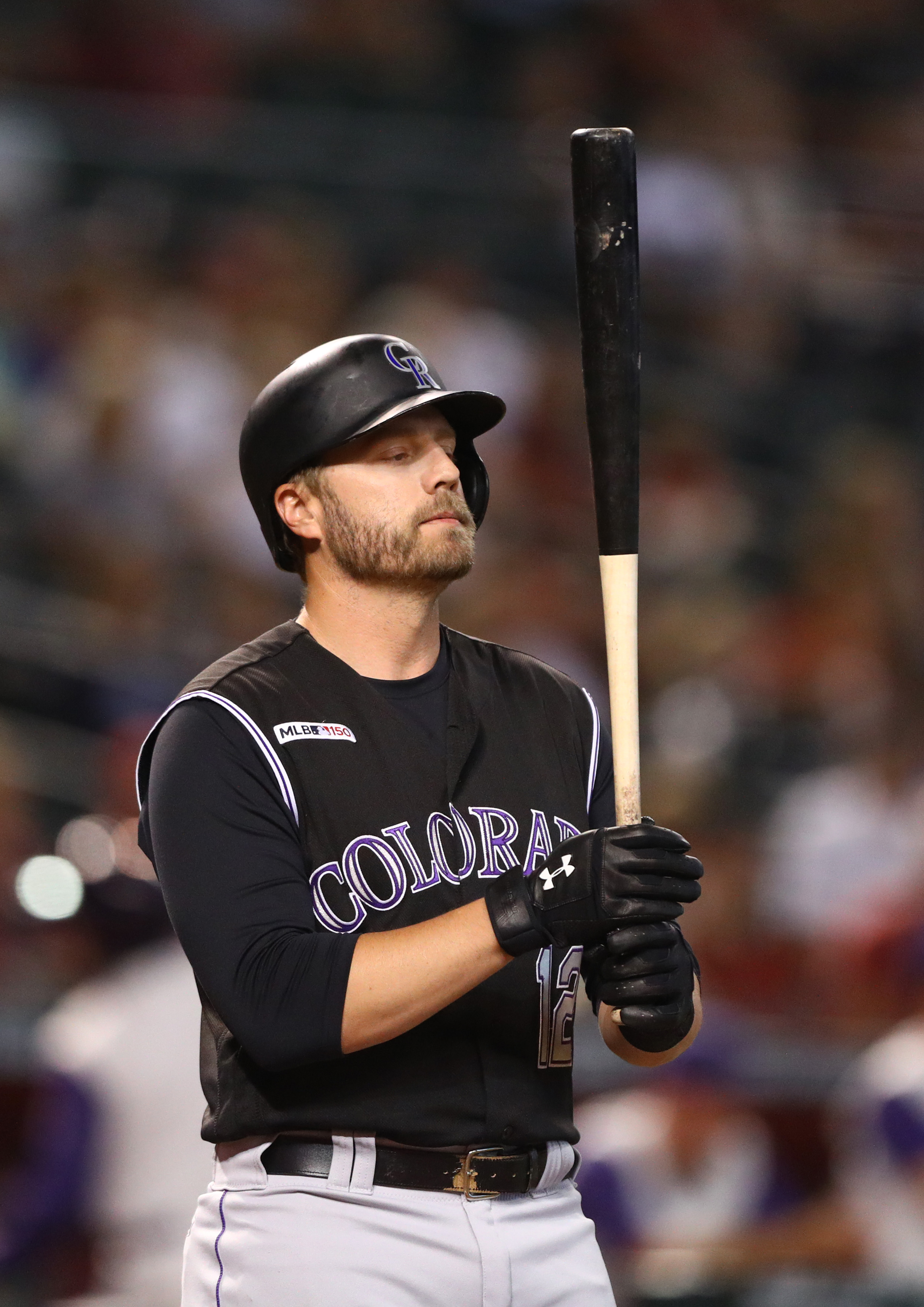
“I’ve moved beyond that,” Reynolds said when asked if he planned to seek another contract once MLB’s transaction freeze has been lifted. “I’ve retired. … I’m really enjoying time with my family, and it’s time for me to move on and find something else to do.”
The 36-year-old Reynolds spent the majority of the 2019 season in the Rockies organization, serving as a part-time first baseman and a bench bat until he was cut loose on July 28. He’d enjoyed a quality season with the Nationals a year prior in 2018, but Reynolds struggled to the lowest offensive numbers of his career with the Rox last year.
Originally a 16th-round pick of the Diamondbacks out of the University of Virginia back in 2004, Reynolds made his big league debut less than three years after being drafted. Reynolds was never considered one of the organization’s premier prospects — his No. 7 ranking on Baseball America’s list of D-backs prospects prior to the ’07 campaign was the only time he broke their top 30 — Reynolds hit the ground running. He was promoted to the big leagues in mid-May and closed out the remainder of the season as a regular in the lineup, hitting .279/.349/.495 with 17 home runs.
By 2008, Reynolds was Arizona’s everyday third baseman. His power was unquestionable, although the same could be said of his questionable contact skills. Reynolds became one of the game’s quintessential boom-or-bust players, regularly headlining home run and strikeout leaderboards alike. From 2008-11, he averaged 35 big flies per season but also led his league in strikeouts each year along the way. At that time, a player who was punching out in roughly a third of his plate appearances was an alarming anomaly; the league average strikeout rate back in Reynolds’ first full year was 17.5 percent — a full six percent lower than 2019’s mark.
Reynolds had a rough year in 2010, prompting the D-backs to trade him to the Orioles in return for reliever David Hernandez and prospect Kam Mickolio. He bounced back with the Birds and helped them to the postseason in 2012, but Baltimore declined an $11MM club option over Reynolds’ final arbitration year that offseason and non-tendered him, making him a free agent for the first time in his career.
Reynolds would bounce from Cleveland to New York to Milwaukee to St. Louis to Colorado to D.C. and back to Colorado on a series of one-year and minor league deals from that point forth. He delivered some productive seasons along the way and even popped 30 homers for the 2017 Rockies before giving the Nationals an absurd 5-for-5, two-homer, 10-RBI day in 2018 (video link).
Reynolds will conclude his playing career with a .236/.328/.453 batting line over the life of 6243 plate appearances and 1688 Major League games. In that time, he belted 298 home runs, 253 doubles, 14 triples and stole 64 bases while also scoring 794 times and knocking in 871 runs. The slugger took home nearly $30MM in career earnings while providing a litany of tape-measure home runs on which we can all fondly look back. Best wishes to Reynolds and his family in whatever lies ahead.
The State Of MLBTR
As the founder of MLB Trade Rumors, I’d like to take a brief moment to update you on the current state of the website. I realize that with the distress of COVID-19, the situation of a baseball website is the last thing on your mind, so I’ll keep it short.
Like most small businesses, mine has been hit hard by the coronavirus. Traffic is down due to MLB’s delayed season, and I don’t expect our typical trade deadline bump or a normal 2020-21 offseason. Ad rates have plummeted as well. As you know, MLBTR is free and entirely supported by banner advertising. While I’ve had to suspend some interesting but non-essential projects, in the long-term I think MLBTR will be fine.
You may have noticed that our overall post volume has decreased due to the lack of baseball news, and we’ve increased our original posts to fill the void. When player transactions and related rumors start back up, we’ll be covering that fully as we have over the last 15 years. Until then, we’ll continue experimenting with different topics both current and historical to create interesting reading material. Be sure to let us know what you’d like to see. Also, please note that the advent of weekday videos on MLBTR is not any kind of “pivot to video” and does not replace posts or result in fewer written posts on the site. Video is something we decided to try out this year, as the format may suit certain content better than the written word. We hope you’ll check out our YouTube channel and subscribe, but if it’s not for you, that’s OK.
I appreciate so many of you continuing to visit the site every day. If you’d like to help, just keep visiting, commenting, and retweeting. And be sure to tell your friends about MLBTR and share the link with them. Thanks for reading!
Al Kaline Passes Away
Tigers legend Al Kaline passed away Monday at his home at the age of 85, a family friend confirmed to John Lowe of the Detroit Free Press. An 18-time All-Star, a 10-time Gold Glover in the outfield, the 1955 AL batting champ and a key contributor on Detroit’s 1968 World Series-winning roster, Kaline is among the very best to ever play the game and joins Ty Cobb among the top players to ever suit up for the Tigers organization.
The Baltimore native posted a career .297/.376/.480 batting line with 3007 hits, 399 home runs, 498 doubles, 75 triples, 137 steals, 1622 runs scored and 1582 RBIs, establishing himself as the face of a generation of Tigers baseball from his debut in 1953 to the time he retired in 1974. He is the Tigers’ all-time leader in games played, home runs and walks, and he trails only franchise greats and fellow Cooperstown inductees like Cobb, Hank Greenberg and Charlie Gehringer in virtually all key offensive categories. His No. 6 was retired by the club in 1980, making him the first recipient of that honor.
Kaline’s importance to the organization reaches immeasurably beyond his on-field accolades, however. Even after he retired as a player, the next generation of Tigers fans who didn’t have the good fortune to watch him play instead grew up listening to his insights, anecdotes and experience as one of the voices of Tigers baseball. He also served as a special assistant in the club’s front office and regularly appeared in Spring Training to work with upcoming waves of young Tiger talent.
Kaline will be remembered both as a one of the all-time greats and a revered gentleman off the field. He was named the 1970 Fred Hutchison Award winner, recognizing “character and competitive spirit” and also named the winner of the 1973 Roberto Clemente Award. Media members, former teammates and Tigers players alike have flocked to social media to express their sorrow over the loss of one of the game’s iconic figures.
Said Justin Verlander: “Such a kind and generous man who meant so much to so many. I hope you knew how much I enjoyed our conversations about baseball, life, or just giving each other a hard time. I am honored to have been able to call you my friend for all these years. R.I.P. Mr Tiger, Al Kaline.” James McCann, John Hicks, Niko Goodrum, Grayson Greiner and Jake Rogers are among the many recent Tigers players who have echoed similar sentiments on Twitter.
We at MLB Trade Rumors join those around baseball in expressing heartfelt condolences to the friends, family, loved ones and legions of fans whose lives have been touched by Kaline.
Three Diamondbacks Minority Owners Sue Managing General Partner
A trio of Diamondbacks minority owners have filed a lawsuit against the franchise’s managing general partner Ken Kendrick, according to a report from Zach Buchanan of The Athletic. The plaintiffs allege that Kendrick illegally forced them to either increase their stake in the Diamondbacks or have their shares bought out by the team. Kendrick argues that he and the team were within their rights to issue such an ultimatum.
The dispute stems from a letter in which Kendrick instructed minority owners with stakes of less than one percent to either increase their share to at least that threshold or to sell their shares back to the team at a price determined by a third-party appraiser. That decision was motivated by the Diamondbacks’ desire to “streamline its ownership group” and decrease the number of owners with minimal stakes in the franchise.
That initiative was backed by MLB, which “prefers” that teams maintain smaller ownership groups to facilitate more efficient governance. However, the suing owners argue that since the idea originated with the Diamondbacks and was brought to MLB for approval, the minority owners maintain their status as eligible holders.
For what it’s worth, Buchanan went on to say via Twitter that the lawsuit is in no way related to the team’s ballpark concerns, which have prompted rumors about relocation. Since the three stakeholders involved in the lawsuit all own less than one percent of the team, Buchanan says, “they have no governing power over it,” and therefore the franchise could relocate with them on board. Kendrick and team president and CEO Derrick Hall spoke in February about the team’s stadium situation, hinting at a persisting hope to construct a new ballpark (be it in Arizona or elsewhere). The team’s stadium lease with Maricopa County would allow the D-Backs to leave Chase Field as early as 2022.
It’ll be a story worth following as the suit progresses, and we’ll be sure to provide updates for you as they come.
City Of Toronto Announces Events Ban
4:10pm: Toronto’s ban focuses on city-led events, mayor John Tory clarified in a public statement. While the ban does not appear to explicitly rule out professional sporting events, mayor Tory’s press release states:
The City’s decision provides clear direction to event organizers to enable them to make sound decisions in support of public health efforts and their business needs, access insurance, support impacted employees and manage sponsors. The City urges event organizers to follow Toronto’s Medical Officer of Health’s recommendations of physical distancing as a way to minimize COVID-19 transmission in the community when reviewing their event plans for the upcoming months and make prudent decisions about their cancellations. Physical distancing means limiting the number of people a person comes into close contact with, including keeping two metres (six feet) apart from others, avoiding mass gatherings and avoiding crowds.
Asked for additional clarity, mayor Tory’s office confirmed that sporting events are not specifically barred under the ban (Twitter link via TSN’s Bryan Hayes). That seems something of a technicality at this point, however. Given the municipal limitations set forth by mayor Tory’s office and a recent provincial emergency order prohibiting organized events of more than five people, it’s extraordinary difficult to envision a scenario in which a stadium whose capacity sits north of 53,000 is hosting baseball games.
3:44pm: The City of Toronto has banned public events until at least June 30, tweets Tom Harrington of CBC News Radio. While it’s long been apparent that Major League Baseball’s shutdown will extend beyond the current May 10 date, the news out of Toronto provides further evidence that if the league determines that play can indeed resume, there will be notable challenges and obstacles to staging MLB games.
The ban on public events comes against the backdrop of increased speculation about the possibility of games being played in empty parks. Should the league attempt to resume play prior to the end of June, it’s now clear that the Blue Jays will either need to take that measure or explore a neutral site at which to host their home games. It’d be a surprise if they’re the only club that finds itself exploring such alternatives.
The Toronto Sun’s Rob Longley provides a bit of context on what the ban means for the Jays (Twitter link); from Opening Day through June 30, the Rogers Centre was scheduled to host 54 percent of the Blue Jays’ home contests in 2020. We already knew that a notable chunk of those games wouldn’t take place as scheduled, of course, and it’s possible that if the conclusion of the regular season is indeed pushed back into late October that the Jays could recoup some home games on a newly constructed schedule. A late start to the season would surely require some agile adjustments to the schedules of all 30 clubs.
Of course, there’s also no guarantee that Toronto’s events ban will only run through June 30. As we’ve seen with stay-at-home and shelter-in-place orders throughout the United States, the end dates on these public health measures are regularly extended and are hardly set in stone.
MLB Announces Minor-League Financial Support
Major League Baseball has announced a plan to continue financial support and medical benefits to all minor-league baseball players. Jeff Passan of ESPN.com reported that a deal was pending (Twitter links), while Baseball America’s JJ Cooper first reported one was in the works (Twitter links).
The plan is for teams to issue $400 weekly payments to all minor-league players — less than higher-level players would typically receive but more than is the norm for players on the lower rungs. The agreement runs through the end of May, unless the minor-league season begins prior to that point in time.
There are a few exceptions. Players that are still being housed and fed at Spring Training sites will not receive funds on top of that existing support. And each team is responsible to handle Dominican Summer League players on its own accord.
MLB also covered a few “procedural” matters in its announcement. The league has officially informed Minor League Baseball — a separate entity that represents the many minor-league teams around the country — that “Major League Clubs are unable to supply their Minor League affiliates with players as a result of the national health emergency.” And MLB indicates that teams are “in the process of informing Minor League players of the suspension of their Uniform Player Contracts.”
Details On The MLB/MLBPA 2020 Season Agreement
Major League Baseball and the MLB Players Association reached a deal Thursday addressing many of the outstanding questions facing the game in the wake of the coronavirus shutdown, including how the two sides will address a shortened (or perhaps altogether canceled) 2020 season. The specifics of this agreement still aren’t fully known, due in part to the ongoing fluidity of how baseball and the players’ union will have to adjust to future events, though we’ve already learned quite a few ways in which the sport’s structure will be altered for this wholly unique season. Some of the latest details…
- ESPN’s Jeff Passan and Kiley McDaniel published a highly-recommended breakdown of the agreement, including an explanation of how MLB’s $170MM advance payment will be distributed to players if the season is cancelled entirely.
- Another key insight from Passan and McDaniel: “The arbitration system will be adjusted to consider lessened counting statistics because of the shorter season, and salaries secured during the 2021 offseason through arbitration won’t be used in the precedent-based system going forward.” No further detail is provided regarding the adjustment to the arbitration system, which in a sense is already set up to consider lessened counting statistics. For example, if Kris Bryant hits 20 home runs in the course of an 81-game 2020 season, will that be viewed as the equivalent of a 40 home run campaign? Passan and McDaniel’s other arbitration-related revelation – that the upcoming batch of arbitration salaries will be excluded as future precedents – implies that players may not have the luxury of getting a 40 home run type raise for a 20 home run half-season.
- The ESPN duo also notes that 2020 luxury tax payrolls will be assessed “base[d] it on what full-season salaries were supposed to be, not prorated salary payment.” This is notable in that a team like the Yankees, who are way above the luxury tax threshold, will still be taxed even though they will actually pay out much less than $208MM in salaries. The actual tax paid will be prorated, according to Passan and McDaniel. The writers also explain, “And if there is no season, there will be no taxes owed, implying every team would reset to the lowest competitive balance tax threshold.” Before the coronavirus struck, teams such as the Red Sox and Cubs basically devoted their offseasons to getting under the threshold and resetting their tax rate for the future.
- Speaking of veteran players on minor league contracts, several of those deals contained player opt-out dates set five days prior to the Opening Day that never occurred. MLB.com’s Jeffrey Flanagan (Twitter link) has heard speculation that the league could simply push those deadlines to five days prior to the season’s new start. With no official policy yet in place, we’ve seen different approaches from various teams to this issue, ranging from some clubs agreeing to delay opt-out decision dates independently, to some teams officially selecting a non-roster player’s contract in order to confirm their place on the Major League roster.
- The MLB/MLBPA agreement also has a provision for players who aren’t on a 40-man roster but are on guaranteed contracts, the Athletic’s Zach Buchanan tweets. Such players as the Diamondbacks‘ Yasmany Tomas “will receive more advance pay than a minor-leaguer,” though it isn’t clear if they would receive the full $5K daily salary through April and May. Tomas was set to make $17MM in 2020, which was the last season of his six-year, $68.5MM deal signed back in December 2014. Arizona outrighted Tomas off its 40-man roster in each of the last two seasons, and he has appeared in only four Major League games for the D’Backs in that time.
- For a high-level explainer of this week’s agreement between MLB and the MLBPA, check out Jeff Todd’s video here.