
Red Sox Designate Eduardo Nunez For Assignment
The Red Sox announced Monday that they’ve designated infielder Eduardo Nunez for assignment and optioned right-hander Hector Velazquez to Triple-A Pawtucket. In a pair of corresponding moves, right-hander Ryan Weber and first baseman/outfielder Sam Travis were called up from Triple-A.
Now 32 years of age, Nunez proved to be an excellent pickup for Boston when the Sox acquired him from the Giants prior to the 2017 non-waiver trade deadline. He gave the lineup a strong jolt that season, hitting .321/.353/.539 through 173 plate appearances down the stretch before his season came to a close with an ALDS knee injury that saw him helped off the field. Nunez re-signed with the Sox for a two-year guarantee, the second season of which was a player option, and simply has not been the same player.
In 676 plate appearances for the Sox over the past two seasons, Nunez has scuffled to a dismal .255/.277/.366 batting line with a dozen homers and steals apiece. His struggles and Dustin Pedroia‘s career-altering knee injury prompted the Red Sox to also trade for Ian Kinsler last summer in a move that now looks quite lopsided. Boston won last year’s World Series, so the end result of all their moves was as good as can be hoped, of course; but Kinsler didn’t hit much with Boston, and the Sox would surely like to have righty Ty Buttrey in their bullpen this season following his breakout with the Halos.
The Red Sox will have a week to trade Nunez, pass him through outright waivers or release him. He has enough service time to reject an outright assignment and retain his salary even in the event that he clears waivers, so this seems likely to spell the end of his time with the organization. Nunez is still owed about $2.07MM of this season’s $5MM salary, making it a near certainty that he won’t be claimed. In all likelihood, he’ll soon become a free agent and be granted the ability to explore opportunities with other clubs.
Athletics Acquire Homer Bailey
The Oakland Athletics have closed on a deal to acquire Kansas City’s Homer Bailey, according to ESPN’s Jeff Passan. Ken Rosenthal of The Athletic first reported (via Twitter) that a trade was imminent. The Royals will receive minor-league infielder Kevin Merrell in return, according to an official Athletics release.
Bailey, 33, will go down as another bargain-bin acquisition for the playoff-hungry Athletics, who sit six games behind the first-place Astros, but currently slot in as the second Wild-Card team in the American League. Much like last season, when the team won 97 games and landed in the Wild Card game, the Athletics will hunt for affordable pitching help (which came in the form of Mike Fiers in 2018) to boost the club to back-to-back postseason berths. Rarely a team to make splash acquisitions, the A’s will likely remain on the periphery of the discussions surrounding marquee starters like Noah Syndergaard and Trevor Bauer. Of course, that doesn’t mean that value can’t be found elsewhere on the trade market.
Evidently, David Forst, Billy Beane and company believe that Bailey represents such a value. With the Dodgers, who acquired and immediately released Bailey in a December blockbuster with the Reds, paying the remainder of his hefty salary, the Royals snagged the veteran on a minor-league deal, meaning that the Athletics will only owe about $250K to Bailey.
Though he was maligned last season for his 1-14 record, Homer Bailey has shown some encouraging signs this year, and has posted his lowest ERA since 2014. He’s striking out 8.1 batters per nine innings, and home runs have come less often than last season. This isn’t an acquisition that can transform a pitching staff overnight, but Bailey will step in as a low-cost veteran who could pay dividends in the stretch run.
It’s been pitching that has concerned the Athletics all season, and many anticipated the team pursuing upgrades on the mound this summer. With a myriad of injuries preventing promising southpaws Sean Manaea, Jesus Luzardo, and A.J. Puk from contributing thus far, Oakland has had to patch together a makeshift rotation to carry them through the first half. Not to mention breakout star Frankie Montas, who won’t be eligible for postseason play after a PED suspension. And while the staff hasn’t plummeted to the bottom of the league—Mike Fiers, Brett Anderson, and Chris Bassitt have held their own—it’s hard to put much confidence in that group winning a playoff series, especially against the juggernauts of the American League.
Expect more to come from Oakland this trade season, especially on the pitching front. The front office, though garnering a reputation as frugal, can be aggressive when it senses a window for contention, and the club is in a good spot. Other veteran starters may still be in play, but it seems that with Bailey in the fold, the team’s focus will shift to the bullpen. The existing group has a solid track record between Liam Hendriks, Blake Treinen, and Lou Trivino, though consistency has been lacking in that department this season.
As for Kansas City, it seems unlikely that this is the last we’ll hear from Dayton Moore and the front office this July. The 32-61 Royals have been rumored to be open to trades involving just about anybody on the roster, with a few exceptions. Adalberto Mondesi and Hunter Dozier appear to be two cornerstones that the franchise is intent on keeping around, though a steep asking price for Whit Merrifield might make it difficult to pry him away from KC. Alex Gordon, meanwhile, may have redeemed some of his value with a renaissance season, but the veteran seems keen on playing out his career with the Royals, the franchise that drafted him.
That said, there are a number of Royals who could find themselves in different uniforms by the time the calendar turns to August, with Danny Duffy, Ian Kennedy, Jake Diekman, and Jorge Soler perhaps the most realistic trade candidates. Diekman has apparently already attracted some interest from the Nationals, and other contending clubs could be drawn to Kennedy’s resurgence as a high-leverage reliever. Of course, in the cases of Kennedy and Duffy, the Royals would likely have to eat considerable portions of their remaining contracts to facilitate a trade.
Kevin Merrell, who heads to Kansas City in this swap, was a 2017 draft selection of the Athletics in Competitive Balance Round A. Ranked by MLB.com as the Athletics’ 17th-best prospect, Merrell is touted for his speed on the bases, with questions surrounding his bat. In general, his profile keeps with the Royals’ trend of acquiring speedy athletes, and Merrell, 23, has the potential to grow into a multi-positional depth role with Kansas City. With a crop of impressive young position players and an influx of college pitchers from the 2018 draft, the team may find its way out of the rebuilding phase quicker than anticipated.
Red Sox Acquire Andrew Cashner
7:35pm: The Orioles are picking up exactly $1.78MM, per Rosenthal. They’ll also cover “most” of the performance bonuses Cashner could earn, according to Sean McAdam of BostonSportsJournal.com.
5:30pm: Baltimore will pay approximately half of the ~$3.36MM in guarantees left on Cashner’s deal, Ken Rosenthal of The Athletic tweets. The Orioles also owe Cashner $1.5MM in signing bonus money in both 2020 and ’21.
4:32pm: The Red Sox have acquired righty Andrew Cashner and cash considerations for prospects Elio Prado and Noelberth Romero, the Orioles have reported.
Cashner, 32, was famously swapped straight-up for Anthony Rizzo in a 2011 trade between the Cubs and Padres. After a breakout 2013 campaign, in which the hard-throwing righty posted a 3.09 ERA/3.35 FIP (2.6 fWAR) in 26 starts, it’s been mostly unfulfilled promise for the former first-rounder. The TCU product was smashed in the first season of a two-year, $16MM deal he signed with Baltimore prior to the 2018 campaign, with a near-league-low 5.82 K/9 against 3.82 BB/9 en route to a 0.6 fWAR season in 28 starts.
He’s been better this year, though his K rate remains among the league’s lowest and peripheral markers (4.25 FIP, 4.88 xFIP) are non-believers in the sustainability of his 3.83 ERA. Cashner’s average fastball velocity, once an eye-popping 98.8 MPH in predominant relief for the 2012 Padres, now sits at a barely-above-league average 94.0. He’s mostly scrapped the bread-and-butter sinker he featured so prominently from 2013-18, overhauling his repertoire back to the four-seam/changeup/slider mix with which he began his career. Returns have been positive: his 8.7% swinging-strike rate is his highest since transitioning full-time to a big-league rotation, and his chase rate’s bettered the standard he established from 2016-18. Cashner’s grounder-heavy repertoire should play well in Fenway Park, with any opposite-side power somewhat neutralized by the ballpark’s spacious right-field dimensions.
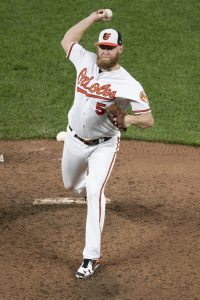
Our own Steve Adams offered ample justification for transitioning the righty back to a late-inning role, but it appears such a move won’t be in the short-term cards for the Bo Sox. Cashner will apparently start Tuesday’s game for Boston, with GM Dave Dombrowski noting that the move eases the undue stress the club’s bullpen has endured thus far. Cashner’s two-year deal includes a $10MM vesting option for 2020 should the righty eclipse the 187 inning mark this year, a fact of which his acquiring club is surely aware.
Boston’s rotation has been solid this season, though it’s true that the fifth spot has been a sore one. Hector Velazquez, Brian Johnson, Ryan Weber, Josh A. Smith and Darwinzon Hernandez have each tried their hands, to less-than-stellar results, and the club had no clear fill-in at the minors’ upper levels. Nathan Eovaldi is set to return soon, but the team expects to plug him straight in to its beleaguered closer’s role.
Both Prado and Romero, 17, will transition from the Red Sox Dominican Summer League affiliate to that of the Orioles. Neither are big-time bonus babies, and reports are scarce, but Orioles GM Mike Elias does have ample experience scouting in Latin America from his time with the Cardinals and Astros organizations.
Photo courtesy of USA Today Sports Images.
Nationals Place Max Scherzer On Injured List
The Nationals have placed ace Max Scherzer on the 10-day injured list (retroactive to July 10) with a mid-back strain. They recalled catcher Spencer Kieboom from Double-A Harrisburg to take Scherzer’s 25-man spot.
Scherzer last pitched a week ago, when he turned in a seven-inning, four-hit performance with 11 strikeouts against no walks in a win over the Royals. It was another in a long line of gems for Scherzer, a three-time Cy Young winner who may be on his way to his fourth such award this season. The 34-year-old has logged a magnificent 2.30 ERA/2.00 FIP with a jaw-dropping 12.6 K/9 against 1.6 BB/9 across 129 1/3 innings so far in 2019. He’s likely the MVP of a Nationals team that has climbed out of the basement over the past several weeks to grab a 1 1/2-game hold over the NL’s top wild-card spot.
Considering Washington’s place in the standings, it obviously can’t afford to go without Scherzer for longer than a minimum IL stint. Scherzer said Friday his injury isn’t a “long-term” one, per Todd Dybas of NBC Sports Washington. As of now, though, the Hall of Fame-caliber workhorse is in line for a rare stay on the shelf. He’ll be out until at least July 20.
Brodie Van Wagenen Addresses Mets’ Struggles, Deadline Plans
Embattled Mets GM Brodie Van Wagenen discussed his team’s dire straits today with the media. Deesha Thosar of the New York Daily News and Mike Puma of the New York Post were among those to round up the choicest quotes. MLB.com’s Christina De Nicola approached it from a bit of a different perspective, focusing on the forward-looking aspects of Van Wagenen’s chat.
With the Mets all but buried in the standings, Van Wagenen faced the music on his “come get us” pre-season bravado with respect to the rest of the NL East contenders. As he put it today, “they came and got us.”
That may put a satisfactory wrap on a memorable quote, though it also glosses over some of the actual causes of the Mets’ failings by suggesting their rivals simply got the better of them. Van Wagenen’s claim that the club was the favorite in the division wasn’t just an attention-grabbing statement worthy of skepticism; it also seemingly represented a key driving factor for the team’s decisionmaking over his first offseason at the helm.
Van Wagenen did accept blame for how things have gone, though he did so in a curious manner, deflecting even as he absorbed culpability. “I wouldn’t want to put the blame on players or coaches or scouts or anybody of that matter,” he said, “but I can tell you that this team we built was one of unified vision and it hasn’t worked, so I accept my responsibility in that capacity as well.” Likewise, he seemingly minimized the role of big-picture roster-building when he cited a failure to “do enough of the little things right as a team.”
At the end of the day, the top roster-building decisionmakers have to own their missteps. There are quite often intervening factors that do help explain unanticipated struggles, to be sure. But it’s hard to argue that unforeseeable or simply unlucky happenings have really driven the disaster in Queens this season — Jed Lowrie aside, at least. (The oft-injured veteran has yet to play. He is now said to be dealing with a calf injury, with no apparent target for a return.)
The single major blunder, to this point, has been Van Wagenen’s signature trade — the swap that brought in ace closer Edwin Diaz and highly compensated veteran Robinson Cano. It seemed a highly questionable decision at the time, albeit one that would almost certainly deliver short-term rewards. Instead, both players have struggled mightily, and rather unexpectedly, even as the key prospects sent in the trade have prospered.
“You have to look at where we were and where we are now,” Van Wagenen said when asked whether he has had second thoughts on the deal. He noted that Diaz and Cano still have the remainder of the season to “change the narrative.”
Once again, this explanation seems to miss the mark. The real problem isn’t (just) the ensuing struggles of those players. It’s the series of conceptual failings that led to the deal in the first place. First, the deal was rough for the Mets from a value standpoint, given the huge amount of Cano’s contract the team absorbed. Even assuming that away, it was legitimately questionable whether the Mets had a strong enough roster to justify that kind of outlay for such clearly win-now players (a closer and an aging second baseman). Beyond all that, there were quite possibly better ways to utilize the team’s resources — a dedicated pursuit of Manny Machado, increased offer to Yasmani Grandal, etc. — even in a scenario in which the team pushed for contention.
The point here isn’t to lay on the blame. Van Wagenen had a distinctly difficult task as an agent-turned-GM who was trying (with limited resources) to turn around a roster that had struggled in the prior season. That was the strategic direction of ownership — even if the new GM pitched it in his interviews. And it wasn’t a ridiculous thing to attempt. It’s just that the undertaking came with obvious risks, especially in the manner it was pursued, and several of the downside scenarios have come to fruition — none moreso than the big-picture one, in which the Mets are left yet again facing a need to pursue some amount of rebuilding or reloading while also carrying a series of player assets that hints towards near-term contention.
It was a tricky spot; it is now, all the more. Van Wagenen will need to adapt on the fly. So, where do the Mets go from here?
Most notably, Van Wagenen slammed on the brakes so far as expectations are concerned. In mid-June, Van Wagenen said that the Mets were “right where we wanted to be.” Now, about a month later? “In the second half of the year I think we have low expectations for what we can be,” he said bluntly. Rather than posturing as front-runners, says the GM, the Mets will fashion themselves as “underdogs” who’ll “try to prove some people wrong this year and certainly try to improve on it next year.” It’s a starkly different look from an executive who said before the season, upon his latest hot stove conquest: “This action, rather than our inaction, should demonstrate to the fans that we say what we do and we do what we say.”
Without any pretense to immediate contention, the Mets can turn to making the best of the roster they have compiled. “We have to face our reality, to some degree, about where we are in the standings,” said Van Wagenen. Rental players — Zack Wheeler, Todd Frazier, Jason Vargas (who does have an option remaining) — seem clearly to be on the block. But the question remains whether the Mets will also “face reality” with respect to their broader organizational position, which is certainly a question that can’t be answered by Van Wagenen alone.
Van Wagenen says the Mets will be “open-minded, … thoughtful and measured” at the deadline, though that characterization obviously doesn’t offer much in the way of specific direction. He was clear that he does not “anticipate being in a situation where we’d have a total teardown rebuild.” He also says he “fully expect[s]” the team’s best veterans with future contract control “to be on our roster” past the trade deadline — though he didn’t rule out deals of star pitchers Jacob deGrom and Noah Syndergaard. The front office has been bombarded with phone calls of late, adds Van Wagenen. It’ll certainly be interesting to see whether any of those chats lead to creative scenarios in which it makes sense for the Mets to move some of their best and best-known players.
If there’s a definitive statement on the Mets’ near-term approach to be found in Van Wagenen’s words today, it probably resides in this passage:
“The reason why we put some chips on the table this year is because we felt like we had a core of starting pitchers from which we could build around. … Right now, as we look at the halfway point, we feel like we have a core going forward, just maybe a different core. … We have a core from which we can compete, and we’ll look at our moves with both win now or certainly win in 2020 [perspectives] and looking beyond that.”
You can probably read that to mean just about whatever you want it to, but it certainly sounds as if Van Wagenen sees a vision of the future. Perhaps it suggests the club’s ace hurlers are now open to be moved … or that they are part of the “different core.” If there’s a core in place, one might think that a big push for 2020 would yet make sense … yet Van Wagenen was careful to note that the team needs to be “looking beyond that” point in time.
Whatever the precise core concept — it presumably features Michael Conforto, Pete Alonso, and Jeff McNeil at a minimum — there’ll be an awfully tough path to navigate. Whether they pursue immediate contention or some manner of rebuilding, the Mets face a tricky financial situation in 2020, when they owe about $115MM to players (not including David Wright) even before accounting for raises to Syndergaard, Diaz, Conforto, Steven Matz, Seth Lugo, Brandon Nimmo, and a few others. For a team that hasn’t yet cracked $160MM in payroll to open a given season, it’ll be challenging to add enough to spur a turnaround. And with so much already on the books, no small part of it (Cano, Lowrie, Jeurys Familia, Yoenis Cespedes) largely immovable, it’ll also be tough to embark upon a dedicated rebuilding effort.
Yankees, Twins Have Each Asked About Package Deal For Stroman, Giles
The Blue Jays have one of the best starters (Marcus Stroman) and one of the best relievers (Ken Giles) available on this summer’s trade market, and TSN’s Scott Mitchell tweets that teams have been expressing interest in acquiring both in the same package. Both the Twins and the Yankees have reached out to Toronto to express interest in a single trade to net both pitchers, per Mitchell, who cautions that the organization’s preference may be to maximize the return by orchestrating separate trades.
Minnesota’s interest in Giles (and relief help in general) has already been reported. But for all the help the Twins could use in the ‘pen, the rotation is also a potential area of focus. The wheels have come off the Martin Perez project of late, as the lefty has been hammered for a 5.37 ERA with 7.7 K/9, 4.0 BB/9, 0.85 HR/9 and a 54.6 percent grounder rate across his past 10 starts. And while Michael Pineda has improved in recent weeks as he distances himself from 2017 Tommy John surgery, he also figures to have his workload more carefully managed late in the season.
The Yankees are a similarly logical landing spot for Stroman. Luis Severino has yet to pitch this season due to multiple injuries, while each of James Paxton, Domingo German and CC Sabathia has spent time on the injured list. Left-hander J.A. Happ has struggled as well (5.02 ERA, 5.35 FIP in 89 12/3 innings) — unable to replicate a quartet of strong seasons from 2015-18.
Stroman recently had a bit of a health scare, exiting his last outing against the Royals due to a pectoral cramp. His final start prior to the All-Star break was skipped, but Stroman isn’t expected to miss time beyond that. If the issue is as minor as it appears to be, Stroman’s value wouldn’t be likely to take a hit. It seems quite likely that Stroman will be wearing a new uniform come Aug. 1, although Atkins danced around the matter without addressing the likelihood of a deal in a recent meeting with the Toronto media (link via Shi Davidi of Sportsnet):
I would say this: Marcus has put himself in an incredible position throughout his career, not just over the last four months. He has been durable. He has performed at an exceptionally high rate. He’s been one of the better pitchers in baseball over the last three years and because of that he is in a great position for his future with the Toronto Blue Jays and there are 29 other teams that are thinking the same way, that they would love to have someone that has been durable and has been productive. We’ll see. With another year of control for us, that’s attractive to us, that’s extremely attractive to other teams, as well. He’s put himself in a remarkable spot and earned all of that respect.
As for Giles, he may appear to be somewhat of a luxury for a deep Yankees relief corps, but it’s also true that the ‘pen hasn’t been as dominant as many might have expected. Aroldis Chapman and Tommy Kahnle have thrived, and Chad Green looks reborn since a brief demotion to Triple-A in late April. Adam Ottavino has a sub-2.00 ERA but 6.1 BB/9 mark. Zack Britton‘s bat-missing ability still hasn’t returned, as his 6.3 K/9 mark isn’t much higher than his 4.9 BB/9. Jonathan Holder had to be optioned to the minors after struggling to keep his ERA under 7.00. Dellin Betances, like Severino, hasn’t pitched in 2019.
Either Stroman or Giles on his own would have a fairly notable asking price, so adding both at once may very well teeter on exorbitant. The Jays seem likely to move both, though, and they’re also expected to gauge interest in Justin Smoak, Freddy Galvis, Aaron Sanchez, Eric Sogard, Daniel Hudson and other veterans as their rebuilding efforts continue.
Red Sox “Pushing” To Add To Rotation
The Red Sox are making a push to land a starting pitcher on the trade market and “prefer to act sooner rather than later,” reports Ken Rosenthal of The Athletic (via Twitter).
Boston is said to be casting the proverbial wide net in seeking an arm to slot into the starting five behind Chris Sale, David Price, Eduardo Rodriguez and the struggling Rick Porcello. The Red Sox re-signed Nathan Eovaldi on a four-year, $68MM contract this past offseason in hopes that he could round out the rotation behind that bunch, but Eovaldi underwent surgery to remove a loose body from his elbow in late April. He’s yet to return from that procedure, and even when he does, the organization plans to use him in the ninth inning to help fortify a beleaguered relief corps that went unaddressed in the offseason.
The market for starting pitching is thin but not barren. Madison Bumgarner is widely expected to be traded between now and July 31, although the Red Sox are known to be on his no-trade last. Division-rival Marcus Stroman is a likely candidate, too, as is Baltimore’s Andrew Cashner. Detroit’s Matthew Boyd is available for a high asking price, and it’s at least anecdotally worth pointing out that Red Sox president of baseball operations acquired Boyd for the Tigers when he previously served as their GM. Like Bumgarner, Zack Wheeler of the Mets is a free agent at season’s end and is a strong candidate to be traded this month. The Royals could potentially move southpaw Danny Duffy as well, and there will be other options beyond the group listed here.
As recently as last week, Red Sox owner John Henry publicly indicated that he didn’t anticipate adding “a lot of payroll” for the 2019 season. Boston is already the lone MLB team in the top luxury tax bracket, and any dollar that’s added to the team’s payroll will come with a 75 percent overage tax as a result. Boston can avoid paying a steep financial price by either acquiring a pre-arbitration arm or convincing a potential trade partner to pay down some of a veteran’s guaranteed salary, but either approach would require a steeper price tag in terms of prospects.
The Red Sox’ farm system isn’t considered to be particularly robust — although the oft-recited “don’t have the prospects to get something done” line is overstated. MLB.com’s most recent rankings of the Boston system credits the team with eight 50-grade prospects, while top organizational prospects Triston Casas and Futures Game participant Jarren Duran have both elevated their stock on Fangraphs’ midseason update.
Jake Arrieta Has Bone Spur In Elbow, Could Require Surgery
10:28am: Manager Gabe Kapler confirmed Arrieta has a bone spur. The Phillies will evaluate Arrieta in the coming days to determine whether he should keep pitching (via Lauber).
8:24am: Arrieta does think he has a bone spur, but he expects he’ll be able to continue pitching through it this season, per Scott Lauber of the Philadelphia Inquirer.
7:49am: Phillies right-hander Jake Arrieta turned in his latest clunker Saturday, a 4 1/3-inning start in which he allowed five earned runs on 11 hits in a loss to the Mets. Afterward, not only did Arrieta have some choice words for Mets third baseman Todd Frazier, but the former ace suggested he has been pitching through an injury (via Ken Rosenthal and Matt Gelb of The Athletic).
“I labored physically,” Arrieta said. “I wasn’t able to put the ball where I wanted to. It’s been that way for a few weeks. Just physically not in a great spot.”
It turns out Arrieta’s dealing with a bone spur in his right elbow that will likely require surgery at some point, Rosenthal and Gelb report. The Phillies have known about the injury, but their hope has been that it won’t prevent him from continuing to pitch. Now, though, it looks possible Arrieta will have to undergo a season-ending procedure, according to Rosenthal and Gelb. He previously underwent season-ending surgery on a bone spur while with the Orioles in 2011.
Although Arrieta said there’s no medical examination scheduled, Jim Salisbury of NBC Sports Philadelphia tweets that his elbow “will be checked.” If that exam yields bad news, his season – the second of a three-year, $75MM contract – could end. Should that happen, it seems likely to affect the Phillies’ trade deadline plans. Even with Arrieta having thrown a team-high 108 innings this season, its rotation has failed to produce compelling results and could be in line for upgrades. The struggles of the Phillies’ staff have helped lead to a mediocre 46-43 record for the club in the wake of an ultra-aggressive offseason. Philadelphia’s in third place in the NL East and 6 1/2 games behind the first-place Braves, though it’s only a half-game back of a wild-card spot.
Formerly a star with the Cubs, with whom he won the 2015 NL Cy Young Award, Arrieta has declined precipitously since he joined the Phillies. Arrieta was merely decent across 172 2/3 innings last year, but he has fallen well short of even posting average production this season. The 33-year-old has put up a 4.67 ERA/5.07 FIP with 7.08 K/9 and 3.33 BB/9. Despite a 50.9 percent groundball rate, Arrieta has yielded home runs on 20.2 percent of fly balls – roughly a 6 percent increase over last year’s figure. It seems Arrieta’s elbow issue has contributed to his problems, though, and it’s in question whether he’ll be able to keep laboring through it.
Carlos Carrasco Diagnosed With Leukemia
SUNDAY: The Indians issued an update on Carrasco on Sunday, Zack Meisel of The Athletic tweets. “Last month, Carlos Carrasco was diagnosed with chronic myeloid leukemia, a treatable form. He has been cleared to resume strength and conditioning workouts and throwing activity. No timetable for a return.”
SATURDAY: Carlos Carrasco has been diagnosed with leukemia, he told Dominican news channel CDN 37. Carrasco has been treated, and he has it under control to the point where he hopes to return to pitch again this season, per MLB Network’s Jon Heyman (via Twitter).
The Indians certainly will take their time with Carrasco, though this newest diagnoses sheds some light on what has been a difficult season for Carrasco. Previous indications were that Carrasco was suffering from a blood condition that, at the very least, prompted lethargy and the pursuit of treatment.
The Indians placed him on the injured list on June 5 after seeing their longtime co-ace pitch to a 4-6 record with an uncharacteristic 4.98 ERA (4.13 FIP). Carrasco has long been underrated while pitching in the shadow of star righty Corey Kluber and the outspoken Trevor Bauer, but even in an off-year with significantly mitigating factors, Carrasco put together 65 innings of palatable baseball.
The team has shown up in full support of Carrasco as he recovers. Per Ryan Lewis of the Akron Beacon Journal, Carrasco was present on June 4 for a team meeting wherein they discussed the situation. This team meeting was not about baseball, but about supporting Carrasco as he undergoes recovery.
Nationals, Anthony Rendon Discussing Extension
Nationals third baseman Anthony Rendon is slated to become the best position player to hit free agency in the upcoming offseason. He might not reach the open market, though. Nationals owner Ted Lerner and Rendon’s agent, Scott Boras, are discussing an extension for the All-Star, Mark Zuckerman of MASNsports.com reports.
Boras was at Nationals Park on Saturday – an indication of how serious negotiations have become, Zuckerman observes. The two sides have talked about a new deal for Rendon on and off for a while now, though they haven’t been able to bridge the gap thus far. Jesse Dougherty of the Washington Post reported earlier this week there hadn’t been much progress between the team and player, noting Rendon’s likely seeking a pact in the range of the seven-year, $234MM extension Rockies third baseman Nolan Arenado signed before the season.
Rendon’s trophy case is nowhere near as full as that of Arenado, who has earned five All-Star trips and six Gold Gloves, among other awards. Nevertheless, Rendon has been one of the majors’ premier players in his own right. Rendon, whom the Nationals chose sixth overall in the 2011 draft, debuted in 2013 and has since slashed .286/.363/.482 (125 wRC+) with 122 home runs and 29.0 fWAR in 3,597 plate appearances. Only 11 position players have bettered Rendon in the fWAR department dating back to his first at-bat, and he’s now enjoying his top season yet. On the strength of a .304/.388/.612 line (150 wRC+) with 20 homers in 320 PA, Rendon finally picked up a long-overdue All-Star nod.
Now, having lost Bryce Harper to free agency last winter, the Nationals don’t seem prepared to let yet another homegrown superstar depart. Harper’s also a Boras client, but even though the team was unable to retain the outfielder, its ownership is known to have a positive relationship with the super-agent.
Along with Rendon, four of the Nationals’ other players are Boras clients, including high-profile starters Max Scherzer and Stephen Strasburg. Washington signed Scherzer to a seven-year, $210MM contract in free agency entering 2015. The club then handed Strasburg a seven-year, $175MM extension in May 2016, when he was just a few months from potentially testing the open market. The Nationals may now follow suit with Rendon.