
Marlins Decline Ichiro’s Option, Claim Chad Wallach From Reds
The Marlins announced that they’ve declined a $2MM club option on outfielder Ichiro Suzuki and also claimed catcher Chad Wallach off waivers from the Reds. The pair of moves leaves Miami’s 40-man roster count at 34 players.
Ichiro, who turned 44 two weeks ago, will see his three-year tenure with the Marlins come to an end as the team’s new ownership begins to trim salary in a reported effort to shed $40-50MM off the payroll for 2018. The future Hall of Famer had a productive second year with the Marlins in 2016, hitting .291/.354/.376 in 365 trips to the plate. However, the 2017 season saw Ichiro receive the smallest amount of playing time he’s had in Miami — just 215 plate appearances — and resulted in a dreary .255/.318/.332 batting line.
The 10-time All-Star is a Cooperstown lock, but he’s had just one season of above-average production (by measure of OPS+) in the past seven years. While it’s natural to wonder if the beloved Ichiro is nearing the end of his playing days, he recently told Tim Healey of the South Florida Sun-Sentinel that he’d continue to play until he’s “at least 50” if he continues getting opportunities. He may very well have to settle for a minor league pact this offseason, but it’s not out of the question that a team would look to bring the veteran into its outfield mix — particularly an NL club capable of carrying a deeper bench.
Wallach, who will turn 26 tomorrow, was originally drafted by the Marlins in the fifth round of the 2013 draft. Miami shipped him and right-hander Anthony DeSclafani to the Reds in exchange for a one-year rental of Mat Latos in what now looks to be a lopsided deal (DeSclafani’s injury status notwithstanding).
The son of former big league infielder Tim Wallach, Chad turned in a respectable .240/.363/.410 batting line in 243 Double-A plate appearances in 2016. However, his bat took a big step back in 2017 upon reaching Triple-A Louisville, where he batted just .226/.280/.398 and saw his strikeout rate jump nearly seven percent in the same number of PAs (243). He did make his MLB debut with the Reds in ’17, going 1-for-11 with a single and five strikeouts.
Mike Minor To Decline Mutual Option
Left-hander Mike Minor has declined his half of a $10MM mutual option and is now a free agent, MLB.com’s Jeffrey Flanagan reports (via Twitter). He’ll receive a buyout of $1.25MM as part of the two-year, $7.25MM contract he inked with Kansas City prior to the 2016 campaign. The Royals have interest in re-signing Minor as their closer moving forward, he adds, but he’ll first have the opportunity to gauge interest from other clubs now that he’s hitting the open market.

Minor, 30 in December, missed the 2015 season due to shoulder surgery but landed a two-year pact in Kansas City, as they expected that he’d be ready to return to the mound as a rotation option in the first half of the 2016 campaign. However, lingering effects of that shoulder procedure kept Minor from taking the mound in the Majors at all in 2016.
Though he didn’t make good on the first year of that two-year pact, Minor nonetheless proved to be an immense bargain. Healthy in 2017, Minor shifted to the bullpen and climbed the ranks in the Royals’ relief corps, beginning with low-leverage innings but eventually serving as the team’s closer late in the year.
Minor was a genuine weapon working as a reliever. In 77 2/3 innings he averaged 10.2 K/9 against 2.6 BB/9 with a 42.4 percent ground-ball rate en route to a 2.55 ERA. Minor allowed just five homers all season and was utterly dominant against left-handed opponents (.161/.228/.196) while also rendering right-handed bats largely useless (.221/.281/.383). That performance made the decision to walk away from a potential $10MM salary in 2018 (a net of $8.75MM for Minor when factoring in the buyout) an easy one, as Minor should have no problem handily topping that mark in free agency.
While some clubs will undoubtedly have some trepidation about the fact that Minor missed a pair of seasons following a shoulder operation, he showed no ill effects in 2017 and should be poised to command a strong multi-year deal. Bullpen help is in demand for all 30 teams each offseason, and left-handed relievers that can dominate both left- and right-handed hitters alike are rare commodities. That Minor exhibited an ability to work multiple innings throughout the year is a strong point in his favor as teams gravitate further away from rigid, one-inning relief roles.
Minor figures to draw interest both as a closer and as a setup option for teams that already have strict closers in place. He could also find some interest from clubs that are intrigued by plugging him back into the rotation, but he’d almost certainly be leaving money on the table right now by rolling the dice on a return a starting role. Whatever contract he signs may contain some incentives based on starts and total innings if that’s a route he’s interested in pursuing, but more than half the teams in the league will probably be interested in adding Minor to their bullpen. That’s the best route for him to maximize his earning power, which figures to be substantial. We ranked Minor 18th on yesterday’s Top 50 Free Agent list and pegged him for a four-year deal just south of Brett Cecil‘s $30.5MM pact in St. Louis.
Photo courtesy of USA Today Sports Images.
2017-18 Top 50 MLB Free Agents With Predictions
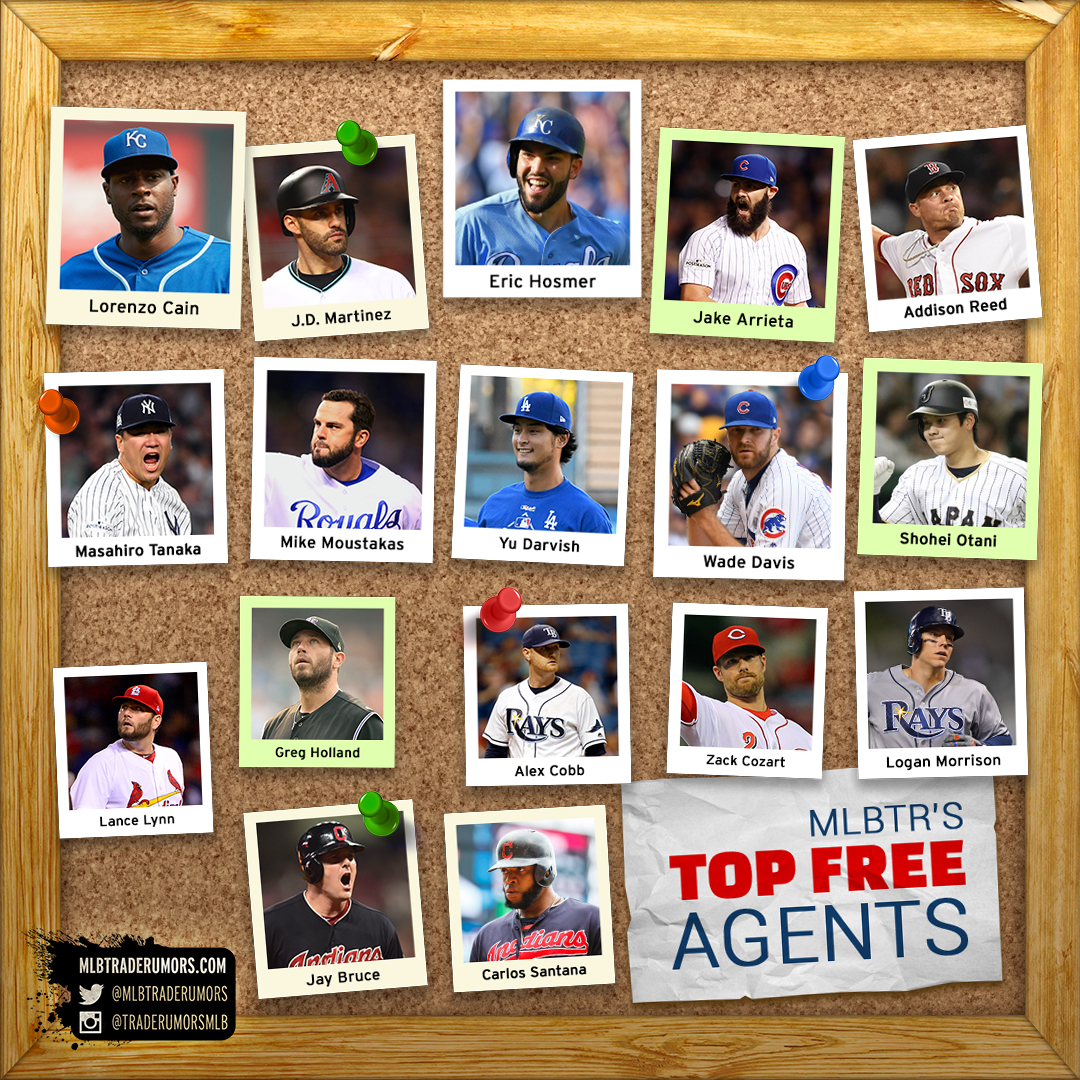
MLB Trade Rumors is proud to present our 12th annual Top 50 Free Agents list! The entire list of available free agents can be found here, and you can filter by position, signing team, and qualifying offer status with our mobile-friendly free agent tracker here.
New to MLBTR? You can follow us on Twitter, like us on Facebook, follow us on Instagram, and download our free app for iOS and Android.
MLBTR writers Steve Adams, Jeff Todd, and Jason Martinez joined me in this collaboration, debating free agent contracts and destinations for many hours. We vetted these as much as possible, but with 50 predictions and a volatile free agent and trade marketplace, we know we’ll be off on some. Let us know what you think in the comment section!
Looking for Shohei Otani? Scroll to the bottom of the post for information on Japan’s Babe Ruth, whose free agency is a special case. On to our Top 50 free agents:
1. Yu Darvish – Cubs. Six years, $160MM. Let’s start by addressing the elephant in the room. Darvish recorded a mere ten outs in his two brutal World Series starts for the Dodgers. With those ugly outings fresh in our minds, projecting him to receive the winter’s largest contract creates cognitive dissonance. However, Darvish remains what he was a week ago: a very good starting pitcher and the best in this free agent class.
Darvish spent the first seven years of his career in Japan starring for the Nippon Ham Fighters. The Fighters made Darvish available to MLB teams in December 2011, at a time when there was no limit on bidding for the exclusive right to negotiate with the player. The Rangers beat out the Blue Jays, Yankees, and Cubs with a $51.7MM bid and signed Darvish to a six-year, $56MM deal on top of that. Darvish’s fine Rangers career included 782 2/3 innings of 3.42 ERA ball with a 11.0 K/9, plus four All-Star appearances and a second-place Cy Young finish. He was traded to the Dodgers in July, making him ineligible for a $17.4MM qualifying offer. While with the Rangers, Darvish went about 22 months between starts due to Tommy John surgery. He’s been injury-free this year and nudged his way past the 200-inning plateau in his brief start last night. The 31-year-old righty should have no problem setting a new free agent record for a Tommy John survivor, passing Jordan Zimmermann’s five-year, $110MM deal. Seven-year contracts have historically been reserved for slightly younger pitchers without elbow surgery on their resume, so we’re expecting six years for Darvish. Free agent starters have exceeded a $25MM salary four different times, and we’re projecting Darvish to become the fifth. If the Dodgers decide to move on, the Cubs, Phillies, Nationals, Cardinals, Astros, and Twins could be potential suitors. There’s a shortage of obvious big-market players here, allowing for dark horses to enter the mix.
Signed with Cubs for six years, $126MM. Deal includes opt-out clause after second year.
2. J.D. Martinez – Red Sox. Six years, $150MM. Martinez came up through the Astros’ farm system but struggled through 975 plate appearances in the Majors and was released in March 2014. The Astros didn’t understand the impact of his recently-overhauled swing. The Tigers scooped Martinez up on a minor league deal, and he went on to rake at a .300/.361/.551 pace with 99 home runs in 1,886 plate appearances for them from 2014-17. A trade to the Diamondbacks this past July removed the possibility of a qualifying offer and boosted Martinez’s stock further as he went nuts with 29 home runs in 62 games. He finished with a career-high 45 bombs on the season. The biggest knock on Martinez is his right field defense, which has been a clear negative for the last two years. He also missed significant time with an elbow fracture in 2016 and a foot sprain to begin this year. Still, Martinez’s right-handed power will make him the most coveted bat on the market, enough that teams without corner outfield openings could trade someone to create a spot. The Diamondbacks may not have the payroll space to retain Martinez, leaving the Cardinals, Red Sox, and Giants as top suitors.
Signed with Red Sox for five years, $110MM. Deal includes opt-out clauses after second, third, and fourth years.
3. Eric Hosmer – Royals. Six years, $132MM. Every year one free agent is particularly polarizing, and this winter it’s Hosmer. The first baseman did solid work for the Royals over seven seasons, with a well-timed career-best batting line of .318/.385/.498 in 671 plate appearances this year. He just turned 28 and will be looking for at least six years — quite likely more. However, defensive metrics rate his glove poorly (a 2017 Gold Glove nomination notwithstanding), and off years with the bat resulted in replacement level seasons in 2014 and ’16. A case will be made for a $200MM contract, but it’s not a very good case. Teams seeking a first baseman have free-agent alternatives such as Carlos Santana, Logan Morrison, and Yonder Alonso, as well as trade candidate Jose Abreu. If Hosmer gets a huge contract, it probably won’t be from the game’s more analytical teams. The Royals seem likely to make a spirited effort to retain Hosmer as the face of their franchise, while the Red Sox, Cardinals, Mariners, and Rockies could enter the market to varying degrees. Hosmer is a lock to receive and reject a qualifying offer.
Signed with Padres for eight years, $144MM. Deal includes opt-out clause after fifth year.
4. Jake Arrieta – Brewers. Four years, $100MM. A July 2013 trade from the Orioles to the Cubs rebooted Arrieta’s career, which peaked with the NL Cy Young Award in 2015. Arrieta’s star has dimmed since then, as he’s become more prone to walks, home runs, and hits and stopped pitching deep into games. He still provided value to the 2017 Cubs, with 30 starts of 3.53 ERA ball. Though he turns 32 in March, Arrieta’s case for a long-term deal is boosted by excellent physical conditioning. We expect him to come out looking for a six-year deal, but land at four or five. Arrieta appears likely to move on from the Cubs, with whom he was unable to agree to an extension in the past few years. However, it’s possible Arrieta could circle back to the Cubs later in the offseason if his market disappoints. We don’t see a clear favorite to sign him, so we’ve chosen a dark horse pick in the Brewers. The Cardinals, Nationals, Astros, Rangers, Phillies, Yankees, Angels, Mariners, Braves, Twins, and Dodgers could be in the mix depending on the price.
Signed with Phillies for three years, $75MM. Deal includes opt-out clause after second year, which Phillies can void with two-year extension.
5. Masahiro Tanaka – Phillies. Five years, $100MM. Tanaka, 29 this month, is coming off his fourth and perhaps worst MLB season. He posted a 4.74 ERA in 30 regular season starts, with a ridiculous 21.2% of his flyballs allowed becoming home runs. It wasn’t a Yankee Stadium problem, as Tanaka was even more homer-prone on the road. On the bright side, Tanaka put up a career-best strikeout rate, a 3.77 ERA in the second half, and three excellent, homer-free postseason starts. Back in January 2014, Tanaka joined the Yankees via the Japanese baseball posting system after pitching seven years for the Rakuten Golden Eagles. With the posting fee capped at $20MM, the Yankees won the bidding over the Cubs, White Sox, Dodgers, and Diamondbacks with a seven-year, $155MM deal that included an opt-out that comes due at midnight on Saturday. The biggest wrinkle in Tanaka’s long-term prospects may be the partially torn UCL in his right elbow, which surfaced more than three years ago. Tanaka went the rehab route instead of undergoing Tommy John surgery. In 2015 Tanaka missed time with a forearm strain and had arthroscopic elbow surgery in the offseason. This year, he had a DL stint for shoulder fatigue. If Tanaka opts out, he will be walking away from three years and $67MM left on his Yankees contract. Ervin Santana was able to land a four-year deal with a rehabbed and healed UCL, and it seems that opting out is the right call for Tanaka. The Yankees could be in a position to lower their luxury tax hit by adding a year or two and reducing the average annual value of his contract. If Tanaka moves on from the Yankees, the Cubs, Nationals, Astros, Cardinals, Dodgers, Angels, Phillies, Twins, Mariners, Rangers, and Brewers could be possibilities. If he does opt out, the Yankees will assuredly issue a qualifying offer in order to collect draft-pick compensation.
Elected to remain with Yankees, forgoing opt-out clause and free agency.
6. Mike Moustakas – Braves. Five years, $85MM. Moustakas, 29, set a Royals franchise record with 38 home runs this year. The second overall draft pick in 2007, Moustakas didn’t click as a hitter until 2015. The third baseman suffered an ACL tear in May 2016, ending that season early, but exhibited no health problems in his return this year. The biggest flaw in Moose’s game is his low 5.7% walk rate this year, resulting in a .314 OBP that drove down his overall value as a hitter despite the power. Defensive metrics were also down on his once well-regarded glovework this year, though teams may be willing to chalk that up to rust coming off his knee injury. Regardless, he should do well in free agency. If the Royals move on, the Angels, Braves, and Cardinals could be options. Like Hosmer, Moustakas is going to receive and reject a qualifying offer.
Re-signed with Royals for one year, $6.5MM.
7. Lorenzo Cain – Giants. Four years, $70MM. Yet another Royals free agent, Cain adds value with his hitting, baserunning, and glove as a center fielder. He’s a speedy, well-rounded player who was worth more than four wins above replacement this year. Dexter Fowler’s five-year, $82.5MM deal with the Cardinals will be a likely model, though Cain is a year older than Fowler was. Cain is the only plus defensive center fielder on the market who also carries an above-average bat, which should create plenty of demand. If the Royals don’t retain him, the Giants, Mariners, Blue Jays, and Rangers could be matches. The Royals have reportedly yet to decide on a qualifying offer for Cain, but it’d be a big surprise if he doesn’t get one.
Signed with Brewers for five years, $80MM.
8. Wade Davis – Astros. Four years, $60MM. Davis, 32, came up as a starter in the Rays system and was traded with James Shields to the Royals in a December 2012 blockbuster. 2013 was a tumultuous year for Davis – his wife had a baby, he lost his stepbrother unexpectedly, and he pitched his way out of the rotation by August. He began 2014 as the Royals’ setup man and never looked back, garnering Cy Young votes in a dominant season. He moved into the team’s closer role when Greg Holland got hurt the following year and will forever be remembered flinging his glove into the air after punching out Wilmer Flores looking to end the 2015 World Series. Davis missed time late in 2016 with a flexor strain in his pitching elbow, but the Cubs were not deterred in deftly trading Jorge Soler for him last offseason. Davis had a fine year as the Cubs’ closer, though he walked more than five batters per nine innings in the second half and that trend continued as manager Joe Maddon pushed him into multi-inning postseason stints. Despite a few warts, Davis is the best closer available and will likely be targeting Mark Melancon’s four-year, $62MM deal from last winter. The Cubs shied away from big-money closers last winter, but it’s still possible they could pony up for Davis. If the Cubs look elsewhere, the Astros, Cardinals, Rangers, Nationals, Twins, Braves, and Rockies could be fits. Davis is another slam-dunk recipient of the qualifying offer and will reject in search of a long-term deal.
Signed with Rockies for three years, $51MM.
9. Lance Lynn – Rangers. Four years, $56MM. Lynn, a 30-year-old righty, kicks off the second tier of free-agent starting pitching. He made 161 starts for the Cardinals in his career, regularly topping 30 per year. Lynn went under the knife for Tommy John surgery in November 2015. He missed all of 2016, as expected, but was one of only 12 pitchers to reach 33 regular season starts in 2017. While Lynn was never a big control guy, his 3.8 walks per nine innings was the second-worst mark of all qualified MLB starters. His strikeout and home run rates were also career worsts, so his 3.43 ERA can be attributed largely to a .241 batting average on balls in play. If Lynn’s BABIP regresses and other rates hold steady, his ERA could easily jump past the mid-4.00s. Still, Lynn takes the ball every fifth day and has had a lot of big league success since 2012. The righty’s reported asking price of $100MM+ over five years seems unattainable, but half of baseball is seeking rotation help. That includes the Rangers, Orioles, Twins, Mariners, Phillies, Cubs, and Brewers. Given the expected demand for Lynn, the Cardinals are likely to make a qualifying offer, and he’s likely to reject.
Signed with Twins for one year, $12MM.
10. Greg Holland – Cardinals. Four years, $50MM. Holland ascended to the Royals’ closer job when they traded Jonathan Broxton at the 2012 trade deadline. He established his dominance in 2013-14 with a 1.32 ERA and 13.4 K/9 in 129 1/3 regular season innings, earning Cy Young Votes and All-Star nods in each season. Holland apparently tore his elbow ligament late in the 2014 season, pitching through the injury in 2015 before succumbing to Tommy John surgery shortly before his team began its World Series run. He spent 2016 as a rehabbing free agent and landed a one-year contract with the Rockies in January of this year. A $15MM player option for 2018 vested in that contract, which he will reportedly decline in search of a multiyear deal. Holland was healthy in 2017 and was one of the best relievers in baseball for the first two months of the season. He endured a brutal eight-game stretch in August before rebounding with a strong finish in his final 11 regular-season appearances. Holland will have a market similar to that of his former setup man, Wade Davis. Considering the fact that he’s turning down a $15MM player option, Holland is a lock to also reject a one-year, $17.4MM qualifying offer.
Signed with Cardinals for one year, $14MM.
2017-18 MLB Free Agent Tracker
Our 2017-18 MLB Free Agent Tracker is now available! Our tracker allows you to filter by position, team, signing status, handedness, qualifying offers, and contract years, amounts, and options. We’ll be updating it quickly throughout the offseason. The tracker is mobile-friendly as well, so give it a try on your phone. Check out our 2017-18 MLB Free Agent Tracker today!
Angels Sign Justin Upton To Five-Year Contract
After spending the past several weeks weighing an opt-out clause that would’ve allowed him to forgo the remaining four years and $88.5MM on his contract, Justin Upton has reached a compromise with the Angels. The Halos announced on Thursday that they’ve signed Upton to a new five-year contract that runs through the 2022 campaign, in essence extending his current deal by one year in exchange for tearing up the opt-out provision. Upton, a client of Reynolds Sports Management, will reportedly earn $106MM on the five-year deal, which contains a full no-trade clause.
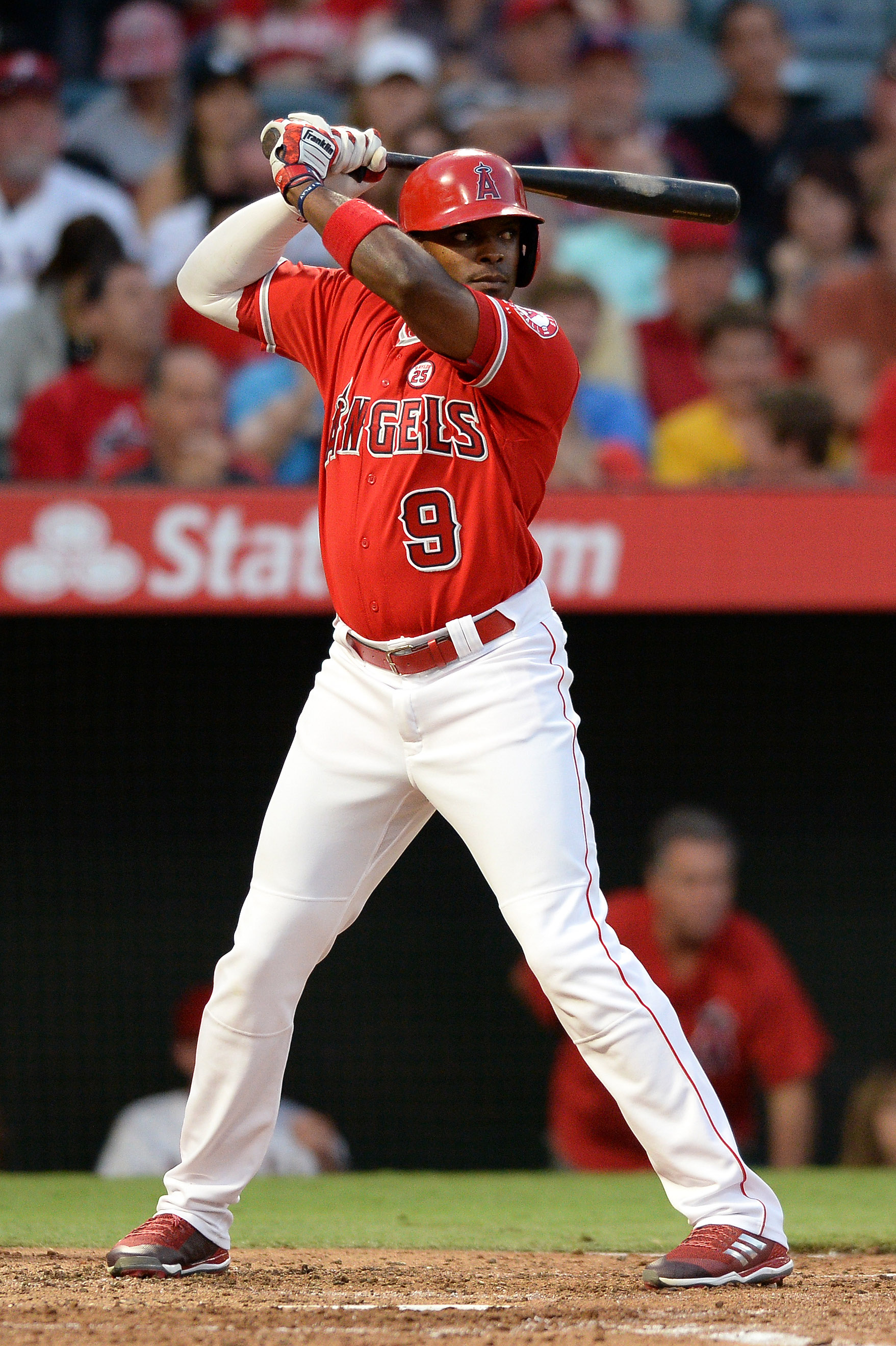
Upton’s deal can technically be viewed as a one-year, $17.5MM extension of his current contract, then, which brings the total value of the deal to $150.5MM over seven years. He’ll now reportedly earn $16MM in 2018, $18MM in 2019, $21MM in 2020, $23MM in 2021 and $28MM in 2022 on a contract that carries through his age-34 season.
[Related: Updated Los Angeles Angels payroll outlook and depth chart]
Los Angeles acquired Upton from the Tigers on Aug. 31 in exchange for pitching prospect Grayson Long and a player to be named later, hoping that Upton’s bat would help fuel a run at an American League Wild Card berth. While the Angels ultimately fell short of that goal, it was through no fault of Upton; in 115 plate appearances with the Angels, Upton nearly matched his OBP and slugging numbers with the Tigers, hitting .245/.357/.531 with seven homers in the season’s final month. Overall, he finished out the year with a .273/.361/.540 batting line, a career-high 35 homers and 14 steals.
Upton’s first year with the Tigers got off to a poor start, prompting many to question the initial six-year, $132MM contract before Upton righted the ship in Detroit about halfway through that 2016 campaign. Dating back to July 1 of last season, Upton has batted .270/.352/.548 with 58 home runs in 946 trips to the plate — good for a park- and league-adjusted wRC+ of 137. (In other words, his bat has bee about 37 percent better than that of a league-average hitter.)
Beyond his excellence at the plate, Upton turned in yet another solid year on the defensive end of the equation. Defensive Runs Saved pegged him at +8, while Ultimate Zone Rating had him at 2.1 runs above average. Statcast’s new Outs Above Average metric was a bit less bullish, grading him at -1 outs. Despite the variance in those respective metrics, the Angels can reasonably expect at least average defensive contributions from Upton next year in addition to strong offense and above-average baserunning.
For the Angels, left field was a clear need whether a deal with Upton was worked out or not. The Halos are lacking in upper-level bats that can be relied upon to contribute to a big league lineup, but Upton will now join Mike Trout and Kole Calhoun in the Angels’ outfield and in the heart of their order. Aging slugger Albert Pujols, of course, remains a fixture in the lineup as well, though the soon-to-be 38-year-old struggled through the worst season of his Hall of Fame career in 2017.
The Pujols commitment remains an onerous financial obligation, but the Angels now have Josh Hamilton‘s massive contract off the books, which will effectively be replaced by the Upton deal. Upton’s contract , though, will come with a lesser luxury tax obligation — $21.2MM annually if the contract is viewed as a five-year, $106MM deal or $21.46MM if it’s viewed as seven years and $150.25MM. The Angels will also see both Ricky Nolasco and Huston Street come off the books this winter once their options are declined, further creating some payroll flexibility, both as it pertains to the luxury tax and the 2018 roster.
The backloaded nature of Upton’s new contract structure should allow the Angels to be a bit more aggressive in filling out their 2018 roster this winter. Between Upton, Trout, Pujols, Calhoun, Andrelton Simmons and Luis Valbuena, the Angels have about $105MM in guaranteed 2018 salary on the books. That figure will rise into the $128MM range after Garrett Richards, Matt Shoemaker, Tyler Skaggs, Andrew Heaney, Martin Maldonado, Blake Parker, Jose Alvarez, Cam Bedrosian and J.C.Ramirez are tendered contracts (and potentially more if C.J. Cron and Blake Wood are also tendered). That should leave the Angels with some spending money to address needs at second base and at an infield corner (whichever Valbuena does not play) in addition to stabilizing their injury-plagued pitching staff.
USA Today’s Bob Nightengale reported the total guarantee of the contract (Twitter link). ESPN’s Buster Olney tweeted the annual breakdown of the deal, and MLB.com’s Jon Morosi added that Upton received a no-trade clause.
Photo courtesy of USA Today Sports Images.
The MLB Offseason Begins
The 2017 season came to a conclusion last night when the Astros closed out a Game 7 victory over the Dodgers, officially (and remarkably) making Sports Illustrated’s famous 2014 prediction a reality. Houston’s aggressive rebuilding tactics led to the selections of George Springer (No. 11), Carlos Correa (No. 1), Lance McCullers (No. 41) and Alex Bregman (No. 2) near the top of their respective drafts, while the team’s front office, scouting department and player development staff deserve praise for compiling a roster that is rife with hidden gems.
Dallas Keuchel, a seventh-round pick in ’09, blossomed into one of baseball’s best starters over the past few years in Houston. Waiver claims like Collin McHugh and Will Harris have cemented themselves as big leaguers. Marwin Gonzalez, a Rule 5 pick out of the Cubs organization, was one of the game’s most versatile and most valuable players in 2017. Some raised an eyebrow at last winter’s two-year deal for Charlie Morton after he made just four starts in 2016, but he capped a terrific season with a heroic four-inning relief appearance in Game 7, clinching the first World Series in franchise history.
American League MVP candidate Jose Altuve came to the Astros as an unheralded international signing that received a mere $15K bonus back in 2007. And, of course, general manager Jeff Luhnow and his staff deserve credit for their dramatic, last-minute acquisition of Justin Verlander, who looked better than ever for the Astros down the stretch and took home ALCS MVP honors with 16 innings of one-run ball.
While congratulations are in order for the Astros, the front office won’t spend too much time celebrating. Like baseball’s other 29 teams, they’ll look ahead to the 2018 season (and beyond) with visions of a future World Series Championship firmly in their sights. Here are some of the key dates of the MLB offseason, which kicks off today…
- Nov. 2: Commencement of a five-day, exclusive negotiation window that teams have with their own free agents. (Also, MLBTR’s Top 50 Free Agent rankings with predictions!)
- Nov. 4: Deadline for players with opt-out clauses (e.g. Justin Upton, Masahiro Tanaka) to exercise those provisions.
- Nov. 6: The deadline for MLB clubs to formally issue one-year qualifying offers (valued at $17.4MM this offseason, as reported by MLBTR) to free agents is 5:00pm ET. Those players will have 10 days to weigh the offers and can negotiate with other clubs during that 10-day window. After that 5pm deadline, all free agents are eligible to begin negotiating with other teams.
- Nov. 13-16: General Managers’ meetings take place in Orlando, Fla.
- Nov. 20: Deadline for teams to set their 40-man rosters in advance of the Rule 5 Draft.
- Dec. 1: Deadline to tender contracts to arbitration-eligible players.
- Dec. 10-14: MLB’s annual Winter Meetings take place in Orlando, Fla.
- Dec. 14: The Rule 5 Draft is held on the final day of the Winter Meetings.
- Jan. 13: Arbitration exchange day — the date on which teams and players must exchange filing numbers for arbitration. Hearings, if necessary, typically begin in early February.
- Mar. 29: Opening Day! Baseball is back.
Names like J.D. Martinez, Yu Darvish, Jake Arrieta, Eric Hosmer, Mike Moustakas headline the 2017-18 class of MLB free agents. We’ll be running our Top 50 Free Agent rankings, which will include contract projections and predictions as to where each of the 50 will sign, later this afternoon.
The offseason figures to, as always, bring plenty of action on the trade front as well (tip of the cap to Jerry Dipoto). At the forefront of this winter’s trade talks, of course, will be Giancarlo Stanton. Several other names will be bandied about the rumor mill as well, though, with players like Ian Kinsler, Jose Abreu, Dee Gordon, Brad Hand and many others standing out as offseason trade candidates.
MLBTR readers can bookmark our new and improved Free Agent Tracker as a useful offseason resource. It can be filtered by position, team, signing status, handedness, qualifying offers, and contract years, amounts, and options. We’ll be updating that and our list of free agents throughout the offseason as the free-agent landscape begins to take shape.
You can also follow along with MLBTR’s Offseason Outlook series to get a feel for the decisions that each of the league’s 30 teams will face over the winter and some of the routes they could take to Opening Day 2018. We at MLBTR look forward to another active offseason of hot stove coverage and hope you’ll follow along with us throughout the process!
Red Sox Exercise Options On Chris Sale, Craig Kimbrel
The Red Sox announced this morning that they’ve formally exercised their 2018 club options over ace Chris Sale and closer Craig Kimbrel. Sale will earn $12.5MM in 2018, while Kimbrel will be paid $13MM.
Additionally, the Sox announced that they’ve outrighted left-hander Robbie Ross Jr. and infielder Josh Rutledge, each of who has elected free agency. Boston has also selected the contracts of outfielder Bryce Brentz and left-hander Williams Jerez from Triple-A Pawtucket.
The option decisions on Sale and Kimbrel were among the easiest in all of baseball. The pair finished out the season as two of the most valuable players on the Red Sox and two of the best in all of baseball in their respective roles. Sale led the American League with 214 1/3 innings and a remarkable 308 strikeouts (12.9 K/9), pitching to a stellar 2.90 earned run average along the way. Kimbrel, meanwhile, posted a 1.43 ERA with 35 saves in 69 innings and struck out a staggering 49.6 percent of the batters he faced (16.4 K/9). Sale’s contract includes a $13MM option for the 2019 season as well, while Kimbrel will be a free agent for the first time next winter.
Ross, 28, was limited to just 15 innings between the Majors and Triple-A this season due to a back injury that ultimately required surgical repair. Prior to that, however, he was a quality setup man in Boston, pitching to a 3.57 ERA with 8.5 K/9, 3.3 BB/9 and a 49.4 percent ground-ball rate in 116 innings in 2015-16. Lefties hit just .200/.302/.297 against Ross in that time, while righties hit him at a .260/.333/.388 clip. Ross would’ve been eligible for arbitration this offseason after earning $1.825MM in 2017. He’s expected to be healthy for Spring Training and could make for an affordable and experienced option for a team seeking left-handed bullpen help.
Rutledge, also 28, logged 118 plate appearances in 2017 — his third year with Boston. He’s seen very limited action with the Sox dating back to 2015, though, hitting just .252/.319/.313 in 259 plate appearances across those three seasons. The versatile Rutledge can handle second base, third base and shortstop, and he even saw 13 innings at first base for the Sox in 2017. He’ll likely land a minor league pact somewhere this offseason and compete for a bench role in Spring Training.
Red Sox Hire Tony La Russa As Vice President, Special Assistant
NOV. 2: The Red Sox have formally announced the addition of La Russa to their baseball operations department. Per the team’s release, La Russa “will assist Dombrowski in all areas of baseball operations, including player development and consultation with the major and minor league coaching staffs.”
NOV. 1: The Red Sox are set to add Hall of Fame manager Tony La Russa to their organization, according to a report from Chad Jennings and Michael Silverman of the Boston Herald. La Russa just wrapped up a stint with the Diamondbacks, which he began as “chief baseball officer” and ended as “chief baseball analyst” after a front office shakeup.
We’ll likely know more soon, as the Herald reports an announcement could come tomorrow. What is clear is that La Russa will not be wearing a uniform. Jennings and Silverman say that he’s not slated to take a role on the staff of incoming skipper Alex Cora.
La Russa, who is now 73 years of age, instead seems slated to join a front office that’s helmed by Dave Dombrowski. (The two go way back, Jon Heyman of Fan Rag notes on Twitter.) It seems likely that La Russa will function in some kind of senior advisory capacity rather than taking up a spot with everyday duties in the chain of command, though that’s just speculation at this stage.
Boston has failed to make its way out of the divisional round in each of the past two postseasons, despite capturing consecutive AL East crowns. In the aftermath, skipper John Farrell lost his job and was ultimately replaced by Cora — who’ll be a rookie manager but is currently experiencing a deep run in his job as the Astros bench coach. It’s not entirely clear whether La Russa will have any role in helping to mentor Cora, but his vast experience will surely be drawn on as the organization looks both to repeat its divisional title and advance further into the playoffs.
Negotiation Impasse Could Jeopardize Shohei Otani Posting
Despite a variety of roadblocks, it has become widely assumed that Japanese star Shohei Otani would transition to the majors over the coming offseason. That possibility could now be in jeopardy, Joel Sherman of the New York Post reports, owing to a dispute regarding the nature of the transfer rules that would govern the transaction.
Under the preexisting rules regime, Otani would have been made available to any Major League Baseball team willing to pay the maximum $20MM transfer fee. While MLB’s restrictive new international spending rules severely limited his potential earning capacity, he appears to be at peace with taking less now rather than waiting until he is old enough not to have his bonus capped.
Trouble is, the posting deal between MLB and Nippon Professional Baseball just expired, leading to negotiations on a new agreement. Per Sherman, the approach contemplated was to allow the NPB team to receive a payout tied to the value of the contract(something in the realm of 15 to 20 percent of the total guarantee).
In the case of Otani, of course, that would have meant a drastic reduction of the money flowing to his current club, the Nippon Ham Fighters. While MLB would be willing to allow Otani to sign under the preexisting rules, per Sherman, that attempt at a compromise has run afoul of the MLB player’s union.
While the MLBPA does not count Otani as a member, and wouldn’t even do so upon his signing (since it’ll be a minor-league deal), it does have a stake here since the issue is subject to collective bargaining. According to Sherman, the union is concerned with the possibility that Otani will end up taking home a bonus significantly less than the value paid to the Fighters.
Ultimately, it seems that there’s still room for talks to sort things out. Sherman does not suggest that the union is interested in spoiling the transfer, for example; to the contrary, he says it is attempting to work with Otani. (That effort, he notes, has been complicated by the fact that Otani is still utilizing a Japanese lawyer and has yet to choose a MLBPA-certified agent.)
Even if things eventually get sorted, the news is quite notable. With the World Series wrapping up tonight, the open market will be fired up tomorrow. Teams shopping for starting pitching will begin negotiating in earnest, unsure of whether Otani will actually come — and, if so, exactly what he’s looking for in choosing a team. All things considered, the Otani situation is about as big a wild card on the market as could be imagined.
Phillies Hire Gabe Kapler As Manager
OCT. 30, 3:41pm: The Phillies have announced that Kapler will indeed take over the dugout.
7:30am: Kapler is indeed the Phillies’ choice to be their next manager, reports MLB.com’s Todd Zolecki. He impressed in a second interview this past Friday, and an announcement could come on Monday, according to Zolecki.
OCT. 29: The Phillies look to be close to naming Gabe Kapler as their next manager, as Jon Heyman and Robert Murray of FanRag Sports report that “barring something unforeseen,” Kapler is the team’s choice to replace Pete Mackanin. An official announcement could come as early as Monday, or perhaps until after the World Series is over.
Kapler and Triple-A manager Dusty Wathan were known to be the finalists for the job. Former Red Sox manager John Farrell also known to be in the running if Philadelphia opted for a skipper with MLB experience. It now seems, however, that the Phillies will go in the opposite direction with Kapler, who will be joining a Major League staff for the first time in any capacity. He has worked as the Dodgers director of player development for the last three years, and Kapler’s dugout resume consists of managing the Red Sox A-ball affiliate in 2007 and coaching on Team Israel’s staff during the qualifying rounds of the 2013 World Baseball Classic.
Despite this relative lack of experience, however, Kapler has long been cited as a potential manager of the future, even dating back to his playing career as an outfielder with the Red Sox, Rangers, Rays, Tigers, Rockies and Brewers from 1998-2010 (he took a year off for that Single-A managing stint). Kapler was seen as a strong contender for the Dodgers’ last managerial vacancy, and it was even seen as something of an upset when the team instead hired Dave Roberts.
The Phillies were thought to be looking to hire a more analytically-minded manager, and Kapler would certainly fit that description. Two years ago, ESPN.com’s Mark Saxon profiled Kapler’s full embrace of statistical analysis, physical and mental training methods in helping mold the Dodgers’ minor leaguers. Kapler, 42, would be the latest in the game’s trend of younger managers not far removed from their playing days and without much formal managerial or even coaching experience.
Assuming the hire is official, Kapler will take over a young Phillies team still in the midst of a rebuild, but already with some intriguing building block pieces on the roster. Phils GM Matt Klentak surprised many when he removed Mackanin from the manager’s job to a front office position last month, though since Mackanin was already in place when Klentak became GM in October 2015, Klentak has now firmly put his own stamp on the manager’s job. Klentak and Kapler have a past relationship, as Klentak was working in the Rockies’ baseball operations department in 2003 when Kapler was playing for the team.