
Trade Rumors Front Office Subscriber Chat, Today 3pm CT
MLBTR's Steve Adams is hosting a live chat today, exclusively for Trade Rumors Front Office subscribers.

Unlock Subscriber-Exclusive Articles Like This One With a Trade Rumors Front Office Subscription
- Access weekly subscriber-only articles by Tim Dierkes, Steve Adams, and Anthony Franco.
- Join exclusive weekly live chats with Anthony.
- Remove ads and support our writers.
- Access GM-caliber tools like our MLB Contract Tracker
Dodgers Sign Edwin Diaz
December 15th: The deal also contains a condition club option for 2029, reports Jon Heyman of The New York Post. That option has a $6.5MM base, with Diaz able to earn an extra $750K for 45 games finished and 50 games finished, plus another $1MM for 55 games finished. The specific conditions for the option aren’t known but Alden González of ESPN reports that it would be available to the Dodgers if Diaz spends a certain amount of time on the injured list.
December 12th: The Dodgers officially announced the signing today.
December 9th: For the second straight offseason, the Dodgers are signing the top relief arm on the market. They’ve reportedly agreed to a three-year, $69MM contract with now-former Mets closer Edwin Diaz. It’s a record-setting annual value for a reliever, breaking the $20.4MM record that Diaz himself already held. Diaz’s contract with the Dodgers contains $4.5MM in deferred salary annually. The net-present value, for luxury tax purposes, is roughly $21.1MM.
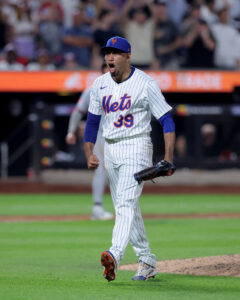
Diaz, a Wasserman client, returned to the open market this winter when he opted out of the final two seasons of the precedent-setting five-year, $102MM contract he signed with the Mets the last time he was a free agent. The right-hander had been guaranteed $38MM over the final two seasons of that contract, so by opting out and testing the market, he secured himself an additional one year and $31MM in guarantees. The Mets, according to Joel Sherman of the New York Post, offered Diaz a three-year, $66MM deal with “slight” deferrals.
The 31-year-old Diaz (32 in March) has spent the past seven years in Queens and, after a rocky first campaign, has turned in a collective 2.36 ERA (2.12 SIERA, 2.15 FIP) with a mammoth 40.8% strikeout rate and 8.9% walk rate. He’s piled up 144 saves in 332 appearances as a Met.
For the Dodgers, Diaz represents the most on-the-nose means of addressing a problem that nearly doomed them in the postseason: a lack of reliable bullpen help. Injuries to Evan Phillips, Tanner Scott, Brusdar Graterol and others left the Dodgers with a thin enough stock of trustworthy relievers that L.A. turned to Blake Snell, Tyler Glasnow and Yoshinobu Yamamoto (one day after he threw nearly 100 pitches) in pivotal high-leverage settings during their World Series run. That they even progressed to the World Series was largely attributable to historic performances from starters Yamamoto, Snell, Glasnow and Shohei Ohtani in the postseason’s earlier rounds.
The Dodgers have now signed the top reliever on the market in consecutive offseasons. They inked Tanner Scott to a four-year, $72MM pact last winter, though that deal contained $21MM worth of deferred money, thus knocking down the present value. Scott’s first year in L.A. didn’t go at all as hoped; he limped to a 4.74 ERA with improved command but lesser velocity and strikeout rates. After yielding 11 home runs in the 2022-24 seasons combined, Scott served up 11 round-trippers in his first season as a Dodger.
Certainly, they’ll hope for better results with Diaz, whose track record is lengthier and steadier than that of Scott. While he’s naturally had some year-to-year variance in his earned run averages — as is the case for any reliever — Diaz has been at 3.52 or better in each of the past five seasons, including three sub-2.00 campaigns. He’s punched out at least 34.6% of his opponents each season along the way, and since a shaky walk rate in 2021, he’s sat between 7.7% and 9.3% in that regard for four straight seasons.
That’s not to say there aren’t any red flags at all with regard to Diaz. His average fastball velocity has dipped in two consecutive seasons. While this past season’s average of 97.2 mph was still well above average, it’s also two miles per hour shy of Diaz’s 2022 peak. He also gave up considerably more hard contact. Diaz’s 88.5 mph average exit velocity and 39.7% hard-hit rate were both the second-highest marks of his career, trailing only his disastrous 2019 season (his first as a Met). Neither is a glaring issue, particularly considering Diaz maintained elite strikeout and swinging-strike rates (38% and 18%, respectively), but he’ll want to avoid allowing those negative trends to continue, however slight they may currently be.
Diaz will slot into the ninth inning, pushing Scott to a setup role alongside Alex Vesia, Blake Treinen, Anthony Banda, Brock Stewart and Graterol. Will Klein, Ben Casparius and Jack Dreyer all had solid or better seasons in 2025, but if everyone is healthy — far from a given — there’s only room for one of that trio in the final bullpen spot. Of course, injuries will inevitably create opportunities for many of the Dodgers’ overqualified depth arms, and each of Klein, Casparius, Dreyer and Edgardo Henriquez have minor league options remaining.
The Dodgers have paid the luxury tax in (more than) three consecutive seasons and are more than $60MM over the $244MM first-tier luxury threshold, meaning they’ll pay a 110% tax on the AAV on Diaz’s contract. However the annual salaries break down, he’ll cost them an additional $25.3MM in taxes alone. Assuming an evenly distributed $23MM per season, RosterResource, now projects next year’s Dodgers payroll at just over $359MM (although that does not account for substantial deferrals to Ohtani, Scott, Freddie Freeman, etc.).
The Mets would have been subject to those same penalties had they matched or topped this offer. Diaz reportedly entered the market seeking a five-year contract. When that didn’t materialize, he clearly pivoted to a record-setting, shorter-term arrangement. The extent of the deferrals in New York’s offer aren’t yet clear, but there’s no indication (yet, anyway) that the Dodgers’ offer includes any deferred money.
While New York couldn’t have known when signing Devin Williams to a three-year, $51MM pact that Diaz would also sign for three years and a total of $18MM more, the results from those two high-end relievers will now be carefully watched by Mets fans for the next three seasons. If Williams returns to form, it’ll look like a savvy pivot to get a comparable reliever at a lesser rate. If not, there will be plenty of second-guessing and criticism from the fan base.
Of course, owner Steve Cohen also clearly has the resources to have simply won the bidding on both relievers, but that’s ultimately not the route the front office chose. They’ll now look to other avenues as they seek to continue adding to the bullpen. The Mets were open to re-signing Diaz even after adding Williams, and while this deal clearly went past their comfort zone, there are other high-end arms still available — Robert Suarez, most notably. Choosing to let Diaz walk also frees up further resources for a potential re-signing of Pete Alonso or perhaps a run at another target of note.
The Mets bid farewell to Diaz, who rejected a $22.025MM qualifying offer, with only minimal compensation for his departure. Due to their status as luxury tax payors, they’ll receive a compensatory draft pick after the fourth round of next summer’s draft. The Dodgers, meanwhile, will surrender their second- and fifth-highest selections in next year’s draft. The league-allotted cap on their personal spending pool for international amateur free agents will also be reduced by $1MM.
Such considerations tend to be ancillary for the market’s top-spending clubs. Perennial luxury payors consider them the cost of doing business in the deepest waters of the free agent pool. The Dodgers have punted draft picks to sign Shohei Ohtani and Freddie Freeman (among others) in recent seasons. For them, the allure of adding a closer with nearly unrivaled dominance takes precedence as they try to assemble a roster capable of winning three consecutive World Series for the first time since the 1998-2000 Yankees.
The Athletic’s Will Sammon first reported the agreement. Sammon and colleague Ken Rosenthal were also the first to report the three-year term. ESPN’s Jeff Passan broke the total guarantee. Joel Sherman and Jon Heyman of the New York Post reported the Dodgers’ emerging interest in Diaz shortly before the agreement became public. Sherman reported on the deferrals.
Mets, Cristian Pache Agree To Minor League Deal
The Mets have agreed to a minor league contract with outfielder Cristian Pache, reports Pat Ragazzo of Mets On SI. He’ll be in major league camp as a non-roster invitee next spring. Pache is represented by the MVP Sports Group.
Pache, 27, was once considered one of the sport’s top outfield prospects during his earlier days in the division-rival Braves organization. He’s long been touted as a plus-plus defender in center field — a rangy outfielder with good speed and solid raw power but a shaky hit tool that didn’t allow him to get to that pop often enough.
That lack of hit tool has indeed held Pache back. Atlanta traded him to the Athletics as one of four players in return for first baseman Matt Olson, and he’s since bounced to the Phillies, Orioles and Marlins organizations. Pache hasn’t hit in the majors during any of his stops. He’s taken 610 plate appearances at the MLB level and carries just a .181/.243/.275 batting line with a troublesome 30.8% strikeout rate. He has indeed strong defensive grades, but Pache hasn’t hit enough to even profile as a viable fourth outfielder in the majors.
Pache’s numbers in the upper minors have been better but are still lackluster, particularly considering how hitter-friendly most of the environments in which he’s played have been. In parts of five Triple-A seasons, Pache carries a .257/.332/.397 batting line. He spent the 2025 season with the D-backs’ top affiliate in Reno, hitting .251/.351/.389 in 288 plate appearances. That looks decent on the surface, but in that exorbitantly hitter-friendly setting, it’s actually about 20% worse than league-average production, by measure of wRC+.
In many ways, Pache is an even more extreme version of Tyrone Taylor, who’s already on the Mets’ big league roster. Both are right-handed hitting center fielders with questionable bats and strong gloves, but while Pache is the better defender of the two, his bat is even lighter than that of Taylor (who hit .223/.279/.319 with the Mets in 2025).
Pache is out of minor league options, so if he’s added to the big league roster at any point, he’d need to stick or else be designated for assignment and passed through waivers. He gives the Mets some versatile outfield depth, but there are enough offensive question marks surrounding him that he profiles mainly as glove-first insurance in the event of multiple injuries at the big league level.
Rangers Sign Anthony Veneziano To Minor League Deal
The Rangers have signed left-hander Anthony Veneziano to a minor league deal, MLBTR has learned. The KHG Sports Management client also receives an invite to big league camp in spring training.
Veneziano, 28, has pitched for the Royals, Marlins and Cardinals over the past three big league seasons. He briefly crossed paths with Rangers manager Skip Schumaker, as Veneziano came to the Marlins via a waiver claim in September of 2024, when Schumaker was still the skipper in Miami. Veneziano has thrown 40 2/3 innings in the majors, allowing 3.98 earned runs per nine. He has averaged 93 to 95 miles per hour with his four-seamer but has thrown his slider more often while also mixing in a changeup. In 2025, he added a sinker to his arsenal in the big leagues.
That sinker seems to have helped him keep the ball on the ground. He tossed 25 innings this year, split between the Fish and the Cards, with a 4.68 ERA. He had just a 30.6% ground ball rate coming into 2025 but got grounders on 49.4% of balls in play this year, notably above the 41.8% league average. His 21.4% strikeout rate and 9.4% wak rate were both worse than league average but by less than 1% in both cases.
The Cardinals claimed Veneziano off waivers from the Marlins in August but then outrighted him off the 40-man in November. He was able to elect free agency, which allowed the Rangers to add him on this pact.
The southpaw came up as a starter but has primarily been working out of the bullpen in recent years. The 2025 Rangers built out their bullpen by signing a number of veterans to one-year deals. That worked fairly well but it meant that almost the entire relief group hit free agency last month. Phil Maton, Shawn Armstrong, Hoby Milner, Danny Coulombe and Chris Martin all hit the open market at season’s end. Texas also non-tendered Jacob Webb and Josh Sborz shortly thereafter.
Jacob Latz might get a chance at a rotation job next year, which means Robert Garcia is the top lefty in the bullpen. The Rangers added Tyler Alexander last week. If Veneziano can earn a 40-man spot, he still has an option, meaning he could be sent to Triple-A and back throughout the year. He also has less than a year of service time, meaning he could be cheaply retained for the foreseeable future if he can hold a roster spot through the upcoming season.
Photo courtesy of Kim Klement Neitzel, Imagn Images
Diamondbacks Sign Isaiah Campbell To Minor League Deal
The Diamondbacks have signed right-hander Isaiah Campbell to a minor league deal, according to his transactions tracker at MLB.com. The ACES client has been assigned to the Triple-A Reno Aces but will presumably receive an invite to big league camp in spring training.
Campbell, 28, has appeared in each of the past three big league seasons. Suiting up for the Mariners and Red Sox, the righty has thrown 43 innings in the majors, allowing 5.65 earned runs per nine. His 21.9% strikeout rate and 8.3% walk rate are close to average while his 47.7% grounder rate is a few ticks better than par. His .341 batting average on balls in play and 66.6% strand rate are both to the unfortunate side, so metrics like his 4.34 FIP and 3.89 SIERA are a bit more optimistic than his ERA.
Only 7 2/3 of those innings came in 2025, as he spent most of the season with Triple-A Worcester. He logged 57 2/3 at that level this year with a 3.90 ERA. His 18.1% strikeout was a bit on the low side but he got grounders on 50.5% of balls in play. He averages in the mid-90s with his four-seamer and sinker but throws his slider more than half the time. He added a curveball in 2025 and mixed that in sporadically.
Campbell exhausted his final option season this year and will be out of options going forward, which will make it harder for him to hold a roster spot. The Sox outrighted him off their 40-man in October and he was able to elect free agency.
The bullpen was a big problem for the Snakes in 2025. They had planned for A.J. Puk and Justin Martínez but both were felled by UCL surgeries and other guys dealt with injury problems as well. Their relief corps had a collective 4.82 ERA this past season, which was better than just the Angels, Rockies and Nationals.
They will surely make some more moves to upgrade their bullpen before Opening Day but Campbell gives them some extra non-roster depth for now. He has just over a year of MLB service time. If he can earn a roster spot and hold it, he can be cheaply retained beyond the 2026 season.
Photo courtesy of Bob DeChiara, Imagn Images
The Opener: Rotation Market, Relief Market, Mets
With one free agent move already in the books this morning, here are three more things we’ll be keeping an eye on around the baseball world:
1. Will the rotation market heat up?
After weeks of a relatively frozen rotation market, things finally started to pick up this weekend when the Cardinals signed Dustin May to a one-year deal while the Diamondbacks reunited with Kelly on a pact worth $40MM over two years. The top of the market is still largely untouched (aside from Dylan Cease), leaving plenty of viable options for interested teams like Framber Valdez, Tatsuya Imai, and Ranger Suarez. The middle tier of this year’s market could be moving more quickly, by contrast, with Kelly having now signed and plenty of buzz surrounding other mid-market players like Zac Gallen and Michael King. Who could be the next domino to fall?
2. Relief market dwindling fast:
The market for relief pitching has been by far the fastest moving of the winter so far, and that didn’t change this weekend. Kenley Jansen and Tyler Rogers both came off the board as the former inked a one-year pact with the Tigers while the latter landed with Toronto on a three-year deal. Precious few high-end relief arms remain available at this point, with Brad Keller and Pete Fairbanks standing out as the best of the rest. There are still some very interesting candidates who could be had on one-year deals due to age. That’s a group that includes right-hander Chris Martin, who reportedly plans to pitch in 2026 in his age-40 season.
3. Mets fill first base in unorthodox fashion; what’s next?
Mets fans are still reeling from the loss of Pete Alonso to the Orioles at this year’s Winter Meetings, but president of baseball operations David Stearns wasted no time in getting a deal done with another veteran bat who’ll effectively take his spot in the lineup. Switch-hitter Jorge Polanco inked a two-year deal to come to Queens over the weekend, and despite spending most of his big league career as a second baseman, he’ll reportedly be used primarily at first base and DH with the Mets. Polanco’s a quality addition to the lineup, to be sure, but he lacks the power potential that Alonso brought to the table on such a consistent basis. Will the Mets look to supplement that lost power with a big bat in the outfield or at third base? Is there a big move in store on the pitching side of things?
Brewers “Open To” Using Angel Zerpa As A Starter
The Brewers and Royals officially announced the three-player trade (reported yesterday) that sent Isaac Collins and Nick Mears to Kansas City in exchange for Angel Zerpa. Brewers president of baseball operations Matt Arnold spoke to Curt Hogg of the Milwaukee Journal Sentinel about the trade today, and revealed the interesting detail that the club was “open to” the idea of Zerpa moving from the bullpen back to rotation work.
“We have some scouts that think he can do it. He has done it in the past,” Arnold said. “This guy also has postseason experience, too, which we obviously value a lot. Having a guy with that kind of versatility and experience in big games is something we think will really help us.”
As we’ve seen teams move away from traditional pitching roles in recent years, there has been an increased willingness to explore turning relievers (sometimes even career relievers) into starting pitchers. If clubs no longer expressly need their starters to throw more than five innings or take more than two turns through an opposing lineup, stretching a reliever out to handle this increased workload is more of a realistic goal than stretching a reliever to handle seven-plus innings.
Zerpa began his pro career as a starting pitcher, and worked as a starter in three of his first four career games in the majors (in 2021-22). He started only three of his 15 appearances for the Royals in 2023, however, and hasn’t since started a game in anything outside of an opener capacity. Instead, K.C. used Zerpa as a southpaw bullpen weapon, and the hurler posted a 4.03 ERA, 20.8% strikeout rate, 8.0% walk rate, and a whopping 60.6% groundball rate over 118 1/3 innings in 2024-25.
Right-handed hitters were quite productive against Zerpa even as he mostly dominated lefty swingers, and he allowed a lot of hard contact along with his uninspiring strikeout and walk numbers. Zerpa is a hard thrower whose fastball averaged 96.2mph in 2025, but his standard four-seamer hasn’t been very effective over the last two years, while his 96.6mph sinker is his top pitch. The slider was thrown 44.6% of the time in 2025, with a slider used 31.9% of the time and the four-seamer 19.8% of the time. As Hogg noted, increased usage of a changeup might be necessary to help the 26-year-old Zerpa adjust back to starting pitching.
It isn’t the kind of arsenal that immediately stands out as a rotation candidate, and it might be that Zerpa just winds up as a reliever if the Brewers decide against the role change in Spring Training. That said, the fact that the Brewers in particular see starting potential in Zerpa is probably a plus in favor of the experiment working. Milwaukee’s ability to turn unheralded pitchers into capable or even elite starters or relievers has been perhaps the key element of the team’s success over the last decade, so nobody should rule out the possibility that the Brew Crew could help Zerpa unlock another level of performance no matter his role.
Arnold said the Brewers had “been trying to access [in a trade] for a long time,” as “I think that our group felt like this was a really strong arm to access with really, really good ingredients. We’re very excited to get him with our coaches who have done a great job tapping into arms like this for a number of years.”
Zerpa is arbitration-eligible for the first time this offseason, and is arb-controlled through the 2028 season. Because he has primarily operated as a non-closer, Zerpa’s first-year arbitration projection is only $1.2MM. This is a solid price tag even if the left-hander stays in the pen, but he can successfully move into the rotation, he’ll be even more of a bargain over Milwaukee’s period of team control.
One reason why Zerpa may remain in the Brewers’ pen is the club’s current rotation surplus. Freddy Peralta, Brandon Woodruff, Quinn Priester, Chad Patrick, and Jacob Misiorowski line up as the projected starting five, and plenty of other starting candidates (i.e. Logan Henderson, Robert Gasser, Carlos Rodriguez, Tobias Myers) are depth options. The “you can never have too much pitching” mantra applies here since this group is likely to be naturally thinned out by injuries, plus Woodruff and Peralta are both set to become free agents next winter. As trade rumors persist about Peralta, it is even possible the Brewers could suddenly have a big hole atop their rotation this offseason.
MLBTR Chat Transcript
Mark P
- The Weekend Chat is here! We’ll get things rolling after a few questions get into the queue….
Giants fan
- Any truth to the rumors of the Giants being close on a Ketel Marte trade? Chances of that happening and what would the Giants have to give up to get him?
Mark P
- I’d find it surprising if the D’Backs moved Marte to a division rival, of all teams. One would imagine SF would have to significantly outbid other teams to make that happen, which might mean Eldridge would have to be involved.
Bloom
- Is there a way you’d see the cardinals both buying and selling?
Mark P
- As in, trying to make an effort to contend in 2026? Probably not, though the Cardinals aren’t turning up their noses at players who can be MLB contributors immediately. Fitts, for instance, can help next year.
CBA
- What’s one thing you want to see in the next CBA? Any chance the league would go after establishing max contracts?
Mark P
- The union would push back hard on max contracts, as they would anything directed at limiting salaries.
One thing I’d like to see in the next CBA is a longer-term agreement, so we only have to suffer through all of this depressing lockout talk every 6-7 years instead of every four years
Dave
- Hi mark, do you think the royals make another trade for a bat?
Mark P
- I’d think so. Collins and Thomas are upgrades over what they had, but I’d suggest more is needed to really get things cooking.
Motor City Beach Bum
- Who is the best non-Bregman bat the Tigers will realistically pursue?
Mark P
- A quick glance at the Tigers’ entries on MLBTR this winter reveals a real push towards pitching. Bregman, Ketel Marte, and HS Kim are the only position players really linked to Detroit so far, which makes sense since Jeff Greenberg literally said pitching was the Tigers’ priority this winter.
The link to Marte was a little odd since Gleyber will be back at 2B. I’d think Detroit fans wouldn’t be too enamored by Kim as the fallback plan to Bregman, but that might be as realistically big as it gets for Detroit on the position-player side
Chris Young: Rangers “Are Not Shopping Corey Seager”
TODAY: “We are not shopping Corey Seager, I want to make that very clear,” Rangers president of baseball operations Chris Young said today during an interview with MLB Network Radio on SiriusXM. Reiterating many of his same statements to media from earlier in the week, Young today said the trade buzz on Seager was “a little bit overblown,” as interest from rival teams was more in the line of standard due diligence. “Maybe they thought by trading Marcus [Semien], we’d be open on Corey….We call and check in on great players with other teams as well. So teams are doing their job, I get it,” Young said.
DECEMBER 10: The Rangers, as they look to address several areas of need on the roster while simultaneously scaling back payroll, have received numerous calls on star shortstop Corey Seager. However, while Evan Grant of the Dallas Morning News lists the Red Sox (as was reported last night), Yankees and Braves as teams that have inquired, he adds that the Rangers are not at all motivated to move Seager and haven’t had any meaningful trade talks regarding the five-time All-Star.
On the surface, it sounds like a fairly similar situation to that of Ketel Marte in Arizona. Seager, like Marte, is an MVP-caliber talent on a weighty long-term contract whose current club is hoping to walk the line of simultaneously addressing multiple roster needs and scaling back the payroll. The Rangers aren’t expressly turning teams away but also aren’t shopping Seager and would surely need multiple controllable young big leaguers who could help immediately if they were to even entertain the idea of a trade.
Seager, 32 in April, was limited to 102 games last season thanks to multiple hamstring strains but continued to produce at an elite level when on the field. He hit .271/.373/.487 last season and touts a huge .294/.372/.544 batting line in his past 1514 plate appearances as a Ranger. That’s 52% better than league-average production after weighting for his home park, by measure of wRC+. Seager also walked at a career-best 13% clip in 2025 and notched the second- or third-best marks of his career in average exit velocity (92.9 mph), barrel rate (15.3%) and hard-hit rate (53.6%). He also posted a career-high 16 Defensive Runs Saved, while Statcast’s Outs Above Average credited him as a positive defender (+4) for the third time in the past four seasons.
The Rangers signed Seager to a 10-year, $325MM contract prior to the 2022 season. He’s lived up to that massive payday thus far but is still owed $186MM over the next six seasons (paid out evenly at $31MM per year). Adding that type of commitment would send the Yankees careening into the top tier of luxury penalization for a third straight season. They’re currently just shy of the third-tier cutoff ($284MM), per RosterResource. As soon as they cross that line, they’ll be subject to a 95% tax on subsequent additions and will see their top pick in next year’s draft dropped by 10 places. Effectively, Seager could cost them double the remaining commitment on his contract.
It’s not quite so extreme in Boston, where the Red Sox are about $20MM shy of the first luxury tier. Seager would push them into the first tier for a second straight season. They’d owe a 30% tax on the roughly $11MM of Seager’s contract that clocks in beyond that first penalty line. Once they’re more than $20MM over the limit, that’d jump to 42%. Crossing the threshold by more than $40MM would push the Red Sox’ top draft pick back 10 spots and bump the tax on subsequent additions to 72.5%.
The Braves are currently the furthest of this group from the luxury tax threshold, sitting about $33MM shy on RosterResource’s projections. They could technically add Seager without hitting the tax line, though acquiring him would effectively signal a willingness to pay the tax, as they’d be about $2MM away from the first-tier cutoff and have several other acquisitions they’d like to make. However, Ken Rosenthal of The Athletic reported last month that Atlanta is one of eight teams on Seager’s limited no-trade list. That only further reduces the likelihood of a deal. Seager will gain full no-trade protection after the 2026 season, by virtue of 10-and-5 rights.
It’s still not entirely clear what type of payroll figure Rangers ownership has in mind. Texas currently projects for a payroll around $169MM, which is about $47MM shy of last year’s Opening Day mark. They’re looking for help behind the plate, at first base and on the pitching staff. That’s a lot of boxes to check, clearly, but there should be at least some room for modest spending. There are also various trade avenues to explore that don’t involve shipping out their best all-around position player (or one of their best but expensive arms like Jacob deGrom or Nathan Eovaldi, for that matter).
It’s of at least moderate note that Texas didn’t outright dismiss the possibility of trading Seager, but it’s more notable that they’re not digging deeply into the possibility. If one of the interested parties presents a compelling enough offer, perhaps the Rangers would ponder such a switch, but this appears to be a very different scenario than, say, the Cardinals — a rebuilding club with motivation to shed several veteran contracts and a willingness to pay down some of that salary. Seager’s name may well continue to surface in rumors, just as we’ve seen with Marte in Arizona or Tarik Skubal in Detroit, but that doesn’t mean he’s all that available or that the Rangers are eager to deal him.
Giants Showing Interest In Cody Bellinger
It’s been a pretty quiet offseason so far in the Bay Area, though the Giants have at least been linked to several notable trade candidates and free agents. The San Francisco Chronicle’s Susan Slusser adds another big name to the list, writing that the Giants “have checked in on” Cody Bellinger.
While Bellinger’s ability to play first base probably wouldn’t be a factor for a team with Rafael Devers and Bryce Eldridge lined up for first base/DH duty, Bellinger would slot perfectly into the Giants’ vacancy in right field. San Francisco could also slide Bellinger into left field or center field on occasion, depending on how Heliot Ramos or Jung Hoo Lee are deployed. Bellinger is more of a serviceable center field candidate than a true regular, but he is a strong defender in the corners — his work as a left fielder and right fielder for the Yankees in 2025 earned +15 Defensive Runs Saved and +6 Outs Above Average.
Bellinger’s bat would also be a nice fit in the Giants’ lineup, as the 30-year-old is coming off a 125 wRC+ season (29 home runs, .272/.334/.480 in 656 plate appearances) in New York. Bellinger hit far better at Yankee Stadium than he did on the road, which could be a concern for the Giants if Bellinger was playing his home games at pitcher-friendly Oracle Park. On the plus side, the left-handed hitting Bellinger hits both right-handed and left-hand pitchers well, and he has been one of the harder batters in the sport to strike out over the last three seasons.
The Giants have been linked to Bellinger a couple of times during his past forays into free agency, though that was back when Farhan Zaidi was in charge of San Francisco’s front office. Current president of baseball operations Buster Posey was still on the team’s board of directors at the time, and of course Posey has plenty of on-field experience in facing off against Bellinger back during Bellinger’s days as a staple of the Dodgers lineup. Posey has also done business with another Scott Boras client in Matt Chapman, as Posey was instrumental in getting Chapman’s extension finalized late in the 2024 season.
It is possible the Giants’ call on Bellinger might have been routine due diligence, or just to test the waters to gauge Bellinger’s interest in coming to San Francisco. The larger question, of course, is whether or not the Giants are willing to meet Bellinger’s asking price. MLB Trade Rumors projected the former NL MVP (who ranked eighth on our top 50 free agents list) for a five-year, $140MM contract, as Boras is surely looking to finally land the guaranteed long-term deal that eluded Bellinger during the 2023-24 offseason.
Giants team chairman Greg Johnson has been openly wary over long-term contracts in general, particularly for pitchers. Bellinger being a position player might mean the Giants would be more open to signing him to a big contract, yet the team already has a lot of money invested in Devers, Chapman, Lee, and Willy Adames through at least the 2029 season.
For as many holes as San Francisco has in its lineup, starting pitching is a more glaring need, as the Giants have only Logan Webb, Robbie Ray, and Landen Roupp lined up for rotation spots. If the Giants are truly hesitant about heavy investments in starting pitchers, they could look to address their rotation needs via trade, and perhaps use any free agent dollars to sign a prominent position player (like Bellinger).
The Yankees have been the team most directly linked to Bellinger’s services, as New York was known to be prioritizing a known quantity in Bellinger ahead of other top targets like Kyle Tucker. The Mets, Angels, Blue Jays, and Phillies have also reportedly shown interest in Bellinger this winter, though Philadelphia is probably a less likely suitor now that Kyle Schwarber has re-signed.