
Blue Jays Have Shown Interest In Brett Gardner
The Blue Jays have reached out to show some interest in veteran outfielder Brett Gardner, tweets Newsday’s Erik Boland, although Boland adds that the 38-year-old Gardner is still hoping that the Yankees will make an offer for him to return. Joel Sherman of the New York Post hears similarly, writing that the Jays have checked in on Gardner but some clubs wonder whether he’d actually sign with a team other than the Yankees, given the history between the two parties.
Gardner hit .222/.327/.362 with 10 homers, 16 doubles and four triples while playing more center field than the Yankees probably would have hoped in 2021. Aaron Hicks‘ injuries, however, pushed Gardner into a prominent share of time in center, where he logged 816 innings. That was just the second time since 2015 that Gardner had played even 40 games in center, and to his credit, he rated only a bit below average there. For a 38-year-old who’s become more accustomed to left field, it was about as solid a showing as could be expected.
Interest from the Jays makes some sense, given that their roster is exceptionally right-handed. Gardner hit just .213 against righties in 2021, but part of that was due to an abnormally low .243 average on balls in play against them. He walked in 13.9% of his plate appearances versus right-handed pitching against a 20.2% strikeout rate that clocks in below the league average.
Gardner is far from the hitter he once was, when he batted a combined .257/.338/.413 with 109 homers and 130 steals in 1024 games with the Yankees from 2013-19. With the Jays, however, he’d be viewed as a part-time player — a lefty bat off the bench whose primary role would be to offer some occasional breathers or injury insurance for right-handed outfield options like Lourdes Gurriel Jr., George Springer, Teoscar Hernandez and Randal Grichuk. He’d presumably be attainable on a one-year contract, but it’d be understandable if Gardner felt somewhat conflicted about leaving the only team he’s known after 14 big league seasons and 17 professional campaigns, dating back to his selection in the third round of the 2005 draft.
Reds Sign Hunter Strickland
March 23: The Reds have announced the signing, which fills their 40-man roster. Strickland will earn $1.825MM in 2022, tweets MLB.com’s Mark Sheldon. He can also earn another $750K via performance incentives and would receive a $250K assignment bonus if traded.
March 22, 12:50pm: It’s a big league deal for Strickland, tweets Bobby Nightengale of the Cincinnati Enquirer.
8:16am: The two sides have agreed to a deal, tweets MLB Network’s Jon Heyman.
8:00am: The Reds are closing in on a deal with free-agent righty Hunter Strickland, tweets Robert Murray of FanSided. Strickland, a client of All Bases Covered, would give Cincinnati a veteran option to consider for what’s otherwise a largely inexperienced relief corps.
Strickland, 33, split the 2021 season between three clubs, beginning the year with the Rays after signing a minor league deal and pitching well through 16 innings. Tampa Bay still felt comfortable trading him to the Angels for cash, and things quickly went south for Strickland in Anaheim, where he yielded nine runs (seven earned) in just 6 1/3 innings of work. The Halos designated him for assignment and traded him to the Brewers (again for cash).
Strickland quickly righted the ship in Milwaukee and remained in the Brewers’ bullpen for the duration of the season. He notched a tidy 1.73 ERA in 36 1/3 frames with the Brew Crew and added another 2 1/3 shutout frames in the NLDS. Overall, his regular season concluded with 58 2/3 innings of 2.61 ERA ball (4.19 FIP, 4.06 SIERA). Along the way, Strickland whiffed 24% of his opponents against a 9.1% walk rate and a 34.8% grounder rate. He was particularly deft when it came to suppressing hard contact, as Statcast ranked his 29.4% hard-hit rate in the 97th percentile of MLB pitchers and his 86.9 mph average exit velocity in the 84th percentile.
The Reds will be without top reliever Tejay Antone for most, if not all of the 2022 season after he underwent Tommy John surgery in late August last season. Meanwhile, projected closer Lucas Sims won’t be ready for Opening Day, as he’s currently healthy but behind schedule in camp after rehabbing some offseason back troubles. Lefty Amir Garrett was traded to the Royals in this month’s Mike Minor swap, and the Reds have seen both Michael Lorenzen (Angels) and Mychal Givens (Cubs) depart via free agency.
Cincinnati does still have at least a pair of veteran arms at the back of the ‘pen, as former Yankees Luis Cessa and Justin Wilson, both acquired from New York last summer, are still with the club. Righty Jeff Hoffman, though, is the only other projected member of the bullpen with even a year of big league service time. (Hoffman has three-plus years but has still yet to truly solidify himself as a steady option.) Cincinnati does have a handful of more seasoned options in camp as non-roster players, including Buck Farmer, Kyle Zimmer and Trey Wingenter.
Cubs Designate Sergio Alcantara For Assignment
The Cubs have designated infielder Sergio Alcantara for assignment, per a team announcement. His spot on the 40-man roster will go to veteran reliever Mychal Givens, whose previously reported one-year deal has now been formally announced by the team.
Claimed off waivers out of the Tigers organization in Feb. 2021, Alcantara wound up appearing in 89 games with Chicago — most of which came after the team had stripped down the roster with a July fire sale that saw Kris Bryant, Javier Baez and Anthony Rizzo traded (among others). The 25-year-old Alcantara logged 255 plate appearances with the Cubs but managed only a tepid .205/.303/.327 batting line during that stretch — his first extended look at the MLB level. He’d previously had a brief 10-game, 23-plate appearance cup of coffee with Detroit in 2020.
In addition to that lackluster showing in the big leagues, Alcantara owns a pedestrian .261/.340/.317 batting line in 822 plate appearances at the Double-A level. He did hit .305/.447/.451 in a small sample of 103 Triple-A plate appearances in 2021, but that’s an outlier relative to his overall body of work in the minors. Offense, however, has never Alcantara’s calling card anyhow. He’s regarded as a plus defensive player at shortstop who can also handle second base and third base. He’s also walked in 11.1% of his minor league plate appearances against a 17.1% strikeout rate, showing solid bat-to-ball skills and a good knowledge of the strike zone.
An above-average runner with a strong throwing arm and good defensive skills on the whole, Alcantara could potentially be of interest to clubs around the league as they evaluate bench options for the expanded 28-man roster early in the season. He has a minor league option year remaining as well, so he can provide some additional bench flexibility throughout the season. The Cubs will have a week to trade Alcantara or attempt to pass him through outright waivers.
Mariners To Sign Sergio Romo
The Mariners have agreed to a deal with free-agent righty Sergio Romo, tweets Jesse Sanchez of MLB.com. It’s a big league deal that comes with a $2MM base salary, tweets Joel Sherman of the New York Post. The deal is pending a physical. Romo is represented by Meister Sports Management.
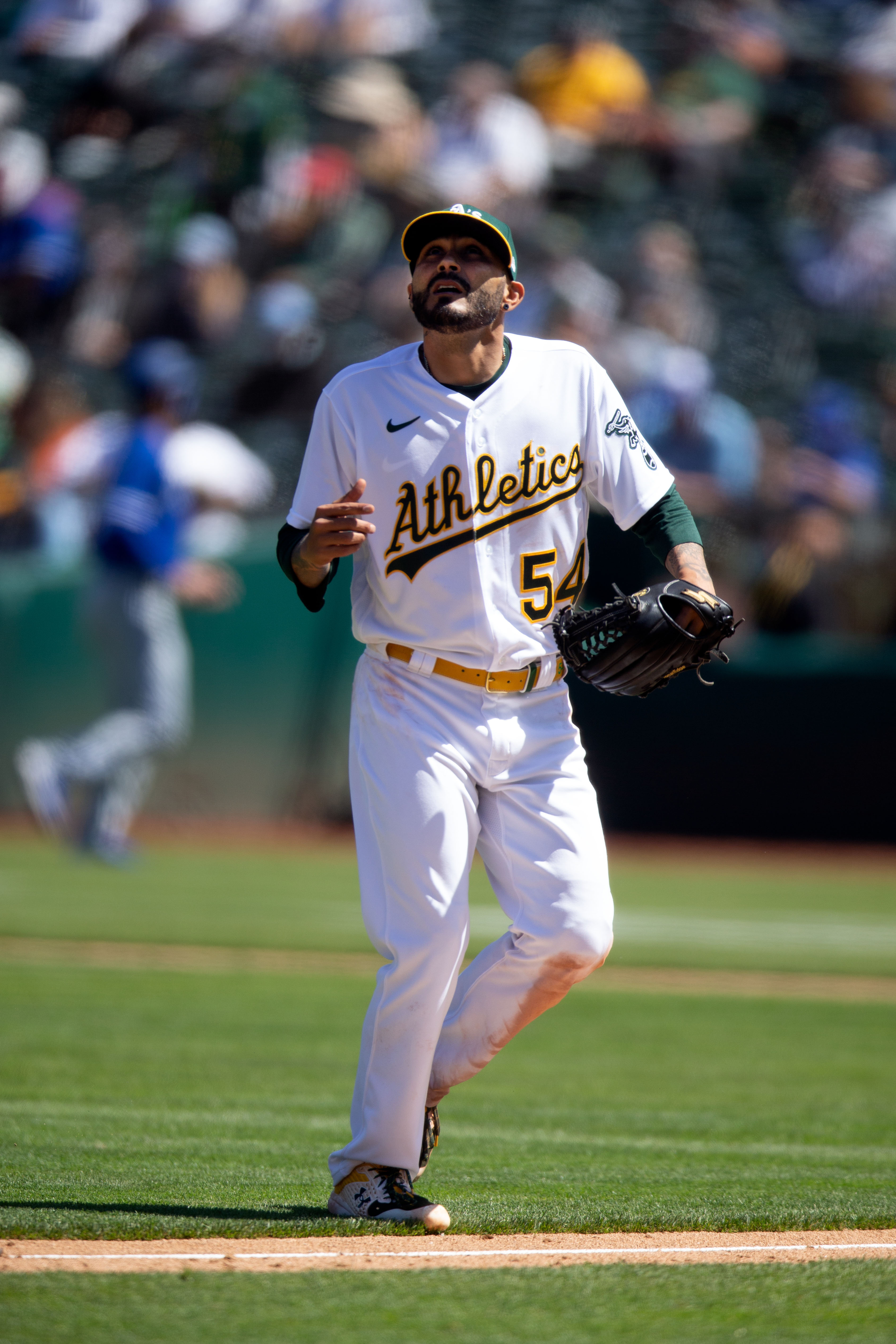
The 39-year-old Romo spent the 2021 campaign with the division-rival A’s, where he posted a 4.67 ERA with a 23.2% strikeout rate against an 8.1% walk rate. It marked a downturn both in terms of ERA and strikeout rate for the 14-year big league veteran, but Romo continued to be among the game’s best in terms of limiting hard contact. His 84.9 mph average exit velocity ranked in the 98th percentile of big league pitchers, and Romo’s 23.3% opponents’ hard-hit rate was the best in the Majors.
A soft-tossing, sidearming slider specialist, Romo has long flummoxed right-handed opponents and kept lefties in check more effectively than most sidearm righties. He wasn’t quite as dominant against either in ’21 as he has been in prior seasons, but neither managed much to do much damage against him overall. Right-handed opponents posted a .240/.290/.420 batting line, while lefties hit .235/.330/.376 — both good for a .305 wOBA.
Romo’s spike in ERA this past season was due, at least in part, to an uncharacteristic dip in strand rate; after leaving 77% of runners on base throughout his career (and 78% in 2020 with Minnesota), Romo saw that rate drop to 69.3%. He also put himself at a disadvantage by throwing a first-pitch strike at just a 59.8% clip — the third-lowest mark of his career. If Romo can get ahead more frequently and maintain his outstanding levels of weak contact, that problematic strand rate will quite likely regress toward his career levels.
The Seattle bullpen was already strong, following a breakout from Paul Sewald and a resurgence from fellow righty Drew Steckenrider. The Mariners will also get both Ken Giles and Andres Munoz back from Tommy John surgery, giving them a pair of power arms capable of reaching triple-digit readings on the radar gun. Righty Diego Castillo was closing games in Tampa Bay before being acquired at last year’s trade deadline, and the club was surely encouraged by the progress made from starter-turned-reliever Erik Swanson.
That said, the Mariners also lost a key arm in recent days when right-hander Casey Sadler underwent a shoulder procedure that will cost him the entire 2022 season. Sadler, 31, posted a comical 0.67 ERA in 40 1/3 innings last year, and while he would never have been expected to replicate that level of dominance, he was surely viewed as a vital member of manager Scott Servais’ bullpen. Romo gives the M’s a veteran replacement for Sadler — one who’ll provide quite a different look than some of his new power-armed teammates. Going from Romo’s 85-86 mph “fastball” to triple-digit heaters from Giles or Munoz in the late stages of a game won’t be an easy transition for opponents.
With Romo on board, the Mariners’ projected payroll ticks up to about $106MM — its highest point since 2019 but still miles shy of the franchise-record $158MM. It’s still possible they’ll boost that total a bit further with another free-agent pickup — though the market has been largely picked over by now — or via a trade acquisition, though much of the team’s heavy lifting appears complete this winter. The M’s were known to be eyeing an experienced option to round out the rotation and have yet to make such an addition, however, and there’s always some room for even further bullpen depth to be added — particularly with expanded 28-man rosters to begin the season.
Red Sox Designate Jeisson Rosario For Assignment
The Red Sox announced this morning that they’ve designated outfield Jeisson Rosario for assignment in order to open a spot on the roster for Trevor Story, whose six-year contract is now official.
Rosario, 22, was acquired from the Padres in 2020 alongside infield prospect Hudson Potts in the trade that sent Mitch Moreland to San Diego. Both Rosario and Potts have now been designated for assignment on consecutive days, though, as Potts lost his 40-man spot yesterday when Boston claimed righty Kyle Tyler off waivers from the Angels.
The fleet-footed Rosario has yet to make his big league debut or even reach the Triple-A level. He spent the 2021 campaign with the Sox’ Double-A affiliate, where he posted a .232/.335/.307 batting line with three home runs, 15 doubles, a triple and a strong 12.3% walk rate against a troubling 27.9% strikeout rate. Scouting reports tout his speed, glovework in center and ability to draw walks, but Rosario is lacking in power and has notable concerns about his hit tool. He’ll be traded or placed on outright waivers within the next week.
Red Sox Sign Trevor Story
March 23: The Red Sox have formally announced the signing of Story to a six-year contract.
March 20: The Red Sox are in agreement with Trevor Story on a six year, $140MM contract. After the fourth year, 2025, Story can opt out of the final two years of the deal. However, Boston can negate that opt-out by picking up a seventh year option for $25MM, or pay a $5MM buyout. If they were to exercise that option, it would add $20MM to the deal, effectively making it a seven-year, $160MM arrangement. Story will not have any no-trade protection as part of the contract. Story is a client of Excel Sports Management.
Story will take over at second base with Xander Bogaerts staying on as the team’s shortstop, per Jim Bowden of The Athletic. Red Sox manager Alex Cora has confirmed that plan, per Marly Rivera of ESPN.
It had been a fairly quiet offseason for the Red Sox up to this point, with the club mostly focused on its pitching staff, adding veterans like Rich Hill, Michael Wacha and Jake Diekman. On the position player side of things, they had only really subtracted since the offseason began, sending Hunter Renfroe to the Brewers for Jackie Bradley Jr. and prospects. Story, however, they have certainly add a tremendous impact bat to their lineup.
After the departure of Troy Tulowitzki, Story took over the everyday shortstop job in Colorado and ran with it. Over the past six seasons, he has played in 745 games and hit 158 home runs, hitting an overall .272/.340/.523, for a wRC+ of 112. He also stole 100 bases and provided excellent defense, accruing 21.6 fWAR in that time.
In addition to helping out the Red Sox this year, the addition of Story makes sense from a long-term view. Xander Bogaerts can opt out of the remainder of his contract at the end of this season, when he will have three years and $60MM left on it, something he seems likely to do. If that should come to pass, they could already have his replacement on the roster. As noted above, the plan for this season is to keep Bogaerts at short and have Story play second, moving Enrique Hernandez to regular outfield duty. Story missed some of last year’s season with an injury to his throwing elbow, and some scouts expressed the belief that he would be best utilized at second base due to that injury impacting his throwing arm. Boston will now have at least one year to see if Story’s arm can rebound in any way before deciding how to proceed beyond 2022.
Although the writing has seemed to be on the wall for quite some time now, this officially ends the Trevor Story era in Colorado. Much like with Nolan Arenado before him, there seemed to be a falling out between the club and their marquee player. Last year, as Story was headed into free agency and the club not in contention, he seemed like an obvious candidate to be traded to a contender. However, the deadline came and went without a deal coming to fruition, something that left Story confused. “I don’t have really anything good to say about the situation and how it unfolded,” Story said in the immediate aftermath of the deadline. During the offseason, there didn’t seem to be any belief that a reunion was in the cards. The club apparently offered him more than the $140MM he got from the Red Sox, with Story preferring his chances of competing in Boston, per Jon Heyman of MLB Network. Between Story and Tulowitzki, the shortstop position in Colorado has been spoken for since 2006. For now, it seems like Jose Iglesias will be taking over, as he signed with the club a week ago. Since the club made a qualifying offer that Story rejected, they will receive a compensatory draft pick after the first round. The Red Sox forfeit their second-highest pick and and will have their international signing bonus pool reduced by $500K.
This deal also closes the book on this year’s mega class of free agent shortstops, which featured Story, Carlos Correa, Corey Seager, Javier Baez and Marcus Semien. Going into the offseason, it was expected by many that the Yankees would be prominent players in this market, given their penchant for high payrolls and obvious need at the position that has been apparent since Gleyber Torres was moved to second base last year. But reports emerged in November that they were considering sitting out the shortstop bidding, content to acquire a stopgap solution as they wait for either of Oswald Peraza or Anthony Volpe to graduate from prospects to big leaguers. That now seems to have been the case, as the club acquired glove-first shortstop Isiah Kiner-Falefa to man the position, while the big five shortstops all landed with surprising suitors. The rebuilding Rangers grabbed both Seager and Semien, while another rebuilding club, the Tigers, nabbed Baez. Correa shockingly lingered on the market before settling on a short-term deal with the Twins, a team not known for reeling in the top fish in free agency. Now Story has come off the board, landing on a team that didn’t have an obvious fit at the position.
Since Chaim Bloom left the small-market Rays and took over as Boston’s Chief Baseball Officer after the 2019 season, the club has been undergoing a sort of semi-rebuild process. It was a few months into his tenure that they traded Mookie Betts and David Price to the Dodgers as part of a process to strip down payroll, despite winning the World Series in 2018. On the heels of that trade, the club went 24-36 in the pandemic-shortened season, slipping beneath the lowly Orioles and into last place in the AL East. After some modest additions to the club, many went into 2021 expecting they would be unable to compete in such a strong division. However, they rallied for a 92-win season, just edging out the Blue Jays for a Wild Card berth, making it as far as the ALCS before falling to the Astros. On the heels of that surprise campaign, it seemed for the past few months that the club might again opt for only modest upgrades. Instead, the Fenway Faithful have the big splash that they were desperately hoping for, easily the biggest since Bloom took over, as the AL East figures to be a four-headed beast yet again.
Bob Nightengale of USA Today first reported that Boston and Story were in agreement, as well as the $140MM guarantee. (Twitter links) Ken Rosenthal of The Athletic was the first to report the six-year term. The fact that there was an unusual opt-out was first relayed by Jon Heyman of MLB Network. The fourth-year opt-out with the seventh-year option structure was first relayed by Joel Sherman of the New York Post. The $5MM buyout and $25MM salary for the final year were first relayed by Heyman. The lack of a no-trade clause was first reported by Sherman.
MLB, MLBPA Reach Tentative Agreement To Reimplement Ghost Runner In 2022
Major League Baseball and the MLB Players Association have reached a tentative agreement to bring the extra-innings ghost runner back for the 2022 season, reports Joel Sherman of the New York Post. Additionally, they have agreed to expand active rosters from 26 to 28 players this season until May 1. The league’s 30 owners need to vote next week to officially ratify the conditions, but Sherman writes that only a simple majority is needed and the provisions aren’t expected to have any issue passing.
Neither development is especially surprising, as reports emerged a couple weeks ago that both were under consideration. The lockout lingered into the second week of March, compressing the Spring Training schedule by two weeks even with the start of the regular season pushed back eight days. The concern is that the shortened ramp-up period might not afford enough time for players to get ready to shoulder a typical regular season workload. By adding a couple players in the early going and limiting the potential for marathon games, the league and union will give managers some extra flexibility in keeping playing time in check.
Sherman adds there won’t be any restrictions on the number of pitchers teams can carry in April. MLB is instituting its 13-pitcher limit this year. That rule change was originally slated to go into effect in 2020, but MLB scrapped it in each of the past two seasons due to concerns about overworking arms while teams were facing the possibility of COVID-19 outbreaks on their rosters. That’ll eventually be a challenge for clubs, but they’ll have some extra leeway on the mound for the first couple weeks of the season.
The return of the extra-innings runner figures to be the more notable development for fans. It was first implemented in 2020 as part of the pandemic protocols. There’s little doubt the rule has indeed served its purpose of preventing marathon games. There has only been one MLB game that exceeded thirteen innings in either of the past two seasons; there were 23 such games in 2019 alone. Nevertheless, the rule has predictably proven divisive among fans, many of whom perceive the placement of a free runner on second base to start extras as gimmicky.
Sherman writes that the ghost-runner rule has only been approved for 2022, but it wouldn’t be a surprise if the league and union revisit it again down the line. The other big on-field pandemic rules change — the seven-inning doubleheader — will not return this year.
One rule that will be in effect permanently is a modification to the designated hitter, albeit one that only seems likely to affect one player. If a team uses the same player as both that day’s starting pitcher and as their DH, he can remain in the game as a hitter even after being removed from the mound. That’s obviously a provision designed to allow the Angels to keep Shohei Ohtani in the lineup deep into games he starts.
Astros, Franklin Barreto Agree To Minor League Deal
The Astros are signing Franklin Barreto to a minor league contract, reports Martín Gallegos of MLB.com (Twitter link). The 26-year-old remains in the AL West after stints with the A’s and Angels.
Barreto is probably best-known for being part of the A’s four-player return from the Blue Jays in the Josh Donaldson deal. That offseason marked the first of four straight in which the right-handed hitting infielder was ranked among Baseball America’s Top 100 overall prospects. He was a top 50 farmhand each season from 2016-18, flashing a promising combination of bat-to-ball skills, power and defensive ability.
While those physical tools have translated to a .285/.356/.505 line in parts of four Triple-A seasons, Barreto has yet to find any success at the big league level. He saw some MLB action in each year from 2017-20, but he only managed a cumulative 237 plate appearances. Barreto owns just a .175/.207/.342 mark in that time, with a dreadful combination of a 42.2% strikeout rate and a 3% walk percentage.
The A’s moved on from Barreto at the 2020 trade deadline, flipping him to Anaheim for Tommy La Stella. Barreto would only appear in six games as an Angel, though. He began last season on the injured list and underwent Tommy John surgery in May, ending his campaign before it began. The Angels outrighted him off the 40-man roster at the end of the year, at which point he elected minor league free agency.
Things obviously hasn’t gone as planned for Barreto at the big league level, but there’s little harm for the Astros in getting a look at him this spring. He’s still relatively young and not all that far removed from being regarded as one of the more promising hitting prospects in the game. Second base — Barreto’s primary position — is obviously spoken for by José Altuve in Houston, but Carlos Correa’s departure has left some uncertainty at shortstop. Barreto will be behind top prospect Jeremy Peña and utilitymen Niko Goodrum and Aledmys Díaz in the organizational pecking order, but he could serve as an upside depth flier at Triple-A Sugar Land.
Luis Castillo Behind Schedule, Justin Dunn Out “Months” With Shoulder Injury
The Reds could be without top starter Luis Castillo when Opening Day rolls around, as manager David Bell told reporters Tuesday that Castillo was briefly shut down due to some shoulder soreness (Twitter link via Bobby Nightengale of the Cincinnati Enquirer). Castillo is healthy now and has resumed throwing, per Bell, but he’s behind schedule in his buildup for the season. There was more concerning news on righty Justin Dunn, acquired in last week’s Jesse Winker trade, as Bell revealed that he’ll miss at least a couple of months due to ongoing shoulder troubles. Nightengale further notes that the Reds were aware of Dunn’s injury status when acquiring him.
The good news for Reds fans is that there’s no indication Castillo is being plagued by a serious injury. It’s possible he’d only miss the first turn or two through the rotation, so long as there are no further setbacks as he builds back up.
For much of the offseason, Castillo stood out as one of the more logical trade candidates on the market. General manager Nick Krall began the offseason speaking of a need to align the Reds’ payroll to its resources, and the first few moves continued a cost-cutting sequence that dated back to last offseason. The Reds placed Wade Miley and his eminently reasonable $10MM salary on waivers and traded catcher Tucker Barnhart to the Tigers. In the days coming out of the lockout, Cincinnati dealt Sonny Gray to the Reds and traded both Jesse Winker and Eugenio Suarez to the Mariners.
Since shedding the remainder of the Suarez deal, however, the Reds have begun to make some more modest additions to the payroll. They picked up about $7MM of salary obligations in the trade that sent Amir Garrett to Kansas City in exchange for Mike Minor, and the Reds have also given out small big league deals to infielder Donovan Solano and reliever Hunter Strickland. Krall has since publicly stated that he does not expect to trade either Castillo or right-hander Tyler Mahle, who was a popular trade target of pitching-needy teams himself.
Castillo, 29, got out to a rocky start in 2021 when he posted an ugly 7.22 ERA through his first 11 appearances. His return to form was swift and emphatic, however, as Castillo closed out the year with a brilliant stretch of 22 starts that saw him work to a 2.73 ERA with a 26% strikeout rate and 9.4% walk rate. Over the past three seasons, he’s given the Reds 448 1/3 innings of 3.61 ERA ball with a 27% strikeout rate, a 9.3% walk rate and an outstanding 56.8% grounder rates. He’s controllable through the 2023 campaign, and it stands to reason that if the Reds don’t contend this year, Castillo’s name will again surface on the summer trade market. It’s a similar story with Mahle, who’s also controlled through 2023.
As for Dunn, the news of a months-long absence due to a shoulder problem that dates back to June 2021, when the right-hander last pitched, is surely a source of frustration. The 26-year-old Dunn pitched 50 1/3 innings of 3.75 ERA ball with Seattle last year but did so with a below-average 22.8% strikeout rate, a bloated 11.3% walk rate and a low 33.8% grounder rate. He last took the ball on June 17.
Dunn is a former first-round pick and well-regarded prospect, having been drafted 19th overall by the Mets in 2016 and traded to the Mariners alongside Jarred Kelenic in the deal that sent Robinson Cano and Edwin Diaz to New York. He can still be controlled all the way through the 2025 season, but it now seems that by the time he’s ready to go for the Reds, he’ll have missed upwards of a year due to shoulder troubles.
The injury news on Dunn squarely takes him out of the running for the fifth spot in the rotation, and with Castillo ailing to a much lesser degree, there’s some uncertainty regarding who’ll round out the starting staff. If Castillo isn’t ready to go, Opening Day would likely fall to Mahle. He’d be followed by Minor and Vladimir Gutierrez, with right-hander Tony Santillan and perhaps lefty Reiver Sanmartin serving as early options as well. The Reds figure to get a look at several top pitching prospects in 2022 — Hunter Greene, Nick Lodolo and Brandon Williamson among them — but it’s unclear whether they’d consider dipping into their farm for an early-season stopgap.
Yankees Avoid Arbitration With Joey Gallo
The Yankees announced this afternoon they’ve agreed to terms with 11 of their 12 arbitration-eligible players. Among them is All-Star outfielder Joey Gallo, whom Mark Feinsand of MLB.com reports (Twitter link) settled for $10.275MM.
That’s right in line with the $10.2MM projection of MLBTR contributor Matt Swartz. Gallo will avoid a hearing during his final trip through the process, as he’s slated to hit free agency at the end of the season. The 28-year-old bounced back from a rough showing in the 2020 shortened campaign to hit .223/.379/.490 through last season’s first few months in Texas. Upon being dealt to the Yankees, however, he slumped to a .160/.303/.404 mark.
If he can regain his first-half form in the Bronx, Gallo would line up as one of the top players in next year’s free agent class. Teammate Aaron Judge will likely be even more coveted, though — if he makes it to the open market. Judge is going through arbitration for a final time this offseason, and the Yankees have maintained they’ll soon initiate extension talks with the three-time All-Star.
They’ll do so with some uncertainty about how much money Judge will make in 2022, however. He was the only of the Yankees’ arb-eligible players not to come to terms with the team today. Jon Heyman of the MLB Network reports (Twitter link) that Judge filed for a $21MM salary while the team offered him $17MM. (Swartz’s $17.1MM projection came in much closer to the team’s filing figure than to the player’s). They didn’t close that gap, and it seems they could be headed for a hearing to determine his ultimate price point.
If Judge and the Yankees agree on a long-term deal in the coming weeks, that’ll prove moot. If they don’t, the 29-year-old’s salary for the upcoming season will likely be chosen by an arbitrator. If it goes to a hearing, the third-party would unilaterally set Judge’s salary at either his desired $21MM or the team’s offered $17MM, not at any sort of midpoint. The Yankees and Judge’s camp could continue to kick around a possible settlement until the hearing begins if they so desire.