
Replacing Lester And Quintana
At present, the Cubs have only two starting pitchers under contract for the 2021 season: Yu Darvish and Kyle Hendricks. The Cubs actually control Darvish through 2023 and Hendricks through ’24, so they’ll continue as rotation mainstays into their mid-30s. The pair combined for 355 2/3 innings of 3.72 ball in 2019, and they’ll earn a total of $36MM in 2021. It’s a good starting point, but the Cubs have to address 60% of their rotation before the 2021 season.
The Cubs’ Three Free Agents
Jon Lester‘s time with the Cubs has been a clear success no matter what else happens, and he’ll never have to buy his own drink in Chicago. The lefty will turn 37 prior to the ’21 season. Is there a way he continues with the Cubs? The easiest path would be through his current contract, which guarantees his $25MM mutual option for 2021 with 200 innings pitched in 2020. Obviously Lester can’t reach that number in a shortened season, but such benchmarks would become prorated. Meaning if MLB teams play an 81-game season, Lester’s goal would become 100 innings.
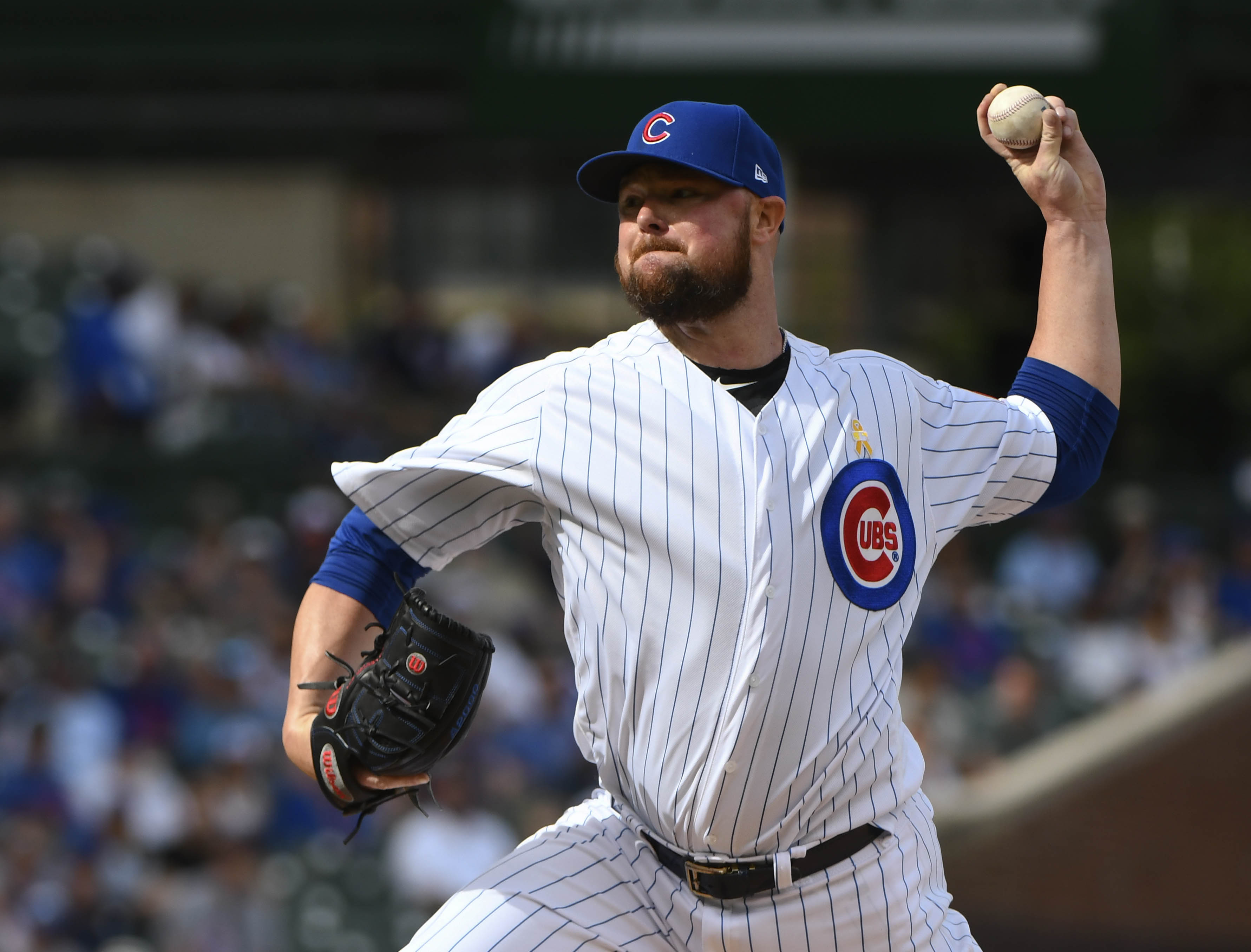
Lester has averaged 5.62 innings per start over the past three years, so in a half-season he’d either need to go deeper into games or make 18 starts to reach 100 innings. In a recent chat with WEEI’s Rob Bradford, Lester talked about the need for pitchers to ramp up carefully to avoid injury, and it’s doubtful he’d push himself well past six innings per start just to get his option to vest. I suppose in the most extreme example, MLB could follow through on its 50-game schedule threat, dropping Lester’s benchmark to about 62 innings. He could theoretically pull that off in 10 starts, but it still seems physically risky to push to a level he hasn’t reached in years.
On the Cubs’ end, they likely prefer the $10MM buyout to locking Lester in for $25MM. So new manager and former Lester battery-mate David Ross could encounter a delicate situation, where if Lester somehow kicks off a 2020 season going deeper into games, Ross’ bosses might push for earlier hooks. Ultimately, though, I don’t expect Lester’s option to vest, in which case it’s a mutual one. It’s rare that both sides exercise such an option, meaning Lester would become a free agent. Working out a new short-term deal could be tricky, with the Cubs already on the hook for a significant $10MM buyout.
The Cubs also stand to lose Jose Quintana to free agency. Quintana, who will turn 32 prior to next season, hasn’t quite gotten the results the Cubs hoped for after giving up Eloy Jimenez and Dylan Cease for him in July 2017. In his time with the Cubs, Q has posted a 4.23 ERA over 429 2/3 innings. His impressive durability has remained intact, but the southpaw has dropped to about 5.4 innings per start since 2018. By a results-based measure, Baseball Reference WAR, Quintana was at just 1.4 in 2019. FanGraphs WAR, rooted in the Fielding Independent Pitching (FIP) stat, puts him at a healthy 3.5 – rewarding respectable strikeout, walk, and home run numbers but ignoring his allowing 10.1 hits per nine innings.
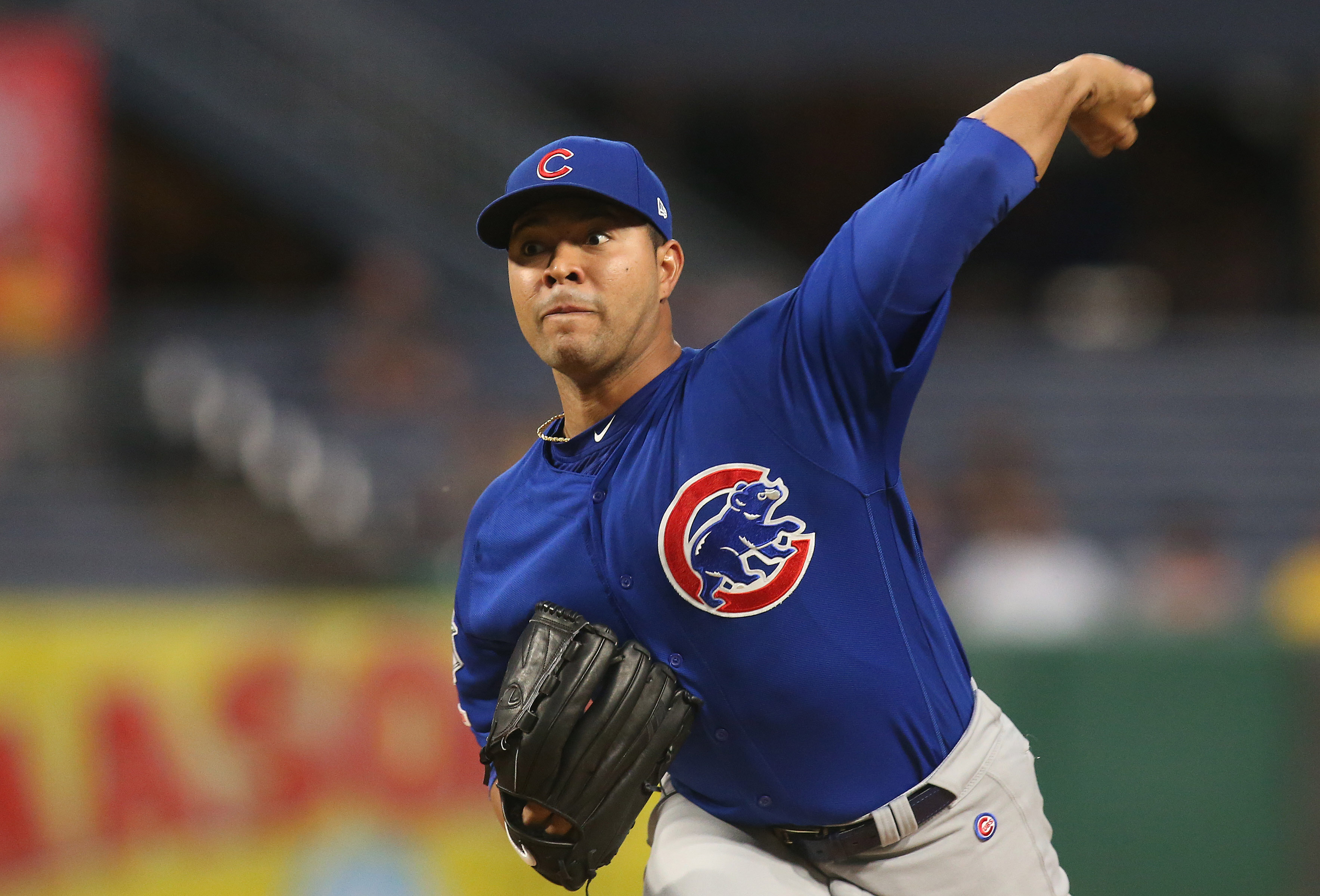
Wherever you land on WAR, it’s fair to say Quintana projects to be better than 2019’s 4.68 ERA. 170 solid innings of 4.30 ball might be a reasonable expectation moving forward. It’s not clear yet on what the qualifying offer may look like if teams play a shortened 2020 season, so it’s impossible to say whether the Cubs would offer one. My guess is that they would not make the offer, instead maintaining their financial flexibility. That’s what they did with Cole Hamels last winter.
Though he’s penciled in as the Cubs’ fifth starter for 2020, Tyler Chatwood‘s contract has been a bust for the Cubs, and he’ll surely be allowed to leave via free agency.
Internal Options
What options do the Cubs have to fill a rotation spot internally? There’s Alec Mills, the soft-tossing righty who turns 29 in November. Mills was a candidate for the Cubs’ fifth starter job this spring, so he’ll likely be in the mix next year as well. Adbert Alzolay, 26 next March, would be in the running again as well. Alzolay pitched 109 innings in total over the past two seasons, and Mills hasn’t been particularly successful even at Triple-A. Both pitchers are depth options, and if they’re favorites for a 2021 rotation job, it will be because they’re affordable.
Lefty Brailyn Marquez is the crown jewel of the Cubs’ farm system, but he’s yet to pitch above High A and projects for a 2022 ETA. Even that goal could be pushed back given the lack of a minor league season this year. The Cubs do have a few starters with experience at Double-A or above in Cory Abbott, Tyson Miller, and Justin Steele, all of whom have ceilings at as back-end starters according to Baseball America. The bottom line? The Cubs need to add at least two starters from outside before next season, and possibly three.
Free Agency
After paying a $7.6MM luxury tax bill for 2019, the Cubs were looking to stay under the $208MM payroll mark in 2020 as a means of resetting the escalating penalties. The Cubs won’t get a free reset if the 2020 season is canceled, but if games are played the club will likely maintain their goal of staying below the base tax threshold. It’s also possible that the luxury tax will be temporarily reduced in some way as part of the current negotiation between MLB and the players’ union, to grease offseason spending. If the Cubs don’t spend money during the 2020-21 offseason, I don’t expect the luxury tax to be the reason again.
Cubs owner Tom Ricketts recently claimed that “about 70 percent of the revenue that comes into our organization comes in on day of game.” He also said, “We’ve already lost half that season, so in a best-case scenario, we’re looking at recovering maybe 20 percent of our total income.” We’ll never know the real financial picture, but obviously the Cubs won’t make nearly as much money as they expected to in 2020. It’s easy to see this being the justification for modest free agent spending. Still, there almost has to be some money to spend if the salaries of Lester, Quintana, and Chatwood come off the books.
While some of the savings could be offset by arbitration raises for players like Kris Bryant, Javier Baez, Kyle Schwarber, and Willson Contreras, it’s impossible to project what those arbitration raises will look like after a shortened season. I imagine we’d be subjected to a fundamental disagreement across baseball on whether a half-season should result in a half-raise, but at least there’s already a mechanism in place to settle that with arbitration hearings.
The free agent market will feature roughly 30 credible options, many of whom the Cubs have already tried. Aside from the trio mentioned above, there’s recent former Cubs Cole Hamels, Jeff Samardzija, Jake Arrieta, Brett Anderson, and Drew Smyly. If the Cubs seek innings, they could make a run at Trevor Bauer, who famously seeks a one-year deal with a team that will let him pitch every fourth day. With three vacancies, getting significant innings out of someone like Bauer could fit the Cubs better than an arguably better pitcher with a poor track record of durability, like James Paxton.
Though the market lacks a true ace, options abound with a solid group including Marcus Stroman, Mike Minor, Jake Odorizzi, Masahiro Tanaka, Robbie Ray, and Anthony DeSclafani. Feel free to explore next winter’s starting pitcher market further with this FanGraphs leaderboard I created. Even on a budget, the Cubs could plausibly target any of these guys.
The Trade Market
I’ve yet to see any concepts floated regarding in-season trading during a shortened 2020 campaign. At the least we can assume players will be traded in the offseason and starting pitchers will be available. The Cubs’ farm system is far from robust, but they do have minor league assets to consider trading. There’s also a good chance of the team trading Kris Bryant, who becomes eligible for free agency after 2021.
Even the teams that were clearly rebuilding for 2020 could adjust course if they somehow make a fluke run in a shortened season with expanded playoffs. Names like Matthew Boyd, Daniel Norris, Joe Musgrove, Jon Gray, Danny Duffy, Chris Archer, Jose Urena, and Nick Pivetta could reasonably be available, though we may be in for an unpredictable offseason.
Whatever path they choose, the Cubs seem likely to remake their rotation in a significant way for 2021. What do you expect them to do? Let us know in the comments.
Brewers Provide Updates On Corey Knebel, Others
The Brewers had a wide slate of injured players during Spring Training — some expected to be key contributors in 2020 — and president of baseball operations David Stearns tells Tom Haudricourt of the Milwaukee-Journal Sentinel that most are progressing well through their rehab.
Former closer Corey Knebel, who underwent Tommy John surgery last spring, is “getting pretty close” to being able to join the bullpen mix, per Stearns. He’s been on a throwing program and seemingly hasn’t had any setbacks, though Stearns noted that the final test is always to see how players fare in competitive settings with adrenaline flowing, and that obviously hasn’t been possible during the COVID-19 shutdown.
It’s easy to forget just how important Knebel was to the Brewers’ bullpen prior to his injury. Josh Hader‘s breakout as MLB’s strikeout king has somewhat overshadowed Knebel, but the two form one of baseball’s best late-inning tandems when both are healthy. From 2017-18, Knebel gave the Brewers 151 1/3 frames of 2.54 ERA ball (2.74 FIP) with a ridiculous 14.7 K/9 and a 40.2 percent overall strikeout rate. He agreed to a $5.125MM salary this offseason — the same as in 2019 — and is under club control through the 2021 season.
Shortstop Luis Urias should be up to speed once play is able to resume, Haudricourt writes. Stearns notes that Urias was already close to getting into Spring Training games at the time of the league shutdown, and he’s of course now had nearly three additional months to mend from the fractured hamate bone he sustained during winter ball. Urias was acquired in the trade that sent Trent Grisham and Zach Davies to the Padres. And while lefty Eric Lauer, the other player the Brewers landed in that swap, was slowed by shoulder troubles this spring, he’s healed up and should be in the rotation competition again when Spring Training 2.0 kicks off (assuming an agreement is reached).
Both players could well hold important roles for the Brewers in 2020 and for years to come. Onetime top prospect Orlando Arcia has yet to seize the everyday role at shortstop, opening the door for Urias — a touted prospect in his own right but one who the Padres felt comfortable dealing to upgrade in other areas. The 22-year-old Urias hasn’t hit in the Major yet but did turn in a ridiculous .315/.398/.600 slash in 73 Triple-A games last year (137 wRC+).
As for Lauer, the 2016 first-rounder was a quick riser to the Major, debuting in 2018. Since that time he’s tossed 261 2/3 innings of 4.40 ERA ball with 8.2 K/9, 3.3 BB/9, 1.20 HR/9 and a 38.9 percent grounder rate. He’s likely more of a mid-rotation or back-of-the-rotation arm, but for a Brewers club that uses its pitching staff in less conventional manners than many other clubs, there could be some ideas to maximize his effectiveness through the use of openers, limiting times through the order, etc. He’s controllable all the way through 2024, so whatever games are able to be played in 2020 will serve as a proving ground of sorts for Lauer. With Brett Anderson lined up for free agency in the 2020-21 offseason, there’s a clear path to innings in future seasons if Lauer or another young Brewers hurler impresses when play resumes.
D-backs, Cubs Owners On Schedule Proposals, Revenue Losses
As MLB’s 30 owners and the Players Association clash over the length of a potential 2020 season — the MLBPA recently proposed a 114-game length, while ownership recently suggested as few as 50 to 60 games — Diamondbacks owner Ken Kendrick offered some strong objection to the notion of pushing the regular-season schedule into November. Appearing on the Burns & Gambo Show on 98.7 FM Arizona Sports, Kendrick rebuked the notion of November play (hat tip to ESPN’s Jeff Passan, on Twitter):
We don’t want to take the risk of putting our players at jeopardy and our game in peril to be playing games beyond the end of October. So our model is and will never be changed that we will not be playing baseball in the month of November or later.
It’s never been likely that the league would accept the union’s 114-game proposal, but Kendrick’s strong words are of particular note given that the union’s plan called for the regular season to conclude on Halloween. Kendrick ostensibly strives to put the well-being of players at the forefront of the issue. However, it’s been reported for weeks that the league has concerns that additional spikes in COVID-19 cases could jeopardize the postseason, where they’d stand to make considerable revenue from national television broadcasts (particularly with an expanded playoff field).
Meanwhile, Cubs owner Tom Ricketts again bemoaned a lack of revenue to ESPN’s Jesse Rogers, claiming that most owners don’t profit much from their teams:
[Owners] raise all the revenue they can from tickets and media rights, and they take out their expenses, and they give all the money left to their GM to spend. The league itself does not make a lot of cash. I think there is a perception that we hoard cash and we take money out and it’s all sitting in a pile we’ve collected over the years. Well, it isn’t.
Ricketts contends that the Cubs derive 70 percent of their revenue from gamedays (ticket sales, concessions, parking, etc.) and that his team is hoping to salvage 20 percent of its would-be revenue in 2020. Of course, that’s the very type claim that has caused the MLBPA to bristle not only throughout negotiations to resume play but for decades prior. The union has repeatedly requested that ownership provide transparent documentation of the potential losses they’re claiming in 2020, but owners don’t appear likely to ever acquiesce on that issue.
Asked about agent Scott Boras recently using Ricketts and the Cubs as an example of suspect claims regarding their revenue, Ricketts merely replied that Boras “doesn’t have any insight into our balance sheet.” He also called the losses facing owners throughout the league “biblical” and spoke at length on his belief that revenue sharing between MLB and the MLBPA is a worthwhile concept to explore in the next CBA. The notion of revenue-sharing has been a total nonstarter for the union.
Chris Ellis, Oscar Hernandez Among Cardinals’ Minor League Releases
Right-hander Chris Ellis and catcher Oscar Hernandez were among the 33 minor leaguers released by the Cardinals in the final week of May, Jeff Jones of the Belleville News-Democrat reports (Twitter thread). Right-hander Johnny Hellweg was also cut loose. Jones’ thread has additional names from each level of the Cardinals’ system, though none of the bunch has any MLB experience.
Each of Ellis, Hernandez and Hellweg has had a fleeting look at the Majors. Ellis was a Rule 5 pick of the Royals in 2018 and subsequently tossed one inning in Kansas City last year before being returned to the Cards. The 27-year-old has been moved in a pair of notable trades, going from the Angels to the Braves alongside Sean Newcomb in the Andrelton Simmons swap before being flipped from Atlanta to St. Louis a year later in the Jaime Garcia deal. (The Braves also sent John Gant and Luke Dykstra to the Cards in that deal.) Ellis had a nice year between Double-A and Triple-A in 2018, but he was rocked for a 7.18 ERA in 79 Triple-A frames in 2019.
Hernandez himself was once a top pick in the Rule 5 Draft, going from the Rays to the D-backs in 2014. He appeared in 22 games with Arizona but hit just .167/.239/.262 in 47 plate appearances. Now 26 years old, Hernandez signed a minor league deal with an invite to big league camp this winter. Despite a solid defensive reputation, he’s managed just a .210/.279/.336 slash in parts of three Triple-A campaigns.
Hellweg, 31, was once a rather well-regarded prospect himself. Originally a 16th-round pick by the Angels (2008), he was in the midst of a solid 2012 campaign at the Double-A level when the Halos flipped him, Jean Segura and Ariel Pena to the Brewers to rent ace Zack Greinke. He was hit hard in 30 2/3 frames with the Brewers and hasn’t pitched in the Majors since the 2013 season. Since then, he’s spent time with the Padres and the Pirates in addition to stints in the independent Canadian-American Association and Japan’s Nippon Professional Baseball. Like Hernandez, he’d inked a minor league deal with the Cards this winter.
The Winding Journey Of An All-Star Slugger
Twins designated hitter Nelson Cruz has carved out a fantastic career with a few different teams since he debuted in the majors a decade and a half ago. As you’ll see below, it has been quite an eventful journey for a player who has gone from relatively unheralded prospect to 401-home run hitter with six All-Star nods on his resume…
Professional Entry
- The Dominican Republic native entered the pros with the Mets, who signed him as an 18-year-old amateur free agent in 1998, but he never took a professional at-bat with the franchise.
Prospect Status
- Cruz was not a leaguewide elite prospect as he climbed his way to the majors. At his best, he ranked as Baseball America’s No. 8 Brewers prospect in 2006. BA rightly wrote then that Cruz, the Brewers’ minor league player of the year, possessed “well above average raw power,” though it also expressed concern over “holes in his swing.”
Early Career Trades
- In the first of multiple trades Cruz has been involved in as a pro, the Mets sent him to the Athletics in August 2000 for infielder Jorge Velandia. However, Velandia was a nonentity in the majors for the Mets. He amassed 92 plate appearances with New York across three years and stumbled to a .149/.281/.216 line.
- Like the Mets before them, the A’s gave up on a young Cruz, but only after he spent a few years in their system. In December 2004, Oakland dealt Cruz and right-hander Justin Lehr to the Brewers for infielder Keith Ginter. Unfortunately for the A’s, Ginter mustered a weak .161/.234/.263 line over 156 PA in 2005 – his lone season with the club. As mentioned earlier, Cruz was a productive Brewers minor leaguer, though he didn’t get much of a chance in the majors as a member of Milwaukee. Cruz made eight appearances and totaled seven PA in 2005.
Headed To The Site Of His Breakout
- The Brewers traded Cruz and former slugger Carlos Lee to the Rangers for righty Francisco Cordero, lefty Julian Cordero, and outfielders Kevin Mench and Laynce Nix in July 2006. Let’s first address the non-Cruz pieces in that swap: Lee was a short-term success as a member of the Rangers, with whom he batted .322/.369/.525 with nine home runs in 260 PA. The Rangers didn’t make the playoffs, though, and Lee bolted for the Astros’ six-year, $100MM contract during the ensuing offseason. Francisco Cordero had a very nice run in Milwaukee, where he pitched to a 2.60 ERA with 11.6 K/9 and 60 saves in 90 innings from 2006-07. He left the Brewers for the Reds’ four-year, $46MM offer, which was then a record for a reliever. Julian Cordero never got past Single-A ball. Mench put up an unimpressive .256/.288/.403 line with nine HRs in 441 PA as a Brewer from 2006-07, while Nix collected a meager 61 PA with the club in parts of three seasons.
Overcoming Adversity
- In hindsight, as effective as Lee and Francisco Cordero were after this trade, Cruz emerged as the most valuable piece for either team. It just took a few more years to finally happen. Cruz got off to a brutal start as a Ranger from 2006-07, when he combined to hit a dismal .231/.279/.384 with 15 HRs in 471 trips to the plate. Discouraged, the Rangers designated Cruz for assignment at the beginning of 2008, but they retained him after he cleared waivers. Cruz went on to mash 37 home runs in the minors that year, and he chipped in a tremendous .330/.421/.609 line and seven homers in 133 major league PA. That was truly the start of a fruitful run in Texas and in the majors as a whole. From 2009-13 as a Rangers regular, Cruz piled up 135 homers, batted .272/.331/.511 and won an ALCS MVP in 2011. To be clear, though, not everything went swimmingly for Cruz in the Lone Star State. The former outfielder’s defensive limitations helped lead to a catastrophic World Series loss to the Cardinals in 2011. Two years later, Cruz was hit with a 50-game suspension stemming from the Biogenesis scandal. However, Cruz contended he only took the substance to combat helicobacter pylori, a bacterial infection that caused a 40-pound weight loss.
Trips To Free Agency
- The PED ban came at an especially inopportune time for Cruz, then a soon-to-be free agent; after rejecting the Rangers’ $14.1MM qualifying offer, he had to settle for a one-year, $8MM guarantee with the Orioles in February 2014. The move wound up as a positive for both sides, though, as Cruz rebuilt his stock as a member of a playoff team by slashing .271/.333/.525 and establishing a new career high with 40 homers.
- Cruz returned to the open market the next offseason, but he did far better that time. In what looked like a questionable move by the Mariners, they handed Cruz a four-year, $57MM guarantee. As it turned out, Cruz more than lived up to his payday in Seattle, where he truly cemented himself as an all-world offensive player. He appeared in at least 144 games in each season from 2015-18 – a 1,967-PA stretch in which he racked up 163 homers, hit .284/.362/.546 and recorded an eye-popping 147 wRC+.
- After his superb Seattle stint, Cruz reached free agency yet again prior to the 2019 campaign. And once again, the team that signed him came away happy. Cruz inked a one-year, $14.3MM guarantee with the Twins, though the pact also included a $12MM club option for 2020. Unsurprisingly, the Twins picked up that option after Cruz helped the team set an all-time single-season HR record (307) en route to 101 wins and a division title. Despite only appearing in 120 games, Cruz contributed 41 of those dingers. Pound for pound, it may have been his greatest season at the plate thus far – he registered a .311/.392/.639 line with a personal-high 163 wRC+.
__
It’s not exactly common to see a player thrive under three consecutive free-agent contracts, but Cruz has managed to accomplish the feat. He’ll have an opportunity to go 4 for 4 if he becomes a free agent again next winter. Although Cruz will turn 40 on July 1, his bat’s aging like fine wine, so it would seem unwise to doubt him.
Latest On MLB, MLBPA
It’s well known that Major League Baseball owners and players have been at loggerheads over several important issues during the sport’s shutdown. One of the key disagreements centers on the length of a potential season. The union side proposed a 114-game campaign with full prorated salaries over the weekend, but the owners clearly have other ideas.
While they have already proposed a sliding pay scale based on an 82-game schedule, they’ve at least kicked around the idea of something in the vicinity of 50 games. Even as few as 42 contests is a possibility, according to Bill Shaikin and Jorge Castillo of the Los Angeles Times. At least to the owners, that would offer some sort of season while mitigating teams’ monetary losses during a year in which there may not be any fans in the stands. MLB claims it would lose $4 billion if there’s an 82-game, spectator-less season in which the players would receive full prorated salaries.
As of now, however, a 50-game season doesn’t look like something the players are going to accept. Commissioner Rob Manfred is allowed to implement as long or short a schedule as he wants; however, as Ken Rosenthal and Evan Drellich of The Athletic reported earlier, the players may be able to object based on the agreement the sides made in March. That deal says the commissioner’s office must make “best efforts to play as many games as possible.”
The players, like the owners, have finances near the forefront of their minds during this standoff. The league’s potential proposal would entitle the players to prorated salaries, but it wouldn’t move the needle enough for them during a severely truncated campaign. As Travis Sawchik of FiveThirtyEight tweets, 50 games is “not acceptable” to the union side. Furthermore, Sawchik points out this potential proposal wouldn’t make nearly enough of a financial difference in the players’ minds. They’d earn roughly 31 percent of their pay – about the same total as owners offered in their first proposal – per Sawchik.
Beyond the money factor, there’s concern on the players’ side over whether a 50-game season would be worthwhile, Jesse Rogers of ESPN.com explains. For instance, would it behoove the players to put themselves at greater risk for injury or contraction of the coronavirus during what would essentially be one-third of a typical season, wherein they’d earn far less money than expected? Rogers also wonders how such a shortened season could affect salaries down the line, as teams and players would have to weigh such a small sample of statistics in future contract talks.
This continues to look like a dire situation for the game, especially with time running out toward actually starting any kind of season (remember, the players would still have to go through another few weeks of spring training beforehand). Now, if the owners don’t offer another counter-proposal, the players will be “done” talking, Sawchik reports.
Latest On Carlos Carrasco
Right-hander Carlos Carrasco has been an eminently successful part of the Indians’ pitching staff since he broke out six years ago, but serious health problems knocked his life and career off course in 2019. It has been almost a full year since Carrasco was diagnosed with leukemia in July, but he made so much progress in his recovery that he was able to make a late-season return as part of Cleveland’s bullpen and earn AL Comeback Player of the Year honors.
Heading into spring training this year, Carrasco looked like a shoo-in to reclaim a spot in the Indians’ rotation. However, before the coronavirus shut down camp, the 33-year-old dealt with a hip flexor strain and inflammation in his pitching elbow. The latter problem threatened to sideline Carrasco for a normal Opening Day, but with the season having been delayed by more than two months so far, he may have a better chance of partaking in a “full” 2020 campaign.
Per Paul Hoynes of cleveland.com, Carrasco has continued to throw bullpen sessions and send videos of them to manager Terry Francona and Carl Willis. Carrasco has been a regular attendee of Indians workouts at Progressive Field. Those actions show Carrasco plans to pitch this year, as Hoynes writes, though he adds that the team’s “prioritized the health of their players and staff members above all else so that decision is still on hold.”
According to the Centers for Disease Control and Prevention, cancer survivors are among those who are at the highest risk of contracting the coronavirus, which puts people like Carrasco in especially dangerous territory. But if he is able to take the mound this season, it should be a welcome sight for the club from both morale and on-field standpoints. Carrasco understandably saw his numbers dip in 2019, but he was a front-line starter over the previous five seasons – an 856-inning stretch in which he logged a 3.27 ERA with 10.13 K/9 and 2.05 BB/9.
Quick Hits: Bitsko, AFL, Minor League Pay, Boras
With the draft fast approaching, Kiley McDaniel of ESPN.com profiles Pennsylvania high school right-hander Nick Bitsko, who ranks among the highest-upside pitchers in this year’s class. Bitsko could go anywhere from the top 10 to the late 30s, per McDaniel, who reports that he has recently helped his stock with Zoom interviews and social media videos showcasing his enticing repertoire. While teams haven’t gotten an extensive look at Bitsko in person, McDaniel explains that the 17-year-old features a fastball that reached 98.5 mph last week and has so much spin that it could be near the top of the majors in that category already. Bitsko also has a pair of breaking balls that have the potential to turn into “above-average” offerings in the bigs, according to McDaniel, who goes into greater detail on those pitches in his piece. It’s worth a read for those interested in learning about an intriguing draft prospect.
More from around the game…
- There may not be any minor league season in 2020, but that could be made up for to an extent with an extended Arizona Fall League campaign. The AFL season usually runs from September to October, but a 2020 version could begin “within weeks” of a potential Opening Day in the majors, Josh Norris and J.J. Cooper of Baseball America report. The MLB and MLBPA would first have to agree to a season, and Norris and Cooper highlight other roadblocks (including financial issues). But if a longer AFL season does come to fruition, all 30 teams would send a roster of prospects to their spring training sites to play games. It’s possible each of those clubs would also have “a second lower level” prospect team, Norris and Cooper write.
- A few more teams have committed to paying their minor leaguers for at least the next handful of weeks. The Tigers’ farmhands will continue to earn $400 per week, and there’s “no end in sight,” Chris McCosky of the Detroit News tweets. The club’s also not planning to cut any minor leaguers as of now, McCosky adds. The Rockies, meanwhile will pay their minor leaguers through at least June, according to Thomas Harding of MLB.com. The Yankees are taking the same approach as Colorado, James Wagner of the New York Times relays.
- Super-agent Scott Boras is taking action to make sure his released minor league clients still receive compensation, per Jon Heyman of MLB Network. Boras, who called those releases “completely unanticipated,” will personally pay all of those players their expected salaries for 2020.
MLB Could Propose Shorter Schedule With Prorated Salaries
JUNE 2: While the league may implement a 50- or 60-game schedule, the union could object to it based on March’s agreement, which says the commissioner’s office must put forth its “best efforts to play as many games as possible,” per Ken Rosenthal and Evan Drellich of The Athletic (subscription required). Regardless, the two sides aren’t making much progress, nor have they scheduled further negotiations. As Rosenthal and Drellich point out, if MLB and the MLBPA are going to meet in the middle for an 82-game season that starts July 4, time’s running out. For that to happen, the players would have to be back in spring training by the middle of this month.
JUNE 1, 10:09pm: The two sides remain far apart in talks, Joel Sherman of the New York Post reports in a piece that’s worth reading in full. In regards to the counter-proposal the union made over the weekend, deputy commissioner Dan Halem told Sherman via text: “The one piece of good news out of [Sunday’s] meeting is that Tony Clark acknowledged that the March Agreement contemplated another negotiation over player salaries if the 2020 season could not be played in front of fans. We were concerned based on media reports if players knew that. Tony told us the players were aware that the March Agreement did not resolve the issue of player salaries in a season without fans. And he said the players‘ decision to accept nothing less than 100 percent of their prorated salaries was due to the risks of playing the season, not because they were promised it in the March 26 agreement.” Clark fired back in an email to Sherman, though, calling Halem’s quote “purposefully misleading and inaccurate.” Clark added that MLB is trying to “negotiate through the media instead of focusing on how to bring baseball back to its fans.”
6:58pm: A season with roughly 50 games would be “a last resort” for the league, Passan writes. The hope remains that MLB and the MLBPA will reach an agreement to avoid that outcome.
4:48pm: The MLBPA and MLB haven’t been able to see eye to eye on a potential 2020 season as they negotiate during this pandemic. In the latest developments, the union proposed a 114-game season this past weekend, though it seems the league is open to a much shorter campaign. MLB plans to propose a smaller schedule – perhaps one with as few as 50 to 60 games – per Jeff Passan of ESPN, but the league would give players a full portion of their prorated salaries.
Whether this plan will appeal to the players remains to be seen, as they wouldn’t come close to their normal salaries in such an abbreviated season. However, as Jon Heyman of MLB Network notes, commissioner Rob Manfred has the right to implement a schedule that’s as long or short as he wants based on the agreement the owners and players made back in March. As of now, Manfred and the league are still hoping to reach some sort of compromise that works out for both sides, Heyman suggests, but Passan adds that MLB is prepared to go with a schedule length of its choosing if it’s unable to find common ground with the players.
Season length aside, it’s notable that the league’s willing to give players their prorated salaries without further reductions in pay. The league presented its latest economic proposal last week – one that didn’t go over well with players, including Nationals ace and influential union member Max Scherzer, who noted the players had already agreed to take lower salaries in the form of prorated salaries and weren’t open to accepting even less money. A 50- to 60-game schedule obviously would not be ideal for the players from a financial standpoint, but if they’re not on board with this plan, perhaps they and the owners will be able to meet in the middle on schedule length in the coming weeks and get a 2020 campaign underway.
Angels Release Luiz Gohara
The Angels released 39 minor leaguers last week, Fabian Ardaya of The Athletic relays (click here for the full list). Left-hander Luiz Gohara may be the most notable player the Angels subtracted.
Now 23 years old, the Brazil-born Gohara was once a premium prospect as a member of the Braves, who acquired him from the Mariners in a January 2017 trade that saw outfielder Mallex Smith go to Seattle (though the M’s quickly flipped Smith to Tampa Bay). Gohara mowed down minor league hitters that year, combining for a 2.62 ERA with 10.7 K/9 and 3.2 BB/9 in 123 2/3 innings, and ended up making his major league debut. That was the first of two straight seasons in which Gohara appeared in the majors, and though has only amassed 49 frames of 5.33 ERA pitching at the game’s highest level so far, he has managed nine strikeouts per nine against 2.94 walks.
It’s now anyone’s guess whether Gohara will make it back to the bigs. Shoulder problems prevented Gohara from pitching professionally last season, when the Braves released him in early August. Gohara caught on with the Angels a few weeks later, but his Halos tenure is now over before he ever threw a meaningful pitch as part of their organization.