
Astros Interview Mark Kotsay For Manager
The Astros interviewed A’s quality control coach Mark Kotsay last week as part of their ongoing search for A.J. Hinch’s replacement, reports Brian McTaggart of MLB.com (via Twitter). Kotsay becomes the ninth known candidate in Houston’s wide-ranging managerial search.
Kotsay also drew consideration from the Giants and Pirates for their vacancies earlier in the offseason, but he ultimately lost out to Gabe Kapler and Derek Shelton, respectively. He has no MLB managerial expereience, but he’s worked in the Padres’ front office and on the Pads’ and A’s coaching staffs since retiring as a player in 2013.
Kotsay joins Joe Espada, Eduardo Pérez and Will Venable as potential first-time managers to sit down with Houston. The Astros have also interviewed former MLB skippers Brad Ausmus, Dusty Baker, Jeff Banister, John Gibbons and Buck Showalter.
Ryan Braun Discusses Future
Franchise icon Ryan Braun is entering the final guaranteed season of the contract extension he signed with the Brewers nearly a decade ago. Now 36, the former MVP is nearing the end of a storied career. In fact, it’s not out of the question that 2020 could prove to be his final season, he acknowledged to reporters (including Tom Haudricourt of the Milwaukee Journal Sentinel) today at Fan Fest.
“I don’t take for granted this could be my last year playing baseball,” Braun told reporters. “It’s definitely a possibility,” he elaborated when asked if he would contemplate retirement after the 2020 season. “We’ll see how the year goes, see where I’m at physically. Obviously, my family’s always my top priority, so we’ll see how everything’s going then.”
Needless to say, that’s hardly a declaration that he’ll certainly hang up the spikes. He added that he doesn’t anticipate making a final decision until after this season, when he can reevaluate his health and family situation as well as the team’s outlook. Braun’s contract does come with a $15MM mutual option for 2021, but mutual options are rarely exercised. Typically, the price point is either high enough that the team would prefer to buy the player out or low enough that the player would rather explore free agency. In Braun’s case, it seems likely the Brewers would buy Braun out for $4MM rather than exercise their end.
That’s not to say, however, that Braun won’t be a key factor on Milwaukee’s 2020 outlook. He’s coming off a strong 2019 effort, in which he hit .285/.343/.505 (117 wRC+) in 508 plate appearances. The club anticipates him taking a similar number of plate appearances this season, he told reporters today. The longtime corner outfielder confirmed that some of that work figures to come at first base, where he’s played just 18 career games (all in 2018). Milwaukee’s corner outfield mix is crowded, with offseason signee Avisaíl García joining MVP candidate Christian Yelich and Ben Gamel. Yelich, notably, is at full strength for spring training after a knee injury ended his 2019 season in September, he told reporters today (including Haudricourt).
Today’s comments from Braun are perhaps unsurprising; that a 36-year-old player may at least entertain thoughts of retirement after the season won’t raise many eyebrows. Nevertheless, it’s notable to hear Braun verbalize the possibility. He is, as mentioned, still a productive hitter. In all fourteen of his MLB seasons, he’s been above-average at the dish by measure of wRC+. He’s certainly unlikely to return to the vaunted offensive force he was in his prime, but Braun still figures to be a valuable player in 2020. Should he again produce at the plate, he’d no doubt draw interest from teams next offseason, if he chooses to keep playing.
Report: Reds “Clear Frontrunners” To Sign Nicholas Castellanos
According to a report from Jon Paul Morosi of MLB Network, the Reds are now seen as the “clear frontrunner” to sign free-agent outfielder Nicholas Castellanos, with Morosi adding that the two sides have made progress in their negotiations over the past few days.
The Giants have also been in contact with Castellanos in recent weeks, per Morosi. The Rangers have also been strongly linked to the 27-year-old. And while Castellanos is decidedly the best slugger left on the market, it could very well be a three-team race for his services; when we explored the best fits for Castellanos last week, we also named the Indians, Cardinals, and Cubs as potential landing spots, but all of those teams have displayed a certain reluctance to splurge on free agents and seem unlikely to do so in this case.
Cincinnati is already looking at a pretty busy outfield mix—especially at the corners, where Castellanos would play—but none of the Reds’ existing pieces can quite match the offensive firepower that Castellanos would add to the lineup. Aristedes Aquino, Jesse Winker, and Phil Ervin are all likely to be deployed frequently in the outfield corners, with Shogo Akiyama and Nick Senzel representing options for the centerfield job.
If indeed the Reds wind up inking Castellanos, two of the aforementioned teams would be doubly hurt by missing out: the Cubs and Cardinals, of course, would have to turn around and deal with the division rival Reds several times every year.
MLBTR originally predicted that Castellanos would earn a four-year, $58MM deal in free agency. There’s still a chance he could reach those numbers, but the one-year, $18MM contract signed by Marcell Ozuna last week might reflect how the industry values Castellanos, whose profile and on-field value resembles that of Ozuna. Castellanos, though, is more than a year younger and doesn’t come with a qualifying offer attached, so signing teams won’t have to worry about surrendering draft pick compensation.
Mets Sign Erasmo Ramirez To Minor League Deal
The Mets have signed right-handed pitcher Erasmo Ramirez to a minor league deal, according to Jesse Sanchez of MLB.com. He’ll get a non-roster invite to big league camp.
Ramirez, 29, spent last year in the Red Sox organization, pitching mostly in Triple-A and making one appearance with the big league team. In 125 1/3 innings with Boston’s Triple-A affiliate, Ramirez notched a 4.74 ERA and struck out 95 batters. In his last stint of sustained big league action, he made 10 starts with the 2018 Mariners, working to a 6.50 ERA.
With the Mets’ rotation mix looking full with the signings of Michael Wacha and Rick Porcello, Ramirez looks mostly like a depth signing who can start in the minor leagues and offer emergency innings in the Majors if necessary.
MLBTR Chat Transcript: Castellanos, Holt, Arenado, Ray, HOF
Click here to read the transcript of this morning’s baseball chat, moderated by MLBTR’s Mark Polishuk
Orioles Have Interest In Andrew Cashner
With the Orioles looking to add an inexpensive veteran arm to their rotation, Andrew Cashner is “one of the free agents under consideration,” MASNsports.com’s Roch Kubatko writes. GM Mike Elias said on Saturday that the O’s would be more likely to acquire a Major League starter through free agency than through the trade market, and Kubatko recently reported that the Orioles were looking at adding a starter on a one-year contract.
There is no shortage of familiarity between Cashner and the O’s, as the right-hander pitched for the team in both 2018 and 2019 before being traded to the Red Sox last July. Cashner originally signed a two-year, $16MM deal in the 2017-18 offseason and posted a 4.73 ERA, 1.76 K/BB rate, 6.0 K/9 over his 249 1/3 innings in the orange-and-black. Those numbers line up with Cashner’s overall inconsistent performance over the last five seasons, as his low-strikeout, grounder-heavy (except in his aberration of a 2018 season that saw him post a career-worst 40.4% ground ball rate) arsenal leads to a lot of variance.
Cashner was pitching pretty well for Baltimore in 2019, however, posting a 3.83 ERA over 96 1/3 innings after largely removing his sinker from his mix of pitches. After being dealt to Boston, however, Cashner posted an 8.01 ERA over six starts before being moved to the bullpen for his first extended dose of relief work since 2012. Between the start of the 2013 season and the end of that six-start stint for the Red Sox, Cashner started 182 of 188 games pitched.
As expected, the Red Sox declined their $10MM club option on Cashner for the 2020 season, and the righty’s trip into free agency hasn’t resulted in much buzz. It could be that any interested teams are perhaps waiting until later in the offseason or during Spring Training to fully access their rotation options before signing a pitcher that projects best as a depth option at this point in his career.
The 33-year-old Cashner does offer a fair amount of durability at the back of a rotation, as he has averaged 157 IP over the last five seasons. There isn’t much certainty within a projected Orioles rotation that consists of John Means, Alex Cobb, Asher Wojciechowski, and several younger options vying for the final two slots, so bringing a veteran innings-eater like Cashner could help matters. There’s also a chance that returning to Camden Yards could help Cashner regain his form from early 2019, and perhaps make him a candidate for another deadline trade this summer.
Teams That Gained Or Lost Draft Picks Via Qualifying Offer Free Agents
Now that Marcell Ozuna has signed, all 10 of the players who were issued a one-year, $17.8MM qualifying offer in November have settled on teams for the 2020 season. Of that group, two (Jose Abreu of the White Sox and Jake Odorizzi of the Twins) accepted their qualifying offers and returned to their clubs — Abreu, in fact, topped off his QO by signing a contract extension that will run through the 2022 season. Stephen Strasburg also isn’t changing uniforms, as the longtime Nationals ace rejected the club’s qualifying offer but eventually re-signed with Washington on a seven-year, $245MM deal.
That leaves us with seven QO players who will be playing on new teams in 2020, and as such, the draft compensation attached to those seven players has also now been allotted. Under the rules of the Collective Bargaining Agreement, the same compensation was handed out to all six teams who lost those players, as the entire sextet fell under the same financial criteria. The Mets, Cardinals, Braves, Giants, Nationals, and Astros all aren’t revenue-sharing recipients, nor did they exceed the luxury tax threshold in 2019, so all six teams will receive a compensatory draft pick between Competitive Balance Round B and the third round of the 2020 draft.
Here is how the so-called “Compensation Round” breaks down. The order of the picks is determined by worst record-to-best record from the 2019 season.
68. Giants (for Madison Bumgarner)
69. Giants (for Will Smith)
70. Mets (for Zack Wheeler)
71. Cardinals (for Marcell Ozuna)
72. Nationals (for Anthony Rendon)
73. Braves (for Josh Donaldson)
74. Astros (for Gerrit Cole)
San Francisco now possesses five of the first 87 picks in next June’s draft. With the Giants still in the NL wild card race last summer, president of baseball operations Farhan Zaidi opted to hang onto Bumgarner and Smith rather than trade either player, a decision that led to some criticism since San Francisco was widely considered to be closer to rebuilding than truly contending. The critics’ judgement grew even harsher after the Giants went 22-32 record in August and September and fell well short of the postseason. Still, given that teams were reluctant to part with top-flight young talent for even controllable players (let alone rentals like Bumgarner and Smith) at the trade deadline, Zaidi clearly felt that the two picks he could recoup from the qualifying offer process were more valuable than anything offered for the two Giants pitchers last July.
It’s worth noting that the 74th overall pick will be Houston’s first selection of the 2020 draft, after the Astros lost both their first- and second-highest selections in both 2020 and 2021 as part of their punishment for the sign-stealing scandal. Since the Red Sox are also under league investigation for their own alleged use of electronics to steal opponents’ signs in 2018, Boston could also potentially lose at least one pick in this year’s draft, so we can’t yet say that the 2020 draft order is finalized. Of course, the order could be further muddled if more trades occur involving picks from the two Competitive Balance Draft rounds, which are the only types of draft picks that can be traded. We’ve already seen the Rays and Cardinals swap their picks in Rounds A and B as part of the multi-player trade that sent Jose Martinez and Randy Arozarena to Tampa Bay earlier this month.
Let’s now look at the six teams who signed the seven QO-rejecting free agents, and see what those clubs had to give up in order to make the signings.
Yankees, for signing Gerrit Cole: Since New York exceeded the luxury tax threshold in 2019, they gave up their second- and fifth-round picks in the 2020 draft (a.k.a. their second- and fifth-highest selections). The Yankees also gave up $1MM in funds from their international signing bonus pool.
Diamondbacks, for signing Madison Bumgarner: As a team that didn’t exceed the luxury tax threshold and was a revenue-sharing recipient, the D’Backs had to give up their third-highest draft choice to sign Bumgarner. This ended up being Arizona’s second-round selection — the team’s first two picks are their first-rounder (18th overall) and their pick in Competitive Balance Round A (33rd overall).
Twins, for signing Josh Donaldson: Minnesota also received revenue-sharing and didn’t exceed the luxury tax threshold, so signing Donaldson put the Twins in position to give up their third-highest draft selection. However, the Twins are actually giving up their fourth-highest pick in the 2020 draft, which is their third-round selection. The Twins’ actual third selection is their pick in Competitive Balance Round B, but those picks aren’t eligible to be forfeited as compensation for QO free agent signings.
Angels, for signing Anthony Rendon: Since the Halos didn’t receive revenue-sharing funds and also didn’t pay any luxury tax money, they had to give up their second-highest draft pick (their second-rounder) and $500K in international bonus funds to sign Rendon.
Phillies, for signing Zack Wheeler: The Phillies surrendered their second-highest selection (their second-round pick) and $500K of their international bonus pool, since they were another team that didn’t exceed the luxury tax line and didn’t receive revenue-sharing money.
Braves, for signing Will Smith and Marcell Ozuna: The dual signings put Atlanta in line for a dual penalty. The Braves didn’t exceed the luxury tax threshold and also didn’t receive revenue-sharing money, so they gave up their second-highest draft pick (their second-rounder) and $500K of international bonus money for Smith. In landing Ozuna, the Braves then had to also forfeit their third-round pick (their third-highest selection) and another $500K from their international bonus pool.
Losing two draft picks and $1MM in international pool money isn’t nothing, though these particular sanctions had less impact on the Braves than on other teams, which undoubtedly influenced their decisions. First of all, the compensatory pick Atlanta received for Donaldson is higher in the draft order than their third-round pick, so the net loss is only a second-round pick. Secondly, the Braves’ movement in the international market is still limited by the punishment handed out by Major League Baseball in November 2017 for Atlanta’s past international signing violations. Part of that punishment included the Braves’ pool for the 2020-21 international market being reduced by 50 percent — being so handcuffed in the international market anyway, the Braves probably felt $1MM in pool money was no great loss.
Royals Re-Sign Alex Gordon
TODAY: Gordon has agreed to waive his 10-and-5 no-trade rights beginning on June 16, as per The Associated Press. Talking with MLB.com’s Jeffrey Flanagan and other reporters about the signing, GM Dayton Moore referred to the unusual provision as a way to “eliminate the red tape” and “take out the dynamics of going through the union” if a trade offer from a contender emerged. Moore also implied that Gordon would still have an unofficial veto about any trade proposal, saying “anything we do with Alex, we would have a conversation with him first. It’s really important to know that. It’s always about the players….If you decide together at some point [that a trade] could benefit Alex, you want to have very easy conversations about things.”
JANUARY 22, 5:33pm: Gordon’s contract pays him an extra $500K upon reaching 250 plate appearances, tweets USA Today’s Bob Nightengale. There’s also a $500K assignment bonus in the event that he’s traded, although as a player with 10-and-5 rights, Gordon can veto any proposed swap.
9:15am: The Royals have struck a new deal with outfielder Alex Gordon, as first reported by MLB.com’s Jeffrey Flanagan (via Twitter). The pact is said to guarantee him $4MM for the 2020 season. Righty Heath Fillmyer was designated for assignment to create roster space.
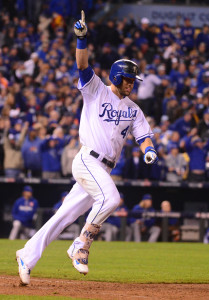
Gordon’s second free agent return to Kansas City comes with less drama and a much lower cost than did his prior one. The veteran previously inked a four-year deal in January of 2016, all but ensuring he’d never wear another uniform.
Entering the 2019-20 offseason, the only question was whether Gordon would decide to continue his career for an additional season. He and the K.C. organization decided upon at least one more.
That aforementioned contract hasn’t worked out at all from an on-field perspective. Gordon, who’ll soon turn 36, has yet to turn in even an average offensive campaign under the new deal. He carries an ugly .237/.320/.366 batting line over the four-season span.
On the other hand, Gordon has continued to turn in sterling defensive work in the outfield. And his bat did trend up in 2019, as he slashed .266/.345/.396 (96 wRC+) with 13 home runs.
While there was never any chance the Royals would pick up a high-priced option over Gordon, it’s not hard to understand the rationale for this move. The money, roster spot, and playing time surely could’ve been appropriated elsewhere, but every team needs some veterans around and the Royals are as familiar and comfortable with Gordon as any club could be with any player.
As for Fillmyer, the 25-year-old has thrown 104 2/3 MLB frames over the past two seasons, working to a 5.07 ERA with 6.2 K/9 and 3.8 BB/9. He turned in solid results while working his way through the farm, but has also struggled at the Triple-A level, where he owns a 5.48 ERA over 116 2/3 innings in 2018-19.
Photo courtesy of USA Today Sports Images.
Quick Hits: Franco, Rays, Goodrum, Red Sox
It was two years ago today that the Brewers made one of the biggest single-day splurges in recent baseball history, acquiring Christian Yelich from the Marlins for a four-prospect trade package, and also agreeing to sign Lorenzo Cain to a five-year, $80MM contract. (Cain’s deal wasn’t officially finalized until he passed a physical on January 26, 2018.) There surely aren’t any regrets in Milwaukee over that red-letter day, as the Brewers have reached the playoffs in each of the two subsequent seasons. Yelich has been nothing short of spectacular in a Brewers uniform, winning the 2018 NL MVP honors and finishing second in the MVP voting last season. It has been a bit more of a mixed bag for Cain, who enjoyed a tremendous 2018 campaign but then struggled through an injury-riddled 2019, though Cain finally won his first career Gold Glove last year after another outstanding defensive showing in center field.
The latest from around baseball…
- MLB Pipeline unveiled the latest edition of its top 100 prospects list today, with the Rays‘ Wander Franco receiving the nod as the game’s top minor leaguer. Franco’s long list of plaudits includes a rare 80 grade for his hitting, the highest possible mark on the 20-80 scouting scale. “If you were to build a hitter from scratch using all of the physical attributes and skills that have come to define great hitters, he’d probably end up looking something like Franco,” details Pipeline’s scouting report on the 18-year-old shortstop. The Rays placed six prospects on the top 100 list, the most of any team. The Dodgers’ Gavin Lux, White Sox outfielder Luis Robert, the Orioles’ Adley Rutschman, and the Padres’ MacKenzie Gore rounded out the rest of the top five. MLB.com’s Jonathan Mayo (who compiled the list along with colleagues Jim Callis and Mike Rosenbaum) details how the list was compiled, the new faces joining the top 100, the prospects from past lists who were omitted from this year’s ranking, and many more details.
- After playing seven different defensive positions in 2019, it looks like the Tigers‘ Niko Goodrum is going to focus only on shortstop for the foreseeable future, Chris McCosky of The Detroit News writes. Goodrum came up in the minors as a shortstop, but he expanded his horizons in hopes that versatility would improve his chances of cracking the big leagues. That strategy worked out pretty well for the 28-year-old, who’s coming off a solid pair of seasons after the Tigers signed him to a minor league deal more than two years ago. While that versatility is still an asset, Detroit likes Goodrum best at shortstop at present, especially after an impressive defensive showing over 326 2/3 innings at short in 2019. While it’s tricky to make a definitive judgement based on such a small sample size, Goodrum received high grades over a range of defensive metrics (+3 Defensive Runs Saved, +8.6 UZR/150, and +6 Outs Above Average).
- Could this be Chaim Bloom’s only chance to hire a Red Sox manager? This is one of many points raised by the Boston Globe’s Peter Abraham while speculating about the club’s rather quiet managerial search. With a nod to how quickly the Sox parted ways with former front office heads Ben Cherington and Dave Dombrowski, Abraham writes that “given the lack of job security in his position, Bloom may only get one chance to hire a manager if he doesn’t get this right.” This leads Abraham to wonder if Bloom could make a hire from outside the organization, in order to put some type of personal stamp on a team that otherwise retained much of its front office staff after Dombrowski was fired.
Pirates Owner Bob Nutting Discusses Player Development, Payroll
The Pirates’ future direction under new general manager Ben Cherington has yet to become entirely certain, as the club hasn’t made any notable moves during Cherington’s two-plus months in charge to indicate either a rebuild or a reload for the 2020 season. This waiting period (or perhaps even the thought of a rebuild in general) hasn’t sat well with many Pittsburgh fans, though it seems like the evaluation of seemingly every level of the organization will continue, as club owner Robert Nutting told Jason Mackey of the Pittsburgh Post-Gazette that he wants a thorough examination of what went wrong with the Pirates in 2019.
“I’m not sure we know how good every one of our players can be. We absolutely have challenges in our development system in terms of processes,” Nutting said. “We absolutely have challenges at the Major League level in terms of information and ways we communicated with players. A real frustration point for me last year was that we had too many players who performed at one level here and a higher level with another club. They were coached differently. They got different information. And they performed at a higher level.”
It wasn’t long ago that the Pirates were the ones drawing plaudits for their ability to revive careers and find hidden gems from lightly-regarded roster pickups, as such canny moves helped the Bucs reach the postseason via three consecutive wild card berths in 2013-15. Since that impressive stretch, however, 2018’s modest 82-79 mark has been the team’s only winning record of the past four seasons. Things seemed to bottom out last year, as a series of struggles both on the field and in the clubhouse led to a brutal 25-48 record after the All-Star break, en route to a 69-win season.
The near-total nature of that second-half collapse makes it somewhat hard to evaluate, as it could have been a perfect storm of off-the-field issues and player dissatisfaction with manager Clint Hurdle, rather than a sign that the Pirates were completely lacking in ability. Nutting is hopeful that more clarity can be achieved under new manager Derek Shelton and a largely overhauled coaching staff.
“We don’t know how good our players are right now,” Nutting said. “I think we need to give Derek, Ben, our analytics team and our coaching staff a chance to see what we can bring out of our players, not only at the Major league level but at Triple-A, too.”
That said, Nutting isn’t only counting on a management change suddenly turning the Pirates into NL Central contenders, blunting saying “We do not have enough talent to be as good as we need to be….I think we have a solid core, but we need to build around it. We need to supplement. That’s going to come from international signings, the draft, trades, and we need to do it throughout the organization. That will take some time.”
Based on these remarks, it doesn’t appear as any spending increase is coming in the near future, at least not in terms of Major League payroll commitments. The Pirates have roughly $68.76MM (as per Roster Resource) in payroll expenditures in 2020, making them again one of the lowest-spending clubs in baseball. Depending on how long it takes to acquire the additional talent Nutting and Cherington feel is required, the owner’s comments won’t change the public perception that higher-priced Bucs players with relatively little remaining team control — such as Starling Marte or Chris Archer — could be trade candidates. Marte has been a particularly well-discussed player this offseason, though it remains unclear as to whether or not a trade could be particularly close, if happening at all.