
Angels Reach Stadium Agreement With City Of Anaheim
DEC. 21: The Anaheim City Council has approved the deal, making it official, Shaikin tweets.
DEC. 4, 1:10pm: The Angels are still weighing whether to renovate the existing stadium or build a new stadium on the current site, Alicia Robinson of the Orange County Register reports. To that end, they’ve hired the same architectural firm that recently designed Minneapolis’ U.S. Bank Stadium — home of the NFL’s Vikings — and the Rangers’ new ballpark in Texas to aid in their decision-making process.
Robinson’s colleague, Jeff Fletcher, tweets that despite remaining in Anaheim, there are no plans to revert to the “Anaheim Angels” moniker; the team will continue to be referred to as the Los Angeles Angels.
11:52am: The Halos will stay at home for at least thirty more years after reaching a deal with the city of Anaheim, according to Bill Shaikin of the Los Angeles Times (via Twitter). As part of the arrangement, which runs through the 2050 campaign, the club has purchased Angel Stadium and its surrounding lots for a sum of $325MM.
This news seems to bring an end to a long-simmering stadium dispute. While other organizations are dealing with more complicated ballpark matters, Angels owner Arte Moreno has at times hinted at the possibility of a move. That never seemed a high-likelihood outcome; now, it’s off the table.
Some important details remain unknown at present. The club will obviously continue to play in the existing ballpark for the time being, but it’s not known whether the facility — at over fifty years of age, one of the oldest in baseball — will ultimately be slated for replacement. At minimum, the Halos are sure to set to work at developing the real estate surrounding the existing stadium.
NL Notes: Donaldson, Braves, Cubs, Bryant, Pirates, Reds
Third baseman Josh Donaldson, the No. 1 free agent left on the board, continues to contemplate his future. The Nationals, Twins, Dodgers and Braves (with whom he thrived in 2019) look like the front-runners for his services. All things being equal, though, it appears Donaldson would prefer to stay in Atlanta. The “belief” is Donaldson’s camp has promised the Braves he’ll let them make a final offer before he signs anywhere else, David O’Brien of The Athletic reports (subscription link). The problem, as O’Brien notes, is that the Braves may not want to give Donaldson, 34, four guaranteed years. Meanwhile, Washington and Minnesota are reportedly open to doing so.
More from the National League…
- The Cubs’ Kris Bryant could be a trade target for Atlanta if it doesn’t re-sign Donaldson, though it’s still unclear how much more team control the former has left. Bryant filed a grievance over service time against the Cubs, whose decision to delay the now-star’s promotion in 2015 earned them an extra year of control. That grievance was heard back in October, and briefs were due Friday, but arbitrator Mark Irvings’ ruling won’t arrive until sometime after Jan. 1, Evan Drellich of The Athletic tweets. For now, Bryant’s under control for two more years, but that figure will drop to one if he unexpectedly wins his grievance. The 27-year-old has been featured in trade rumors, but at least until the league knows how much more control Bryant has, it’s highly unlikely he’ll go anywhere.
- Rookie Pirates manager Derek Shelton has chosen Tarrik Brock as his first base coach, according to Jason Mackey of the Pittsburgh Post-Gazette. This will be the second go-around as a major league 1B coach for Brock, who worked in that role for the Padres in 2016. He went on to serve as the Dodgers’ minor league outfield and baserunning coordinator from 2017-19. Now 45, Brock’s a former outfielder who saw brief MLB action in 2000 with the Cubs.
- The Reds hired Joe Mather as assistant hitting coach earlier this week, per C. Trent Rosecrans of The Athletic. The 37-year-old Mather – who, like Brock, is an ex-outfielder – spent last season as the Diamondbacks’ minor league field and hitting coordinator. He’ll now work alongside new Reds hitting coach Alan Zinter.
MLBTR Poll: Time For Indians To Trade Lindor, Clevinger?
This has already been a winter of major change for the Indians. A couple months removed from their first non-playoff season since 2015, the Indians traded two-time American League Cy Young-winning right-hander Corey Kluber to the Rangers last weekend for reliever Emmanuel Clase and outfielder Delino DeShields. Cleveland did pick up at least one intriguing piece in the 21-year-old, heat-throwing Clase, though it was also a cost-cutting move for the small-market club to get all of Kluber’s $17.5MM guarantee for 2020 off the books.
To the Indians’ credit, they did win 93 games in 2019 with little to no help from Kluber, who slumped through an uncharacteristically poor month before succumbing to a season-ending broken forearm May 1. So, maybe getting rid of Kluber in favor of a Shane Bieber–Mike Clevinger–Carlos Carrasco–Aaron Civale–Zach Plesac rotation won’t have a deleterious effect their fortunes. Maybe they remain well-equipped to compete next year in the AL Central, which has multiple bottom-feeding teams and has seen its reigning champion (Minnesota) make no clear improvements since the offseason got underway. Or maybe the Kluber trade was the first monumental deal the Indians will make in an effort to cut money and look toward the future.
For Cleveland, there’s no bigger decision than whether to trade four-time All-Star shortstop Francisco Lindor, who has popped up in many rumors over the past few months. Lindor’s one of the finest players in the game – no doubt the Indians’ best – but it seems inevitable they’ll trade him in the next couple years. A free agent a pair of offseasons from now, Lindor’s projected to earn $16.7MM in arbitration for 2020. That’s unquestionably a reasonable sum for what he brings to the table and an amount all teams (including the Indians) should be able to afford, but perhaps they’ll sell Lindor off now before his control continues to dwindle. It’s at least under consideration, as they’ve reportedly asked interested teams (the Dodgers, Padres and Reds are among them) for their best and last offers heading into the weekend.
Other than Lindor, the Indians have at least one other extremely valuable trade chip in Clevinger. Set to turn 29 on Saturday, the righty has been one of baseball’s most effective starters since his 2017 breakout. Clevinger still has three years of control left (and should make less than $5MM next season), so he looks like someone the Indians should keep if the goal is to push for a World Series in the near term. However, there’s said to be plenty of trade interest in Clevinger, meaning it’s possible we’ve seen the last of him in an Indians uniform if another team bowls them over with a proposal that’s too enticing to decline. The Indians, for their part, have understandably placed a “crazy high” asking price on Clevinger, per reporter Robert Murray.
While we don’t know exactly what teams have offered (or will offer) for Lindor and Clevinger, it’s fair to say both players are capable of bringing back a haul in a trade. Therefore, it’s reasonable to wonder what the Indians should do with the two of them going forward. Should they retain one or both and try to return to the playoffs next season, or is it time for the franchise to sell high?
(Poll link for app users)
What should the Indians do with Lindor, Clevinger?
-
Trade both 34% (4,716)
-
Keep both (at least for now) 33% (4,620)
-
Trade Lindor 29% (4,064)
-
Trade Clevinger 3% (393)
Total votes: 13,793
Angels To Sign Neil Ramirez
The Angels have inked righty Neil Ramirez to a minor-league deal, according to Ken Rosenthal of The Athletic (via Twitter). It seems safe to assume he’ll receive an invitation to MLB Spring Training.
Ramirez, 30, has continued to get opportunities even as the results continue to disappoint. He’s a 4.46 ERA pitcher through 179 2/3 innings in the majors, with most of the good frames coming in his first two seasons in the league.
It’s not hard to see why teams keep thinking Ramirez might turn the corner. He throws 95 and gets a good number of swinging strikes (13.9% last year). But his command will likely always be in question, as evidenced by his career 4.8 BB/9 walk rate and worrying propensity to surrender the long ball (30 in his last 122 innings).
Checking In On MLBTR’s Top 50 Free Agent Predictions
At the beginning of each offseason, MLBTR publishes a list of the top 50 free agents on the board by projected earning power. It has only been a month and a half since this winter’s top 50 hit the site, but little did we know then that this offseason would move at such a rapid pace. We’ve already seen more than half of the members of this year’s list (27 players), including four of the top five, either sign new contracts or accept qualifying offers. With that said, let’s check in on how MLBTR has fared with its predictions thus far…
1. Gerrit Cole, SP – Predicted: Eight years, $256MM. Signed: Nine years, $324MM.
2. Anthony Rendon, 3B – Predicted: Seven years, $235MM. Signed: Seven years, $245MM.
3. Stephen Strasburg, SP – Predicted: Six years, $180MM. Signed: Seven years, $245MM.
4. Zack Wheeler, SP – Predicted: Five years, $100MM. Signed: Five years, $118MM.
6. Madison Bumgarner, SP – Predicted: Four years, $72MM. Signed: Five years, $85MM.
7. Yasmani Grandal, C – Predicted: Four years, $68MM. Signed: Four years, $73MM.
10. Jake Odorizzi, SP – Predicted: Three years, $51MM. Accepted $17.8MM qualifying offer.
12. Didi Gregorius, SS – Predicted: Three years, $42MM. Signed: One year, $14MM.
13. Will Smith, RP – Predicted: Three years, $42MM. Signed: Three years, $40MM.
15. Cole Hamels, SP – Predicted: Two years, $30MM. Signed: One year, $18MM.
16. Jose Abreu, 1B/DH – Predicted: Two years, $28MM. Accepted $17.8MM qualifying offer and then signed for three years, $50MM.
17. Michael Pineda, SP – Predicted: Two years, $22MM. Signed: Two years, $20MM.
18. Mike Moustakas, INF – Predicted: Two years, $20MM. Signed: Four years, $64MM.
19. Kyle Gibson, SP – Predicted: Two years, $18MM. Signed: Three years, $30MM.
20. Tanner Roark, SP – Predicted: Two years, $18MM. Signed: Two years, $24MM.
21. Julio Teheran, SP – Predicted: Two years, $18MM. Signed: One year, $9MM.
23. Drew Pomeranz, RP – Predicted: Two years, $16MM. Signed: Four years, $34MM.
24. Wade Miley, SP – Predicted: Two years, $16MM. Signed: Two years, $15MM.
26. Travis d’Arnaud, C – Predicted: Two years, $14MM. Signed: Two years, $16MM.
27. Chris Martin, RP – Predicted: Two years, $14MM. Signed: Two years, $14MM.
29. Avisail Garcia, OF – Predicted: Two years, $12MM. Signed: Two years, $20MM.
30. Howie Kendrick, INF – Predicted: Two years, $12MM. Signed: One year, $6.25MM.
31. Rick Porcello, SP – Predicted: One year, $11MM. Signed: One year, $10MM.
32. Brett Gardner, OF – Predicted: One year, $10MM. Signed: One year, $12.5MM.
40. Adam Wainwright, SP – Predicted: One year, $8MM. Signed: One year, $5MM.
42. Josh Lindblom, SP – Predicted: Two years, $8MM. Signed: Three years, $9.125MM.
47. Michael Wacha, SP – Predicted: One year, $6MM. Signed: One year, $3MM.
Total – Predicted: $1,327,000,000. Signed: $1,521,675,000.
A few things stand out here. First of all, special thanks to Braves reliever Chris Martin for making us look good by signing for the exact amount we said he’d receive. In the aggregate, though, we were obviously too conservative with this year’s estimates. However, in our defense, did anyone foresee such a spending bonanza this offseason?
When MLBTR’s Jeff Todd wrote this same piece a year ago, only one top five free agent and just 16 out of 50 had signed or agreed to take the qualifying offer. Furthermore, at that point, MLBTR’s projections were actually $20MM above the amount of money that had been handed out. Historic contracts worth $300MM or more were later given to outfielder Bryce Harper (Phillies) and infielder Manny Machado (Padres), the two highest-rated free agents available, but the MLBPA was nonetheless frustrated by the game’s second straight glacial offseason.
As a result of the union’s discontentment, speculation grew in regards to a potential work stoppage when the current collective bargaining agreement expires in December 2021. Perhaps that will still happen, but executive director Tony Clark & Co. have to be much more pleased with how this offseason has unfolded in comparison to the previous couple. Regardless, judging by the billions that teams have awarded to free agents in under two months, it’s clear there is still plenty of money to go around in Major League Baseball.
10 Relatively Youthful Bounceback Pitching Targets
Much of the heavy lifting has been done in free agency. But there are still a few major players, a host of solid veterans, and no shortage of intriguing reclamation projects left on the open market. Here, we’ll look at a few available hurlers who have previously established significant MLB ceilings and are only entering their age-30 or younger seasons … albeit with significant injury histories that have altered their career trajectories.
We’ll go youngest to oldest:
Edubray Ramos: The still-youthful hurler — he celebrated his 27th birthday just yesterday — endured a highly disappointing 2019 season, struggling through shoulder problems and ultimately throwing only 15 MLB innings. But he was quite effective in 2018 and could be an interesting bounceback candidate after getting some rest over the offseason (though he is pitching in Venezuelan winter ball).
Taijuan Walker: Walker worked back from multiple arm injuries, only to end up as a surprising non-tender from the Diamondbacks. It’s certainly notable that his own club wasn’t convinced, but that won’t stop others from reaching their own risk/benefit assessments. Walker threw 157 1/3 innings of 3.49 ERA ball in his last full season, 2017. In his brief return to the bigs in 2019, Walker was already exhibiting most of his prior velocity and spin rate, so there’s reason to hope the physical tools are still intact.
Aaron Sanchez: It has long been a rollercoaster for the other 27-year-old starter on this list. He has battled through with finger injuries, then showed flashes in 2019 before going down to shoulder surgery. That procedure made it inevitable that he’d be non-tendered by the Astros, but the talent that led the Houston organization to take a shot will surely still intrigue rival organizations.
Alex Wood: He was held up to open the 2019 season and struggled with the long ball when he finally did appear for the Reds, but the southpaw did make it back to the bump. He showed typical velocity, swinging-strike, and K/BB numbers in his seven-start stint to finish out the year. Wood has thrown 839 innings of 3.40 ERA ball in his career, with peripherals that largely match, so don’t sleep on his upside.
Arodys Vizcaino: Over 2017-18, Vizcaino threw 95 2/3 innings of 2.54 ERA ball. The Viz Kid way outperformed his peripherals in doing so, but has always had swing-and-miss stuff. It’s anyone’s guess how he’ll bounce back from shoulder surgery, and he was hardly a perfect pitcher beforehand, but Vizcaino remains an interesting player to watch.
Shelby Miller: Okay, so Miller is going to have to bounce waaaay back if he’s to return to effectiveness. Since the fateful trade that sent him from the Braves to the Diamondbacks after the 2015 season, he has thrown just 183 innings of 6.89 ERA ball. Miller fell far short of a comeback last year with the Rangers, but did show 95 mph heat and is still only 29 years of age.
Jerad Eickhoff: Quite effective through the first forty starts of his MLB career, Eickhoff took a step back in 2017 and then ran into an injury wall. He made it back to the mound for the ’19 campaign but was only good for a 5.71 ERA in 58 1/3 innings. Eickhoff will need to regain some arm speed and figure out how to adapt to a longball-lofting set of opposing hitters.
Danny Salazar: Thirty in January, Salazar remains an intriguing talent. He has exhibited plenty of strikeout ability and found no small amount of success in the majors, but hasn’t yet shown he can find his way back from health issues. It’s unclear as yet what course his career will take, but the upside is tremendous.
Tony Cingrani: Cingrani hasn’t pitched a full season since 2016 and didn’t throw a pitch in the Majors in 2019 due to shoulder surgery. But looking at what the 30-year-old lefty did in parts of two seasons after being traded from Cincinnati to Los Angeles is eye-opening. Cingrani faced 172 hitters as a Dodger and struck out 64 of them (37.2 percent) while walking only 12 (6.9 percent). His swinging-strike rate in L.A. topped 14 percent. Considering the left-handed relief market was thin to begin the offseason and is now largely devoid of proven options, he’s a sensible buy-low target.
Drew Smyly: In addition to being one of those guys who’s younger than you thought every time you look, Smyly was also probably better at his peak than many fully realized. Times have been tougher of late, as he missed all of the ’17 and ’18 seasons and had a brutal run to open the 2019 campaign with the Rangers. But he finished on a better streak with the Phillies after fiddling with his pitch mix, posting a 4.45 ERA with 9.8 K/9 and 3.0 BB/9 in a dozen starts. The velo and swinging-strike numbers are right back where they used to be. Smyly is a sneaky interesting target.
Reds Sign David Carpenter
The Reds have agreed to a deal with veteran reliever David Carpenter, according to the social media accounts of Cincinnati pitching coordinator Kyle Boddy and Carpenter himself. It’s a minors deal with an invite to MLB camp.
Carpenter didn’t exactly regain his former glory last year with the Rangers. But he did make it up for four MLB appearances — his first since way back in 2015. And Carpenter spun 38 2/3 innings of 1.63 ERA ball with 9.8 K/9 and 3.0 BB/9 at Triple-A.
It seems the righty has been back at work at the Boddy-founded Driveline Baseball this winter. (Here’s a video link on Twitter if you’d like to look for yourself.) We’ll see whether he can crack the Reds roster in camp, but moving back towards his once-customary 96 mph heat would surely help.
Ian Kinsler Announces Retirement
Padres second baseman Ian Kinsler has announced his retirement, as Ken Rosenthal of The Athletic reports (via Twitter; full article via subscription link). He’ll move into the San Diego front office as an adviser.
Precisely what will happen to the $4.25MM Kinsler is owed under the contract he inked last winter remains to be seen. That will be subject to negotiations between the team and its now-former player.
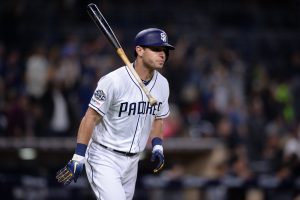
Kinsler, 37, says he simply decided it was “time to move on.” He wraps up a 14-year career with borderline Hall-of-Fame credentials. He tallied a hefty 57.2 rWAR in his career, tied for 140th among all MLB players, and logged overall statistics that put him ahead of some Hall-worthy second baggers. Now begins a five-year waiting period to see whether Kinsler will gain traction among voters.
Though it seems unlikely he’ll command a plaque in Cooperstown, Kinsler turned in an undeniably outstanding career — all the more impressive considering he was a 17th-round draft pick. He was a perennially above-average hitter who excelled in the field and on the basepaths. Kinsler finishes things up just one hit shy of the 2k barrier. Over 8,299 trips to the plate in the majors, he slashed .269/.337/.440 with 257 home runs and 243 stolen bases.
Kinsler will be remembered most for his eight-year run with the Rangers. While that tenure ended with some acrimony when Kinsler was dealt to the Tigers, he thanked the organization in his comments to Rosenthal. Kinsler ended up having a productive, four-year stint in Detroit before rounding out his career with brief stops with the Angels, Red Sox, and Friars. Kinsler picked up a ring with the 2018 Red Sox.
Of more immediate concern is the impact on the Padres roster. Kinsler wasn’t clogging up a ton of payroll space but would’ve occupied an active roster spot and commanded a decent amount of playing time. Now, the path is cleared all the more for recently acquired second baseman Jurickson Profar, who’ll presumably be supplemented by Greg Garcia at second. The Friars have an additional slot and some added financial flexibility to work with in structuring their preferred alignment.
Kinsler hadn’t been in the form he or the team hoped when he signed on this time last year. He managed only a .217/.278/.368 batting line in 281 plate appearances before his season was cut short owing to a herniated cervical disk. Kinsler says that malady also influenced his decision to call it quits. Though he wasn’t able to play to his typical standard or log his 2,000th hit in 2019, Kinsler did make his first and only appearance on the MLB mound, turning in a scoreless frame.
It seems that Kinsler is already preparing for the next chapter in his personal and professional life. MLBTR congratulates him on an outstanding career and extends its best wishes for the future.
Photo courtesy of USA Today Sports Images.
White Sox To Sign Gio Gonzalez
DECEMBER 20: Gonzalez is slated to receive a $5MM guarantee, per James Fegan of The Athletic (via Twitter). He’ll be paid $4.5MM for the coming season, with $1MM in incentives, before the club decides between a $7MM option and $500K buyout.
DECEMBER 19: The White Sox are in agreement with left-hander Gio Gonzalez, MLB Network’s Jon Heyman tweets. Reporter Robert Murray (Twitter link) was the first to break the news that Gonzalez and the Sox were nearing a contract. Gonzalez is represented by CAA Sports.
Gonzalez represents Chicago’s first major pitching acquisition of the offseason, after the Sox were widely expected to target rotation help. While the White Sox have thus far been linked to several big name hurlers on the free agent and trade fronts, the 34-year-old Gonzalez is a less-heralded veteran who still offers some significant upside to the 2020 staff.
Gonzalez was actually drafted by the White Sox (38th overall) back in 2004 but never played for the team, as he was sent to the Phillies as a player to be named later in the November 2005 deal that brought Jim Thome to the Windy City. Over 1901 1/3 career innings with the A’s, Nationals, and Brewers, Gonzalez has established himself as a usually-durable starter who can miss bats (8.6 K/9), limit free passes (3.8 BB/9), keep the ball on the ground (47.1% grounder rate), and limit home run damage (0.8 HR/9).
Gonzalez came close to matching all of these career numbers in 2019, and his 3.50 ERA over 87 1/3 innings with Milwaukee also fell near his 3.68 career ERA. The big outlier, however, was the lack of innings, as Gonzalez spent almost two months on the injured list due to a dead arm. The southpaw already got off to an abbreviated start to the 2019 campaign since he didn’t sign until March 19 (a minor league deal with the Yankees), and missed much of Spring Training rather than going through a normal ramp-up process to Opening Day.
With a full offseason to prepare, Gonzalez could very well return to his normal self next year, which would be a nice boost to a young White Sox rotation. Ace Lucas Giolito is the only projected 2020 rotation member coming off a quality season, as Dylan Cease and Reynaldo Lopez have yet to prove themselves at the MLB level, with Lopez taking a step back after a promising 2018. Gonzalez will now join that trio as Chicago’s starting four, with Dylan Covey, and veteran swingman Ross Detwiler in line to compete for the fifth starter’s job. Michael Kopech is also expected to be in the mix as he returns from undergoing Tommy John surgery in September 2018.
It isn’t quite yet the pitching staff that you would expect from a contending team, which is why the White Sox are likely to keep up their efforts to acquire more front-of-the-rotation help. The Sox have been linked to such names as Hyun-Jin Ryu, Dallas Keuchel, and David Price in recent days, though came up in efforts to sign Madison Bumgarner, Zack Wheeler, Jordan Lyles, and Cole Hamels.
Cubs Sign Ryan Tepera
The Cubs have struck a deal with reliever Ryan Tepera, as first reported by Jon Heyman of MLB Network (via Twitter). It comes with a 40-man roster spot, though Tepera will play on a split arrangement. He’ll earn at a $900K rate in the majors and $300K in the minors.
Tepera, 32, was an effective inning for a nice stretch for the Blue Jays. But he ran into trouble in 2019, when he managed only 21 2/3 innings of 4.98 ERA ball. Long capable of striking out about a batter per inning, Tepera managed a meager 5.8 K/9 in the just-completed campaign. And he succumbed to the long ball malaise that afflicted so many other pitchers, coughing up five in 21 2/3 innings.
It’s a nice opportunity for the Cubs to seek value, though whether Tepera can bounce back may depend upon the question whether he can move past the elbow issues that plagued him in 2019. Tepera lost around 1.5 mph in average fastball velocity as compared to his ’18 numbers, with opposing hitters making contact on pitches in the zone at a 91.1% rate despite typically sitting in the low-eighties. More promisingly, Tepera was still able to generate a 12.6% swinging-strike rate and induce batters to chase on 37.3% of his pitches out of the zone.