
AL Notes: Alvarez, Astros, Benintendi, BoSox, Rays
The Astros and Dodgers “were at an impasse” in trade negotiations over reliever Josh Fields at the 2016 trade deadline, Houston GM Jeff Luhnow said, before Luhnow decided to aim beyond L.A.’s farm system. As Luhnow tells MLB.com’s Alyson Footer, the Astros had had interest in Yordan Alvarez as an international signing before he agreed to a deal with Los Angeles in June 2016. “Really, it wasn’t until the day of the deadline that I remembered the Dodgers had signed Alvarez, and I thought, ‘Well, if we can’t get a minor league player that we’re really excited about, why don’t we just take a flier on this young guy that they just signed that I know we like?’ ” Luhnow said.
After that sudden brainstorm, the Fields-for-Alvarez trade was concluded fairly quickly, putting Alvarez (then a somewhat obscure 18-year-old prospect) onto a new team less than two months into his pro career. “I was surprised and a little worried. I didn’t know what a trade was,” Alvarez said. “I thought they might have been releasing me. I was really surprised, but when they explained it to me, I understood.” The rest, as they say, is history, as Alvarez blossomed in Houston’s farm system and then made an immediate impact at the big league level, hitting an incredible .313/.412/.655 with 27 homers over his first 369 Major League plate appearances.
More from around the American League…
- Andrew Benintendi put on some weight last winter in an attempt to add more power to his game, though in the wake of a down year, the Red Sox outfielder tells WEEI.com’s Rob Bradford that the new goal is “to get lighter and more athletic this offseason.” Many tabbed Benintendi to break out into superstardom in the wake of his impressive 2018 season, though he ended up hitting only .266/.343/.431 over 615 PA in 2019. Some nagging injuries played a role, though Benintendi’s added bulk didn’t translate into more power, as he posted a lower slugging percentage and fewer homers (13) than in 2018. Benintendi is hoping that better health and a more back to his old speed-based game will result in a better 2020 season.
- Also from Bradford’s piece, he notes that Trey Ball and Teddy Stankiewicz have reached minor league free agency and could be unlikely to remain in the Red Sox farm system. Ball was chosen seventh overall in the 2013 draft while Stankiewicz was Boston’s second selection (45th overall) from that same class, though neither player has reached the big leagues. Bradford takes the opportunity to look back at a draft year that ended up as almost a complete miss for the Red Sox, as only five (Mauricio Dubon, Carlos Asuaje, Matt Thaiss, Gabe Speier, and Kyle Martin) of the 40 players selected have reached the majors, and none ever suited up in a Boston uniform. Still, the 2013 draft class did plant some indirect seeds for future success — Asuaje was part of the trade package the Sox sent to the Padres for Craig Kimbrel, while Speier was included as part of the Rick Porcello trade with the Tigers.
- The Rays used a trade-heavy approach in building their roster, though beyond the low-payroll franchise’s usual tactic of trading veterans when they become too expensive, Marc Topkin of the Tampa Bay Times notes that the Rays have also looked to add MLB-ready players rather than younger prospects, while also being willing to move minor leaguers of their own. “But increasingly we’ve been more open to swapping players…earlier in their career. I think at the end of the day, we recognize that we have to be wide open to any acquisition method that gives us a team that we like better than the one we had previously, be it for today or be it for tomorrow,” GM Erik Neander said. “The more near-term sensitivity we have competitively the better position we’re in, so that’s the goal. Striking that balance has to be a constant….Where you want to be is having a mindfulness on the short-term and not having it 100 percent pushed out to the future.” A whopping 16 of the 25 players on Tampa Bay’s ALDS roster were acquired through trades, most in under-the-radar swaps.
Looking For A Match In A Mookie Betts Trade
First of all, there’s more than a decent chance that Mookie Betts will still be a member of the 2020 Red Sox. As per Sox president/CEO Sam Kennedy, the team’s intention to get payroll under the $208MM luxury tax threshold is a “goal but not a mandate,” so it isn’t as if the Red Sox are going into any sort of fire sale mode. While it seems the club will trim some salaries, they could achieve a lot of those savings in other areas (i.e. other trades or non-tenders, or J.D. Martinez could opt out of his contract) before fully exploring the idea of trading the 2018 American League MVP.
This being said, it wouldn’t be much fun if this post was titled “Looking To Pour Cold Water On A Fascinating Trade Possibility.” And, with Betts still firm in his intent to test the free agent market after the 2020 season, there’s certainly a chance he will be wearing another uniform anyway on Opening Day 2021. For a Red Sox organization that is looking for a creative way to shed salary and reload its minor league system, trading Betts before his final year of team control is an option that should at least be on the table, if certainly not one to be taken lightly.
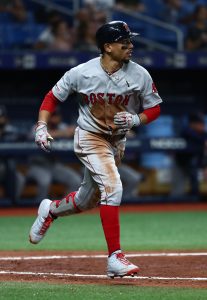 Betts earned $10.5MM in 2018 after defeating the Red Sox in an arbitration case, and his epic MVP campaign saw his salary rise to $20MM in 2019. After hitting .295/.391/.524 with 29 homers over 706 plate appearances last season, Betts is in line for another big raise in third and final trip through the arb process. Matt Swartz will be publishing MLBTR’s official arbitration projections within a few weeks, though he has informed me that Betts is currently projected to earn $27.7 or $27.8MM for the 2020 season (depending on whether Betts’ base 2019 salary is increased by a bonus should he win a Gold Glove).
That number certainly looms large in any discussion of a Betts trade, given that several teams may balk at committing that much money to a single player (even a superstar like Betts) if they have luxury tax concerns of their own. Plus, a team trading for Betts would have to be expecting to have him for one season at the most. Betts has been so adamant in exploring free agency that it’s very unlikely that he pulls a Paul Goldschmidt and signs an extension with a new team rather than finally get a crack at the open market.
With only one year of Betts on offer, the Red Sox know that trading the outfielder won’t solve all their problems. There’s no chance, for instance, of another payroll-clearing blockbuster like Boston’s legendary August 2012 trade with the Dodgers, since Betts lacks the long-term appeal that Adrian Gonzalez (the Dodgers’ primary target) held for Los Angeles.
Teams also aren’t going to clear out their farm systems for just one year of Betts, though Boston can reasonably assume to top what the Diamondbacks received from the Cardinals for Goldschmidt last December. Betts is over five years younger than Goldschmidt and a more valuable defensive player, so the Red Sox will definitely aim for more than the already-impressive package the D’Backs received — a controllable young starter (Luke Weaver), a controllable young everyday catcher (Carson Kelly), a Competitive Balance Round B pick in the 2019 draft, and another prospect in infielder Andy Young, currently ranked by MLB.com as the 23rd-best Diamondbacks minor leaguer. That said, Goldschmidt was also only making $14.5MM in salary in 2019, whereas Betts’ 2020 salary could be almost double that number.
Let’s go through the other 29 teams to see if we can find a fit as a Betts suitor…
No Chance
The Marlins, Blue Jays, Orioles, Royals, Tigers, and Mariners are all rebuilding. And the Red Sox would never trade Betts to the arch-rival Yankees, as amusing as it would be to see New York somehow land another Boston superstar almost exactly 100 years after the Babe Ruth deal.
Probably Not
The Rockies don’t have much salary wiggle room to add an expensive player like Betts. Likewise, payroll restraints will likely keep the Pirates and Diamondbacks out of the mix, though Arizona GM Mike Hazen knows Betts well from their time together in Boston. The Brewers also likely face similar financial restraints, plus they don’t have much elite young talent to grab Boston’s interest. The Rangers are another team without much in the way of blue-chip minor league talent, and while Texas is planning to spend more as the team moves into its new ballpark next season, longer-term acquisitions would seem to make more sense for the Rangers than a win-now move like acquiring Betts. Likewise, the Giants are more apt to pursue a long-term option if they go after any premium players at all (i.e. their interest in Bryce Harper last winter).
I put the Cubs a tick above the other “probably not” teams because they’re under increasing pressure to win in 2020, and could potentially be open to some type of creative swap that could see Chicago and Boston shift around several of their undesirable contracts, in addition to sending Betts to Wrigleyville. But there would seemingly be a lot of moving parts in such a deal, and the Cubs have their own set of luxury tax concerns. Plus, while the Sox and Cubs have made a few minor trades since Theo Epstein took over the Cubs’ baseball operations department, one wonder if Red Sox management could be hesitant about sending a star player Epstein’s way.
Probably Not, AL Contenders Edition
The Red Sox wouldn’t have quite the same reservations about sending Betts to another AL rival as they would about putting him into the Yankee pinstripes, but moving him within the AL East to the Rays seems unrealistic. The Sox probably also wouldn’t be too keen to further strengthen the Astros‘ juggernaut lineup, though Houston is already facing something of a luxury tax crunch with its own crop of star players. The Indians have taken steps to cut back spending over the last year and can quite likely be ruled out of a Betts pursuit, as much as Cleveland is still trying to keep its contention window open for as long as possible.
While neither the Twins or Athletics are big spenders, it’s possible either team could see a Betts trade as a unique opportunity that merits a one-year payroll spike. Trading for Betts could be seen as a souped-up version of Minnesota’s strategy from the 2018-19 offseason, which making short-term acquisitions in lieu of major financial commitments. Acquiring Betts would cost more than just money, of course, and it remains to be seen if the Twins or A’s would be open to giving up the minor leaguers necessary to pry him away from the Red Sox.
Makes Some Sense
I put both the Nationals and Cardinals leaning closer to the “probably not” category, though trading for Betts would be an eye-popping way for either team to reload if Anthony Rendon or Marcell Ozuna was lost in free agency. Trading for Betts could be seen as a one-year stopgap for teams that are strongly trying to contend in 2020, and the Nats or Cards could then let him walk in free agency and pursue a longer-term star in the 2020-21 offseason (a pursuit that would likely include an attempt to re-sign Betts). It’s rather doubtful that Washington would be eager to deal from a relatively thin farm system, however, while St. Louis may have used up most of its expendable but MLB-ready pieces in the Goldschmidt trade.
The White Sox flirted with the idea of adding a superstar to the ranks with their pursuit of Harper and Manny Machado last offseason, and while Betts would be a much shorter-term addition, it would certainly announce the end of Chicago’s rebuild in a major fashion. If you’re wondering why the Pale Hose would look to add Betts for 2020 when they’re far more than just one player away from contention, the club has explored such a tactic in the past — the White Sox made an offer to the Orioles about acquiring Manny Machado in the 2017-18 offseason, when Machado was also a year away from free agency.
As incredible as it would be to see Betts and Mike Trout in the same outfield, the Angels probably aren’t willing to move top prospects for one year of Betts, especially given how GM Billy Eppler has worked hard to reload a once-barren farm system. Still, the firing of manager Brad Ausmus hints at an increasing impatience within Angels ownership, and Eppler is also entering the last year of his contract, so I can’t entirely rule the Halos out as a potential dark horse.
The Braves and Dodgers each have the prospect depth to get Boston’s attention, though neither team is likely to swap much of its top talent for just one year of Betts since neither is exactly in outright “win-now” mode. It could be argued that Los Angeles could be a bit closer to this category if the Dodgers fall short of another World Series, though the Dodgers have tended to save their biggest trades for the July 31 deadline (when they have a firmer idea of their needs) rather than the offseason.
The Win-Now Teams
Since Betts is only signed through 2020, his most logical trade matches are the teams who definitely want to contend next season, and could be most open to a bold deal to make a postseason berth happen.
As much as Phillies GM Matt Klentak has insisted that he is looking to build a sustainable contender, he’ll be expected to more immediately start bearing the fruits of the Phils’ rebuild process and the team’s splashy 2018-19 offseason. Philadelphia’s 81-81 record has led to rumblings that manager Gabe Kapler could replaced, and another down year could also put Klentak’s own job security in question, though the general manager is signed through 2022. The Phillies made big trades for J.T. Realmuto and Jean Segura last winter, though whether they have enough young talent left (or at least enough they’re willing to part with) to acquire Betts remains to be seen. Also, as much as Betts would upgrade the Phils’ middling offensive production, pitching would seem to be Philadelphia’s much more pressing need.
Perhaps no GM is under as much of a microscope as Padres general manager A.J. Preller, as executive chairman Ron Fowler is on record as saying that “heads will roll” in the organization if San Diego faces another “embarrassing” season. Assuming that the Red Sox would be okay with making another big trade with the Padres in the wake of the controversial Drew Pomeranz swap in 2016, a Betts trade would be the kind of major transaction the Padres seemed to be on the verge of making all last offseason, but never completed despite talks about numerous star players with multiple teams. Even if the Padres are more than one player away, the club’s highly-regarded minor league pipeline has so much depth that they could afford to spare a few pieces for Betts and still boast a top-five system. Would a Betts trade be the wisest long-term move? Not really, but after nine straight losing seasons, some type of step towards competitive baseball is definitely needed.
The Reds are a club in more pressing need of lineup help, and since president of baseball operations Dick Williams has set the playoffs as a firm goal for 2020, Betts could very well be a target. Betts’ salary wouldn’t be as big an issue as it would seem for a smaller-market team since the Reds are also planning to spend more. Though Williams has also hinted that the Reds are more apt to explore free agency rather than trades, these plans for an aggressive winter make Cincinnati seem like a solid bet to at least discuss a trade with the Red Sox.
The Mets further thinned out an already shallow farm system in their July trade for Marcus Stroman, and Betts’ salary could prove problematic for a team that has never been too eager to spend despite operating in the New York market. That said, the Mets are firmly planning to contend next year, and GM Brodie Van Wagenen has already shown a penchant for headline-making trades in his first season on the job. Betts would be such a clear and obvious solution to the Mets’ longstanding center field problem that, while it’s not exactly a “one player away” scenario for a team with so many bullpen questions, putting Betts alongside the likes of Pete Alonso, Michael Conforto, Jeff McNeil, and J.D. Davis makes for an awfully scary lineup.
Photo courtesy of USA Today Sports Images
AL Notes: Gerrit Cole, Gardner, Didi
Earlier in the week, Astros pitcher Gerrit Cole was the subject of public discussion when owner Jim Crane made comments regarding the team’s projected inability to re-sign the starter this offseason. On Saturday evening, Cole made a statement all his own.
While it would be advantageous for a site with the phrase “trade rumors” in its header to find a transactional tilt to every story, the lead-in to tonight’s closing post is mainly a breathless tribute to the individual performance submitted by Cole in tonight’s 3-1 win over the Rays. As noted by several reporters, the right-hander’s performance in Game 2 of the ALDS was historic on several levels: with 15 strikeouts across 7.2 innings, Cole became just the 7th pitcher to record 15-or-more K’s in a postseason game; Tampa offered 33 swings and misses on Cole offerings–the most in a postseason game in the pitch-tracking era; and in recording multiple career postseason games with more than 12 strikeouts, Cole joined an elite list that includes only himself, Bob Gibson, Jim Palmer, and Tom Seaver.
The 29-year-old former Bruin will enter the offseason as the top starting option on the open market; judging in part from early postseason results, his representatives at Boras Corp should have no trouble this winter in securing Cole a contract guarantee with a healthy amount of zeroes attached to its end.
More from around the AL circuit…
- The postseason odyssey of one Brett Gardner was profiled in a piece from Joel Sherman of the New York Post today, with Sherman describing the outfielder’s rise from a scrappy pinch runner on the 2009 Yankees championship team to the club’s #3 hitter in tonight’s lineup against the Twins (link). Like Cole, Gardner will be a free agent in about a month’s time, as he plays out the end of a one-year/$7.5MM contract signed last offseason. It would be difficult, at this point, to imagine Gardner in anything other than pinstripes, but the Yanks will nonetheless have an interesting decision re: Gardner this winter. Aaron Hicks will, hopefully, have a healthier season in 2020, while outfielder Clint Frazier looms as a cheaper, organizational option for GM Brian Cashman at the corners–although Frazier would admittedly have a hard time replicating Gardner’s excellent baserunning (70.9 career BSR) or defensive skills (+5 DRS in 2019).
- Given the number of open managerial seats around the game, this month has seen a fair share of debate surrounding what, exactly, a manager should be expected to offer in today’s analytically inclined climate. Manager of the Year candidate and Yankees skipper Aaron Boone, for one, might consider submitting “clairvoyance” as one qualification that every managerial candidate should be in possession of, as his own pre-game forecast directly presaged a historic home run for the previously slump-ridden shortstop Didi Gregorius. Before Gregorius launched a game-breaking, third-inning grand slam deep into the seats in tonight’s 8-2 victory over the Twins, Boone was resolute that a breakout for the Dutchman was just around the corner.
“I still maintain that the best is yet to come from Didi,” Boone told James Wagner of The New York Times (link). “Sometimes it just takes one at-bat, one swing to kind of turn it, and I believe that’s what’s in there for Didi still.” Boone was speaking, of course, of the shortstop’s season-long stagnation at the plate, which included Gregorius’ worst postings since coming to the Bronx in 2015 (84 wRC+ this season). After the beginning of his season was delayed until June, Gregorius saw his numbers trend downward through the summer, culminating in a September output that included a .190 batting average. While the pending free agent is unlikely to command an eye-popping contract this offseason (in part due to his 2019 injury troubles), a healthy and productive postseason wouldn’t, at the least, hurt the 29-year-old’s chances of securing a multi-year guarantee. Not that his fellow free-market shortstops will offer stiff competition toward that goal: among a group that may include Freddy Galvis, Adeiny Hechavarria, and Jose Iglesias, Gregorius may represent the most appealing upgrade for clubs in need of SS help this winter.
Mark Loretta Comments On Cubs Opening
After interviewing this week for the open Cubs managerial seat, Mark Loretta made several comments to a Chicago-area radio station on Saturday that offered insight into his hypothetical strategy for improving the club’s on-field product. Speaking to 670 The Score, the former bench coach for Joe Maddon identified bullpen pitching, defense, and team-wide strikeouts as main areas of focus, were he to land the manager’s job on the North Side (link).
“We have three or four areas where we need to improve,” Loretta said. “We certainly had trouble in the bullpen early and late in the season. The defense, for sure, I think it could have been much better. On the offensive side, we struck out way too much.”
Additionally, Loretta–who played in parts of 15 seasons in the majors–seemed to hint at a lack of structure under the recently ousted skipper Maddon, who has long been considered to be a “player’s coach”.
“We have had a lot of optional hitting practice and fielding practice,” Loretta said. “That’s something we should take a look at as well to see if that actually makes sense. There are certain training times when players need to be on their own. Team concept and team-building exercises and getting together in practice more often are very valid.”
For what it’s worth, the 48-year-old Loretta is not the only in-house coach who might have up-close insight into how the Cubs can improve on 2019’s disappointing 84-78 final result. David Ross–who is described by 670’s Bruce Levine to be a “frontrunner” for the manager’s job–will interview in the coming week, as will first base coach Will Venable; Joe Girardi is also expected to interview, though he is said to also have a keen interest in the open Mets posting.
Loretta formerly worked as a special assistant in the San Diego front office, after a sneakily illustrious playing career split between the Brewers, Astros, Padres, Red Sox, and Dodgers. Team sources from the Padres have indicated that Loretta, a longtime Southern California resident, is also a candidate for the open Padres seat.
League, MLBPA Mull Further Changes To Drug Policy
A slow night in transactional and hot stove-related news allows for a closer reading of the previous week’s industry news, and a Wednesday piece from the Los Angeles Times’ Bill Shaikin is certainly deserving of a look, for those who missed it upon publication. In the shadow of the tragic passing of pitcher Tyler Skaggs from an opioid-related overdose, the league and the MLBPA are, according to Shaikin, discussing changes to the sport’s drug policy that could include loosened restrictions on the use of marijuana (link).
We had previously heard that the two parties were already in evaluating the potential implementation of routine opioid testing for all players, with deputy commissioner Dan Halem going so far as to say that the league would “absolutely” like to add said testing in advance of the 2020 season. The idea of adding opioid testing while relaxing marijuana restrictions is not seen as a strict quid pro quo bargain, per Shaikin’s sources, but the reporter did speak with former major leaguer Kyle Blanks, who admitted to using alcohol, marijuana, and opioids during his playing career in an effort to manage pain. It stands to reason that the league and union, then, might be seeking to discourage players resorting to the deadly allure of opioid use–even if it means more players potentially using cannabis as a palliative.
As it stands, baseball’s Joint Drug Prevention and Treatment Program stipulates that testing for Drugs of Abuse be conducted on a basis of reasonable cause–meaning, essentially, that players are not tested on a routine basis for cannabinoids. Whether, then, a truly impactful change to the Program is forthcoming is unclear; it’s quite possible that the two sides are discussing the removal of cannabinoids from the “Drugs of Abuse” classification, although such a move would likely be symbolic in nature. While 2019 saw seven players suspended for PED use, no major leaguers were suspended this season for violating the sport’s policy in regard to marijuana use, specifically.
NL Notes: Waino, Chop, Zaidi
Sunday will mark the first postseason game played in St. Louis in three years, but Cardinals manager Mike Schildt will be trusting the game’s start to a relatively practiced postseason hand. Redbirds legend Adam Wainwright–a free-agent-to-be this offseason–will be taking the ball for Schildt, who is counting on the pitcher’s experience with what promises to be a raucous Busch Stadium atmosphere.
“You have to account for some of the vibe that’s going on out there,” Schildt told Anne Rogers of MLB.com today, “You have to be able to calm your nerves and you have to be able to control your adrenaline, because I’ve seen it where guys go out there and they’re feeling on top of the moon and their adrenaline is rushing, and two innings later they’re out of gas.”
As Rogers notes, Wainwright will be making his 24th appearance in a postseason game (13 starts), after first appearing in the national October spotlight in 2006 as a relief ace for then-manager Tony La Russa‘s World Series-winning Cards team. That year saw a 24-year-old Wainwright begin his playoff career with 9.2 scoreless innings, and he has only followed up that initial success by compiling a nifty 3.03 ERA across 89.0 career postseason innings. This year marked the now-38-year-old’s first season over the 30-start mark since 2016, and this October should provide him yet another opportunity to assure the Cardinals–and rival clubs–that he deserves a healthy free agent guarantee this winter.
More notes from around the National League in anticipation of Sunday’s NLDS doubleheader…
- The Associated Press is circulating a story involving Wainwright’s teammate Ryan Helsley, who did not take kindly to witnessing the en masse enactment of the Braves‘ “Tomahawk Chop” tradition during Game 1 of the NLDS this Thursday (link). In comments originally made to writer/hero Derrick Goold, Helsley, who is a member of the Cherokee nation, called the “Chop” “disappointing” and “disrespectful”. “[The tradition] just depicts them in this kind of caveman-type people way who aren’t intellectual. They are a lot more than that. It’s not me being offended by the whole mascot thing. It’s not. It’s about the misconception of us, the Native Americans, and how we’re perceived in that way, or used as mascots.” Of course, with the NLDS tied 1-1 heading to St. Louis for Game 3 of the best-of-five NLDS, it’s possible Helsley could have a say in preventing the series returning to Atlanta. The 25-year-old Oklahoman pitched to a 2.95 ERA in 36.2 innings in 2019, his rookie season.
- Giants executive Farhan Zaidi already made MLBTR headlines today, when he gave some insight into the team’s ongoing search for a new GM. In a separate set of quotes relayed by NBC’s Alex Pavlovic, Zaidi conducted something of a performance self-assessment in regard to his work at the 2019 trade deadline–and it’s clear Zaidi is a fair critic (link). “I feel like I alternate nights losing sleep about not potentially buying at the deadline and trying to improve our chances this year, or selling more at the deadline and setting ourselves up better for 2020 and going forward,” Zaidi admitted to Pavlovic. It stands to reason that the veteran baseball man would be left with some cognitive dissonance over his team’s activity this summer, being that the club took something of a walk-the-line approach in their dealings.
While San Francisco held onto impending free agents Madison Bumgarner and Will Smith (and sacrificed the potential prospect assets they might have acquired in a deal involving those players), the team also shaved down the bullpen by sending away Drew Pomeranz, Sam Dyson, and Mark Melancon in separate deals. To be fair, Zaidi was in perhaps the toughest position of any club executive heading into this year’s deadline, as his expected-to-flounder 2019 Giants ripped off a stunning run of success in advance of the Jul. 31 push-or-shove precipice. After playing to their expected level for much of the year, Bruce Bochy‘s boys of summer went 19-6 in July, ultimately forcing their front office leader into something of a compromising position. The Giants went 22-36 from Aug. 1 onward, ultimately finishing with a 77-85 record.
Tony Clark Skeptical Of Organizational Spending Plans
After a 2018 offseason that saw countless veterans linger on the free agent vine much longer than anticipated, MLBPA executive director Tony Clark is expecting yet another cooled stove this winter–and, judging from comments made to The Athletic’s Ken Rosenthal on Thursday, he doesn’t sound particularly pleased about it.
“The Hot Stove season has traditionally been about ticket sales and fan engagement,” Clark told Rosenthal. “Yet several clubs are laying the groundwork for more of the same [this offseason], even as franchise values skyrocket and central revenues continue to increase. These blanket proclamations send precisely the wrong message to fans, and undermine the competitive landscape that fuels interest in the game from day one of spring training through the final game of the World Series.”
For context, it’s important to note that Clark is largely responding to recent comments made by several C-level club executives and owners around the game: Red Sox brass has indicated a desire to get under the CBT threshold in advance of 2020; the Rockies, fresh off of a fourth-place season, indicated a lack of “flexibility” in regard to finances for 2020; and, just this week, our own Steve Adams delved into the possible maneuvers the Astros could undertake in avoidance of the luxury tax line, after owner Jim Crane poured cold water on the idea of a Houston-Geritt Cole reunion. For teams at every position in the standings, “spending” has become a center-stage PR concern in 2019.
Clark also took pains to note that MLB saw a decline in gate attendance for the fourth consecutive season, with, specifically, a 1.6 year-over-year drop from 2018 to 2019. That such a decline would occur while another term–“tanking”–is also becoming common parlance would seem to add some teeth to Clark’s comments. In 2019, 20 teams finished with 90-or-more losses or 90-or-more wins, while a whopping eight teams finished with 100-or-more losses or 100-or-more wins.
Rosenthal’s column also features comments from MLB deputy commissioner Dan Halem, who takes–as one might expect–a more tempered view of game-wide spending patterns, noting that the Minnesota Twins saw a huge jump in 2019 attendance despite a quiet 18-19 offseason in terms of spending (the club’s two “major” expenditures being a collective three years of commitment to Marwin Gonzalez and Nelson Cruz). Certainly, this instance of public back-and-forth represents an interesting bit of repartee occurring between both league and players union in advance of the current collective bargaining agreement’s expiration in December of 2021.
Quick Hits: Yankees, Sanchez, Astros, Peacock, Giants
While Yankees catcher Gary Sanchez has always been known for his ability to send balls into the stratosphere, Kristie Ackert of the New York Daily News writes that his improvement defensively is paying dividends for the World Series-hopeful Yankees. Per Ackert, relievers Zack Britton and Adam Ottavino were admittedly skeptical of their new backstop when they first joined the Yankees, but both have been pleasantly surprised with Sanchez’s work not only blocking the ball (after catching his fair share of flak for surrendering passed balls, Sanchez has cut his total from 18 last year to just seven in 2019), but also managing a pitching staff that includes a deadly stable of hard-throwing bullpen arms with different tendencies. That could very well be magnified as the Yankees play in the postseason; with many questioning the team’s rotation, Aaron Boone figures to rely heavily on what might be the deepest bullpen of the remaining contenders.
Some other notes from around the baseball landscape…
- With the Giants’ search for a new manager underway, John Shea of the San Francisco Chronicle inspects ten candidates who could be the first new manager in San Francisco since Bruce Bochy took over in 2007. They include incumbent Giants coaches, staff members from Farhan Zaidi’s time in Oakland, and other outsiders. Hensley Meulens, Eric Chavez, Mark Kotsay, and others could all be in contention, though Shea notes that some names are more realistic than others, and that those discussed are merely speculative. Still, for Giants fans interested in what each brings to the table, it’s a worthwhile summary.
- If the Astros advance to the ALCS, right-hander Brad Peacock could be added to the roster, per Brian McTaggart of MLB.com. Peacock was a notable omission from the Division Series roster after he struggled in a late-season return from a shoulder injury. There’s hope that he could be fully up to speed ahead of the Championship Series, should the Astros advance. He’s set to throw a simulated game today to stay sharp during his time off the field. With just 11 pitchers on the roster for the first round, Peacock could replace a position player if he is indeed added to the ALCS roster.
Farhan Zaidi: “High Priority” For Giants To Hire GM
Since Bobby Evans was removed from his post as the general manager of the Giants in September of last year, the team has yet to decide on a replacement for Evans. Of course, that doesn’t mean that the organization has been flying blind, as Farhan Zaidi was installed as the president of baseball operations in San Francisco in November of 2018 and has spearheaded the department for the better part of a year.
Now, though, Zaidi has made it clear that he and other Giants decision-makers plan to move quickly in their search for a general manager to co-pilot the franchise’s baseball ops department, according to Alex Pavlovic of NBC Sports Bay Area. After playing out the 2019 season without a second-in-command, Zaidi referred to the search for a GM as a “high priority” as the organization has also begun to vet candidates for the vacant managerial position.
It’s possible that the new GM could be hired in time to take part in the interviewing process for the Giants’ next manager, but that’s far from a foregone conclusion, with Zaidi saying that “there’s no favorite” for the job yet and that the hiring processes will be conducted simultaneously. Still, Zaidi and company are well aware that those two figures will need to have a close working relationship and will have that in mind during the hiring cycle. The interplay between front office and manager has grown in importance in recent years, with the two levels of administration needing to be on the same page as teams implement plans throughout all levels of the organization.
Despite Zaidi’s assertion that no one candidate has separated from the pack, Pavlovic speculates that Athletics assistant GM Billy Owens, familiar with Zaidi from their time together in Oakland, could have the inside track to the job. Owens was considered for the job last offseason, though ultimately the Giants elected to hold off on filling the post for the time being. Owens has experience in the scouting and coaching departments, serving as a minor-league hitting coach prior to assuming a position in the front office.
Per Zaidi, the Giants aren’t hunting for a candidate with a particular area of expertise, but rather looking for someone who will jibe well with the current front office and “[share] the load of managing the overall operation.” He hopes that such an approach will expand the pool of potential candidates, regardless of whether their background comes in scouting, player development, administration, or elsewhere.
In his first year at the helm, Zaidi already has his fingerprints all over the Giants’ makeup. He’s worked to expand the Giants’ analytics department to catch up to the rival Dodgers, his former employer. A seemingly endless cycle of bargain-bin outfield acquisitions has brought some potential pieces to the forefront, including solid performances from rookie Mike Yastrzemski and cast-off Alex Dickerson. Elsewhere, Donovan Solano and Trevor Gott looked like savvy acquisitions, while the signing of Drew Pomeranz later yielded Mauricio Dubon in a July trade.
While the Giants’ midseason hot streak ultimately expired too soon, the team improved its 2018 season and reached 77 wins, appearing to have made some marginal improvements to the roster. In his first full offseason running the Giants, the vacant GM and manager positions are the next priorities for Zaidi, who will have the chance to bring aboard his own staff to carry out an organizational plan.
AL Notes: Twins, Astros, Gurriel, Angels
Although the Twins‘ have enjoyed a rapid turnaround from 78 wins a season ago to 101 wins and a division title this year, that breakout has roots tracing back to 2009, writes Dan Hayes of The Athletic. A decade ago, the Twins landed a transformative class of international amateurs—Miguel Sano, Max Kepler, and Jorge Polanco—that blossomed into franchise cornerstones and 2019 stars. At the time, the $4.65MM the team doled out to land the three 16-year-olds was uncharacteristic for the Twins franchise, which had largely been a non-factor in the international scene; the team had no academy in the Dominican Republic and had virtually no connections with the players’ pseudo-agents. That made it especially difficult to land Sano, a coveted prospect who commanded a $3.15MM bonus and captured the attention of nearly every MLB club. On the other hand, there was less competition for Kepler, a German-born prospect, and Polanco, a scrawny teenager who lacked the projectability of Sano. Of course, those signings have delivered immense value to a team that has ridden Polanco, Kepler, and Sano to the franchise’s first division title since 2010. According to Baseball-Reference’s version of WAR, those three have been the 2019 Twins’ first-, third-, and seventh-most valuable players, combining to contribute 12.8 wins of value to the team.
- At age 35, Astros first baseman Yuli Gurriel could be playing himself into another contract with Houston’s club, writes The Athletic’s Jake Kaplan. Gurriel has enjoyed a career year at an age where he should be declining, perhaps a reflection of his acclimation to the game in the United States. The 2020 season will be the last under his current contract, a five-year, $47MM deal inked prior to 2016, when he defected to the U.S. as one of Cuba’s most accomplished players. He’s by no means the star of a stacked lineup in Houston—he most often slots into the sixth spot for the Astros—but he has delivered solid offensive value, thanks in part to an in-season mechanical change, a focus on lifting the ball, and a heightened focus on preparation.
- With eliminated teams beginning to consider offseason decisions, the Angels will have to decide whether to protect 26-year-old infielder Jose Rojas or expose him to the Rule 5 Draft. He posted career-best numbers at Triple-A this year, slugging 31 home runs and a .293/.362/.577 batting line. Mike DiGiovanna of Baseball America takes a look at Rojas’s case, pointing out that teams around baseball are having some difficulty tuning their evaluation of Triple-A players to the drastically altered offensive environment at the level. Since Triple-A leagues introduced the MLB-used baseball for the 2019 season, power numbers have universally spiked in Triple-A. With the reliability of raw home run numbers in question, DiGiovanna points out that teams are increasingly reliant on their scouts’ eyes in their valuation of Triple-A players.