
Gerrit Cole Discusses Potential Trip To Free Agency
Astros right-hander Gerrit Cole is on a collision course with an enormous payday in the next few months. Arguably the most valuable impending free agent in baseball, the three-time All-Star expressed excitement Tuesday in regards to his potential trip to the open market, per Mark Berman of Fox 26 (video links).
“I’m looking forward to it,” said Cole. “I know what my right is as a player. Once I get six years of service time, my right is to be able to say yes or no to a place I want to play. So I’m excited to be able to exercise that right.”
That may make it sound as if Cole is ready to exit the Astros, but that isn’t necessarily the case. Houston, according to Cole, “checks a lot of the boxes. I expect them to be there when push comes to shove. I wouldn’t mind playing there for a lot longer.”
The feeling’s likely mutual for the Astros, with whom Cole has been brilliant since they acquired him from the Pirates entering the 2018 campaign. While Cole had plenty of high moments as a Pirate, he endured multiple seasons in Pittsburgh in which he battled injuries and didn’t prevent runs at ace-level rates. The Houston version has been durable and elite, though.
Not only is the hard-throwing Cole on pace for his second straight 200-inning season with the Astros, but he has a realistic chance to surpass the 300-strikeout mark. Cole leads the majors with a stunning 13.11 K/9, has walked just 2.31 hitters per nine and has logged a 3.09 ERA/3.00 FIP across 116 2/3 innings. Overall as an Astro, he owns a 2.95 ERA/2.81 FIP with 12.66 K/9 and 2.67 BB/9 through 317 frames. His 9.4 fWAR dating back to 2018 paces all American League starters and ranks third in the game, trailing only supreme aces Max Scherzer and Jacob deGrom.
Scherzer’s a few offseasons removed from signing a seven-year, $210MM contract with the Nationals in free agency. Scott Boras, who also represents Cole, helped Scherzer secure that deal. Along with David Price and Zack Greinke, Scherzer is one of three pitchers to reel in $200MM-plus pacts to this point. The soon-to-be 29-year-old Cole, with Boras’ help, could angle to become the fourth by next season.
KBO’s LG Twins Sign Carlos Peguero, Place Tommy Joseph On Waivers
The LG Twins of the Korea Baseball Organization have made a pair of moves involving former major leaguers, Dan Kurtz of MyKBO.net reports. The club signed outfielder Carlos Peguero and placed first baseman Tommy Joseph on waivers.
Playing in Asia isn’t foreign to the 32-year-old Peguero, though he is new to Korean ball. Peguero spent 2016-18 with the Rakuten Golden Eagles of Nippon Professional Baseball in Japan. Before that, he played parts of 2011-15 in the majors and struggled to a .194/.263/.384 line in a combined 319 plate appearances with the Mariners, Royals, Red Sox and Rangers.
Joseph’s also an ex-Ranger, having joined the team via waivers from the Phillies going into the 2018 season. Joseph ended up spending the entire season in the minors, though, which was unexpected after he was a regular for the Phillies over the previous two years. The right-handed slugger accumulated 880 trips to the plate during those seasons and piled up 43 home runs, but his overall production (.247/.297/.460 – good for a 97 wRC+) didn’t convince the Phillies to retain him, nor did it lead to a chance in Texas.
Unable to find another big league opportunity last offseason, the 27-year-old Joseph signed in Korea for $1MM. While Joseph looked like a candidate to rake in the hitter-friendly KBO, his OPS (.758) over 217 PA has fallen more than 100 points short of the league average (.866) for foreign players.
Rick Ankiel Likely To End Comeback Attempt
Former major league pitcher/outfielder Rick Ankiel is nearing “decision time” regarding his potential comeback, agent Scott Boras told Derrick Goold of the St. Louis Post-Dispatch. It’s unlikely the soon-to-be 40-year-old Ankiel will continue his bid to return to the game, though, Goold writes.
Ankiel, who last played in the majors in 2013, first declared his intention to come back last August. Although Ankiel hasn’t pitched in the bigs since 2004, he was hoping to return as a southpaw reliever. However, Ankiel hasn’t bounced back from the surgery he underwent in November to repair his damaged left ulnar collateral ligament, per Goold, who hears that his recovery has “plateaued.”
Had Ankiel been healthy, it seems he would have been given a realistic chance to vie for a spot with the Cardinals – who originally chose him in the second round of the 1997 draft. According to Goold, the Cardinals checked on Ankiel sometime in the past month to see if he was in shape to sign a minor league contract, but president of baseball operations John Mozeliak didn’t hear back.
Ankiel shined at times as both a pitcher and a hitter in St. Louis. In 2000, his best season as a hurler, Ankiel notched a 3.50 ERA with 3.4 fWAR and 9.98 K/9 against 4.63 BB/9 over 175 innings. A lack of control became a major problem for Ankiel the year after, however, and an extreme case of the yips forced him to transition from the mound to the outfield.
Ankiel didn’t garner a large number of at-bats in a season until 2007, the beginning of a two-year stretch in which he slashed .270/.334/.515 (120 wRC+) with 36 home runs and 3.1 fWAR in 653 plate appearances. Ankiel went on to appear in the majors in each of the next five seasons, also spending time with the Royals, Braves, Nationals, Astros and Mets, but experienced limited success with those clubs.
Injuries Limiting Khris Davis’ Power
Khris Davis has been a remarkably consistent piece of the Athletics’ offense since the team acquired him from the Brewers just a couple months before the 2016 season began. A .247 hitter in his final season with the Brewers, Davis incredibly posted that same average from 2016-18 in Oakland. At the same time, the man known as Khrush slammed 133 home runs – at least 42 in each season – while recording a 128 wRC+ during that three-year, 1,916-plate appearance span.
Durability played an important role in Davis’ counting stats during his first three years as an Athletic. He appeared in no fewer than 150 games in any of those seasons, though hip, oblique and left hand problems have dogged Davis this year, limiting him to 74 of a possible 91 contests. It hasn’t been an ideal outcome for low-budget Oakland, which signed the fan and organizational favorite to a two-year, $33.5MM contract extension entering 2019. Including Davis’ $16.5MM salary this season, he’s under wraps through 2021 for $50MM. That’s a lot for the A’s, who – despite being in the thick of the playoff race for the second straight year – haven’t gotten the optimal version of Davis.
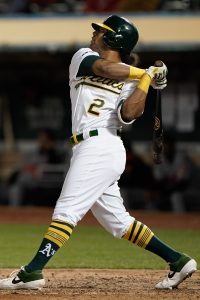
Through 302 plate appearances this season, the 31-year-old Davis has batted a career-worst .236/.305/.433 with a personal-low .196 ISO that sits 91 points below his 2016-18 mark. While Davis does have 16 homers, he’s easily on pace for his fewest in a season as an Athletic, and he hasn’t hit one since June 18. Moreover, his wRC+ (94) comes in 16 points below the league average for a designated hitter.
This past weekend, Davis explained to Susan Slusser of the San Francisco Chronicle that the pain in his hand has hampered his power, saying: “It’s just not as strong as it should be. I’ve been choking up a little bit, and that’s been helping a little, but not a lot of power guys choke up.”
Indeed, although a career-high swing percentage (52.7) has led to Davis’ greatest contact rate as an Athletic (70 percent), he’s not denting the ball to the extent he did in prior years. Davis’ average exit velocity has decreased from 92.5 mph to 89.5 since last season, according to Statcast, while his launch angle has plummeted from 18.1 to 12.4. He has also hit 11.7 percent fewer fly balls since then, which helps explain why he’s so far from the major league-leading 48 homers he amassed a season ago.
Davis’ MLB-best HR total in 2018 played a key part in a .365 weighted on-base average/.378 expected wOBA, but those numbers have sunk to .313/.331 this year. His xwOBA ranks in the league’s 48th percentile, while his expected batting average (35th), hard-hit rate (52nd) and expected slugging percentage (65th and down 106 points from 2018) also aren’t befitting of a top-rate slugger. Here’s an interesting bit of trivia, though: Davis’ expected average is – you guessed it – .247.
The right-handed Davis has typically handled both same-handed and lefty pitchers, though not having the platoon advantage has kneecapped him this year. He’s hitting an unimposing .226/.297/.392 (83 wRC+) against righties thus far. Per FanGraphs, Davis destroyed pitches in the middle of the zone against RHPs just a season ago, but his success in that portion of the plate (and in other areas) versus righties has dwindled significantly in 2019.
With two-plus months left in the season, Davis has time to reverse his fortunes this year and help Oakland to the playoffs. Owing in some part to injuries, though, one of the game’s fiercest sluggers has gone backward in a season where power has run rampant. Considering the hefty investment small-budget Oakland made in Davis coming into the season, it’s in obvious need of a turnaround from the typically elite HR hitter going forward.
Photo courtesy of USA Today Sports Images.
Realmuto Open To Long-Term Deal With Phillies
J.T. Realmuto was clear toward the end of his time with the Marlins that he wasn’t interested in signing an extension with Miami, but the All-Star catcher has taken a different tone with his new organization after just a few months. As Matt Breen of Philly.com reports, Realmuto wasn’t shy during this week’s All-Star festivities about expressing his interest in signing a long-term deal with the Phillies.
“Everything I’ve experienced in Philadelphia has been awesome, so I wouldn’t be opposed to spending the rest of my career there,” Realmuto told the media. It doesn’t sound as though there’d be any particular deadline on talks, either, as Realmuto indicated he’d be open to talks “whether it be tomorrow or in the off-season or next July.”
While plenty has gone wrong for the Phillies in 2019, their acquisition of Realmuto has proven to be a terrific move. His offense is down from last year in Miami (despite a move to a more hitter-friendly park), but his .273/.328/.438 slash line translates to roughly league average for a hitter, per OPS+ and wRC+. Relative to other catchers throughout the league, that’s considerably above-average. And defensively, Realmuto has taken his already strong game to a whole new level.
Realmuto leads the Majors with an incredible 49 percent caught-stealing rate, having thrown out 26 of the 53 players who’ve been bold enough to attempt a steal. His framing marks, once again, are comfortably above the league average, and Baseball Prospectus credits Realmuto as the game’s second-best pitch-blocker (behind Cleveland’s Roberto Perez). Realmuto is tied with Perez for second among all MLB catcher with 10 Defensive Runs Saved, and Baseball Prospectus rates only San Diego’s Austin Hedges as a superior defender behind the dish.
As can be seen in MLBTR’s Extension Tracker, there haven’t been many catchers with four-plus years of service to ink long-term deals in recent seasons. Both Francisco Cervelli (three years, $31MM when he had 5+ years) and Salvador Perez (five years, $52.5MM as a 4+ player) did so in 2016, while Miguel Montero (five years, $60MM as a 5+ player) did so back in 2012. Montero’s deal is dated, though, while Cervelli wasn’t nearly as established a hitter and Perez was signing a make-good deal after initially inking an astronomically club-friendly extension as a pre-arb player. (Mammoth extensions signed by Joe Mauer and Buster Posey were outliers for prime-aged superstars coming off MVP seasons.) From an annual value standpoint, Yadier Molina is earning $20MM per year on a three-year pact that he signed when he was four years older than Realmuto would be in free agency. Yasmani Grandal secured an $18.25MM salary this past winter.
In a sense, a Realmuto extension could help to set some form of precedent for this type of player. He’s already earning $5.9MM in his second season of arbitration and could see that sum pushed to $10MM or more next year even without an extension. He’s on track to reach free agency in advance of his age-30 season, which would set him up nicely for a contract of four years in length. The Mets, as a point of comparison, were willing to pay a reported $60MM for Grandal at the same age, although that deal obviously never came together.
From a team vantage point, the Phillies could easily fit a long-term deal for Realmuto onto the books. Philadelphia opened the current season with a payroll in excess of $161MM (and has pushed $180MM in the past); the organization currently has just under $90MM on the books for Realmuto’s first would-be free agent season in 2021, per Roster Resource’s Jason Martinez.
Tyler Thornburg Rejects Minor League Assignment
Right-hander Tyler Thornburg has refused an optional to Triple-A Pawtucket with the Red Sox and is “trending toward being released” by the organization, Rob Bradford of WEEI.com reports (via Twitter). The Red Sox recalled Thornburg’s rehab assignment yesterday, triggering a 48-hour window to either bring him to the big leagues or option him to the minors. As a player with more than five years of MLB service, however, Thornburg has the right to reject a minor league assignment.
Thornburg, 30, has been on the shelf since late May due to a hip impingement. He’s pitched 18 2/3 innings out of the Boston ‘pen this year, but despite picking up 22 strikeouts in that time, he’s scuffled to a 7.71 ERA thanks to the 10 walks and four homers he’s allowed.
Injuries have decimated Thornburg’s tenure with the Red Sox since Boston acquired him from the Brewers in the December 2016 trade that sent Travis Shaw to Milwaukee. At the time, Thornburg was coming off an excellent season, having given the Brewers 67 innings of 2.15 ERA ball with a gaudy 90-to-25 K/BB ratio. Controllable for another three seasons, Thornburg looked like a potential long-term late-inning option in the Boston relief corps.
Instead, he missed the entire 2017 season due to shoulder troubles that eventually culminated in surgery to alleviate the dreaded thoracic outlet syndrome. TOS surgery has proven considerably more problematic for pitchers than Tommy John surgery in recent years, and like many others before him, Thornburg has struggled in the wake of that procedure. He’s pitched just 42 2/3 innings with the Red Sox in total, working to a 6.54 ERA while yielding an average of 2.1 homers per nine innings pitched. Thornburg’s velocity actually bounced back a bit this season, albeit not quite to his pre-surgery levels (93.7 mph vs. 94.2 mph).
Assuming Thornburg does ultimately end up being cut loose, he’ll become a free agent who can sign with any club. Given the number of teams in search of bullpen help throughout the league, he should latch on elsewhere as he looks to reestablish himself as a viable bullpen piece.
Poll: Shopping Trevor Bauer
MLBTR’s Jeff Todd asked an interesting question Tuesday morning: Should the Mets entertain trade offers for ace Jacob deGrom? To this point, the majority of voters believe they should at least listen to other teams’ proposals for the 31-year-old right-hander. As great as deGrom is, he’s probably not going to help pitch the woebegone Mets into the playoffs this season.
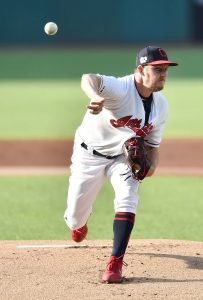
On the other hand, Indians righty Trevor Bauer may aid in a playoff berth for his team yet again in 2019. Nevertheless, Ken Rosenthal of The Athletic reported Monday that the Indians are “aggressive listeners” on Bauer as the July 31 trade deadline approaches. There’s wide-ranging interest in Bauer, according to Joel Sherman of the New York Post.
Cleveland, which happens to be hosting Tuesday’s All-Star Game, went on a tear to end the season’s first half. Winners of six straight, the Indians are 50-38 – good for the majors’ seventh-highest winning percentage (.568) – and have suddenly made the AL Central race intriguing. For a large portion of the first half, it looked as if the Twins would skate to a division title. Now, though, the Indians sit a manageable 5 1/2 games behind them. The Tribe’s also 1 1/2 games up on the AL’s second wild-card spot and a half-game behind the Rays for the league’s No. 5 seed.
An appreciable amount of the Indians’ success can be attributed to the 28-year-old Bauer, which would make trading him in the next three weeks all the more surprising. No, Bauer hasn’t been the ace-caliber performer he was a year ago. Still, though, Bauer has recorded a 3.61 ERA (granted, with a less inspiring 4.10 FIP) and 10.16 K/9 against 3.48 BB/9 over a major league-leading 132 innings.
It’s hard to believe the Indians would be able to trade Bauer and better themselves for this year, especially in light of the other concerns in their rotation. The Tribe’s starting staff looked like one of the league’s best entering the season. Since then, however, Corey Kluber has struggled and missed a vast amount of the campaign because of a fractured forearm. Mike Clevinger has made just five starts, over which he has been a mixed bag, because of a back injury. Worst of all, the team’s still reeling from the awful news that the excellent Carlos Carrasco, who hasn’t pitched since May 30, is battling leukemia.
The absences of Kluber and Carrasco have left Bauer, Clevinger and stellar young righty Shane Bieber as the lone truly dependable members of the Indians’ rotation. Fill-in Jefry Rodriguez has been on the injured list since June 1 with a strained shoulder, and rookie Zach Plesac has fallen off of late. Meantime, Adam Plutko has posted a below-average ERA (4.95) through 36 1/3 innings, and that outdoes even less shiny peripherals.
All of that said, Cleveland’s in an unenviable position with Bauer, whom it will probably lose soon even if it keeps him through the season. Bauer’s making a somewhat expensive $13MM and only controllable through 2020. If we’re to take his word for it, the offbeat Bauer will be trying to max out on one-year contracts every winter in free agency after that. Therefore, if the Indians weren’t in contention, now would clearly be the time for the Indians to flip Bauer. But the back-to-back-to-back AL Central champions are very much in the hunt right now, which could set the stage for an agonizing Bauer decision this month. What do you think they should do?
(Poll link for app users)
What should the Indians do with Trevor Bauer this month?
-
Listen to offers, but only deal him for a huge return 50% (3,913)
-
Trade him for the best offer 35% (2,766)
-
Keep him and try to win it all 15% (1,201)
Total votes: 7,880
Photo courtesy of USA Today Sports Images.
Orioles’ Josh Lucas Accepts Outright Assignment
Orioles righty Josh Lucas cleared waivers and has accepted an outright assignment to Triple-A Norfolk, per a team announcement. He was designated for assignment when Baltimore claimed former A’s righty Aaron Brooks off waivers. Brooks has now been formally added to Baltimore’s big league roster, the team also announced.
It’s the second time that Lucas, 28, has accepted an outright assignment with the Orioles this season rather than head out into free agency. In two stints with the big league club, Lucas has pitched to a 5.74 ERA. To his credit, Lucas has 16 strikeouts in 15 2/3 innings and has continually shown an ability to keep the ball on the ground at an above-average clip. He’s not a hard thrower, averaging 90-91 mph on his heater, but he’s nevertheless managed to be fairly stingy in terms of surrendering home runs throughout his minor league career.
In 114 career innings of Triple-A ball, Lucas has a 3.47 ERA with 8.7 K/9, 2.6 BB/9 and 0.5 HR/9. Given the patchwork state of the Orioles’ roster, it seems quite possible that another opportunity in the Majors could present itself later in the year (which undoubtedly factored into Lucas’ decision to accept the assignment).
Sabathia Interested In Front Office Role With Yankees Following Retirement
CC Sabathia has already made clear that the 2019 campaign will be his final season as a Major Leaguer, but the likely Hall of Famer isn’t ready to step away from baseball entirely. In chatting with reporters today (Twitter links via Newsday’s Erik Boland and NJ.com’s Brendan Kuty), Sabathia revealed that he hopes to land a front office position with the Yankees after his playing days are complete.
“I definitely want to be around the Yankees for years to come,” said Sabathia. Kuty notes that Sabathia has been in general manager Brian Cashman’s ear about a potential special assistant role.
Sabathia would hardly be the only retired big leaguer to take such a position in a team’s front office. Within the past year and a half, the Yankees themselves have hired Carlos Beltran (link) and Andy Pettitte (link) as special advisors to the baseball operations department, for instance. Such roles are often fairly nebulous — at least so far as in duties that are specified to the public — and they typically aren’t full-time commitments. But it’s common for former players in such roles to serve as an instructor for the team and its minor leaguers during Spring Training, visit minor league affiliates throughout the season and in some instances weigh in on roster and/or player development matters.
The 38-year-old Sabathia’s final season has been a solid effort — one that has seen the big lefty cross some notable milestones along the way. In addition to tossing 76 2/3 innings of 4.03 ERA ball with 8.4 K/9 and 3.3 BB/9, Sabathia has collected his 250th Major League victory, recorded his 3,000th career strikeout and surpassed the 3500-inning mark at the MLB level.
AL Central Notes: Indians, Abreu, Allen
The Indians never so much as made a contract offer to Michael Brantley before he inked a two-year, $32MM deal in Houston this offseason, USA Today’s Bob Nightengale reports within a broader look at the club’s struggles to retain top stars. Nightengale interviews both Brantley and CC Sabathia about their emotional departures from Cleveland as part of a piece that wonders whether Francisco Lindor‘s eventual exit is anything less than a foregone conclusion. For his part, Lindor calls Cleveland “home” and adds that he hopes to stay before more vaguely stating: “When that time comes, we’ll decide.” Lindor’s long-term future has been particularly in question since Indians owner Paul Dolan ominously told fans to “enjoy him” while the team has him under control.
Indians fans will want to give the column a read not only for talk of Lindor’s future but also some heartfelt reminiscing from both Sabathia — “I cried like a baby when I was traded” — and Brantley. Both players offer nothing but fond memories of the city, the organization and the fanbase.
More from the division…
- Jose Abreu‘s contractual status with the White Sox has been an ongoing story throughout Chicago’s rebuild. While he’s long been a logical on-paper trade chip, Sox brass has maintained that the first baseman’s clubhouse presence and leadership is virtually indispensable; both sides have openly stated a desire to continue the relationship beyond his current contract, but no deal has come to pass. Now, with Abreu months from free agency, GM Rick Hahn touched on the subject again — discussing the delicate balance of cold, hard statistical value and less quantifiable intangible means of value. “That’s the more, unfortunately, clinical side of things is, ‘OK, a right-handed hitting first baseman who’s produced at this level over the last few years at this age, what do you project going forward and what’s the value of that?'” Hahn asked rhetorically in an interview with The Athletic’s James Fegan. “It’s sort of that more touchy-feely, emotional side of things in terms of knowing the value that he has in this clubhouse and the leadership skills, the softer benefits that he brings to the club, that affects your valuation of a guy like that.”
- Since signing a minor league deal with the Twins, right-hander Cody Allen has pitched four shutout innings in Class-A Advanced Fort Myers, allowing three hits and no walks while striking out four hitters. La Velle E. Neal III of the Minneapolis Star Tribune writes that Allen has made some mechanical adjustments to use his core and legs more effectively, and the Twins will move him to Triple-A Rochester shortly after the All-Star break. Allen’s stock tumbled in 2018 and cratered earlier this season when he was released by the Angels, but he’s a known commodity for Twins chief baseball officer Derek Falvey, who was in the Cleveland front office for most of Allen’s peak with the Indians. Whether he can return to form following his latest change of scenery is anyone’s guess, but Allen is a nice flier to have in the upper minors as Falvey and general manager Thad Levine peruse the trade market for bullpen reinforcements.