
Pirates Designate Willy Garcia For Assignment
The Pirates have designated outfielder Willy Garcia for assignment, Bill Brink of the Pittsburgh Post-Gazette reports (Twitter link). The move creates roster space for the newly re-signed Ivan Nova.
Garcia, who turned 24 in September, has been rated by Baseball America in each of the last two years as the 12th-best prospect in the Pirates’ system. His star may have dimmed, however, following a rough 2016 season that saw Garcia hit only .245/.293/.366 with six homers over 499 plate appearances at Triple-A Indianapolis. Garcia struck out 131 times (against 31 walks), continuing his career-long issues with plate discipline. This problem has offset his other talents, as the 2016 Baseball America Prospect Handbook credits Garcia with strong raw power, above-average baserunning ability and an outstanding throwing arm.
Garcia joins another Pirate (Jason Rogers) as one of six players around the league currently awaiting their next assignment, according to the MLB Trade Rumors DFA Tracker.
Extension Candidate: Carlos Martinez
We know that the Cardinals are interested in exploring an extension with righty Carlos Martinez, though there’s no news of progress (or even earnest engagement) to this point. But new contracts are often sorted out during the spring, and the sides will need to discuss money one way or another since Martinez is entering his first season of arbitration eligibility.
Only 100 days past his 25th birthday, Martinez is young enough to believe he has plenty of good years ahead of him. He’s also among the game’s hardest-throwing starters. Though his average fastball velocity took a slight step back in 2015, it bounced back to a robust 96.5 mph in his most recent campaign. And the results have followed, as Martinez posted a combined 3.02 ERA over the last two seasons. That combination of age, the liveliness of his arm, and results make the Octagon client an appealing candidate for an investment for a St. Louis club that has faced a few questions in its still-talented rotation of late.
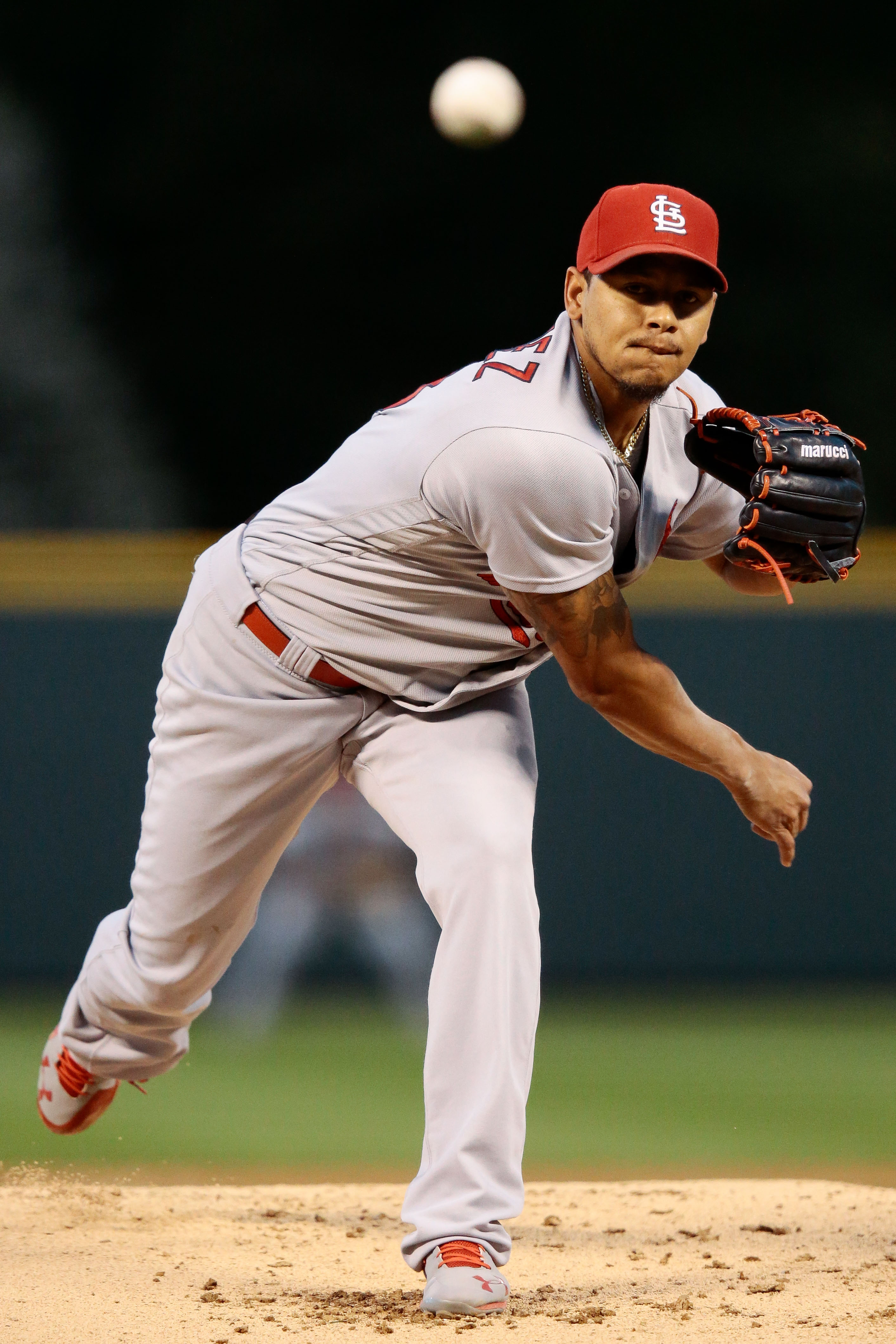
Of course, the arbitration process provides an important starting point for weighing Martinez’s value. MLBTR and contributor Matt Swartz project him to earn $5.3MM in his first season of eligibility, a rather lofty sum for a first-year-eligible starting pitcher. (Dallas Keuchel set a new record last year with a $7.25MM deal, blowing away the long-standing $4.35MM record held by Dontrelle Willis and David Price.) If Martinez continues his current trajectory, he could follow Price in landing some truly significant arb salaries, though unlike the talented lefty, he won’t be able to build off of a Super Two campaign.
For Martinez to max out his earning capacity, though, he’ll need to extend his outings. He topped 180 innings for the first time in 2016, ending up with 195 1/3 frames on the ledger. Durability will be a key consideration for the Cards. Though there haven’t been any significant health concerns to date, Martinez’s combination of youth and propensity for relying on hard pitches gave him a somewhat elevated Tommy John risk profile in the study completed earlier this year by MLBTR contributor Bradley Woodrum (see here for an explanation; here for individual player results).
All told, there’s plenty of reason for confidence in Martinez’s outlook. Increased confidence and usage rates in his changeup — the only one of his four pitches that didn’t score as a top-level offering in 2016 — has allowed him to make strides against lefties, who battered him in 2014. Though he still surrendered a .256/.342/.387 batting line to opposing southpaws in 2016, that’s enough to make him a high-quality starter when combined with his dominating work against right-handed batters (who hit just .204/.270/.269).
Though he lost over one strikeout per nine as against his prior season’s results in 2016, and his swinging-strike rate dwindled a bit to 9.4%, Martinez posted a career-best 56.4% groundball rate. He also worked in the zone more than he had in the preceding two years, though his walk rate has remained relatively consistent. Martinez continues to be tough to take deep — he has allowed 0.6 dingers per nine for his career — and has given up hard contact on less than three of ten balls put in play against him in every one of his seasons in the majors.
So, assuming that St. Louis is prepared to do what’s reasonably necessary to make a deal, what kind of contract might we be looking at? It has been quite some time since we saw a reasonably comparable pitcher in the 3+ service class strike a long-term deal. Johnny Cueto got $27MM over four guaranteed seasons while giving up one option year, but that was way back in 2011, and his platform wasn’t as impressive. Before that, Ervin Santana earned $30MM in a similarly situated deal.
Those numbers seem well shy of what Martinez can command in a market where top-end starters have earned increasingly significant sums. Indeed, the Cards recently reached an arb-only deal with fellow righty Lance Lynn, who took a similarly compelling case into his first year of arbitration eligibility ($5.5MM projection), that priced his arb years at $22MM. For Martinez to give up any free-agent seasons, particularly by way of option, St. Louis will need to up the ante.
Expanding the search a bit, there are some other contracts worth considering. Corey Kluber landed $38.5MM over five years, with two options attached, on the cusp of his age-29 season. He was coming off of a Cy Young campaign, and would have qualified for Super Two status after the season in which he signed his deal (which came in early April of 2015). The contract valued Kluber’s bought-out free-agent years at $13MM and between $13MM and $17MM (depending upon escalators). Before that, Chris Sale took down a $32.5MM guarantee on an identical structure. Sale was just 23 years old at the time, and already pitching like an ace; his contract could well represent the tail end of an old model rather than a truly relevant mark going forward. Looking at 4+ service deals, and excepting ace-level performers (Justin Verlander and Felix Hernandez), Matt Harrison owns the high bar in recent contracts at five years and $55MM (plus an option). He was 27 years of age at the time that deal was struck.
In Martinez’s case, a five-year arrangement (including the 2017 season) would put him under contract for two would-be free-agent years and take him through at least his age-29 campaign, with options perhaps extending the Cards’ control into his early thirties. Taking Lynn’s $22MM and adding another $25MM or so to cover two free agent years — with Martinez’s age roughly balancing off Kluber’s advantage in quality in pricing those seasons — would put the total guaranteed value to roughly the midpoint between Kluber’s and Harrison’s contract. Arguing for a guarantee that reaches or exceeds Kluber’s could represent a sticking point in and of itself. On the other hand, the Cards have perhaps been more willing to spend big in extensions than have the budget-minded Indians, while Kluber’s meteoric rise at a relatively advanced age made him a unique case. Plus, Martinez can reasonably argue that his age-28 and 29 seasons can be expected to earn him much greater sums than even the numbers just noted; relatively youthful free-agent starters such as Jordan Zimmermann have commanded over $20MM annually.
That’s all just a spitball range, of course, and it’s certainly plausible to imagine any number of creative scenarios, including escalators, opt-outs, and options that could play a significant role in determining the final value. Regardless, it’s somewhat uncharted territory; the sides figure to have plenty to talk about over the coming months.
Photo courtesy of USA Today Sports Images.
3 Remaining Needs: National League West
With the new year on its way, we’re actually just six weeks or so away from the opening of Spring Training. But there’s plenty of work yet to do on the transactional side. A variety of interesting and useful free agents remain unsigned, and there are certainly some trade scenarios left to explore. Many teams have addressed needs; some, perhaps, have all but completed their offseason work. But there’s always room for improvement, and a few organizations still have significant holes to fill.
To set the stage for the remainder of the offseason, we’ll take a look at the most pressing remaining needs of every team in baseball over the coming week or so, division by division. (Hat tip to MLBTR commenter mike156 for the idea.) We often discuss things through the lens of an organization’s trajectory; thus, a rebuilding team might “need” to move some salary, while a contender might “need” an expensive starter. But with camp in sight, every club is making final calls on who’ll compete for big league jobs in the season to come (while also pursuing broader opportunities), so the focus here is on specific positions on the MLB roster. Fortunately, the task of roster analysis is made much easier by the MLB depth charts available at RosterResource.com. Each team listed below is linked to its respective depth chart, so you can take a look for yourself.
First up: the National League West. We’ll start with the reigning division champs and go in order of how these teams lined up last year. I identified three needs for each team in this particular division, though they certainly vary in importance, and future iterations could have longer or shorter lists:
- Second Base: Andrew Friedman and co. aren’t afraid to get creative, and don’t feel compelled to add big names. But the projected second base mix — which might include Enrique Hernandez, Chris Taylor, Austin Barnes, Micah Johnson, and Charlie Culberson — doesn’t appear to hold all that much promise. Los Angeles is rumored to be pursuing a solution, with particularly intense discussion surrounding Brian Dozier of the Twins, so the expectation remains that an outside addition will be made.
- Left Field: The in-house options are certainly more robust in the corner outfield, but that remains an area that the Dodgers could look to improve — particularly, if the team can find a true difference-maker (all the better if he hits from the right side). If Yasiel Puig remains as a semi-regular option in right, that would leave the other corner spot open to a variety of platoon scenarios, potentially involving Trayce Thompson, Scott Van Slyke, Darin Ruf, or even Hernandez or Culberson from the right side, and Andre Ethier and Andrew Toles from the left. Options? Sure, plenty. But adding an established piece to handle the bulk of the load might not only boost the lineup, but also permit L.A. to carry another of its much-loved flex players.
- Right-Handed Reliever: This isn’t a pressing need, exactly, but we’ve heard plenty of chatter about possible righty pen pieces — Joe Blanton, especially. Pedro Baez and Chris Hatcher currently rate as the top two right-handed set-up options in front of closer Kenley Jansen, so adding to that group makes quite a bit of sense.
- Third Base: San Francisco gave up a fairly significant piece to obtain Eduardo Nunez at the trade deadline last year, while shipping Matt Duffy in the trade that brought back Matt Moore. That reshuffling left Nunez as the presumptive man at the hot corner, with postseason hero Conor Gillaspie providing a platoon mate. But it’s certainly fair to argue that the organization could reap significant rewards by adding a bigger bat to play third, bumping Nunez into a super-utility role in which he could provide plenty of value.
- Left Field: Like the Dodgers, the Giants certainly have internal possibilities to fill the void in left. If a third baseman is ultimately added, that might free Nunez to spend some time there, too. (Then again … just read this.) As things stand, the position will likely be manned by a combination of unproven (albeit fairly well-regarded) players: Jarrett Parker and Mac Williamson. And Gorkys Hernandez remains available as a reserve, too, though he’ll likely supplement Denard Span in center. There are a few familiar names on hand as minor-league free agents, but in the aggregate, there’s a lot of uncertainty.
- Right-Handed Reliever: The Giants’ pen has a lot of quality arms, despite the struggles in the ninth inning in 2016, and adding Mark Melancon as the closer largely closes the books in terms of needs there. But it never hurts to build depth and create competition, and the Giants could conceivably push pitchers such as Cory Gearrin and George Kontos by adding one or two alternatives.
- First Base: While Ian Desmond is apparently penciled in at first base, it still seems to make all the sense in the world to add another player there while utilizing Desmond in the outfield. Read here for more on that situation.
- Right-Handed Reliever: While the Rox are fairly heavily invested in a variety of relievers, the pen remains questionable. That’s most apparent in the team’s lack of right-handed setup options in front of presumptive closer Adam Ottavino. Currently, Jason Motte and Chad Qualls are the only two righties who seem clearly in line for such a role, with players like Jordan Lyles, Carlos Estevez, and Miguel Castro among the other options. Given the team’s investment in Desmond, excellent position-player core, and relatively promising crop of starters, now may be the time to spend a little extra to complete the bullpen.
- Starting Pitcher: “You can never have too much pitching.” Corollary: especially if you are the Rockies. Colorado likely feels comfortable with at least four of its rotation spots, but bringing in some depth and generating camp competition seems like a worthwhile course given the history of attrition in Coors Field. Investing a bit to fill some innings while reducing pressure on the team’s younger arms could go a long way towards making the Rockies a contender — and even enhancing their mid-term outlook.
- Left-Handed Reliever: The top two southpaw options in the Arizona pen, presently, are Andrew Chafin and Steve Hathaway. While the former has a fair bit of MLB experience, he was hit hard in the majors last year. And while the latter earned his way to the bigs with a solid minor-league season, and did log 9.2 K/9 over his 14 2/3 MLB frames, he also coughed up eight earned runs in that brief debut. Bottom line: depth, at a minimum, would be desirable. The D-Backs have already shown a willingness to draw a player by offering a role, when they signed Fernando Rodney to step in as the closer, and that approach may pay dividends here as well (even if it means waiting to see what players shake loose during camp).
- Right-Handed Reliever: While the need isn’t quite as pronounced, perhaps, the right-handed side of the relief corps could also stand to be buttressed. Randall Delgado is a reliable provider of innings, but hasn’t consistently delivered results. Jake Barrett, Enrique Burgos, Silvino Bracho, and Evan Marshall are each intriguing to varying degrees, but still come with uncertainty. With plenty of veteran righties still out there, it’s a fairly easy call to keep pursuing depth.
- Bench Bat: Much of the position-player side of the roster is accounted for, but the D-Backs could stand to add some pop — or, perhaps, just a useful all-around player who can play multiple roles — to their bench. Yasmany Tomas (defense) and David Peralta (health) come with big questions; other 40-man pieces such as Jeremy Hazelbaker, Ketel Marte, and Socrates Brito have yet to prove they’re capable major leaguers; and additional potential options on hand (lefties Oswaldo Arcia and Zach Borenstein) are equally uncertain. It’s not a pressing need, perhaps, but with a market still loaded with power bats, an interesting opportunity could present itself.
- Starting Pitcher: True, the Friars already signed Jhoulys Chacin and Clayton Richard. But those two hurlers are arguably their current top starters, which isn’t optimal. There’s a reason, after all, that they were available on such modest contracts. While Luis Perdomo showed quite a bit of promise last year as a Rule 5 pick, it’s perhaps preferable to at least create a situation where he doesn’t have to work at the major league level. And the other potential rotation pieces on the 40-man — Christian Friedrich, Paul Clemens, Cesar Vargas, Zach Lee, and Walker Lockett — are hardly proven commodities. San Diego has been tied to a variety of veteran free agents, including Jake Peavy and Jered Weaver, and could also look into the trade market if an opportunity arises.
- Shortstop: Luis Sardinas may still be deserving of a shot, but he hasn’t done anything to date to show he’s capable of being an everyday option at short. The other options are wanting, too: while prospect Carlos Asuaje hit well last year at Triple-A, he hasn’t played short since 2014; Jose Rondon reached the majors at just 22 years of age, but didn’t exactly master the upper minors with the bat; 21-year-old Javier Guerra struggled last year at High-A; Jose Pirela was non-tendered and re-signed to a minor-league deal after a poor showing in 2016; and Rule 5 selection Allen Cordoba is as speculative as they come, given that he hasn’t played above the Rookie ball level.
- Closer: It isn’t strictly necessary for the Pads to add a closer, as they could utilize Brandon Maurer in that role and could welcome Carter Capps back to action at some point in 2016. But there’s little reason not to explore a market that includes several former 9th-inning men who might like a crack at another stint. Pursuing that route in 2016 with Rodney paid dividends when he was flipped over the summer, and the cost of a signing could be recouped by avoiding larger arbitration raises to existing players.
Free Agent Faceoff: Boone Logan vs. Jerry Blevins
It has been a good year to be a left-handed reliever on the free-agent market — even if your name isn’t Aroldis Chapman and you don’t work routinely in the triple digits with your fastball. Brett Cecil and the Cardinals kicked things off with a four-year, $30.5MM pact that even includes no-trade protection. Power southpaw Mike Dunn scored three years and $19MM from the Rockies. And even true LOOGY Marc Rzepczynski scored $11MM over two seasons in his contract with the Mariners.
Those big deals suggest that there was plenty of competition in the market, which perhaps bodes well for the best remaining southpaw arms. Two, in particular stand out: Boone Logan, who played most recently with the Rockies, and Jerry Blevins, formerly of the Mets. You could throw Travis Wood into this mix, too, but he may have a somewhat different (if perhaps overlapping) market, since he’s capable of working as a starter. J.P. Howell has also been a quality reliever in recent years, but the soft-tossing southpaw declined last year in run prevention, velocity, and swinging-strike rate, so we’ll leave him out of the mix for this particular look at the relief market.
Focusing on Logan and Blevins, a variety of organizations could still be willing to cough up significant guarantees. In the A.L. East, the Orioles are deeper in the right-handed department (other than closer Zach Britton); the Yankees’ top southpaw after Chapman, Tommy Layne, isn’t exactly a late-inning monster; the Blue Jays are thin with Cecil departing (they project to feature Aaron Loup); and even the Red Sox could conceivably enter the picture (though they may feel set with Robbie Ross and Fernando Abad). The West, too, has conceivable suitors: the Astros entered the winter looking for a southpaw to pair with Tony Sipp, the Angels’ top southpaw is the solid but somewhat unexciting Jose Alvarez, and the A’s have made surprising pen investments in the past and would carry Daniel Coulombe as their LOOGY if Sean Doolittle is utilized as a closer (or is traded).
Over in the National League, the N.L. East-rival Nationals and Mets could both stand to add late-inning lefties, and the Marlins could as well. Miami has already spent heavily on its pen, and seemingly feels it’s complete, but doesn’t have a high-end lefty after losing Dunn. And the Cubs could stand to buttress their mix after adding swingman Brian Duensing on a modest contract — assuming, at least, that Mike Montgomery isn’t bumped from the rotation by some trade.
Apart from the fairly robust remaining need, there’s every reason to believe that both Logan (32) and Blevins (33) have set themselves up for nice contracts. Indeed, they turned in rather similar, rather productive seasons in 2016. Logan finally converted his steadily excellent swinging-strike rate into results, as he posted a 3.69 ERA (while spending half his time at Coors Field) on the back of 11.1 K/9 and 3.9 BB/9 along with a 49.5% groundball rate. And Blevins allowed just 2.79 earned per nine. He also posted 11.1 K/9 while allowing 3.2 free passes per nine innings and generating grounders on 45.8% of the balls put in play against him.
Logan worked with an average 93.0 mph fastball but utilized his slider on over half of his deliveries to the plate. That mix enabled him post a personal-best 16.4% swinging-strike rate, which tied him with Andrew Miller for the third-highest mark among southpaws who threw at least thirty innings (trailing only Chapman and Britton).
Though he’s less of a power pitcher, and doesn’t get quite as many swings and misses, Blevins’ actually squeezed out a few more strikeouts than did Logan in their most recent seasons. Blevins continued to rely heavily on a cut fastball, his usage of which jumped when he went to the Mets in 2015, and that may have helped him limit the damage when pitching without the platoon advantage.
Indeed, Blevins holds the advantage over Logan when facing right-handed hitters. Though his strikeout, walk, and home run numbers weren’t nearly as good as when he did have the platoon advantage, Blevins limited righties to a .172/.266/.345 batting line last year. And he has generally been at least serviceable against them over his career. Logan, on the other hand, shows much more pronounced splits. Opposing righties have posted a big .288/.376/.478 slash against him in 847 total opportunities across his 11 MLB campaigns.
Looking at the bigger picture, neither pitcher really stands out. Logan missed some time in 2014 after undergoing surgery for bone chips following the 2013 season, but has generally been reasonably healthy. And Blevins did miss much of 2015 after consecutive forearm fractures, though both were freak instances. Each pitcher has had up years and down years, but their overall arcs aren’t altogether dissimilar. Over their careers, some metrics prefer one to the other (Blevins’s 3.58 FIP tops Logan’s 4.03 mark; Logan’s 3.78 xFIP is better than Blevins’s 3.92 rate).
So, it seems like a close call. If you were looking to add a useful southpaw arm to your bullpen, which of these two free agents would you prefer?
Which Free-Agent Lefty Do You Prefer?
-
Jerry Blevins 53% (2,949)
-
Boone Logan 47% (2,639)
Total votes: 5,588
Minor MLB Transactions: 12/30/16
We’ll keep tabs on the day’s minor moves here:
- Lefty Nick Greenwood has agreed to re-sign with the Twins on a minor-league arrangement, MLBTR has learned. The 29-year-old control artist has 36 MLB frames under his belt. He has allowed 21 earned runs on 38 hits and six home runs in that stretch, with just 17 strikeouts, but he also issued only five walks. Greenwood had spent his entire career with the Cardinals organization before 2016, when he hooked on with Minnesota on a minors pact after a brief indy ball stint. He showed well, especially over his 79 1/3 innings at the Triple-A level (where he worked to a 2.84 ERA with 4.7 K/9 and 1.2 BB/9), but never got the call back to the bigs. Greenwood will hope to repeat that solid work and perhaps earn another shot at the majors in 2017.
Poll: Boston’s Catcher Of The Future
Red Sox catcher Blake Swihart “has been told there will be no more experimenting with other positions” in 2017, writes WEEI’s Rob Bradford. His outfield experiment is seemingly over, meaning he’ll return to his original position of catcher and remain there exclusively for the foreseeable future.
Swihart, 25 in April, has long rated as one of the game’s best all-around prospects. However, questions surrounding his defensive prowess (and the presence of many other catchers on the Boston roster) led the Sox to try Swihart in left field last year. However, the experiment proved to be an ill-fated one, as Swihart suffered a severe ankle injury shortly into his first exposure to outfield work and wound up undergoing season-ending surgery to repair the matter.
That injury made the 2016 campaign an abbreviated and disappointing one for Swihart, who finished the year with a lackluster .258/.365/.355 batting line in just 79 Major League plate appearances to go along with a .243/.344/.311 slash in 122 PAs with Triple-A Pawtucket. Despite those offensive struggles and some apparent questions about his defensive capabilities, though, the Red Sox don’t appear to have soured on Swihart. On the contrary, Nick Piecoro of the Arizona Republic reported again this week that the Diamondbacks inquired with Boston on both Swihart and Christian Vazquez and found president of baseball operations Dave Dombrowski reluctant to deal either young backstop. That leaves the Red Sox with three catching options in 2017 and well beyond, creating for a somewhat uncertain outlook.
As Bradford writes, Sandy Leon will be given the first crack at regular playing time in 2017 as he looks to show that his 2016 breakout is sustainable. Leon finished the season with a sensational .310/.369/.476 batting line in 283 plate appearances, but his bat wilted in the season’s final month. In addition to that, Leon’s .392 average on balls in play appears entirely unsustainable, especially for a player that has such limited speed. Leon batted an incredible .366 on grounders putting him on par with burners like Billy Hamilton and Trea Turner. Meanwhile, the league as a whole batted just .239 on grounders, and one can reasonably expect a player with Leon’s lack of speed to check in below the mean over a larger sample of at-bats.
Nonetheless, Leon thwarted a stellar 41 percent of attempted stolen bases last season, and while he rated as a somewhat below-average pitch framer, per Baseball Prospectus, he has a strong track record in that regard when looking at his minor league career as a whole. At the very least, he could be a sound defensive option that hits from both sides of the plate, and he’s controllable through 2020. Certainly, there’s value in Leon, the question for Dombrowski & Co. is simply how much of his seemingly out-of-the-blue offensive gains in 2016 are sustainable.
Swihart figures to battle with Vazquez to see who will back up Leon to open the season, but if Leon sputters then either of the two promising young understudies could eventually find himself in a more prominent role with the Sox in 2017. Swihart does have a minor league option remaining, so he can be sent down without being exposed to waivers if the Sox wish to get him some more work both behind and at the plate in the wake of his truncated 2016 campaign.
As recently as the 2014-15 offseason, Swihart rated as the game’s No. 17 overall prospect, per Baseball America, who praised him as a potential two-way force behind the dish. Swihart didn’t begin switch-hitting or catching until he was about halfway through high school, and BA’s scouting report noted that the lack of lifetime experience in both regards always created the potential for some growing pains as he got to the upper levels of the minors and into the Major Leagues. “There’s a chance that his aggressive tendencies will be exploited by advanced pitching, which could result in a challenging transition to the big leagues after a lengthy apprenticeship in Pawtucket in 2015,” BA wrote at the time. But Swihart’s overall package of tools and athleticism undoubtedly remain appealing to both the Red Sox and to other organizations. It’s understandable, then, that Dombrowski and his staff aren’t exactly keen on trading him at all, let alone when his value is at a low point.
Vazquez, meanwhile, never generated the same level of prospect fanfare that Swihart did. However, he’s long been touted as one of the best defensive catchers in all of Minor League Baseball, and his superlative glovework gives him a high floor. He’s thrown out 44 percent of attempted base thieves at the Major League level and a similarly impressive 38 percent caught-stealing rate over the life of his minor league career. Vazquez has drawn consistently excellent framing marks throughout his minor league career and is a .273/.339/.379 hitter in 109 Triple-A games. He missed the 2015 season due to Tommy John surgery, but the procedure didn’t seem to have an adverse affect on his throwing in 2016, as he caught 19 of 47 runners between the Majors and Triple-A (40.4 percent).
BA’s most recent scouting report on Vazquez cites “sneaky” pop that could yield an annual home-run total in the low double digits, and he did hit 18 homers at Class-A back in 2011, though that’s the lone pro season in which he’s demonstrated significant power, and it’s quite a ways in the rear-view mirror at this point. Still, given his defensive ceiling, Vazquez doesn’t need to be a star at the plate to be a starter in the Majors.
To somewhat crudely sum things up, Leon has had the most success in the Majors, while Swihart has the highest offensive ceiling of the bunch and Vazquez has the best defensive skill-set. The Red Sox will devote countless hours of evaluation to answering this question (and likely have already been doing so for the past year), but let’s see what MLBTR readership thinks on the matter (link to poll for Trade Rumors app users)…
Who represents the best long-term catching option for the Red Sox?
-
Blake Swihart 50% (6,188)
-
Christian Vazquez 35% (4,317)
-
Sandy Leon 15% (1,874)
Total votes: 12,379
Twins Reportedly Asking Teams For Final Offers On Brian Dozier
Brian Dozier‘s name has been a focal point of the rumor mill for the better part of a month, but his prolonged saga may be drawing to a close, as La Velle E. Neal III of the Minneapolis Star Tribune reports that the Twins have asked interested teams to make their best offers for Dozier in the coming days. According to Neal, Minnesota doesn’t want the scenario to drag on too much longer and will prepare to open the 2017 season with Dozier as the second baseman if no palatable offer surfaces.
Neal suggests that the sticking point between the Twins and the Dodgers, who have long been the clear primary suitor for Dozier, has been that Los Angeles is seeking a straight up, one-for-one swap of Dozier and top pitching prospect Jose De Leon. The Twins, meanwhile, have understandably been insistent on the inclusion of at least one more well-regarded prospect. The Dodgers “haven’t blinked,” however, according to Neal. That lines up with this week’s report from FanRag’s Jon Heyman that the Dodgers aren’t willing to include any of Cody Bellinger, Yadier Alvarez or Walker Buehler alongside De Leon in a trade to acquire Dozier.
Other teams to express interest in Dozier at some point this winter include the Giants, Cardinals, Nationals and Braves, per Neal. However, there’s been very little chatter surrounding the Giants’ interest in recent weeks, while reports out of St. Louis and out of D.C. have suggested that interest from those teams may be somewhat overstated. ESPN’s Mark Saxon reported earlier this week that while the Cardinals may have some interest, they’re not actively pursuing Dozier. More recently, he tweeted that the Cardinals’ reported interest was part of the Twins’ effort “to extract max value from the Dodgers.” Meanwhile, Chelsea Janes from the Washington Post reported this week that any inquiries made on the Nationals’ behalf haven’t been serious in nature.
Atlanta hasn’t been mentioned too often as a potential landing spot for Dozier, though there’s certainly a reasonable fit there. Jace Peterson projects as the everyday second baseman at the moment, but Dozier’s bat would represent a marked upgrade. Adding Dozier would run somewhat counter to many of the Braves’ recent maneuverings on the trade market, which have generally taken a more long-term focus, though Atlanta did send three mid-level prospects to the Cardinals to acquire Jaime Garcia. Of course, Dozier would require top-tier young talent, and there’s been no indication that the Braves are willing to deal that type of talent for shorter-term gains.
While it’s certainly possible that one of these teams steps up and makes an offer to rival the Dodgers, or that another surprise suitor emerges from the woodwork, it seems that the likeliest scenario for a Dozier trade would simply be for the Twins and Dodgers to find a common ground. Neal notes that if the Twins were going to pull the trigger on a one-for-one swap, Dozier would’ve been dealt by now, which indicates that a trade would probably require L.A. to improve its current offer.
Considering the fact that Dozier is controlled for another two seasons at a total of $15MM, the Twins don’t need to simply take the best offer that someone puts on the table. While many point to Dozier’s prodigious second half in 2016, he’s somewhat quietly been a very good player for Minnesota over the past four seasons, averaging 4.1 fWAR and 4.5 rWAR per year in that time. The Twins could well hold onto Dozier until the trade deadline, when a larger market for his services — due to injuries to and/or underperformance from second basemen around the league –could emerge. Of course, in doing so, they run the risk that Dozier has another poor start to the season, as he did in 2016, or that he incurs an injury himself.
D-backs Notes: Wieters, Swihart, Vazquez, O’Brien Trade, Relievers
The latest column from the Arizona Republic’s Nick Piecoro is packed with quotes from GM Mike Hazen and info pertaining to the team’s offseason plans and 2017 outlook, with a heavy focus on the catching situation. Some highlights from the column, which I’d recommend checking out in its entirety…
- The D-backs have already non-tendered Welington Castillo, signed Jeff Mathis and claimed Juan Graterol off waivers this winter, but Hazen tells Piecoro they’re still keeping an eye on the catching market, including Matt Wieters. “Matt’s a really good player and a good leader,” said Hazen. “We’ve kept up on everybody on the catching market.” Per Hazen, the likely course of action for the D-backs is to add a third catcher-capable player to partner with Mathis and Chris Herrmann in a “three-way system,” but that does not appear set in stone. “If we found more of a long-term replacement for the position, it could morph into something different,” said Hazen, though he did note that a long-term option is likelier to surface on the trade market than in free agency.
- To that end, Piecoro again reports that the D-backs spoke to the Red Sox about catchers Blake Swihart and Christian Vazquez. However, he also reports that Boston is considered “unlikely” to move either young backstop. It’s not surprising to see a new-look D-backs front office that contains former Red Sox execs Hazen, Amiel Sawdaye and Jared Porter all show interest in two of their former top prospects — especially when the Diamondbacks lack a clear long-term option behind the plate. Piecoro has already reported on Arizona’s interest in Swihart and Vazquez once earlier this winter, and it doesn’t seem like anything has changed since that time. Vazquez, a defensive standout with a perhaps questionable bat, is controlled through the 2020 season. Swihart carries a much higher offensive upside but isn’t as proficient as Vazquez with the glove. He’s controlled through 2021.
- Hazen also tells Piecoro that catcher-turned-outfielder Peter O’Brien, whom the club recently designated for assignment, has drawn trade interest from both American League and National League teams. Hazen cited a need “to improve our defensive versatility and flexibility” as the driving factor behind removing O’Brien from the 40-man roster. The 26-year-old O’Brien has in the past posted impressive power numbers in the minors, but he’s never hit in the Majors and is also strikeout prone (32 strikeouts in 79 MLB plate appearances). Beyond that, scouts have long suggested that he’s a man without a position on the diamond, and the old front office regime had already moved him off his original position of catcher. Nonetheless, O’Brien has 50 homers across his past two Triple-A seasons plus another six big flies in the Majors in that time (albeit all in hitter-friendly settings).
- The D-backs are still on the hunt for another bullpen arm but would like to keep the commitment to one year, Piecoro writes. Hazen explained to Piecoro that there are enough (relatively) young arms already in the organization that have piqued the interest that the front office doesn’t want to potentially block someone down the road by committing to a multi-year deal.
Who’s On First For The 2017 Rockies?
The Rockies surprised most everyone when they signed Ian Desmond to a five-year, $70MM contract. But eyebrows really shot up when the team said that it intends to utilize the shortstop-turned-center fielder at yet another new position: first base.
While there’s little reason to suspect that Desmond isn’t capable of handling the position defensively, it’s a bit of an odd fit. Desmond has settled in as a solid-but-not-great hitter who contributes quite a bit on the bases, making for an offensive profile that isn’t substantially better than a variety of other players who are presumably available for much less money. His real value lies in the fact that he can do those things while also playing premium defensive positions.
It’s debatable just how good of an outfielder Desmond will be going forward, as his initially strong metrics slipped over the course of the 2016 season. He could probably still contribute all over the infield, too, as he retains the athleticism and arm strength that made him a quality shortstop in the not-so-distant past. (The miscues, alas, probably mean he won’t again play short unless a mid-season need arises.) That versatility led some to suggest that Desmond could sign as a Ben Zobrist-type, everyday utility player.
To be fair, Colorado could plan to keep Desmond at first for just a single season, shifting him back to the outfield in 2018. And the team could value the fact that he’d represent an option elsewhere if there’s an injury. But free-agent contracts are signed primarily for the contributions that a player provides in the early years of a deal, and it’s arguable that Desmond will represent a fairly middling overall option at first, which is traditionally the realm of quality batsmen who simply can’t field other positions.
Of course, the Rockies also still possess a seeming glut of left-handed-hitting outfielders. Desmond makes a good bit of sense as a right-handed outfield piece to join that mix, with one pre-existing player being cashed in via trade. Both Charlie Blackmon and David Dahl can handle center; Carlos Gonzalez is still viewed as an everyday corner piece; and Gerardo Parra was signed to be a heavily-used fourth outfielder. All four hit from the left side, as do other potential MLB options such as Jordan Patterson and Raimel Tapia.
So, whatever the team’s true intentions, it remains plausible to imagine that a trade will open up a move of Desmond to a corner outfield spot, with the Rockies adding another player (or multiple players) to play at first. The free-agent market remains chock full of possibilities. Mark Trumbo and Mike Napoli could be signed as everyday options, though only the former has clearly been linked to Colorado. We’ve heard of at least some interest on the Rox’ behalf in Chris Carter, who might conceivably take the lion’s share of the work while being paired with a lefty bat. Brandon Moss, Logan Morrison, Pedro Alvarez, and Adam Lind could represent left-handed platoon options, with any number of righties joining them to face opposing southpaws. Luis Valbuena and Trevor Plouffe are primarily third basemen, but could also represent fits. (Highly-regarded prospect Ryan McMahon could also be a factor at some point; the left-handed hitter only just turned 22, and didn’t exactly dominate at Double-A last year, but could conceivably be ready later in 2017.)
There are trade possibilities, too, whether or not that might come in a hypothetical swap involving one of the outfielders. Colorado has explored a deal for White Sox slugger Jose Abreu, who would represent a major acquisition. His teammate, Todd Frazier, is surely also on the blocks, and could conceivably be shifted across the diamond from third, though that’s pure speculation. It’s hard to see any other established regulars being made available at this stage; the Padres’ Wil Myers, for example, would probably only be dealt at a tremendous price. And other quality, controllable pieces likely wouldn’t be available unless the Rockies were willing to part with Dahl or a top prospect. But part-time options — most notably, perhaps, Matt Adams of the Cardinals — could well be had for a modest return.
Given the lay of the land, what’s your best bet as to how the Rockies end up filling their first-base job in 2017? (Answer options randomized; app users can weigh in here.)
Who'll Play First Base For The Rockies In 2017?
-
Ian Desmond 34% (2,847)
-
Mark Trumbo 23% (1,918)
-
Chris Carter + Platoon Partner 13% (1,092)
-
Jose Abreu 9% (740)
-
Matt Adams + Platoon Partner 9% (721)
-
Other 5% (451)
-
Moss, Morrison, Alvarez, or Lind + Platoon Partner 5% (417)
-
Mike Napoli 3% (289)
Total votes: 8,475
10 Bounceback Hitter Candidates Still Available In Free Agency
Recently, we took a look at 10 still-available pitchers who could offer bounceback opportunities at appealing price tags. Today, we’ll do the same from the position-player side. We’re looking for players who have been limited by injury or suffered dips in performance, but whose age and track record suggest that a turnaround could deliver plenty of value to their new organizations. Here are some of the interesting hitters who remain on the open market as 2017 beckons:
Chris Iannetta, C: Now 33 years of age, Iannetta has turned in two straight marginal campaigns with the bat. But he hit .238/.357/.386 in over 1,000 plate appearances from 2012 through 2014, with 151 walks to go with 251 strikeouts. Iannetta still draws free passes at a hefty clip, but suffered from low BABIPs in each of the last two seasons (.225, .266). Though he’s making more soft contact than he did at his best, Iannetta turned in a 34.9% hard-contact rate and 22.4% line-drive rate last year, both of which were near his career-best marks. Though he rated as one of the game’s worst framers in 2016, he was one of the best in the season prior.
Adam Lind, 1B/DH: From the same age bracket as Iannetta, Lind maintained his power (.192 ISO, 20 home runs in 430 plate appearances) last year with the Mariners, but posted an anemic .286 OBP. There were two main culprits: a .259 BABIP and 6.0% walk rate that represented nearly a 50% drop from his personal best (11.5% in 2015). While it’s unlikely that the left-handed slugger will again post such strong walk tallies, he ought to be able to rebound somewhat in that regard. And it’s reasonable, perhaps, to anticipate a bounceback in the BABIP department; Lind continued to make about as much hard contact as he did during his productive preceding seasons and maintained a fairly typical mix of grounders, liners, and flies.
Logan Morrison, 1B/DH: As with Lind, Morrison represents a particularly intriguing target since the market was so saturated with defensively limited slugger types. The 29-year-old has never been a consistent producer, and seemed headed for an early end to his time with the Rays after an abysmal start to the 2016 season. But he rebounded beyond any expectations over his final 303 plate appearances, slashing .275/.350/.498 and driving 14 home runs in that half-season of work. While hitting to the pull side more than ever before in 2016 (an even 50%), Morrison made hard contact at a personal best rate of 34.2% and left the yard on 15.2% of his flyballs, the second-best mark of his career. His final numbers could look even better had he not ended up requiring wrist surgery in September. The injury risk may harm Morrison’s stock further, but it also increases the potential payoff.
Billy Butler, DH: There isn’t much to love about Butler’s last three seasons, as he has been about a league-average overall hitter — well shy of what you’d hope for from a right-handed hitter who’s limited to DH duties. But he did show quite well in his brief stint at the end of 2016 with the Yankees and remains rather difficult to strike out (career 14.8% walk rate). Plus, Butler produced a strong 28.9% line-drive rate in 2016 while cutting back on an infield fly rate that had soared to 9.4% in 2015, perhaps suggesting he could turn back into a reasonably productive hitter — particularly given that he’s still just 30 years of age.
Trevor Plouffe, 3B: There’s no denying that Plouffe was banged up in 2016, as he was shelved at various times by intercostal and oblique strains as well as a broken rib. He finished strong, posting a .277/.345/.465 slash over his last 113 trips to the plate, and carried a slightly above-average .248/.312/.426 batting line while swatting 74 long balls over his prior four seasons. While there isn’t much reason to expect that Plouffe will be a top-quality regular, he has every chance of returning to being a useful player: he’s just thirty years old and rated as an average-or-better third baseman in 2014-15.
Luis Valbuena, 3B: The role of injuries is even more straightforward in Valbuena’s case, as he was humming along nicely (.260/.357/.459 with 13 home runs over 342 plate appearances) before he was cut down with a hamstring injury. Unlike Plouffe, he hits from the left side, enhancing his function. While the 31-year-old is not well-regarded with the glove, Valbuena can still play third base and has spent time in the middle infield as well (along with a brief foray into the corner outfield).
Chris Coghlan, INF/OF: A left-handed hitter with some defensive versatility, Coghlan has provided the Cubs with over 1,000 plate appearances of .264/.351/.441 hitting and 26 home runs over the last three seasons. Of course, that output came on both sides of his ill-fated stint with the A’s, where he slashed an anemic .146/.215/.272 to start the 2016 campaign. The 31-year-old Coghlan typically receives good marks in the corner outfield, saw spot duty in center earlier in his career, and is at least serviceable enough at second and third to have been utilized at both spots in recent years.
Desmond Jennings, OF: While things didn’t end well in Tampa Bay, Jennings is still just 30 years of age and isn’t far removed from being a solid, everyday player. He has plenty of experience in center field and has generally drawn strong reviews for his work in the corner outfield. Jennings has been beset by injuries over the last two years, and has been inconsistent at the plate even when healthy. But he managed a .150 ISO last year, even as his on-base numbers were doomed by a .243 BABIP, and could again be a solid asset if he can return to his career plate-discipline marks. Last year’s 9.3% walk rate matched his career numbers, though he jumped to a 25.8% strikeout rate in 2016 while posting a 12.0% swinging-strike rate that was about 50% higher than he had ever carried previously.
Austin Jackson, OF: 2016 was supposed to provide a bounceback opportunity for AJax, who’ll soon turn 30, but a knee injury ended his year after just 203 largely uninspiring plate appearances with the White Sox. Jackson’s power has fallen off a cliff, and he wasn’t running as much even before the injury, but perhaps a lengthy respite can get the still-youthful player back in physical form. He was nearly a league-average hitter with solid glovework in center as recently as 2015, so perhaps his forgettable stint in Chicago is more a blip than the start of a full-scale falloff.
Colby Rasmus, OF: Rasmus played well enough in 2015 to earn a qualifying offer after the season. His return to the Astros wasn’t nearly as productive, as he scuffled to a .206/.286/.355 batting line. But Rasmus was playing with a cyst in his ear, which was ultimately removed via surgery, and also underwent hip and core muscle procedures after the season, so perhaps injuries played a major role in his poor campaign. He also wasn’t helped by a .257 BABIP. Rasmus is still just 30 years of age and produced a strong .238/.314/.475 batting line with 25 dingers in 2015. There are other sources of potential value here, too: Rasmus has typically graded quite well on the bases, though he doesn’t attempt many steals, and metrics were quite pleased with his glovework in both the corner outfield and center in his most recent campaign.