
Brewers, Eric Young Jr. Agree To Minor League Deal
The Brewers and speedster Eric Young, Jr. are in agreement on a minor league contract with an invite to Major League Spring Training, tweets ESPN’s Jerry Crasnick. The MVP Sports Group client will receive a $1MM salary plus incentives if he makes the big league roster, Crasnick adds.
Young, 30, spent the 2015 season with the Braves and Mets, hitting just .153/.217/.247 in 94 Major League plate appearances but .249/.351/.315 in 307 PAs at the Triple-A level. Young doesn’t have much power in his bat, but his speed is a game-changer; the second-generation big leaguer led the National League with 46 stolen bases back in 2013, and he’s swiped 144 bags in 179 tries at the Major League level. Young has experience at second base and in the outfield, but he’s seen most of his recent work in left field and center field. He’ll presumably compete for a bench spot in Milwaukee, where his father spent the 2002-03 seasons in the later stages of his 15-year Major League career.
Free Agent Faceoff: Cespedes vs. Upton vs. Gordon
Few would’ve expected all three of Justin Upton, Yoenis Cespedes and Alex Gordon to remain on the free-agent market with just over two days of the calendar year remaining, but none of the trio has found a new team for the 2016 season at this juncture. With Jason Heyward off the board — and to a team, the Cubs, that didn’t figure to impact the corner outfield market anyhow — the market for the remaining top-tier outfielders should pick up in the not-too-distant future. Any of the three would represent a corner outfield upgrade for just about any team on the market, but each has points in his favor and points against, so let’s take a quick look at each outfielder.
Upton: The youngest player of the trio in this discussion, Upton will play next season at just 28 years of age. He’s four years younger than Gordon and two years younger than Cespedes, meaning any team that signs him will be buying more of his prime than they would in signing one of his competitors. Upton was the No. 1 pick in the 2006 draft, and while he hasn’t developed into the superstar projected by many scouts, he’s a well-above-average bat that could bolster any offense. Upton’s bat was about 20 percent better than the league average in 2015 with the Padres, and that gels with his career line. He’s averaged 25 homers and 148 games per season dating back to 2009 and does have one elite, superstar-caliber season (2011) under his belt. That year, he showed a glimpse of his true ceiling, hitting .289/.369/.529 with 31 homers and 21 steals. In the outfield, Upton is a solid, if unspectacular defender. He’s received positive marks in right field and left field from both Ultimate Zone Rating and Defensive Runs Saved, although neither considers him an elite defensive option. He’s the weakest defensive player of this trio but also shouldn’t hit a decline phase in that regard as soon as his two corner counterparts.
Cespedes: The only player of this bunch that isn’t tied to draft pick compensation, Cespedes also boasts the most power of the group. Upton’s .202 isolated power (slugging minus batting average) is impressive, but Cespedes’ career mark of .215 tops it, and his 2015 mark of .251 bests anything ever compiled by Upton or Gordon. Defensive metrics absolutely love Cespedes in left field, where has a penchant for highlight-reel throws and above-average range. Cespedes, though, has seen his walk rate decline in each of his big league seasons. His .328 OBP from 2016 is almost entirely a function of his .291 batting average, and if that mark regresses to his career level of .271 going forward, Cespedes could struggle to keep his OBP above .300. A player with his power, defense and speed can certainly add value in other ways, but a poor approach and lack of plate discipline will become more prounounced issues if his power begins to fade in the later stages of what could be a six- or seven-year contract.
Gordon: At 32, Gordon is the oldest of the remaining top tier of outfielders. He has the least power of the group by a wide margin, but he’s also been easily the best defensive player, ranking eighth in the Majors in Defensive Runs Saved and fifth in Ultimate Zone Rating among all players at any position over the past three years. Gordon strikes out the least of this bunch and walks the most, so he has a considerably different skill set than his younger, more powerful free-agent peers. Gordon figures to command the shortest commitment of this trio — a five-year deal is the expectation here — and while that’s an advantage in some regards, the reasoning behind that term (his age) is not. Upton, for instance, could sign a contract with an opt-out after three years, as Heyward did, and still re-enter the market younger than Gordon is right now. A five-year deal for a 32-year-old is a risky proposition, and having rejected the Royals’ qualifying offer following the 2015 season, Gordon comes with the additional red flag of draft pick compensation.
As stated earlier, any of the three would represent an upgrade for most clubs. The White Sox, Giants, Padres, Angels, Orioles, Tigers, Indians and Royals could all use corner outfield upgrades, though not all of those clubs has the financial means to add a top free agent. (Notably, Kansas City’s most recent offer reportedly resulted in Gordon’s camp telling him they have “no chance” to re-sign him.) Further fits could arise in the wake of trades, too.
There’s no true apples-to-apples comparison, as each player figures to command a different price tag. MLBTR predicted a five-year, $105MM deal for Gordon earlier this offseason while estimating a six-year, $140MM deal for Cespedes and a seven-year, $147MM deal for Upton (though Upton could command an opt-out, as the youngest of the group, which would be yet another wrinkle to the equation). There are a number of factors to be considered, but for the rudimentary purposes of this poll, we’ll simply ask, in a vacuum…
Which free agent outfielder would you rather sign?
-
Justin Upton 38% (7,504)
-
Yoenis Cespedes 36% (7,099)
-
Alex Gordon 27% (5,342)
Total votes: 19,945
Minor MLB Transactions: 12-29-15
Here are the day’s minor moves from around the league…
- The Orioles and veteran infielder Paul Janish have agreed to a minor league contract with an invite to big league Spring Training, reports MASNsports.com’s Roch Kubatko. The 33-year-old defensive specialist will return to the same organization with which he spent the entire 2015 campaign, where he’ll again serve as infield depth. Per Kubatko, the Orioles love Janish’s glove and consider his defense to be at least on par with starting shortstop J.J. Hardy, and while he may begin the season with Triple-A Norfolk, there’s a good chance that the O’s will ultimately select his contract due to his defensive prowess, as they did in 2015. Janish batted .235/.313/.272 in 344 minor league plate appearances with the Orioles last season before hitting .286/.278/.371 in 36 Major League plate appearances after being moved up to the bigs. Janish can provide strong defense at three positions and drew interest from the Astros as well, as Kubatko adds that Houston was a finalist before Janish elected to return to Baltimore.
Latest On White Sox Outfield Search
The White Sox are actively pursuing outfield upgrades, with Alex Gordon and Yoenis Cespedes “among [the] possibilities” for the team, tweets Ken Rosenthal of FOX Sports. Chicago has been linked to outfield upgrades ever since adding Todd Frazier in a three-team trade with the Reds and Dodgers, and Rosenthal himself reported that the South Siders were interested in Gordon just last week.
Either Gordon or Cespedes would provide a major upgrade for the Sox, who currently project to have an outfield of Melky Cabrera, Adam Eaton and Avisail Garcia (left to right). While Eaton is among the game’s more underrated players and quietly enjoyed an excellent 2015 after a slow start, the club’s corner options are less exciting. Cabrera is only one season removed from a strong performance in Toronto and recovered from a slow start of his own to bat .288/.330/.449 with 11 homers from June 1 through season’s end. Considering that finish and the remaining $29MM on his contract over the next two seasons, Cabrera seems likely to stay put.
Garcia, on the other hand, has been a more disappointing case. He’ll earn a projected $2.3MM next season (per MLBTR contributor Matt Swartz) but is coming off a season in which he batted just .257/.309/.365 with sub-par defense in right field and poor baserunning metrics. The White Sox looked at Garcia as a potential star when they acquired him from the Tigers in 2013’s three-team Jake Peavy/Jose Iglesias trade, but he’s yet to realize his potential, having delivered below-average offense with the Sox in addition to his poor glovework. Both Baseball-Reference and Fangrapgs peg his collective body of work at sub-replacement level over his time in Chicago.
The 32-year-old Gordon would considerably improve Chicago’s outfield defense even if he were to shift to right field, as he rates eighth in Defensive Runs Saved and fifth in Ultimate Zone Rating among Major Leaguers at any position over the past three seasons. (Alternatively, Cabrera could move to right field in the event of a Gordon signing.) Gordon’s bat has been about 16 percent better than the league average over the past four seasons, as he’s produced at a .275/.354/.436 clip despite a decidedly pitcher-friendly home environment, so he’d add value on both sides of the ball. He’ll probably command a five-year committment when all is said and done, and he’d require the Sox to part with their top unprotected draft pick — the No. 27 selection the team received as compensation for the loss of Jeff Samardzija in free agency.
Cespedes, unlike Gordon, wouldn’t cost the Sox a draft pick, and he’s also two years younger. Those elements, however, lead to a higher expected asking price for the slugger, who is coming off the best season of his four-year Major League career. Cespedes, slashed a combined .291/.328/.542 with 36 homers between the Tigers and Mets, would be a more impactful offensive upgrade for the Sox, pairing with countryman Jose Abreu in the middle of the order. His glovework hasn’t generated as much fanfare as Gordon’s, but he’s an above-average defender in the corner outfield and could handle center on a short-term basis in the event that Eaton misses some time due to minor injuries.
Garcia is still just 24 years of age, so he could potentially improve and lessen the need for a player such as Gordon or Cespedes. But, the Sox are very much in win-now mode as they seek to maximize the prime years of Chris Sale, Jose Quintana and Abreu as well as the limited two-year window for which they control Frazier before he can become a free agent.
Reactions To And Effects Of The Aroldis Chapman Trade
Earlier today, the Yankees made a drastic move to upgrade the bullpen, acquiring Aroldis Chapman from the Reds in exchange for a four-player package including third baseman Eric Jagielo, right-hander Rookie Davis, right-hander Caleb Cotham and second baseman Tony Renda. Given the domestic abuse allegations surrounding Chapman and the Yankees’ newfound bulk of elite relievers, there are no shortage of reactions to to this move. Here are some of the early reaction pieces and ripple effects from the trade…
- Yankees GM Brian Cashman spoke to the media shortly after the trade was announced and said his “intent” is to hang onto Andrew Miller and Dellin Betances, using both in conjunction with Chapman at the back of the bullpen (via ESPN New York’s Wallace Matthews). Wallace notes that Cashman could eventually change course and move Miller, perhaps in a trade for a controllable starter (while also shedding some payroll), though Cashman himself gave no indication of such a scenario playing out. The YES Network’s Jack Curry, in fact, tweets that Cashman said he called Miller shortly after the news broke and said he intends to keep all three relievers.
- As MLB.com’s Bryan Hoch writes, Cashman said the Yankees did as much due diligence as possible in looking into Chapman’s legal troubles and the possible suspension he faces from commissioner Rob Manfred under MLB’s new domestic violence policy. Cashman somewhat delicately noted that the asking price on Chapman has been “modified” in light of the allegations — that is to say, it has dropped significantly — which led the Yankees to make the acquisition. Said Cashman: “Certainly there are some serious issues here that are in play. I think it’s certainly reflected in some of the acquisition price. There’s risk, and I understand that. … We’ve done as much due diligence on the subject at hand as we possibly can, and we’ve completed the transaction based on a lot of that due diligence.”
- Just how much has the price dropped? Joel Sherman of the New York Post hears that the Reds wanted Aaron Judge and one of Luis Severino or Gary Sanchez at the trade deadline. Sherman also looks atáthe reasons for the Yankees’ pursuit of Chapman in spite of the allegations, noting that the trade creates a potentially historic bullpen trio, helps to protect a fragile rotation, preserves the Yankees’ top prospects and changes the narrative that the team is not spending this offseason in an effort to win now. (Although, the trade certainly creates the opportunity to launch a far less flattering narrative.) Owner Hal Steinbrenner offered the following comment when asked by Sherman: “I approved the trade after significant thought and research, as I do with any significant trade.”
- Within his piece, Sherman notes that a suspension is most likely forthcoming for Chapman, but it will probably be “more in the 10-25 game range” than the 40-plus games that would cost Chapman his shot at free agency next winter. (Chapman currently has five years, 34 days of MLB service, meaning that if he misses 46 days of the regular season, he’d fall shy of six years of service and miss out on free agency eligibility.)
- The Yankees have built a laughably good bullpen on paper, writes Fangraphs’ Jeff Sullivan, who notes that the Steamer projection system now forecasts that the Yankees will have far and away the game’s best bullpen in terms of wins above replacement. However, he also notes that the upgrade might not be quite as drastic as some would think, because while Chapman comes with quite a bit of name value, the actual difference between him and lefty Justin Wilson, who departed in a trade after an excellent season, isn’t as stark as many might expect.
- ESPN’s Keith Law writes (Insider subscription required) that the Reds “must have wanted to get rid” of Chapman, because the package they received isn’t exactly inspiring. Law calls the package “all quantity but little quality,” noting that Davis has the chance to be an average MLB starter (roughly a No. 4 starter, he specifies) and Cotham can pitch in the bullpen right now. Jagielo will hit for some power but can’t play third base, in Law’s estimation, and has plenty of injury issues. The Reds didn’t get enough for a player of Chapman’s caliber, Law opines, but he also feels that the Yankees are sending the wrong message by acquiring a player with Chapman’s allegations hanging over his head.
- The Reds aren’t done trading after this move, president of baseball operations Walt Jocketty told reporters, including C. Trent Rosecrans of the Cincinnati Enquirer. Jocketty said that the Reds will make more moves “if we can,” and he wouldn’t close the door on potentially trading Brandon Phillips even after the veteran invoked his no-trade clause to block a move to the Nationals earlier this month. (Jocketty did note that it’s likely Phillips will be with the team in 2016, though, adding that he hasn’t spoken to him since the failed Nationals trade.) The trade highlights Jocketty’s desire to add players that are reasonably close to the Major Leagues, Rosecrans writes, as each has already seen action at the Double-A level or higher. “That’s what I’m looking for. I want guys that can help us the next year or two,” said Jocketty. “I told our guys when we were researching different clubs that it’s nice to have guys who are long-range prospects, but we need guys in the next couple of years and that’s why we’re looking more for Double-A and Triple-A guys.” Cotham will probably pitch for the Reds in 2016, Jocketty said, and Jagielo, too, could be with the team next season, even if he has to do so in a bench capacity initially.
- The Yankees are, in some ways, emulating the model that the Royals rode to a championship, writes Barry Svrluga of the Washington Post. The team now boasts a three-headed bullpen monster that rivals Kansas City’s trio of Kelvin Herrera, Wade Davis and Greg Holland, and they’re also prioritizing young, up-the-middle players that can improve their defense (notably, he points out recent acquisitions of Aaron Hicks and Didi Gregorius). The Yankees differ from Kansas City in the sense that their powerhouse bullpen was constructed largely via financial muscle, but the parallels, at least, are there in some regards.
- Jim Callis and Jonathan Mayo of MLB.com have updated the list of the Reds’ Top 30 prospects to include both Davis and Jagielo, who rank eighth and ninth, respectively, among Cincinnati farmhands in their eyes.
Athletics Sign Henderson Alvarez
6:27pm: Heyman tweets that Alvarez will receive $100K for making his 12th start and another $100K for making his 15th start. He will receive $150K for his 18th start, $200K for his 21st start, $300K for his 24th start, $350K for his 26th start and $400K upon making his 28th start.
5:56pm: The Athletics have announced the signing of right-hander Henderson Alvarez to a one-year deal. Previous reports had indicated that the deal was close, with Jon Heyman of CBS Sports, Yahoo’s Jeff Passan and SB Nation’s Chris Cotillo all contributing details. Alvarez reportedly will receive a $4.25MM guarantee and can earn up to $1.6MM worth of incentives on his one-year deal as well. Alvarez, a client of the Beverly Hills Sports Council, is under club control through the 2017 season via arbitration after being somewhat surprisingly non-tendered by the Marlins earlier this winter.

The 25-year-old Alvarez missed most of the 2015 season due to shoulder problems that ultimately required season-ending surgery in July, and that was enough for Miami to cut him loose rather than risk paying him roughly $4MM (per MLBTR contributor Matt Swartz’s projection) and watching him struggle through similar injury problems in 2016. This past season, Alvarez was the Marlins’ Opening Day starter but totaled just 22 1/3 innings of 6.45 ERA ball and didn’t pitch after May 22. However, he reportedly won’t be ready for the start of the season (though he could return within the first month of the ’16 campaign).
However, Alvarez was outstanding for the Marlins in 2014, when he totaled 187 innings with a 2.65 ERA, 5.3 K/9, 1.6 BB/9 and a 53.8 percent ground-ball rate. Though Alvarez has never been one to miss many bats, he possesses pristine control and has kept the ball on the ground at a 55 percent clip in his big league career to date. As many as 10 teams reportedly showed interest in Alvarez before he signed with the A’s.
Assuming his shoulder is healthy, Alvarez will slot into the Oakland rotation behind Sonny Gray, alongside right-hander Jesse Hahn and lefty Rich Hill (who was reportedly promised a rotation spot when signing his one-year deal with the A’s). Oakland has a deep crop of rotation candidates to fill out the final spot, including Chris Bassitt, Kendall Graveman, Sean Nolin, Aaron Brooks and Jarrod Parker. Top prospect Sean Manaea, acquired in the Ben Zobrist trade with Kansas City, is a former first-round pick that isn’t too far off either, having reached the Double-A level and thrown 49 2/3 innings there this past season. With the exception of Hill, all of the names listed are controlled beyond the 2016 season, giving the A’s a wide variety of options both in terms of their rotation and in trade scenarios.
Photo courtesy of USA Today Sports Images.
Athletics Designate Arnold Leon For Assignment
The Athletics announced that they have designated right-hander Arnold Leon for assignment in order to clear a spot on the 40-man roster for right-hander Henderson Alvarez, whose one-year deal with Oakland has now been announced by the team.
The 27-year-old made his Major League debut with the A’s in 2015 and played a fairly significant role in the bullpen, soaking up 26 1/3 innings and working to a 4.39 ERA. Leon averaged 6.4 K/9 against 3.1 BB/9 to go along with a 45.9 percent ground-ball rate and an average fastball velocity of 91.7 mph. Leon has a significantly better track record at the Triple-A level, where he has a 2.56 ERA with 9.2 K/9 against 4.2 BB/9 in parts of three seasons, totaling 59 2/3 innings. Leon has spent his entire career in the Athletics organization, having signed with the club as an amateur free agent out of Mexico back in 2008.
Yankees Acquire Aroldis Chapman
After months of trying to add a third dominant reliever to their bullpen, the Yankees on Monday announced the acquisition of left-hander Aroldis Chapman from the Reds in exchange for a quartet of minor leaguers. Third baseman Eric Jagielo will head to Cincinnati, as will second baseman Tony Renda and right-handers Rookie Davis and Caleb Cotham. Chapman will presumably slide into the Yankees’ closer role, combining with fellow southpaw Andrew Miller and right-hander Dellin Betances to create perhaps the most formidable bullpen trio in all of Major League Baseball next season.
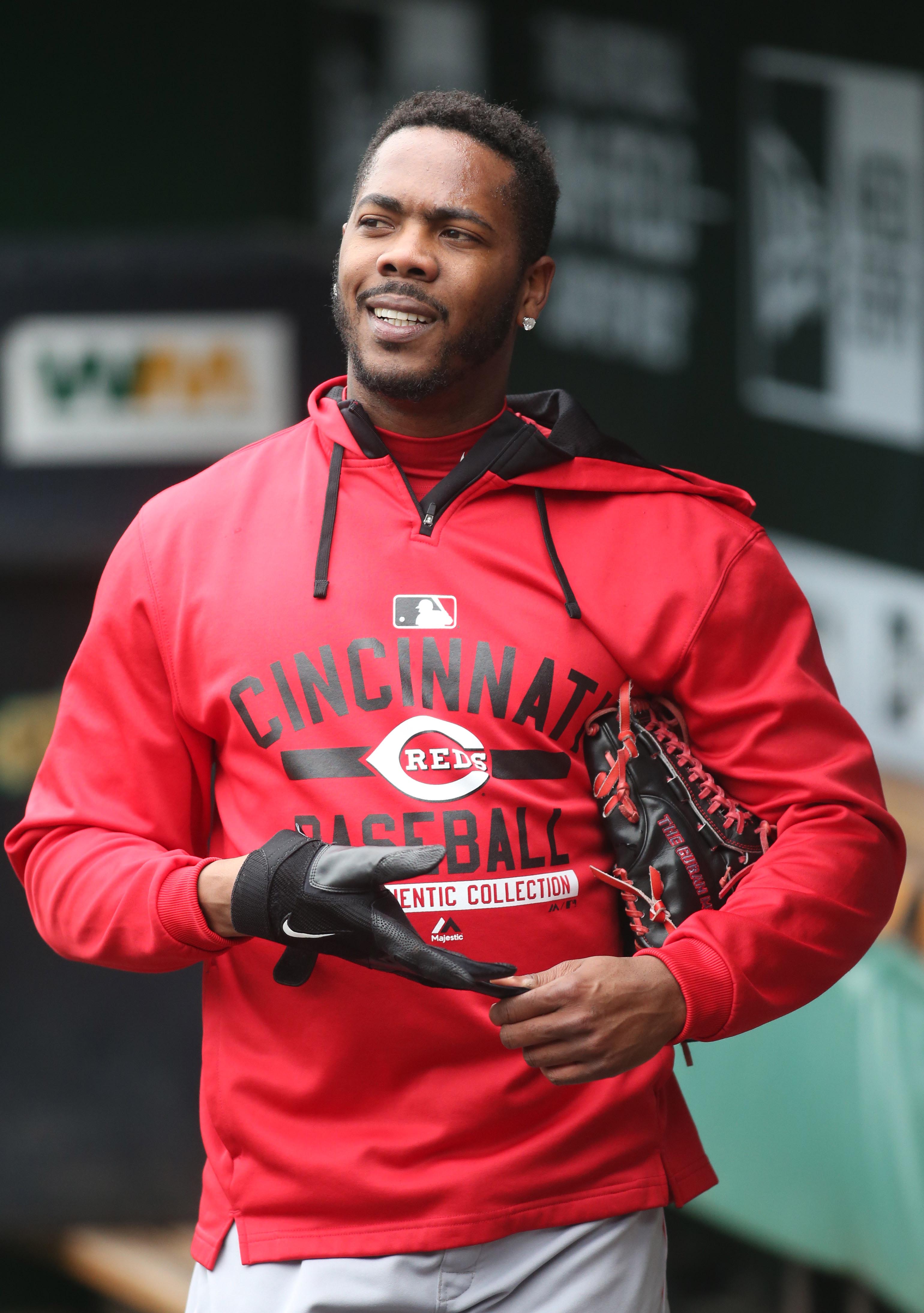
Chapman, 27, is arguably baseball’s best relief pitcher, but he comes with significant off-field baggage in the form of domestic violence allegations that ultimately halted a trade to the Dodgers from being finalized earlier this month. Chapman is currently being investigated by the league, and there’s a very real chance that he’ll serve some form of suspension from commissioner Rob Manfred under the league’s newly implemented domestic violence policy. What type of suspension is up to Manfred, though as many have pointed out, there are service time implications in any suspension that could impact Chapman’s free agency; if Chapman misses more than 45 days of the regular season due to suspension, he’ll fall shy of reaching six years of Major League service, which would prevent him from becoming a free agent next winter. A suspension would also lessen the financial commitment for Chapman in 2016; MLBTR contributor Matt Swartz currently projects the lefty to earn $12.9MM in 2016 after earning $8.05MM in 2015.
Strictly looking at Chapman’s on-field resumé, the results are astounding. In 2015, he worked to a 1.63 ERA with 15.7 K/9, 4.5 BB/9 and a 37.1 percent ground-ball rate. Over the past four seasons in Cincinnati, the Cuban-born phenom has delivered an exceptional 1.90 ERA while averaging 16.1 strikeouts and 3.8 walks per nine innings to go along with an average of 36 saves per season. Chapman is known for his blistering fastball; the left-hander averaged 100.3 mph on his heater in 2014 and followed that up with a similarly incredulous 99.5 mph average this past season. His addition could free the Yankees to trade Miller or Betances, but Joel Sherman of the New York Post hears that the team’s initial plan is to keep all three in an effort to effectively shorten games to six-inning affairs (Twitter link). That’s a bit hyperbolic in nature, of course, but probably not as much as skeptics might think; as MLB.com’s Andrew Simon points out (on Twitter), the Yankees now possess the pitchers with the three highest strikeout percentages in all of baseball from 2014-15 in Chapman (46.3 percent), Miller (41.6 percent) and Betances (39.5 percent).
That trio will be important for a Yankees team that is rife with uncertainty in the rotation. The club’s starting five currently projects as Masahiro Tanaka, Luis Severino, Michael Pineda, Nathan Eovaldi and CC Sabathia. (Ivan Nova could be in the mix as well, though he is reportedly being shopped.) Tanaka pitched through a small tear of the ulnar collateral ligament in his right elbow in 2015, while Pineda has a long history of shoulder issues and Sabathia struggled through knee injuries before ending the season in rehab for alcohol abuse. Even Severino, who was dominant in his rookie showing, has never thrown more than last season’s 161 2/3 innings in a single season. The ability to shorten games with an elite bullpen triumvirate would lessen the expectations placed on what looks to be a potentially shaky rotation.
The Reds will be adding two minor leaguers from the Yankees’ second tier of prospects (Jagielo and Davis) in addition to a pair of prospects that didn’t crack the Top 30 lists of either MLB.com or Baseball America (Cotham, Renda; hat tip to BA’s John Manuel, on Twitter). BA considers Davis the best of the bunch, having recently ranked him sixth in the Yankees’ farm system. MLB.com, meanwhile, has Jagielo sixth and Davis rated 10th.
Jagielo, 23, was selected in the first round of the 2013 draft out of Notre Dame. A knee injury that required arthroscopic surgery shortened his 2015 season, but when he was healthy, he batted .284/.347/.495 with nine homers in 58 games/248 plate appearances at the Double-A level. MLB.com’s scouting report notes that Jagielo is strong and has “good loft in his swing,” giving him the ability to drive the ball to all fields. His penchant for strikeouts (23.3 percent in 2015; 24.4 percent in 2014) is a red flag, but MLB.com notes that he draws enough walks to post sound OBP numbers even if his batting average is lackluster. The question surrounding Jagielo is whether he’ll stay at third base or move across the diamond to first, as questions about his range and arm strength are oft-cited strikes against him. Despite those potential issues, MLB.com did rate him as the No. 7 third-base prospect in the game.
As for Davis, Norris notes in his scouting report over at BA that alterations to his delivery led to a breakout of sorts in 2015. Davis pitched to a combined 3.86 ERA with 8.9 K/9 against 1.8 BB/9 in in 130 2/3 innings between Class-A Advanced and Double-A. The mechanical changes resulted in increased velocity, per Norris, who writes that Davis sits 93 to 95 mph with his heater — a pitch that is complemented by a sharp mid-70s curve and a low-80s changeup. BA indicates that he could be a mid-rotation starter, while MLB.com notes that he has good control but spotty command (i.e. throws strikes but doesn’t command the pitches within the strike zone) and could be best suited for a relief role, where his velocity could approach triple digits.
The Yankees acquired Renda, 24, from the Nationals this past season in exchange for right-hander David Carpenter. The fleet-footed infielder batted .269/.330/.358 in 532 Double-A plate appearances between the two organizations, adding three homers and 23 steals (in 29 attempts). Renda rated 12th among Nationals farmhands last season and was 22nd on MLB.com’s Top 30 at the time of the trade to the Yankees in early June. BA praised his compact swing and line-drive stroke in last winter’s scouting report, noting that his bat has a chance to be above-average, and he’s tough to strike out. He’s drawn praise for his makeup and work ethic as well, and last offseason Fangraphs’ scouting report praised his advanced bat control while noting that he lacked power.
Cotham, who turned 28 in November, made his big league debut with the Yankees this past season but struggled, yielding seven runs on 14 hits (four homers) and a walk with 11 strikeouts in 9 2/3 innings. That 11-to-1 K/BB ratio is encouraging, however, as is the 1.74 ERA that Cotham recorded in 31 innings at the Triple-A level, where he struck out 30 batters and walked just five. Cotham worked exclusively out of the bullpen between Double-A and Triple-A in 2015, totaling a 2.21 ERA with 9.6 K/9 against 2.1 BB/9. He could potentially step directly into the Reds’ bullpen, where he’d bring a fastball that averaged 92.6 mph in his brief big league tenure this past season.
Ultimately, the Reds added mid-level prospects and an MLB-ready bullpen arm in exchange for one year of the game’s best closer, it would seem. While the return is somewhat disappointing in a vacuum, it’s clear that Chapman’s domestic violence allegations rightly lowered the asking price and prevented Cincinnati from maximizing his value in a trade. It’s easy to speak now with the benefit of hindsight, but the reported offer of Braden Shipley plus a pair of other Top 10 prospects from the Diamondbacks in July does appear to be a stronger package than the one received by Cincinnati today. However, with the reason for Cincinnati’s reduced leverage in trade talks being entirely out of the team’s control, it’s not fair to simply state that they should have taken that deal. Jose Peraza, after all, was said to be heading to the Reds from the Dodgers as part of the trade package with L.A. before Chapman’s off-field issues derailed those discussions.
For the Reds, who have also traded Todd Frazier this winter (in a trade that was met with lukewarm reviews, at best, for Cincinnati’s return), the Chapman trade seems unlikely to spell the end of their offseason rebuilding efforts. Cincinnati has also attempted to move second baseman Brandon Phillips, though he reportedly elected not to waive his no-trade protection to approve a deal to the Nationals. Right fielder Jay Bruce is also no stranger to trade rumors, either, and could see his name circulate on the rumor mill with increased frequency as the Reds seek to stockpile more young talent.
Baseball America’s Josh Norris first reported that the two teams were nearing a trade (Twitter link). Jack Curry of the YES Network reported that a trade involving Chapman was close (Twitter link) and later tweeted that four minor leaguers were going to Cincinnati. Norris reported Davis’ inclusion in the deal (Twitter link). FOX’s Ken Rosenthal tweeted that the agreement as in place.
Photo courtesy of USA Today Sports Images.
Cuban Pitcher Yaisel Sierra Declared A Free Agent
Cuban right-hander Yaisel Sierra has been granted free agency, MLB.com’s Jesse Sanchez reports on Twitter. The 24-year-old is now free to sign with any team without restriction, as he is not subject to the international spending limitations.
It’s not clear what kind of signing timeline to expect, but Sierra has already shown his full arsenal on several occasions to major league scouts. Most recently, he faced live batters in a Florida showcase, reportedly drawing rave reviews for his mid-nineties heater and promising slider. Baseball America’s Hudson Belinksky came away impressed, writing:
The righthanded Sierra looked extremely polished on the mound. He repeated his moderate stride very well, consistently landing online and hitting his spots down in the strike zone. Sierra has a clean arm action, with a smooth wrap in the back and ease through release.
As BA’s Ben Badler explains, Sierra possesses “the best pure stuff” of any Cuban pitcher. But he’s never been dominant in Serie Nacionale; at times, in fact, he’s struggled. And Sierra has generally shown “poor command and pitchability,” according to Badler, with his relatively advanced age also limiting his appeal.
It’s certainly possible that Sierra’s recent showcases have upped the price tag, of course. And he is believed to be near big league readiness, which means any investment has some hope of paying off sooner rather than later.
Sanchez has previously suggested that Sierra could receive offers of around $30MM in total value. While it obviously remains to be seen what kind of cash he will be able to pull down, a commitment of that level would likely only be available if teams think he has some possibility of sticking in a rotation.
Where Does The 2015-16 Free Agent Market Stand?
As the end of 2015 approaches, it seems an opportune time to take stock of the free agent market. Plenty of contracts have met or exceeded already-lofty expectations. But it’s also rather notable that a variety of high-end players — including five of MLBTR’s ten highest-rated free agents coming into the winter and multiple players predicted to earn over $100MM — remain available.
Thus far, 69 players have signed for a total of $1.609B. That’s a big chunk of change, to be sure, but still falls shy of the $2B+ in total commitments handed out in the winter of 2013-14.
Expectations have long been that this year’s market would break records in terms of total spend, and the quality and volume of free agents still unsigned continues to suggest that will occur. There’s no question that a huge amount of earning potential remains available at this point in the current market. Above-average to premium position players include Justin Upton, Yoenis Cespedes, Chris Davis, Alex Gordon, Ian Desmond, Dexter Fowler, Howie Kendrick, and Denard Span. There are still quality arms out there, as well: Wei-Yin Chen, Kenta Maeda, Yovani Gallardo, Ian Kennedy, and Scott Kazmir among them.
Every one of those players placed among MLBTR’s top thirty available free agents. All but Span was predicted to land a $50MM+ contract. And we attributed over $1B in total earning capacity to those thirteen players alone.
But with the free agent market dragging along slowly, especially for position players, ESPN.com’s Buster Olney wonders whether it’s time for some of those players to consider pillow contracts. He says that Upton, Desmond, and Kazmir are among those who ought to begin thinking about taking one-year deals. And Olney suggests that some — he names Gallardo and Kennedy — might even need to prepare for the possibility of a holdout into the regular season.
From my perspective, it certainly wouldn’t be surprising to see a few top-fifty free agents settle for a chance to re-enter the market with as part of a weaker 2016-17 class. But there’s also little reason to give up on a bigger contract at this stage, and good reason to believe that many or most will still reach or exceed expectations.
Olney is right to note that next year’s much-less-appealing slate of free agents will provide some incentive for players to settle for one-year arrangements. But the less exciting market to come also impacts teams, who have some added incentive to lock into a player at an area of need if the future replacement options don’t look promising.
I’d suggest, too, that a delay in the market shouldn’t necessarily be interpreted as an indication that money has dried up. We’ve seen before that funding can still available well into the spring. Back in that boom class of 2013-14, for example, over $440MM was spent after the calendar turned to the near year (not including players who waited until mid-season, but factoring in the total outlay needed for the Yankees to land Masahiro Tanaka).
And this year’s remaining free agent class is much more impressive than the group whose signing timeline was put on hold by the great Tanaka chase. It should be paid as such, even if each individual won’t max out their earning potential.
We’ve already heard, for instance, that at least Davis, Gordon, and Kazmir have fielded significant offers, and are apparently holding out for something better. And it’s not at all uncommon for big cash to be committed late. We’ve seen nine-figure deals go to players like Tanaka, Max Scherzer, and Prince Fielder after the new year. And there are numerous examples of lengthy contracts with $10MM+ AAVs that have been handed out in January, February, or March — including James Shields, Ubaldo Jimenez, Matt Garza, Nick Swisher, and Michael Bourn.
It’s probably worth bearing in mind the lesson of Ervin Santana, whose market fell apart after he apparently pushed too hard for a bigger contract. But his case also demonstrates that the downside risk isn’t so bad, either, as he struck a $15MM contract for his single season and then got over $50MM the next year upon re-entering the market.
While it’s true that there’s more supply left this time around than is usually the case, that could simply be a reflection of the outstanding class of players on the open market and the numerous options at some positions. The market for power bats, in particular, has several players and teams involved who may be waiting for a first mover to break the present standstill.
In some ways, moreover, the early spending this year suggests that there will still be plenty of cash to go around over the next few months. Nobody anticipated the Diamondbacks committing over $200MM to one player. Jason Heyward and Ben Zobrist both went to a team (the Cubs) that didn’t necessarily seem in clear need of adding them. The trickle-down effect is that the other clubs with interest in those kinds of players remain in the market.
At this point, it’s also worth noting, only eleven clubs have even committed $20MM to a single player. The Dodgers, Angels, Rangers, Astros, White Sox, Yankees, and Mets are not among them. And only five teams have awarded contracts of $50MM or more, with the Cubs and Giants each giving two. So there’s probably more capacity — if not also willingness — to spend.
However the market develops, it seems fair to say that we could be in for an unusually active spring in terms of free agency. As camp begins to approach and extension season moves into focus, there’s still plenty of potential for intrigue.
My own expectation is that the market will still pay out over $2.5B in total commitments by the time it’s all said and done. In addition to the thirteen players discussed above, there are numerous other members of the open market who seem likely to sign guaranteed deals. What do you think?
Will Total Free Agent Spending Top $2.5 Billion?
-
Yes 61% (3,155)
-
No 39% (1,981)
Total votes: 5,136