
Mariners Making Progress On Wade Miley Trade
1:12pm: The Mariners and Red Sox are making progress on a trade that would send Miley to Seattle, Rosenthal now tweets.
11:41am: The Mariners and Red Sox are in trade talks centering around one of Boston’s starters, reports Ken Rosenthal of FOX Sports (Twitter link). It’s not clear precisely which player is being targeted, according to Rosenthal, but it’s believed to be either Clay Buchholz or Wade Miley, he adds.
Dipoto is familiar with both pitchers to varying degrees after his recent stint as a senior adviser in the Red Sox front office. However, his ties with Miley date back to his days with the Diamondbacks; Dipoto was Arizona’s interim GM in 2010 and was the club’s director of scouting when Miley was drafted in 2008, so it stands to reason that he sees a good deal of things to like in Miley’s arm.
The Mariners are known to be eyeing rotation upgrades — Dipoto has said as much — but recently lost out on their top target, right-hander Hisashi Iwakuma, who agreed to a three-year deal worth a reported $45MM in guaranteed money. Dipoto has been far and away the most active GM on the trade market this winter, so it’s hardly a surprise to see him further linked to upgrading his roster in that fashion.
Miley, 29, is guaranteed a total of $15.25MM over the next two seasons and has a $12MM club option for the 2018 season on his contract, making him a highly affordable option. Buchholz, too, is reasonably affordable, as he’s owed $13MM for the 2016 campaign. He’s controllable through 2017 via a club option.
Latest On Trade Interest In Boston’s Starting Pitchers
Names such as Joe Kelly, Wade Miley and Clay Buchholz have all been mentioned in a wide variety of trade rumors thus far today, so we’ll start keeping track of non-major updates in one spot. Thus far, the Mariners are known to be discussing either Miley or Buchholz (and, as I noted in that post, Seattle GM Jerry Dipoto has a long history with Miley). The Rangers, on the other hand, are said to have quite a bit of interest in Kelly. Boston, of course, signed David Price to a record-setting $217MM contract last week, giving them more starters than rotation spots. The remaining pitchers on their roster figure to be oft-mentioned as trade candidates at this week’s Winter Meetings.
Here’s the latest…
- The Red Sox aren’t motivated to trade Kelly at this time, a Major League source tells WEEI.com’s Rob Bradford. Kelly is more affordable than either Buchholz or Miley in the near-term, and his finish to the season was exceptionally strong, so it shouldn’t come as a total shock that the team isn’t necessarily looking to deal him. There still seems to be quite a bit of interest in Kelly, however, so it’s certainly possible that a club alters Boston’s course of thinking in the coming three to four days.
- The Rangers have indeed talked to the Red Sox about a deal involving Kelly, tweets Evan Grant of the Dallas Morning News, but their focus is said to be elsewhere at this time. MLB.com’s T.R. Sullivan adds (also via Twitter) that in addition to Kelly, the Rangers have spoken to Boston about Miley.
- The Marlins have checked in with the Red Sox about both Miley and Kelly, according to MLB.com’s Joe Frisaro (Twitter link). Miami is known to be seeking starting pitching upgrades, and the Marlins had quite a bit of interest in Miley last year at this time before he wound up being traded to the Red Sox.
- Nick Cafardo of the Boston Globe reports that the Royals are interested in some of the Red Sox’ starters but don’t have interest in Rick Porcello (Twitter link).
Tony Sipp Seeking Three-Year Deal
Left-hander Tony Sipp is seeking a three-year contract in the Zach Duke/Boone Logan mold, reports ESPN’s Jerry Crasnick (via Twitter). That means he’ll be eyeing an average annual value between $5MM and $5.5MM as he looks to find a new home this winter.
Sipp, 32, enjoyed his finest season as a Major Leaguer in 2015, working to a 1.99 ERA with 10.3 K/9, 2.5 BB/9 and a 38.8 percent ground-ball rate in 54 1/3 innings. Sipp was dominant against left-handed batters, holding them to a .227/.290/.309 batting line, but he also exhibited dominance over right-handed batters as well. Even hitters who held the platoon advantage over Sipp mustered a paltry .190/.243/.370 slash.
Sipp has somewhat quietly enjoyed a brilliant two-year stretch working out of the Houston bullpen, and he’s averaged better than 10 strikeouts per nine innings in three consecutive seasons now. While he doesn’t immediately jump out as a household name for fans, he’s among the best left-handed options (perhaps the best) on the market this year. His primary competition for that three-year deal is probably Antonio Bastardo, though it’s of course possible that both players could receive such a pact.
To this point, Sipp has been connected to a fair number of teams, including the Orioles, Astros and Royals. Darren Wolfson of 1500 ESPN recently tweeted that Sipp is also on the Twins’ radar. Minnesota’s need for a left-handed reliever is glaring, as the lone proven option in manager Paul Molitor’s bullpen is closer Glen Perkins, who is coming off a pair of injury-shortened seasons.
Cubs To Re-Sign Trevor Cahill
11:55am: Cahill will receive a one-year, $4.25MM contract from the Cubs, according to Olney (Twitter link). ESPN Chicago’s Jesse Rogers adds that while Cahill is definitely in the bullpen for now, the Cubs told Cahill he could be stretched out for rotation work should the need arise (Twitter link).
11:46am: The Cubs have agreed to re-sign right-hander Trevor Cahill, reports ESPN’s Buster Olney (via Twitter). The John Boggs client was said within the past hour to be nearing a deal with an unreported club.
Still just 27 years of age (28 in March), Cahill enjoyed a renaissance in the bullpen after signing a minor league deal with the Cubs midway through the season. While the D-backs, Braves and Dodgers all seemingly gave up on him in various ways last season, Chicago received 17 brilliant innings of relief from the former starter in a relief role down the stretch. Cahill yielded just four runs in those 17 innings and recorded an outstanding 22-to-5 K/BB ratio to go along with an as-always excellent ground-ball rate: 61.8 percent. He also pitched 5 1/3 innings in the postseason, allowing two runs on seven hits and no walks with eight strikeouts (3.38 ERA).
While Boggs recently told Nick Cafardo of the Boston Globe that Cahill’s preference was to return to a rotation, it seems likely that he’ll continue to be used out of manager Joe Maddon’s bullpen with the Cubs. Chicago already has Jake Arrieta, Jon Lester, John Lackey, Kyle Hendricks and Jason Hammel as rotation options, and further additions to the starting mix shouldn’t be entirely ruled out. If the bullpen is indeed the landing spot for Cahill, he will re-join the likes of Hector Rondon, Pedro Strop, Justin Grimm, Neil Ramirez and Travis Wood in the team’s relief corps.
Mets, D’Backs Had Interest In Joakim Soria
Joakim Soria is going home. Early Monday morning, the Royals and Soria’s representatives shook hands on a lucrative three-year, $25MM deal that includes a mutual option for a fourth season. Prior to signing with Kansas City, Soria also drew interest from a group of teams that includes the Mets and Diamondbacks, MLBTR has learned. The Tigers, Giants, and Twins – who were previously known to have a fondness for Soria – were also among the clubs to show interest.
The Mets’ interest in Soria is particularly notable because assistant GM John Ricco recently explained that the team wasn’t in on Darren O’Day or Ryan Madson due to their high price tags.
“We didn’t see ourselves playing in that top end where O’Day was,” Ricco said earlier this week. “But I think that next tier, we’re going to be keeping an eye on….We’re going to meet with a lot of the representatives for the relievers here over the next couple of days.”
Meanwhile, there have been conflicting reports about Arizona’s plans for bolstering the bullpen. Back in November, Jon Heyman of CBSSports.com reported that Arizona seemed “intent on acquiring a closer” while Ken Rosenthal of FOX Sports said that the team was probably “content” to add arms in front of Brad Ziegler. The D’Backs went on to make a push for Aroldis Chapman before he was sent to the divisional rival Dodgers, but their interest in Soria would indicate that they are willing to spend on the bullpen.
Trevor Cahill Nearing Deal With Unknown Team
Right-hander Trevor Cahill is nearing a contract with a yet-unknown club, reports Joe Stiglich of CSN Bay Area (Twitter link). That club is not the A’s, however, according to Stiglich. ESPN’s Buster Olney reported last week (Twitter link) that the Pirates were one club that Cahill was considering. He’s said to be looking for a one-year bounceback deal, according to Olney.
Cahill, a client of agent John Boggs, enjoyed a renaissance in the bullpen after signing a minor league deal with the Cubs midway through the season. While the D-backs, Braves and Dodgers all seemingly gave up on him in various ways last season, Chicago received 17 brilliant innings of relief from the former starter in a relief role down the stretch. Cahill yielded just four runs in those 17 innings and recorded an outstanding 22-to-5 K/BB ratio to go along with an as-always excellent ground-ball rate: 61.8 percent. He also pitched 5 1/3 innings in the postseason, allowing two runs on seven hits and no walks with eight strikeouts (3.38 ERA).
That late surge in the ‘pen is a small sample, to be sure, but it undoubtedly piqued the interest of numerous clubs seeking bullpen help. Boggs recently told Nick Cafardo of the Boston Globe that Cahill hoped to return to a rotation, though he added that his client would be open to a bullpen role if a starting job didn’t materialize. It’s tough to envision a contending club promising Cahill a rotation spot based on 22 1/3 innings — however strong they might’ve been — but a rebuilding club could look to plug him into the rotation as a low-cost, high-upside option and hope he pitches himself either into a trade chip or extension candidate. Cahill is, after all, still just 27 years of age. A resurgence from a pitcher that young that was once a rock-solid rotation piece in Oakland and Arizona (2010-12) certainly isn’t out of the question.
Rangers Interested In Joe Kelly, Drew Smyly
The Rangers have spoken to the Red Sox about right-hander Joe Kelly, reports MLB.com’s T.R. Sullivan (via Twitter), who adds that Rays lefty Drew Smyly is another potential target for the Rangers. Meanwhile, the Boston Globe’s Nick Cafardo tweets that the Rangers are “very interested” in Kelly. Rob Bradford of WEEI spoke with Kelly himself, who acknowledged the possibility that he could be moved due to Boston’s rotation surplus.
Kelly, 27, struggled tremendously in his first 14 starts with Boston, logging a 5.67 ERA that prompted a demotion to the minors. Upon returning, Kelly pitched to a much-improved 3.77 ERA with a 50-to-18 K/BB ratio in 11 starts, including an impressive 2.35 mark across his final eight outings of the season. Kelly also averaged 95.4 mph on his fastball, ranking him among the game’s hardest-throwing starters, and can be controlled for three more seasons via the arbitration process. If Texas, or any other club, believes that his end-of-season production is sustainable, he’s certainly an appealing trade chip. And, of course, many have long believed that Kelly could thrive in a bullpen role, which would be a nice fallback option for any team should he not pan out in the rotation.
The 26-year-old Smyly stands out as another reasonable rotation target for the Rangers. Like Kelly, he’s controllable through the 2018 season, though he’s coming off a season that was significantly shortened by a small labral tear in his left shoulder. Smyly threw just 66 1/3 innings for the Rays in 2015, although they were high in quality, as has come to be the expectation. Smyly logged a 3.11 ERA with 10.4 K/9 against 2.7 BB/9 to go along with a 36.8 percent ground-ball rate. While the Rays have already moved one starter this winter in Nate Karns, reports have indicated over the past month that they’re open to moving another arm.
Free Agent Profile: Yoenis Cespedes
Yoenis Cespedes did more to boost his stock in 2015 than any other free agent (with the arguable exception of Zack Greinke), but will teams buy fully into the superstar’s sky-high ceiling?
Pros/Strengths
There’s no denying that Cespedes just put up a full season of superstar production. His age-29 season started off with an excellent showing for the Tigers and continued with an even better run after a mid-season trade to the Mets.
All told, the 30-year-old Cuban native put up a .291/.328/.542 slash over 676 plate appearances with 35 home runs and 105 runs batted in. It was every bit the season one would hope for from a middle-of-the-order bat, and then some.
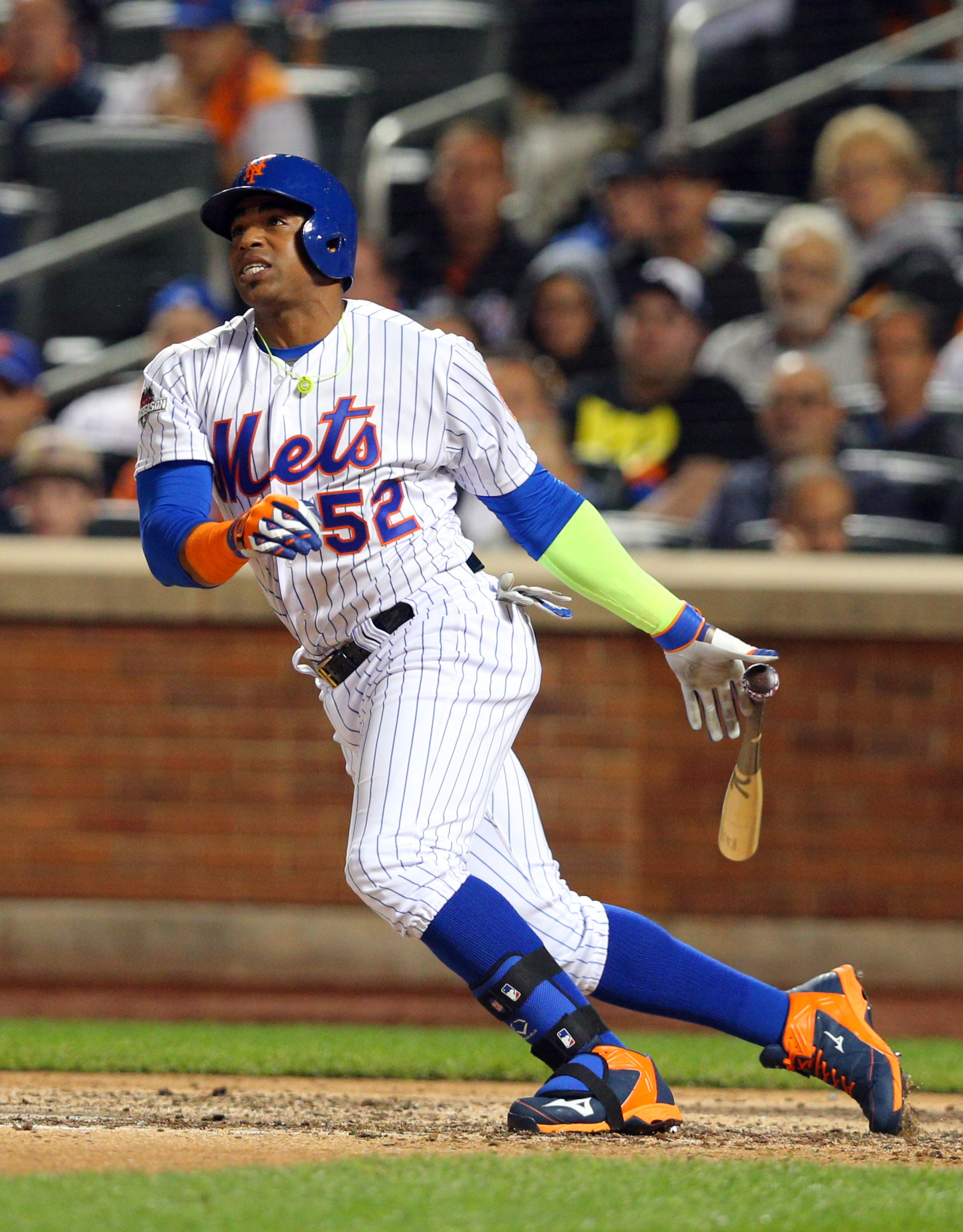
That showing validated the incredible breakout season Cespedes had as a 26-year-old rookie back in 2012. He set career marks last year not only in the traditional power categories noted above, but also in ISO (.251).
Cespedes also put up personal bests in hard contact, line-drive rate, and home runs per flyball (while hitting less flies than ever before). Another indicator of the qualify of contact is the infield fly, and Cespedes dropped to single digits in that mark for the first time ever. And it’s worth noting, too, that Cespedes carries a strikeout rate of around 20%, right at the league average and quite a fair mark for a slugger.
Production at the plate isn’t the only area that Cespedes excelled last year. He also continued to draw outstanding defensive ratings in left field, racking up double-digit DRS and UZR tallies for the second consecutive year while demonstrating a highlight-reel arm. And he showed that he can handle center in a pinch, though certainly prospective shoppers will be well aware that he’s not a natural option up the middle.
It’s worth noting, too, that Cespedes rates out as an excellent baserunner. He has continually measured well in Fangraphs’ BsR metric, never moreso than last year.
The defense and baserunning points serve not only to demonstrate the overall value that Cespedes brings, but also to highlight his outstanding athleticism. He is as loaded with tools as players come and is still putting them to use at a prime level as he hits the market. And he has a good overall track record of durability: despite dealing with some dings and dents at times, he’s only missed minor stretches as a professional.
Add it all up, and you have a player that has shown — very recently — that he’s capable of putting up over six wins above replacement, which is exactly what Cespedes did last year. While it’s true that there were two less-than-exciting seasons sandwiched between 2012 and 2015, he still averaged out at about three WAR in those years, suggesting a palatable floor.
Cons/Weaknesses
The biggest questions with Cespedes relate to those two intervening years noted above. Just as you can’t look past a monster 2015, you can’t ignore his (relatively) sub-par 2013-14 campaigns.
That lesser version of Cespedes was still a good player, as noted above. But it wasn’t one that teams would be lining up to get with a nine-figure guarantee. Over that span, Cespedes slashed .251/.298/.446 — good for a 106 wRC+ — while swatting 48 long balls.
Clearly, the pop has been there all along, even if it hasn’t always been quite as strong as it was last season. But Cespedes’s on-base troubles are not easily glossed over. His 2015 effort was driven in part by a .323 BABIP that lands about twenty points above his career mark. In years where that dips, his OBP falls with it. Indeed, Cespedes has shown a declining walk rate in every season, falling last year to below five percent.
Defensively, Cespedes hasn’t always enjoyed the sterling reputation his numbers would suggest. That’s true, in part, because he’s never before rated as above-average in terms of range. While his arm will surely remain a weapon for some time, it’s fair to wonder if he’ll be able to repeat the overall defensive showing from 2015.
While overall baserunning effectiveness is far more important than stat-padding stolen bases, it’s worth noting also that Cespedes has never returned to the 16 swipe-level he showed in just 129 games as a rookie.
There are some other, less stat-driven questions surrounding Cespedes. He’s been traded three times in the last two years, and while there were readily apparent team-specific reasons on each occasion, it’s telling to some that so many teams were willing to let him go. And there have been off-the-record whispers that Cespedes marches to his own drum, though as explained in that link, there’s little substantial evidence that he’s ever been a problem in the clubhouse or failed to put in the necessary work.
Personal
Cespedes was born and raised in Cuba, and played for his home province’s club, the Alazanes of Granma. He was a Serie Nacionale star from the moment he broke in, putting up a strong .302/.379/.503 batting line in the top Cuban league at just 17 years of age. Susan Slusser and Demian Bulwa of the San Francisco Chronicle have penned an interesting look into the unfortunate travails that Cespedes and his family went through to make it to the United States and Major League Baseball.
Notably, after entertaining an active bidding war for his services prior to the 2012 season, Cespedes chose to take a lesser deal in order to move up his free-agent timeline. While there were reports that he could’ve landed six years, he took four with the A’s and negotiated a clause requiring that he be released at the end of the contract. (That ultimately rendered him ineligible for a qualifying offer, which was a factor in his various trades. The Mets negotiated with him to modify the provision, making it possible for the team to sign him, after the threat of the QO had already been removed by a mid-season swap.)
It seems fair to say, then, that Cespedes put a high value on reaching the open market, and he’s said to have something of a businessman’s appreciation for the transactional side of the game. Marketing is not an insignificant consideration in the entertainment industry, of course, and he and his representatives spared no expense in extolling his value to prospective new employers. Now, presumably, he’ll wait for the pitches to roll in.
Among the pursuits that Cespedes has picked up since coming to the United States is golf. Though a mid-playoff round created some controversy recently, he’s said to be something of a prodigy on the links.
Market
Looking at 2015 alone, Cespedes stands out among free agent outfielders. After all, he had a better overall season than any of the players he’s competing against on the open market.
But that doesn’t mean teams will prefer him unanimously. Jason Heyward and Justin Upton are both significantly younger, with the former representing a strong all-around package and the latter delivering much of the same pop with better on-base abilities. Chris Davis offers stunning power, though he might not be viewed as a true corner outfield option, while Alex Gordon will command less years owing to his age and has been a more consistent performer.
(We’ve already profiled Heyward, Upton, and Davis.)
Interestingly, we haven’t heard much to distinguish the different markets of these players, many of whom figure to appeal to the same teams. It could be that the market is waiting for one motivated team or one motivated player to push for a deal to set the market and get the action going. As against the competition, though, Cespedes does have one distinct advantage: all the others turned down qualifying offers and come with draft compensation attached, whereas Cespedes was ineligible and thus can be acquired for cash alone.
Cespedes could conceivably end up with any of a variety of clubs. That includes the Mets, though that relationship seems destined to end as a summer/fall fling. Clubs with deep enough pockets and the most obvious need are the Angels and Giants. The Tigers, Cardinals, Orioles, and White Sox could probably afford him and arguably have the need — or, at least, the want — though it’s not clear whether any would be willing to devote that much cash. Smaller spenders like the Royals and Padres could be a fit, particularly if the asking price falls, and big-market teams such as the Cubs, Dodgers, Rangers, and Nationals might conceivably line up if they were to shift other assets.
It’s hard to put any single one of those organizations on Cespedes specifically — or any of the other top free agent corner outfielders — but it seems there ought to be enough demand to go around.
Expected Contract
There are a broad range of possible outcomes here. On the one hand, he’s been inconsistent and there are younger options on the market (as well as other alternatives in Gordon and, to an extent, Davis). On the other, we’re seeing some ridiculous new salary heights and Cespedes has the kind of star power and possible impact that could lead to a bidding frenzy.
I find myself leaning slightly toward the lower end, but evidence of continued upward movement in MLB spending has pushed up my expectations. I’ll join in the earlier prediction of MLBTR’s Tim Dierkes: six years and $140MM.
Al Alburquerque Joins Magnus Sports
Recently non-tendered right-hander Al Alburquerque has changed agencies, MLBTR’s Tim Dierkes tweets. He’s now a client of Magnus Sports — the joint venture between Praver/Shapiro Sports Management and singer/actor Marc Anthony. The right-hander joins Aroldis Chapman and Yankees prospect Gary Sanchez as the fledgling agency’s newest additions.
Alburquerque was cut loose by the Tigers coming off a season in which he worked to a 4.21 ERA with 8.4 K/9, 4.8 BB/9 and a 48.3 percent ground-ball rate in 62 innings of relief work. Alburquerque has long shown a penchant for missing bats in the Majors, but he’s also struggled to control the ball. After averaging six walks per nine innings across parts of three seasons from 2011-13, he improved to a career-best 3.3 BB/9 rate in 2014 before taking a step back this most recent season. Alburquerque will turn 30 next June, and the hard-throwing right-hander comes with two years of club control before he reaches the requisite six years of MLB service time to again become a free agent.
The change has been updated in MLBTR’s Agency Database. If you see any notable errors or omissions, please let us know via email: mlbtrdatabase@gmail.com.
Dodgers To Sign Hisashi Iwakuma
DEC. 7, 9:30am: Iwakuma will land a three-year, $45MM contract, according to Jon Heyman of CBS Sports (via Twitter). That would match MLBTR’s prediction from early November.
DEC. 6, 8:45pm: There is a deal in place that is believed to be for a three-year term, Jon Heyman of CBSSports.com reports on Twitter. If that’s the case, then Los Angeles will be acquiring the age-35 through age-37 campaigns of the veteran.
7:24pm: The Dodgers are nearing agreement on a deal with free agent righty Hisashi Iwakuma, according to multiple reports. Indeed, ESPN.com’s Jim Bowden reports on Twitter that an agreement is already in place, while Joel Sherman of the New York Post hears it’s not yet done (Twitter link) but says other clubs think a pact will be finalized. The sides are “moving toward completion” of a contract, per Ken Rosenthal of FOX Sports (via Twitter).
Possible financial terms remain unreported. Iwakuma, a client of the Wasserman Media Group, got off to a slow start and dealt with shoulder issues last year, but ended up turning in a typically excellent campaign for the Mariners. Over 129 2/3 innings, he worked to a 3.54 ERA with 7.7 K/9 against 1.5 BB/9.
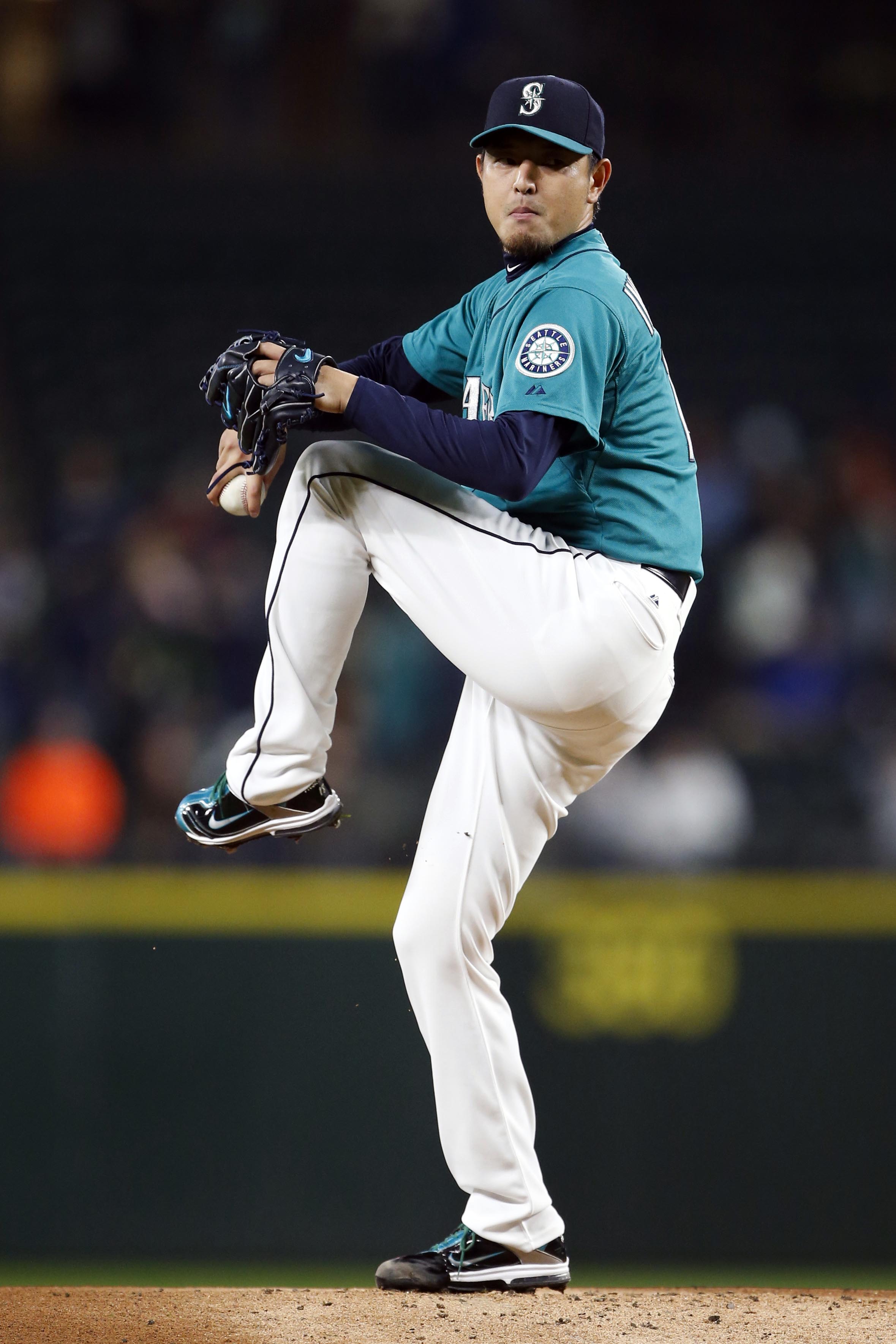
Remarkably enough, that’s the worst single-season earned run average the 34-year-old has compiled over a single campaign. He’s been remarkably good since coming to Seattle from Japan before the 2012 season. In 653 2/3 total MLB frames, Iwakuma has allowed just 3.17 earned runs per regulation game.
ERA estimators largely support the results. Iwakuma posted a 3.36 SIERA last year and carries a 3.33 mark over his four seasons. In addition to a sparkling 16.2% K-BB%, Iwakuma has induced groundballs on just over half of the occasions that a batter has put one of his pitches in play.
Never reliant on velocity, Iwakuma has experienced only a slow drop in fastball velocity. Last year, he averaged 88.9 mph on his fastball, down from the 90.3 he maintained back in 2012.
It is worth noting, though, that Iwakuma missed starts in each of the last two seasons. He was sidelined for about a dozen outings last year, though he obviously ended the year producing solid results from the rotation. Iwakuma has also been somewhat susceptible to the long ball, allowing a 13.8% HR/FB rate and 1.10 home runs per nine over his career.
In rating Iwakuma the 25th-best free agent available, MLBTR’s Tim Dierkes predicted that he’d be able to find three years and $45MM on the open market. Aside from age, the major factor weighing down the righty’s value is the fact that a signing team will be required to part with a draft pick.
It’s easy to see why the Dodgers would be interested in the veteran. Paying a hefty average annual value won’t stress the club’s payroll much (if at all), but by adding an older player the club would be able to avoid a lengthy entanglement. Los Angeles had, of course, reportedly pursued several other high-profile pitchers only to fall short in the bidding.
Photo courtesy of USA Today Sports Images.