
Angels Non-Tender Cesar Ramos
The Angels announced tonight that they have non-tendered left-handed reliever Cesar Ramos. The move comes as something of a surprise, considering Ramos’ reasonable $1.7MM projected salary and strong results out of the Halos’ bullpen in 2015. Ramos will join a class of free-agent left-handed relievers that is fronted by Tony Sipp and Antonio Bastardo.
Ramos, 31, logged a 2.75 ERA with 7.4 K/9, 2.5 BB/9 and a 47.1 percent ground-ball rate in 52 1/3 innings with the Angels in 2015. That translated to a sound 3.02 FIP, although SIERA (3.56) and xFIP (3.79) were a bit less bullish on Ramos due to a lack of strikeouts and a perhaps unsustainable 4.4 percent homer-to-flyball rate. MLB.com’s Alden Gonzalez wrote recently that Ramos was viewed as a non-tender candidate because he also typically worked in low-leverage situations — often in mop-up duty.
Ramos didn’t dominate lefties, but same-handed batters weren’t able to show any semblance of power against him, batting .274/.346/.316 in 109 plate appearances. He held his own against right-handed pitching as well, yielding a .284/.324/.382 batting line in 112 PAs. Certainly, Ramos wasn’t an overpowering bullpen arm, but he has a track record of solid performance, having worked to a 3.49 ERA with 7.2 K/9 against 3.6 BB/9 across the past five seasons/276 innings.
With just over five years of service time, Ramos has only one year of club control remaining, so any team that signs him won’t receive the benefit of multiple years of control. Neverthelss, he’s a seemingly useful bullpen piece that should find his way into a big league bullpen in 2016.
Indians Acquire Collin Cowgill, Designate Nick Hagadone
The Indians have acquired outfielder Collin Cowgill from the Angels in exchange for cash considerations and designated left-hander Nick Hagadone for assignment, per a club announcement. MLB.com’s Alden Gonzalez reported (via Twitter) that Cowgill was headed to Cleveland just before the trade was announced.
Cowgill, 30 next May, gives the Indians a strong defensive option in the outfield corners, though he comes with a light bat. The right-handed hitter comes to Cleveland with a .236/.299/.334 batting line in 745 trips to the plate as a Major Leaguer and a .188/.233/.290 line in just 74 PAs last season in Anaheim. However, Cowgill is a standout left/right fielder in the eyes of defensive metrics such as Ultimate Zone Rating and Defensive Runs Saved and also has the ability to play center field. Cowgill has saved 28 runs in 1336 innings of corner defense, per DRS. UZR agrees, pegging him at +25 runs in that time. He’s average to below-average in center, per those same metrics, but he’s played just 370 innings there in his career.
Hagadone’s removal from the 40-man roster isn’t entirely unexpected, as the lefty reliever underwent elbow surgery in late July that was projected to sideline him for six to nine months. He was projected to receive just $700K in arbitration, but the Indians probably didn’t want to commit the dollars nor the roster spot to Hagadone without knowing when he could return to the mound. He also has a fairly spotty track record as a Major Leaguer; while he worked to a sound 3.55 ERA with a 55-to-18 K/BB ratio in 50 2/3 innings from 2014-15, his big league work prior to that point amounted to a 5.59 ERA in 67 2/3 innings.
Per MLB.com’s Jordan Bastian, Indians president of baseball operations Chris Antonetti said that he has interest in keeping Hagadone in the organization despite removing him from the 40-man roster (Twitter link).
Marlins To Non-Tender Henderson Alvarez
The Marlins will non-tender right-hander Henderson Alvarez — their Opening Day starter from this past season — sources tell Jeff Passan of Yahoo Sports (Twitter link).
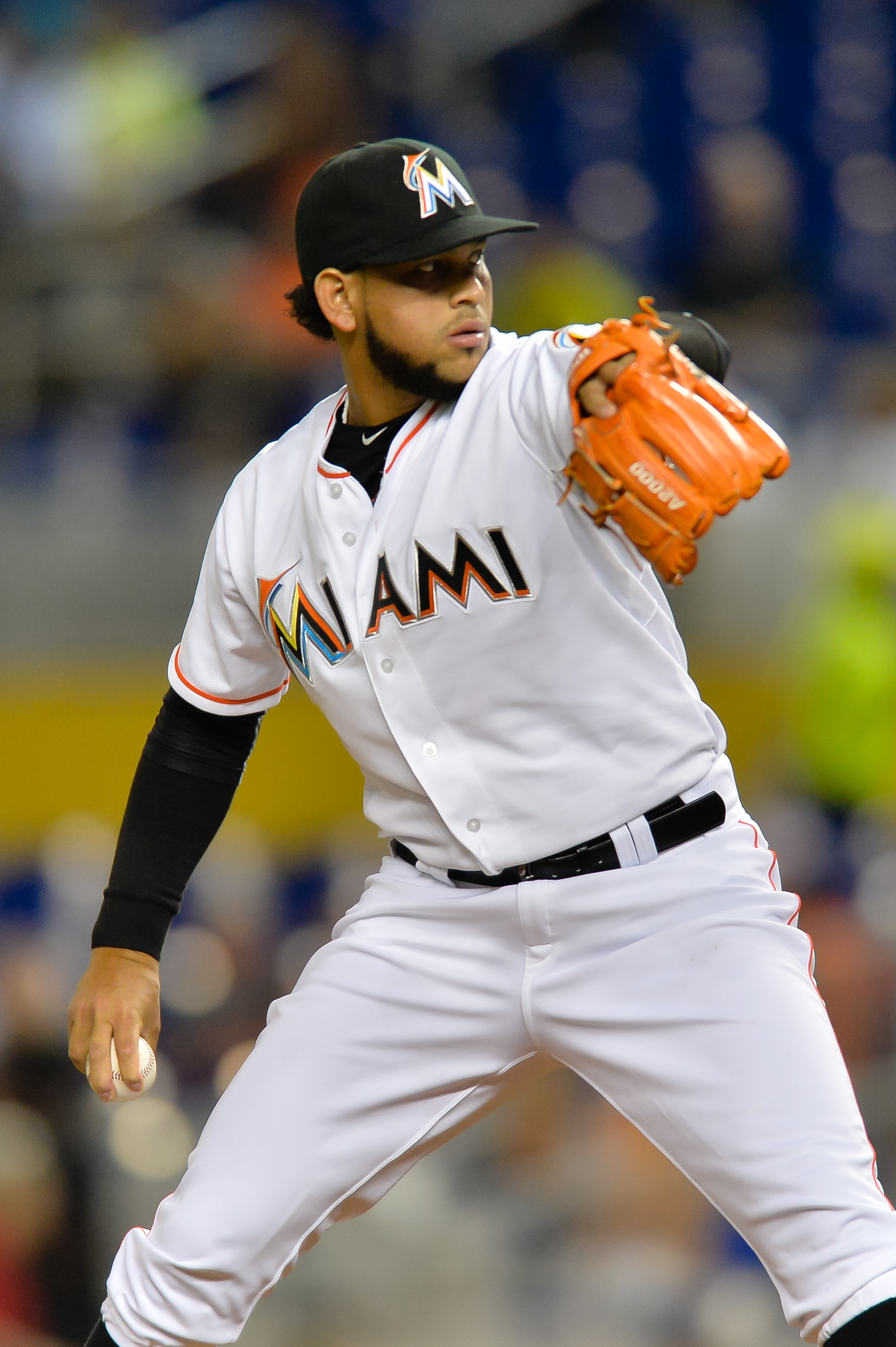
The decision comes as somewhat of a surprise but seemingly indicates that the Marlins aren’t fully convinced that Alvarez will be able to contribute in 2016 as he recovers from right shoulder surgery that he underwent back in late July. Indications in September were that the Marlins felt comfortable tendering Alvarez, who projected to earn $4MM this year (per MLBTR contributor Matt Swartz), a contract for the 2016 season. However, recent reports have suggested that the team was no longer certain that would be the case, as Alvarez’s injury was expected to keep him out at least into the first month of the season.
Despite questions surrounding the health of his shoulder, Alvarez figures to draw widespread interest on the free-agent market. He’s still just 25 years of age (26 in April) and pitched to a sparkling 2.98 ERA with 5.2 K/9, 1.9 BB/9 and a 53.6 percent ground-ball rate from 2013-14 when healthy in Miami (including a a no-hitter on the final day of the season in 2013).
Alvarez has just over four years of big league service under his belt, meaning that any club which signs him to a big league deal will be able to control him for not only the 2016 season but also the 2017 campaign, via the arbitration process. Alvarez has never been one to miss many bats, but he’s a well-regarded arm that could certainly slot into the middle of a big league rotation, so long as his shoulder allows him to do so.
Photo courtesy of USA Today Sports Images.
Royals Non-Tender Greg Holland
The Royals announced that they have non-tendered injured closer Greg Holland as well as infielder Orlando Calixte (Twitter link). Holland, who would have been arbitration eligible for the final time this winter and came with a projected $11.3MM price tag, will enter the free-agent pool.
It’s been known for quite some time that the Royals would non-tender Holland, who underwent Tommy John surgery earlier this year and missed the end of the season. Kansas City has expressed interest in working out a two-year contract that would allow the team to retain Holland, who was among the most dominant pitchers in baseball when healthy. Any contract would, of course, backload most of the salary into the second year of the deal, as Holland will almost certainly not take the mound in 2016 as he recovers from the operation.
Though it was a well-known possible outcome, the non-tender is nonetheless notable; due to the fact that the Royals weren’t able to strike up a two-year pact with Holland in advance of tonight’s deadline, he and agent Scott Boras will now have the opportunity to negotiate with all 29 other clubs to see if a more lucrative offer is available on the open market.
Orioles Acquire Francisco Pena From Royals, Designate Paul Janish
The Orioles announced that they have acquired catcher Francisco Pena from the Royals in exchange for cash considerations and designated infielder Paul Janish for assignment in order to clear room on the 40-man roster.
Pena, 26, is the son of former Major League catcher Tony Pena. He picked up seven plate appearances with the Royals this past season — the first seven he’s seen in the big leagues — and collected a single in that brief cup of coffee. Pena spent the bulk of the season at Triple-A Omaha, where he’s played since 2014, and batted .251/.305/.430 with 13 homers. He’ll replace some of the depth that the Orioles lost when they traded Steve Clevenger to the Mariners earlier today.
Janish, 33, is a well-traveled veteran known for outstanding infield defense but a light bat. He hit .286/.278/.381 in 14 games with Baltimore this season and is a career .216/.284/.291 hitter at the Major League level. He can elect free agency upon clearing outright waivers and should draw interest from multiple clubs as an infield depth option due to his veteran status and defensive prowess.
Cardinals Non-Tender Steve Cishek
The Cardinals announced that they have non-tendered right-hander Steve Cishek as well as catcher Cody Stanley. The latter of the two, as Derrick Goold of the St. Louis Post-Dispatch notes (Twitter link), is in the midst of serving a suspension.
Cishek’s non-tender wasn’t necessarily unexpected, considering his lofty $7.1MM arbitration projection (per MLBTR contributor Matt Swartz). Nevertheless, his entry into the free-agent market is notable, as teams will now have the opportunity to negotiate with a player that was once considered to be a star-caliber closer.
The 29-year-old Cishek saved 88 games for the Marlins from 2012-14 and logged a stellar 2.65 ERA with 9.9 K/9 and 3.2 BB/9 over his first 257 2/3 innings as a Major League reliever (2010-14). However, he struggled in the early stages of the 2015 season, even earning a demotion to the minors along the way. Cishek performed well at Triple-A and yielded just one earned run across 12 2/3 innings in his return to the Majors before being traded to St. Louis for right-hander Kyle Barraclough.
With the Cardinals, Cishek posted a strong 2.31 ERA, but that number didn’t tell the full story of his work in St. Louis, as he posted a somewhat troublesome 20-to-13 K/BB ratio in 23 1/3 innings with his new club. His velocity was also down in 2015, as his 90.8 mph average heater was the lowest of his career and a good bit south of the ~92.5 mph he averaged when at his best.
Although he’s coming off the worst season of his career, Cishek still seems like a candidate to land a big league deal when considering his entire body of work at the Major League level: a 2.82 ERA, 9.6 K/9, 3.4 BB/9 and a 50.1 percent ground-ball rate.
Mariners GM Jerry Dipoto On Mark Trumbo Trade
On Wednesday, Jerry Dipoto traded slugger Mark Trumbo for the second time. As the GM of the Angels, Dipoto jettisoned Trumbo in December 2013, soon after signing superstar first baseman Albert Pujols. After dealing Trumbo roughly two months after taking over in Seattle, Dipoto wants it known that it’s nothing personal with Trumbo, just business.
“There’s no particular reason for it. When I called him, I actually told him not to take this the wrong way,” Dipoto said when asked by MLBTR on a conference call. “He’s a great guy, he brings a lot of skill to the table and it’s always difficult to trade right-handed power, but there are reasons for everything. The first time that I moved him, we needed pitching and we tapped into two young upside starters (Tyler Skaggs, Hector Santiago) that we needed at the time. I felt good about that trade and I feel good about this one, too. In this case, we’re bringing in a backup left-handed hitting catcher along with payroll and roster flexibility as we move into the hot stove portion of the offseason. I explained all of this to Mark. He’s going to an ideal place to hit but it just wasn’t an ideal fit for us on our side.”
As many outsiders picked up on, Dipoto indicated that Trumbo was moved in large part because of his projected $9.1MM salary for 2016. Unlike the last Trumbo trade, Dipoto isn’t moving Trumbo in order to eliminate redundancy in the lineup, and Dipoto himself isn’t sure how the first base position will be filled. Still, I asked the GM whether he would be more likely to fill that spot via free agency or trade.
“It’s tough to say. There’s still a lot of time between now and Opening Day. We’ve discussed a lot of trade candidates with various teams around the league and we’ve at least surveyed the free agent pool, but have not engaged [any available first basemen] at this point,” Dipoto said.
Of course, this year’s free agent crop includes Chris Davis, the man that Trumbo might wind up replacing in Baltimore. Dipoto’s comment would indicate that the Mariners have not reached out to Davis, though — as MLBTR’s Steve Adams noted this week — he may not be a logical match for Seattle anyway. Dipoto has made it known that he prefers the trade market to free agency and, as he revealed, that has been the only avenue explored thus far for first basemen. Seattle would also have to sacrifice the No. 11 overall pick to sign Davis, a player who could command a six-year, $144MM deal in the estimation of MLBTR’s Tim Dierkes.
Meanwhile, Dipoto seemed genuinely excited about the addition of catcher Steve Clevenger as a complementary piece that can fit in as a catcher, first baseman, or a designated hitter. Dipoto stopped short of guaranteeing anything for the out-of-options player, but it sounds like he has a role in mind for him. Clevenger’s versatility coupled with the signing of catcher Chris Iannetta also gives Seattle options when it comes to Mike Zunino. Seattle can now afford to let Zunino start the year in Triple-A Tacoma, but they could also carry all three players with Clevenger seeing time at first base. Still, Dipoto’s plan and preference is to have Zunino begin the year in Triple-A for additional seasoning.
White Sox Non-Tender Tyler Flowers
The White Sox have non-tendered catcher Tyler Flowers and right-hander Jacob Turner, tweets Mark Gonzales of the Chicago Tribune. Cutting ties with Flowers is at least somewhat of a surprise, as many considered Flowers likely to at least find himself in a timeshare with newly signed Alex Avila. He’d been projected to earn $3.5MM by MLBTR contributor Matt Swartz, while Turner had been projected at $1MM.
Flowers, who turns 30 in January, is just a career .223/.289/.376 hitter across parts of seven seasons, but he’s produced offensively at a clip that is roughly average for catchers over the past two seasons (.240/.296/.378, 90 OPS+). He also delivered positive pitch-framing metrics in 2015 and has caught about 28 percent of attempted base-stealers over the past two seasons.
The departure of Flowers leaves Rob Brantly and Kevan Smith as the two other backstop options on the White Sox’ 40-man roster. I’d imagine that the departure of Flowers opens the White Sox up to possible trades for catching help or free-agent additions such as Michael McKenry and Dioner Navarro, as well as Wilin Rosario, who recently elected free agency.
Olney’s Latest: Price, Greinke, Carrasco, Shark, Cubs, Heyward
ESPN’s Buster Olney begins his latest Insider-only blog post by offering his take on David Price‘s deal with the Red Sox. Olney notes that while the blame for Boston’s failure to retain Jon Lester as its ace lies on owner John Henry and not former GM Ben Cherington, Henry deserves credit for recognizing the mistake and going to the measures necessary to bolster his rotation. Rival evaluators have wondered to Olney how Price will adapt to losing his velocity as he ages, but for the short-term, Price gives Boston exactly what it needed — an ace to front the rotation and shift names like Rick Porcello, Wade Miley, Eduardo Rodriguez and the injury-prone Clay Buchholz down the rotation.
Some more highlights from Olney’s column…
- Price’s signing creates a perfect storm for Zack Greinke, who now stands alone as the top free agent starter on the market with a pair of division rivals — the Giants and Dodgers — bidding against one another to secure his services. One person close to the situation suggested to Olney that Greinke could land a five-year deal worth $165MM (an average annual value of $33MM), which meshes with a recent report from ESPN’s Jayson Stark that said Greinke could take a five-year deal if it meant a sizable increase over Price’s AAV.
- The Indians have been listening to offers on their young starters, but the price tags for pitchers like Price and Greinke have underscored the value of controllable, young arms like Carlos Carrasco and Danny Salazar, leading to a perhaps exorbitant asking price. For instance, the Indians asked the Giants for a package that included both Brandon Belt and Joe Panik in exchange for Carrasco in recent talks, according to Olney. While some Giants fans may recoil at the notion, Olney writes that with pitchers such as J.A. Happ commanding $36MM over three years, Carrasco’s four-year, $22MM contract and two club options come with incredibly high value. Carrasco talks between the two sides are dead at this point, he adds.
- The Cubs have been positioning themselves for a run at Jeff Samardzija since before Price made his final decision. The Giants are among the other clubs with interest in Samardzija, according to Olney, who wonders if the teams that missed out on both Price and (eventually) Greinke will then check in with Johnny Cueto as an alternative.
- The Cardinals have at least spoken to Greinke, but there’s no indication that they’re prepared to compete with the Dodgers and Giants for his services, making it seem unlikely that they’ll emerge as a late dark-horse candidate in his market.
- The Cubs weren’t comfortable with the notion of roughly $55MM per season for a pair of pitchers each season for the foreseeable future, referring to a potential combo of Price and Lester. Olney calls a swap of Jorge Soler and Braves right-hander Shelby Miller a potential plan B for Chicago, which would then free up the club to make a run at Jason Heyward.
Details, Reactions And Effects: The David Price Deal
Here’s a roundup of reactions to and news about David Price‘s seven-year, $217MM pact with the Red Sox.
- The signing came together partly as a result of maneuvering regarding Price’s fellow free agent starting pitcher Zack Greinke, Ken Rosenthal of FOX Sports writes (Twitter links). The Dodgers and Giants wanted Greinke to make a decision, while Greinke wanted to know where the Red Sox stood. The Sox, who had increased their offer to Price yesterday, wanted him to come to a decision so they knew whether to turn their attention to Greinke or possibly others.
- The Cardinals made the second-best offer to Price, Bob Nightengale of USA Today writes. Their seven-year offer was, however, worth $30MM less than that of the Red Sox. The Cubs also met with Price, but did not extend an actual offer.
- The Red Sox’ willingness to offer a deal with no deferred money helped persuade Price to sign quickly, ESPN’s Jerry Crasnick tweets. (Of course, it must have also helped that the Red Sox’ offer was so much more lucrative than anyone else’s.) Price’s contract contrasts with the seven-year, $210MM deal Max Scherzer got last offseason, for example — although the dollar figures appear similar, Scherzer’s deal contains plenty of deferred compensation that reduces the deal’s present-day value. (Price’s deal also includes an opt-out after three years, while Scherzer’s does not.)
- Red Sox president of baseball operations Dave Dombrowski says the team is likely done making significant moves, reports John Tomase of WEEI.com. “We’ll be open-minded going into the Winter Meetings,” Dombrowski says. “We’ll see what happens over the next few days leading into that, but be in a position that I think our major moves are done. But when you go to the Winter Meetings, you can never tell what happens.” In addition to reaching an agreement with Price this offseason, the Red Sox have, of course, traded for closer Craig Kimbrel and signed outfielder Chris Young.
- Like Nightengale, Rosenthal also writes that Boston “blew away the field” with their offer. Rosenthal also notes that Price’s successes after being traded from the Rays to the Tigers and then the Blue Jays might have helped convince former Tigers exec Dombrowski that Price could succeed in a tough market.
- Price’s 2016 salary will add to a Sox payroll that appears likely to result in a large luxury tax penalty, Alex Speier of the Boston Globe writes. They could end up with a $215MM payroll for luxury tax purposes, which would result in a bill of about $9MM — 30% of the amount they spend over the $189MM threshold.
- The $31MM average annual value of Price’s contract isn’t a bad one for a large-payroll team like the Red Sox, and Price fits the Sox’ needs perfectly, writes ESPN’s Keith Law (Insider-only). Price immediately becomes by far the Red Sox’ best starter, and his combination of relative youth and good offspeed stuff suggests that he should age relatively gracefully in the next several seasons. Price’s addition should also help the team move Joe Kelly to a relief role for which he’s well suited. And signing Price, rather than, say, Greinke helps the Red Sox keep the 12th overall pick in next year’s draft, since Price wasn’t eligible to receive a qualifying offer after being traded at midseason.
- Price is a true ace, but the Red Sox are taking on lots of risk with his contract, Barry Svrluga of the Washington Post writes. Lengthy deals for pitchers frequently turn out to be troublesome, and if Price doesn’t take advantage of his opt-out, the last four years of his contract could become a headache. Also, Svrluga writes, Price (who has a 5.12 career ERA in 63 1/3 playoff innings) still must prove he can step up in the postseason.