
MLB Announces 2023 All-Star Rosters
The starters for the 2023 All-Star Game were already announced earlier this week, and today the league revealed the reserve selections and the pitching staffs for the National League and American League teams. Fan balloting determined the game’s starters, while the reserves and pitchers were picked by a combination of the player ballot and selections from the league office.
This won’t be the final list of players involved, as some more substitutions will be announced later for players who are injured or who have opted not to participate. Every team must have at least one player represented at the Midsummer Classic, and the starting pitchers for the game will be announced on July 10.
Of note, Shohei Ohtani will be in the game as both a DH and as a pitcher for the third consecutive season. The Braves led all teams with eight All-Stars, while the Rangers weren’t far behind with six players chosen. This year’s All-Star Game takes place in Seattle on July 11.
National League
- Catcher: Sean Murphy, Braves
- First Base: Freddie Freeman, Dodgers
- Second Base: Luis Arraez, Marlins
- Third Base: Nolan Arenado, Cardinals
- Shortstop: Orlando Arcia, Braves
- Outfield: Ronald Acuña Jr., Braves
- Outfield: Corbin Carroll, Diamondbacks
- Outfield: Mookie Betts, Dodgers
- Designated Hitter: J.D. Martinez, Dodgers
- Pitchers: Alexis Diaz/Reds, Camilo Doval/Giants, Bryce Elder/Braves, Zac Gallen/Diamondbacks, Josiah Gray/Nationals, Josh Hader/Padres, Mitch Keller/Pirates, Clayton Kershaw/Dodgers, Justin Steele/Cubs, Spencer Strider/Braves, Marcus Stroman/Cubs, Devin Williams/Brewers
- Position Players: Ozzie Albies/Braves, Pete Alonso/Mets, Nick Castellanos/Phillies, Elias Diaz/Rockies, Lourdes Gurriel Jr./Diamondbacks, Matt Olson/Braves, Austin Riley/Braves, Will Smith/Dodgers, Jorge Soler/Marlins, Juan Soto/Padres, Dansby Swanson/Cubs
American League
- Catcher: Jonah Heim, Rangers
- First Base: Yandy Díaz, Rays
- Second Base: Marcus Semien, Rangers
- Third Base: Josh Jung, Rangers
- Shortstop: Corey Seager, Rangers
- Outfield: Randy Arozarena, Rays
- Outfield: Mike Trout, Angels
- Outfield: Aaron Judge, Yankees
- Designated Hitter: Shohei Ohtani, Angels
- Pitchers: Felix Bautista/Orioles, Yennier Cano/Orioles, Emmanuel Clase/Guardians, Luis Castillo/Mariners, Gerrit Cole/Yankees, Nathan Eovaldi/Rangers, Kevin Gausman/Blue Jays, Sonny Gray/Twins, Kenley Jansen/Red Sox, Michael Lorenzen/Tigers, Shane McClanahan/Rays, Shohei Ohtani/Angels, Framber Valdez/Astros
- Position Players: Yordan Alvarez/Astros, Bo Bichette/Blue Jays, Adolis Garcia/Rangers, Vladimir Guerrero Jr./Blue Jays, Austin Hays/Orioles, Whit Merrifield/Blue Jays, Salvador Perez/Royals, Jose Ramirez/Guardians, Luis Robert Jr./White Sox, Brent Rooker/Athletics, Adley Rutschman/Orioles
The A’s May Have Found A Hidden Gem On The Waiver Wire
2022 was a year of change for Brent Rooker, who was a member of four different organizations within the span of seven months. After five years with the Twins, Rooker was dealt along with Taylor Rogers to the Padres for Chris Paddack and Emilio Pagan in April 2022. From there, Rooker found himself on the move again at the trade deadline when San Diego sent him to the Royals for catcher Cam Gallagher. Rooker finished out the season in K.C. but was designated for assignment in November, paving the way for the Athletics to claim him off waivers.
As Rooker noted in a chat with MLBTR readers back in February, the specific timing of the trades made things particularly difficult since “
Stability isn’t usually a word associated with an A’s franchise that has made a habit of roster overhauls, including the latest fire sale that has seen the Athletics part ways with several prominent veterans as part of the latest rebuild. The result hasn’t been pretty, as the A’s entered play today with a league-worst 7-26 record, and the increasing possibility of a move to Las Vegas has led to a lot of public discord amongst Oakland fans.
Though it all, however, Rooker has become a major bright spot in the early portion of the 2023 season. Entering the year with a career .200/.289/.379 slash line over 270 plate appearances in the majors, Rooker has exploded to hit .333/.442/.726 with 10 home runs over his first 104 PA in an Athletics uniform. Rooker’s slugging percentage and 218 wRC+ lead all qualifies hitters, and his on-base percentage also leads the American League.
This kind of huge breakout caught even Rooker himself a little off-guard. “In a vacuum, the numbers themselves are more than I ever thought I could do,” Rooker told MLB.com’s Martin Gallegos and other reporters last week. “That’s not taking away the confidence I have in myself. That kind of production for a month’s worth of games is probably past even my expectations of myself, so that’s been a pleasant surprise for me.”
Such high-level production isn’t totally alien to Rooker, who has pretty consistently mashed minor league pitching over five seasons on the farm. This includes a career .274/.387/.590 slash line over 906 PA at the Triple-A level, which is a standout performance even with the caveat of 273 of those plate appearances coming in the hitter-friendly environment of the Pacific Coast League (with the Padres’ Triple-A affiliate). Rooker also carried some prospect pedigree as the 35th overall pick of the 2017 draft, and he was ranked 92nd on Baseball America’s top-100 prospects list prior to the 2018 season.
Despite this resume, Rooker couldn’t really break though on a Minnesota team that already had multiple up-and-coming outfielders on the active roster or in the farm system all vying for playing time. Rooker’s cause wasn’t helped when he suffered a fractured forearm in just his seventh big league game in 2020, and his only other extended taste of MLB playing time came in 2021, when he batted .201/.291/.397 over 213 PA for the Twins.
Still, that rough season had just enough glimmers of hope for Rooker that he told Gallegos and company that it has contributed to his big 2023 numbers. “The last two years, I’ve just been trying to figure out how to extend those good times that I had,” Rooker said. “I knew I could do it because I’d have weeks in Minnesota where I’d hit really well with a lot of success. That put it in my head and heart that I was good enough to do it. I just had to figure out how to do it for longer periods of time.”
It is probably safe to assume that some regression is inevitable, due to both Rookier’s .340 BABIP and the lack of track record to back up his early standing as an elite hitter. That said, there hasn’t been much luck in what Rooker has been doing, as his .479 wOBA is above his xwOBA….but not by much, as Rooker’s .447 xwOBA is still in the 99th percentile of all hitters. His barrel rate and walk rate are also both outstanding, and his overall hard-hit ball rate is well above league average. Strikeouts have been a persistent issue for Rooker throughout his career, but cutting his strikeout rate down to even a modest 22.1% (within the 49th percentile of hitters) has helped greatly, given what Rooker is doing with all that extra contact.
Landing a possible late bloomer on the waiver wire is a dream for any team, particularly a rebuilding Oakland club in sore need of some good news. Rooker entered the season with only one year and 59 days (1.059) of MLB service time, so he wouldn’t even gain arbitration eligibility until after the 2024 season, and free agency until after the 2017 season. Naturally, five great weeks doesn’t automatically turn a 28-year-old player into a building block, but if nothing else, Rooker’s presence gives the Athletics something to think about as they approach the trade deadline.
To be clear, all of that team control might make it unlikely that Rooker himself is traded, as the A’s might be intrigued enough to see what they really have in the outfielder beyond 2023. The idea can’t be entirely ruled out given the Athletics’ scored-earth approach to their rebuild process, but dealing Rooker after a big first half might backfire if Rooker does continue to be a quality regular going forward — “selling high” would perhaps become selling too soon.
Rooker has seen a lot of time at DH, and has seen some time in both corner outfield positions with borderline passable glovework. Not that Rooker is in any danger of losing at-bats at this point, but if any of Ramon Laureano, Tony Kemp, or Jesus Aguilar are moved at the deadline, that just opens up more playing time for Conner Capel or JJ Bleday, with Rooker picking up any extra at-bats in the corner outfield or at DH. Kemp and Aguilar are the likeliest to be moved since they aren’t under contract beyond 2023, and while Laureano is arbitration-controlled through 2025, he has received some trade interest in the past.
Cristian Pache Will Not Make Athletics’ Roster; A’s Exploring Trade Scenarios
The Athletics will not carry Cristian Pache on the team’s Opening Day roster, manager Mark Kotsay announced late last night (link via Matt Kawahara of the San Francisco Chronicle). Because he’s out of minor league options, Pache will need to be traded or placed on outright waivers. The A’s will likely designate him for assignment prior to Opening Day, which would remove Pache from the 40-man roster and buy them a few days to explore possible trades. Outfielders Brent Rooker and Conner Capel will be on the roster, Kotsay added.
Effectively moving on from Pache after one year in the organization is a clearly suboptimal outcome for the A’s, who acquired the slick-fielding center fielder as one of the main pieces (alongside headliner Shea Langeliers) in the trade that sent Matt Olson to Atlanta. The 24-year-old appeared in 91 games for the A’s last year but posted an anemic .166/.218/.241 batting line through 260 plate appearances, exhausting his final minor league option year in the process. Things didn’t go much better in Triple-A, evidenced by a tepid .248/.298/.389 slash (68 wRC+) in an extremely hitter-friendly Las Vegas environment.
That lack of minor league options, lack of production, and the Athletics’ offseason acquisition of speedster Esteury Ruiz sealed Pache’s fate, it seems. Pache has had a productive showing in spring training, hitting .302/.362/.419 in 47 plate appearances, but the A’s already informed Ruiz last week that he’ll make the roster. It’s possible they’re confident in their ability to deal Pache for a return of modest value, but if the eventual transaction is a waiver placement, it’ll be a rather damning outcome for the team, given that Pache was a pivotal part of the prospect return in the A’s latest fire sale.
Pache is still just 24 years old, and he remains an elite defender (5 Defensive Runs Saved, 8 Outs Above Average in just 646 innings in 2022). As recently as the 2020-21 offseason he was considered among the 20 best prospects in the sport. However, his bat hasn’t developed at all, leaving the A’s in a tough spot this spring. The dilemma wasn’t exactly unforeseeable, though, given Pache’s prior struggles in Atlanta and the fact that he had only one option year remaining at the time of the trade.
Kotsay candidly acknowledged back in February that Pache could be showcasing himself for the other 29 teams in baseball this spring, and it appears that’s indeed been the case. The best-case scenario for the A’s would be to find a trade partner, and Kotsay indicated to Kawahara last night that the front office is exploring the possibility. Speculatively speaking, both the Rockies and Marlins have been in search of help at in center for awhile now, though Miami moved Jazz Chisholm Jr. to the outfield this year in hopes of patching that longstanding need. Rebuilding clubs with injured center fielders like the Royals (Drew Waters) and Reds (Nick Senzel) are also logical fits. It’s also possible certain contending clubs could look at Pache’s glove and see him as a valuable fourth outfielder, even if the bat never comes around.
As far as Oakland is concerned, it seems clear now that Ruiz will get the everyday nod in center field, while Ramon Laureano lines up in right field. The left-handed-hitting Capel and right-handed-hitting Rooker could form a platoon in left field, and many of Oakland’s infielders (Tony Kemp, Seth Brown, Aledmys Diaz) have experience in the outfield as well.
The Athletics’ Outfield Dilemma
In late January, I took a look at some of the Athletics’ options in what’s a generally crowded mix of rotation possibilities. Calling it a true logjam or crunch might overstate things a bit, as those monikers are typically more appropriate when there are more established players than there are spots to go around. For the A’s, it was more a matter how they can divide up the innings among a wide variety of unproven names.
Similar questions persist in the outfield, where Oakland has one lock for playing time and otherwise a carousel of names who could rotate through the remaining spots. Ramon Laureano is a fixture in the outfield and will continue to be through much of the season’s first half, at least (health-permitting). Laureano can play all three spots but has been better in right field than in center recently. He’s coming off a disappointing .211/.287/.376 batting line in 2022, but from 2018-21 he slashed .263/.335/.465 while playing quality defense.
Were it not for injuries and an 80-game PED suspension derailing Laureano’s trajectory, he might already have been traded by now. The A’s have gutted the rest of the roster while embarking on their latest rebuild, but Laureano is one of the few remaining veterans. Trading him this offseason would’ve been selling low, but it’d only take a couple months of productive ball to restore some of the 2018-21 shine. With a good showing in April, May and June, expect Laureano to be among the more talked-about trade candidates on the summer market.
Because of that, he should be penciled in for full-time at-bats in the outfield. It seems likely that’ll come more in the corners than in center, but whatever form it takes, Laureano’s going to be out there every day.
As far as the rest of the outfield is concerned, things are far murkier. Let’s take a look at who’ll be vying for playing time…
On the 40-man roster
Cristian Pache, 24, RHH, no minor league options remaining
Pache’s lack of minor league options and lack of production in either Triple-A or the Majors make him the most confounding player of this group. He’s still just 24 years old, is considered to be an elite defender, and as recently as the 2020-21 offseason was considered to be among the 20 best prospects in all of baseball. Pache’s bat simply hasn’t developed, however, evidenced by a disastrous .156/.205/.254 batting line in 332 MLB plate appearances and an ugly .248/.298/.389 showing in Triple-A last season. Pache posted five Defensive Runs Saved and eight Outs Above Average in only 646 innings last year. He’s one of the best defensive players in the game but currently one of its worst hitters. The A’s can’t send him down without exposing him to waivers, and the glove alone would probably get Pache claimed. At the same time, it’s hard to keep trotting him out there with such an anemic batting line. Giving up on Pache as an everyday player and relegating him to a bench role is also unpalatable, though, given his youth and the fact that he was one of the key pieces in the trade that sent Matt Olson to the Braves. The A’s have to hope Pache can somehow develop his offensive approach at the big league level, and if he can’t, he could eventually force them into a tough decision. A big spring could also position him as a trade candidate; manager Mark Kotsay candidly admitted last month that Pache could be “showcasing himself for 29 other teams.”
Esteury Ruiz, 24, RHH, two minor league options remaining
The Pache dilemma is exacerbated by the fact that the A’s acquired another potential center fielder in this offseason’s Sean Murphy trade. The 24-year-old Ruiz stole a whopping 86 bases in 2022 and is considered among the fastest players in the sport. Like Pache, he has the potential for plus range in center, though scouting reports are far more bullish on Pache’s instincts and overall defensive prowess. There are some similar red flags with Ruiz’s game, though his minor league numbers are a sight to behold. He hit .332/.447/.526 in 541 plate appearances between Double-A and Triple-A last season, but Ruiz also posted bottom-of-the-scale exit velocity and hard contact numbers. His lack of hard contact can be somewhat erased by what’ll surely be plenty of infield hits, but there are questions about how impactful his bat and glove can be at the game’s top level. He’s ready for a look right now, but playing time will depend on how the A’s view Pache and, quite likely, their other offseason outfield acquisition. Speaking of which…
JJ Bleday, 25, LHH, three minor league options remaining
Acquired in a straight-up swap for reliever A.J. Puk, Bleday is a former No. 4 overall draft pick whose prospect star has dimmed in recent years as he’s struggled throughout the minors. The Marlins have spent several years in search of an everyday center fielder and still don’t have one, yet they were content to trade Bleday for a controllable bullpen piece. Scouting reports on Bleday peg him as more of a left fielder, and clearly the Marlins agree, or else they wouldn’t have moved on. Bleday has above-average raw power, but he strikes out and pops up too often in trying to get to it in a game setting. He’s a career .225/.337/.409 hitter in the minors, and his strikeout rate has risen at every level, topping out at 27% in Triple-A last year and 28.2% in his 238-plate appearance MLB debut. Bleday took 605 PAs between Triple-A and the Majors last season and, in addition to 166 strikeouts, he popped up a staggering 33 times. That’s an automatic out in nearly one-third of his plate appearances. The A’s can offer some new coaching perspective, so perhaps they can unlock something in Bleday that the Marlins couldn’t, but so far the results on Bleday haven’t come close to aligning with his draft status.
Seth Brown, 30, LHH, two minor league options remaining
Because Brown has spent so much time at first base and in right field (688 innings apiece), it may be a surprise to many that he’s also logged 141 innings in center. He’s not a great option there, but Brown can handle the spot in a pinch and can cycle through all three outfield spots, first base and designated hitter. He’ll have free-agent signee Jesus Aguilar and Oakland’s Rule 5 pick Ryan Noda (more on him in a bit) competing for time at those positions, however, so Brown could see a fair bit of outfield work. The 30-year-old Brown smashed 25 home runs last year and stands as one of the team’s primary power threats. Virtually all of his MLB production has come against righties, which leads to some easy platoon maneuverings. Brown will be arbitration-eligible next winter, and if he continues bashing righties in the first half, he’ll join Laureano on the trade market.
Tony Kemp, 31, LHH, cannot be optioned without his consent (five-plus years of service time)
One of the team’s elder statesmen at just 31 years of age, Kemp is another likely summer trade candidate. He’s spent more time at second base than in left field over the past few seasons, but he’s played both with a fair degree of regularity. Oakland’s signing of Aledmys Diaz could cut into his time at second base, though. Kemp, like Brown, is a better hitter against righties, though the split isn’t as glaring in his case. He should be out there regularly to begin the season, but the presence of Diaz and looming prospect Zack Gelof feels like it’ll eventually lead to a trade, so long as Kemp is playing reasonably well.
Aledmys Diaz, 32, RHH, cannot be optioned
The A’s needed to spend some money this offseason, and luring free-agent bats to a last-place club in a cavernous home park can’t be easy. They paid up on a pair of multi-year deals for versatile infield/outfield veterans Diaz and Jace Peterson (the former of whom seems ticketed for regular work at third base). Diaz can act as a left-handed complement to Kemp at second base, mix in at all four infield slots and will probably also see occasional time in left field and at designated hitter. He’s making more than $7MM this season, which is a sizable sum by Oakland’s standards, so expect him to play fairly regularly.
Ryan Noda, 26, LHH, cannot be optioned (Rule 5 Draft pick)
Noda will need to earn his way onto the roster, but he’s a first base/corner outfield slugger who was blocked in Los Angeles by names like Freddie Freeman, Mookie Betts and J.D. Martinez. With the A’s, there are no such roadblocks to playing time, and he’ll get the chance to prove his career .894 OPS in the minors, including a .259/.396/.474 showing in Triple-A Oklahoma City last year can carry over to the big league level, to some extent. Noda, 27 later this month, has nearly twice as much first base time as he does corner outfield time in his pro career, but the A’s grabbed him for his bat, and he’ll get chances against righties so long as he earns a spot this spring.
Conner Capel, 25, LHH, two minor league options remaining
Capel posted a respectable .264/.364/.422 slash in Triple-A between the Cardinals and the A’s (who claimed him off waivers from St. Louis) in 2022. A 40-plate appearance cup of coffee in Oakland resulted in an eye-popping .371/.425/.600 slash late in the season, though a .423 average on balls in play in that tiny sample had plenty to do with it. Capel’s minor league track record is more solid than standout, but he’s on the 40-man roster and will try to hit his way into an Opening Day roster spot, even if he doesn’t share the recent production and/or prospect pedigree of some of his competitors.
Cal Stevenson, 26, LHH, two minor league options remaining
A thrice-traded former 10th-round pick, Stevenson turned heads with a .322/.413/.529 output in Triple-A last year — his first season in the A’s organization. That came on the heels of his inclusion in the trade sending Christian Bethancourt from Oakland to Tampa Bay, and Stevenson’s overall Triple-A output clocked in at .284/.389/.413 in 307 plate appearances. Stevenson walks at a high clip and has strong bat-to-ball skills, but he’s not a premium defender and has never topped nine home runs in a full season.
Brent Rooker, 28, RHH, one minor league option remaining
The former No. 35 overall pick (Minnesota, 2017), Rooker came to the A’s by way of a waiver claim. Oakland is his fourth team in the past calendar year, as clubs continue to be intrigued by his raw power and minor league production even as injuries and MLB struggles have undercut his appeal. Rooker is a first baseman/left fielder who has a career .274/.387/.590 slash and 62 dingers in 906 Triple-A plate appearances, but he’s mustered tepid .200/.289/.379 line in 270 big league plate appearances. It’s big-time right-handed pop, but Rooker needs to cut back on the 31.9% strikeout rate he’s shown in the Majors.
—
Given the slate of options already on the 40-man roster, it’s not a huge surprise that the A’s didn’t add a ton of minor league outfield depth over the winter. Cody Thomas was retained after they passed him through waivers following a DFA, and he’s in camp as a non-roster invitee. Thomas carved up Triple-A pitching in 2021 but missed nearly all of 2022 on the injured list. If he can get back to that ’21 form (.289/.363/.665), he could get another look in 2023. Meanwhile, old friend Greg Deichmann is back in the organization on his own minor league deal after scuffling in his lone full season with the Cubs (who acquired him in the 2021 trade that sent Andrew Chafin from Chicago to Oakland).
Looking just at the names on the 40-man roster, there are clearly far more bodies than at-bats to go around. The A’s are somewhat handcuffed by Pache’s lack of options, so he seems likely to make the roster and occupy at least a part-time role. Both Ruiz and Bleday are clearly viewed as potential outfield regulars by the Athletics’ front office, though neither is a necessary lock to break camp on the active roster (even if they’ll surely be given every opportunity to do so). The A’s are the perfect club to carry someone like Noda — a polished upper-minors hitter who can’t be optioned given his Rule 5 status — but they’ll need to also get Kemp and Brown sufficient at-bats (particularly if the goal is ultimately to trade one or both this summer).
Each of Capel, Stevenson and Rooker could factor into plans as well, though that trio ostensibly feels more like upper-minors depth or perhaps part-time options off the bench. On many clubs, playing time with this type of saturated outfield mix would boil down to a meritocracy, but the rebuilding A’s can and likely will be more patient with out-of-options players, Rule 5 selections and hopeful summer trade chips.
It’s a fluid situation, one without clear answers. An ideal situation would see Laureano, Brown and Kemp play well enough to be traded for decent returns, while Pache takes enough of a step forward to hold down center field as Ruiz and Bleday emerge as viable options on either side of him (all while Noda hits enough to seize the first base job). Things rarely work out so smoothly for any club, however. The A’s badly need some of their newly acquired outfield talent to pan out, though, as last offseason’s slate of trades did little to improve the long-term outlook. How they allot playing time on the path to reaching that end goal will be one of the key stories to monitor for A’s fans this year.
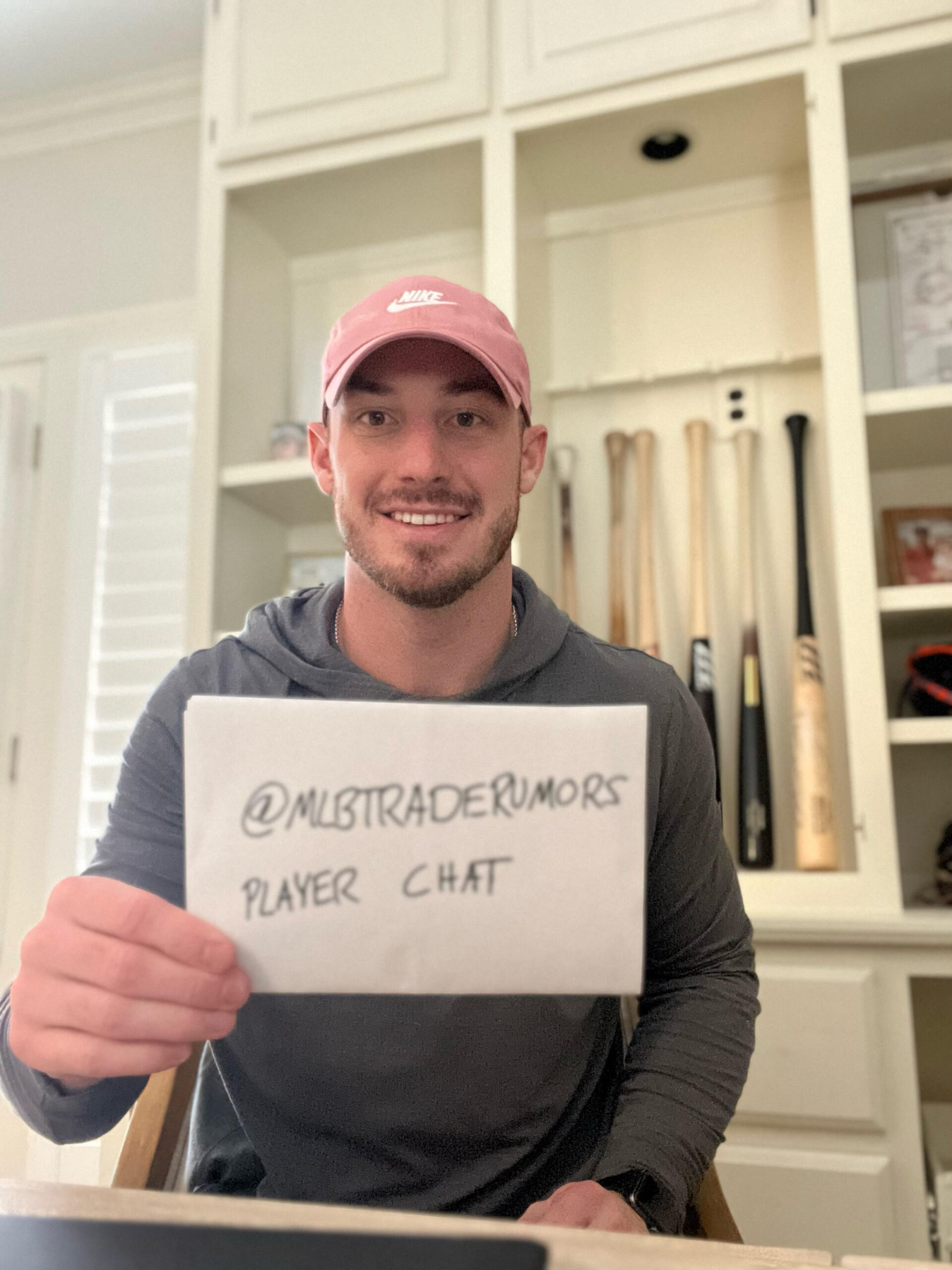
Read The Transcript Of Our Chat Hosted By MLB Outfielder Brent Rooker
After being drafted by the Twins in the 38th round out of Mississippi State, Brent Rooker went back to college for another year. That move paid off, as the Twins took him again in the first round in 2017. At the time, Baseball America ranked the outfielder/first baseman as a top 100 prospect in the game, writing, “He projects as a middle-of-the-order weapon with power as a strong carrying tool.”
Rooker reached Triple-A in 2019. The minor league season was cancelled in 2020, but Rooker was able to make his MLB debut in September of that year. In his sixth game in the Majors, he went deep off the Cardinals’ Daniel Ponce de Leon. Unfortunately, Rooker’s forearm was fractured on a hit-by-pitch not long after that.
The surgery for that injury went well, and Rooker was back in the bigs in April of ’21. The left fielder showed promise that year, popping nine home runs in 213 plate appearances for the Twins. One highlight: a four-hit effort against the Rays, including a home run off Evan Phillips.
The Padres were drawn to Rooker, as they acquired him along with Taylor Rogers in the April 2022 trade that sent Chris Paddack and Emilio Pagan to Minnesota. After a few brief big league looks for San Diego, the Padres traded Rooker to the Royals in August of ’22 for Cam Gallagher. Finally, in November of last year, the A’s claimed Rooker off waivers from the Royals.
A whirlwind 2022 season saw Rooker as a member of four different organizations. He still managed to hit 28 home runs in 365 plate appearances at Triple-A. Rooker joins an A’s team that currently projects to have Ramon Laureano and Seth Brown at the outfield corners and Aledmys Diaz at DH. The 28-year-old Rooker appears to have little left to prove at Triple-A and is in a good place to compete for playing time as a right-handed power bat.
As Brent notes, he’s at least above replacement level at Twitter, and you should follow him @Brent_Rooker12. Brent volunteered to chat with MLBTR readers today, and we’re happy to have him! Click here to read the transcript of the chat, where Brent talks about everything from the mental weight of a serious injury, the biggest gaps between Triple-A and the Majors, his favorite teammates/toughest opponents, clubhouse food spreads and more!
A’s Claim Brent Rooker
The Athletics announced Thursday that they’ve claimed outfielder/first baseman Brent Rooker off waivers from the Royals. Kansas City designated Rooker for assignment earlier in the week.
Rooker, 28, was the No. 35 overall draft pick by the division-rival Twins back in 2017. The hope was that the former Mississippi State slugger could be a quick-the-Majors source of pop for the Twins, and that proved to be partially true. Rooker mashed his way through the minor leagues, reaching Triple-A by the 2019 season and hitting .281/.398/.535 through 274 plate appearances there. Minnesota gave him a brief big league look during the shortened 2020 season, and Rooker responded with a 6-for-19 showing, including a homer and a pair of doubles.
Unfortunately, that brief production didn’t carry over into a larger sample in 2021. Rooker remained productive in Triple-A (.245/.367/.564, 20 homers in 62 games) but managed only a .201/.291/.397 slash with an ugly 32.9% strikeout rate in 213 plate appearances at the MLB level in 2021. The Twins sent Rooker to San Diego alongside Taylor Rogers in the trade that brought Chris Paddack and Emilio Pagan to Minnesota, and Rooker again thrived in Triple-A while struggling in limited MLB action.
Overall, Rooker is a .200/.289/.379 hitter in 270 Major League plate appearances but a .274/.387/.590 hitter in 906 Triple-A plate appearances. While he’s seen time both in left field and at first base in his career, however, scouting reports at the time of the draft called it a stretch for him to ever be a full-time outfielder, and that’s just how things have played out so far. In just 386 2/3 innings in the outfield corners, Rooker has posted -11 Defensive Runs Saved, -7 Outs Above Average and a -4.8 Ultimate Zone Rating. Ultimately, if he’s to solidify himself in the big leagues, his bat will need to carry the day, and he’ll likely need to move to either first base or designated hitter.
Rooker has one minor league option year remaining, so the A’s will be able to shuttle him between Oakland and Triple-A Las Vegas in 2022 — assuming he lasts the whole offseason on the 40-man roster. Oakland is as good a landing spot as Rooker could have hoped for, given that the rebuilding A’s only have two set outfielders in the out-of-options Cristian Pache and Ramon Laureano — the latter of whom could be traded. Lefty-swinging Seth Brown will rotate between the outfield corners, first base and DH, but there’s clearly playing time available for Rooker if he can hit his way into a roster spot next spring.
Royals Announce Several Roster Moves
The Royals announced Tuesday that they’ve designated lefty Jake Brentz, right-hander Nate Webb and first baseman/outfielder Brent Rooker for assignment. Their roster spots will go to right-hander Alec Marsh, catcher Freddy Fermin and outfielder Diego Hernandez, each of whom has been selected to the 40-man roster in advance of tonight’s deadline to protect players from the Rule 5 Draft.
Kansas City also announced a one-year deal with non-tender candidate Ryan O’Hearn, avoiding arbitration and ostensibly locking him into a roster spot for the 2023 season. Lynn Worthy of the Kansas City Star reports that O’Hearn will be guaranteed $1.4MM and can earn another $250K of bonuses. O’Hearn was paid $1.3MM in 2022 and is controllable through the 2024 season via arbitration.
Brentz, 28, had a nice rookie season with the Royals in 2021 when he pitched to a 3.66 ERA with a 27.3% strikeout rate in 64 innings of relief. A 13.3% walk rate always served as a red flag, but as a bat-missing lefty with an average fastball of 97 mph and a 49% ground-ball rate, Brentz showed plenty of promise. His 2022 season was unfortunately blown up by injury, however. Brent tossed just 5 1/3 innings with a woeful 9-to-11 K/BB ratio and a 23.63 ERA (14 earned runs) before undergoing surgery to repair a torn UCL in his pitching elbow. That procedure, performed in late June, ended his season.
Webb, 25, was limited to just 33 1/3 innings across three minor league levels this season, struggling at each stop and spending more than two and a half months on the injured list. Although he was healthy to finish out the season, Webb concluded his 2022 campaign with a combined 9.99 ERA and 39-to-27 K/BB ratio in those 33 1/3 frames.
Rooker, acquired on Aug. 2 in a trade that sent backup catcher Cam Gallagher to the Padres, appeared in only 14 games with the Royals and went 4-for-25 with four walks and a double. Drafted by the division-rival Twins with the No. 35 overall pick back in 2017, Rooker was a bat-first prospect touted for his plus raw power but has managed just a .200/.289/.379 batting line in 270 Major League plate appearances. He’s a career .274/.387/.590 hitter in parts of three Triple-A seasons, so it’s possible another club will take a look on waivers or in a minor trade — particularly since he still has a minor league option year remaining.
The Royals again opted against non-tendering the now-29-year-old O’Hearn, despite the fact that four full seasons have elapsed since his productive rookie effort in 2018. Since hitting .262/.353/.597 in 170 plate appearances as a 24-year-old rookie, the lefty-swinging O’Hearn has managed only a .211/.282/.351 slash in 901 plate appearances. Even with a pair of younger, highly touted first base prospects in Vinnie Pasquantino and Nick Pratto needing playing time next season, though, Kansas City will continue to hope O’Hearn can eventually recapture that rookie form and factor into the first base/DH mix.
Padres, Royals Swap Brent Rooker, Cam Gallagher
The Padres have traded outfielder Brent Rooker to the Royals for catcher Cam Gallagher, according to Dennis Lin and Ken Rosenthal of The Athletic.
Rooker, 27, is an outfielder who has hit well at every level he’s played, with the notable exception of the big leagues. Drafted by the Twins in 2017, he made it to the bigs in 2020 and got into 65 games as a Twin before heading to the Padres in the deal Chris Paddack–Taylor Rogers trade.
After getting into two games as a Padre this year, he now has 67 MLB games on his ledger, with a tepid .205/.290/.400 line. That production is about 10% below league average, as evidenced by his wRC+ of 90. But he’s always done better at other levels, including this year. In 61 Triple-A games, he’s hit 19 home runs and slashed .272/.385/.605 for a wRC+ of 137.
Despite his lack of success at the big league level, the Royals are clearly willing to be on that minor league track record. Rooker still has options and will finish this season between one and two years of MLB service time, meaning the Royals have time to figure out how to maximize his talents. With Whit Merrifield and Andrew Benintendi having been traded in recent days, Rooker will help shore up some of the outfield depth that has been subtracted.
As for Gallagher, 29, he was a second round pick of the Royals back in 2011 and has been with them since. He made his MLB debut in 2017 and has largely served as backup to Salvador Perez in that time. However, with this year’s promotion of MJ Melendez, it seems he was nudged out of the plans for KC. In 171 career games, he has a slash line of .240/.302/.355, wRC+ of 77. Due to his strong defensive work, he’s produced 1.5 wins above replacement in that time, according to FanGraphs. For the Padres, he figures to serve as depth behind Jorge Alfaro and Austin Nola, with prospect Luis Campusano around as well.
Injury Notes: Padres, Rangers, Rockies
The Padres placed Mike Clevinger and Adrian Morejon on the COVID injured list, recalling Ray Kerr and Reiss Knehr from Triple-A, per the team. Kerr, 27, will give the Friars a third southpaw out of the bullpen behind closer Taylor Rogers and Tim Hill. Though Clevinger has been starting, Knehr, 25 will probably pitch in relief for now. Knehr has been tagged with a 5.84 ERA across 51 2/3 innings in Triple-A so far this season while making 10 starts and appearing twice in relief. The Padres rotation currently goes six deep, even with Clevinger out. Brent Rooker was also added to the active roster to serve as the 27th man for today’s doubleheader.
- Rangers outfielder Steele Walker was placed on the COVID injured list, per the team. Zach Reks has been placed on the active roster to take his place. This will be Reks’ third go-round with the Rangers already this summer, though he’s been limited to just 22 plate appearances over nine games. Reks has torn it up for Round Rock, however, slashing .340/.433/.631 in 120 Triple-A plate appearances. Walker was only recently recalled for his big league debut. He’s gone just 1-for-14 at the plate with a pair of walks over five games. His lone hit was a solo shot. Walker, 25, was a former second-round pick of the White Sox, acquired straight-up in the deal for Nomar Mazara in December of 2019.
- The Rockies have placed southpaw Ty Blach on the 15-day injured list with a left wrist sprain, per the team. Ryan Feltner was recalled from Triple-A to take his roster spot. Justin Lawrence was also added to the active roster to serve as the 27th man for today’s twin bill. Blach, 31, has made 15 appearances on the year (one start) with a 6.61 ERA over 31 1/3 innings.
Injury Notes: Clevinger, Kittredge, Kremer, Gregorius
The Padres announced that right-hander Mike Clevinger has been reinstated from the injured list, with outfielder Brent Rooker being optioned in a corresponding move. After a lengthy absence from the majors while recovering from Tommy John surgery, Clevinger had to return to the IL after just three starts due to a triceps strain. Thankfully, he only required a minimum stay on the shelf and is quickly back on the roster, starting today’s game.
While many teams around the league are dealing with mounting injuries to their pitching staffs, the Padres now have an embarrassment of riches when it comes to their starting rotation. Clevinger joins Yu Darvish, Sean Manaea, Joe Musgrove, MacKenzie Gore and Blake Snell, with Nick Martinez likely getting bumped into a long-relief role. The club is off to a great start, sporting a record of 32-21, just three games back of the Dodgers in the NL West. The strength of their rotation has played a big role in that, as their collective 3.11 ERA is fourth-best in all of baseball, trailing only the Yankees, Dodgers and Astros.
Some other IL reinstatements from around the league…
- The Rays announced that righty Andrew Kittredge has been reinstated from the injured list, with fellow righty Calvin Faucher being optioned to make room for him. Kittredge was slowed by some lower back tightness but is able to return after a minimum stay on the injured list. Last year, he threw 71 2/3 innings with a 1.88 ERA, 27.3% strikeout rate, 5.3% walk rate and 53.5% ground ball rate. That success earned him a key role in the bullpen, as he eventually earned eight saves and seven holds. He wasn’t able to continue that this year, possibly due to this back injury. Over 18 innings, his ERA is an even 3.00, with a 19.7% strikeout rate and 44.2% grounder rate, though he’s limited walks to just 1.5% of batters faced.
- The Orioles reinstated righty Dean Kremer from the injured list today, with fellow righty Denyi Reyes being optioned in a corresponding move. Kremer landed on the injured list back in April due to an oblique strain. He is starting today’s ballgame for the O’s, which will be his season debut. His MLB time has been on the rough side so far, as his career ERA is currently 6.84 through 72 1/3 innings. However, while rehabbing from this injury, he’s thrown nine scoreless innings in the minors with a whopping 18 strikeouts against just two walks.
- The Phillies announced that they have reinstated Didi Gregorius from the IL, with Nick Maton trading places with him, heading to the IL due to a right shoulder sprain. Gregorius returns after about a month on the IL due to a left knee sprain. Prior to that, he was hitting .288/.338/.356 on the season. The resulting 97 wRC+ indicates that his bat has been about 3% worse than league average, though it’s still a big improvement over last year’s wRC+ of 68. Maton was just recalled a few days ago to provide help in the middle infield when Jean Segura landed on the IL, but will now join him on the shelf after just two games. Without those two options, it’s likely that Gregorious, Bryson Stott and Johan Camargo will now share the middle infield duties.