
Nationals’ Rizzo On Offseason Spending, Rotation, CJ Abrams
Nationals president of baseball operations and general manager Mike Rizzo said recently that his club will be on the lookout for middle-of-the-order bats this offseason, in an effort to supplement a growing young core. The Nats would reportedly “love” a reunion with Juan Soto — unsurprisingly so; who wouldn’t at least be interested? — and the free agent market will have big-name bats ranging from corner infielders Pete Alonso, Alex Bregman and Christian Walker, to shortstop Willy Adames, to slugging corner outfielders like Anthony Santander and Teoscar Hernandez.
Multi-year free agent deals of any real magnitude haven’t been a focus for the Nationals throughout the past three years of their rebuild, but Rizzo suggested in his weekly appearance on 106.7 The Fan’s “Sports Junkies” show that a return to the deeper waters of free agency could be possible this winter (Audacy link to the entire 14-minute interview). Asked if ownership “will be open to going out and giving bigger money to guys who are established” (as opposed to the recent run of one-year deals and reclamation-project hitters), Rizzo replied:
“I think if the opportunity arises and the right fit arises, I don’t see any reason they wouldn’t. They’ve done it in the past when there’s players out there that are available that fit what we’re looking for.”
The Lerner family, which owns the Nats, has indeed been willing to spend at top-of-the-market levels in offseasons past. Washington has twice doled out more than $200MM on single free-agent deals: Max Scherzer‘s seven-year, $210MM contract and Stephen Strasburg‘s seven-year, $245MM pact. The latter of those two signings, of course, did not pan out. The former stands as one of the best and most successful major free agent signings in history. The Lerners have also given the green light to another pair of nine-figure signings in Patrick Corbin (six years, $140MM) and, way back in 2010, Jayson Werth (seven years, $126MM — a massive contract at the time).
Certainly, the Nationals haven’t spent at the level that will be required to sign Soto this offseason, but Soto figures to command a historic contract. No team has really gone to that length — arguably not even the Dodgers, given the unique and deferral-laden structure of the 10-year contract they gave to Shohei Ohtani last winter. (MLBTR’s Darragh McDonald and I discussed the possibility of a Nationals pursuit of Soto on this morning’s episode of the MLBTR Podcast, which was recorded prior to Rizzo’s comments.)
With regard to the rest of the free agent class, none of Bregman, Alonso, Santander, Hernandez or any of the other big bats in free agency figure to exceed the limits at which the Nationals have spent in the past. That doesn’t ensure that the Nationals will pony up for a top-of-the-market bat, but there’s precedent for them spending at or even in excess of most of those levels. Add in the fact that the only guaranteed contracts on the Nationals’ books beyond the current season are the remaining two seasons of that Strasburg deal and Keibert Ruiz‘s eight-year, $50MM extension (spanning the 2023-30 seasons), and there’s room for the Nats to engage with any free agent they deem a fit — Soto included.
Rizzo noted that expenditures to bolster the lineup needn’t only come on the free-agent side of things. He listed both the trade level and the “development level” of player acquisition as well, noting that between the three he expects an “active, interesting winter” for his club. Rizzo stopped short of declaring the team’s rebuild entirely over and proclaiming the 2025 campaign a clear win-now season, but the general tone of his comments Wednesday painted a team on the rise with increased expectations of contending sooner than later.
Much of that has to do with the strides Washington has seen from its collection of in-house starting pitchers, for whom Rizzo effused praise. Right-hander Jake Irvin and lefties MacKenzie Gore and Mitchell Parker will all finish with 30-plus starts and more than 150 innings. Southpaw DJ Herz, called up later in the season, will close out the year with 19 big league starts, in all likelihood.
All four pitchers currently have an ERA between 4.04 and 4.30. Broadly speaking, their earned run averages have ticked up late in the season as their workloads have reached previously uncharted waters. Each is already at least 27 innings past his previous single-season career-high mark. In Irvin’s case, his 183 1/3 innings are 40 more than his previous highwater mark. Some fatigue and growing pains are to be expected. Still, Rizzo made clear that the simultaneous development of that quartet is among the organization’s biggest successes this season and serves as “a great measuring stick going forward.”
Presumably, the Nats hope that top pitching prospect Cade Cavalli, who missed the 2023 season and much of 2024 while recovering from Tommy John surgery, can join that group in 2025. It’s a solid-looking collection of arms, although given the general volatility and attrition rate of pitchers, it’s easy to envision Rizzo and his staff considering at least one veteran addition this winter to supplement the group and safeguard against injuries and/or regression. Rizzo didn’t specifically call out rotation support as an area of need, but virtually any team would be reluctant to head into a season with five starters under the age of 28 and with three or fewer years of big league service atop the depth chart.
Rizzo was also naturally asked about the recent demotion of shortstop CJ Abrams, whom the Nationals optioned over the weekend. At the time of the move, the team only indicated that it was for an off-the-field issue. Subsequent reports have suggested that Abrams’ demotion was a disciplinary measure after he stayed out all night at a casino the night before a day game against the Cubs. Rizzo unsurprisingly declined to delve into specifics but confirmed it was an off-field issue and voiced support for Abrams moving forward:
“It was not performance-based. We felt it was in the best interest of the player and the organization to do so. It’s an internal issue that we’re going to keep internal. … It’s not the end of the world for CJ. It’s not the end of the world for the Nationals. It’s something that happens over the course of time, especially with young players. We love CJ. We care for CJ. We’re in constant communication with he and his agent, and we still have a great relationship.”
“…We have a standard here. We’ve had it for a lot of years. When players don’t reach those standards, we have to do what’s in the best interest of the organization. … And when players fail to reach those standards, we have to do something to get them back into the mode of Nationals, and teammate, big leagues. We felt that it was warranted in this case. Like I said, not the end of the world. Not the end of CJ Abrams. Not the end of the Nats.”
Abrams, who’ll turn 24 in a couple weeks, came to the Nationals alongside Gore, James Wood, Robert Hassell III and Jarlin Susana in the trade sending Soto to the Padres. The former top prospect looked to be in the midst of a full-fledged breakout for the first half of the season, slashing .282/.353/.506 through early July. He’s since fallen into a protracted slump, hitting just .191/.254/.321 over his past 236 turns at the plate. (He’d picked up the pace again of late, going 11-for-28 with a pair of homers and three doubles in his past eight games.)
The demotion to the minors won’t cost Abrams in terms of big league service, arbitration trajectory or free agent timeline. He’d already accrued a full year of service in 2024 at the time he was sent down. He’ll finish the year with 2.130 years of service, making him a very likely Super Two player who’ll be eligible for arbitration four times rather than the standard three. The first of those four — assuming he indeed qualifies as a Super Two player — will come this offseason. He’s under club control through the 2028 season.
Nationals Place Trevor Williams On Injured List, Recall DJ Herz For MLB Debut
2:20pm: Williams spoke to the Nationals beat and said while there’s no firm timetable for his return, he’ll be shut down from throwing entirely for at least the next two weeks (X link via MASNsport.com’s Mark Zuckerman). That effectively rules out any hope of a minimum 15-day stint on the injured list for the righty.
11:10am: The Nationals announced Tuesday that they’ve placed right-hander Trevor Williams on the 15-day injured list due to a strained flexor muscle in his right forearm. Left-hander DJ Herz has been recalled from Triple-A Rochester and will make his MLB debut when he starts tonight’s game.
Williams is in the midst of a career year at age 32, having pitched 56 1/3 innings of 2.22 ERA ball out of the Washington rotation. He’s achieved those results in spite of a below-average 21% strikeout rate and benefited from both a .270 average on balls in play and minuscule 3.3% homer-to-flyball rate — all of which signal the potential for regression. Nonetheless, Williams’ performance thus far has been a major driving factor behind the Nationals exceeding preseason expectations and hanging around an NL Wild Card race that is largely populated by sub-.500 clubs at the moment.
The Nats didn’t provide a timetable for Williams’ return. That he’s dealing with a muscle strain as opposed to a damaged flexor tendon is perhaps a silver lining, but that doesn’t preclude a notable absence in and of itself. Teammate Josiah Gray is dealing with the same injury and has been on the shelf for nearly two months at this point. All injuries cases are different, and we don’t know how the placement and severity of Williams’ strain compares to that of Gray, but Gray’s injury is evidence that Williams is hardly assured a swift return to the mound.
The timing of the injury is particularly poor for both the team and Williams himself. If Washington were to hang around and make a Wild Card push, one would presume a healthy Williams would play a notable role. Even if he saw his pristine ERA regress toward the vicinity of his 3.97 SIERA, he’d still be a useful veteran presence on the staff. And if the Nats were to fall well out of the postseason picture, it’s easy to envision Williams becoming a sought-after trade chip. His injury throws a wrench into both scenarios.
On a personal level, it’s also poorly timed for the pitcher himself. Wiilliams is playing out the second season of a two-year, $13MM contract and is slated to reach free agency at season’s end. He landed that $13MM guarantee in the 2022-23 offseason on the heels of a year spent primarily in a swingman role with the Mets. Had Williams reached the market a second time on the heels of a two-year run as a starter — the second season being a career-best performance — he’d have been in line for a more substantial payday, even heading into his age-33 season. It’s still possible he could return in a relatively timely manner, pitch well and reach that endgame, but the injury muddies his chances of doing so.
Turning to the 23-year-old Herz, he’ll get his first big league start less than a year after being acquired in the trade that sent Jeimer Candelario from the Nats to the Cubs. The 2019 eighth-rounder has had mixed results in the minors this year. On the one hand, his 3.75 ERA and 27.5% strikeout rate in Rochester are both strong marks. On the other, Herz has averaged just four innings per start and walked an astounding 19% of his opponents. Command has always been a weakness for the 6’2″ lefty; he’s never walked fewer than 13% of his opponents in a full season.
The Nats have already had one lefty make his MLB debut and greatly exceed expectations this season. They’ll hope that Herz can follow in the footsteps of teammate Mitchell Parker in that regard. Given the state of the rebuilding Nationals and the lack of other upper-minors pitching depth, Herz could have a fairly long runway to prove himself in the event that Williams and/or Gray remain sidelined for a significant period. Top prospect Cade Cavalli stands as one potential alternative, but he’s being monitored carefully in his return from 2023 Tommy John surgery. Prospect Jackson Rutledge and last season’s Rule 5 pick, Thaddeus Ward, are both on the 40-man roster in Rochester but both have ERAs north of 6.00 in Triple-A this season.
Nationals Designate Dominic Smith For Assignment
The Nationals announced Tuesday that they’ve designated first baseman Dominic Smith and right-hander Cory Abbott for assignment. Washington has also granted righty Andres Machado his release so that he can pursue an opportunity in Japan. That slate of moves clears space on the 40-man roster for lefties DJ Herz and Mitchell Parker as well as righties Cole Henry and Zach Brzykcy. That quartet of pitchers is now protected from next month’s Rule 5 Draft.
Smith, 28, was a first-round pick, longtime top prospect and (more briefly) a quality run producer for the division-rival Mets prior to being non-tendered in the 2022-23 offseason. From 2019-20, Smith treated the Mets to a stellar .299/.366/.571 batting line in 396 trips to the plate. He swatted 21 homers and connected on 31 doubles in that time before stumbling to a .643 OPS over his next two seasons and being cut loose. Smith’s lone year in D.C. brought about a rebound to some extent, as he turned in a .254/.326/.366 batting line with a dozen homers, but that wasn’t enough for the Nats to retain him and offer him a raise in arbitration.
Also 28 years old, Abbott has spent the past two seasons with the Nats. The former Cubs farmhand has logged 87 1/3 innings of 5.87 ERA ball in the Majors with Washington, fanning 21.3% of his opponents against an 11% walk rate. Abbott posted strong minor league numbers up through the Double-A level and once ranked as one of the Cubs’ more promising pitching prospects, but he’s now struggled in both Triple-A (5.46 ERA in parts of three seasons) and the big leagues. He’s out of minor league options as well, which could make it tough for another club to claim him.
Both Abbott and Smith will be traded or placed on waivers within the next week. Both can become free agents if they’re unclaimed.
As for Machado, he’ll start the next chapter of his career overseas — likely on a seven-figure guarantee that wouldn’t have been available to him in North American ball. He’s out of minor league options and not yet arbitration-eligible, so he was likely to lose his 40-man roster spot and spend next year trying to work his way back to the big leagues.
From 2021-22, Machado was a quietly solid member of the Washington bullpen, tallying 91 appearances and 95 innings of 3.41 ERA ball. He benefited from a .264 average on balls in play and had success in spite of pedestrian strikeout and walk rates of 18.3% and 9.9%, respectively.
Some degree of regression appeared in store, but perhaps not to the extent he saw in 2023 when he was torched for a 5.22 ERA in 50 innings despite marked improvements in his K-BB profile (20.8% strikeout rate, 6.3% walk rate). While Machado improved in terms of missing bats and limiting free passes (to say nothing of a 1 mph uptick in fastball velocity, to 96.7 mph on average), he also become staggeringly homer-prone; in 50 innings he served up 12 long balls — 2.34 homers per nine frames (and a home run on 24% of the fly-balls he yielded). He’ll take that plus velocity and improved command overseas, though it’s not yet clear precisely which team he’ll join.
All four of the prospects added to the Nationals’ 40-man roster today rank among their top 30 prospects at MLB.com. Herz is 22 years of age, while the others are all 24. Herz was the Cubs’ eighth-round pick in 2019 and came to the Nats by way of this summer’s Jeimer Candelario trade. He punched out nearly a third of his opponents while working as a starter in Double-A but also issued walks at almost a 14% clip. Injuries have plagued the career of Henry, a 2020 second-round pick with a potentially plus slider and plus-plus changeup. He pitched just 33 1/3 innings this past season. Similar to Herz, Parker is a lefty who missed bats in droves in the upper minors but did so with shaky command. Brzykcy is a bullpen prospect with a power fastball who missed the 2023 season due to Tommy John surgery.
Big Hype Prospects: Eder, Herz, Rincones, Montgomery, Schwartz
After another week of action, a spate of strikeouts has cost Jakob Marsee his spot atop the hitter leaderboards. James Triantos has slipped in above him. Top pitcher status is harder to judge. Braden Nett, Davis Daniel, Ricky Tiedemann, and Jackson Jobe all have a case.
Let’s see who else merits a look.
Five Big Hype Prospects
Jake Eder, 25, SP, CWS
(A/AA) 56.2 IP, 11.1 K/9, 5.7 BB/9, 6.99 ERA
A southpaw pitching prospect who was once as blue chip as they come, Eder hasn’t recovered well from Tommy John surgery. While his elbow is healthy, he’s lost velocity, movement, and command since his prospect peak. The White Sox dealt Jake Burger for Eder at the trade deadline and likely wish they could ctrl-z that decision. Following the swap, Eder coughed up an 11.42 ERA in five starts for the Sox Double-A affiliate.
On a positive note, Eder has a 3.24 ERA in 8.1 AFL innings – good for ninth-best in the league. He’s coughed up a pair of home runs to go with eight walks and 10 strikeouts. The book isn’t closed on Eder, but he needs to take an active role in writing the next chapter. The current chapter is titled TINSTAAPP.
DJ Herz, 22, SP/RP, WSH
(AA) 94.1 IP, 12.7 K/9, 5.4 BB/9, 4.01 ERA
Another southpaw traded at the deadline, Herz is widely seen as a future reliever due to a below-average fastball and breaking ball. His command is also poor. Where he stands out is his changeup. It’s a carrying pitch that should yield a Major League future. Herz continues to work as a starter in the AFL where he’s posted 18 strikeouts in 11 innings. Alas, his command woes (six walks) continue to limit his ability to pitch deep into outings. We await to see if his stuff plays up out of the bullpen.
Gabriel Rincones Jr., 22, OF, PHI
(A/A+) 533 PA, 15 HR, 32 SB, .248/.351/.427
A third-rounder in the 2022 draft, Rincones Jr. is best known for high-caliber exit velocities. He’s expected to wind up at first base due to suspect corner outfield defense and poor speed. Despite a lack of wheels, Rincones has shown aptitude on the bases – a trait that can sometimes portend a gamer’s mentality. His bat should carry him to the Majors without any major adjustments. At the very highest levels, he might prove too susceptible to breaking stuff. With players of this profile, breaking ball recognition is usually the difference between a big leaguer and a Quad-A guy. Rincones is among the top 10 AFL hitters with a .327/.462/.577 triple-slash.
Benny Montgomery, 21, OF, COL
(A+) 497 PA, 10 HR, 18 SB, .251/.336/.370
A former eighth-overall pick, Montgomery has seen his prospect status rapidly erode since draft day. Speed remains his best trait, though he also demonstrates above-average power. His contact is held back by funky mechanics. Most organizations – the Rockies among them – aren’t adept at developing players with a non-standard approach. They’re often left to sink or swim on their own. Encouragingly, Montgomery has cut down on his swinging strike rate at every level. He needs to continue that growth while doing something about the extreme 62.6 percent ground ball rate he posted this season. He also needs to improve his outfield defense where his double-plus speed helps him to recover from poor jumps and routes. He’s slashing .373/.468/.510 in the AFL, albeit with 17 strikeouts in 60 plate appearances.
JT Schwartz, 23, 1B, NYM
(AA) 277 PA, 4 HR, 4 SB, .302/.383/.437
Schwartz doesn’t have much of a shot with the Mets. He’s likely in the AFL to showcase him in front of other teams. He has the look of a future big leaguer – the sort who helps rebuilding teams trudge through another season. While Schwartz has the physical size to hit for power, his current approach is built around batting average and OBP. He’d draw more attention in the pre-Moneyball era. In 45 plate appearances, he has six doubles and two home runs along with a 1.011 OPS.
Three More
Liam Hicks, TEX (24): Hicks has low-key paced the league on the hitting side including a six-hit day. Despite the heady results, he’s not particularly impactful with the bat. His catching is of the third-string variety – he’s struggled to control the running game throughout his entire career. Other aspects of his defense draw critiques. Without an obvious position, Hicks looks like a ‘tweener whose plus discipline and contact rate could hide his shortcomings.
Kyle Manzardo, CLE (23): Manzardo, who we’ve already discussed ad nauseam in past episodes, leads the league with five home runs and 11 extra base hits. The power adjustment he showed upon joining the Guardians remains in evidence.
Oliver Dunn, PHI (26): A Rule 5-eligible second baseman, Dunn is making a case for consideration. He popped 21 home runs with 16 steals this summer while showing plus plate discipline. He’s strikeout-prone, but the power breakout renders that more forgivable. In 46 AFL plate appearances, he’s swiped nine bases to go with a 1.076 OPS, three doubles, three triples, and a dinger.
Did I miss a detail or nuance? DM me on Twitter @BaseballATeam to suggest corrections.
Cubs Acquire Jeimer Candelario
Jeimer Candelario is headed back to Chicago. The Cubs announced they acquired the switch-hitting third baseman from the Nationals for prospects DJ Herz and Kevin Made. The Cubs had an open 40-man roster spot after outrighting Edwin Ríos yesterday.
Candelario was one of the best rental hitters on the market after a strong four months in Washington. It was exactly what the Nats had envisioned when signing him to a one-year, $5MM free agent contract last winter.
Originally signed by the Cubs as an amateur more than a decade ago, Candelario made his big league debut with Chicago. His first stint on the North Side was short-lived. He played in five games in 2016 and 11 more the following season before being dealt to the Tigers in the Justin Wilson trade, as the Cubs pushed in young talent for veterans while trying to defend their World Series title.
Candelario got his first extended run down the stretch in Detroit and was an everyday player by the following season. He was a below-average regular for the first two years but took a significant step forward in 2020. Candelario carried that over a full schedule the following season, when he led the majors in doubles. Between those two seasons, he hit .278/.356/.458 in more than 800 trips to the plate.
As was the case for essentially everyone in the Detroit lineup, things fell apart in 2022. Candelario slumped to a .217/.272/.361 line over 124 games. The Tigers non-tendered him in lieu of paying around $7MM for his final season of arbitration eligibility. While it’s a move Detroit probably wishes they had back in hindsight, the subsequent $5MM free agent deal indicates the market didn’t value Candelario as a $7MM player just a few months ago.
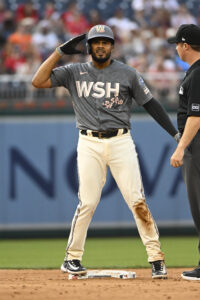
The 29-year-old has certainly elevated his stock since that point. He has more or less regained his 2020-21 form. Candelario hit .258/.342/.481 through 419 plate appearances with Washington. He connected on 16 homers and 30 doubles, ranking fifth in the majors in the latter category. He’s walking at a roughly average 8.6% clip against a decent 21% strikeout rate.
Candelario has been better from the left side of the plate this season, a departure from his early-career work. He’d typically fared better against southpaws but now has similar platoon splits overall. Since the start of 2020, he’s a .253/.334/.438 hitter against right-handed pitching and owns a .256/.330/.437 line versus lefties. That well-rounded offensive production adds to a Chicago lineup built mostly on strong depth as opposed to impact talent aside from Cody Bellinger.
While his profile has mostly been built on offense, Candelario has also gotten solid reviews from public metrics for his third base defense this year. Defensive Runs Saved has pegged him two runs above par in 834 1/3 innings of hot corner work, while Statcast has estimated him as four runs above average. Candelario had gotten mixed to below-average marks throughout his time in Detroit but should at least be a solid gloveman in Chicago.
He has some experience at first base as well but hasn’t played anywhere aside from third since 2020. The Cubs could plug him in at either spot but will presumably use him more often at the hot corner. Nick Madrigal, Patrick Wisdom, Christopher Morel and Miles Mastrobuoni have been part of a revolving door at the position. Morel has raked but isn’t a good defender. Wisdom hits for power but doesn’t consistently put the ball in play; Madrigal has the opposite profile. Candelario is the most balanced of the group.
It’s a modest financial addition for Chicago. Candelario is due around $1.67MM in salary through year’s end. He’d tack on another $200K in incentives if he reaches 600 plate appearances, though that’s also fairly modest. As calculated by Roster Resource, the Cubs have a luxury tax number a bit north of $228MM.
That’s a little less than $5MM shy of the $233MM base threshold. It had seemed the Cubs were trending towards staying below that mark and selling away veteran pieces, but a recent eight-game win streak completely changed the calculus. The addition of one of the top rental hitters available affirms their status as buyers, which had already become clear when they took Bellinger off the trade market yesterday. They also added some middle relief depth tonight in acquiring José Cuas from Kansas City and figure to look for more impactful bullpen upgrades in the next 24 hours.
Candelario’s time in Washington proved fruitful for both parties. He revitalized his stock and now looks positioned for a much more lucrative free agent trip. He’ll be one of the top hitters available in a below-average class for bats. The Nats never seemed likely to issue him a qualifying offer, but the trade officially takes that off the table. Players dealt midseason are ineligible for the QO, so Candelario will hit the market unencumbered by draft compensation.
The club adds a pair of players to a continually improving farm system. Made, 20, is a right-handed hitting shortstop from the Dominican Republic. He didn’t appear on Chicago’s midseason top 30 prospects at Baseball America but ranked 19th on the organizational list at FanGraphs. The outlet credited the 5’9″ infielder with roughly average tools and suggested he has an outside shot to be an everyday shortstop. He’s hitting .240/.328/.355 over 300 plate appearances with High-A South Bend. He hit just three homers there but walked at a solid 10% clip against a lower than average 18% strikeout rate.
Herz, 22, has gotten 14 starts with Double-A Tennessee. The former eighth-round pick owns a 3.97 ERA across 59 innings, striking out an excellent 30.4% of opponents but walking 14% of batters faced. He was 19th among Cubs’ prospects at Baseball America and 22nd at FanGraphs. He sits in the low 90s with his fastball and has an excellent changeup, but the obvious control woes lead most evaluators to point to a bullpen future. There’s little harm for the Nats in letting him continue to start in the minors. Herz and Made will have to go on the 40-man roster this offseason to stay out of the Rule 5 draft.
It’s the first of likely multiple deadline deals for the rebuilding Nats. Candelario was their most obvious trade chip. Middle reliever Kyle Finnegan could be on the move as well. Washinton’s top realistic trade piece would be outfielder Lane Thomas, though it remains to be seen how eager they are to deal him.
Michael Cerami and David Kaplan of Bleacher Nation reported the Cubs and Nationals were in discussions about Candelario. Ken Rosenthal of the Athletic first reported Candelario was being traded to Chicago. Cerami was first with Herz and Made going back to Washington.
Image courtesy of USA Today Sports.