
Indians’ Recent Struggles Lead To Difficult Deadline Decisions
A couple weeks ago, the Indians season seemed to hit a crossroads. The team was in a good place in the standings. As recently as June 26, Cleveland was sporting a 41-32 record, sitting only a game and a half behind the AL Central-leading White Sox. They were the only real threat to Chicago in an otherwise bad division.
The state of the roster, though, told a different story. Cleveland’s offense has underwhelmed all year, with the team’s strong run prevention keeping them in the race. The Indians were dealt a series of injuries to their top three starters — Zach Plesac, Shane Bieber and Aaron Civale — in fairly rapid succession, though. That left an unproven, inexperienced group taking the bump without the benefit of a high-powered lineup to back them up.
Not surprisingly, it’s been tough sledding for Cleveland in recent weeks. The Indians have gone just 4-10 over their last fourteen games, falling 7.5 back of the White Sox. They’re a more manageable four games back in the Wild Card race, but their skid has raised some questions about the team’s ability to stay in contention. Plesac returned from the IL this week, but the Indians are still without Bieber and Civale and continue to have questions about the lineup. FanGraphs gives the Indians just a 7.1% chance of reaching the postseason at this point, with their odds of winning the division down to 3.5%.
The front office is no doubt aware of those dwindling playoff odds. Indeed, Jon Heyman of MLB Network hears from rival executives that Cleveland has made some players on the big league roster available to other clubs in advance of the July 30 trade deadline.
It’s not clear specifically which players are on the market, but there’s no indication the Indians are planning any sort of full-on teardown. Bieber and José Ramírez would be the top two players on the trade market were they made available, but it seems highly unlikely the Indians would market those kinds of controllable stars in response to two weeks of poor play. The Cleveland front office would probably figure to listen to offers on players with less club control. There aren’t many players on the Indians roster who stand out as obvious trade chips at first glance, though.
Second baseman César Hernández looks like the team’s most plausible trade candidate. He’s hitting .226/.305/.413 and has already tied his career high in home runs (15) this season. It’s a nontraditional shape of production for Hernández, who typically hits for strong averages and reaches base at a high clip without hitting for much power. While Hernández’s profile has changed in 2021, he’s been similarly valuable as before. His 95 wRC+ this year isn’t far off his career mark (99) and is essentially unchanged from his 2019-20 production (97). Hernández is making an affordable $5MM this season and comes with a $6MM club option (no buyout) for 2022.
Cleveland would figure to welcome interest in corner outfielder Eddie Rosario. He’s making $8MM, though, and wasn’t having a particularly good year even before landing on the 10-day injured list with an abdominal strain this week. The Indians have a handful of young relievers (James Karinchak, Emmanuel Clase, Nick Sandlin) who would figure to draw plenty of attention, but it’s not clear the team would consider moving any of them. Veteran relievers Nick Wittgren and Bryan Shaw would probably be more attainable but wouldn’t bring back franchise-altering returns.
More broadly, the Indians are facing an interesting few months as an organization. The controllable core of Ramírez, Bieber, Civale, Plesac and Franmil Reyes looks good enough to anchor a contender. They would obviously love for Andrés Giménez and Amed Rosario to produce enough to supplement that group. The farm system is regarded as one of the league’s best. It’s not inconceivable to see the Indians as a threat in the division in the coming years, even if the front office moves a couple veterans before the deadline in an acknowledgment of their increasingly slim playoff chances in 2021.
As the past few weeks have shown, though, there’s still plenty of work to be done to make the current roster a legitimate contender. The rotation is very strong at the top but the recent injury woes have exposed its lack of depth. The outfield has been a weak point for years. The catching duo of Roberto Pérez and Austin Hedges is a well-regarded defensive grouping but has offered virtually nothing at the plate, and the team’s first basemen have been the worst offensively in MLB this year. Giménez also struggled in his first crack at locking down shortstop.
There’s still a few weeks for president of baseball operations Chris Antonetti and the rest of the front office to settle on a pre-deadline plan. Even if they stand pat or serve as minor sellers, the upcoming offseason will be a pivotal one to determining the franchise’s long-term direction.
Indians Avoid Arbitration With Nick Wittgren
The Indians and right-hander Nick Wittgren have avoided arbitration by agreeing to a $2MM salary for the 2021 season, The Athletic’s Zack Meisel reports (Twitter link).
The 29-year-old Wittgren was making his second of three trips through the arbitration process this winter. MLBTR contributor Matt Swartz projected Wittgren to earn between $1.4MM-$2.2MM after the righty earned $1.125MM last offseason in another arb-avoiding deal.
Acquired in something of a steal of a trade from the Marlins in February 2019, Wittgren built off the promise he showed in Miami to become a key part of the Cleveland bullpen. Over 80 games and 81 1/3 innings with the Tribe, Wittgren has a 2.99 ERA, 4.19 K/BB rate, and 9.7 K/9. ERA predictors haven’t been quite as impressed (4.24 FIP, 4.02 xFIP, 3.56 SIERA) since Wittgren has gotten some good luck in the form of an 84% strand rate and a .254 BABIP, and Statcast also doesn’t love many of his peripheral numbers. Wittgren is also a bit homer-prone, though he does do a good job of limiting walks.
The Tribe has been comfortable using Wittgren as a setup man, and it seems likely that he’ll continue in that role in 2021, albeit in front of a new closer now that Brad Hand was cut loose. James Karinchak or Emmanuel Clase could be tabbed as the top ninth-inning options, and it’s possible Wittgren might also pick up the stray save opportunity.
Did The Marlins Gift The Indians A Setup Man?
Like any club, the Indians have had their share of notable players slip through their fingers, though the losses of Kirby Yates and Gio Urshela can likely be forgiven when looking at the low costs of acquisition for the likes of Corey Kluber and Mike Clevinger. Cleveland’s Feb. 4, 2019 acquisition of righty Nick Wittgren from the Marlins isn’t going to have that type of long-term impact on the franchise, but it nevertheless appears to be another high-quality, low-cost pickup for a team that has had its share of success in that regard in recent years.
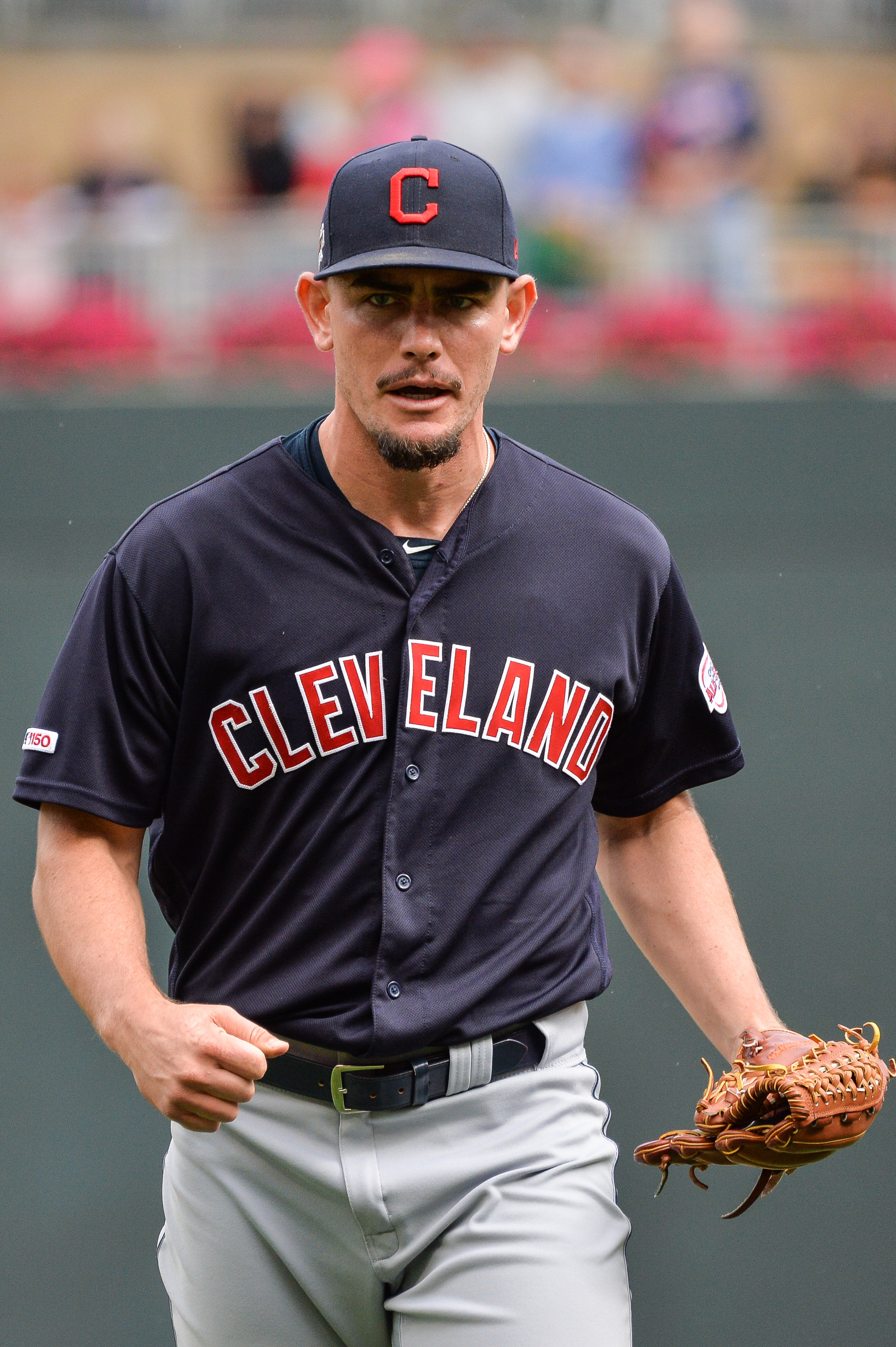
When the Marlins designated Wittgren for assignment in Jan. 2019, it registered as something of a surprise, as noted here at the time. He’d had an up-and-down year in 2018 but finished out the season with a 2.94 ERA, 8.3 K/9, 4.0 BB/9, 0.27 HR/9 and a career-best 46 percent ground-ball rate in 33 2/3 innings with Miami. Wittgren was a 27-year-old with a minor league option remaining, a 3.60 ERA (3.50 FIP) and a 116-to-38 K/BB ratio in 127 2/3 innings of relief for the Marlins. He wasn’t expensive — still pre-arbitration at the time — and could’ve been controlled through 2022.
Whatever the reasons, the Marlins felt Wittgren was the most expendable piece on the 40-man roster when they signed Neil Walker. Five days after being designated for assignment, he was traded to Cleveland in exchange for Jordan Milbrath — a minor league righty who is only about two months younger than Wittgren and, at the time, had only briefly reached Triple-A.
For an Indians club that had moved on from the long-solid trio of Cody Allen, Zach McAllister and Dan Otero and, a year prior, had lost iron man Bryan Shaw in free agency, Wittgren proved to be a godsend. While he didn’t break camp with the team, Wittgren was summoned in early April and made his Cleveland debut by pitching 1 1/3 innings with four strikeouts. At no point in 2019 did the righty carry an ERA higher than 3.34, and by the time the season had drawn to a close, Wittgren was regularly pitching in the eighth inning as one of Brad Hand‘s primary setup men. His 12 holds ranked third on the club behind Oliver Perez and Adam Cimber.
Wittgren doesn’t have the flashy Statcast numbers that some other relievers we’ve profiled recently do. He’s not a hard-thrower (92.3 mph average fastball), and he ranks below average in terms of spin rates and hard-hit rates. His home-run rate looked ripe for regression in 2018 and did indeed spike in 2019 — although the extent of that spike was surely impacted by the juiced ball (as was the case for virtually every pitcher in the league).
But Wittgren has demonstrated above-average control throughout his career and generally been effective against both righties and lefties (last year’s more pronounced platoon splits notwithstanding). Fielding-independent metrics suggest that the sub-3.00 ERA he’s managed over the past two seasons isn’t likely to hold up, but Wittgren has a career 3.71 FIP in 185 1/3 big league innings at this point.
In some ways, Wittgren mirrors the previously mentioned Shaw, who was a similarly unheralded pickup but emerged as a rock-solid late-inning stabilizer in Cleveland for a half decade. He’s not an overpowering righty but generally has solid control and has, to this point in his career, managed to maintain an ERA south of his FIP and (particularly) his xFIP thanks to home run suppression skills. He has a ways to go in terms of matching Shaw’s uncanny durability, but Wittgren still seems like a solid piece in the ‘pen — even if his ERA trends a bit closer to his FIP marks.
As a 28-year-old middle reliever/setup man without huge strikeout totals, we probably won’t see Wittgren named to any All-Star teams in the near future. He’s the type of reliever who even in maintaining success will also maintain relative anonymity. Most seventh- and eighth-inning relievers on smaller market clubs aren’t exactly household names. But considering the cost of acquisition — Milbrath is already out of the Marlins organization after posting a 4.50 ERA an 5.49 FIP in 52 Triple-A frames last year — and the fact that Wittgren can be cheaply controlled through 2022, the trade looks like a nice under-the-radar move that can help Cleveland for the foreseeable future.
Players Avoiding Arbitration: American League
Entering the day, there were more than 150 players on the clock to exchange arbitration figures with their respective teams prior to a noon ET deadline. As one would expect, there’ll be an utter landslide of arbitration agreements in advance of that deadline. We already ran through some key facts and reminders on the arbitration process earlier this morning for those who are unfamiliar or simply need a refresher on one of MLB’s most complex idiosyncrasies, which will hopefully clear up many questions readers might have.
We’ll track the majority of the American League’s settlements in this post and split off a separate one for NL settlements as well. Note that all projections referenced come courtesy of MLBTR contributor Matt Swartz:
- Newly acquired Angels righty Dylan Bundy receives a $5MM salary, per Jon Heyman of MLB Network (Twitter links). He had projected at a $5.7MM price tag. Teammate Hansel Robles gets $3.85MM, per Heyman, just shy of his $4MM projection.
- The Yankees have worked out deals with all of their eligible players. The team has a hefty $8.5MM pact with Aaron Judge, per MLB.com’s Mark Feinsand (via Twitter). Backstop Gary Sanchez settled for $5MM, per Feinsand (via Twitter). The New York org will pay righty Luis Cessa $895K and Jonathan Holder $750K, Murray reports (Twitter links). Fellow reliever Tommy Kahnle will earn $2.65MM, per Jon Heyman of MLB Network (via Twitter). And star lefty James Paxton has settled at $12.5MM, Heyman adds via Twitter. Chad Green and Jordan Montgomery have also agreed to terms, the former at $1.275MM and the latter at $805K, per Heyman (Twitter links).
- The Twins announced that they struck deals with Trevor May, Taylor Rogers, Eddie Rosario and Byron Buxton. Jon Heyman of MLB Network followed up with salary terms (all links to Twitter). May earns $2,205,000; Rogers takes home $4.45MM; Rosario lands at $7.75MM; and Buxton receives $3.075MM. While the first and last of those land rather close to the projected amount, Rogers got $550K more and Rosario got $1.15MM less than the calculators predicted.
- Shortstop Carlos Correa settled with the Astros for $8MM, per MLB.com’s Brian McTaggart (via Twitter). Righty Brad Peacock lands at a $3.9MM salary, per Chandler Rome of the Houston Chronicle (Twitter link). The former went for more than his $7.4MM projection, while the latter ended up shy of the $4.6MM mark produced by the computers. The ‘Stros also have agreed with closer Roberto Osuna as well, per an announcement. It’s a $10MM deal, slotting in just $200K shy of his projection, per Rome (via Twitter).
- The Orioles have a deal with outfielder/first baseman Trey Mancini, Roch Kubatko of MASNsports.com tweets. It’s for $4.75MM, per Dan Connolly of The Athletic (via Twitter), well south of the $5.7MM projection.
- Outfielder Jorge Soler has agreed to a $7.3MM deal with the Royals, MLB.com’s Jeffrey Flanagan tweets. That’s well off of the $11.2MM that MLBTR’s model projected, though it is likely that the cause of the gulf lies in the interpretation of the correct baseline to start from in building Soler’s salary. He’s in the 4+ service class but had been playing on the original deal he signed out of Cuba.
- The Tigers have a deal in place with southpaw Matthew Boyd, per Anthony Fenech of the Detroit Free Press (via Twitter). It’ll pay him $5.3MM, per Chris McCosky of the Detroit News (Twitter link). That falls comfortably below the $6.4MM, suggesting that Boyd’s camp was concerned with the way his suboptimal ERA would play in the arb process. Fellow lefty starter Daniel Norris will earn $2.96MM, McCosky tweets.
Earlier Settlements
Indians Acquire Nick Wittgren
2:55pm: The Marlins have announced the trade, revealing that they’ll acquire fellow righty Jordan Milbrath from Cleveland in the deal.
Milbrath, 27, reached Triple-A for the first time last season but was hit hard in a small sample of 13 2/3 innings. He spent the bulk of the season in Double-A, where he notched a 3.42 ERA with 8.8 K/9, 3.8 BB/9 and a gaudy 60.9 percent ground-ball rate. Milbrath’s ground-ball rate has exploded over the past two seasons — he was north of 70 percent in 2017 — though his success to date has come against younger competition. He’ll turn 28 on Aug. 1, making him a bit too old to be considered a “prospect,” perhaps, though his ground-ball tendencies still make him an intriguing bullpen candidate for the Marlins.
1:50pm: The Indians have reached a deal to acquire right-handed reliever Nick Wittgren from the Marlins, Ken Rosenthal of The Athletic tweets. Cleveland will send a minor league pitcher to Miami in return.
Wittgren, 27, was somewhat surprisingly designated for assignment by the Marlins last week. On the surface, the righty pitched quite well, working to a 2.94 ERA with 8.3 K/9, 4.0 BB/9, 0.27 HR/9 and a career-best 46 percent ground-ball rate in 33 2/3 innings for the Fish. It’s unlikely that he’d be able to replicate the good fortune he had in terms of allowing home runs (one allowed; 2.7 percent homer-to-fly ball ratio), however, and the four walks he averaged on a per-nine-inning basis was the highest mark of his career.
Nonetheless, Wittgren has a career 3.60 ERA, 8.2 K/9 and 2.7 BB/9 in 127 2/3 of big league relief and still has a minor league option remaining, so the Indians will be able to shuttle him back and forth between Cleveland and their Triple-A affiliate in Columbus this season if need be. Wittgren doesn’t throw especially hard, averaging a bit better than 92 mph on his heater, and he doesn’t generate gaudy spin rate totals. However, he’s still managed solid results to this point in his career and represents a sensible addition for a Cleveland club that is facing enormous uncertainty in the bullpen while also navigating payroll concerns.
Marlins Designate Nick Wittgren For Assignment
The Marlins announced that they’ve designated right-hander Nick Wittgren for assignment. His roster spot will go to veteran infielder Neil Walker, who signed a one-year contract with Miami this evening.
It registers as at least a moderate surprise to see Wittgren cut loose, as the right-hander pitched to a 2.94 ERA with 8.3 K/9, 4.0 BB/9, 0.27 HR/9 and a career-best 46 percent ground-ball rate in 33 2/3 innings with Miami this past season. However, Wittgren isn’t likely to repeat the success he had in limiting homers last season (one allowed; 2.7 percent homer-to-fly ball ratio), and the four walks he averaged on a per-nine-inning basis was the highest mark of his career.
Last year was a roller coaster for Wittgren. He allowed just one earned run through his first 15 2/3 inning, posting a 17-to-7 K/BB ratio along the way before being absolutely destroyed over the next month. Wittgren missed a bit of time with a finger injury along the way and was ultimately torched for eight runs on 14 hits and six walks through just 6 2/3 innings before being optioned to Triple-A. He returned as a September call-up, though, and posted a brilliant 1.59 ERA (two runs in 11 1/3 innings) with an 11-to-2 K/BB ratio.
All of that said, Wittgren is a 27-year-old righty (28 in late May) with a career 3.60 ERA, 8.2 K/9 and 2.7 BB/9 in 127 2/3 of big league relief. He also has a minor league option remaining, which could boost his appeal should the Marlins look to find a trade partner. Wittgren did miss some time in 2017 due to an elbow strain, but he avoided elbow troubles in 2018. His 92.1 mph average fastball in 2018 falls right in line with his 92.2 mph career mark, though he relies heavily on that offering and doesn’t generate much spin on it.