
Remembering The Top Of The 1997 Expansion Draft
In case you missed it, MLBTR founder Tim Dierkes and I are gearing up for a mock expansion draft that will kick off Thursday at 1 p.m. CT. On the eve of our event, I figured it would be worthwhile to go back to 1997 – the last time there was a real expansion draft in Major League Baseball – and specifically focus on the first 10 players whom the Devil Rays and Diamondbacks took off the board. For the most, real standouts were hard to come by near the top of that draft (here are all 70 selections if you’re interested). Maybe Tim’s Portland Lumberjacks and my Las Vegas Vipers will stumble on more gems Thursday.
1.) Tony Saunders, LHP, Devil Rays:
- Saunders, then 23, was coming off a rookie year with the Marlins in which he pitched to a 4.61 ERA/4.46 FIP across 111 1/3 innings. Little did he or Tampa Bay know his career wouldn’t extend much beyond then. Saunders made 40 starts and tossed 234 1/3 innings of 4.53 ERA/4.51 FIP from 1998-99, but he broke his arm (warning: that video is hard to watch) on the mound in the second of those seasons and broke it again while rehabbing the next year. He had to retire after that.
2.) Brian Anderson, LHP, Diamondbacks:
- Twenty-five at the time, Anderson was a former No. 3 overall pick (1993) who was coming off a run of unspectacular pitching with the Angels and Indians when he went from Cleveland to Arizona in the expansion draft. But Anderson did end up eating a lot of innings as a member of the Diamondbacks, with whom he recorded a 4.52 ERA/4.91 FIP with 4.39 K/9 and 1.64 BB/9 over 840 2/3 frames from 1998-2002. He was part of the D-backs’ only World Series-winning team in 2001.
3.) Jeff Suppan, RHP, Diamondbacks:
- Then 22, Suppan was coming off a so-so tenure in parts of three seasons with the Red Sox when the Diamondbacks selected him. He barely even pitched for the Diamondbacks, as the Royals purchased him in 1998 after Suppan totaled 66 innings of 6.68 ERA ball in Arizona. However, Suppan did go on to a long major league career. As a member of a few different teams, he combined for a 4.70 ERA/4.86 FIP and 2,542 2/3 innings from 1995-2012.
4.) Quinton McCracken, OF, Devil Rays:
- A former Rockie who was 27 when the expansion draft rolled around, McCracken got off to a decent start in Tampa Bay in 1998, when he batted .292/.335/.410 with seven home runs, 19 steals and 1.5 fWAR in 675 plate appearances. However, owing in part to a torn ACL, McCracken only mustered a line of .229/.308/.291 with one homer, six steals and minus-1.4 fWAR in 202 PA from 1999-2000. The Rays released him after that.
5.) Gabe Alvarez, 3B, Diamondbacks:
- Alvarez, whom Arizona took from San Diego, never played for Arizona. The Diamondbacks traded Alvarez, righty Matt Drews and infielder Joe Randa to the Tigers for third baseman Travis Fryman on the day of the expansion draft. None of Alvarez, Drews or Randa offered much impact in Detroit. Fryman didn’t play for Arizona, which quickly flipped him and lefty Tom Martin to Cleveland for third baseman Matt Williams.
6.) Bobby Abreu, OF, Devil Rays:
- This could have been an absolute steal for Tampa Bay, but the club squandered it. Abreu, whom the D-Rays got from the Astros, went on to enjoy at least a “Hall of Very Good career.” He played with a few teams (primarily the Phillies) from 1996-2014 and slashed .291/.395/.475 with 288 homers, 400 steals and 59.8 fWAR. None of his 10,081 plate appearances came as a Ray, though, as the club dealt him to the Phillies for shortstop Kevin Stocker on the day of the draft. Stocker took 804 PA with Tampa Bay from 1998-2000 and batted .250/.329/.347 with nine homers.
7.) Jorge Fabregas, C, Diamondbacks:
- The Diamondbacks wanted Fabregas so much that they were happy Tampa Bay took Abreu instead. Oops. Most recently a member of the White Sox when the Diamondbacks scooped him up, Fabregas had a short stint in Arizona. He amassed 167 PA with the team in 1998 and hit .199/.263/.245. The D-backs traded him and righty Willie Blair to the Mets that summer for RHP Nelson Figueroa and outfielder Bernard Gilkey.
8.) Miguel Cairo, INF, Devil Rays:
- Twenty-three when the Rays grabbed him from the Cubs, Cairo wound up lasting 17 seasons with several different clubs, though he was never much of an offensive threat. His OPS as a Devil Ray from 1998-2000 (.675) matched his lifetime mark.
9.) Karim Garcia, OF, Diamondbacks:
- This couldn’t have worked out better for Arizona, and it had little to do with Garcia’s contributions in its uniform. After swiping the then-22-year-old from the Dodgers, the Diamondbacks saw Garcia turn in a .222/.260/.381 line in 354 PA in 1998. The D-backs subsequently traded Garcia to the Tigers for outfielder Luis Gonzalez, who was largely outstanding in the desert from 1999-2006 and whose World Series-winning hit against Mariano Rivera and the Yankees in 2001 will always count as one of the most iconic moments in baseball history.
10.) Rich Butler, OF, Devil Rays:
- Butler joined Tampa Bay as a 24-year-old who played in all of seven games with the Blue Jays in 1997. He appeared in 79 as a Devil Ray from 1998-99, but he never played in the majors again after combining to hit .219/.274/.350 in 259 PA during those two seasons.
Quick Hits: Nationals, Cards, Liberatore, Draft, Torkelson
The Nationals are among the teams who released several minor leaguers within the last week, with Brittany Ghiroli and Emily Waldon of The Athletic (subscription required) reporting that the defending World Series champions cut somewhere in the neighborhood of 30 players. As for the remaining players in Washington’s farm system, the club will be paying them $300 per week through the month of June — down from the $400 weekly stipend that has become the norm throughout baseball, as per the March agreement between the players and the league. “The Nationals are believed to be the only Major League team paying a lower stipend amount,” Ghiroil and Waldon write, though the Athletics announced earlier this week that they would be ending the stipend entirely at the end of May.
Just as the A’s were heavily criticized for their decision, the Nats have already taken some heat for the stipend cut, considering that the total amount of money being saved is so relatively minor for a billion-dollar franchise. As one unnamed Nationals minor league put it, even a reduced stipend is better than being released, but “For us lucky ones still getting help, it’s bittersweet. I wish the owners really weighed how much that $100 they cut us back is saving them versus how much it helps put food on the table for us and our families.”
[UPDATE: Nationals reliever Sean Doolittle tweeted that he and the rest of Washington’s Major League roster will be supporting their organization’s minor leaguers by “committing funds to make whole the lost wages from their weekly stipends. All of us were minor leaguers at one point in our careers and we know how important the weekly stipends are for them and their families during these uncertain times.”]
More from around baseball…
- The January swap with the Rays that saw the Cardinals acquire left-hander Matthew Liberatore “could be a monster trade” for the Redbirds, an American League scout tells Derrick Goold of the St. Louis Post-Dispatch. “There is a small clutch of the best pitching prospects in the minors, and I don’t think you could find 10 better than Liberatore,” the scout said, reinforcing the belief that the Cards have quickly been able to reload its young pitching depth (and its left-handed depth, specifically, as Liberatore and 2019 first-rounder Zack Thompson are both southpaws). The full trade saw St. Louis and Tampa swap draft picks in Competitive Balance Rounds A and B — the Cards got the lower of the two selections — and exchange Liberatore and minor league catcher Edgardo Rodriguez for Jose Martinez and Randy Arozarena. Since Martinez and Arozarena were both somewhat blocked in the crowded Cardinals’ depth chart, moving them for a very promising young starter indeed looks like a shrewd move for St. Louis, as the Cards lost little from their big league roster.
- While much of the discussion surrounding the 2020 draft has focused on its reduced length, the biggest story talent-wise has been the amount of quality college pitching available. “It’s just remarkable how loaded this class is in terms of arms,” an area scout tells Baseball America’s J.J. Cooper, with a team scouting director also noting that “the depth and the amount of really good arms, I don’t know if I’ve seen one like this in my lifetime.” As a result, due to the abbreviated nature of this year’s draft, there should be several good college pitchers available in free agency once the draft’s five rounds are complete.
- The first overall pick, however, is expected to be a position player, as Arizona State first baseman Spencer Torkelson has been increasingly thought to be the Tigers’ 1-1 choice. Detroit scouting director Scott Pleis didn’t drop any hints to MLB Pipeline’s Jim Callis, saying that “we continue to talk” about who the top pick might be, with “five or six guys” included in the final list of potential candidates. Beyond Torkelson, Callis hears from sources that the Tigers are also looking at several other of the consensus top prospects of this year’s class, such as Austin Martin, Asa Lacy, Nick Gonzales, and Emerson Hancock. “Officials with other clubs would be surprised if Detroit doesn’t take Torkelson,” Callis writes.
The Rays’ Huge Win In Free Agency
The Rays have crafted a reputation as one of the sport’s best organizations at finding undervalued talent. That typically manifests in frequent roster churn via trades and waiver claims. Given their budgetary limitations, the franchise has been decidedly less active in free agency. Last offseason, Tampa surprisingly stepped up to ink one of the better players available on the open market: right-hander Charlie Morton. The early returns couldn’t have been better.
In December 2018, the Rays added Morton on a two-year, $30MM guarantee. That’s hardly overwhelming money for most teams, but it no doubt accounted as a major splash by Rays’ standards. Morton’s $15MM salary counted for about a quarter of the club’s $60MM season-opening payroll last season, according to Cot’s Contracts. It was a major gamble for a front office lacking the resources of most of its rivals across the league. Nor was this a situation of a low-payroll team stepping in only after a free agent’s market fell way below expectations. Entering the offseason, the MLBTR staff projected a two-year, $32MM deal for Morton that almost perfectly aligned with the guarantee he actually received.
Morton’s age (he’d just turned 35) was the impetus for the contract’s short term. His performance over the prior two years had been fantastic. With the Astros from 2017-18, he spun 313.2 innings of 3.36 ERA/3.53 FIP ball with strong strikeout and ground ball numbers. His days as an unexciting back-end starter in Pittsburgh were long behind him. Morton had reinvented himself in Houston, sitting in the mid-90’s with a hammer curveball.
Nevertheless, even the Astros were reluctant to completely buy Morton’s late-career renaissance. They declined to offer him a $17.9MM qualifying offer. It was a bizarre move at the time that only looks worse in hindsight. That decision proved beneficial for Morton as a free agent, since his suitors needn’t worry about losing a draft pick to sign him. It proved equally beneficial for the Rays.
Would Tampa have still ponied up for Morton if doing so would’ve cost them their third-highest pick in the 2019 draft? Unclear. (They ended up selecting Campbell University right-hander Seth Johnson with that selection, if you’re curious). Fortunately, they didn’t have to make that decision.
Morton was brilliant in year one in Tampa. He tossed a career-high 194.2 innings with career-best marks in ERA (3.05), FIP (2.81), strikeout rate (30.4%), and both fWAR (6.1) and bWAR (4.9). He finished third in AL Cy Young voting, behind only a pair of former Astros’ teammates, Justin Verlander and Gerrit Cole. Morton was no doubt one of the biggest reasons the Rays advanced to an ALDS.
What does the future hold for Morton in Tampa? Hopefully, he’ll be able to play out his final guaranteed year under contract in 2020. If MLB doesn’t come to an agreement on a return to play this season, his situation will be more in flux. Morton’s contract calls for a club option of up to $15MM in 2021, one the Rays would almost certainly exercise given his 2019 dominance.
In February, though, Morton indicated he wasn’t sure he’d want to continue playing beyond 2020. How a potentially cancelled season could impact his thought process isn’t yet clear. Whatever the future holds, it’s apparent the Rays have already gotten a return well above and beyond the cost to bring Morton aboard.
AL East Notes: Severino, Red Sox, Snell, Boras
After undergoing Tommy John surgery during Spring Training, Yankees right-hander Luis Severino tells George A. King III of the New York Post that “things have been progressing well” in the initial stages of the rehabilitation process. Severino has been working with team trainers at the Yankees’ Spring Training facility in Tampa “since the day after I had my surgery,” and said he has “been making steady progress — lifting, doing exercises. Since three months ago…I feel way better. I’m doing everything I need to do right now so that I can start throwing this summer.”
Given the normal 12-15 month timeline attached to TJ recovery, it would be a boon for both Severino and the Yankees if he is able to return by Opening Day 2021 (assuming next season begins as usual in late March), and it’s probably more realistic to assume he’ll miss at least a month of a regularly-scheduled 2021 campaign. Severino already missed almost all of the 2019 season due to lat and shoulder injuries, tossing only 20 1/3 total innings over the regular season and postseason.
More from around the AL East…
- Had the season begun as expected, the Red Sox “would have had some tough decisions to get down to 26” players on the Opening Day roster, manager Ron Roenicke tells Peter Abraham of the Boston Globe. Now, since Major League rosters are expected to be expanded by anywhere from two to four extra players, it “will give us a chance to keep some players we like,” Roenicke said. This is one small silver lining amidst a wholly unique season that will present many difficulties for all teams, as Abraham outlines how Roenicke is trying to keep his team prepared both in the short term and in preparation of whatever shape the 2020 season (if it happens at all) could take. Providing updates on a few players, Roenicke said starters Eduardo Rodriguez, Nathan Eovaldi, Martin Perez, and Ryan Weber have been throwing two simulated innings per week in order to stay fresh, with the idea being that the quartet can quickly ramp up to being able to toss five innings by the end of an abbreviated second Spring Training.
- Rays left-hander Blake Snell recently became the Boras Corporation’s newest client, which agent Scott Boras calls “a great opportunity for us,” the Tampa Bay Times’ Marc Topkin writes. “We consider him an elite performer who is still at the beginning of his career,” Boras said, noting that his agency’s “resources” in both on-field preparation and off-the-field endeavors make for “a great combination” with Snell. The southpaw’s contract runs through the 2023 season, and while there isn’t any immediate opening for the Boras Corporation to receive a commission on a future deal, Boras repeatedly dismissed the suggestion that his change in representation could be a step towards finding a new team. “The main idea right now is that we’re going to work with the team to provide every resource and to make [Snell] a better Ray,” Boras said.
Brooks Pounders, Deck McGuire Among Rays’ Minor League Releases
The Rays have released “20 or so” minor league players from their system, Marc Topkin of the Tampa Bay Times reports. The full list of names has yet to be announced, though two non-roster invitees to Tampa’s Spring Training camp have been cut. Topkin reports that right-hander Brooks Pounders was one of the releases, and righty Deck McGuire tweeted earlier this week that he had also been released. Pounders and McGuire both inked minors contracts with the Rays back in February.
Pounders has the more recent experience on a Major League diamond, tossing 7 1/3 relief innings for the Mets in 2019 but spending much of the season at the Triple-A level (for the Mets’ and Indians’ affiliates). Originally a second-round pick for the Pirates in the 2009 draft, Pounders has bounced around to seven different organizations over his pro career, accumulating 45 2/3 frames at the MLB level with the Mets, Rockies, Angels, and Royals over the last four seasons. While he owns an impressive 9.3 K/9 and 3.92 K/BB rate against big league hitters, Pounders has a career 8.47 ERA, largely due to an ungainly 2.8 HR/9.
McGuire also has a journeyman’s resume, being part of eight different MLB organizations over his career as well as pitching with the Korean Baseball Organization’s Samsung Lions in 2019. McGuire posted a 5.05 ERA over 112 1/3 innings with the Lions, which is close to his 5.23 ERA over career 51 2/3 Major League innings (with the Reds, Blue Jays, and Angels in 2017-18). McGuire was selected 11th overall by Toronto in the 2010 draft, though he has yet to find much consistency even at the minor league level, with a 4.31 ERA, 2.33 K/BB rate, and 7.7 K/9 over 1079 2/3 IP.
The two pitchers were competing for jobs in Tampa Bay’s 2020 bullpen, and for what it’s worth, Pounders had tossed four scoreless innings of spring action prior to the coronavirus shutdown. While the Rays join several other teams in making mass releases to clear room on minor league rosters, Tampa is also one of the teams who has publicly committed to paying its remaining minor leaguers their $400 weekly stipend at least through the end of June. At that point, Topkin writes that “Rays officials will re-evaluate the plan…based on several factors, such as whether big-leaguers are playing and the potential to stage some form of late-summer minor-league camp or development program.”
Three Teams Played Musical Chairs With First Basemen…And Five Teams Came Away Winners
Last week, I looked at Cole Sulser’s prospects of making an impact in the Baltimore Orioles bullpen. Sulser found his way to Baltimore via Tampa Bay after being included in a three-way swap of more prominent players. Today, let’s take a look at those players.
To review: in December of 2018, the Indians, Mariners, and Rays engaged in a three-way deal that shuffled around their first basemen. In this rare three-way challenge trade, each team came away with (at least one) major-league first baseman. The Rays got Yandy Diaz, the Mariners Edwin Encarnacion, while the Indians snagged a pair of first basemen in the deal: Jake Bauers and Carlos Santana.
There were auxiliary pieces that fit less cleanly into our first basemen carousel. The Rays picked up Sulser from Cleveland, while Tampa also sent $5MM to the Mariners. Seattle paid that money forward, sending a total of $6MM to the Indians. Coming back to Seattle was the Indians’ Round B selection in the draft. The Mariners ended up selecting right-handed pitcher Isaiah Campbell out of Arkansas with the #76 pick in the draft. Those pieces aside, let’s check in on how each team is feeling about their end of this whirlwind deal one season after the fact.
Indians
This move – and much of their offseason last winter – was largely about shuffling money around – but not wholly so. The Indians took back Santana, who had only recently been sent to Seattle after playing one season in Philadelphia. Santana made $20.3MM in 2019, but his contract was offset by sending out Encarnacion, who was owed $21.7MM in 2019 with a $5MM buyout for 2020. The difference in their salaries, plus the money acquired from Seattle netted the Indians close to $7.5MM in 2019, though they took on more long-term money in Santana.
On the field, this deal basically amounts to two exchanges for the Indians: Santana over Encarnacion in terms of big-money players, and Bauers over Diaz for cost-controlled assets. As for the first exchange, the Indians have to count this as a win. After one so-so year with the Phillies, Santana returned to form in a big way with the Indians. All aspects of Santana’s game came together in 2019. He hit .281/.397/.515 on the year with 34 home runs and 110 RBIs. He turned in his typically strong BB-K numbers, posting identical walk and strikeout rates of 15.7% (slight improvements on his career norms in both departments). His isolated power (.234 ISO) was the second-highest mark of his career, while the .397 OBP was a new career-high for a full season. Santana’s season totaled 4.6rWAR/4.4 fWAR, good for 135 wRC+, and he’ll be back in their lineup for 2020.
Bauers, on the other hand, is a work in progress. He brings an added level of versatility, appearing in 31 games at first and 53 games in left, but he’ll need to improve at the plate to put that value to work. Bauers hit just .226/.312/.371 across 423 plate appearances in his first season with the Indians. His walk rate dropped to 10.6% and with a power mark of just .145 ISO. That’s not enough pop from a first baseman/left fielder. He finished with below-average marks of 78 wRC+ and -0.4 fWAR. Still, all hope is not lost for Bauers. A career-low .290 BABIP might point to some positive regression in the future, and he doesn’t even turn 25-years-old until October.
Mariners
The Mariners’ biggest get here was the draft pick. GM Jerry Dipoto continued his rebuild, and ultimately, the swap of sluggers was an avenue to add another draft pick. After taking on Santana a week prior, the Mariners shed long-term money by swapping in Encarnacion, whom they eventually flipped to the Yankees.
While with the Mariners, Encarnacion was about as good as expected, slashing .241/.356/.531 with 21 home runs in 65 games. With the rebuild in full swing, EE was never expected to spend a full season in Seattle. Given his start to the year, the Mariners’ return for the DH was a little underwhelming, but the market for teams in need of a designated hitter was limited. Still, Trader Jerry added right-hander Juan Then from the Yankees. Fangraphs ranks Then as the Mariners’ #13-ranked prospect after finishing the season in A-ball. Campbell, selected with the acquired draft choice, comes in at #16.
The Yankees and Mariners essentially split the remaining money owed Encarnacion at the time, so the M’s did see some financial benefit as well. It’s often difficult to track the wheeling and dealing done by Dipoto, but we can give it a go here. To do so, we have to go back to the deal that sent Santana from the Phillies to Seattle. Dipoto sent Jean Segura, Juan Nicasio, and James Pazos to Philly for Santana and J.P. Crawford. In sum, he started with Segura, Nicasio, and Pazos, and the Mariners ended up with Crawford, Then, and Campbell, along with some financial saving both in the short-and-long-term.
Rays
It was surprising to see the Rays move Jake Bauers at the time of this deal, but they’re no stranger to dealing from a young core. The Rays picked up Sulser and Diaz for Bauers in this trade, while also sending $5MM to the Mariners. Considering Sulser was eventually lost on waivers to the Orioles (though he did give them 7 scoreless innings in 2019), the move essentially amounts to the Rays paying $5MM to swap in Diaz for Bauers. At the time of the deal, Bauers was seen as an up-and-comer, while Diaz was a little-known 27-year-old utility player with little-to-no boom in his boomstick. As has often been the case of late with Rays’ trades, at a cursory glance, the Rays were trading away controllable youth for a role player.
But where the Rays are concerned, it’s often worth delving a little further. Diaz quickly became known for his above-average exit velocities. And while Diaz was a little older and without the prospect pedigree of Bauers, he came with similar team control, more versatility given his ability to line up at the hot corner, and his biceps have a cult following all their own.
Injuries unfortunately limited Diaz’s production in 2019, but when he was on the field, he was dynamite. While posting a line of .267/.340/.476 across 79 games, Diaz was coming into his own as a hitter with a 116 wRC+. Diaz’s minor league career to this point was a testament to his ability to get on base, limit strikeouts, and make hard contact, but a groundball-heavy approach limited his power.
But it was a different story in Tampa. Diaz produced a career-best .208 ISO to go with a 91.7 mph exit velocity that put him in the top 8% of the league, per Statcast. His hard-hit percentage continues to be well above average, and a small improvement in launch angle and a large jump in barrels led to Diaz smashing 14 home runs in 79 games after hitting just 1 in 88 big league games with the Indians.
Not only that, but Diaz returned from the injured list in time for the playoffs, leading off the wild card game with a solo shot off Sean Manaea. Diaz went deep his second time up as well, at which point the Rays had more than enough to get past the A’s. It was a monster performance from Diaz in the biggest game of the year up to that point. (Things didn’t go quite so well for Diaz in Houston, as he went 0 for 9 with four strikeouts in the ALDS.) The Rays have to feel pretty good about where they stand with Diaz moving forward, as he should continue to be a cheap source of offense for the next couple of seasons.
For that matter, all three teams have to feel pretty good about this deal, as they each accomplished their goal. If Bauers has a better showing in 2020 and the Mariners’ prospects come to fruition, there will ultimately be very little not to like about this three-way deal. Include the Orioles for nabbing Sulser and the Yankees for getting a half a season of Encarnacion, and it could be argued that five teams actually came away winners from this three-way swap of first baseman.
Latest News, Notes On Minor League Pay
The manner in which teams are — or, in some cases, aren’t — continuing to pay their minor league players has drawn increased attention as the end of the month draws near. Major League teams agreed back in March to pay minor league players $400 per week through the end of May, but most minor league players now face ongoing financial uncertainty. The Dodgers have already committed to continue that $400 weekly stipend through the end of June, but veteran left-hander David Price is stepping up to add a helping hand, pledging $1,000 to each non-40-man Dodgers minor leaguer, according to a report from Francys Romero (Twitter link). That includes more than 220 minor leaguers, per MassLive.com’s Chris Cotillo. It’s a similar gesture to the one Shin-Shoo Choo made with the Rangers back in April.
Of course, the very fact that veterans such as Choo and Price even feel it necessary to step up to help out minor leaguers speaks to the manner in which minor league players are under-compensated. While some clubs — the Marlins and Padres — are reportedly set to pay out that $400 weekly stipend through the end of the minor league season, the Athletics are cutting off the stipend at month’s end. Others have extended the stipend through June but have not committed further.
Here’s how a few other clubs are handling the matter…
- The Mets, Rays, Brewers, Cardinals, Giants and Indians are all extending the $400 weekly stipend through the month of June, per reports from MLB Network’s Jon Heyman (tweet), the Tampa Bay Times’ Marc Topkin, the Milwaukee Journal-Sentinel’s Todd Rosiak (tweet), the St. Louis Post-Dispatch’s Derrick Goold, Alex Pavlovic of NBC Sports Bay Area (tweet) and Kyle Glaser of Baseball America (tweet). “This money right now, especially for guys who aren’t as well off, this is a huge deal,” Rays minor league catcher Chris Betts tells Topkin. “…I’m beyond excited about it, and I’m honestly just more stoked and proud that the organization I play for took this route more than anything.”
- The Athletics have, unsurprisingly, drawn a wide array of harsh criticism for their wide-ranging furlough and the full cutoff of minor league payment, Susan Slusser of the San Francisco Chronicle writes. Slusser notes that owner John Fisher repeatedly used the word “family” in his letter to fans explaining the cutbacks, but many impacted by the cuts don’t feel the effects of that word. “It’s very hard to preach family and then not act like it when times are difficult,” Class-A pitcher Aiden McIntyre tells Slusser. Triple-A outfielder Jason Krizan added: “…[I]t hurts to see the Marlins continue to pay their players when they made the least in baseball last year,” though he noted he’d rather remain an Athletic and receive benefits than otherwise. Other players, past and present, voiced similar criticisms to Slusser, as did a big league agent and an executive with another club. Sports Illustrated’s Stephanie Apstein writes that termination of the stipend saves the Athletics an approximate $1.3MM.
Blake Snell Hires Boras Corporation
Rays left-hander Blake Snell has changed representation and is now a client of the Boras Corporation, Ken Rosenthal and Josh Tolentino of The Athletic report (subscription link). MLBTR has made note of Snell’s agency change in our database.
Snell’s switch to the game’s highest-profile agent comes long before he’ll be eligible to reach the open market. Coming off an AL Cy Young-winning season in 2018, he and his former agency, Apex Sports, scored a five-year, $50MM extension from the Rays in March 2019. That deal made for a record for players with fewer than three years’ service time in both length and total value. As a result of the pact, the 27-year-old Snell is slated to remain in Tampa Bay through the 2023 campaign.
As noted Monday here at MLBTR, Snell – the 52nd pick in the 2011 draft – has been quite effective for the Rays since he made his major league debut in 2016. However, aside from his 180 2/3-inning showing two years ago, he hasn’t eaten a great deal of frames in any season. Snell has averaged a bit over five innings per start in 97 outings, but the hard thrower has put up a sterling 3.24 ERA/3.42 FIP with 10.41 K/9 and 3.81 BB/9 along the way.
How A Minor Signing Led To A Cy Young Winner
Former major league outfielder Brad Hawpe was a more-than-respectable offensive player during his peak with the Rockies. While Hawpe had difficulty early on from his debut in 2004 through the next season, he combined to slash .288/.384/.518 (124 wRC+) with 99 home runs in 2,338 plate appearances from 2006-09. The last of those four years, an All-Star campaign for Hawpe, went down as his final truly effective effort as a hitter. After Hawpe got off a .255/.343/.432 start (94 wRC+) with only seven homers in 2010, the team released him late that August.
Hawpe, then 31 years old, drew a vast amount of interest when he reached free agency amid a pennant race. He ultimately signed a minor league contract with the Rays, who at the time were in a hotly contested fight for AL East supremacy with the Yankees and Red Sox. The Rays did end up with 96 victories and a division crown that season before falling in the ALDS, but their regular-season sucess wasn’t Hawpe’s doing. He debuted with Tampa Bay on Sept. 1 and went on to hit .179/.304/.333 with two homers in 39 at-bats in its uniform.
Hawpe didn’t participate in the Rays’ postseason series, and shortly after its conclusion, he rejected their arbitration offer in order to revisit the open market. Because he was a Type B free agent under MLB’s old system, the Rays were entitled to a compensatory draft pick for losing Hawpe. And they did watch him exit when he took San Diego’s $2MM guarantee in January 2011. Hawpe didn’t produce as a Padre or as a member of the Angels, with whom his career concluded in 2013, but the Rays have benefited immensely from his short-term run with them and stand to continue gaining from it over the long haul.
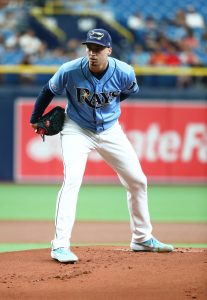
In essence, the Rays traded one month of Hawpe – who cost them very little money – for the 52nd selection in the draft. The Rays used that choice on a then-Washington state high school left-hander named Blake Snell. The year Tampa Bay drafted him, Baseball America wrote in his scouting report, “Because of his signability, his velocity and how well he has performed in front of crosscheckers, Snell could get popped as high as the supplemental first round, though on pure talent he would probably go a few rounds later.”
The gamble has worked out for the Rays, with whom Snell has been elite at times dating back to his first season in 2016. He spun 89 innings of 3.54 ERA ball then, and though Snell struggled enough the next season to earn a short-term demotion to the minors, he returned to MLB to finish with a decent 4.04 ERA in 129 1/3 frames. But it was 2018 when Snell truly took off; owing in part to a jump in velocity, he pitched to a 1.89 ERA with 11.01 K/9 and 3.19 BB/9 across 180 2/3 innings en route to AL Cy Young honors.
With injuries troubling him, Snell was unable to reign atop the AL again last year, when his ERA ballooned to 4.29 in 107 innings. However, that’s not to say he totally fell off the map. You’d be hard-pressed to find a team that wouldn’t sign up for the 3.32 FIP and 12.36 K/9 against 3.36 BB/9 he posted last season.
The Rays already extended Snell on a five-year, $50MM guarantee deal before the prior campaign, keeping a high-end starter under control through 2023. To think, it all started with the minor addition of Hawpe a decade ago. Not bad.
Photo courtesy of USA Today Sports Images.
A Standout’s Unusual Path To D.C.
Since he made his major league debut in 2015, Trea Turner has established himself as one of the reigning World Series champion Nationals’ most valuable players. A second baseman and then a center fielder at the beginning of his career, Turner took over as the Nationals’ shortstop in 2017 and now has a stranglehold on the position.
Dating back to his first full season in 2018, Turner has accounted for 8.3 fWAR and hit .283/.348/.451 (110 wRC+) with 38 home runs and 78 stolen bases – the second-highest total in MLB – across 1,309 plate appearances. And the 26-year-old Turner figures to contribute similar or better production in Washington for at least the next couple seasons, as he’s only now about to enter his first of three arbitration-eligible campaigns.
With Turner having already given the Nationals quite a bit of surplus value, it’s worth revisiting how he joined the team in the first place. To say the least, it was unusual transaction that led him to D.C. Turner was a 20th-round pick of the Pirates in 2011, but he elected to pass on signing with the Bucs in order to play at North Carolina State. That proved to be a wise decision by Turner, who increased his stock so much as a college player that the Padres took him 13th overall in 2014. Little did Turner or the Padres know then that he’d never play a real game in their uniform, nor was either side aware their relationship would end in such unconventional fashion.
While Turner continued to succeed as a young pro with the Pads, ranking as Baseball America’s 65th-best prospect prior to 2015, the club parted with him that year. Actually, though, San Diego agreed to trade Turner in December 2014 in a three-team blockbuster that also involved the Rays and Nats and. The Padres received outfielder Wil Myers, pitchers Gerardo Reyes and Jose Castillo, and catcher Ryan Hanigan. The Rays acquired first baseman Jake Bauers, righty Burch Smith, outfielder Steven Souza Jr., catcher Rene Rivera and lefty Travis Ott. The Nationals picked up righty Joe Ross and a player to be named later. Ross showed flashes at the beginning of his Nats tenure, but injuries have helped knock him off course in recent years. On the other hand, the PTBNL, Turner, has been a gem.
Although the Padres and Rays had a handshake agreement in regards to Turner, they weren’t allowed to make it official for a while because of previous MLB rules. The league formerly had a system in place that barred teams from trading anyone who wasn’t a year removed from being drafted. So, because Turner didn’t meet that requirement, he had to spend several more months with the Padres, even though he knew he wasn’t really a member of the team. Turner’s agent, Jeff Berry, suggested he’d fight the setup. In the end, however, Turner didn’t officially change hands until June 2015 – one month after the league instituted new rules to stop something similar from taking place.
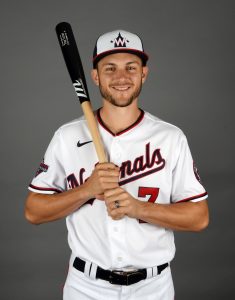
To the Padres’ credit, they treated Turner well during his waning months with the club. Turner had to go to Padres spring training and play in the minors as part of the franchise as he waited for the finalization of the trade, and he complimented the team on multiple occasions during that period.
Unfortunately for San Diego, it hasn’t gotten nearly enough out of this trade in hindsight. Turner, after all, has clearly become the top player in this massive swap. Myers had an All-Star season in 2016, which persuaded the Padres to hand him a six-year, $83MM extension, but he has fallen off since then and is now someone they’d like to remove from their books. Reyes had a rough go in his MLB debut last season (7.62 ERA), though he did amass 38 strikeouts in 26 innings. Castillo performed well as a rookie two years ago, but injuries wrecked his 2019. Unlike those three, Hanigan never even played for the Padres, who quickly flipped him to the Red Sox for third baseman Will Middlebrooks. Although Middlebrooks did pile up 270 PA as a Padre in 2015, he was just a .212/.241/.361 hitter then.
It’s fair to say this deal will not go down as a shining moment for Padres general manager A.J. Preller. Conversely, it’s one of the many feathers in the cap of GM Mike Rizzo and the Nationals, for whom a one-time player to be named later helped to a championship several months back.
Photo courtesy of USA Today Sports Images.