
Denard Span On His Future
It’s been nearly 20 months since Denard Span suited up in a big league game, and the former Twins, Nationals, Giants, Rays and Mariners outfielder suggests in an interview with Patrick Reusse of the Minneapolis Star-Tribune that he may not do so again. Span reveals that he received offers in the 2018-19 offseason, although they clearly weren’t compelling enough to leave his young family. Span adds that he worked out this winter with an eye toward a 2020 return and received “two or three” minor league offers — but they came from clubs without much of a path to the Majors even in the event that he played well in Triple-A.
“I haven’t announced it, officially, but maybe this is it,” Span said when asked about retirement. “…I still would have the ability to help a team. But 36-year-old outfielders who haven’t played in two years … not happening. I’m very satisfied pouring my life into our family, to Anne, a wonderful person, and our two boys.”
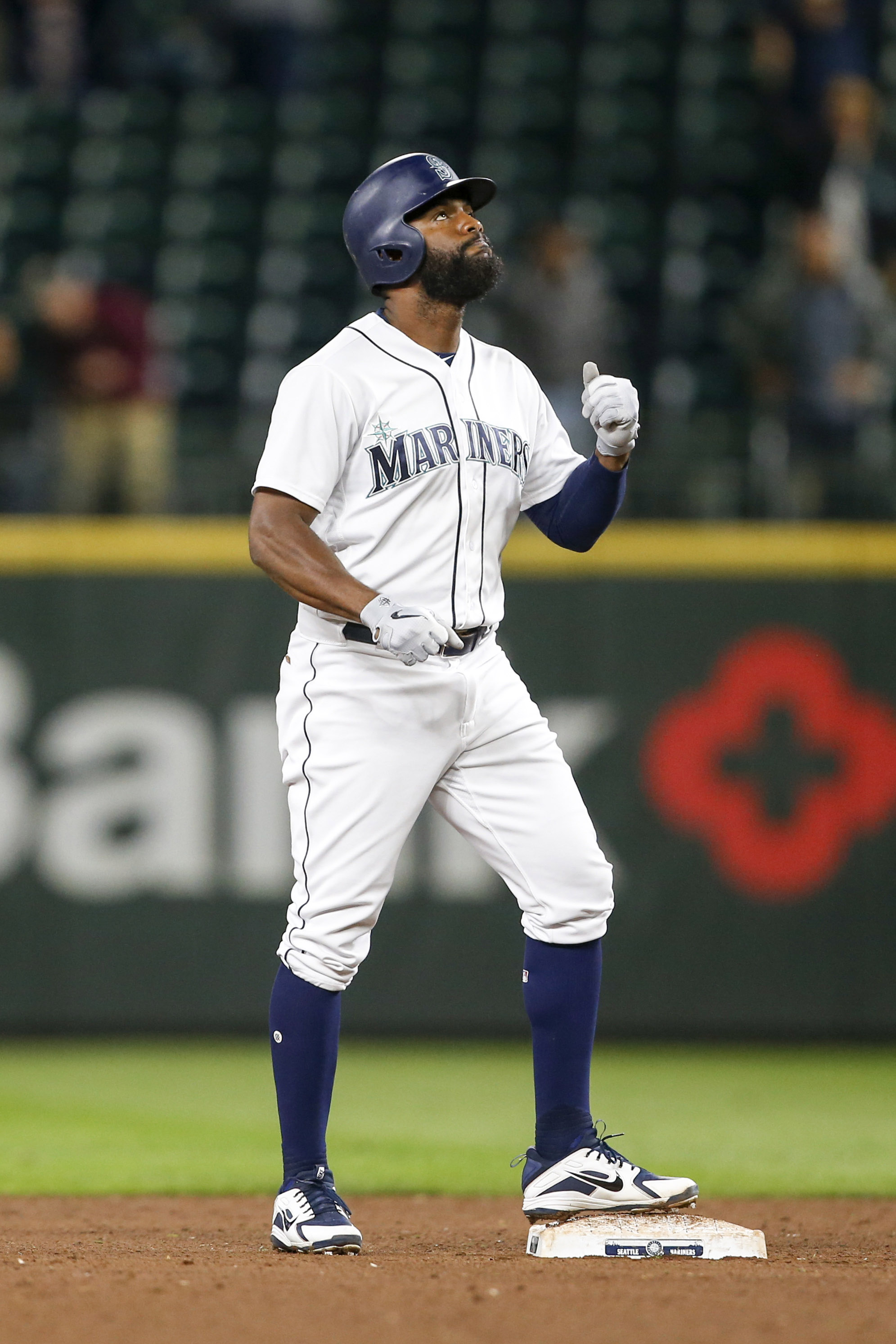
If this is indeed it for the amiable Span, it’s been quite a strong career. A first-round pick out of high school by the Twins back in 2002, Span took nearly six years to ascend to the big leagues, but he made an immediate impact upon arrival. Twenty-four years old at the time, Span finished sixth in AL Rookie of the Year voting in 2008 and hit .294/.387/.432 (122 OPS+ and wRC+ alike) through 487 plate appearances, helping push the Twins to a dramatic Game 163 showdown with the White Sox. Minnesota fell in a crushing 1-0 loss to the South Siders, but Span had announced his presence in the big leagues and would never look back.
Over the next four seasons, Span was the consummate leadoff man in Minnesota, hitting a combined .283/.351/.381 with a nine percent walk rate and just an 11.5 percent strikeout rate. In addition to a knack for working counts and putting the ball in play, Span showed off well above-average baserunning skills and the ability to play plus defense wherever he was slotted into the outfield (center field, more often than not). Heading into the 2010 campaign, Span signed a five-year, $16.5MM contract extension that contained an option for an additional $9MM.
Span provided excellent value over the course of that contract, but he only spent half of it in a Twins uniform. As the Twins fell from their status as a perennial AL Central contender and moved into a rebuild, Span had two guaranteed years and the club option remaining on that highly appealing deal. Minnesota flipped him to the Nationals in a straight-up swap for then-vaunted pitching prospect Alex Meyer — a deal that proved regrettable for Minnesota after repeated shoulder injuries torpedoed Meyer’s career.
The Nats had no complaints, though, and that may have been the case even if Meyer had eventually developed into a quality big leaguer. Span hit .292/.345/.404 in three seasons with Washington, continuing to add value on the bases and in the field along the way. By the time he reached free agency, Span was solidified enough to command a three-year, $31MM contract from the Giants. Even as his glovework deteriorated — San Francisco didn’t help matters by continuing to play him in center for lack of a better option — Span remained solid at the plate. However, he played out the final year of that deal between his hometown Rays and the Mariners after the Giants sent him to Tampa Bay in the Evan Longoria trade.
All told, Span has logged 11 seasons in the Major Leagues and batted a combined .281/.347/.398 with 71 home runs, 265 doubles, 72 triples, 185 stolen bases (in 244 tries — 76 percent), 773 runs scored and 490 RBIs. He was never an All-Star despite a strong career that checked in at 28 wins above replacement per both FanGraphs and Baseball Reference — a likely result of the understated manner in which he brought value to his teams (on-base percentage, baserunning, defense).
Clubs clearly saw the value in Span, though, as he was a regular from the moment he debuted up through the end of the 2018 season, and he inked a pair of multi-year deals that helped propel his career earnings north of $58MM (including his draft bonus). Best wishes to Span moving forward, whatever the future holds.
AL East Notes: Paxton, Rays, Iglesias, Martin
After undergoing back surgery in early February, Yankees southpaw James Paxton was given a timeline of three-to-four months before he could return to the field. As we approach the end of that estimated recovery period, Paxton described his back as “a non-issue” in an interview Friday on the YES Network (hat tip to ESPN.com). “I feel totally healthy, so I’ll be ready to go as soon as the season comes about….I think I’m back to full strength,” Paxton said, noting that he has already thrown an estimated 12-14 bullpen sessions.
If there is any silver lining for the Yankees in this league-wide shutdown, the lack of game action has allowed several injured Yankees to recover without missing any time. As such, should the 2020 season begin in early July as rumored, New York could have Paxton, Giancarlo Stanton, and possibly Aaron Judge and Aaron Hicks all available for the roster. It will be a particularly important season for Paxton, who is scheduled to hit free agency this winter and projects to be one of the top starters available on the open market. While the back surgery only adds to Paxton’s not-insubstantial injury history, a big performance in whatever consists of a 2020 season would certainly help Paxton’s case at a healthy multi-year contract in the offseason.
More from the AL East…
- Rays players will begin limited workouts at Tropicana Field on Monday, and the Tampa Bay Times’ Marc Topkin details how the club will take a very measured approach to restarting its preseason preparations. “There’s a lot more downside to moving too fast than too slow,” GM Erik Neander said. “Our priority remains the health and safety of our players, staff and their families. We will learn a lot through this initial, conservative step, and that will serve us well as we continue to ramp up.” Only small groupings of players will be allowed to work out or use the field at any given time, rather than the entire roster; the Rays will take some time before deciding whether to bring Yoshitomo Tsutsugo and Ji-Man Choi back to North America.
- The Orioles inked Jose Iglesias to a one-year deal last winter with the expectation that the veteran could help both on the field and in the clubhouse. Third base coach and infield instructor Jose Flores tells Roch Kubatko of MASNsports.com that Iglesias already started to develop a mentor/student relationship with young shortstop Richie Martin. “Josie shares a lot of his ideas, we share with Richie, and he seems to take all that into play,” Flores said. “And I think Richie has actually become a better infielder just by having Josie working out with him during the course of Spring Training.”
- It remains to be seen if Martin will make Baltimore’s MLB roster if/when the season gets underway, as while the former Rule 5 pick definitely wasn’t ready for big league competition last year, Martin won’t be able to get any further minor league seasoning if there isn’t any official minor league ball in 2020. Therefore, Martin could wind up on the “taxi squad” rumored to be planned in support of teams’ Major League rosters, or an expanded 30-man roster could provide room for Martin to land more playing time with the Orioles. Flores noted that Martin had been playing some second base during spring camp in order to help boost his versatility and chances of making the club as a backup infielder. For what it’s worth, Martin had also been hitting well before Spring Training was shut down, with an .869 OPS over 30 plate appearances.
Coronavirus Notes: Upcoming Negotiations, Furloughs, Angels, Brewers, KBO
It’s make-or-break time for MLB and the MLBPA on forging a path to baseball in 2020. With some significant negotiations looming this week, ESPN’s Jeff Passan runs through some of the biggest questions facing the league. The battle between players and owners is rife with potential roadblocks, and it’s not just the conditions of 2020 that are at stake. With the CBA renegotiation still in the (what-now-feels-like distant) future, both sides are aware of the impact any concession can make to the bigger picture. The way this week’s negotiations are handled could reveal the potential the two sides have of forging an effective working relationship moving forward. One would think now would be an ideal time for opposing sides to come together, and yet it’s just not as simple as that when billions of dollars are at stake. There are countless people and opinions to take into account on both sides of the aisle. While we await a loaded week of negotiations, let’s check in on how teams are handling their non-player-and-coach employees…
- Teams are taking a variety of approaches when it comes to their employees in the wake of COVID-19, but the Angels have come under fire for taking a more drastic approach than most, per The Athletic’s Ken Rosenthal. The Angels will be furloughing employees from nearly every department, including, in the words of Rosenthal, “weakening its amateur scouting department heading into the draft.” The optics aren’t great here for the large-market Angels, especially when clubs like the Brewers, Giants, and Phillies have made commitments to retaining their staff at least through October. The Blue Jays also recently made the decision to keep employees’ on their full-time salaries through October 1, tweets John Lott, a frequent contributor to The Athletic. The Brewers have been the most aggressively pro-employee, per Rosenthal, committing to keeping their staff on through the entirety of the baseball season. The pro-employee approach is laudable, though not necessarily all that shocking coming out of Milwaukee. The Brewers have increasingly stepped into the spotlight in recent years as a progressive organization, from the supportive atmosphere provided players to making special efforts to get Milwaukee residents in to see games to their very team-building approach. The Angels, meanwhile, might find tough sledding ahead when it comes to signing undrafted amateur players. Without their typical scouting infrastructure in place, those relationships will be harder to build in an open market, and it’s possible the decisions being made by ownership today will have far-reaching consequences for the organization’s future.
- The Rays, meanwhile, are readying to return to the field. Camp will re-open on Monday for a small collection of 15 to 20 players, per Marc Topkin of the Tampa Bay Times. Those players involved will still be keeping a separation of six feet from other players, and workouts will be limited. Still, it’s a positive sign to see players start to congregate again around a playing field. It’s also, no doubt, a risky proposition, but so long as safety precautions are followed and we don’t see a breakout of cases among these players, these workouts could be a harbinger of more baseball to come.
- Baseball is back already in some places of the world, of course. The KBO is about 17 games into their 2020 season, and they’re about to get a lot more popular. A new deal was announced for ESPN to become the English-language home of KBO games set to broadcast around the world, per ESPN’s Santa Brito. Play-by-play announcers will continue to provide commentary while social distancing. ESPN will soon be broadcasting KBO games “throughout Canada, Mexico, Central America, the Caribbean (including the Dominican Republic), Europe, Middle East, Africa, and parts of Asia.”
Brent Honeywell Undergoes Ulnar Nerve Procedure
May 22: Rays pitching coach Kyle Snyder tells reporters that the organization hopes Honeywell will be cleared to throw off a mound prior to the offseason (Twitter link via Marc Topkin of the Tampa Bay Times). Suffice it to say, that seems to rule out any contributions in 2020.
May 21: The Rays announced Thursday that touted pitching prospect Brent Honeywell Jr. underwent a decompression procedure on his right ulnar nerve yesterday. He’ll start strength and mobility exercises next Monday, MLB.com’s Juan Toribio tweets.
It’s yet another arm-related setback for Honeywell, a 2014 second-round pick who has ranked among the game’s premier pitching prospects in each of the past five offseasons. The 25-year-old hasn’t pitched in a minor league game since 2017, however. He underwent Tommy John surgery after sustaining a UCL tear in spring 2018, and he fractured his elbow last June while rehabbing from that Tommy John procedure. Honeywell had returned to a mound early in Spring Training this year, but there’s now no clear timetable for when he’ll resume throwing.
Scouting reports on Honeywell tout him as a high-impact starter — one who possesses a legitimate five-pitch mix, with each offering carrying average or better potential. One of the few pitchers in today’s game tossing a legitimate screwball, Honeywell has long been considered a potentially vital cog to the Rays’ future pitching plans, but his arm simply hasn’t cooperated. When he’s been healthy enough to take the mound, Honeywell has turned in 416 innings of 2.88 ERA ball with 9.9 K/9, 2.0 BB/9, 0.58 HR/9 and a ground-ball rate near 41 percent.
The Rays obviously have ample pitching depth. Their five-man rotation would consist of Charlie Morton, Tyler Glasnow, Blake Snell, Yonny Chirinos and Ryan Yarbrough. Beyond that quintet lies a quality stock of secondary options including Brendan McKay, Anthony Banda, Trevor Richards and Jalen Beeks. Southpaw Shane McClanahan, the No. 31 pick in 2018, isn’t too far behind that group. That said, few arms in that bunch can match Honeywell’s ceiling, making the latest bout of uncertainty regarding his health all the more difficult for the organization.
Remembering The Best Minor League Signing In Rays History
After six seasons in the big leagues, Carlos Pena found himself at a crossroads heading into the 2006-07 offseason. Heading into his age-29 season, Pena had hit .243/.331/.459 with 86 homers over his first 1925 plate appearances in the Show, good for an above-average 109 wRC+ and 111 OPS+. Yet while it was incorrect to say that Pena had truly struggled, there was certainly a sense that the 10th overall pick of the 1998 draft had underachieved.
Five different organizations, after all, had already parted ways with Pena over those first six seasons. The Rangers (Pena’s original draft team) and A’s both dealt him, and the 2006 season saw the Tigers and Yankees both release the slugger. An 18-game stint with the Red Sox ended up being Pena’s only taste of Major League action in 2006, and he headed into free agency that winter again looking for another opportunity.
That next chance came in Tampa Bay, as Pena signed a minor league deal with the then-Devil Rays in February 2007. Since player payroll was as much of an issue for the Rays then as it is now, the club was constantly on the lookout for low-cost acquisitions, and a minors deal for Pena seemed like a worthwhile flier. That said, Pena had been reassigned to Tampa’s minor league camp and could potentially have been an expendable piece once again had Greg Norton not suffered an injury just prior to Opening Day. With a sudden vacancy at first base, Pena was inked to a Major League contract and found a place on the 25-man roster.
The rest, as they say, was history. As Pena celebrates his 42nd birthday today, he can look back with pride on a big league career that spanned 14 seasons, with the apex of that career coming in a Rays uniform. From 2007-10, Pena went from being an under-the-radar signing to a major contributor to Tampa becoming a winning franchise.
After a bit of a slow start in April, Pena caught fire the rest of the way over the 2007 season. He hit .282/.411/.627 over 612 PA, ranking second among all batters in OPS+ (172) and fourth in both home runs (46), and wRC+ (167). Fangraphs’ isolated power metric also indicated that Pena boasted the most pure power of any hitter in baseball that season, with a league-best .345 mark.
That enormous breakout earned Pena a Silver Slugger Award, AL Comeback Player Of The Year honors, and a ninth-place finish in AL MVP voting. It also earned him a three-year, $24.125MM extension that offseason, giving him some security after beginning his career in such itinerant fashion. From the Rays’ perspective, they were making a sizeable commitment by their standards, yet that contract also yielded a huge return for the team.
While Pena never again matched his huge 2007 numbers, he delivered three more quality seasons over the length of the extension, hitting .224/.353/.479 with 98 homers from 2008-10. In addition to that big bat, Pena also provided some excellent glovework at first base, earning a Gold Glove in 2008.
Perhaps most importantly, of course, Pena also helped the Rays (who were now officially the Rays, having dropped the “Devil” portion of their name after the 2007 season) finally become relevant. After 10 straight losing seasons, Tampa Bay shocked the baseball world by not just getting over the .500 mark, but also winning the AL East and the American League pennant before losing to the Phillies in the World Series. After dipping to an 84-76 record in 2009, the Rays won another division title in 2010, though they were beaten by the Rangers in the ALDS.
These two postseason trips ended up being the only playoff baseball of Pena’s career. While he didn’t hit much during the World Series, Pena was an otherwise stellar performer in October, hitting .269/.388/.522 with four homers over 80 postseason PA.
Pena’s career arc is a prime example of why every offseason sees teams hand out minors contracts and Spring Training invitations to all manner of veteran players. While many of those veterans end up being roster filler or don’t make it to the end of camp, there’s virtually no risk involved on the club’s part, it only takes one of those minor league deals to hit for a front office to look like geniuses — you never know when a change of scenery could turn an underachiever into a late bloomer. Just when Pena’s career looked to be on the downswing, his revival in Tampa led to eight more seasons in the majors and a special place in the memories of Rays fans.
One Trade The Rays Would Like To Have Back
The Rays have a reputation for winning trades, with good reason. They’ve proven especially adept at picking up undervalued assets from other organizations. Just this month, MLBTR’s Connor Byrne has covered three key players on the current roster who were acquired either in minor deals or were seen as lesser-regarded players in a more notable swap.
There’s one prominent example, though, of a player whom the Rays gave up as a secondary piece in a bigger trade, only to watch blossom in his new surroundings: right-hander German Márquez. Even the smartest organizations have their share of misses.
At the time the Rays and Rockies completed their January 2016 four-player swap, it was generally seen as the Corey Dickerson–Jake McGee deal. Dickerson had put up fantastic offensive numbers in parts of three seasons in Colorado, hitting .299/.346/.532 (124 wRC+) with 38 home runs in 921 plate appearances. Even after adjusting for Coors Field, Dickerson looked like a fantastic hitter. There were questions about him defensively, but there was obvious appeal to adding a potential middle-of-the-order bat with four seasons of team control for Tampa Bay.
On the other side, the Rockies most visible acquisition was the final two arbitration seasons of McGee. He’d carved out a masterful run at the back end of the Rays’ bullpen in the four years prior. The Rockies envisioned a left-handed strikeout arm anchoring their relief corps. (That didn’t happen, as McGee has fallen off, particularly after signing an ill-fated three-year deal to return to Colorado as a free agent after 2017).
Despite McGee’s prior dominance, the deal seemed tilted in the Rays’ favor. Dave Cameron, then of Fangraphs, opined that the Dickerson-McGee framework “just doesn’t make any sense for the Rockies.” As MLBTR’s Steve Adams and Jeff Todd explained, “it’s somewhat surprising…the Rockies felt comfortable parting with four years of Dickerson for two years of a reliever, however excellent he may be, and one mid-level pitching prospect. Colorado, of course, may see considerably more in Marquez than others in the industry.”
Maybe the Rockies were truly outliers in evaluating the then-20-year-old pitcher more favorably than the rest of the league. If they were, credit to them. Over the past four seasons, Márquez has handily been the most valuable player in the swap. He’s racked up between 10 and 12 wins above replacement despite not reaching the majors until that September. His curveball, merely projected to average as a prospect, has actually proven one of the better swing-and-miss offerings of its type leaguewide, per Brooks Baseball. Increased reliance on his slider in 2018 coincided with a second big uptick in his strikeout rate. Long an elite strike-thrower, Márquez now has bona fide swing-and-miss stuff to back it up. Colorado doubled down on their faith in him with a $43MM guarantee last spring that could keep Márquez around via club options through 2024.
On the other side, Dickerson was merely a good hitter over two years in Tampa, undone a bit by an aggressive approach. He hit .265/.310/.480 (109 wRC+) in 1177 plate appearances from 2016-17. With his arbitration costs rising, the Rays somewhat surprisingly shipped him to Pittsburgh for Daniel Hudson, whom they subsequently released, and second base prospect Tristan Gray. Both Gray and Kevin Padlo, the second player the Rockies sent to Tampa four years ago, remain in the system as decently-regarded prospects.
The Rays figure to recoup some long-term value from Padlo and Gray, but that’ll likely pale in comparison what Márquez has achieved in Colorado. He stands out as the one who got away for Tampa.
Quick Hits: Latest On The Impact Of Coronavirus Around The Game
As players and owners work on negotiating a financial accord to allow for the start of play, opinions have trickled in from all reaches of the baseball-sphere with personal stances about how best to reboot gameplay. After Blake Snell set off a bit of a firestorm with his concerns about returning to the field, many players have chimed in to support the lefty hurler. Obviously, many players are justifiably concerned about what gameplay would mean for their safety and the safety of their families. No one understands this as much as Yoan Moncada, whose 1-year-old daughter was recently hospitalized. She’s doing better now, and Moncada, despite the scare, is ready to return to play should that become a possibility, per Daryl Van Schouwen of the Chicago Sun-Times. Van Schouwen provides a quote from Moncada, who said, “[My family is] concerned, as everybody is. But if the conditions are safe, they’re going to be good with it. But it is a concern no matter what.” Obviously, everyone has been affected in some form or fashion by this pandemic, and players face difficult personal decisions ahead before returning to play. Of course, COVID-19 has hurt not just the players and owners…
- While most of the focus has remained on the league’s attempts to return to the playing field, the consequences of the shutdown are hitting home for many professionals in the field. The Reds, Rays, and Marlins have announced furloughs that are to begin in June, and the latest from MLB Network’s Jon Heyman (via Twitter) has the Angels among the teams considering the same. Officially, the Angels are still on the fence. It is nonetheless an unfortunate and troubling development for those involved. Hopefully, some of the larger market franchises will be better equipped to weather the storm for their employees.
- Beyond the question of will-they-or-won’t-they play a 2020 season, there are ancillary questions that need answering in the event of a shortened 2020 season. Joel Sherman of the New York Post runs through a whole host of those issues that will require answers at some point. Among Sherman’s inquiries are topics ranging from a potential trade deadline to drug testing to the practical concerns of the games themselves. Baseball is in a better position than heavy-contact sports like basketball and football, but the game still cannot be played with players keeping a 6-foot distance from one another. It helps that the primary action takes place between a batter and pitcher standing 60 feet and 6 inches apart, but there is plenty of potential for in-game contact, as well as the mere fact of shuffling 26-man rosters from stadium to stadium together.
- The Red Sox will be able to resume play at Fenway Park this season according to Boston Mayor Marty Walsh. There are, of course, a number of conditions to meet before play resumes at Fenway. For instance, fans will not be allowed in attendance, per Michael Silverman of the Boston Globe. There will also be safety measures that the city of Boston must sign off on before play resumes. Still, it may give players a welcome sense of familiarity to be able to play in their home ballparks, even without fans in the seats. The number of teams that will be able to resume play in their home parks remains up in the air for now, though that does seem to be the goal for most teams.
How Does The Future Payroll Look For Cost-Conscious Rays?
2020 salary terms are set to be hammered out in the coming days. But what about what’s owed to players beyond that point? The near-term economic picture remains questionable at best. That’ll make teams all the more cautious with guaranteed future salaries.
Every organization has some amount of future cash committed to players, all of it done before the coronavirus pandemic swept the globe. There are several different ways to look at salaries; for instance, for purposes of calculating the luxury tax, the average annual value is the touchstone, with up-front bonuses spread over the life of the deal. For this exercise, we’ll focus on actual cash outlays that still have yet to be paid.
We’ll run through every team, with a big assist from the Cot’s Baseball Contracts database. Next up is the Rays:
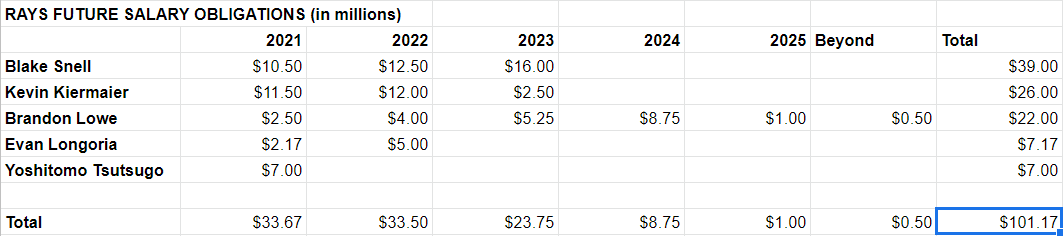
Rays Total Future Cash Obligation: $101.17MM
*Does not include vesting option for Charlie Morton (value between $3MM and $15MM based upon number of days on injured list)
*Includes remaining obligations to Evan Longoria (traded to Giants)
(click to expand/view detail list)
Which 15 Players Should The Rays Protect In An Expansion Draft?
In a few weeks, we’ll be running a two-team mock expansion draft here at MLBTR. Currently, we’re creating 15-player protected lists for each of the existing 30 teams. You can catch up on the rules for player eligibility here.
So far, we’ve done the Yankees, Red Sox, Blue Jays, and Orioles. The Rays are next.
In reality, if the Rays were faced with an expansion draft, they’d make a bunch of trades to minimize the damage of losing quality players given their impressive depth. I decided to lock down only seven players:
Charlie Morton
Blake Snell
Tyler Glasnow
Austin Meadows
Brandon Lowe
Brendan McKay
Wander Franco
That leaves some very tough calls among these 29, of which you can only choose eight:
Willy Adames
Jose Alvarado
Nick Anderson
Randy Arozarena
Anthony Banda
Jalen Beeks
Michael Brosseau
Diego Castillo
Yonny Chirinos
Ji-Man Choi
Yandy Diaz
Oliver Drake
Peter Fairbanks
Brent Honeywell
Kevin Kiermaier
Andrew Kittredge
Nate Lowe
Manuel Margot
Jose Martinez
Brian O’Grady
Michael Perez
Colin Poche
Hunter Renfroe
Trevor Richards
Daniel Robertson
Chaz Roe
Yoshitomo Tsutsugo
Joey Wendle
Ryan Yarbrough
With that, we turn it over to the MLBTR readership! Click here to select exactly eight players you think the Rays should protect in our upcoming mock expansion draft. Click here to view the results.
Quick Hits: Judge, Team Finances, Tsutsugo
Should the Yankees sign Aaron Judge to a long-term extension? Joel Sherman of the New York Post isn’t sure, noting that Judge already has a significant injury history, is already under team control through his age-30 season, and how the Yankees’ financial situation will be impacted in the post-coronavirus baseball world. There’s also the fact that the Yankees have generally shied away from contract extensions since Hal Steinbrenner took over the team, and the two players whose deals were most recently extended (Aaron Hicks and Luis Severino) have battled injuries since inking those new contracts. Judge is in the first of his three arbitration-eligible seasons, and back in January agreed to an $8.5MM deal for the 2020 season.
More from around baseball….
- Most of the 30 teams have already arranged to pay non-baseball employees through the end of May, with such clubs as the Phillies, Tigers, Rockies, and Padres already committed to avoiding job cuts or furloughs beyond May 31. However, there is concern and, “among front-office officials there is an expectation,” ESPN.com’s Buster Olney writes, that there could be major job losses within baseball operations departments after the draft in June. Scouts could be in particular danger, as some clubs have already made moves in recent years towards relying on video analysis rather than in-person reports for scouting purposes. As one team executive tells Olney, “it just doesn’t make any sense to me that these [teams] need to dump people making $40K, $50K. Those savings are not difference-making,” even for franchises that will be taking a big revenue hit this season. Such actions are likely to hurt a team’s reputation around the sport, and could impact future chances of hiring or keeping front office personnel in the future.
- Yoshitomo Tsutsugo has been in Japan since late March, and Marc Topkin of the Tampa Bay Times writes that the newly-acquired Rays slugger is continuing to work out in preparation for his first Major League season. Keeping in touch with Rays staff throughout, Tsutsugo has been involved in various workout, hitting, and throwing routines. As to when Tsutsugo will be able to return to North America, nothing will be determined until (or if) a plan to launch the 2020 season is underway, and Tsutsugo be further delayed given travel restrictions between Japan and the U.S. For instance, Tsutsugo could face a mandatory 14-day self-quarantine upon arriving in America, regardless of any COVID-19 symptoms he may or may not show.