
Nationals Release Trevor Rosenthal
The Nationals have released reliever Trevor Rosenthal, the team announced. The club recalled fellow right-hander Austin Voth from Double-A Harrisburg to take Rosenthal’s 25-man roster spot.
Rosenthal was a standout reliever for most of his run with the Cardinals from 2012-17, during which he was a dominant closer at times. However, Rosenthal’s Cardinals career came to an unfortunate end when he underwent Tommy John surgery in August 2017. He sat out 2018 while rehabbing the injury, but Rosenthal parlayed his track record in St. Louis into a $7MM guarantee with the Nationals last November. The Nats still owe Rosenthal approximately $3.73MM.
Washington’s hope upon signing Rosenthal was that he’d help repair a bullpen that was among the league’s worst in 2018. Instead, Rosenthal became the poster boy for an even sorrier Nationals relief corps this season. The trouble began right away for the 29-year-old Rosenthal, who failed to record a single out until his fifth appearance of the season. After a couple more weeks of struggles, the Nationals sent Rosenthal to the injured list April 26 because of a viral infection.
Rosenthal finally returned from a rehab assignment June 10, but his long layoff didn’t lead to a rebirth. Fittingly, he didn’t get anyone out during his final Nationals appearance in a loss Saturday versus the Braves, who posted three earned runs on three walks against him. Rosenthal concluded his disastrous D.C. run with a 22.74 ERA and 7.11 K/9 against an unbelievable 21.32 BB/9 in 6 1/3 innings.
As woeful as Rosenthal has been this year, he still has his Cardinals days and a 98 mph fastball on which to hang his hat. Consequently, teams could pursue Rosenthal on a minor league contract in his return to free agency.
Injury Notes: Hendricks, Dodgers, Nats, Tribe, German
Injured Cubs starter Kyle Hendricks played catch in the outfield Friday, though the righty “could miss another couple of turns” through the team’s rotation, Steve Greenberg of the Chicago Sun-Times writes. “We’re happy that the initial shutdown has been good, but we’re not ready to talk through a plan yet, or a progression,” general manager Jed Hoyer said of Hendricks, who has been out since June 15 with a right shoulder impingement. The Cubs started Tyler Chatwood in Hendricks’ place Thursday, but the next opportunity may go to prospect Adbert Alzolay, per Greenberg. Alzolay, 24, followed Chatwood in Thursday’s game and enjoyed a triumphant debut in a win over the Mets.
- Dodgers shortstop Corey Seager and center fielder A.J. Pollock could start rehab stints during next month’s All-Star break, manager Dave Roberts said Friday (Twitter links via Ken Gurnick of MLB.com). Meanwhile, reliever Scott Alexander still hasn’t returned to throwing since left forearm inflammation forced him to the injured list June 8. Seager went to the IL on June 13 with a left hamstring strain, which should cost him four to six weeks. Pollock underwent early May surgery on his troublesome right elbow. The expectation then was that he’d be back in July.
- Nationals first baseman Ryan Zimmerman began a rehab assignment Friday at the Double-A level, Jamal Collier of MLB.com tweets. Zimmerman has been out since April 28 with plantar fasciitis in his right foot, the latest in a long line of injuries for the 34-year-old. While Zimmerman posted a couple resurgent offensive seasons from 2017-18, he came out of the gates slowly this year before hitting the IL. Zimmerman’s a .213/.302/.373 batter thus far in 86 plate appearances. Matt Adams, Howie Kendrick and Gerardo Parra have been the Nationals’ most common first base choices in Zimmerman’s absence. Kendrick has been brilliant at the plate, while Adams and Parra have only put together replacement-level numbers.
- A few reinforcements are trying to work back for the Indians, as Mandy Bell of MLB.com details. Ace Corey Kluber, shelved since May 1 with a fractured right forearm, has an upcoming eight-week checkup that will determine whether he’ll be able to start throwing. Fellow righty Danny Salazar just threw a second two-inning simulated game, but he’s “waiting to advance to a real game in Arizona before he gets a rehab assignment,” Bell explains. Shoulder issues have kept Salazar out of action since 2017. Unlike Kluber and Salazar, reliever Dan Otero‘s not making progress. Already out almost three weeks with right shoulder inflammation, Otero is now dealing with a setback of unknown severity.
- Yankees righty Domingo German could rejoin their rotation before the All-Star break, manager Aaron Boone told reporters Friday (via Bryan Hoch of MLB.com). German has been out since June 9 with a left hip flexor strain. The 26-year-old struggled over a handful of starts leading up to his IL placement, though he still carries a respectable 3.86 ERA/4.05 FIP in 70 innings on the season.
Nationals To Sign First-Rounder Jackson Rutledge
The Nationals announced an agreement with first-round pick Jackson Rutledge on Monday. Rutledge’s pick (No. 17) comes with a $3.61MM slot value, but he’ll receive $3.45MM, Jon Heyman of MLB Network tweets.
The 6-foot-8 Rutledge, a right-handed pitcher from San Jacinto College in Houston, entered the draft as a top 15 prospect in the eyes of MLB.com (No. 12), Baseball America (No. 14) and ESPN’s Keith Law (No. 15). In their free scouting report, Jim Callis and Jonathan Mayo of MLB.com write that Rutledge is one of the premier junior college draft prospects in recent memory and may have “the best all-around stuff” in this year’s class. The 20-year-old Rutledge’s fastball sits between 94 and 97 mph, and can hit 99 on occasion. He complements that offering with an impressive slider and a potentially “plus” curveball.
FanGraphs’ Kiley McDaniel and Eric Longenhagen are a bit less bullish on Rutledge than the rest, as they ranked him 21st going into the draft. They note there are concerns regarding Rutledge’s “build, athleticism, and injured hips,” though they still regard him as a “physical beast” with an imposing fastball and promising breaking pitches.
Rizzo On Trading Scherzer: Nats “Certainly Not Thinking About That Right Now”
Even after a 15-5 rout of the Diamondbacks today, the Nationals’ record is just 33-38, leaving the club with a lot of ground to make up in the standings. Washington is 8.5 games back of Atlanta in the NL East, and six games behind the Phillies for the last wild card slot, and barring a big turn-around in the coming weeks, speculation will only increase that the Nats could become sellers at the trade deadline.
Near-term free agents like Sean Doolittle, Howie Kendrick, and even star slugger Anthony Rendon have drawn a lot of the trade buzz, though the biggest move the Nationals could make is offering up ace Max Scherzer. Such a trade doesn’t appear to be in the cards, however, as GM Mike Rizzo told The Athletic’s Ken Rosenthal (subscription required) that “we’re certainly not thinking about that right now.”
“We control the best pitcher in baseball for 2 1/2 more years – three playoff runs,” Rizzo said. “[Scherzer is] extremely well-priced. If you look at his contract, he’s extremely, extremely well-priced. We would have to command something that would be franchise-altering to consider moving him.”
Scherzer is officially owed $142.5MM through the end of the 2021 season, though $105MM of that sum will be paid out in deferrals from 2022-28. As Rosenthal mentions, Washington could also include money in a hypothetical trade in order to lessen the $30MM annual luxury tax hit attached to Scherzer’s deal.
The inclusion of the “right now” qualifier in Rizzo’s statement perhaps leaves the door slightly open for a trade, though it probably leans closer to due diligence rather than any hint towards moving Scherzer. After all, while Rizzo said the Nationals are still hoping for a midseason run, “you also have to be flexible and open-minded enough to know when you have to make changes and go in a different direction.”
Dealing Scherzer, however, would be the type of move that doesn’t only change “direction,” but perhaps sets a new course overall. The Nats have yet to abandon the idea of contending even in 2019, let alone in 2020, and trading a front-of-the-rotation arm like Scherzer doesn’t seem like the type of deal a club looking to contend next season would make, regardless of the huge return such a deal would inevitably bring. Trading a perennial Cy Young candidate and obtaining the type of win-now pieces necessary to reload for another crack at the NL East in 2020 would be an awfully difficult needle to thread, especially when simply keeping Scherzer is such an obvious boon to the rotation.
Between this factor and the personal ties between Rizzo and Scherzer, a trade seems unlikely at best. “I’ve never been closer to a player in my career. I drafted him in Arizona,” said Rizzo, who was formerly the Diamondbacks’ scouting director. “I watched him grow up. We went hard after him (in free agency). We made him a promise that if you’re signing for seven years and you’re deferring all this money to help us win championships, we’re going to do everything we can to win.”
Nationals Place Kyle Barraclough On IL
10:46am: Barraclough began feeling pain in his forearm after Saturday’s game and will go for an examination Sunday, manager Dave Martinez told reporters (via Jesse Dougherty of the Washington Post).
10:14am: The Nationals have placed right-handed reliever Kyle Barraclough on the 10-day injured list with “radial nerve irritation,” Todd Dybas of NBC Sports Washington reports. The club recalled infielder Adrian Sanchez from Double-A Harrisburg to take Barraclough’s roster spot.
Barraclough’s IL placement comes on the heels of his latest brutal 2019 outing, in which he surrendered three earned runs on three hits (including one homer) and a walk during a loss to the Diamondbacks on Saturday. Barraclough, who recorded just one out in the game, has now given up multiple earned runs in six appearances since May 12. Thanks in part to tumbling velocity, the ex-flamethrower has stumbled to an ugly 6.39 ERA/6.04 FIP in 25 1/3 innings this year.
Barraclough, to his credit, has fanned 10.66 batters per nine and slashed his walk rate from in the fives over previous seasons to 4.26 this year. However, the ex-Marlin has seen his groundball rate fall to 37.7 percent, down almost 7 points compared to his career mark, and has yielded a lofty 2.49 homers per nine. That’s not what the Nationals had in mind when they acquired the 29-year-old at the outset of last offseason.
Thus far, Barraclough has been one of many problems in a Washington bullpen that has been downright awful. The struggles of the Nationals’ relief unit have played a large role in their dismal 32-38 start.
Nationals Shut Down Koda Glover Following Setback In Rehab
In what has become an all-too-familiar refrain for Nationals fans, right-hander Koda Glover has suffered a setback in his rehab from a forearm strain and will be shut down entirely for the next six weeks, manager Dave Martinez told reporters Thursday (link via Sam Fortier of the Washington Post). Glover received a platelet-rich plasma injection at the recommendation of Dr. James Andrews after experiencing elbow pain in a recent throwing session.
Once touted as the Nationals’ potential closer of the future, Glover has instead seen his career punctuated by a series of prolonged absences due to injury. Since his debut in 2016, the now-26-year-old Glover has missed time due to a torn labrum in his hip, multiple shoulder injuries and a lower back injury as well. High as the organization’s expectations for Glover have been, he’s managed to tally just 55 1/3 innings as a big leaguer dating back to 2016. In that time, the former eighth-round pick has a 4.55 ERA (4.00 FIP) with 6.8 K/9, 3.4 BB.9, 0.81 HR/9, a 41.4 percent ground-ball rate and an average fastball velocity of 96.2 mph.
Despite that minimal workload, Glover has spent enough time on the Major League disabled list/injured list to qualify for arbitration eligibility this offseason. While some might peg him as a potential non-tender candidate, there’d be little risk in retaining him. His lack of innings, particularly in his platform 2019 campaign, would make his raise rather minimal. Glover also has a pair of minor league options remaining, which enhances his appeal moving forward. And the Nationals, who carry MLB’s worst bullpen ERA, aren’t exactly in a position to be parting with any relievers they believe to be talented — even if Glover’s absence has contributed to the current state of the Washington bullpen.
Howie Kendrick Is Killing The Ball
Howie Kendrick has been a quality major leaguer throughout most of his career, which began in 2006. Kendrick’s a lifetime .292/.335/.427 hitter with a 108 wRC+ and 29.9 fWAR in a combined 6,129 plate appearances with the Angels, Dodgers, Phillies and Nationals. But now, a month from his 36th birthday, the infielder/outfielder may be better than ever.
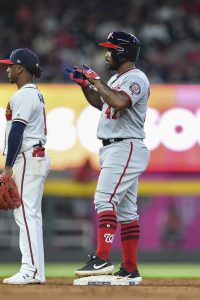
Kendrick collected two hits and a pair of walks in the Nationals’ win over the White Sox on Monday, raising his line to .333/.376/.604 (149 wRC+) in 178 trips to the plate this season. That’s impressive for anyone, let alone an aging player who missed nearly all of 2018 thanks to the ruptured right Achilles he suffered last May. Kendrick’s output is all the more extraordinary when considering there doesn’t appear to be anything particularly fluky about it.
Never known for striking out much, Kendrick’s doing it almost less than ever this season, having gone down on strikes a meager 14.6 percent of the time. At the same time, Kendrick has never quite rivaled Mike Trout at drawing walks. That has remained the case in 2019, though his current rate (6.7 percent) stands as one of the highest figures of his career. And the righty-swinging Kendrick has always been tough on both same- and left-handed pitchers, which has certainly been true this season.
Kendrick’s increase in production stems largely from an uptick in power. His ISO (.270) is twice his career number (.135), in part because of a greater emphasis on hitting fly balls. Kendrick’s pulling the ball more than ever, going less to the opposite field than he ever has, and his newfound power reflects that. His FB rate (32.6 percent) is more than 8 percent his lifetime figure (24.1), and his launch angle – which was in the one-degree range from 2015-17 before climbing to 7.9 during his injury-limited 2018 – has skyrocketed to 9.2.
Kendrick’s effort to put the ball in the air more has paid serious dividends. He already has 11 home runs, seven fewer than his most in a season; although his 24.4 percent HR-to-FB rate isn’t going to hold, both Kendrick’s approach at the plate and the way he’s hitting the ball suggest a massive drop-off may not be in the offing. Kendrick’s swinging and missing a career-best rate and making more contact than he has at any point, particularly on pitches outside the strike zone. When Kendrick has connected, he has posted the majors’ 14th-best weighted on-base average (.408), per Statcast. And that’s hardly just a product of good fortune, as shown by his 11th-ranked expected wOBA (.424). Kendrick’s xwOBA ranks in the majors’ 96th percentile, while his expected slugging percentage (.610; 96th), expected batting average (.328; 99th), hard-hit rate (50 percent; 93rd percentile) and exit velocity (91.7 percent; 88th) also reside toward the top of the league.
If there’s one problem with Kendrick’s offensive game, it’s a lack of speed. While Kendrick has been a double-digit stolen base threat for the majority of his career, he has swiped a mere two on four attempts dating back to last season. According to Statcast’s sprint speed metric, Kendrick is now one of the majors’ slowest runners. Kendrick’s .331 batting average on balls in play may decline as a result, especially considering he’s hitting the ball on the ground most of the time, and the lack of speed won’t help his cause in the field either. To Kendrick’s credit, though, he’s still a versatile defender, having logged double-digit appearances at first, second and third base this season.
Kendrick’s superb late-career showing looks like an important development for him and the Nationals. Not only is Kendrick helping his future earning power a few months away from another trip to free agency, but he could aid in a playoff push for the Nats. Worst-case scenario for Washington: If the club falls out of the postseason race and decides to sell before the July 31 deadline, it’ll likely have a solid trade chip on its hands in Kendrick. The veteran’s on a non-prohibitive $4MM salary, making him all the more enticing to potential suitors.
Photo courtesy of USA Today Sports Images.
KBO’s Lotte Giants To Acquire Jacob Wilson, Release Carlos Asuaje
The Lotte Giants of the KBO League are set to acquire infielder Jacob Wilson from the Nationals, as per a report from Naver Sports (hat tip to The Athletic’s Sung Min Kim). Wilson will take the place of infielder Carlos Asuaje, who is being released.
As per the Pacific Coast League’s official transactions page, Wilson has been placed on the Triple-A Fresno Grizzlies’ temporarily inactive list, likely while the details of the move to South Korea are finalized. Wilson was originally a 10th-round pick for the Cardinals in the 2012 draft, and has compiled a .257/.336/.435 slash line and an even 100 home runs over 3029 career PA in the minors. Wilson has yet to reach the big leagues at age 28, and the move to the KBO League offers him a new opportunity (and larger salary) than he was likely to obtain continuing in the Nats’ organization.
Wilson has mostly played second and third base in his career, though he has experience all over the diamond, with multiple starts at first base, shortstop, and both corner outfield positions. He also heads to the Giants in the wake of his best-ever season at the plate, as Wilson has clearly enjoyed the thin air of the PCL to the tune of a 1.023 OPS in 230 plate appearances for Fresno.
Asuaje only just joined the KBO this past offseason, delivering a .252/.356/.368 slash over 194 PA this season. A veteran of 175 MLB games with the Padres from 2016-18, Asuaje hit .240/.312/.329 over 586 PA for San Diego, with the large majority of his production coming against right-handed pitching.
NL Injury Notes: Cano, Dodgers, Phillies, Nationals
While a decision won’t come until Sunday, the Mets are “seriously considering” placing second baseman Robinson Cano back on the injured list, Anthony DiComo of MLB.com tweets. Cano went to the IL on May 23 with a left quad strain, only to re-aggravate the injury when he returned this past Wednesday. While the 36-year-old suggested at the time he wouldn’t require another IL stint, he hasn’t played since then. Even now, Cano insists he “feels good,” per DiComo.
More from the NL…
- Dodgers outfielder Alex Verdugo has been playing through “nagging” lower back tightness over the past couple weeks, but it’s “not serious,” according to manager Dave Roberts (via Bill Plunkett of the Orange County Register). That may at least partially explain why the rookie’s numbers have nosedived of late, though he’s still slashing a solid .291/.344/.457 (113 wRC+) in 195 plate appearances this season. Verdugo has been the Dodgers’ primary center fielder since A.J. Pollock underwent elbow surgery at the outset of May. Pollock will have the PICC line removed from his elbow Wednesday and could begin baseball activities soon after that, Plunkett relays. Pollock will reclaim center upon his return, according to Roberts, but Verdugo’s still “going to play.”
- The Phillies placed outfielder Adam Haseley on the IL on Saturday because of a strained left groin, Scott Lauber of the Philadelphia Inquirer writes. The club’s not sure how much time Haseley will miss; in the meantime, it recalled outfielder Nick Williams from Triple-A Lehigh Valley as his replacement. Haseley, a 2017 first-round pick whom the Phillies promoted when outfielder Andrew McCutchen suffered a torn ACL on Monday, racked up a mere eight plate appearances before going on the shelf.
- Nationals reliever Justin Miller started a rehab assignment at the Double-A level on Saturday, when he threw a perfect inning and fired nine strikes on 10 pitches, Jesse Dougherty of the Washington Post reports. Miller has been on the IL twice this season, including since May 18 with a right rotator cuff strain. The injuries have contributed to a tough year for Miller, who has notched a 4.02 ERA (with an unsightly 7.04 FIP), 6.32 K/9 against 2.3 BB/9, and a microscopic 19.1 percent groundball rate in 15 2/3 innings. He’s one of a multitude of Nationals relievers who have disappointed in 2019.
Nationals Activate Trevor Rosenthal
The Nationals announced the reinstatement of reliever Trevor Rosenthal from the 10-day injured list Saturday. They optioned fellow right-hander Kyle McGowin to Double-A Harrisburg in a corresponding move.
In what looked like a beneficial move in the making, the Nationals signed Rosenthal to a $7MM guarantee last November. Rosenthal was coming off a season-plus lost to Tommy John surgery at the time, though he had established himself as a quality reliever with the Cardinals dating back to his 2012 debut. However, the 29-year-old Rosenthal has been anything but effective as a member of the Nationals. Not only did it take Rosenthal until his fifth appearance of the season to record an out, but he allowed 12 earned runs on seven hits and nine walks in three innings before going on the IL on April 26 with a viral infection.
Adding to his issues in 2019, the hard-throwing Rosenthal didn’t register encouraging numbers during his prolonged stay in the minors. While pitching at the Double-A level, Rosenthal yielded six earned runs on nine hits (two homers) with 11 strikeouts against seven walks in 9 1/3 innings.
At this point, it’s hard to believe Rosenthal will reestablish himself in Washington, but a turnaround would be a significant boon for the club. The Nationals’ bullpen has been one of the worst in the majors throughout the season, which has helped lead to an awful 28-35 record and a six-game deficit in the NL East. In the Nats’ most recent late-game blowup on Friday, closer Sean Doolittle surrendered the decisive two runs en route to a 5-4 loss to the Padres.