
10:41am: The deal also allows Guyer to earn up to $400K in plate-appearance-based bonuses in both 2018 and 2019, Bastian tweets. And the option value can rise to as much as $3.75MM with escalators.
9:51am: It’s a two-year, $5MM contract for Guyer, tweets MLB.com’s Jordan Bastian. He’ll receive $2MM in 2017 (just shy of the $2.1MM midpoint between the two sides’ arbitration numbers) and $2.75MM in 2018. Guyer’s contract contains a $3MM club option for the 2019 season, which comes with a $250K buyout.
9:35am: The Indians announced on Wednesday that they’ve signed outfielder Brandon Guyer to a two-year deal with a club option for the 2019 season. The 30-year-old Guyer (31 next week) was arbitration-eligible and had filed for a $2.3MM, which the Indians countered with a $1.9MM offer (as shown in MLBTR’s 2017 Arbitration Tracker). Rather than hammer out a one-year pact, Guyer will instead agree to lock in both of his remaining arbitration salaries in exchange for a club option over what would’ve been his first free-agent year.
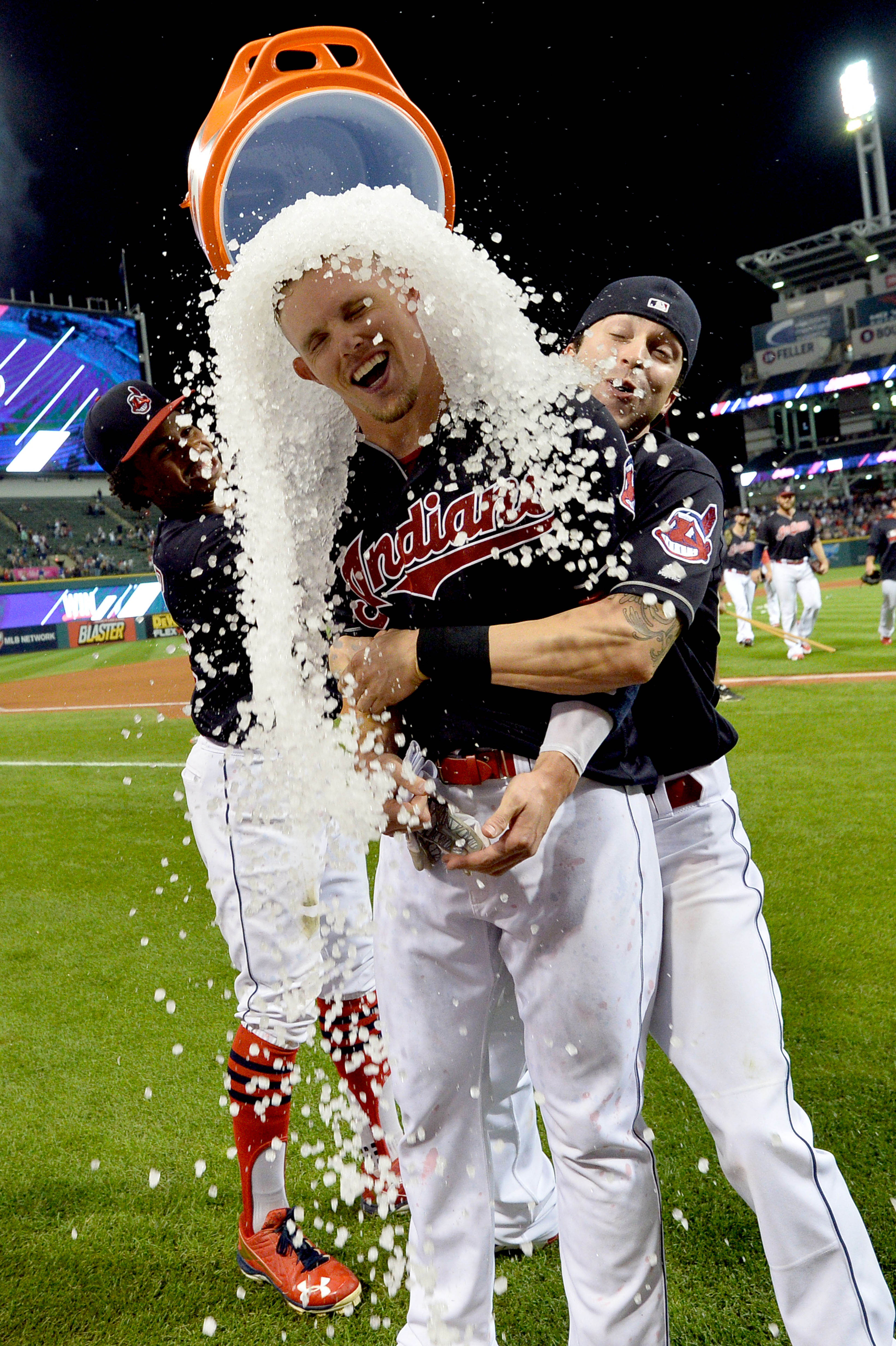
Guyer, a longtime member of the Rays, was a deadline pickup for the Indians, who traded minor league outfielder Nathan Lukes and minor league righty Jhonleider Salinas to the Rays to acquire the remaining two and a half years of control on Guyer’s contract. Guyer has long been a thorn in the side of left-handed pitching, and Cleveland benefited substantially from that trait, as Guyer slashed .333/.438/.469 in a limited role (91 plate appearances) over the remainder of the regular season following the trade. He also chipped in a .333/.500/.389 batting line in 24 postseason plate appearances.
Beyond his strong career performance against left-handed pitching (.289/.391/.470), Guyer thrives in one perhaps underappreciated element of the game: getting hit by pitches. Shortly after the trade, August Fagerstrom examined Guyer’s uncanny penchant for being hit by pitches over at Fangraphs, observing that Guyer is not only the active leader in total HBPs over the past couple of seasons, but the leader in HBPs on a percentage basis (min. 500 PAs) dating all the way back to 1921.
A ridiculous 6.1 percent of Guyer’s plate appearances have resulted in him being plunked by a pitch, which compensates for a below-average walk rate and has allowed him to consistently post strong OBPs in the Majors. As Fagerstrom breaks down in the aforementioned Fangraphs column, Guyer’s HBP magic isn’t as much from crowding the plate (though he does that, too) as it is from a striding toward the plate and the inside edge of the batter’s box as he loads for a swing. While some might raise an eyebrow at calling that a “skill,” Guyer’s propensity for reaching base the hard way has undoubtedly benefited his teams over the years, and no one in the game seems as adept at doing so.
Turning to Guyer’s glovework, he has experience at all three outfield positions but has spent the majority of his time in left field, where he grades out as an above-average defender. With Cleveland, however, he’s likely to spend the bulk of his time in right field, where he’ll serve as a platoon partner for the left-handed-hitting Lonnie Chisenhall (who has struggled considerably against southpaw pitchers in his career). Guyer, of course, can move all over the outfield for manager Terry Francona, if needed. Guyer and Chisenhall will be part of a mix that includes a hopefully healthy Michael Brantley in left field, Tyler Naquin in center (who could also potentially benefit from some platooning) and presumptive reserve outfielder Abraham Almonte.
Photo courtesy of USA Today Sports Images.
I like this signing for The Tribe. A solid player at a reasonable rate.
Agreed 100%
6 over 2 with a 5 million dollar option and 1 million buyout?
Do you not see the actual article?
“It’s a two-year, $5MM contract…contains a $3MM club option for the 2019 season, which comes with a $250K buyout.”
Good signing by the Tribe! Guyer plays the game the right way, and gets on base a lot!
I like guyer a lot, but the guy leans into pitches, don’t know if that’s “the right way”
No offense but you clearly haven’t seen him bat enough. He doesn’t lean into the pitches. When he starts his swing and takes his step, his foot lands on the very edge of the upper right corner. Since his foot wasn’t there initially, many pitchers who are throwing off the plate end up hitting him.
He’s even talked about how it isn’t about getting on base, that’s just how he’s always swung
Great signing! This guy should continue to thrive under Tito and his copious usage of platoons. He compliments both naquin and chiz almost perfectly. He brings that much needed grit and most importantly he comes at a very reasonable cost.
Great signing. You can look at statistics all you want, but they can be misleading, as certain guys with great numbers don’t pass the “eye test” (for example, hitting tons of home runs in the 8th inning of meaningless blowouts to pad their stats) and vice-versa.
This guy has decent power, gets on base, always hustles and plays solid D and delivers in clutch situations. Solid ballplayer at a reasonable price. Maybe the Tribe can now jettison Almonte.
It’s a really nice signing for Cleveland, but your perception of Guyer demonstrates why stats are important: our memories are selective and don’t necessarily paint an accurate picture.
Guyer is a career .193/.280/.277 hitter in “Late & Close” situations and has done the vast majority of his damage at the plate in low-leverage situations (.818 OPS) versus high-leverage spots (.569 OPS).
I’m sure he had a few clutch hits down the stretch in Cleveland and/or over the years in Tampa, but the picture you painted isn’t representative of his career to date.
Granted, I think it’s all more or less noise. He’s a very good hitter against lefties, and I’d be happy to have him up in any spot against an opposite-handed pitcher, regardless of leverage.
Point taken…lol. I guess I can’t argue your numbers, and suffer from selective memory, but in his limited time in Cleveland, he’s seemed to fit in really well.
I like the signing as a platoon partner to Chiz and to occasionally spell Naquin..
As a rays fan i love guyer
hes great
Best of luck to cleveland
Great signing! it’s the little sneaky moves like these that help ball clubs