
Latest On Steve Pearce
Steve Pearce proved to be a brilliant in-season pickup by the Red Sox a year ago, when they acquired him from the division-rival Blue Jays in late June. Pearce not only put up excellent regular-season production with Boston, but the first baseman dominated during the Fall Classic to earn World Series MVP honors in a five-game victory over the Dodgers. The Red Sox and Pearce could have gone their separate ways then and ended their relationship on a high note, but a couple weeks after the team won its latest title, it re-signed the 36-year-old to a $6.25MM guarantee.
While Boston undoubtedly expected the good times to continue rolling for Pearce in 2019, he has instead trudged through a season defined by underperformance and injuries. After starting the campaign on the shelf because of a strained left calf, Pearce debuted in early April and proceeded to hit a ghastly .180/.245/.258 (29 wRC+) with one home run in 99 plate appearances through May. The Red Sox sent Pearce back to the IL on June 1 with back problems. Pearce hasn’t returned to action since then, owing largely to the posterior ligament knee injury he suffered while on a rehab stint. A month and a half later, he’s still not slated to make his way back to the majors anytime soon, Christopher Smith of MassLive.com reports.
Manager Alex Cora issued an update Thursday on Pearce, saying he’s “just rehabbing” at the team’s complex in Fort Myers, Fla., and not “even close to (being) back.” As of now, Pearce isn’t “participating in many baseball activities” and is only hitting off a tee, Smith writes.
The absences of Pearce and Mitch Moreland (who has taken two at-bats since late May) have thrown a wrench into the plans Boston had at first base entering the season. The righty-swinging Pearce and the left-handed Moreland were supposed to be the Red Sox’s solution at the position. Rookie Michael Chavis, who had been at second base, has instead emerged as the team’s starter at first with Pearce and Moreland unavailable. Meanwhile, Brock Holt and Marco Hernandez have taken the reins at second, which played a part in the Red Sox’s decision to to designate struggling veteran Eduardo Nunez for assignment this week. Moreland’s due back soon, Smith notes, though it’s not yet clear how the Red Sox will dole out playing time at first and second when he returns.
How Good Is Shane Greene?
With the Tigers mired in a rebuild and closer Shane Greene in his second-last year of team control, the right-hander ranks as one of baseball’s most obvious trade candidates heading into the July 31 deadline. While little has gone right this year for Detroit, whose 29-62 record stands as the game’s second worst, Greene has been one of the team’s few bright lights. That’s especially encouraging for the Tigers considering they may be on the verge of dealing the All-Star to a contender.
A Tiger since they acquired him from the Yankees in a noteworthy three-team trade entering the 2015 season, Greene’s tenure in the Motor City has been a mixed bag. He was subpar in his first year with the Tigers while mostly working as a starter, and has proved inconsistent as a reliever since then. Greene’s career has continued its up-and-down trajectory this season, but 2019 has checked in on the overwhelmingly positive side in terms of results. The 30-year-old owns a near-flawless 1.06 ERA in 34 innings, during which he has converted 22 of 24 saves. Greene has racked up those numbers on a reasonable $4MM salary, which should only add to his appeal for reliever-needy contenders.
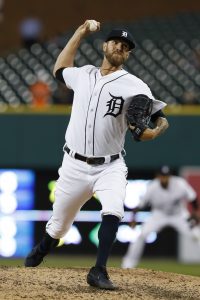
Chris McCosky of the Detroit News reported last week that interested clubs view Greene as more a setup man than a closer, despite the success he has enjoyed putting a bow on rare Detroit wins this year.
The question is: Would an acquiring team be getting a real difference-maker in Greene? His ERA says yes, as do Greene’s 9.26 K/9, 2.65 BB/9, career-high 53.4 percent groundball rate and improved swinging-strike and contact rates. Furthermore, thanks in part to a personal-best 15.2 percent infield fly mark, Greene’s hard-contact rate against has tumbled from 37.5 percent last year to 27.3 this season. According to FanGraphs, just 11 relievers have yielded a lower hard-hit percentage than Greene.
Statcast only places Greene in the league’s 49th percentile in the hard-hit department, though it assigns him far better reviews in the expected slugging percentage (67th), expected weighted on-base average (80th) and expected batting average (86th) categories. It also indicates Greene has made changes to his pitch mix compared to last year, having upped his cutter usage by almost 6 percent and thrown his slider 4 percent less. Greene’s slider hasn’t produced poor results, but his cutter and his main pitch – a sinker – have been particularly tough on opposing hitters. Thus far, they’ve managed sub-.200 wOBAs against the two. Those offerings have helped Greene stymie same-handed batters, who have logged a pitiful .170 wOBA against him, and also keep lefties at bay (.271).
As effective as Greene has been in 2019, there are some red flags accompanying his performance. For one, his velocity isn’t quite where it was in 2018. Beyond that, it appears Greene has benefited greatly from luck. ERA estimators FIP (3.66), xFIP (4.04) and SIERA (3.62) paint Greene as something closer to a useful reliever than a a true shutdown option, and the .179 batting average on balls in play he has surrendered to opposing hitters likely won’t hold. The number’s a whopping 125 points below Greene’s career norm (.304). Allowing less impactful contact has helped Greene sustain that figure to this point, granted, but it’s nevertheless a good bet to climb as the season progresses. Likewise, Greene’s 86.1 percent strand rate – which is a lofty 17-plus points higher than his usual (69.0) – may regress toward his lifetime mean over the next couple months. Plus, although Greene’s aforementioned xwOBA (.282) is among the league’s best, it’s still 66 points higher than the real wOBA he has given up (.216).
It’s clear there are no shortage of reasons for optimism and pessimism in regards to Greene’s 2019 output. It’s also obvious Greene’s a capable major league reliever, though, and with another year of arbitration control left, he’ll be in demand around the deadline.
Photo courtesy of USA Today Sports Images.
Washington’s Yan Gomes Acquisition Isn’t Working Out
The Nationals were one of eight teams whose catchers posted a sub-replacement fWAR in 2018, which led general manager Mike Rizzo to make over the position entering this season. Rizzo said goodbye to Matt Wieters and Pedro Severino, the Nationals’ primary catchers last year, and brought in Kurt Suzuki in free agency and Yan Gomes in a trade with the Indians. Both pickups looked fine on paper, and Suzuki has played pretty well through the first four months into the season. Gomes, on the other hand, has been stunningly bad.
Set to turn 32 this Friday, Gomes was a valuable backstop in Cleveland, where he totaled 13.7 fWAR from 2013-18. But Gomes has taken massive steps back in D.C., where he has accounted for minus-0.2 fWAR and mustered an unsightly .202/.298/.290 batting line with three home runs in 208 plate appearances. Gomes’ 54 wRC+ is barely more than half the 101 he managed last year with the Tribe, and his .087 ISO ranks ninth worst in the majors among 262 hitters who have amassed at least 200 trips to the plate.
To make matters worse, Gomes hasn’t been the same caliber of defender he was just a year ago, when he ranked as one of Baseball Prospectus’ premier catchers (including in the pitch-framing department). Although Gomes has thrown out a strong 36 percent of would-be base stealers – up from 29 percent in 2018 – BP regards the Washington version as a below-average backstop and a subpar framer. Meanwhile, Statcast only puts Gomes’ in the majors’ 36th percentile when it comes to stealing strikes.
Statcast also thinks little of Gomes’ offense, placing him in the 26th percentile or worse in hard-hit rate, average exit velocity, expected slugging percentage, expected batting average and expected weighted-on base average. There isn’t a huge difference between Gomes’ xwOBA (.276) and real wOBA (.261), which suggests a major rebound isn’t coming at the plate. FanGraphs offers even more bad news, noting Gomes’ hard-hit percentage (25.2) has dropped exactly 18 points since 2018 and ranks third last in the majors. Gomes is hitting far more ground balls and far fewer line drives than he did a year ago, which predictably hasn’t been a recipe for success.
If you’re holding out for encouraging signs, there are a few, starting with Gomes’ K/BB ratio. He has struck out in 23.1 percent of plate appearances, down from 25.8 percent or more in each of the previous four seasons. Moreover, Gomes’ walk rate, 10.1 percent, is a career best and almost doubles his lifetime mark (5.4). He’s also swinging and missing less than he has in recent years and making much more out-of-zone contact than ever. And Gomes’ .258 batting average on balls in play, a 37-point decrease from his lifetime figure (.295), indicates he has dealt with some poor fortune this year.
Even if Gomes’ BABIP does normalize as the season goes on, odds are the Nationals aren’t going to get the 2018 All-Star version they wanted. To this point, Gomes has surprisingly been a less valuable player than right-hander Jefry Rodriguez, whom the Nationals traded to the Indians for him and who hasn’t exactly been a world-beater in his own right. The Nats also parted with outfield prospect Daniel Johnson, a 24-year-old who has notched quality numbers in his first Triple-A action this season, and young infielder Andruw Monasterio.
Waving goodbye to Rodriguez, Johnson and Monasterio to acquire Gomes was an understandable decision for Washington at the time, but the move hasn’t yielded dividends thus far for the playoff hopefuls. Unless Gomes revisits his prior form during the final couple months of the campaign, the Nationals may buy him out in the offseason in lieu of exercising a $9MM club option for 2020.
Diamondbacks Activate Wilmer Flores From Injured List
TODAY: The D’Backs have activated Flores, the team announced. Flores will take the roster spot left behind by Kevin Cron, who was optioned to Triple-A after last night’s game.
WEDNESDAY: Diamondbacks infielder Wilmer Flores has been out for almost two months because of a fractured right, but he’s on the cusp of a return. The club could activate Flores from the 10-day injured list as early as Thursday, Nick Piecoro of the Arizona Republic reports.
The 27-year-old Flores landed the second-largest guarantee ($4.25MM) the Diamondbacks doled out during a frugal winter for the club in free agency. The former Met inked his deal after a few useful years in New York, but the team non-tendered Flores in November in lieu of paying him a projected $4.7MM in arbitration.
Unfortunately for Arizona, Flores hasn’t appeared in a major league game since May 18, nor was he all that productive up to then. So far as a Diamondback, Flores has slashed a modest .281/.326/.398 (88 wRC+) with two home runs in 138 plate appearances. As has typically been the case, though, the right-handed Flores has performed well against lefty pitchers. He was also amid a hot stretch at the plate before fracturing his foot.
Once Flores officially returns to the bigs, he’ll try to impress the Diamondbacks enough for them to exercise his $6MM club option for 2020 after the season. Flores will “get every lefty” the playoff-contending D-backs face when he comes back, manager Torey Lovullo said. That means lefty-swinging corner infielder Jake Lamb will head to the bench against southpaws, leaving third base to Eduardo Escobar and first to Christian Walker, as Piecoro notes.
Jeff Bridich: Rockies Playing “Really Bad Baseball”
This has been an up-and-down season for the Rockies, who began 3-12, climbed all the way to 40-34 and have since nosedived to 46-50. The multiple rotten stretches the Rockies have stumbled through this year may prevent them from earning a third straight playoff berth, but for now, they’re a still-manageable 3 1/2 games out of wild-card position in the jam-packed National League. However, that doesn’t seem to be of much solace to general manager Jeff Bridich, who admitted to Thomas Harding of MLB.com that the Rockies are playing “really bad baseball.” Bridich added that the Rockies’ horrid performance over the past several weeks could complicate matters leading up to the July 31 trade deadline.
“It all needs addressing,” Bridich said of his roster, though he doesn’t see “any quick fixes” and suggested he’s not gearing up to purchase outside help right now. While Harding notes Bridich bought at the previous two deadlines, which helped the team get to the postseason in each case, the GM was frank in saying this year “feels different” compared to those seasons.
“Just watch us play,” Bridich said. “We get a good outing from our starter and we’ll find a way to lose that game through offense or the bullpen or defense. We’ll get a lot of offense one game and our bullpen will come blow it or defense will blow it, or combine. There’s a different way each night, it seems. When that’s your reality in all parts of your team, it’s a tough go to fix all that in one small time period of the year.”
Problems are indeed prevalent for the Rockies. Despite having to pitch half its season at Coors Field, Colorado’s staff was legitimately effective last year. Among their starters, Kyle Freeland finished fourth in NL Cy Young voting, German Marquez was a strikeout machine, and Tyler Anderson, Jon Gray and Antonio Senzatela offered fine complementary performances. This year, with the exception of Gray, everyone from that group has taken noticeable steps back. Meanwhile, the Rockies’ bullpen has felt the absence of Adam Ottavino, who signed with the Yankees in the offseason, and fellow veterans Wade Davis and Seunghwan Oh (whose season is now over because of an elbow injury) have been dreadful. The bullpen’s lone bright spot over a large sample of work has been Scott Oberg, who has posted a 1.35 ERA/3.06 FIP in 46 2/3 frames.
As Bridich suggested, the Rockies’ position player group has also fallen flat. Despite the presences of Nolan Arenado, Trevor Story, Charlie Blackmon and David Dahl, the unit’s the fifth worst in the league by fWAR (5.2). Colorado has scored the majors’ fourth-most runs (527), but according to park-adjusted metric wRC+ (85), only five offenses have been worse. In the field, the club has been run-of-the-mill at best in errors (15th), Defensive Runs Saved (20th) and Ultimate Zone Rating (22nd).
Thanks to the Rockies’ team-wide issues, they may be more inclined to sell or stand pat than buy in the next two weeks. The trouble is, if the team wants to ship players out, it doesn’t seem to have a lot of realistic trade chips. Oh, catcher Chris Iannetta and infielder Mark Reynolds are the Rockies’ only impending free agents, but there’s little to no trade value in any of those cases. While the Rockies would likely jump at the chance to get any of the big contracts of Davis, Ian Desmond, Jake McGee and Bryan Shaw off their books, that’s not happening. Daniel Murphy has been hot of late, though he’s a soon-to-be 35-year-old with almost $18MM in guaranteed money left on his contract through 2020.
On the other hand, Story – who has two years of arbitration eligibility left after this one – would bring back a haul in a trade. But it’s almost impossible to imagine the Rockies dealing the 26-year-old this summer, especially considering they’d like to extend him. Gray and Oberg, who also come with arbitration control through 2021, would be easier to give up than Story. However, it would take a “truly special” return for the team to trade either of those right-handers, according to Harding.
AL Notes: Astros, Tribe, Kluber, Mondesi, M. Chapman, Twins
The Astros had interest in trading for catcher Martin Maldonado before the Cubs acquired him from the Royals on Monday, Ken Rosenthal of The Athletic reports (subscription link). Maldonado was a pre-deadline pickup for Houston last July, when it acquired him from the division-rival Angels, but the Astros’ attempt to re-sign him during the offeason failed. The Astros then brought in free agent Robinson Chirinos, who has been their No. 1 backstop all year but has slumped of late. Chirinos is a better hitter than Maldonado, but the latter is far and away the superior defender. Astros backup catcher Max Stassi is another defense-first option, though he’s having a much worse season at the plate than Maldonado. For Houston, re-acquiring Maldonado could have brought about the end of the out-of-options Stassi’s time on its 40-man roster.
More on a few other American League clubs…
- Indians ace Corey Kluber‘s recovery from the fractured right forearm he suffered May 1 took a significant step Wednesday, per Paul Hoynes of cleveland.com. Kluber threw an all-fastball, 20-pitch bullpen session – his first since incurring the injury – without any issues. “Everybody came out smiling,” manager Terry Francona said. Kluber will throw a bullpen again Sunday, though there’s still no timetable for his return to the majors. Despite having to deal with long-term absences of Kluber and fellow rotation stalwarts Carlos Carrasco and Mike Clevinger this season, the Indians are 54-40 and tied for the AL’s second wild-card spot.
- Royals shortstop Adalberto Mondesi went to the injured list with a left shoulder subluxation Wednesday. Fortunately, the injury isn’t as severe as Mondesi initially feared, Lynn Worthy of the Kansas City Star tweets. With that said, it remains unknown how much time the 23-year-old cornerstone will miss. A former stud prospect, Mondesi has developed into an untouchable major leaguer for the Royals, having combined passable offense with plus defense and excellent base running since a breakout 2018.
- Athletics third baseman Matt Chapman left their win over the Mariners on Wednesday with left ankle soreness, Oakland announced. Chapman is day-to-day, Rusty Simmons of the San Francisco Chronicle relays. Winners of eight of 10 and tied with Cleveland for the AL’s second wild-card position, the A’s are rolling thanks in part to Chapman, who’s enjoying another superstar-caliber campaign. The 26-year-old has torched the opposition for a .279/.363/.552 batting line with 22 home runs and 4.2 fWAR over 405 plate appearances in 2019.
- The Twins designated reliever Mike Morin for assignment Tuesday, which came as somewhat of a surprise considering the 3.18 ERA and .79 BB/9 the right-hander has posted in 22 2/3 innings this season. Manager Rocco Baldelli admitted it was a “very difficult” decision to jettison Morin, who did “his job very well” (via Do-Hyoung Park of MLB.com). With 37 players on their 40-man roster after Morin’s DFA, the Twins “will almost certainly” select a reliever from the minors (recent pickups Cody Allen and Carlos Torres are among the candidates) or acquire one via trade to replace him.
Minor MLB Transactions: 7/17/19
The latest minor moves from around baseball…
- Left-hander Robbie Ross recently joined the Sugar Land Skeeters of the independent Atlantic League. The 30-year-old has already thrown 7 1/3 innings with the club, striking out 13 but allowing eight earned runs on 10 hits and six walks. Ross spent last season in the minors with the White Sox after an injury-limited 2017 in Boston. Before that, Ross was fairly successful in the majors with the Rangers and Red Sox from 2012-16 – a 321 2/3-inning span in which he logged a 3.83 ERA/3.78 FIP with 7.41 K/9, 3.22 BB/9 and a 52.3 percent groundball rate.
- The Rockies made a pair of 40-man roster transactions Wednesday, moving infielder Brendan Rodgers to the 60-day injured list after he underwent season-ending shoulder surgery and reinstating lefty Harrison Musgrave from the 60-day IL. The club optioned Musgrave, who hasn’t pitched since May 3 because of a flexor strain, to Triple-A Albuquerque after activating him. The 27-year-old Musgrave allowed four earned runs on nine hits and seven walks (with 12 strikeouts) in 10 innings before his IL placement. As a rookie last season, Musgrave threw 44 2/3 frames to rank seventh among Rockies relievers in that category, but he only mustered a 4.63 ERA/5.31 FIP with 6.45 K/9 against 4.43 BB/9.
Reds Acquire Justin Grimm
The Reds have acquired right-handed reliever Justin Grimm from the Dodgers, according to Doug Gray of RedsMinorLeagues.com. The Dodgers received cash considerations in return, per Andersen Pickard of SB Nation.
Grimm never pitched in the majors for the Dodgers, who signed him to a minor league contract in late March. To this point, the 30-year-old has spent the season with Triple-A Oklahoma City and pitched to a bloated 5.66 ERA despite 12.2 K/9 against 3.3 BB/9 over 41 1/3 innings.
At his best, Grimm was a solid piece of the Cubs’ bullpen from 2013-16, during which he posted a 3.29 ERA/3.17 FIP with 10.48 K/9, 3.94 BB/9 and a 45.2 percent groundball rate in 180 1/3 innings. That came after Grimm struggled in 2012 with the Rangers, though, and he fell off in 2017 with the Cubs before enduring a rough 2018 divided between the Royals and Mariners. Adding up all of Grimm’s major league work, he has notched a 4.98 ERA/4.07 FIP with 9.13 K/9, 3.89 BB/9 and a grounder percentage of 43.8 in 356 frames.
Diamondbacks Reportedly Shopping Adam Jones
Diamondbacks general manager Mike Hazen has said he’s unsure whether to buy, sell or do both at the upcoming trade deadline, but the team is “shopping” at least a few players, Bob Nightengale of USA Today wrote earlier this week. The list includes outfielder Adam Jones and the previously rumored duo of outfielder David Peralta and starter Robbie Ray, per Nightengale.
Trading veterans wouldn’t necessarily be a white-flag move on the part of Arizona, which could still find ways to remain competitive. Just last offseason, the Diamondbacks traded the longtime face of their franchise, first baseman Paul Goldschmidt, in a package that netted them multiple major league-ready pieces in right-hander Luke Weaver and catcher Carson Kelly. Both players have helped the Diamondbacks’ cause during a 48-47 start that has put them a mere game behind the National League’s last playoff spot, though Weaver has been out since late May with a forearm strain.
Unlike Goldschmidt, it’s safe to say Jones wouldn’t return much in a deal. The longtime Oriole got off to a fast start with the D-backs this season after joining the club for a guaranteed $3MM in early March, but Jones’ offensive production has cratered since the beginning of June. Overall, the 33-year-old has hit .261/.310/.433 with 13 home runs and a personal-worst 90 wRC+ across 353 plate appearances. To Jones’ credit, after a few dismal years in the outfield at the end of his Orioles tenure, he has essentially been a neutral defender in right this season (zero Defensive Runs Saved, minus-0.6 Ultimate Zone Rating).
Even considering Jones’ passable work in the grass and his well-regarded leadership, the five-time All-Star’s production over the past couple years indicates he wouldn’t move the needle much for a playoff hopeful down the stretch. It seems doubtful anyone would acquire Jones and expect him to offer a ton of on-field value, but regardless, he wouldn’t be able to stop a trade from occurring. Thanks to the 10-and-5 rights Jones earned with the Orioles, he blocked a trade last year and finished the season in Baltimore.
Poll: Aroldis Chapman’s Opt-Out Clause
Ken Rosenthal of The Athletic reported Wednesday morning that Yankees closer Aroldis Chapman will become one of the most notable names on the free-agent market in the offseason. Chapman still has two years and $30MM left on the five-year, $86MM contract he signed entering 2016, but a source told Rosenthal the left-hander is “one million percent” likely to exercise his opt-out clause and revisit the open market in a few months. Chapman subsequently denied the report, but the still-great fireballer does seem like a realistic candidate to outdo the remainder of his current contract in free agency. MLBTR’s Tim Dierkes expects Chapman to opt out, having ranked the Cuban flamethrower sixth in his most recent list of potential free agents.
There may be an argument for Chapman to stay put, though, if you consider the less-than-ideal trip to free agency fellow longtime standout closer Craig Kimbrel took this past season. Kimbrel, thanks in part to a qualifying offer, went until early June without a contract before finally signing with the Cubs. But Kimbrel showed real signs of decline in 2018, and despite that, the 31-year-old still signed a three-year, $43MM contract worth a substantial amount more than what’s left on Chapman’s pact.
Chapman, who will turn 32 next February, remains a game-ending force. The former Red and Cub has lost a bit of velocity this season, but he’s still throwing near 100 mph. He’s also the owner of a 2.45 ERA/2.09 FIP with 13.01 K/9, 2.95 BB/9, a 45.8 percent groundball rate and 25 saves in 29 chances across 36 2/3 innings this year. Neither lefties nor righties have done much to solve Chapman, who has yielded a .257 weighted on-base average/.263 expected wOBA in 2019.
Not only has Chapman thrived again this year, but no other reliever would offer a better track record than him in free agency. Dodgers closer Kenley Jansen could opt out of the two years and $38MM left on his contract, but he has been more vulnerable than usual this season. Giants closer and impending free agent Will Smith has been tremendous this year, though he can’t match Chapman’s long-term excellence. Meanwhile, Chapman’s teammate Dellin Betances has enjoyed a phenomenal career as a setup man, yet multiple injuries have prevented him from pitching at all this season. The rest of the impending free-agent class doesn’t approach Chapman.
If there’s one factor that could significantly tamp down Chapman’s earning power, it’s a qualifying offer. Teams didn’t want to cough up a massive amount of money and surrender a draft pick for Kimbrel or starter Dallas Keuchel, two stars who sat without a job until last month. Chapman would also have a QO and draft compensation hanging over his head, as there’s no chance the Yankees would allow him to leave without getting something in return. But it’s improbable that would be enough to stop Chapman from giving free agency another whirl during the upcoming winter. What do you expect him to do?
(Poll link for app users)
Do you expect Aroldis Chapman to opt out after the season?
-
Yes 57% (4,025)
-
No 43% (3,060)
Total votes: 7,085