
Rockies Release Jorge De La Rosa
The Rockies have released veteran left-hander Jorge De La Rosa, Thomas Harding of MLB.com relays (Andersen Pickard of MLB Daily Dish first reported the news). De La Rosa had been with the club since it signed him to a minor league pact April 5, his 38th birthday, though an oblique injury prevented him from taking the mound.
This unceremoniously ends De La Rosa’s second go-around as a member of the Colorado organization, with which he has spent the majority of his career. The Rockies first acquired De La Rosa from the Royals in a 2008 trade, and he went on to become one of the most successful starters in franchise history. From 2008-16, an 1,141 1/3-inning span, De La Rosa overcame hitter-friendly Coors Field to post a 4.35 ERA/4.24 FIP with 7.77 K/9, 3.79 BB/9 and a 48.1 percent groundball rate.
After his first Rockies stint ended, De La Rosa joined the Diamondbacks in 2017, lasting one-plus season in Arizona’s bullpen before the team released him last August. De La Rosa quickly caught on with the Cubs and pitched well in relief with them, though his performance didn’t persuade Chicago or any other team to give him a guaranteed deal last offseason. Between the D-backs and Cubs over the previous two years, he combined for a 3.77 ERA/4.47 FIP with typical strikeout, walk and groundball numbers (7.71 K/9, 4.02 BB/9, 48.2 GB%).
The Yankees’ Rotation Looks Like A Problem
Although the Yankees haven’t gotten an inning from injured ace Luis Severino this year, their rotation has done a decent job weathering his absence to this point. As of this writing, the Yankees’ starting staff ranks 10th in the majors in K/BB ratio, 12th in ERA and 13th in fWAR, and has helped the injury-laden club to a 41-26 start and a half-game lead in the American League East. While most of the unit’s numbers are passable in the aggregate, it’s just 19th in the game in FIP and has begun faltering of late.
Without Severino, who’s out for at least another month because of a lat strain, left-hander James Paxton stands out as the Yankees’ No. 1 starter. The former Mariner got off to a white-hot start this year before going to the injured list May 5 with a left knee issue. Paxton hasn’t been good since then, having allowed nine earned runs on 11 hits and seven walks (with 12 strikeouts) in 11 1/3 innings, though he still boasts strong numbers on the season. The 30-year-old’s not worth worrying about from the Yankees’ perspective if he’s healthy, but as someone who has never thrown more than 160 1/3 innings in a season, it’s anyone’s guess whether Paxton will hold up into the fall.
Like Paxton, right-hander Masahiro Tanaka is someone whose rotation spot is etched in stone. But Tanaka has also declined of late, in part because his signature splitter hasn’t been up to par in 2019. That said, considering Tanaka owns a 3.58 ERA/4.01 FIP in 83 innings this year, his presence is hardly a detriment to New York’s rotation.
Unfortunately for the Yankees, solutions are harder to find after Paxton and Tanaka. Domingo German, who stepped into the Yankees’ rotation to replace Severino, looked like a breakout star through mid-May. The 26-year-old has come crashing down since then, though, and has been on the IL since June 9 with a left hip flexor strain. German has logged an ugly 5.74 ERA/5.25 FIP over his most recent five starts, despite his 11.14 K/9 against 1.69 BB/9 during that 26 2/3-inning span. Beyond that, it’s worth noting German is already nearing his innings total from all of 2018, having tossed 70 (24 fewer than last year), and has never reached 125 in a professional season.
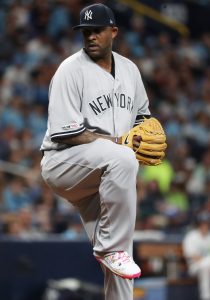
Worsening the Yankees’ situation, aging lefties J.A. Happ and CC Sabathia have each fallen short of expectations this season. Happ, whom the Yankees re-signed to a two-year, $34MM contract over the winter, has managed a 4.66 ERA/5.34 FIP through 75 1/3 frames. According to Baseball Savant, the 36-year-old Happ’s hard-hit rate against has risen by almost 8 percent since last season, while his strikeout rate has fallen by nearly 7 percent.
The soon-to-retire Sabathia, meanwhile, isn’t having the final season he or the Yankees envisioned. The potential Hall of Famer has pitched to a playable 4.42 ERA, yet his 5.98 FIP is unsightly, and he has only completed six innings on two occasions. Moreover, Sabathia’s groundball rate is 6.5 percent below his career mark, which has helped lead to a massive increase in home runs against. Sabathia yielded homers on 11.7 percent of fly balls in 2018, but the number has climbed to 20.8 this season. While Sabathia reinvented himself over the previous couple seasons as a soft-contact specialist, hitters have increased their hard-hit rate against him by better than 5 percent since a year ago.
Barring outside acquisitions, it appears the suddenly slumping Yankees are stuck with their current alignment of starters for the time being. Along with Severino and German, the Yankees are missing Jordan Montgomery (out for the year because of Tommy John surgery) and Jonathan Loaisiga (strained shoulder). Those injuries have depleted the Yankees’ depth, which has left them to deploy reliever Chad Green as an opener to underwhelming results.
In positive news for the Yankees, Severino’s as good a reinforcement as you could possibly land during the season. On paper, he’d form a more-than-capable trio with Paxton and Tanaka. It would be risky to expect Severino to immediately return in top form, though, meaning it would behoove the club to add at least one new starter before the July 31 trade deadline. It seems fair to expect any of Madison Bumgarner, Matthew Boyd or Marcus Stroman to end up in a Yankees uniform by then. Acquiring one of those three could make the difference in the Yankees holding off the Rays and Red Sox in the AL East or having to overcome a one-game playoff for the third straight season. The way the Yankees’ current starters are trending, it’s going to be difficult to keep their rivals at bay even as injured stars come back on the offensive side.
Mets To Sign First-Round Pick Brett Baty
JUNE 14: The deal will be announced tomorrow, Healey tweets. Baty receives $3.9MM, per MLB.com’s Jim Callis (Twitter link), thus leaving the Mets some added room to work with.
JUNE 11: Mets first-round pick Brett Baty will take a physical and sign a deal with the club this weekend, Tim Healey of Newsday reports. Financial details aren’t known yet, but as the 12th overall selection, Baty’s pick comes with a recommended slot value of $4,366,400.
The 19-year-old Baty is a high school third baseman from Texas who entered the draft as a consensus top 20 prospect. FanGraphs was highest on the now-former University of Texas commit going into the draft, ranking him eighth. Baseball America had Baty at No. 15, while ESPN’s Keith Law and MLB.com placed him 17th.
Although there are concerns about Baty’s age and whether he’ll stick at third base, all of those outlets think a great deal of his power potential and general offensive upside. FanGraphs’ Kiley McDaniel and Eric Longenhagen compare Baty to Cardinals third baseman Nolan Gorman, a first-round pick in 2018 who’s one of the majors’ best prospects.
The Overlooked Pirate
Andrew McCutchen was the face of the franchise during his time with the Pirates, one of their best players ever, but it became obvious a couple years back they’d have to trade him. Entering 2018, McCutchen’s final year of team control, the low-budget Pirates knew they weren’t going to extend the outfielder. Consequently, Pittsburgh traded McCutchen to San Francisco for two prospects – right-hander Kyle Crick and outfielder Bryan Reynolds – as well as $500K in international bonus pool space. Crick debuted first with the Pirates and has been a quality piece of their bullpen, but Reynolds has been even an more impressive major leaguer thus far.
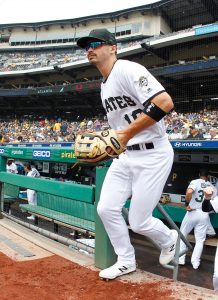
Reynolds was a 2016 second-round pick of the Giants who ranked among their top five prospects when they traded him for McCutchen. At the time, Pirates general manager Neal Huntington said of Reynolds: “Bryan is an effective offensive player that also plays quality defense. We look forward to working with Bryan to maximize his tools and help him become a quality well-rounded Major League player who can impact a game in many ways beyond his quality bat.”
That sounds right up to now. Since the Pirates promoted Reynolds to their roster April 20, the 24-year-old has slashed a tremendous .354/.407/.563 (157 wRC+) with five home runs in 171 plate appearances. As a member of the Pirates’ outfield, he has accounted for three Defensive Runs Saved and a plus-0.4 Ultimate Zone Rating in 335 innings divided between left and center. The package has been worth 1.7 fWAR, making Reynolds one of the most valuable first-year players in baseball. If not for Mets first baseman Pete Alonso and Padres shortstop Fernando Tatis Jr., there would be far more NL Rookie of the Year buzz centering on Reynolds.
Many a rookie has fizzled after a blazing start, though, so it’s worth checking into the odds of Reynolds continuing to post above-average production going forward. The switch-hitting Reynolds was a .312/.373/.472 batter in 1,217 minor league plate appearances, which augurs well, though all but 57 of those attempts came in Double-A ball or lower. Reynolds always ran high batting averages on balls in play in the minors, but his .439 BABIP as a Pirate flat-out isn’t going to sustain itself. It ranks first in the league among those who have totaled at least 170 PA this year. Reynolds is on pace to accrue upward of 400 trips to the plate this season. Of hitters who amassed at least that many a year ago, no one put up a BABIP better than .375.
Going solely by BABIP, Reynolds’ production is going to fall. Reynolds also appears unlikely to keep up his .210 isolated power, considering it never rose above .188 during extended looks in the minors (and that occurred during a low-A stint in 2010). He’s also hitting the plurality of batted balls on the ground, which doesn’t bode well for power. That said, all hope isn’t lost for Reynolds. According to Statcast, Reynolds ranks closer to the top of the league than the bottom in expected slugging percentage (.439; 53rd percentile), weighted-on base average (.347; 62nd percentile), average exit velocity (90.1 mph; 69th percentile), sprint speed (73rd percentile), hard-hit percentage (47.4; 88th percentile) and expected batting average (.300; 92nd percentile).
So, while Reynolds’ .412 weighted on-base average ranks 14th in the league and puts him a few points above Nolan Arenado, he’s not that good. Reynolds’ xwOBA sits 55 points lower than his xwOBA, though it still places him a point or two above household names such as Alex Gordon, DJ LeMahieu and Jose Altuve. Like LeMahieu, Reynolds walks at a slightly below-average clip (7.5 percent). Meanwhile, Reynolds’ strikeout percentage (22.2) is a tad above average. Combining the two numbers makes Reynolds an average performer in terms of K/BB ratio. And the fact that Reynolds hasn’t yet shown any vulnerability from either side of the plate only makes him a more appealing offensive piece.
Reynolds’ bottom-line production through almost two months of his major league career paint him as a budding star. A peek under the hood suggests he’s not there yet, but Reynolds does look like a legitimate building block for the Pirates. He and Crick are amounting to a nice return for one year of control over McCutchen, whom the Pirates weren’t going to bring back. It’s a welcome bit of good news for a team that doesn’t appear to have made out that well in sending Gerrit Cole, Austin Meadows and Tyler Glasnow away in other key trades dating back to January 2018.
Photo courtesy of USA Today Sports Images.
David Freese: Red Hot
David Freese is best known for one small stretch of baseball – the 2011 World Series – in which his .348/.464/.696 slash in 28 plate appearances helped lead the Cardinals to a title and earn him World Series MVP honors. However, as great as Freese was during the Cardinals’ triumph over the Rangers seven years ago, he’s no one-hit wonder. Freese has been a solid major leaguer since his career began in 2009, evidenced by his .276/.351/.422 line (115 wRC+) with 110 home runs and 19.9 fWAR with the Cards, Angels, Pirates and Dodgers. Now 36 years old, Freese isn’t showing any serious signs of slowing down.
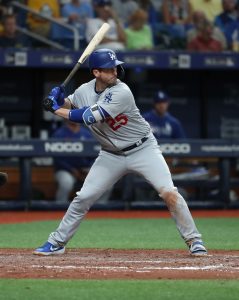
With the Pirates out of contention at the end of last August and facing Freese’s impending trip to free agency, they traded him to the Dodgers. Los Angeles was enamored enough of Freese, who thrived with the club over a small sample last season, that it re-signed him to a one-year, $4.5MM guarantee almost immediately after its World Series loss to Boston. Seven months later, it’s looking like a fantastic decision on the Dodgers’ part.
A third baseman for most of his career, Freese has essentially been a first base-only option for the Dodgers this year. From an offensive standpoint, first is one of the most demanding positions in the game, and Freese has handled it with aplomb. The right-handed hitter has batted an eyebrow-raising .308/.419/.635 with eight home runs and a .327 ISO through 124 plate appearances, pulverizing both same- and left-handed pitchers along the way. Of hitters who have come to the plate at least 120 times this year, Freese’s 177 wRC+ ranks fifth.
Is Freese this good? Considering what he has done over the life of his career, no. However, the veteran has made real strides in his advanced age. His 16.1 percent walk rate is nearly twice his lifetime figure, while his strikeout percentage (21.8) is down a bit relative to his career. At the same time, Freese is making far more hard contact and less soft contact than usual, according to FanGraphs, and putting the ball more in the air and less on the ground than he has in any other season. His 10.2-degree launch angle is far above his usual norm, per Statcast. All of that’s a recipe for added power. Interestingly, Freese is hitting to the opposite field more, though it certainly hasn’t led to a decrease in meaningful contact.
Freese’s .348 batting average on balls in play indicates good fortune has been on his side, especially for a slow runner, but it’s not a bloated figure in his case. He has posted a .343 lifetime BABIP, after all. On the other hand, Freese’s .442 weighted on-base average – which sits third in the majors – definitely isn’t going to hold. However, his .395 expected wOBA sits 17th and isn’t indicative of a player who’s at high risk of seeing his production crash to Earth.
Freese may no longer be an everyday player, but unlike most major leaguers in their late 30s, he remains a valuable contributor. Not only could Freese help the title-contending Dodgers to a World Series in 2019, but it appears he’ll encounter a fair amount of interest in free agency in the offseason. That’s if the Dodgers don’t re-sign him first, of course.
Photo courtesy of USA Today Sports Images.
Padres Reportedly Willing To Trade Most Position Players
Padres outfielder Hunter Renfroe has come up in trade rumors this week, and the club is indeed willing to deal the 27-year-old slugger, Kevin Acee of the San Diego Union-Tribune reports. However, Renfroe’s not the only Padre who could end up on the move before the July 31 trade deadline. The team’s willing to give up “virtually” any of its position players except for shortstop Fernando Tatis Jr., third baseman Manny Machado and first baseman Eric Hosmer, according to Acee.
The Padres’ goal in dealing from its current position player cast would be to upgrade offensively at two spots – catcher and center field – and add “young arms,” per Acee. Their desire to pick up controllable pitching has long been known, though it’s interesting they want a better offensive backstop.
Major leaguers Austin Hedges and Austin Allen haven’t hit, but Triple-A catcher Francisco Mejia rode his potential at the plate into high rankings on prospect lists not long ago. As recently as last summer, when the Padres acquired Mejia from the Indians for relievers Brad Hand and Adam Cimber, Keith Law of ESPN regarded Mejia as one of the game’s top five farmhands. While Mejia has struggled mightily in the majors since then, he’s still just 23 and has tallied a mere 134 plate appearances in the bigs. It’s unclear from Acee’s report whether the Padres would be open to parting with Mejia, who has raked since they optioned him to the minors last month, or if they just don’t think he’s ready to make an offensive impact at the game’s highest level yet.
The 26-year-old Hedges has made an MLB impact, meanwhile, but almost solely behind the plate. Hedges rates as an elite defender, and though he was a respectable offensive player just last season, he otherwise hasn’t hit much since his 2015 debut.
Likewise, center fielder Manuel Margot has seldom hit since the Padres first promoted him in 2015. There has been talk of San Diego demoting him to the minors to help alleviate its outfield logjam. But as a 24-year-old speedster who has excelled in the field and won’t reach arbitration until the offseason, he’d likely draw interest on the trade market.
Perhaps aside from Renfroe, right fielder Franmil Reyes stands out as the Padres’ most valuable trade chip among position players. They offer similar offensive skill sets, and Renfroe’s a much better defender, though Reyes is three-plus years younger. Set to turn 24 in July, Reyes has slashed .263/.320/.520 (123 wRC+) with 35 home runs in 516 PA since he first came up last season. Further increasing Reyes’ appeal, he’s earning a minimal salary and isn’t scheduled to reach arbitration until after the 2021 season.
If the Padres keep Renfroe and Reyes, perhaps they’d consider trading fellow corner outfielder Josh Naylor. The 21-year-old Naylor hasn’t gotten off to a strong start since the Padres promoted him May 24, but he’s a top 100 prospect or close to it. Franchy Cordero, yet another of their young corner outfielders, seems likely to stay put when considering his recent injury issues. Cordero, 24, has missed most of the past season-plus with right elbow issues, and he suffered a mild quad injury while rehabbing this week.
As for the rest of San Diego’s roster, outfielder Wil Myers and second baseman Ian Kinsler jump to the fore as players the team would probably like to move. The trade value is minimal in both cases, though.
Myers, 28, hasn’t lived up to the six-year, $83MM contract the Padres gave him in January 2017. They backloaded the deal, meaning he’s owed almost $63MM through 2022 (including a $1MM buyout in ’23). Although Myers was a 30-home run hitter as recently as 2017, he’s still just a .242/.324/.450 batter (106 wRC+) dating back to then.
Kinsler, 36, joined the Padres on a two-year, $8MM contract in the offseason. While Kinsler has long been a quality major leaguer, the Padres haven’t gotten much return on their investment so far. Kinsler has hit .204/.264/.387 (72 wRC+) with minus-0.3 fWAR in 201 PA., though he has fared much better following an ice-cold April (.262/.309/.505 since May 1). Regardless of whether the Padres find a taker for Kinsler, it seems like only a matter of time before he loses his starting spot to standout prospect Luis Urias.
After a surprisingly competitive start to the season, San Diego has begun fading from the National League playoff race. Losers of five straight, the Padres sit 33-36 and 5 1/2 games out of wild-card position. However, with the talent already on hand and the high-potential players baking in the minors, the club may not be far away from contending on an annual basis. It seems general manager A.J. Preller will operate aggressively over the next month-plus in an effort to better position his roster to accomplish that. With that in mind, the Padres should be a compelling team to watch leading up to the deadline.
Dave Dombrowski Discusses Boston’s Deadline Approach
After winning a major league-best 108 regular-season games and a World Series in 2018, the Red Sox have come out somewhat flat this year. The club’s firmly in the playoff hunt again, but at a middling 36-34, it sits a game out of an American League wild-card spot. Still, in discussing the upcoming trade deadline with Chris Cotillo of MassLive.com, Red Sox president of baseball operations Dave Dombrowski predictably revealed a willingness to buy.
Boston’s “always open to improving” should “the right opportunity” come along, Dombrowski said. The two-time championship-winning executive added the team will take an “aggressive” approach if it remains in contention leading up to July 31. That’s unsurprising coming from Dombrowski, who has been active on the summer trade market during his time in Boston. Just a year ago, pre-deadline acquisitions in first baseman Steve Pearce and right-hander Nathan Eovaldi played instrumental roles in the Red Sox’s run to a title. The season prior, Dombrowski pulled in reliever Addison Reed and infielder Eduardo Nunez in July, and he picked up lefty Drew Pomeranz and infielder Aaron Hill in 2016.
Judging by Dombrowski’s Red Sox history, moves are likely to happen in the coming weeks. The team’s bullpen is one area many Red Sox fans hope Dombrowski upgrades, but he’s not panicking over the maligned unit.
“People keep asking that question and have been asking it,” he told Cotillo of his relief corps. “It’s amazing how many fans and reporters in almost every city in Major League Baseball ask that same question.”
Boston’s bullpen does rank in the majors’ top 10 in ERA, FIP and K/BB ratio, all of which supports Dombrowski’s belief that it’s not in dire shape. Marcus Walden, Brandon Workman, Heath Hembree and Matt Barnes are among much-utilized Red Sox relievers who have posted respectable or better production in 2019. However, the team hasn’t found a full-time closer to take over for Craig Kimbrel, who officially said goodbye to Boston when he signed with the Cubs last week.
Additionally, the Red Sox are devoid of a lefty reliever at the moment, though the mending Brian Johnson could help in that regard when he returns from the injured list in the coming days. Johnson may end up in play for the Red Sox’s rotation, as could suspended knuckleballer Steven Wright when he comes back later this month. Their starting staff hasn’t gotten much production behind the established quartet of Chris Sale, David Price, Rick Porcello and Eduardo Rodriguez. Eovaldi, Hector Velazquez, Ryan Weber, Josh Smith and Darwinzon Hernandez have fallen flat across a combined 17 starts.
While Eovaldi’s a strong bet to reclaim the remaining spot in Boston’s starting staff when he comes off the IL, it’s up in the air when that will happen. Out since undergoing elbow surgery in late April, Eovaldi suffered a setback in his bicep last weekend. His arm problems could help inform Dombrowski’s deadline plans and persuade the exec to add another legit starter capable of aiding in the club’s playoff push. At the very least, the Red Sox look like candidates to increase their starting depth before the end of July.
Of course, in Boston’s case, the luxury tax is worth keeping in mind as it gears up to potentially add outside help. According to Jason Martinez of Roster Resource, the Red Sox’s luxury tax payroll currently checks in at more than $251MM, which puts them on pace to exceed the league’s highest threshold ($246MM). If that occurs, the Sox will have to pay a 75 percent surtax for every dollar spent over the limit. They’ll also see their top 2020 draft pick fall 10 spots. The franchise ran a $239MM luxury tax payroll in 2018, which cost it $11.95MM in taxes and 10 spots on its first selection in this month’s draft.
Alex Avila Suffers Left Calf Strain
Diamondbacks catcher Alex Avila exited the team’s game Thursday with a left calf strain, Zach Buchanan of The Athletic reports. Avila will go for an MRI, but he told Buchanan, “It will cost me some time.”
The 32-year-old Avila already missed more than a month earlier this season because of a strained left quad. When healthy, though, the soon-to-be free agent has enjoyed a productive season for the playoff-contending Diamondbacks. Avila, who hit his fifth home run of the year Thursday, has slashed .220/.410/.508 (135 wRC+) with a sky-high 23.1 percent walk rate through 78 plate appearances. Almost all of the lefty-swinging Avila’s trips to the plate have come against right-handed pitchers, as he has struggled versus southpaws throughout his career.
Although it’s a small sample of work, Avila has earned solid defensive marks and continued to throw out base stealers at a high clip (3 of 5) this season. The all-around package is one the Diamondbacks will miss if Avila has to return to the IL.
Primary catcher Carson Kelly – acquired in last winter’s Paul Goldschmidt trade with the Cardinals – has been a bright spot for the D-backs, but right-handed pitchers have manhandled him. He’ll continue to get the majority of reps, though, with either Caleb Joseph or John Ryan Murphy likely to come up from Triple-A Reno to grab Avila’s roster spot. Joseph is already on Arizona’s 40-man roster, while the team outrighted Murphy off it June 1.
Ben Zobrist Could Return This Season
The Cubs have been without utilityman Ben Zobrist since May 8 as he deals with a divorce, but they’re “open” to welcoming him back “later in the season,” president of baseball operations Theo Epstein told Jesse Rogers of ESPNChicago.com and other reporters Thursday.
If the 38-year-old Zobrist does return in 2019, it’s “likely” to come toward the end of the season – possibly in September – a source tells Rogers. Notably, the Cubs won’t have to pay Zobrist for however long he stays away from the team. The club has already saved upward of $2MM since Zobrist’s leave began, and it’ll continue to pocket the same amount per month while he’s out. The money the Cubs haven’t had to shell out for Zobrist helped them sign free-agent closer Craig Kimbrel to a three-year, $43MM contract last week.
The Kimbrel addition has been a benefit of Zobrist’s disappearance, yet it’s not surprising that Epstein is hopeful the respected veteran will return. The four-year, $56MM contract the Cubs handed Zobrist entering the 2016 season likely stands as one of the smartest moves Epstein has made atop their baseball department. The switch-hitting, defensively versatile Zobrist has been one of the Cubs’ MVPs for a sizable portion of his tenure, and he played an important role in their drought-breaking World Series championship during his first year in their uniform.
Now in the last season of his deal, Zobrist did get off to a slow start on the field while dealing with a distracting situation off it. He opened 2019 with a .241/.343/.253 line (69 wRC+), no home runs and a nearly nonexistent .012 ISO in 99 plate appearances before going on the restricted list. If Zobrist does return toward year’s end and the contending Cubs are in position to clinch another postseason berth, he may need to log much better numbers than he has so far in order to earn a spot on their playoff roster. Fellow Cubs second basemen David Bote and Addison Russell have recorded far superior production to Zobrist in 2019, while the same holds true for the corner outfield-capable group of Kris Bryant, Jason Heyward, Kyle Schwarber and even the just-added Carlos Gonzalez.
Miles Mikolas Has Fallen Off
The Cardinals signed free-agent right-hander Miles Mikolas to a two-year, $15.5MM guarantee in what became one of the wisest moves of the 2017-18 offseason. Although hardly a bank-breaking commitment, it was somewhat of a gamble for St. Louis. After all, Mikolas was an unspectacular major leaguer with the Padres and Rangers from 2012-14 who then spent three years pitching in Japan. Mikolas was dominant overseas, though, and he carried that excellence into 2018 in St. Louis.
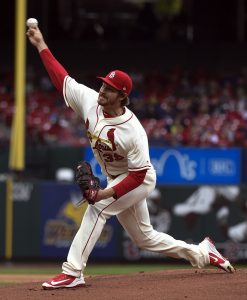
During his first year with the Cardinals, Mikolas pitched to an outstanding 2.83 ERA/3.28 FIP in 200 2/3 innings. While Mikolas only struck out 6.55 batters per nine, he walked a mere 1.3 and induced ground balls at a 49.3 percent clip. Mikolas’ stinginess in the walk and fly ball departments helped lead to a 4.3 fWAR, which ranked 12th among major league starters.
Sold on Mikolas’ output last season, the Cardinals signed him to an extension worth a guaranteed $68MM for four years back in February. That deal will keep Mikolas under wraps through 2023, but unfortunately for the Cardinals, it’s not looking like a great move so far. Facing the lowly Marlins on Wednesday, Mikolas allowed five earned runs on eight hits in five innings, thereby raising his ERA to 4.83 in 78 1/3 frames this season. His 4.74 FIP isn’t much better.
Mikolas’ 2019 woes haven’t come because of significant declines in the strikeout, walk, groundball or BABIP categories. Those numbers look almost the same compared to last season, though there has been a noticeable drop in his strike rate. Nobody posted a higher strike percentage than Mikolas’ 69.3 a year ago, but the figure has fallen to 65.8 in 2019. Meanwhile, Mikolas’ strand rate has decreased by a large margin (from 76.2 percent to 70.9), and he has been far more prone to surrendering long balls.
After yielding home runs on a meager 9.2 percent of fly balls in 2018, Mikolas is all the way up to 19.7 this season. It hasn’t helped that Mikolas’ infield fly rate has plummeted from 9.8 percent to 4.2. At the same time, his hard-hit rate has climbed by greater than 5 percent, according to FanGraphs, while Statcast indicates his average exit velocity against has hopped from 85.4 mph to 88.2. Consequently, Mikolas’ weighted on-base average/expected wOBA against has shot from .271/.286 to .339/.347.
So why the newfound contact management issues? For one, Mikolas isn’t fooling as many hitters this year, as they’ve chased 5 percent fewer pitches than they did last season. And left-handed hitters have been especially tough on Mikolas, who held them to a .309 wOBA last season but has seen the number jump to .396 this year. As seen in these FanGraphs heatmaps (2018, ‘19), he’s not staying away against lefties as well he did last season.
Worsening matters, Mikolas’ once-elite slider has been ineffective, and he has leaned on it less as a result. While Mikolas’ slider was one of the most valuable pitches of its kind a year ago, per FanGraphs, it has taken colossal steps backward this season. Batters posted a measly .201/.231 wOBA/xwOBA versus the offering in his first year in St. Louis, but they’re up to .395/.329 in the current campaign. If we’re to take that 66-point gap in face value, there has been some poor fortune involved. However, it simply hasn’t been close to as lethal as it was in 2018, perhaps owing to a 1 mph drop in velocity and somewhat of a change in typical location (heatmaps via FanGraphs: ’18, ’19).
Contrary to last season, when Mikolas’ slider helped him perform like one of the majors’ top starters, troubling signs abound for the 2019 version of the righty. His struggles are a key reason why the Cardinals have gotten off to a mediocre start and are on track to miss the playoffs for a fourth straight season. That’s not what the Redbirds had in mind when they bought high on Mikolas over the winter.
Photo courtesy of USA Today Sports Images.