
Padres Option Francisco Mejia
The Padres activated catcher Francisco Mejia from the 10-day injured list and optioned him to Triple-A El Paso on Saturday, the team announced. In other moves, the Padres sent reliever Phil Maton to El Paso and recalled left-hander Nick Margevicius from Double-A Amarillo.
The most notable move here is the demotion of Mejia, formerly a star prospect whose career hasn’t gotten off the ground in San Diego. The Padres acquired Mejia, then ESPN prospect guru Keith Law’s fifth-ranked farmhand, from the Indians for relievers Brad Hand and Adam Cimber last July. Since then, the switch-hitting Mejia has slashed a dismal .176/.224/.324 (46 wRC+) in 116 plate appearances with the Padres, and he didn’t acquit himself well defensively before landing on the IL on May 11 with a left knee sprain.
During the 23-year-old Mejia’s injury-forced absence, San Diego utilized Austin Hedges and Austin Allen as its top two catchers. The Austins will continue to reign supreme with Mejia heading to the minors. They’ve offered almost nothing at the plate this season, but Hedges has lived to his billing as an elite defender for his position, ranking first in the majors in Baseball Prospectus’ Fielding Runs Above Average metric. Hedges has also caught 38 percent of would-be base stealers in 2019, which comes in far above the 29 percent league average.
There’s no word on how long Mejia will stay in the minors, but it’s worth keeping an eye on with respect to his service time. Mejia entered the season with 62 days’ service and has amassed another 65 this year, giving him 127 overall. He needs another 45 to accrue a full year of service. As things stand, Mejia is on pace to reach free agency after the 2024 campaign.
Brewers Place Gio Gonzalez On Injured List
The Brewers have placed left-hander Gio Gonzalez on the 10-day injured list with a “dead arm,” according to Adam McCalvy of MLB.com. The placement is retroactive to May 29. Gonzalez’s roster spot went to catcher Manny Pina, whom the Brewers activated from the IL. Pina missed two weeks with a hamstring injury.
Brewers officials believe Gonzalez’s arm fatigue may be related to an unusual past few months, per McCalvy. The accomplished 33-year-old unexpectedly went without a job until signing a minor league deal with the Yankees on March 19, meaning he didn’t participate in a normal spring training. Gonzalez then logged three starts with the Yankees’ Triple-A affiliate before opting out of his contract and inking a major league pact with the Brewers for a guaranteed $2MM.
The Gonzalez signing has worked out so far for the Brewers, who have gotten six starts and 31 innings of 3.19 ERA/3.18 FIP ball from the former Athletic and National. Gonzalez, Brandon Woodruff, Zach Davies and Chase Anderson have been the only bright spots in a Milwaukee rotation that has gotten poor production from Jhoulys Chacin, Freddy Peralta, Corbin Burnes, Adrian Houser and Jacob Barnes in a combined 25 starts.
Given the struggles of the Chacin-Peralta-Burnes-Houser-Barnes group and 32-26 Milwaukee’s realistic shot at winning a second straight NL Central title, free-agent left-hander Dallas Keuchel stands out as an obvious fit for the club. Keuchel could sign as early as midnight ET on Sunday without costing his next employer draft pick compensation. The Brewers showed interest in Keuchel during the offseason, but it’s unclear if they’re still open to signing him.
An Early Look At Nationals’ Deadline Options
The Nationals are 24-33, 9 1/2 games back of the NL East lead and six out of wild-card position. If that keeps up, they seem likely to sell leading up to the July 31 trade deadline. For now, though, that isn’t the Nationals’ intention. An American League executive told Jayson Stark of The Athletic that Washington’s “still talking about adding. They’ve been calling around, looking for upgrades in the bullpen. And teams with that attitude have a hard time flipping and saying it’s time to re-trench for next year.”
If the Nationals aren’t going to wave the white flag, the bullpen’s a logical place to seek upgrades. Their relief corps has been a horror show all season, ranking last in the majors in ERA (7.23), 29th in blown saves (11), 28th in FIP (5.26) and 26th in walks per nine innings (4.38). As you’d expect from those statistics, bright spots have been difficult to find in the group.
Of the seven Nationals who have logged double-digit relief appearances this season, only closer Sean Doolittle has put up respectable numbers, but even the oft-dominant left-hander had a couple blowups in the second half of May. Meanwhile, blowups have been all too common throughout the season for southpaw Matt Grace and hard-throwing righty Kyle Barraclough – one of the Nationals’ key offseason acquisitions. Fellow offseason pickup Trevor Rosenthal could scarcely record an out before the club banished him to the injured list April 26 because of a viral infection. Wander Suero, Tony Sipp and the injured Justin Miller have mostly been ineffective, while it’s too soon to pass judgment on a Tanner Rainey–Javy Guerra–Kyle McGowin trio that has thrown a combined 13 1/3 innings.
Unfortunately for the Nationals, with the deadline still two full months away, teams with valuable relief trade chips may want to keep them in hopes of sparking a late-July bidding war. Although, Nationals general manager Mike Rizzo was able to pry reliever Kelvin Herrera out of Kansas City almost a month and a half before last year’s deadline. The Herrera acquisition didn’t work out, though, continuing Rizzo’s spotty track record of bullpen trades. Even getting Doolittle and Ryan Madson from the Athletics in 2017 cost the Nats Blake Treinen and Jesus Luzardo, the former perhaps baseball’s best closer in 2018 and the latter now an elite pitching prospect, as well as a good third base prospect in Sheldon Neuse. The summer before that, reeling in Mark Melancon from the Pirates forced the Nationals to give up now-excellent Pittsburgh closer Felipe Vazquez.
Though the Nationals want to make yet another in-season trade(s) to repair their wonky bullpen, the luxury tax line is worth keeping in mind in their case. Ownership reportedly doesn’t want to exceed the $206MM threshold, which helps explain why Washington hasn’t just signed free-agent closer Craig Kimbrel to better its late-game situation. The team’s a bit under $203MM in luxury tax payroll, per Jason Martinez of Roster Resource, and would have to shell out a 50 percent surtax for every dollar spent over the line.
The tax is likely weighing on the Nationals’ minds as they consider buying. However, there’s plenty of time for the club to change course and pivot toward selling if the on-field product doesn’t improve. Should Washington take that route, it could consider moving the premier impending free agent in the game (at least among position players), third baseman Anthony Rendon. Rizzo was in a similar position last year with Bryce Harper, but given that the Nationals were hovering around the .500 mark, he decided to retain the outfielder. The Nationals then missed the playoffs and failed to re-sign Harper, leading him to bolt for the division-rival Phillies in free agency after rejecting a qualifying offer. All the Nats got for his exit was a fourth-round pick. The departure of a qualified Rendon would return something better – a draft choice after Competitive Balance Round B – but only if they stay below the tax line.
Beyond Rendon, Stark points to Doolittle and right-handed ace Max Scherzer as potential trade chips. Stark hears from multiple executives that the Nationals are not interested in moving Scherzer, though. The 34-year-old Scherzer’s contract still has more than $100MM on it – including in deferrals – but he remains a dominant force who’d draw plenty of interest. Doolittle has just another year of control left (a $6.5MM club option), though trading him would likely damage the bullpen-needy Nationals’ chances of competing in 2020. More realistically, a Nats sale could revolve around Rendon with Michael A. Taylor, who’s under control for one more year, and potential free agents Matt Adams, Howie Kendrick, Brian Dozier and Gerardo Parra also looking like trade candidates.
Mariners Sign Kelby Tomlinson, Jaycob Brugman
The Mariners have signed infielder Kelby Tomlinson and outfielder Jaycob Brugman to minor league contracts, per Roster Roundup.
The 28-year-old Tomlinson is best known for a long run with San Francisco, which selected him in the 12th round of the 2011 draft. Tomlinson stayed with the organization through last season, the fourth straight year in which he logged major league action. The righty-hitting Tomlinson was an offensive bright spot as a part-time player with the Giants from 2015-16, but his numbers cratered thereafter. Tomlinson ended his Giants tenure with a .265/.331/.332 line (84 wRC+), three home runs and 19 steals over 687 plate appearances.
San Francisco outrighted Tomlinson after last season, leading to a minor league opportunity with the division-rival Diamondbacks. However, Tomlinson opened 2019 by hitting an unappealing .218/.320/.276 with no HRs across 100 PA with Arizona’s Triple-A club. As a result, the D-backs released him May 12.
Brugman, 27, has spent most of the season on the minor league injured list with the Orioles, who released him last week after he came off the IL. He had been with the O’s since they acquired him from the Athletics for right-hander Jake Bray in November 2017 . Brugman’s only major league experience came in ’17 as a member of the A’s, with whom the left-hander hit a respectable .266/.346/.343 (90 wRC+) and totaled three home runs in 162 attempts. Otherwise, Brugman has mostly played at Triple-A over the past few seasons. He carries a .276/.342/.403 slash with 14 homers in 856 PA at the minors’ top level.
Diamondbacks Release Marc Rzepczynski
The Diamondbacks have released left-handed reliever Marc Rzepczynski, according to Roster Roundup. He had been with the organization since signing a minor league deal in February.
The journeyman Rzepczynski has been an effective reliever for most of his career, which began with the Blue Jays in 2009, but hasn’t seen much action at the game’s highest level of late. After a 31 1/3-inning season with the Mariners in 2017, “Scrabble” threw just 10 1/3 frames between the M’s and Indians last year. Opposing offenses battered Rzepczynski during that small sample, collecting eight earned runs on 16 hits and 10 walks.
Prior to his release, Rzepczynski recorded mediocre numbers across 25 2/3 innings with the Diamondbacks’ Triple-A affiliate in Reno. The 33-year-old pitched to a 3.86 ERA/4.74 FIP with 6.31 K/9 and 4.21 BB/9, though he did log a superb 60.5 percent groundball rate. Rzepczynski has also induced grounders at a high clip in the majors (59.7 percent), where he has posted a 3.89 ERA/3.88 FIP and 8.47 K/9 against 4.24 BB/9 in 434 2/3 innings. Most of his success has come at the expense of same-handed hitters, whom he has held to a .227/.296/.305 line.
Miguel Cabrera To Undergo MRI On Knee
Tigers first baseman Miguel Cabrera left the team’s game against the Braves on Friday with right knee soreness, manager Ron Gardenhire told Chris McCosky of the Detroit News and other reporters. Cabrera will undergo an MRI.
“I felt it at the plate the last three games — I didn’t use my legs too much,” Cabrera said (via McCosky).
Thanks in part to his knee pain, Cabrera failed to reach base in any of his three plate appearances Friday. The future Hall of Famer, 36, has trudged through an uncharacteristically difficult season to this point. Cabrera owns a .284/.356/.356 line, good for a 93 wRC+, through 219 trips to the plate. The longtime 30-home run threat has shown almost no power along the way, with two HRs and the majors’ third-worst ISO (.072).
While Cabrera’s performance has been a letdown, the durability he has shown thus far has been encouraging. After missing all but 38 games a year ago because of a ruptured left biceps tendon, he has come back to appear in each of Detroit’s 54 contests this season. This injury could snap that streak, though, and would leave the Tigers to choose among Brandon Dixon, Niko Goodrum and John Hicks to handle first.
Poll: Hyun-Jin Ryu’s Next Contract
Left-hander Hyun-Jin Ryu could have shopped his services to all 30 major league teams last offseason, but the career-long Dodger opted against going to the open market. Instead, Ryu accepted a $17.9MM qualifying offer to stay in Los Angeles, in part because of a long list of injury troubles that could have hampered his earning power. Dating back to 2013, the Korean-born Ryu’s first season in the majors, he has missed significant time because of arm problems (including shoulder and elbow surgeries) as well as foot and groin issues. The latter forced Ryu to the 10-day IL earlier this season, but he got off to a strong start before then and has come back far better since returning April 20.
After throwing just 82 1/3 innings last season, Ryu has already amassed 73 frames through the first two months of 2019. Ryu shut out the Mets over 7 2/3 innings on Thursday to finish May with an incredible four scoreless starts in six tries. Across 45 2/3 innings this month, Ryu pitched to a near-spotless 0.59 ERA with 36 strikeouts against a meager three walks. He now owns easily the majors’ leading ERA (1.48) and walk rate (0.62 per nine, with 8.51 K/9). His success in the run prevention and walk categories doesn’t look like a fluke either. Ryu, after all, put up a 1.97 ERA with 1.64 BB/9 (against 9.73 K/9) during his injury-shortened 2018.
Even if Ryu isn’t quite as great as his ERA indicates, his 2.78 FIP over the past season-plus is befitting of a front-line starter and ranks sixth among all pitchers who have thrown at least 150 innings since 2018. He’s behind a pretty good quintet of Jacob deGrom, Chris Sale, Max Scherzer, Patrick Corbin and Gerrit Cole in that regard. DeGrom, Sale and Corbin have each scored nine-figure contracts going back to the offseason, while Cole figures to join them when he reaches free agency during the upcoming winter.
Ryu’s also on schedule to reach the open market, though he’s not going to cash in to the same extent as Cole. Concerns over Ryu’s durability figure to combine with the soon-to-be 33-year-old’s age and 2013-17 performance (when he was good but not great) to cap his earning power. However, he can look in his own locker room to find a lefty who overcame injury questions, advanced age and a far shorter track record than Ryu’s to recently score a large payday in free agency. That’s Rich Hill, whom the Dodgers re-signed to a three-year, $48MM guarantee heading into 2017 – his age-37 season.
Free agency worked out for Hill, but one would be remiss to ignore the fact that the process has taken an unfriendly turn for certain hurlers since he landed his payday. Jake Arrieta received less guaranteed cash than expected in 2018, while Gio Gonzalez settled for a minor league deal entering this season and Dallas Keuchel remains unsigned. At the same time, however, Nathan Eovaldi, Alex Cobb, J.A. Happ, Charlie Morton and Lance Lynn did surmount obstacles of their own en route to $30MM-plus guarantees in the previous two offseasons.
We’ll use the $30MM number as a jumping-off point for this poll, but if Ryu continues to perform like a front-line option and stay reasonably healthy, he could blow past it.
(Poll link for app users)
How much do you expect Ryu to earn on his next contract?
-
$60MM or more 30% (1,622)
-
$40MM-$49MM 27% (1,476)
-
$50MM-$59MM 23% (1,256)
-
$30MM-$39MM 19% (1,026)
Total votes: 5,380
Progress Report: Pittsburgh’s Return For Gerrit Cole
In one of the most significant trades of the 2017-18 offseason, the Pirates sent right-hander Gerrit Cole to the Astros for a four-player package. The move put an end to nonstop trade rumors centering on Cole, who had been a Pirate since they selected him first overall in the 2011 draft. Cole largely lived up to the billing in Pittsburgh, but with the Pirates being a low-budget team and Scott Boras functioning as the hurler’s agent, the club had little choice but to deal him. Cole was down to his penultimate year of control, and the Pirates knew they weren’t going to be able to prevent him from reaching free agency after 2019.
Cole has excelled with the Astros since the deal went down, though even they haven’t locked him up to an extension. The soon-to-be 29-year-old is likely to reach the open market after the season, when he could be the top player available. In the meantime, Cole could help guide an elite Houston team to a World Series championship. On the other hand, the Pirates haven’t contended since they traded Cole (in fairness, nor did they in his final two seasons in the Steel City). At 27-28, it appears the Buccos are on their way to a fourth consecutive year without a playoff berth. The package they got for Cole hasn’t really helped matters.
Righty Joe Musgrove, arguably the headliner from Pittsburgh’s point of view, came over after a year in which he moved to the Astros’ bullpen and stood out. But the Pirates shifted Musgrove back to the rotation, and aside from a horrendous showing in May, he has resembled a decent big league starter. While Musgrove has given up 27 earned runs on 38 hits in 30 innings this month, his overall numbers as a Pirate are fine. The 26-year-old has given Pittsburgh 30 starts and 178 1/3 frames of 4.29 ERA/3.60 FIP ball with 7.57 K/9, 2.12 BB/9 and a 44.8 percent groundball rate dating back to his arrival.
In the aggregate, Musgrove has been more the solution than the problem for the Pirates. He’s also on a pre-arbitration salary this season and still has three years of arb control thereafter. Realistically, there’s not a lot to complain about with Musgrove, though the same hasn’t been true of the other three players the Pirates got back.
The hope was that big, hard-throwing righty Michael Feliz would emerge as a lights-out member of the Pirates’ bullpen right away. They’re still waiting. Feliz managed a 4.13 FIP and 10.38 K/9 in 47 2/3 innings last season, but he walked more than four batters per nine and limped to a 5.66 ERA. To make matters worse, the 25-year-old has spent most of this season in Triple-A. Across the 12 innings Feliz has logged in the majors in 2019, he has surrendered 11 earned runs on 12 hits and nine walks (with an impressive 16 strikeouts, it should be noted).
Outfielder Jason Martin, who was the Astros’ 15th-ranked prospect at the time of the trade, totaled the first 38 plate appearances of his major league career earlier this season. He didn’t produce much, though, nor has the 23-year-old acquitted himself all that well at the minors’ highest level thus far. Martin got a promotion after crushing Double-A pitching last season, but he’s the owner of a meager .225/.284/.371 line in 338 Triple-A attempts.
That leaves 26-year-old third baseman Colin Moran, who has garnered the most playing time of anyone Pittsburgh got back for Cole. The former top 100 prospect has been just a guy with the Pirates – a league-average hitter whose WAR suggests he’s something between an average player and a replacement-level performer. Over 618 trips to the plate as a Pirate, Moran has hit a respectable but unexciting .274/.335/.414 (102 wRC+) with 17 home runs and 1.1 fWAR.
Including Moran’s contributions, the Pirates have gotten 4.7 fWAR out of the Cole trade so far. Last July, seven months after that deal, the Pirates traded two hyped young players (righty Tyler Glasnow and outfielder Austin Meadows) to Tampa Bay for a potential Cole replacement righty Chris Archer. That transaction has worked out far worse for the Pirates to this point, as Dan Szymborski of FanGraphs recently explained.
The Cole and Archer moves have left the Pirates with a bunch of controllable parts, but nobody from the group looks like much to write home about so far. At the same time, the swaps stripped the organization of a trio of players who have been high-end contributors elsewhere. Two of them, Glasnow and Meadows, are under control for the foreseeable future. These are mistakes a small-budget team can ill afford to make, and they help explain why the Pirates are stuck in neutral.
Carlos Carrasco Has Gone Backward
Indians right-hander Carlos Carrasco was somewhat quietly one of the majors’ most dominant starters from 2014-18. During that 807 2/3-inning, 131-start span, Carrasco recorded a 3.31 ERA/3.03 FIP with 10.18 K/9, 2.03 BB/9, a 48.0 percent groundball rate and upward of 20 wins above replacement. That five-year stretch convinced the Indians to keep and extend Carrasco in the offseason, when there were rumblings they could offload starters, signing him to a team-friendly contract. Two months into the season, though, the back-to-back-to-back AL Central champions haven’t resembled their previous selves, in part because Carrasco hasn’t managed the same results as he did in prior years.
The 32-year-old Carrasco has pitched to a 4.98 ERA through 65 innings, averaging just over five frames per start after logging better than six an outing during the previous half-decade. Carrasco’s 4.07 FIP is nowhere near as underwhelming as his ERA, but it’s still a run higher than he and the Indians are accustomed to. His strikeout and walk rates are phenomenal (10.94 K/9, 1.52 BB/9), and his .353 batting average on balls in play further suggests positive regression in the run prevention department. Aside from those figures, though, there are legit reasons for concern regarding Carrasco.
It begins with a newfound difficulty keeping the ball out of the air. Carrasco’s groundball percentage has nosedived to a career-worst 39.2, leading to personal worsts in fly ball rate (38.7) and launch angle against (14.2). Surprise, surprise: Home run troubles have come with those changes. Carrasco’s yielding gopher balls on 20 percent of flies, up from 12.7 during his aforementioned five-year stretch of excellence. It’s not just HRs, though – Carrasco’s surrendering more damaging contact in general. He ranks in the bottom 8 percent of the league or worse in exit velocity against (90.9), barrel percentage against (14.1) and hard-hit rate (47.3 percent), according to Statcast, which also assigns Carrasco a below-average expected weighted on-base average against (.329, compared to .280 in 2018).
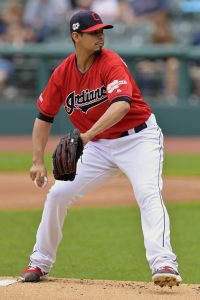
So what’s causing Carrasco to falter? His biggest problem seems to be his changeup, a pitch he has relied on between 16 and 18 percent of the time dating back to last season. Batters have posted a .432/.377 xwOBA versus the offering this season after mustering a matching (and weak) .224/.224 against it a year ago. As is typically the case with changeups, Carrasco has primarily used it in an effort to quell opposite-handed hitters. They’ve caused the most damage against Carrasco, though, having slashed .287/.331/.574 for a .371 wOBA.
In essence, the average lefty swinger who has faced Carrasco in 2019 has hit like Trevor Story or Matt Chapman. That wasn’t the case last year, when lefties managed a Joe Panik-esque .302 wOBA off Carrasco. It’s happening in part because Carrasco isn’t locating his change as precisely as he did in 2018, keeping it too close to the middle of the plate (and inside versus lefties). That wasn’t true last season. Carrasco has had a similar problem with his curveball, having allowed a ludicrous .908/.719 wOBA/xwOBA when throwing it, though he has only turned to the pitch 2.3 percent of the time (down 5 percent from last year, when it was much more effective).
Cleveland’s a 28-28 team with a minus-12 run differential, already facing a 9 1/2-game deficit in the division it has owned in recent seasons. Considering the myriad issues the Indians are facing – including the weeks-long absences of injured righties Corey Kluber and Mike Clevinger, not to mention fellow RHP Trevor Bauer‘s own decline – a middling version of Carrasco is one of the last things they needed. That’s what the Indians have gotten, though, and unless Carrasco returns to form, catching the first-place Twins is going to be an even tougher task.
Photo courtesy of USA Today Sports Images.
3 Minor League Signings Helping Drive Rangers’ Offense
For Major League Baseball teams, there is essentially no risk in signing a player to a minor league contract. Cognizant of that, the Rangers were aggressive on the non-guaranteed market in the offseason, inking 20 players to minors contracts. Two months into the regular season, three of those players – Hunter Pence, Logan Forsythe and Danny Santana – have helped lead the Rangers’ offense to the game’s third-most runs (306) and a 10th-place ranking in wRC+ (103).
Pence, the most proven member of the trio, starred for much of his career with the Astros and Giants before recent struggles forced him to settle for a cheap pact with the Rangers. But the longtime outfielder looked done during the previous two years in San Francisco, especially when he hit .226/.258/.332 (59 wRC+) with four home runs and a .106 ISO in 248 plate appearances last season. To his credit, though, Pence spent the offseason working to turn things around, as he explained to Jessica Kleinschmidt of NBC Sports California in December. You may have scoffed at his efforts back then, chalking them up to a washed-up player grasping at straws, but it now looks as if Pence has discovered the Fountain of Youth during his age-36 season (Pence de Leon?).
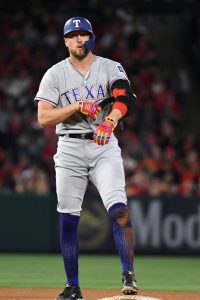
Through 153 trips to the plate with the Rangers, Pence has slashed .295/.346/.619 with 11 homers and a .324 ISO. He has already given the Rangers 1.1 fWAR after combining for minus-0.2 with the Giants from 2017-18. Pence’s revival certainly doesn’t look like a product of luck or ballpark – there’s nothing abnormal in his batting average on balls in play or K/BB ratio, and he has logged far better numbers outside hitter-friendly Globe Life Park.
Pence is pulling more pitches, hitting more fly balls and making better contact, all of which has helped opened the door to his power resurgence, while swinging and missing less and chasing fewer pitches out of the zone. Pence’s average exit velocity on fly balls and line drives sits at a strong 96.6 mph, up from 91.5 in 2018, and his weighted on-base average/expected wOBA has spiked from .255/.267 to .401/.387. In the xwOBA department, Pence has gone from hitting like Joey Rickard to resembling Juan Soto. It’s an amazing one-year turnaround.
If there’s one knock on the 2019 version of Pence, it’s that he has largely been limited to the designated hitter spot at his advanced age. Forsythe, on the other hand, has spent the season in the field, registering most of his appearances at first base but also playing at least five games at shortstop, third and second. Now 32, Forsythe was one of baseball’s most valuable second basemen with the Rays from 2015-16, but he began falling off the next season and then cratered last year between the Twins and Dodgers. It looks as if Forsythe’s back after joining Texas on a deal in late February, though. Like Pence, a fellow right-handed hitter, Forsythe has offered better production outside of Arlington while posing a legitimate threat against pitchers of either handedness.
Forsythe has opened his Rangers career with a line of .309/.414/.485 (136 wRC+) and 1.2 fWAR in 163 attempts, far outdoing the minus-0.2 he posted in that category last season. An unsustainable .406 BABIP has aided Forsythe’s cause, but he has made real strides otherwise. While Forsythe’s power hasn’t been sensational (three homers, .176 ISO), he’s well ahead of his paltry 2018 output in that regard (two HRs, .059 ISO in 416 PA). As with Pence, a greater emphasis on pulling and elevating the ball has led to Forsythe’s uptick in the power department. His average exit velocity has climbed from 89.6 mph on liners/flies last year to 92.8 this season. Forsythe’s also swinging at far fewer pitches than ever outside the strike zone. Those factors have assisted in a strong .390/.362 wOBA/xwOBA, an enormous step up from the .274/.277 Forsythe recorded in 2018.
And then there’s the 28-year-old Santana, who was a 3.9-fWAR player with the Twins during a 430-PA debut in 2014. Until this season, that looked like a total fluke (and perhaps it still does). Santana combined for minus-2.3 fWAR from 2015-18 with the Twins and Braves, though he’s back above water this year. Granted, with a 0.6 fWAR over 125 trips to the plate, Santana’s no world-beater. Still, that’s more than the Rangers could have reasonably expected when they took a flier on Santana in December. Since then, the switch hitter has slashed .296/.339/.478 (107 wRC+) with four HRs and six steals in 125 PA, also showing off his defensive flexibility by appearing multiple times at first, second, short and in center field.
Santana, however, could have a tougher time than Pence and Forsythe maintaining his numbers. In fact, they’ve already started to drop over the past month. The fact that he’s running ugly strikeout and walk rates (4.0 percent versus 29.6) and enjoying a .400 BABIP doesn’t offer a ton of hope going forward. Beyond that, Santana’s struggling against left-handed pitchers and hitting noticeably worse on the road. That said, there’s little difference between Santana’s wOBA (.347) and xwoBA (.341).
Should Santana continue to impress the Rangers through the season, they’ll have a chance to keep him via arbitration for the next two years. Otherwise, they could easily say goodbye to him. Meanwhile, Pence and Forsythe – two impending free agents – could either stick with the surprising Rangers (27-27) through the season if they’re in contention or emerge as summer trade chips if the team falls out of the race. Texas is in a win-win situation with all three of these minor league pickups, which is surely what general manager Jon Daniels hoped for when he added them over the winter.
Photo courtesy of USA Today Sports Images.