
James McCann: Offensive Force?
A few weeks into last offseason, the White Sox parted with their 2017-18 primary catcher, Omar Narvaez, sending him to the Mariners for reliever Alex Colome on Nov. 30. The White Sox found Narvaez’s replacement a couple weeks later when they signed former Tigers starting backstop James McCann to a one-year, $2.5MM deal. In other words, a franchise mired in a 10-year playoff drought paid a minimal cost for an unexciting (maybe even bad) major leaguer. You’re forgiven if you couldn’t have cared less at the time.
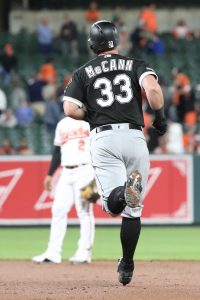
Five-plus months later, Chicago’s decision to buy low on McCann looks like one of one of the shrewdest of the winter. The 28-year-old has been an absolute hitting machine as a member of the White Sox, with whom he has slashed .346/.384/.523 (145 wRC+) in 138 plate appearances. Based on wRC+, McCann has been in the same league as franchise catchers Gary Sanchez (154) and Willson Contreras (152) in overall offensive production. It’s a stunning rise for McCann, whom the Tigers non-tendered in November in lieu of paying a projected $3.5MM in arbitration.
McCann can now take solace in the fact that he has been a revelation with division-rival Chicago this year while Detroit’s catchers have been dreadful. That said, the Tigers weren’t crazy for letting him go. McCann was a useful regular for the Tigers once – in 2017 – but still didn’t manage world-beating offensive production that year. His Tigers tenure, which spanned from 2014-18, concluded with a .240/.288/.366 line (76 wRC+) and minus-0.2 fWAR in 1,646 trips to the plate. That’s bad. Defensively, McCann did throw out between 30 and 45 percent of base runners in each of his seasons in the Motor City. That’s good. But he floundered as a pitch framer and blocker. That’s bad.
What we know is that McCann has thrived as a White Sox after he did no such thing as a Tiger. The question is whether he’s born anew in a different uniform, if it’s just a two-month blip or something in between. First of all, he’s not going to sustain this kind of offensive production. He didn’t really walk in Detroit and hasn’t in Chicago either, having recorded rates in the 5 percent range with both teams. McCann’s also not going to keep up a .435 batting average on balls in play, especially considering his lifetime mark is .309. Plus, as someone who currently has four home runs and has never topped 13 in a full season, he won’t make up for his inevitable drop in average with a significant power surge.
While the above paragraph paints a bleak picture, all hope isn’t lost for McCann, who has cut his strikeout and chase rates by roughly 3 percent and elevated his contact rate by about 2 percent. He has also made more meaningful contact, evidenced in part by a noticeable rise in isolated power. McCann put up an unimposing .126 ISO with the Tigers, including a woeful .094 last year, though he’s running a career-high .183 in the category this season. FanGraphs indicates McCann has slashed his soft contact rate by almost 6 percent, while Statcast shows his average exit velocity has hopped from 87.5 mph to 90.5. Statcast also credits McCann with a .347 expected weighted on-base average. That’s a hefty 48 points below his real wOBA (.395), but it’s still 24 points above average and more than respectable for a catcher.
The right-handed McCann has done a lot of his 2019 damage against same-sided pitchers, which is noteworthy in his case because they’ve typically stymied him. When Chicago added McCann, it couldn’t have expected him to suddenly prove capable of handling righties. He has so far, though, and his offensive strides have come with improved defense. Not only has McCann continued to stop would-be base thieves at a high rate (35 percent), but he has been a scratch overall defensive player after grading out as one of the league’s worst catchers in 2018, according to Baseball Prospectus. If that’s not enough, McCann has developed a solid rapport with potential ace Lucas Giolito.
Adding everything up, it’s clear the McCann signing has worked out brilliantly for the White Sox. He has already given Chicago 1.6 fWAR, double his previous career high, and could remain in the team’s plans beyond this season. Once the 2019 campaign finishes, the Sox will have to decide whether to tender McCann a contract for his final year of arbitration eligibility. It would be a no-brainer decision right now. However, in the seemingly improbable event McCann’s overall production careens off a cliff, the club will be able to move on without any damage.
Photo courtesy of USA Today Sports Images.
Checking In On Last Year’s Toughest Outs
If you’re an offensive player in baseball, there is nothing more important than avoiding outs. Common sense indicates the more you get on base – whether with a hit, a walk or a hit by a pitch – the better your team’s chances are of scoring and ultimately winning. That’s why on-base percentage is more useful than batting average or slugging percentage, two other conventional stats that help define a hitter’s value.
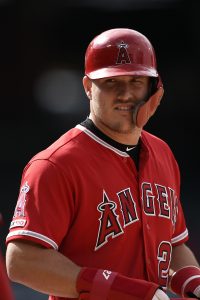
Just six qualified hitters reached the .400-OBP mark in 2018. The group included the best player in baseball, another potential Hall of Famer, each league’s MVP, an elite hitter who helped his team to a championship and a potential star in the making. Let’s take a look at how that six-man club is doing in 2019…
Mike Trout, Angels (2018 OBP: .460):
Here’s the “best player in baseball” mentioned above. The 27-year-old Trout has reached 45.5 percent of the time through 231 plate appearances, putting him right in line with last year’s league-best effort. He’s also on track for his fifth straight season with at least a .400 OBP. Trout was a .312 hitter in 2018 who walked 20.4 percent of the time. His average has noticeably dropped (to .283), but his walk rate is up a bit and opposing pitchers have helped Trout’s cause by already hitting him six times. He wore 10 pitches last year in 378 more PA.
Mookie Betts, Red Sox (2018 OBP: .438):
Betts got on base a bit less than Trout last season, but the Boston superstar led the sport in fWAR en route to AL MVP honors. While Betts hasn’t been quite as sharp this year, he has still avoided outs at a phenomenal clip (.400 in 255 trips to the plate). The 26-year-old has walked 14-plus percent of the time for the second consecutive season, but a 55-point decline in batting average (.346 to .291) and a 54-point BABIP drop (.368 to .314) have hurt his OBP. Plus, Betts isn’t on pace to match the eight HBPs he totaled in 2018, having picked up only two so far.
Joey Votto, Reds (2018 OBP: .417):
Votto’s the “potential Hall of Famer” named in the opening. The hitting savant has managed a remarkable .424 OBP dating back to his 2007 debut, in part because he has drawn nearly as many walks as strikeouts. However, that hasn’t been the case in 2019. Now in his age-35 season, Votto’s walk rate is at a pedestrian-by-his-standards 11.6 percent – down nearly 5 points from his career mark – while his strikeouts have soared. Putting the ball in play less helps explain why Votto, a lifetime .309 hitter, has only mustered a .242 average this season. Worse, Statcast credits Votto with a .229 expected average, indicating a rebound may not be on the way. Despite his newfound woes, Votto has still put up an above-average .340 OBP in 215 PA this year, but it’s nothing to get excited about in the venerable first baseman’s case.
Brandon Nimmo, Mets (2018 OBP: .404):
Nimmo’s far and away the least accomplished member of this list, but that doesn’t take away that the 26-year-old was a stupendous offensive player in 2018. As only a .264 hitter, though, his high OBP came thanks in part to a league-leading 22 HBPs over 433 PA. Nimmo has not been a magnet for pitches this year, however, having taken three in 130 trips to the plate. He’s also batting a mere .200 and has seen his BABIP fall from .351 to .288. Nimmo is collecting walks at a terrific clip (16.1 percent), but his .344 OBP is still a 60-point drop-off from last season.
Christian Yelich, Brewers (2018 OBP: .402):
We arrive at the other MVP on this list. What’s Yelich, 26, doing for an encore? Well, he ranks third in the majors in OBP (.425), in part because his walk rate has climbed from 10.4 percent to 15.1. Yelich has also logged a .314 average even though his BABIP has sunk 87 points since last year.
J.D. Martinez, Red Sox (2018 OBP: .402):
Martinez, described above as “an elite hitter who helped his team to a championship,” has been closer to very good than great this season. A .375 BABIP/.330 average helped drive Martinez’s OBP last season, but he’s at .315/.298 in those categories through 219 PA this season. Consequently, the 31-year-old has “only” reached base 37.9 percent of the time. But Martinez is striking out a lot less, which bodes well, and Statcast puts his expected average at .321. Another .400-OBP season certainly isn’t out of the question for Martinez.
Photo courtesy of USA Today Sports Images.
Boras: Dallas Keuchel Will Be Ready Quickly
Free-agent left-hander Dallas Keuchel hasn’t pitched in a major league game since last October and didn’t participate in spring training. As a result, there’s plenty of concern over how fast Keuchel will be ready to join a team when he ends his months-long stay on the open market and signs. But clubs shouldn’t worry about Keuchel’s preparedness, according to agent Scott Boras, who told Jon Morosi of MLB.com on Thursday that his client could be good to pitch within approximately a week of signing.
Keuchel has been throwing a 95- to 104-pitch sim game every five days to stay in shape, Boras said. We’ve heard that before (links here), but the potential one-week time frame is a new development. However, it’s likely worth taking with a grain of salt. For one, it’s not unusual for Boras to publicly talk up a client. Beyond that, it would be reasonable for Keuchel’s next employer to prefer for the 31-year-old to embark on a short minor league tuneup. Doing so would give Keuchel an opportunity to pitch in a real game (or games) before he potentially impacts a major league pennant race.
Keuchel has garnered plenty of big-game experience, including with the World Series-winning Astros in 2017, and carries a tremendous regular-season track record going back to his 2014 breakout. Nevertheless, the 2015 AL Cy Young winner hasn’t been able to find a team since free agency opened last Oct. 29. Free-agent closer Craig Kimbrel is in the same boat, but it’s one that figures to finally reach shore soon.
After midnight on June 2, the day before the draft begins, teams will be able to sign Keuchel or Kimbrel without having to pay anything other than money. Clubs would have to surrender draft compensation before then, which has helped lead to this impasse between MLB and the two high-profile free agents.
Mets Notes: Potential Sellers, Alonso, Lugo
The latest out of Queens…
- The Mets started 2019 in solid fashion, sitting a season-high five games over .500 through 13 contests, but have stumbled over the past month and a half. Now in possession of a 27-28 record, the Mets should consider an aggressive teardown if they’re not in contention around the July 31 trade deadline, Buster Olney of ESPN opines. By going in that direction, Olney notes the Mets would mimic the 2015 Padres – a team that tried to contend, wound up failing miserably and then traded away several big-name acquisitions within the next year (Craig Kimbrel, Justin Upton and James Shields among them). San Diego general manager A.J. Preller’s decision to pivot toward a rebuild helped the Padres construct an elite pool of young talent that has begun paying enormous dividends at the major league level. If Mets GM Brodie Van Wagenen takes a similar route sometime soon, Olney names closer Edwin Diaz and the right-handed starter trio of Jacob deGrom, Noah Syndergaard and Zack Wheeler as players he could market in an effort to add more high-end youth to the organization.
- Of course, New York’s not devoid of young, impact talent in the bigs. First baseman Pete Alonso, he of the .264/.338/.624 line (151 wRC+) with 19 home runs in 222 plate appearances, is a testament to that. The 23-year-old may be on his way to top rookie honors in the National League, but his journey to the majors wasn’t easy, as Tim Britton of The Athletic details. Alonso first joined the organization as the 64th pick of the 2016 draft, and Britton – with help from Alonso, his father and multiple Mets scouts – revisits that event and many other moments that led to it.
- The Mets are likely to activate reliever Seth Lugo from the 10-day injured list Friday, Deesha Thosar of the New York Daily News suggests. Lugo went to the IL on May 20 with right shoulder tendinitis, which has left New York’s disappointing bullpen without arguably its best setup man. The 29-year-old Lugo, a former starter, broke out as a late-game force in 2018 and has since pitched to a 2.30 ERA/2.97 FIP with 8.73 K/9, 2.53 BB/9 and a 47.3 percent groundball rate in 78 1/3 relief innings.
Poll: Choose Your Franchise Catcher
Although potential Hall of Famers Buster Posey and Yadier Molina are among the most decorated catchers in baseball history, it appears the two 30-somethings have given way to a new guard at the position. J.T. Realmuto, Gary Sanchez and Willson Contreras stand out as the most valuable behind-the-plate building blocks in today’s game, owing to performance, age and affordable control. The Brewers’ Yasmani Grandal also belongs in the current class of elite backstops, but the fact that he’s 30 years old, expensive and only signed through this season works against him in comparison to Realmuto, Contreras and Sanchez.
Among those three, the longest big league track record belongs to the Phillies’ Realmuto, who’s in his age-28 season. The athletic Realmuto broke out with the Marlins in 2016 and proceeded to rack up 11.3 fWAR through last year, trailing only Posey and Grandal at his position. He’s fresh off back-to-back 4.0-fWAR seasons and is on a similar pace in his first year as a Phillie.
So far in his new digs, Realmuto has accounted for 2.0 fWAR through 208 plate appearances. While Realmuto’s offensive production has dropped from where it was over the previous three seasons (115 wRC+), his 102 wRC+ remains far above average for his position (89). He’s also an all-world defensive player who possesses far more speed than you’d expect a catcher to have. If there’s one check against Realmuto, it’s that he’s only under control for another season after this one, in which he’s earning $5.9MM.
No full-time catcher has fared better at the plate this season than the hard-hitting Sanchez, whose 154 wRC+ ranks 18th among all players with at least 100 PA. The 26-year-old has mashed 17 home runs, good for a fifth-place tie, to put an uninspiring 2018 behind him. Sanchez combined for 7.5 fWAR from 2016-17, his first two seasons, but fell to 1.7 in ’18 and sits well behind Realmuto this season (1.2). Although Sanchez has a big arm, he’s not in Realmuto’s stratosphere as an overall defender. However, Sanchez is making barely over the league minimum this year and comes with three more seasons of control via arbitration.
Contreras, who turned 27 on May 13, has been a revelation at the plate since he debuted in 2016. Dating back to then, Contreras’ 119 wRC+ ranks second among backstops (only Sanchez’s 128 has been better), while his 7.5 fWAR is eighth. He’s at 152 and 1.7 in those categories this year, having swatted 12 homers and gotten on base at a 40 percent clip. Although Contreras has not gotten rave reviews behind the plate this season or for most of his career, his offense, age and affordability are all huge pluses. Like Sanchez, he’s in his final pre-arb season and controllable through 2022.
Considering all of the above factors, which of these three catchers would you want to build a team around?
(poll link for app users)
Choose Your Franchise Catcher
-
J.T. Realmuto 40% (5,316)
-
Gary Sanchez 31% (4,139)
-
Willson Contreras 29% (3,947)
Total votes: 13,402
Last Season’s 2 Best Closers Have Fallen Off
Right-handers Edwin Diaz and Blake Treinen were unquestionably the two best closers in baseball in 2018. And unless you want to make an argument for dominant Brewers lefty Josh Hader, Diaz and Treinen were likely the game’s top two relievers period. However, a couple months into the 2019 season, they’re no longer running roughshod over their competition.
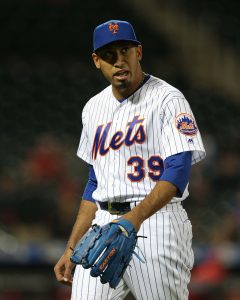
In what proved to be his final season in Seattle, where he burst on the scene in 2016, Diaz tossed 73 1/3 innings and notched a 1.96 ERA/1.61 FIP with an eye-popping 57 saves in 61 attempts. Along the way, the flamethrower ranked fourth among relievers in K/9 (15.22) and 15th in BB/9 (2.09), leading to the league’s fourth-best K/BB ratio (7.29). He also trailed only Hader in swinging-strike percentage (18.9).
Despite Diaz’s incredible performance, the retooling Mariners deemed him expendable in the offseason. Seattle sent the 25-year-old to the Mets in an earth-shattering December trade that saved the M’s a ton of money and improved their farm system.
No doubt, the Mets expected Diaz to be the driving force behind a much-improved bullpen in 2019. To this point of the season, Diaz has perhaps been the Mets’ premier late-game option, but their bullpen has been a weak unit overall. For his part, the 25-year-old Diaz has been closer to the pitcher he was in 2017, when he was good but not otherworldly.
Diaz’s most recent outing, which came Wednesday against the Dodgers, surely counts among the worst of his career. He entered the game with an 8-5 lead in the bottom of the ninth inning and proceeded to allow six straight base runners amid a stunning collapse. Diaz yielded four earned runs on five hits (two home runs) and an intentional walk in what turned into a 9-8 loss for New York. The only batter he retired, Alex Verdugo, hit the game-winning sacrifice fly. The defeat left Diaz with a 3.22 ERA after he entered it with a 1.64 mark.
It’s easy to look at the shiny ERA Diaz had prior to Wednesday and attribute it to one bad performance. Similarly, it doesn’t take a lot of effort to say his .347 batting average on balls in play has been unlucky. However, the reality is that there are concerns across the board.
Diaz’s FIP (3.99) is up almost a run and a half since last year, while his weighted on-base average/expected wOBA against has risen from .214/.215 to .324/.289. It doesn’t help that Diaz’s strikeout rate has plummeted. After fanning 44.3 percent of batters in his Seattle swan song, Diaz has fallen to 36.1 in his introduction to New York. Beyond that, Diaz’s swinging-strike, line drive, hard/soft contact and chase rates have also gone in the wrong direction. He’s not keeping the ball on the ground as much either, which has led to newfound home run troubles. Diaz has already given up as many HRs as last season (five) through 51 fewer innings (22 1/3), and he’s now halfway to 2018 in blown saves (two).
Treinen, who made good on 38 of 43 attempts in 2018, has joined Diaz in failing on two tries so far this season. The 30-year-old may have been even better than Diaz in ’18, when he compiled a ridiculous 0.78 ERA/1.82 FIP across 80 1/3 innings. Treinen’s strikeout and walk rates (11.2 and 2.35 per nine) were excellent, albeit not as great as Diaz’s, as was his 51.9 percent groundball rate. But Treinen, who has significantly cut back his sinker and slider usage, is at 9.55, 3.95 and 40.3 in those categories this season. Meanwhile, Treinen’s ERA/FIP is up to 3.62/3.87 and his wOBA/xwOBA against has shot from .187/.214 to .313/.298.
What are some of the factors behind Treinen’s drop-off? Well, the .230 BABIP batters logged against him a year ago has moved to a more reasonable .306. At the same time, he’s not stranding as many base runners, having gone from an 85.9 percent left-on-base rate to 79.9. Furthermore, the right-hander is generating fewer swinging strikes, getting fewer out-of-zone swings and giving up more hard contact than he did last season. With that in mind, it’s no surprise that Treinen, like Diaz, has had more difficulty keeping the ball in the park. Just two balls left the yard then against Treinen, who has allowed three through 27 1/3 innings in 2019.
While Diaz and Treinen have recorded disappointing numbers this season, the letdown is largely as a result of the utter brilliance they displayed last year. Any team in the majors would still take either hurler, though their current clubs – both of which are playoff hopefuls – may need more from them if they’re going to earn postseason bids.
Photo courtesy of USA Today Sports Images.
The Importance Of Scott Kingery
In a spirited attempt to repair their position player group and snap a seven-year playoff drought, the Phillies added four new regulars to their lineup during the offseason. The big-ticket acquisitions of Bryce Harper, J.T. Realmuto, Andrew McCutchen and Jean Segura left the club with just four holdovers. Of the returning quartet, only first baseman Rhys Hoskins and second baseman Cesar Hernandez have produced in 2019. On the other hand, this has been a horrid year for third baseman Maikel Franco and Odubel Herrera, who didn’t exactly comprise a confidence-inspiring pair entering the campaign.
The 26-year-old Franco broke into the league in earnest in 2015, when he looked like a long-term core piece in the making during an 80-game, 335-plate appearance debut. Since then, though, success has been hard to come by for Franco. He turned in an 0-for-4 performance in a loss to the Cardinals on Thursday, dropping his batting line to an inept .215/.281/.393 through 210 tries this year. Franco’s 63 wRC+ ranks as the majors’ eighth-worst mark among 167 qualifying hitters.
While 2019 has gone poorly for Franco, it has been even worse for Herrera. Not only has Herrera failed on the field, where he has hit .222/.268/.341 (67 wRC+) in 139 trips to the plate, but he’s amid a troubling situation off it. The league placed Herrera on administrative leave Tuesday after he was arrested Monday on a charge of simple assault relating to a domestic violence incident.
It’s too early to jump to conclusions on Herrera’s arrest at this point, but we can judge him on what he has done between the lines. The fact is the 27-year-old’s production has been a letdown since 2018. Before then, he was a quality player who earned a five-year, $30.5MM extension from the franchise in 2016.
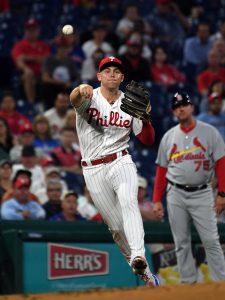
The Phillies have given Franco and Herrera plenty of rope so far in their careers, but they’re looking less and less like answers at their respective positions. And Philadelphia is no longer a rebuilding team – it’s in first place in the NL East, which figures to be a multi-team dogfight through September – meaning it must consider making moves to improve at third and in center. Luckily for the club, it may have an in-house solution for one of those spots in utility player Scott Kingery.
The 25-year-old Kingery opened the season as a reserve, but he has taken on a prominent role rotating between the hot corner and center since he returned from a month-long stay on the injured list. Going back to his May 19 activation, Kingery has started nine of the Phillies’ 11 games. Now, if he proves capable of performing like a legit full-timer, he’d take some of the pressure off executives Matt Klentak and Andy MacPhail heading into the July 31 trade deadline.
Philadelphia believes in Kingery, evidenced by the six-year, $24MM guarantee it gave him in March 2018. Kingery was a top 100 prospect at that point, but he had never even taken a major league at-bat. That inexperience was on display during a rough rookie season for Kingery, who struggled to a .226/.267/.338 line (62 wRC+) with 126 strikeouts against 24 walks in 484 tries.
So far, the sophomore version of Kingery is trumping his Year 1 numbers through 72 PA. However, his .328/.375/.567 slash (148 wRC+) looks as if it’s built on a house of cards. Having drawn a meager three walks against 20 strikeouts, Kingery is getting by on a sure-to-plummet .432 batting average on balls in play and a power surge that also looks unlikely to last. With three homers, Kingery’s fly balls are leaving the yard at an 18.8 percent rate – a figure he only approached once in the minors (in 2017). As a Double-A player that season, Kingery recorded a .295 ISO. Coming into this year, that was the only time Kingery had even neared a .200 ISO, let alone blown by it. With that in mind, don’t bet on Kingery maintaining his current ISO (.239).
Although there are reasons for pessimism regarding Kingery’s hot start, that’s not to say he can’t be a valuable regular for the Phillies now or in the future. It would be a colossal boon for the club if it happened immediately, considering its remade offense has been closer to middle of the pack than great this season. That’s largely because of Franco, Herrera and corner outfielder Nick Williams, who have combined for minus-1.1 fWAR in 414 PA. The Phillies can’t count on those three – nor can they expect a breakthrough from unproven outfielder Roman Quinn, 26, or McCutchen to man his old stomping grounds in center consistently – leaving the onus on Kingery to assert himself in a full-time role. If Kingery falls on his face, the Phillies may have to deal with the burden of finding two new regulars leading up to the deadline.
Photo courtesy of USA Today Sports Images.
Latest On Michael Wacha
The Cardinals pulled right-hander Michael Wacha from their rotation May 24, but they don’t want his demotion to last through the season, as Derrick Goold of the St. Louis Post-Dispatch explains. Pitching coach Mike Maddux told Goold the change isn’t “permanent,” adding, “He’ll definitely let us know when he’s ready to go back in.”
The relegation of Wacha opened the door for the Cardinals to promote flamethrowing prospect Genesis Cabrera, whose debut in Philadelphia on Wednesday didn’t go that well. The 22-year-old Cabrera gave up three earned runs on five hits and two walks in 3 2/3 innings, though he did strike out five. Worsening matters, Wacha’s appearance in relief of Cabrera surely ranks among the most awful performances of his career. Pitching for the first time since May 22, Wacha allowed six earned runs on five hits, including three home runs, and three walks in a single inning of work.
In the wake of Wednesday’s nightmare, Wacha owns a 6.51 ERA/6.52 FIP with 8.5 K/9, 6.04 BB/9 and a 24 percent home run-to-fly ball rate over 47 2/3 frames. It’s a shocking fall from grace for someone who looked like a potential front-line starter from his 2013 debut through 2015. However, various injuries have been deleterious to Wacha’s availability and effectiveness in recent seasons. The 27-year-old spent time on the IL earlier this season with a left knee injury and has seen his velocity fall by about a mile per hour on all of his pitches.
As poorly as 2019 has gone for Wacha, St. Louis doesn’t want to “pigeonhole” him into becoming a long reliever, manager Mike Shildt told Goold. Ideally for the Cardinals, Wacha will perform well enough in his newfound role to earn another shot in their disappointing rotation. A return to form is sorely needed for Wacha, who’s due to become a free agent after the season, but his platform year couldn’t be going much worse so far.
Mike Zunino Close To Return
The Rays have been without injured catcher Mike Zunino for three weeks, but he could return as early as Friday, Marc Topkin of the Tampa Bay Times reports. Zunino went to the 10-day IL on May 9 with a left quad strain.
Injuries, not just to Zunino, have victimized Rays catchers this year. Zunino headed to the shelf just four days after an oblique strain sent fellow backstop Michael Perez to the IL. When the club lost Zunino, it promoted Anthony Bemboom as his replacement, but the latter wound up on the IL on May 15 with a knee sprain.
With only struggling minor league Nick Ciuffo to turn to as a healthy 40-man option, the banged-up Rays had to scour the trade market for help earlier this month. They acquired former Mets starter Travis d’Arnaud from the Dodgers on the 10th and landed journeyman Erik Kratz in a deal with the Giants on the 16th. Unfortunately for Tampa Bay, those two haven’t offered much help so far. D’Arnaud and Kratz have combined for seven hits (five singles, two doubles), 17 strikes and three walks in 52 plate appearances, essentially making them automatic outs.
Aside from Perez – who’s still dealing with “discomfort,” per Topkin – no Rays backstop has done much at the plate this season. That includes Zunino, though the ex-Mariner’s .220/.260/.407 line in 96 PA would be welcome for the Rays compared to what they’ve gotten from d’Arnaud and Kratz.
It seems likely the return of Zunino will lead to the end of Kratz’s time on the Rays’ 40-man roster. The 38-year-old’s out of minor league options and has been behind d’Arnaud in Tampa Bay’s pecking order.
Forrest Whitley Dealing With Shoulder Fatigue
The Astros have sent right-handed pitching prospect Forrest Whitley to the minor league injured list with shoulder fatigue, Chandler Rome of the Houston Chronicle was among those to report. There’s no timetable for Whitley’s return. For now, he’ll head to the Astros’ Florida-based spring training facility to rehab.
For the majority of minor leaguers, an IL placement stays off the radar. The 21-year-old Whitley’s a special case, though, considering he’s a consensus top 10 prospect who could make a major league impact as early as this season. However, once he returns to action, Whitley’s performance in the minors will have to dramatically improve if he’s going to earn a promotion in the coming months.
Whitley, a first-timer at the Triple-A level this season, hasn’t looked ready for a call-up yet. In five starts and 24 1/3 innings at Round Rock, he has given up a whopping 33 earned runs on 35 hits, nine home runs and 15 walks (with 29 strikeouts).
General manager Jeff Luhnow doesn’t seem overly concerned, contending the hard-throwing Whitley’s “stuff,” velocity and spin look normal. In Luhnow’s estimation: “He’s not commanding it, he’s putting guys on base and allowing a lot of home runs. It’s a combination of probably the delivery, the pitch selection and a lot of different things that are going on. He’s had a bit of bad luck, too.”
The Astros are hopeful Whitley’s trip to the IL will give him a chance to hit the “reset” button, per Luhnow, who wants the hurler to “prove to us that he’s ready for an opportunity here if one presents itself.”
Houston’s 37-20 and in possession of one of the game’s most effective rotations, so it’s not exactly hard up for Whitley’s help. However, the Astros’ starting staff doesn’t look quite as infallible as it did over the previous couple seasons. Unsurprisingly, the losses of Charlie Morton, Dallas Keuchel and the injured Lance McCullers Jr. since 2018 have removed some of the bite from the team’s rotation.
Justin Verlander and Gerrit Cole still make for an elite one-two punch, while Brad Peacock‘s return to a starting role has worked out to this point. Wade Miley has outdone the 2018 version of Keuchel in terms of run prevention, though the former’s peripherals don’t align with his stingy 3.32 ERA. And rookie Corbin Martin, another of the Astros’ high-caliber pitching prospects, has stumbled over four starts since receiving his first MLB promotion May 11. Martin’s only in Houston’s rotation thanks to the performance- and injury-related issues that have haunted Collin McHugh this season.
Even if Whitley doesn’t join Martin in getting an audition in the Astros’ rotation this year, he could be in line for one in 2020. The team’s starting five is slated for plenty of upheaval after this season. Cole, Miley and McHugh may exit in free agency, which would leave the Astros looking for answers behind Verlander and perhaps Peacock and McCullers (if he’s back from Tommy John surgery). Whitley, Martin, Josh James and J.B. Bukauskas could represent a few other potential options in an organization with plenty of young pitchers.