
Pitching Notes: Uehara, Lincecum, Senzatela, Hoffman, Kohn
Reliever Koji Uehara says that he is open to considering offers from teams in Japan’s Nippon Professional Baseball league, as the Japan Times recently reported. That’s something of a reversal from the 42-year-old reliever, who had indicated he did not intend to play again in his homeland. After preparing for the MLB season, but finding interest scant, Uehara now says he has changed his mind and would consider pitching once again in the NPB. It’s at least a bit surprising that Uehara has not generated more pursuers among major-league clubs. He continued to produce declining results in 43 innings last year, finishing with a 3.98 ERA, but still ended with 10.5 K/9 against 2.5 BB/9 and generated a strong 15.8% swinging-strike rate.
Here are a few more pitching notes from around the game:
- While it’s clear the Rangers intend to utilize new pitching addition Tim Lincecum in the bullpen, just how he’ll be deployed isn’t yet clear. Jeff Wilson of the Fort Worth Star-Telegram posted a video of the former ace discussing his new club. It seems that Lincecum is intrigued by the possibility of closing but is largely open to fitting in wherever the team prefers. “They see that,” Lincecum says of working in the 9th. “I feel like I could do that. I’ve done that in the Cape and at the college level. It’s going to be, obviously, different, but I feel like I could tap into that mentality.”
- The Rockies elected this offseason to make a number of bullpen additions but not to pursue outside acquisitions for the rotation. That decision was no doubt as much about the team’s assessment of its internal options as it was about a need to maximize resources. In a pair of articles, here and here, Nick Groke of the Denver Post reports on two key staff members. Antonio Senzatela is said to be hard at work on his secondary offerings, with a new change-up in the works alongside continuing work on a curve. Meanwhile, fellow young righty Jeff Hoffman dealing with a shoulder issue. There’s no indication its a serious injury, but Hoffman is still going to rest for at least a week or more before he resumes throwing. As things stand, the Rox may be lined up to utilize a five-man unit that does not include either of these hurlers, as the current Roster Resource depth chart projects, but both are important parts of the near-term and future picture in Colorado.
- When the Twins brought in righty Michael Kohn last fall, the hope was that he could rebound from a rotator cuff problem and get his career back on track. Unfortunately, he’ll now require an absence of four to six months to recuperate from a “nerve issue,” per Mike Berardino of the St. Paul Pioneer-Press (via Twitter). The 31-year-old Kohn has a 3.52 ERA in 115 career innings in the majors, though that has come with a 111:79 K/BB ratio. It’s hard to read much into his results last year, as they were mostly accumulated in the low minors, but Kohn was able to make it through 13 solid innings late in 2017, over which he racked up 18 strikeouts against just four walks while permitting two earned runs on eight hits.
Rangers Designate Brett Nicholas, Announce Signing Of Tim Lincecum
The Rangers announced today that they have designated catcher Brett Nicholas for assignment. His roster spot was needed for the addition of righty Tim Lincecum, whose previously reported signing is now official.
With this move, the Rangers could be slated to utilize Juan Centeno as the backup to regular receiver Robinson Chirinos. With younger backstop Jose Trevino also on the 40-man and veterans Curt Casali and Michael Ohlman also in camp as non-roster players, there are a few other options on hand, too.
Of course, Nicholas may well end up back in Rangers camp himself if he clears waivers. The 29-year-old has only limited MLB time, with 110 plate appearances over the past two seasons. He has produced solid numbers with the bat at Triple-A of late, though, with consecutive .809 and .822 OPS campaigns.
Royals Sign Jon Jay, Place Jesse Hahn On 60-Day DL
5:49pm: Jay’s incentives kick in with a $100K bonus for reaching 250 plate appearances, tweets Jon Heyman of FanRag Sports. From there, he’ll receive an additional $100K bonus for every 25 PAs up through 600. Jay hasn’t reached 600 PAs in a season since 2013, so it’s perhaps unlikely that he’ll earn the full $1.5MM of incentives, but he should be able to unlock a decent share of his bonuses if he remains healthy
2:33pm: The Royals have signed outfielder Jon Jay to a one-year deal, per a club announcement. It’s a $3MM guarantee with as much as $1.5MM in incentives, per Rustin Dodd of The Athletic (via Twitter).
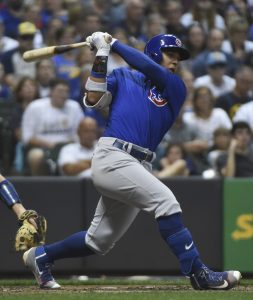
The bonuses are based upon plate appearances and can begin to be earned at Jay’s 250th trip to the dish, per MLB.com’s Mark Feinsand (via Twitter), who adds that the CAA Sports client is expected to be given a shot at an everyday job. In a corresponding move, the team placed recently acquired righty Jesse Hahn on the 60-day DL due to a sprained ulnar collateral ligament in his right elbow.
[RELATED: Updated Royals Depth Chart]
In an offseason of change, the Kansas City organization has now acted to fill the shoes left by departing stars Eric Hosmer and Lorenzo Cain. The former will turn his job over to Lucas Duda. And the latter will now be replaced, at least in part, by Jay.
It seems the Royals have made another interesting value play here. After landing Duda for just a single-season, $3.5MM commitment, the club has added another quality veteran player without constricting future financial flexibility.
Of course, the club won’t get quite the anticipated productivity that walked away in the form of Hosmer and Cain, as is reflected in the purchase prices. The departing stars, each of whom profile as first-division regulars, commanded a total combined guarantee of $224MM — not a minimal premium over the $6.5MM total that Kansas City has promised to Duda and Jay.
It’s far from clear that these moves will spur a winning product in 2018, but it’s certainly fascinating to see the Royals making such investments when the organization could instead have embarked upon a more dramatic rebuilding effort. The ensuing signings put something of a different spin on the earlier salary-cutting trades that allowed the club to move some of the obligations owed to Brandon Moss and Joakim Soria.
Jay, who’ll soon turn 33, is fresh off of another solid season. He has not been as productive of late as he was earlier in his career with the Cardinals, but gave the Cubs 433 plate appearances of .296/.374/.375 hitting in 2017. A quality baserunner who is at least a near-average center fielder, Jay would optimally function as a fourth outfielder at this stage of his career.
Even if he’s a bit extended as a regular, Jay seems a good bet to perform up to and beyond his new salary. He has traditionally carried minimal platoon splits, so the left-handed hitter ought to be a flexible asset for the Royals to utilize. With plenty of uncertainty in the remaining mix of outfielders, among other areas of the roster, the signing will help stabilize the unit.
As for Hahn, the injury is the latest in a long line of health troubles for the 28-year-old righty. Acquired from the A’s alongside prospect Heath Fillmyer in exchange for reliever Ryan Buchter and Brandon Moss (who was included more for financial purposes), Hahn entered camp with the hope of vying for a rotation spot or, at least, a bullpen gig with his new organization.
The former sixth-round pick (Rays, 2010) displayed plenty of promise with a 3.23 ERA, 7.1 K/9 and 3.0 BB/9 through his first 170 MLB innings between the Padres and the A’s. However, injuries have hit him hard since that time, and Hahn has struggled to a 5.59 ERA in 116 innings over the past two seasons while battling triceps and forearm injuries. He’s out of minor league options but will be able to work a minor league rehab assignment to get up to speed later this season if he is deemed healthy enough to take the ball once again.
Photo courtesy of USA Today Sports Images.
Athletics Release Brandon Moss
The return of Brandon Moss to the Athletics has proven short-lived, as was anticipated from the time he was picked up in a trade with the Royals. Oakland announced today that Moss was released after being designated for assignment over the weekend.
Moss, 34, will cost the A’s around $5MM in total — costs that were absorbed in order to enable the team’s acquisition of southpaw Ryan Buchter. That could still be offset by any MLB earnings Moss takes home this year, though a new team will only need to pay him at the league minimum salary.
It’s not exactly a hospitable market setting for the veteran slugger to enter. Moss, whose offensive productivity has fallen off in recent years, will almost certainly be looking at a minor-league deal. Adam Lind just took a minors pact, after all, despite quality output at the plate in 2017.
For Moss, things just haven’t been the same since he was dealt away by the A’s following a productive three-season run from 2012 through 2014. He did hit well enough in 2016 to earn a $12MM deal from Kansas City, but stumbled to a .207/.279/.428 slash line in 401 plate appearances last year. While Moss still hit the ball out of the yard 22 times, that doesn’t really stand out in a league environment that has seen a significant rise in the frequency of the long ball.
Retirement Notes: Pelfrey, Capuano, Hinojosa
We’ll use this post to round up some recent news from a few veteran hurlers whose playing days appear to be at an end:
- Right-hander Mike Pelfrey appears to be moving on from his days on the mound, as Wayne Cavadi of NCAA.com reported recently (thanks to alert reader Alex Hudson for the tip). Pelfrey, who played at Wichita State University and is finishing up his degree there, has agreed to join the baseball coaching staff of another local school, Newman University. After a dozen years in the majors, the former ninth-overall pick says that teaching pitching was a natural progression. “After a couple of surgeries and I felt like the last couple of years that my abilities were declining, I got more into that mentor role,” says Pelfrey. Assuming this is indeed the end of the line, Pelfrey will finish his big-league run with 1,476 1/3 innings of 4.68 ERA pitching. After a long stretch with the Mets, the sinkerballer spent three seasons with the Twins before finishing things off with the Tigers and White Sox over the past two campaigns. The above-linked post features an extensive chat with Pelfrey and is well worth a look for those with interest in the big righty.
- It seems that another dozen-year big-league veteran, southpaw Chris Capuano, is in the same boat. In an interesting chat with Garry Brown of The Republican earlier this year, the southpaw indicated that he’s finished with his pitching career. Instead of continuing the grind, as had previously seemed possible, Capuano plans to pursue a master’s degree and perhaps ultimately work with the MLB Player’s Association in some capacity. Like Pelfrey, Capuano tossed over fourteen-hundred frames at the game’s highest level. Even as he battled through injuries and bounced between six organizations, Capuano was a model of stability on the mound. He compiled a solid lifetime 4.38 ERA and rarely strayed too far from that level of pitching. Capuano will no doubt be best remembered for his six seasons with the Brewers; the lefty found early-career success in Milwaukee and finished his playing career there in 2016.
- It seems that another former MLB hurler, Dalier Hinojosa, is also finished with his playing career, as he recently told Francys Romero of Ciber Cuba. Hinojosa, 32, long played for the Guantanamo entrant in Cuba’s Serie Nacional. He came to affiliated ball in 2014, reaching the majors in each of the next two seasons. While he only has thrown 35 2/3 MLB innings, most of them with the Phillies, Hinojosa will finish his brief MLB career with a shiny 1.51 ERA. Despite posting those solid numbers, bringing a fastball that sat at 94 mph, and getting swings and misses with about one out of every ten pitches, Hinojosa was outrighted by the Phillies after the end of the 2016 season and was later released. He did not appear in 2017 after shoulder issues arose.
Extension Candidate: Whit Merrifield
The Royals front office is in an interesting spot as it attempts to engineer a soft landing after multiple seasons of contention from a roster whose core is no longer fully intact. Despite the obvious challenges, GM Dayton Moore says he’s as optimistic as ever about the organization’s outlook.
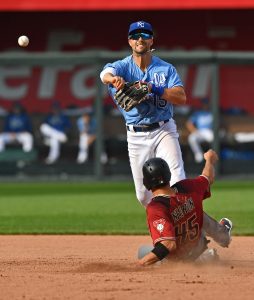
Perhaps no single player embodies that hope and this team’s unique approach more than infielder Whit Merrifield, a late-bloomer who quietly became one of the team’s best players. Given their current stance, the Royals shouldn’t be opposed to considering long-term deals with key players. But is Merrifield a worthwhile target?
As is often the case for teams that push for a World Series in — in this case, successfully — there’s a dent to the future outlook. That frequently shows up in the form of lost prospects, missed opportunities to swap veterans for younger talent, and ongoing commitments to expensive, older veterans. In this case, Alex Gordon and Ian Kennedy stand out as underperforming contracts.
At the same time, the Kansas City organization does have some valuable deals on the books — namely, the extensions agreed to with lefty Danny Duffy and catcher Salvador Perez. There’s still potential for those agreements to sour, but at present they seem to represent appealing commitments. And they both run through 2021. It’s worth remembering, too, that the club pursued star first baseman Eric Hosmer. Though it’s clear the Royals will be increasingly attentive to drawing down salary commitments, they did not force deals for players such as Duffy, Perez, or even pending free-agent closer Kelvin Herrera this winter. While Kansas City did give up talent to move some salaries (see here and here), those swaps are nothing like the full-throated efforts we’ve seen some other clubs take after a downturn in fortunes.
Unlike some small-market organizations that find themselves in this general situation, then, the Royals do not appear to be pursuing a strip-down rebuild. The retention (to this point) of Herrera and the signing of Lucas Duda confirm that the club isn’t just punting in the hopes of securing favorable draft position. Trying to remain at least somewhat competitive while undergoing a roster transition comes with quite a different blend of risk and benefit from a “tanking” strategy — which brings us back around to Merrifield, who deserves some consideration as a potential extension target after compiling 3.9 rWAR and 3.1 fWAR in his first full MLB campaign.
In most cases, perhaps, a player who achieves that kind of value immediately upon reaching the majors would be a clear candidate for a long-term deal. Here, though, there’s no getting around the fact that Merrifield is already 29 years of age — older than Hosmer and just a smidge younger than Mike Moustakas. With just 1.101 years of MLB service to his credit, though, he won’t quality for arbitration until 2020 and can’t reach the open market until 2023, when he’ll be entering his age-34 season.
Given that they already control him until he’s 33, the Royals need not be in any rush to secure Merrifield for the long haul. At the same time, though, the club ought to have ample leverage, so perhaps we shouldn’t immediately dismiss the merits of exploring a deal. While picking up control over Merrifield’s earliest-possible free agent campaigns might be a nice feather in the cap, the potential value for the team lies mostly in locking in future salaries at an appealing rate while announcing the presence of a new core piece to go with Duffy and Perez.
Despite his late ascension to the majors, Merrifield showed good promise in a half-season of time in 2016, with decent hitting output along with high-end glovework and baserunning. Though he took a slight step back in the latter two areas on a rate basis last year, at least by the numbers we have to work with, Merrifield also took a step forward with the bat. His low walk rate (4.6% in 2017) means he’ll probably never be an OBP monster, but he made plenty of contact (14.0% strikeout rate), showed a sudden power outburst (19 home runs, .172 isolated slugging), and produced overall at about five percent better than league average. It doesn’t hurt that Merrifield can steal a bag, having recorded 34 swipes in his first full season in the big leagues.
There’s some risk here, to be sure. Merrifield needs to hit at a high average to maintain a palatable on-base percentage. And he’s no sure thing to keep up the power surge — he never maintained an ISO that high over a full minor-league season — though perhaps Merrifield is one of those players who has benefited from a bouncier baseball. As Eno Sarris of The Athletic recently explained (subscription link), history suggests that Merrifield likely won’t have more than a few more quality seasons before the aging curve catches him.
In the aggregate, though, there’s good reason to believe that Merrifield will at least continue to profile as an above-average regular for some time. His athleticism and background — he has plenty of professional time at second, third, and the corner outfield, and the team is trying him in center this spring — suggests he could move around the diamond as the team’s needs change, providing value even if he checks back into a reserve role.
Merrifield may not be a face-of-the-franchise type, but taking an opportunity to lock in value on a player of his ilk is just the kind of move that can pay dividends for an organization that is already thinking about how it will compile a winning roster in the near future. To be sure, it would be a somewhat novel contract to negotiate. While players with non-star profiles and equally thin track records (and service time tallies) have certainly agreed to terms in the past — e.g., Juan Lagares (4 years, $23MM) and pre-breakout Jose Altuve (4 years, $12.5MM) — they were significantly younger. Perhaps the Yan Gomes contract, a six-year, $23MM pact that included two options at the end, would be a closer fit, but even he was just 26 years of age at signing.
There are certainly some light shades of Ben Zobrist here, though it’s a stretch to draw any strong comparisons. As a quality player who can move around the diamond, Merrifield could be viewed as a much lesser version of the renowned utilityman, who commanded only a $18MM guarantee in an extension with the Rays back in 2010. Zobrist was 28 at the time but was already a Super Two. Of course, that deal was a ridiculous bargain; on the other hand, there’s nothing to suggest Merrifield will ever approach Zobrist in overall value.
In truth, the Zobrist pact is tough to use as a comp for any purposes because it was so unique. The same might hold for a hypothetical Merrifield extension. My own thought is that Merrifield’s age/service status ought to make him much more amenable to taking a discount on his anticipated future earnings while also leaving the Royals with less incentive to give value for the right to control any prospective free-agent campaigns than they would for a more youthful player. (To be clear, that’s all speculation based on my outside observation of the circumstances.) Perhaps, then, the sides could explore a contract that includes a relatively limited overall guarantee for most or all of Merrifield’s pre-arb and arb-eligible seasons, with a range of possible options scenarios to be considered.
At what price might this become attractive for the Royals? Merrifield is going to earn just over the league minimum for 2018 and 2019. His salary for the ensuing three campaigns will depend upon what he does in the meantime, of course, but there are some comps that give some idea of what Merrifield could earn if he continues playing at the same general level. Joe Panik just agreed to a $3.45MM first-year arb salary, for instance, while DJ LeMahieu started with $3.0MM and has taken down a total of $16.3MM in his three seasons of arbitration.
Even if we peg Merrifield’s anticipated earnings through 2022 in the realm of $16MM or so — give or take a few million – that doesn’t mean the Royals should be willing to spend that much on an extension. Pre-committing isn’t necessary unless there’s some benefit to the club, yet the rights to free-agent years won’t have that much value for an older, non-star performer. Perhaps the Royals would promise Merrifield something in the realm of his likely arb earnings if he agrees to very low prices on two option years. Or maybe the team will pursue a discount on the arb seasons if the contract includes an option or two at higher prices (such that they likely won’t be exercised unless Merrifield succeeds beyond expectations, in which case he’d be rewarded). The most interesting scenario, though, may be a deal that only locks the sides in through the first two seasons of arbitration while leaving team options for the third arb year, at a discounted rate, along with one or two would-be free-agent years. That might give the late bloomer the security he needs while affording the team an appropriate blend of protection and expected cost savings.
To reiterate: there’s no urgency here and likely not a huge amount of upside to be captured for K.C. But if this organization really does intend to remain competitive in the relatively near future while steadily building up a new core, it’ll require a whole lot of incremental moves that add value. Exploring a new deal with Merrifield offers just that sort of potential opportunity, but only in the right circumstances.
Photo courtesy of USA Today Sports Images.
Rangers Meeting With Julio Pablo Martinez
Now that Cuban outfielder Julio Pablo Martinez is officially able to sign, he’s meeting with the Rangers today to hammer out a deal, according to Ben Badler of Baseball America. It is believed that the sides will agree to a $2.8MM bonus.
Texas has been seen as the favorite to land Martinez for the past several weeks. Indeed, the Rangers have struck two trades — see here and here — to max out their possible international bonus pool assets. Having already spent a good bit of money over the past year or so, the Rangers have $2.8MM left and are expected to spend it all on Martinez.
While the Yankees and Marlins were also reportedly in pursuit of Martinez, all indications at this point are that he’s zeroed in on the Rangers. For Texas, the move will bring a high-quality prospect into the organization who may not be far from seeing the majors. Badler says that Martinez will jump right into BA’s top 100 prospects list. The 21-year-old is a left-handed hitter who is said to possess good power and speed.
Latest On Indians’ Rotation Plans
The Indians entered the offseason with enviable depth in their pitching staff, particularly among rotation hopefuls. While that led some to wonder whether trades might be considered, to this point the Cleveland organization has not shipped away pitching.
Midway through Spring Training, it seems the situation is beginning to resolve itself — at least as to how things will look when camp breaks. Paul Hoynes of the Plain Dealer has the latest on the defending AL Central champs.
Per Indians skipper Terry Francona, the current expectation is for Mike Clevinger to hold down a rotation spot to open the season. “He’s strong, and he should be able to be that innings-eater type pitcher,” says Francona.
Of course, Clevinger did a good deal more than eat innings last year. 2017 was a breakout effort for a pitcher who entered the season with just 53 MLB frames under his belt. Over 121 2/3 innings, including 21 starts, he posted a 3.11 ERA with 10.1 K/9 and 4.4 BB/9.
Suffice to say, such a campaign would secure most hurlers a starting job for the ensuing season. For the pitching-rich Indians, though, there are quite a lot of other arms to consider.
At the onset of the offseason, the biggest question surrounded enigmatic righty Danny Salazar, who has long dealt premium stuff but suffered from injury and performance lapses. He wasn’t traded, but now there’s a shoulder injury to worry about. Though it’s possible Salazar will return to pitching off of a mound in a few days, says Francona, the pitcher is “not going to be ready” for the start of the season.
That news more or less sews up a spot for Clevinger, though this organization still has some pitching decisions to make. As Hoynes writes, the club is still waiting to see how the competition plays out between Josh Tomlin and Ryan Merritt. The former has struggled with long balls in recent years but remains an elite control artist, while the latter — who is also more notable for limiting the free pass than for strikeouts — has produced good results in very limited MLB action.
In addition to deciding the outcome of that battle, the Indians will be making some interesting bullpen decisions. Tomlin or Merritt could join the relief unit, but they’ll be contending with a long list of possibilities, including quite a lot of non-roster invitees (as shown in this Indians depth chart). All told, there’s still a good bit of potential roster intrigue in Cleveland.
Astros Place Anthony Gose On Outright Waivers
The Astros have placed lefty Anthony Gose on outright waivers, per Jake Kaplan of The Athletic (Twitter link). That will ultimately open a 40-man spot, though it’s not clear whether the organization has immediate plans for utilizing it.
Gose was taken in the Rule 5 draft back in December, meaning any claiming team would need to retain him on the active roster for all of 2018 in order to keep him permanently. Given his prior MLB experience as an outfielder, he would be arbitration-eligible after the season were that to occur.
If Gose clears waivers, he’ll be offered back to the Rangers, who had signed him to a minors deal last fall. The Texas organization took a low-risk shot despite the fact that Gose had only previously thrown 10 2/3 High-A innings, over which he allowed nine earned runs and six walks but also recorded 14 strikeouts.
Despite the limited track record, the 27-year-old Gose has shown a powerful throwing arm on the hill and could also bring value on the bases and in the outfield. But it seems his interesting time in Astros camp did not make the desired impression. Gose failed to record an out in his only Grapefruit League appearance, issuing walks to all three hitters he faced.
Rays Sign Carlos Gomez
March 3rd: The Rays have made the signing official. Gomez’s incentives are based on games played, per the Associated Press. He’d rake in $100K each for 80, 90, 100, 110 and 120 games.
February 21st: The Rays have agreed to a one-year deal with veteran outfielder Carlos Gomez, according to MLB.com’s Jesse Sanchez (via Twitter). Gomez, a Boras Corporation client, receive a $4MM if he passes a physical, per Marc Topkin of the Tampa Bay Times (Twitter link). The deal also includes $500K in potential incentives and a $500K assignment bonus, per Jon Heyman of Fan Rag (via Twitter).
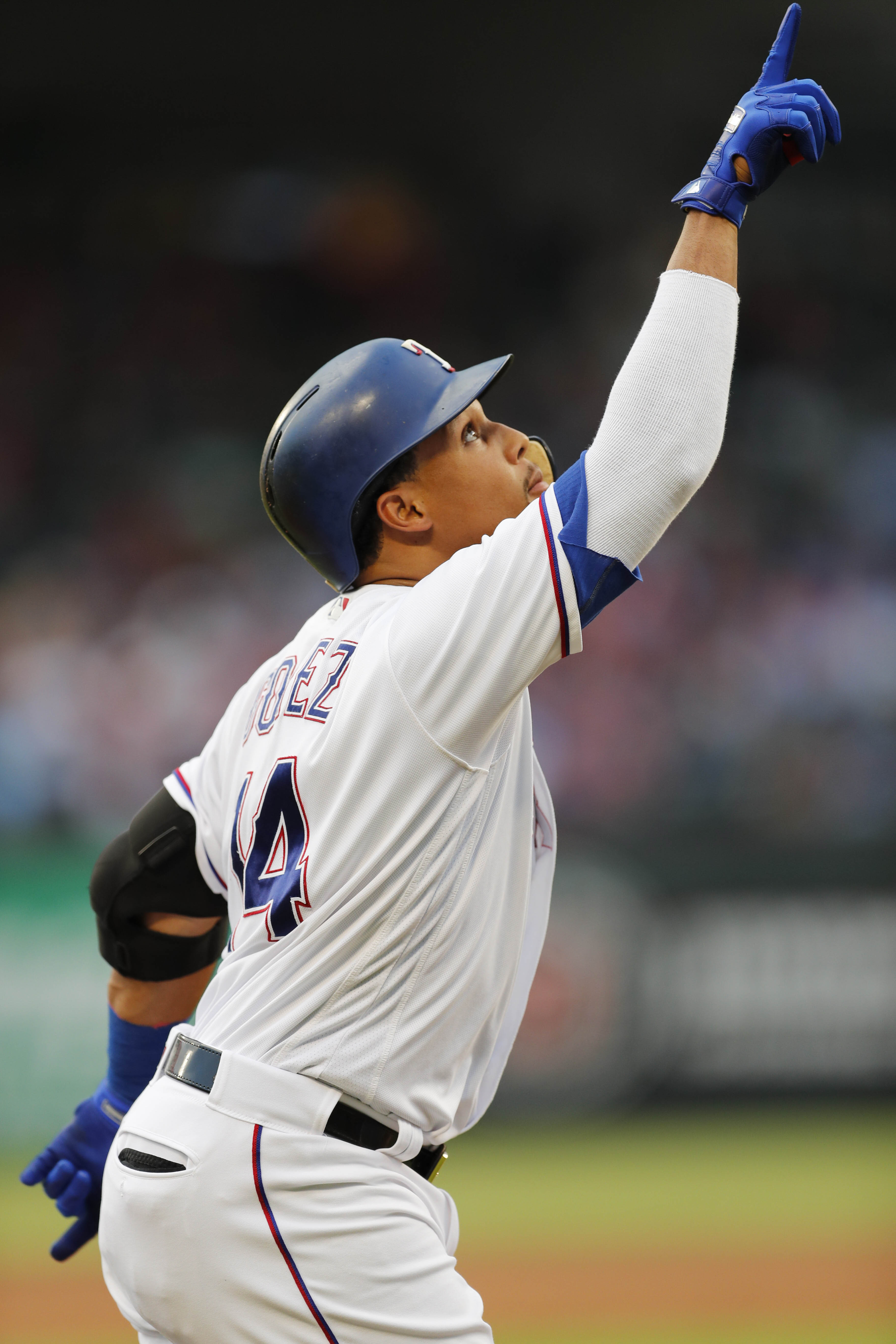
If finalized, this pact would represent an interesting narrative shift after weeks of salary-paring moves from Tampa Bay. The organization just shipped away outfielder Steven Souza and starter Jake Odorizzi while designating left-handed-hitting slugger Corey Dickerson for assignment. Of course, Tampa Bay also picked up righty power hitter C.J. Cron and reliever Sergio Romo.
All things considered, then, it seems the Rays are engaged in a broad re-shaping of their 2018 roster and near-term balance sheet, more than a pure tear-down. That would square with the team’s insistence last night — via top baseball execs Erik Neander and Chaim Bloom — that further moves to part with veterans were not anticipated.
It is still a bit difficult to know just what to make of the overall slate of moves. Perhaps the addition of Gomez was in some part simply a reaction to the team’s decision to deal Souza, which came about as a result of what that front office duo suggested was an overwhelming offer from the Diamondbacks. Similarly, earlier moves — especially, the addition of Denard Span as a salary offset in the Evan Longoria deal — had left the Rays with a lefty-heavy outfield mix.
There’s no doubt some opportunism in the Gomez contract itself. MLBTR predicted he’d command a $22MM guarantee over two seasons, ranking him 23rd on the list of the top 50 free agents at the start of the offseason. Landing such a productive player at the reported rate — just $4MM on a single-season commitment — represents a notable bargain.
Though Gomez has earned his share of detractors with a vibrant and assertive (some might call it brash) personality on the field, and is not far removed from a miserable run with the Astros, he is coming off of a big season with the Rangers. Notably, Gomez received an $11.5MM guarantee in advance of the 2017 campaign. He went on to post a .255/.340/.462 batting line with 17 home runs and 13 steals over 426 plate appearances.
To be fair, there were a few clear signs of an ongoing decline. Gomez’s strikeout rate stayed in the thirty percent range, as it did in his rough prior campaign, and he was reliant upon a .336 BABIP that sits above his career mean. And Gomez is no longer a premium performer on the bases or in the field. Still, he rated as a plus on the basepaths and drew near-average grades for his glovework in center, so he still offers value as an all-around player. While it seems unlikely Gomez will return to his superstar peak, he seems likely to be at least an average regular or high-end platoon option.
Whatever the reason things shook out this way, the Rays will — barring further action — enter the 2018 season with an outfield unit that nobody could have predicted when the offseason got underway. Gomez, Span, and Mallex Smith now appear to represent the top three options to flank center fielder Kevin Kiermaier.
Photo courtesy of USA Today Sports Images.