
Mariners Acquire Yimi Garcia
Less than 24 hours after beefing up their lineup with the acquisition of Randy Arozarena, the Mariners have bolstered their bullpen by acquiring right-hander Yimi Garcia from the Blue Jays. Outfielder Jonatan Clase and minor league catcher Jacob Sharp are going from Seattle to Toronto in return.
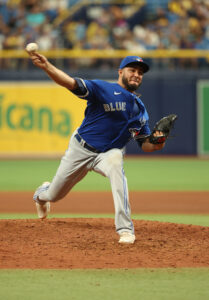
Garcia, 34 next month, is in his third season with the Jays. He originally signed a two-year, $11MM contract with Toronto, but he’s beefed up that contract through his performance. Garcia pitched enough games to vest a $6MM option for the current season and also picked up an additional $1MM of incentives in years one and two of the contract, ultimately turning it into a three-year, $18MM pact. He’s a rental for the Jays who’ll be owed $2.1MM from now until season’s end. Garcia is a free agent thereafter.
Regarded as one of the better relief arms on this year’s market, Garcia will bolster a bullpen that looked like one of the strongest in the game heading into the season but has been hit with some notable injuries. Star setup man Matt Brash required Tommy John surgery that knocked him out for the season, while offseason trade acquisition Gregory Santos only recently made his team debut after suffering a significant lat strain in spring training. The right-hander was removed from his most recent appearance with a knee issue. Perhaps that pushed the Mariners to make this move, but Santos has not yet been placed on the injured list, nor has the team announced a substantial injury for the right-hander.
Seattle has spent much of the season patching things together on the bridge to manager Scott Servais’ excellent closer, Andres Munoz. Now, if Santos’ knee injury proves minor they could go from a piecemeal approach to a pair of high-octane setup men in a matter of weeks.
Garcia has been a force this year, sporting a career-high 96.7 mph average fastball en route to a mammoth 36.5% strikeout rate that tops his prior career-high by nearly five percentage points. He’s coupled that with a strong 7% walk rate.
Over the past two seasons, Garcia has notably cut back on the usage of that fastball and significantly upped his curveball usage, helping to contribute to the rise in punchouts. He’s sitting on an excellent 2.70 ERA that metrics like FIP (2.64) and SIERA (2.30) suggest could undersell his performance to date. Garcia has gone 5-for-6 in save opportunities (bringing his career total to 26) and picked up 10 holds this year as well. He only just returned from a monthlong stay on the injured list due to a bout of elbow neuritis (nerve inflammation), but Garcia has tossed two innings, faced eight batters and punched out five of them while averaging 96.6 mph on his fastball; the elbow doesn’t seem to be bothering him.
In return for Garcia, the Jays will add a big league-ready outfielder with a full six seasons of club control: Clase. The 22-year-old speedster made his big league debut with the M’s earlier this season and .195/.233/.220 slash in a tiny sample of 44 plate appearances. That’s a small enough number of plate appearances at a young enough age that it’s not worth reading into; Clase has had a nice season in Triple-A Tacoma this year, slashing .274/.373/.483 with 10 homers, 11 doubles, four triples and 26 steals in 35 attempts. His 25.7% strikeout rate there is higher than one would prefer for a player who’s considered to have below-average power, but Clase has also walked in nearly 15% of his plate appearances.
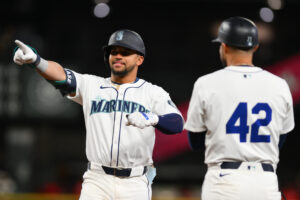
This year’s 26 steals are a nice mark but they don’t tell the full tale of Clase’s speed. Baseball America pegs him as a 70-grade runner (on the 20-80 scale), while FanGraphs lists him as a true 80-grade burner. His 29.6 ft/sec average sprint speed this season (as measured by Statcast) ranks in the 97th percentile of MLB players. Clase swiped a whopping 79 bases (94 attempts) in just 129 games between High-A and Double-A last year — all while hitting .242/.353/.449.
For a Jays club that’ll see Kevin Kiermaier retire at season’s end, he stands as a potential everyday player as soon as 2025 … if he can make enough quality contact to keep himself in the lineup. The Blue Jays have one of the game’s best outfield defenders in Daulton Varsho, who could slide to center in place of Kiermaier next year, but Clase will have a chance to win an everyday role regardless of whether it’s in left or center. Despite all his speed, Clase isn’t regarded as the same level of defender as Varsho, though he’s young enough that he could of course improve his reads, jumps and routes in the years ahead.
Sharp, 22, was Seattle’s 17th-round pick just last summer. The former UNLV backstop is a right-handed hitter who’s spent the season thus far in Class-A, hitting .255/.339/.435 (105 wRC+). He’s a bit old for that level, but it’s still hard to overlook his eye-catching bat-to-ball skills. Sharp has struck out in only 9.9% of his plate appearances — a mark that’s barely higher than his 9.4% walk rate. He’s thrown out 21% of runners who’ve attempted to steal against him since being drafted. He’s a longer-term play than Clase, but a catcher with that type of feel for contact makes for an interesting add to the lower levels of the farm.
ESPN’s Jeff Passan first reported that the Mariners were acquiring Garcia and sending Clase to Toronto. Sportsnet’s Ben Nicholson-Smith first reported Sharp’s inclusion in the trade.
Dodgers Trade James Paxton To Red Sox
The Red Sox have added some depth to their rotation, acquiring lefty James Paxton from the Dodgers in exchange for minor league infielder Moises Bolivar, the teams announced Friday. Boston transferred right-hander Bryan Mata to the 60-day injured list to open a spot on the 40-man roster. WEEI’s Rob Bradford reported yesterday that the Red Sox, who need some rotation stability and who employed Paxton from 2022-23, were expected to pursue him.
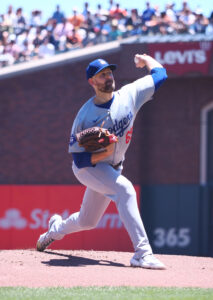
Paxton was something of a surprise DFA by the Dodgers. He’s made all 18 starts asked of him this season and posted a respectable, if unspectacular 4.43 earned run average. Those numbers closely mirror the 4.50 ERA he logged in a similar sample of 96 frames with Boston last season, but the rest of the 35-year-old’s profile doesn’t look nearly as strong.
After averaging 95.2 mph on his fastball with the Sox last season, Paxton is down to 93.2 mph in 2024. He’s seen his strikeout rate plummet from 24.6% to 16.4%, while his walk rate has soared from 8% to 12.3%. Paxton’s average exit velocity has also jumped by a mile and a half per hour, from 89.3 mph with the Sox to 90.8 mph with Los Angeles. His overall hard-hit rate has climbed in similar fashion, from 39.6% to 43.3%. He’s gotten by with a career-low .267 average on balls in play and homer-to-flyball rate that’s also notably lower than his career marks.
Whether Paxton can sustain his passable results with that lackluster array of under-the-hood numbers is far from clear, but the Sox also don’t necessarily need him to perform like an front-of-the-rotation arm. Boston’s depth behind Tanner Houck, Kutter Crawford, Nick Pivetta, Brayan Bello and Cooper Criswell is thin, and several of those arms (Houck, Crawford, Criswell) are either approaching or have already established new career-high workloads. Adding a stable back-end arm surely holds plenty of appeal for a team in that situation — particularly given Paxton’s affordable contract.
Paxton inked a one-year deal with $7MM guaranteed and another $6MM in attainable bonuses. However, $3MM of that guarantee came in the form of an up-front signing bonus that’s already been paid out. He’s also already unlocked all $6MM of incentives ($2MM for making the Opening Day roster and another $4MM based on his number of games started). As such, the Red Sox will only owe him the prorated portion of that $4MM base between now and season’s end (approximately $1.42MM).
That modest sum bumps Boston’s payroll to an approximate $180MM. Their luxury-tax ledger is a good bit higher, checking in at an estimated $218.1MM prior to this swap (via RosterResource). Paxton will push the Sox just shy of $220MM, leaving chief baseball officer Craig Breslow and his staff about $17MM of breathing room between their current number and the first luxury tax threshold. Breslow & Co. should have ample room to make further additions, even if ownership is reluctant to cross that first tax threshold. Boston, in addition to seeking rotation depth, has been in the market for bullpen upgrades and a right-handed bat.
For the Dodgers, the trade of Paxton, who ranks third on their team in innings pitched, clearly isn’t a sign of selling. Los Angeles is in first place in the NL West and stands as a veritable lock to make the postseason. But the Dodgers also welcomed Tyler Glasnow and Clayton Kershaw back from the injured list this week.
That pair of high-quality veterans joins a youthful trio of Gavin Stone, Justin Wrobleski and River Ryan in the rotation at the moment, but the Dodgers are also expecting Yoshinobu Yamamoto to return in August and Walker Buehler to return sometime before season’s end. Between that depth and their outspoken pursuit of an “impact” starting pitcher on the trade market (in the words of general manager Brandon Gomes), Paxton was pushed out of the mix.
In exchange for the final two-plus months of Paxton’s services, the Dodgers will receive the 17-year-old Bolivar. He signed with the Red Sox as an amateur free agent out of Venezuela just this past January, receiving a bonus of $25K. He’s not considered a high-end prospect in Boston’s system, but that sort of lottery-ticket return is to be expected for a veteran pitcher who was designated for assignment.
Bolivar, already six feet tall and listed at 175 pounds, has gotten out to a strong start in his professional debut. He’s appeared in 31 games with the Red Sox’ Rookie-level Dominican Summer League affiliate and slashed .270/.364/.423 with three homers and nearly as many walks (17) as strikeouts (21). He’s a right-handed hitter who’s played primarily third base but has also logged 26 innings across the diamond at first base.
FanSided’s Robert Murray first reported that the two sides were engaged in trade talks. ESPN’s Jeff Passan reported a deal had been finalized. Fabian Ardaya of The Athletic and Alex Speier of the Boston Globe added details on the Dodgers’ return.
The Blue Jays Shouldn’t Be Resisting A Reset
The 2024 season clearly hasn't gone the way the Blue Jays hoped. Expected to contend for a Wild Card spot at the very least, the Jays have instead encountered notable injuries (Jordan Romano, Alek Manoah) and seen career-worst performances from several key players (Bo Bichette, Alejandro Kirk, Justin Turner, Kevin Kiermaier). Top prospect Orelvis Martinez received an 80-game PED suspension. Very, very little has gone well in Toronto -- as evidenced by their 46-56 record and -82 run differential.
Unsurprisingly, Toronto has become a deadline seller. The front office reportedly isn't interested in any kind of large-scale rebuild, however, and is focused on primarily selling off rental assets. Reliever Yimi Garcia has already been traded to the Mariners. Starter Yusei Kikuchi and the aforementioned Turner are among the candidates to change hands. That'll bring back some modest returns in terms of prospects. It's also not sufficient for a team in Toronto's situation.

Unlock Subscriber-Exclusive Articles Like This One With a Trade Rumors Front Office Subscription
- Access weekly subscriber-only articles by Tim Dierkes, Steve Adams, and Anthony Franco.
- Join exclusive weekly live chats with Anthony.
- Remove ads and support our writers.
- Access GM-caliber tools like our MLB Contract Tracker
Mariners Still Active In Trade Market
The Mariners’ acquisition of Randy Arozarena last night is perhaps the most notable swap of the season thus far, but Seattle isn’t content with that lone acquisition. MLB.com’s Jon Morosi tweets that the M’s are still talking to other clubs, looking to add another bat and a high-leverage reliever. Adam Jude of the Seattle Times adds some context on the team’s search for bats, reporting that two of the top bats on the market — Oakland’s Brent Rooker and Chicago’s Luis Robert — may not be likely to land in Seattle. The A’s have been reluctant to trade with Seattle, per Jude, while an acquisition of Robert is considered “highly unlikely at this point.”
Both Rooker and Robert would add a controllable, high-end bat to what has been a stagnant Mariners offense. Rooker is arb-eligible for the first time this offseason and controlled three more years. Robert is signed through the 2025 season, and his contract contains a pair of $20MM club options.
The A’s haven’t always been reluctant to deal within the AL West, but the last time they completed a trade with the Mariners came back in 2017, when the two clubs swapped Emilio Pagan for Ryon Healy. In fact, the only trade they’ve made with a division rival in the past three years was this April’s acquisition of righty Brandon Bielak in a deal that sent cash back to the Astros. It’s always possible there’ll be a change in direction, but their once-frequent intra-division trades (e.g. Elvis Andrus, Khris Davis, Jed Lowrie, Jurickson Profar, Pagan, Healy) have dried up in recent years.
With regard to Robert, there’s no intra-division component to be considered, but traction on Robert hasn’t really picked up, it seems. ESPN’s Jeff Passan writes that the White Sox have set a high asking price and haven’t yet seen potential trade partners willing to meet it or even come particularly close.
The mere mention of Rooker and Robert aligns largely with the latest reporting from Daniel Kramer of MLB.com, who suggests that Seattle’s front office has been “aggressive” in trying to add multiple impact bats. Arozarena checks one box, but the Mariners’ lineup could use upgrades at multiple spots.
It’s even possible the M’s and Rays could line up on another deal; Kramer writes that the two teams discussed infielders Isaac Paredes and Yandy Diaz in the offseason. Mark Feinsand of MLB.com tweets that the Mariners are again a potential landing spot for Diaz, who is drawing trade interest and was reinstated from the restricted list within the past hour after a week-long absence to tend to an undisclosed family matter.
Like Arozarena, the 32-year-old Diaz got out to a slow start in 2024 but has heated up in recent months. Over his past 280 plate appearances, he’s slashing a robust .302/.354/.453 with seven homers, 16 doubles, a triple and just a 13.9% strikeout rate. He’d give the Mariners an upgrade over the recently designated Ty France and simultaneously accomplish the team’s ongoing goal of reducing their MLB-worst strikeout rate. He’s earning $8MM the second season of a three-year, $24MM contract extension and is owed $10MM in 2025 before the team must decide on a $12MM option for the 2026 season.
Paredes, 25, is arguably one of the most appealing possibilities on the entire trade market. He’s played third base primarily of late, but the versatile infielder can handle all four infield positions and has emerged as a genuine middle-of-the-order slugger. Dating back to Opening Day 2023, he’s slashed .250/.353/.469 with 47 homers in 241 games. He’s earning only $3.4MM this season in the first of four arbitration seasons (as a Super Two player). Paredes’ versatility, productive bat, remaining control and currently affordable price tag could make the prospect cost to acquire him prohibitive, but the Rays are generally open to listen on anyone — and teams have been at least inquiring on Paredes recently.
Twins Outright Diego A. Castillo
July 26: Castillo cleared waivers and accepted an outright assignment to Triple-A St. Paul, per Do-Hyoung Park of MLB.com on X.
July 24: The Twins announced Wednesday that they’ve designated infielder Diego Castillo for assignment and optioned right-hander Ronny Henriquez to Triple-A St. Paul. Their spots on the roster will go to reliever Brock Stewart, who’s been activated from the 60-day injured list, and righty David Festa, who’s been recalled from St. Paul.
Castillo, 26, appeared in four games with the Twins and went 2-for-6 with a double, two walks and a strikeout in eight plate appearances. He’s had a nice season in the minors as well, hitting a combined .274/.382/.403 in 296 plate appearances between the Triple-A affiliates for Baltimore and Minnesota. That marks the continuation of a long run of OBP-driven production in the upper minors. Castillo has played in parts of four Triple-A seasons, and while he doesn’t hit for a ton of power, he’s a .290/.402/.406 hitter in 1073 Triple-A plate appearances. He’s primarily been a shortstop (3906 innings) but also has 1922 innings at second base, 619 innings at third base, 535 innings in left field, 224 innings in right field and 66 innings at first base.
Despite that versatility and a strong Triple-A track record, Castillo hasn’t gotten much big league playing time. He made his debut with the 2022 Pirates and logged a career-high 283 plate appearances. However, he hit just .206/.251/.382. The D-backs gave him one big league plate appearance in 2023, and the Twins have given him all of eight.
It’s certainly arguable that Castillo deserves a longer look somewhere, but a Twins organization that’s deeper in the infield than anywhere else on the diamond was probably never going to have that opportunity. Even with each of Royce Lewis, Carlos Correa, Jose Miranda, Kyle Farmer and Alex Kirilloff on the injured list, Minnesota has Carlos Santana at first base, Edouard Julien at second base, All-Star Willi Castro at shortstop and top prospect Brooks Lee at third base. Several of the injured Twins will be back sooner than later, too. Lewis began a rehab assignment in Triple-A last night. Miranda will follow suit today.
Minnesota will either trade Castillo or place him on outright waivers within the next five days. Waivers themselves could be another 48-hour process. Castillo will know the outcome of his DFA within the next week.
As for Stewart, his return will be a significant boon for the Twins’ bullpen. The former Dodgers prospect has proven to be an exceptional find on a minor league pact. He’s missed time with injury in each of the past two seasons, but Stewart has added considerable velocity since his rotation days in the Dodgers’ system and has been a bullpen behemoth in Minnesota when healthy. He’s pitched 41 innings dating back to 2023 and carries a remarkable 0.66 ERA with a huge 34.8% strikeout rate against a 10.6% walk rate.
Stewart will slide right into a late-inning, high-leverage mix also including Jhoan Duran, Griffin Jax and Jorge Alcala. Righty Justin Topa also also went out on a rehab assignment yesterday, providing another potential boost in the near future. He’s been out all season with a knee injury but posted a 2.61 ERA, 21.9% strikeout rate, 6.5% walk rate and 56.7% ground-ball rate in 69 innings for the Mariners last season. The Twins added Topa in the offseason trade that send Jorge Polanco to Seattle.
Orioles, Phillies Swap Austin Hays For Seranthony Dominguez
The Orioles announced Friday that they’ve traded outfielder Austin Hays to the Phillies in exchange for right-hander Seranthony Dominguez and outfielder Cristian Pache. Baltimore is designating righty Levi Stoudt for assignment to open a 40-man roster spot, the team announced. The Phillies filled their open roster spot by reinstating right-hander Michael Rucker from the 60-day injured list.

It’s a rare swap of major leaguers between a pair of World Series hopefuls. Hays will give the Phillies a more impactful right-handed bat in their outfield mix than they had in the glove-first Pache. Hays isn’t having his best season but was a 2023 All-Star and has pounded left-handed pitching both in 2024 and throughout his career. Dominguez, similarly, is having a down season but sports a much better track record. He’s still a hard-throwing reliever with high-leverage experience and has at times operated as the Phillies’ closer.
Hays, 29, is hitting .255/.316/.395 this season in 175 plate appearances. He missed nearly a month with a calf strain earlier this season, and it’s certainly possible that injury impacted his production; Hays hit just .111/.200/.111 in 50 trips to the plate prior to that IL stint but has returned with an excellent .313/.363/.509 slash in 125 subsequent plate appearances.
That slash is perhaps partially attributable to the fact that Hays has been platooned more than in seasons past, thanks to the emergence of lefty-hitting outfielders Colton Cowser and Heston Kjerstad in Baltimore. Between that pair, center fielder Cedric Mullins, right fielder Anthony Santander and first basemen/designated hitters Ryan O’Hearn and Ryan Mountcastle, the O’s are dealing from a wealth of corner depth in this swap. Hays has been exclusively a corner outfielder this year and hasn’t played center field with any regularity since 2020.
Prior to this season’s rough start (and the emergence of those young top prospects), Hays has been a fixture in the Baltimore outfield. The former third-round pick was a top-100 prospect himself and from 2019-23 tallied 1886 plate appearances with a strong .264/.317/.441 batting line (109 wRC+). Hays doesn’t walk much (career 5.9%) but strikes out at a 21.5% clip that’s slightly below league-average. He’s typically posted average or better grades in left field, though his marks this season are down across the board. Again, however, that’s not necessarily a surprise for an outfielder who’s battled a lower-leg injury that impacted his speed and mobility.
Hays will give the Phillies a productive platoon partner to pair with lefty-swinging Brandon Marsh in left field. Both Marsh and Hays (in a pinch) can handle center field as well, though it’s likely that defensive standout Johan Rojas will continue to patrol that position regularly — barring an additional outfield acquisition from president of baseball operations Dave Dombrowski. Hays has bludgeoned lefties at a .328/.394/.500 clip in 72 plate appearances this year and touts a lifetime .272/.328/.463 output against southpaws.
The Phillies will be able to control Hays through the 2025 season if they choose, though he’d be an expensive part-time player if they plan to platoon him all season in 2025. He’s earning $6.3MM this year in his second arbitration season and will be due one final raise this winter — likely to a number north of $8MM — before qualifying as a free agent in the 2025-26 offseason.
Turning to the Orioles’ end of the deal, they’ll first and foremost add an experienced reliever in the form of the 29-year-old Dominguez. He’s been tagged for a 4.75 ERA this year in 36 innings but entered the 2024 campaign with a career 3.31 earned run average, 27 saves and 52 holds. Dominguez has been uncharacteristically homer-prone this year and thus struggled to strand runners, but his velocity (97.5 mph average fastball), strikeout rate (25.5%) and walk rate (7.6%) all remain strong. This year’s walk rate is actually a career-low, and Dominguez’s 25.5% strikeout rate isn’t terribly far off the 27.5% mark he carried into the season.
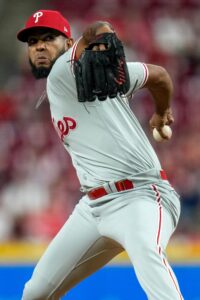
As is often the case with relievers, Dominguez’s pedestrian earned run average is skewed by a small number of meltdowns. He’s been tagged for four earned runs on two separate occasions this season, accounting for 42% of his earned runs in those two trips to the mound (just 5.2% of his total appearances).
That clearly doesn’t make the bottom-line results any more palatable, but it’s preferable to have a reliever who’s had a handful of awful outings as opposed to one who’s prone to giving up a run or two every other time out. With Craig Kimbrel currently in a rough patch and Danny Coulombe on the 60-day injured list, Dominguez could find himself in some leverage situations.
Like Hays, Dominguez can be controlled through the 2025 season — but the choice is at the team’s discretion. He’s playing out the second season of a two-year, $7.25MM contract that covered his final two arbitration seasons and includes a club option for what would’ve been his first free-agent year. The O’s will hold an $8MM club option over Dominguez that comes with a $500K buyout — effectively rendering it a net $7.5MM decision. If he can rebound to his prior form following the swap, that could prove to be a palatable price point even for what’s typically been a frugal Orioles club (albeit under their now-former ownership).
Baltimore will also add Pache to its bench mix. It’s an offensive downgrade, as the 25-year-old is hitting only .202/.288/.269 in 118 plate appearances and carries a .179/.243/.272 slash in parts of five MLB seasons. That said, Pache is a lights-out defender who’s been credited with a dozen Defensive Runs Saved and 16 Outs Above Average in just 1334 career innings in the outfield. He’s a plus-plus defender in center field, offering the O’s a more true fourth outfielder than Hays did, but he can certainly play strong corner defense as well.

Pache is out of minor league options, so he can’t be sent to the minors without first being designated for assignment and exposed to waivers. As such, he’ll need to stick on Baltimore’s roster. For a team that’s a near-lock to make the postseason, this type of outfielder — light hitting, plus defense, good speed — is a particularly useful asset.
Pache is earning just north of the league minimum this season. Dominguez is being paid $4.25MM and has the $500K buyout on his option. The swap is close to cash-neutral, but the Phillies will be taking on about $297K in additional payroll. When factoring in their luxury tax status, the trade will cost them about $481K overall.
As a result of this swap, the 26-year-old Stoudt will be designated for assignment for the third time this season. He’s bounced from the Reds, to the Mariners (his original organization), to the Orioles via a series of waiver claims. Stoudt allowed 11 runs in 10 1/3 innings during last year’s MLB debut with Cincinnati. He was one of four players the Mariners sent to the Reds in the Luis Castillo blockbuster two seasons ago.
A former third-round pick, Stoudt ranked among the top 20 prospects in both the Mariners’ and Reds’ systems from 2021-23. He’s worked primarily as a starter in the minors, but the O’s put him in their Double-A bullpen after claiming him. He’s posted a 4.26 ERA in 12 2/3 innings in that role but also walked 12.1% of his opponents, continuing some longstanding command issues. The Orioles can trade Stoudt until Tuesday’s deadline. Failing that, he’ll likely be placed on outright waivers.
Brewers Seeking Left-Handed Bat
Starting pitching has long been the Brewers’ top priority on the trade market — and likely still is — but in the wake of Christian Yelich‘s placement on the injured list with a significant back injury, the team is now also seeking a left-handed bat, Ken Rosenthal of The Athletic reports. Yelich is attempting non-surgical rehab to get back to the field sooner than later, but he’ll very likely require surgery this offseason as he aims to correct an issue that’s plagued him for some time now.
Milwaukee is hitting .256/.332/.403 against right-handed pitching as a team — good for a 108 wRC+ that ranks ninth among MLB teams. However, Yelich’s return to MVP-caliber form this season has played a substantial role in that production. The 2018 NL MVP and 2019 MVP runner-up carries a .315/.406/.504 batting line on the season. He’s ripped 11 homers and added 21 doubles, three triples and 21 steals (in 22 attempts).
Yelich has tormented both left- and right-handed pitchers, and Milwaukee has several righty bats (e.g. William Contreras, Joey Ortiz, Willy Adames) who’ve been quite productive against righties. The rest of the lineup, however, is lacking in terms of impact left-handed bats. Garrett Mitchell, Brice Turang, Sal Frelick and switch-hitting Blake Perkins (who’s been better as a right-handed hitter) are all lighter-hitting options. Yelich was the team’s primary left-handed power threat, and now it’s both unclear precisely when he’ll return and how effective he’ll be upon activation.
The market generally isn’t steeped in impactful lefties, but there are a few who have floated throughout the rumor mill in recent weeks. Marlins center fielder/second baseman Jazz Chisholm Jr. is widely expected to be traded prior to Tuesday’s deadline. He’s controlled through the 2026 season. The Rays have been active in selling off some veterans to both clear payroll and make way for younger/more inexpensive contributor and would likely be willing to move Brandon Lowe, who can be a free agent at season’s end but has two club options on his contract. Angels switch-hitting infielder Luis Rengifo is another option and is controlled through 2025. Former Brewer and current Nats outfielder/DH Jesse Winker is enjoying a rebound campaign after a pair of injury-wrecked seasons (one in Milwaukee) and as a rental on a selling club is among the likeliest trade options in the game.
The weekend slate of games will be worth following with a watchful eye. The Giants, for instance, would have several left-handed bats that could hit the market if they fail to make up any ground in the standings (or fall back even further). Michael Conforto is an impending free agent, while Mike Yastrzemski and LaMonte Wade Jr. are controlled through the 2025 season.
Milwaukee currently has a payroll of about $112MM — a notable drop from last year’s season-end payroll of about $126MM. This month’s acquisition of Aaron Civale already added a bit of money to the books, and gap between the current payroll and last year’s mark should signify that GM Matt Arnold and his team have a bit of financial wiggle room as they look to address multiple needs in the next four-plus days.
Blue Jays Plan To Keep Chris Bassitt, Kevin Gausman
The Blue Jays enter next week’s trade deadline as clear sellers, but virtually all of the focus thus far has been on the rental players they can offer to other teams. Left-hander Yusei Kikuchi, relievers Yimi Garcia and Trevor Richards, and catcher Danny Jansen are all free agents at season’s end and thus all candidates to change hands. Sportsnet’s Ben Nicholson-Smith reports that Toronto hasn’t changed its stance on hoping to contend in 2025 and as such has not been shopping either Chris Bassitt (signed through 2025) or Kevin Gausman (through 2026). As is the case with Vladimir Guerrero Jr. and Bo Bichette (both under club control through 2025), that pair of arms is generally expected to stay put.
At least with regard to Bassitt, it’s mildly surprising that the Jays aren’t more strongly contemplating a trade. The veteran righty is in year two of a three-year, $63MM contract and pitching fairly well — but it’s also his age-35 campaign. He’ll pitch all of next year at 36. Generally, when teams sign a free agent to a multi-year deal, they’re more interested in the earlier seasons of the deal and consider the final year(s) to be the cost of doing business. Toronto doesn’t have much pitching depth, so they’d need to replace Bassitt either via free agency or trade, but one would think that next year’s $21MM salary could be reallocated to a younger arm. Beyond that, Bassitt could of course net the Jays some young talent as well.
Bassitt, who’s pitching as this is being written, entered play Thursday with a 3.71 ERA, 21.3% strikeout rate, 9.3% walk rate and 41.2% grounder rate. He’s started 20 games and tossed 114 innings — an average of just over 5 2/3 innings per appearance. He’s still a clearly above-average starter, but some clubs might take this opportunity to try to add some young talent, clear some payroll off the following season’s books and reinvest that notable salary elsewhere. (The Cubs, for instance, have considered the possibility of taking that approach with Jameson Taillon.)
It’s a similar story with Gausman, although at 33 years of age with two extra years to go and in the midst of a down season, a trade involving him might not be so straightforward. Gausman’s 93.9 mph average fastball is down from last year’s 94.7 mph and from 2022’s 95 mph. His 22.9% strikeout rate is still a solid mark, but it’s way down from last year’s 31.1% clip. Ditto his 6.3% walk rate, which is slightly improved over last year’s 7.2% mark but nowhere close to his 3.9% rate from 2022.
Gausman is missing fewer bats than usual and giving up an uncharacteristic level of loud contact. This year’s 90.2 mph average exit velocity and 11.4% barrel rate are both career-worst marks, while Gausman’s 1.30 HR/9 is his worst mark since the juiced ball season in 2019. Gausman is earning $24MM this season and $23MM in each of the next two years. He’ll have a combined $54MM still owed to him as of the trade deadline.
Also signed through the 2025 season is reliever Chad Green, whom the Jays will pay $10.5MM next year. MLB.com’s Jon Morosi suggests that the Yankees are interested in a reunion, citing Green’s low ERA and status as a popular teammate in New York as part of the rationale.
It’d frankly be something of a surprise if the Yankees were interested in going down that road, however. Green’s 1.82 ERA is impressive, but the right-hander will also turn 34 next May. He’s sitting on a career-low 22.1% strikeout rate and an 8% walk rate that, while solid, is the second-highest of his career. This season’s 95.3 mph average fastball is the second-lowest of his career, and Green is yielding a woeful 92.7 mph average exit velocity and 48.7% hard-hit rate — both among the worst marks in baseball.
Green’s pristine earned run average is largely a function of two things: a .192 average on balls in play that stands as the tenth-lowest in baseball among the 441 pitchers with at least 20 innings pitched and a 100% strand rate. Green hasn’t allowed a single man he’s put on base to come around and score thus far. Neither of those marks are sustainable — particularly not when nearly half his batted balls are leaving the plate at 95 mph or more.
On top of all that, the Yankees are in the top tier of luxury penalization. They’d owe a 110% tax on top of Green’s salary. He’d cost them more than $7MM to rent for the remainder of the current season, and assuming they end up back in the top tax bracket next season, Green’s final year of his contract would cost the Yankees an outlandish $22.05MM. Perhaps if the Blue Jays agreed to pay down the vast majority of his contract or take back an undesirable pact, New York would indeed welcome the opportunity to bring back a popular teammate. That said, Green’s underlying numbers and the Yankees’ luxury-tax status make it hard to see how a reunion between the two parties would be realistic.
A’s Place Mason Miller On Injured List With Broken Left Hand
3:10pm: Gallegos now tweets that Miller “did not pound the table out of frustration” but rather “put his hand down awkwardly” while getting ready to do an exercise.
3:02pm: The A’s indeed announced that Miller has been placed on the 15-day IL due to a fractured left hand. He’s the corresponding move to activate right-hander Ross Stripling from the 15-day IL.
2:47pm: The Athletics are placing star closer Mason Miller on the 15-day injured list due to a fractured pinkie finger in his left (non-throwing) hand, reports Martin Gallegos of MLB.com. Miller suffered the injury when he pounded a padded table in the Athletics’ training room out of frustration earlier this week, per Gallegos.
Miller has been one of the most oft-speculated names on the trade market throughout the season. The A’s were considered long shots to trade the right-hander anyhow, given that they control him for five additional seasons. ESPN’s Buster Olney reported earlier this week that Miller was “out of play” on the trade market. Whether that was due to this injury — Olney’s report came yesterday, while Miller’s injury occurred Monday, per Gallegos — or whether the A’s had simply decided the offers weren’t going to be sufficient isn’t clear.
Regardless, it now seems quite likely that Miller will remain with the A’s through the deadline. A trade is still technically possible, but it was already going to be difficult to line up on valuing five years of control over perhaps MLB’s most dominant reliever. Throwing an injury into the mix only further complicates the scenario and makes it more difficult for the A’s to extract max value.
The 6’5″ Miller is a flamethrowing powerhouse who’s averaged 100.9 mph on his heater this season, per Statcast, and fanned a comical 45.8% of his opponents. This year’s 9.2% walk rate is a step forward from last year’s 11.5% mark. Opponents rarely make contact against Miller in the first place, and when they do, it’s typically feeble in nature. He’s yielded just an 86.6 mph average exit velocity and a putrid 29% hard-hit rate on the season. Only four of the batted balls against Miller have been “barreled” as measured by Statcast. Miller’s gargantuan 20.3% swinging-strike rate leads all pitchers in MLB (min. 10 innings pitched). He’s sitting on a 2.21 ERA with even better marks from metrics like FIP (1.68) and SIERA (1.62).
Miller entered the season with under one year of major league service time. He’s under club control for another five seasons beyond the current campaign, though he’ll finish the 2025 season with 2.166 years of service time, making him a surefire Super Two player. That’ll let him go through the arbitration process four times rather than the standard three. Either way, he can’t become a free agent until the 2029-30 offseason.
Miller’s utter dominance and that mountain of club control made him one of the most coveted players on the trade market, although it bears repeating that a deal was in no way a strong likelihood. Assuming he does indeed make it through the season on Oakland’s roster, it’s likely that trade chatter surrounding the power-armed 25-year-old will rekindle this offseason.
Latest On Rangers’ Rotation, Trade Possibilities
The Rangers have patched together their rotation for much of the season as they anticipate the returns of veterans Max Scherzer, Tyler Mahle and Jacob deGrom. Scherzer has already returned. Mahle is set to make his fifth minor league rehab start today and should make his Rangers debut before long. It’ll be a bit longer before deGrom makes it back, but he tossed a 40-pitch bullpen just yesterday, per Jeff Wilson of RangersToday.com. Left-hander Cody Bradford is on a minor league rehab assignment and expected to return soon, though Evan Grant of the Dallas Morning News writes that he’ll work out of the bullpen upon his return. Texas reinstated righty Dane Dunning from the injured list earlier today, too. He’s in the ‘pen for now but could move back to a starting role depending on how the next week goes.
What once was a starting pitching hodgepodge looks increasingly enviable. If Mahle is cleared to return after today’s start, he’ll join Scherzer, Nathan Eovaldi, Jon Gray, Michael Lorenzen, Andrew Heaney and Dunning as viable rotation options, with Bradford in the bullpen and deGrom looming on the horizon. That’s nine MLB-caliber starters, to say nothing of veteran starter Jose Ureña (who started six games but is in the bullpen presently).
With so many options suddenly at their fingertips, there’s been plenty of speculation about the Rangers trading from that stockpile of arms — even as they narrow the deficit in the postseason hunt. Texas has won four straight games. The Mariners have lost three straight. The Rangers now sit only three games back of the first-place Astros in the West and are just 5.5 games out in the Wild Card hunt. They’re not going to operate as a pure seller, but Ken Rosenthal of The Athletic suggests that Lorenzen or perhaps even Gray could be moved before Tuesday’s trade deadline.
Lorenzen, 32, signed with the Rangers on a one-year, $4.5MM deal in spring training. It was a bargain price for a veteran righty coming off a solid season, and he’s proven to be well worth the investment. He’s pitched 97 innings over the course of 17 starts and turned in a 3.53 ERA. Lorenzen’s 18.5% strikeout rate and 11.6% walk rate both leave plenty to be desired and point to some likely ERA regression, but he’s been precisely the type of veteran rotation stabilizer the Rangers hoped to be acquiring when signing him.
As of deadline day, Lorenzen will have just $1.5MM of that base salary yet to be paid out. He’s already picked up $800K of innings-based incentives and will get another $200K when he reaches 100 innings, likely in his next start. Assuming that comes with the Rangers — he’s their probable starter Saturday — a new team would be on the hook for the remaining portion of his base and additional incentives he’d unlock by reaching 120 innings ($300K), 140 innings ($350K), 160 innings ($400K) and 180 innings ($450K). He’s on pace to barely reach that final milestone.
At most, a team adding Lorenzen would pay around $1.5MM in base salary and an additional $1.5MM worth of incentives. If Lorenzen is pitching well enough to reach that 180-inning mark, it’d be considered money well spent. If nothing else, a budget-conscious team looking to add a stable starter (e.g. Twins, Guardians) could view Lorenzen as an affordable option.
Gray would be a more surprising trade candidate. He’s in the third season of a four-year, $56MM contract that’s paying $13MM both this year and next. Thus far, he’s posted 94 innings of 3.73 ERA ball on the season. While Gray’s 19.7% strikeout rate is the lowest of his career (aside from the shortened 2020 season), his 5.8% walk rate is a career-best mark. He’s still averaging 95 mph with his heater, while his opponents’ chase rate and swinging-strike rate are roughly in line with his 2022-23 marks.
Rosenthal also cites a pair of names the Rangers would prefer to hang onto even as they ponder trading from their rotation depth: Eovaldi and Heaney. The former is well on his way to vesting a $20MM player option for the 2025 season. That option would decrease his trade value — a new team would be stuck with the $20MM in the event of a major, post-trade injury. Beyond that, Eovaldi has been one of the team’s best arms this season, notching a 3.31 ERA, 24.6% strikeout rate and 6.1% walk rate in 106 innings. He’d likely be ticketed for their playoff rotation, should they get there. And, even if they don’t, the Rangers might simply hope Eovaldi stays healthy and enjoys pitching in his home state enough that he’d pick up that player option for the 2025 season.
As for Heaney, he’s turned things around after a shaky first season in Texas. The veteran southpaw boasts a 3.60 ERA, 23.5% strikeout rate and 6.8% walk rate in exactly 100 innings. He’s a free agent at season’s end, so one would imagine he’s an on-paper trade candidate in this scenario where Texas deals from its excess. However, the Rangers don’t have an established left-hander in their bullpen. Brock Burke was excellent in 2022 but took a step back in ’23 and was optioned earlier this season after being shelled through 9 2/3 innings. Rookie Jacob Latz has a solid 3.68 ERA in 36 2/3 innings, but he’s walked 13.5% of his opponents. Bradford could possibly fill that role, but he’s yet to return from a stress reaction in his ribcage.
Heaney has experience pitching both as a starter and reliever, including during his time with Texas. He’s throwing well right now but would likely be pushed out of a theoretical postseason rotation. In that setting, he could slide into the bullpen and match up against tough lefties and/or provide multiple innings in long relief.